Friday, July 15, 2011

MAFIA (Il giorno della civetta, 1968)

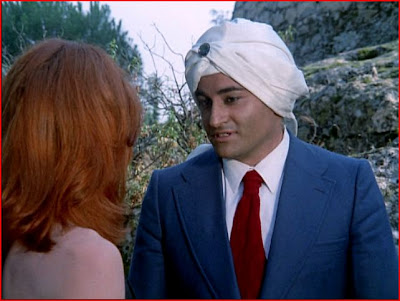
Fans of WildEast's spaghetti western and Eurocrime DVDs may be disappointed by Damiano Damiani's adaptation of Leonardo Sciascia's literary mystery novel The Day of the Owl, just as American moviegoers may have been disappointed when it hit U.S. screens under the utterly generic title Mafia in 1970. For Americans, that name carries connotations of urban crime -- indeed, of American crime -- that have nothing to do with Sciascia's story of small-town Sicily. "Eurocrime" fans, meanwhile, are unlikely to be satisfied with a story that has very little action of violence beyond its opening killing. As well, fans of Claudia Cardinale -- the star of this WildEast double-feature disc -- may be disappointed with the relatively little she has to do in a film that gives her top billing, made at the peak period of her stardom, at the same time she got top billing over Fonda, Bronson and Robards in Sergio Leone's Once Upon A Time in the West. But having laid down all these caveats, I found Damiani's film modestly effective as an atmospheric mystery and a critique of systematic corruption in Italy.

The mystery is the shooting of an honest contractor in the road-construction business in a sun-baked Sicilian town. Most people's first instinct is to ignore the crime; a busload of passengers would have looked right past the corpse had a carabinieri officer not also been on board. A young detective from "the north," Bellodi (Franco Nero) is the new officer in charge in town, a position that we soon realize is a revolving door to futility. The local mafioso, Don Mariano (an unwell-looking Lee J. Cobb) has seen the authorities come and go while he remains in power. I mean that literally: Mariano's house in the center of town and carabinieri headquarters look out at each other across a little public square. Bellodi presumes Mariano to be behind the killing of a businessman who wouldn't play ball with the mafia, but he has no evidence yet. However, the killing took place in plain view of the Nicolosi house, and as it happens the man of the house has disappeared, leaving his wife Rosa (Cardinale) alone. Has he left because he was the killer, or was he removed because he saw something he shouldn't have?


It's good to be the Don; Lee J. Cobb presides over his Mafia fiefdom

Bellodi's methods are manipulative if not Macchiavellian. With further evidence unlikely to turn up, he has to resort to trickery and outright lying to get people to open up or betray themselves. He tells Rosa that her husband has been found dead -- a lie -- just to see how she'll react, who she'll instinctively blame. Later, he'll confront crooks with fake confessions, hoping that they'll tell the truth if they think their pals are tossing them under the bus. His strategy is to compel someone into thinking their only option is to finger the real killer of the contractor or reveal where Nicolosi can be found. But his adversaries are just as good at lying as he is, if not better. They want Bellodi to believe that Nicolosi killed the contractor because the victim was having an affair with Rosa. When Bellodi deduces a different story and has Mariano and his cohorts arrested, the remaining mafiosi form a united front with an indifferent criminal justice system (Mariano is on good terms with the local ruling party) to overwhelm Bellodi's case with their own perjuries. Before long there's a new sheriff in town, so to speak, but a victorious Mariano finds himself missing Bellodi, whom he could at least respect as a worthy foe. The new man, like so many others, strikes the Don as just another "quack-quack-quack" -- like his own minions who quack in amused chorus when the worst is over. Maybe the story should have been called Day of the Duck.


Franco Nero goes incognito (right) for his meetings with the informer Parrinieddu (Serge Reggiani, left)

Given the cast and the literary pedigree, Mafia is no B-movie or genre picture and doesn't strive for sensationalism. We have the one shooting, and one corpse found later, and an attempted rape of Cardinale's character that doesn't go very far. Damiani's film stands or falls on conventional dramatic terms. On the director's part, the real strength of the picture is its sense of place. The square with the police station and the Don's house at opposite ends and characters constantly going in and out of jail or paying court to Mariano, is an ideal and picturesque dramatic space. On the outskirts of town, Tonino Delli Colli's cinematography gives you a strong sense of the wide-open, sun-blasted and grungy environment of road construction, the mundane business of a small-town mafia.


The cast is a mixed bag. Cardinale maintains a sullen glare for most of the picture, though she wears it well, but her character's ultimate helplessness makes little lasting impression. Cobb operates well short of full-blast, but with that voluble character actor that can sometimes be a good thing. It's wise to underplay, too, when character actors like Serge Reggiani (as an informer), Nehemiah Persoff (as a sleazy contractor) and Gaetano Cimarosa (as a really voluble gangster) are acting up a thespian storm around you. The real weak link in the cast is Franco Nero, who strikes me as too young for his role and too lacking in authority or cunning. He spends most of the show in his carabinieri uniform looking smug. That may be how his character was written in the original novel, but in the movie it provokes a feeling of pointlessness. For its original Italian audience, the most disappointing thing about Il giorno della civetta may have been the co-starring of Nero and Cardinale with a complete lack of romance between the two superstars.

Mafia is not a great mafia movie, but it's an interesting pop-culture artifact of 1960s Italy. In a way, it may have been a necessary prelude to the tough-cop movies of 1970s Italy, since it can't help leaving audiences frustrated at the triumph of injustice and probably wishing that someone would just lash out at organized crime. Damiani's film portrays something closer to the glum reality against which cinema would react with a vengeance.

Tuesday, July 12, 2011

On the Big Screen: CAVE OF FORGOTTEN DREAMS (2010)

If any director working today has a good old-fashioned Mondo movie in him, it's Werner Herzog. The tempestuous Teuton shares the genre's omnivorous eye for the bizarre and its often pretentiously dyspeptic temperament. He also has the classic Mondo instinct for winging it and finding excuses to throw disparate elements together. Nothing in his newest documentary shows that so well as its postscript, in which Herzog departs from the 32,000 year old Chauvet cave to visit a nearby artificial biosphere, warmed by a nuclear power plant, where albino alligators are being cultivated. Herzog closes the film with a speculation that the alligators' new environment may spread to encompass the cave, so that someday the alligators' descendants may wonder, as we do now, what the Chauvet cave paintings were all about. He goes so far as to equate modern-day humans with albino alligators in our essential incomprehension of the paintings' meaning to their painters. Herzog puts on a good show, but all his formidable bluster can't cover the fact that, once he'd heard about the alligators, he just had to have them in his movie about cave paintings, and he'd figure out a way to explain their inclusion later.

In America, Herzog is probably better known as a documentarian than for his epic features of the 1970s and 1980s. Given his cartoonish accent and his globetrotting proclivities, he's our modern-day Jacques Cousteau, or maybe a real-life Steve Zissou. But he also remains a pictorial genius and a postmodern primitive who synthesizes classical narrative cinema and the pre-Hollywood model of the cinema of attractions. He can tell stories, but his first impulse is always to show us something amazing, whether it's the Iraqi oil fields burning or Klaus Kinski dining alone. It was an inspired decision to let him have a 3D camera and enter the Chauvet cave to show us the oldest-known artwork by human beings.


Image from The New Yorker magazine website.

Discovered only in the 1990s, the cave paintings were preserved after a long-ago rockslide sealed the original entrance. To protect the precious pictures from the ravages of tourism, access is strictly limited, and those limitations are part of the genius of Cave of Forgotten Dreams. Herzog has an unparalleled opportunity to work, but he's also under extraordinary constraints. He can only bring three crewmembers down with him, they can film usually only for an hour at a time, and they cannot step off the pathways the preservationists have installed. Under these conditions the director behaves himself. Faced with the mystery of what can be seen on the other side of an overhang which features the only human representation at Chauvet (a woman's rear end), he ultimately contrives a pole which he can extend out to the other side while remaining on the walkway. Herzog is nothing if not a problem solver.

He also makes the best use of 3D that I can imagine. The technology still has its limitations; compositions in depth can still look a lot like layers of transparencies rather than figures in actual space. But Herzog plays to the technology's strengths -- he may even have discovered strengths hitherto unknown. He'll give you what you expect, directing a scholar to brandish a spear at the camera. But what he excels at is the close-up examination of texture, the interplay of light and shadow on contoured surfaces. He believes that the Chauvet painters exploited the contours of the cave walls for effects (hence the necessity of 3D) and wants to convince us that the paintings are not just the earliest human pictures but the earliest moving pictures. As he presents them, you can almost buy his argument. You can believe that the multiple legs on the creatures are meant to represent movement, and you can believe that they might have been part of a presentation in which select images were illuminated by torchlight one at a time in narrative fashion. That's really more my idea than Herzog's, but his ideas get you thinking. In any event, his close-up in-depth shots of the paintings are extraordinary, as are the panning shots that try to catch the paintings in full.

Herzog is famously disparaging toward the work of Jean-Luc Godard -- once saying that there was more pure cinema in kung-fu movies -- but Cave of Forgotten Dreams finds him expressing Godard-like skepticism about the communicative power of images. What can the Chauvet paintings really tell us about the people who painted them? Not much, really. Other evidence tells us that the cave wasn't used as a human dwelling. Did it serve some ritual role? One piece of evidence, a bear skull mounted on an altar-like rock, is suggestive but insufficient. The point Herzog returns to constantly is that we simply can't know for certain what Chauvet was all about, or what forgotten dreams inspired the painters. That radical uncertainty only seems to inspire him to peer more deeply into each image, as if to reproduce for us the effect he and the researchers claim to have experienced, the feeling that they were interrupting works still in progress. Given that some of the paintings reportedly juxtapose images created centuries or millennia apart, it could be argued that Herzog does continue the original painters' work by filming them and suggesting additional layers of meaning. New dreams can be superimposed on the old and forgotten -- but what will the albino alligators make of all this? The irony of it all, which the director probably appreciates, is that the alligators may someday commune with the cave paintings with less restraints than Herzog had, and if they have the mental means, they'll confront the paintings with fresh eyes, long after Herzog's own dreams have been more completely forgotten. For us, here and now, Cave of Forgotten Dreams is a look into an abyss of history that may inspire dreams of history looking back.

Saturday, July 9, 2011

THE CHRISTIAN REVOLT (Amakusa Tokisada Shiro, 1962)

Outsiders often think of Japan as a homogeneous nation and culture, but the Japanese themselves are often quite conscious of the problems minorities face in their country. Throughout his career, the director Nagisa Oshima has shown a special concern for the mistreatment of minorities, particularly Koreans. In Amakusa Tokisada Shiro, Oshima took up the topic of the persecution of Christians under the Tokugawa Shogunate. The best known Japanese work on this subject outside Japan is probably the Catholic author Shusaku Endo's novel Silence, an adaptation of which has long been a dream project for Martin Scorsese. While Endo generously focuses on the persecution of European missionaries, Oshima looks at the suffering of Japanese Christians and their conflicted response to persecution. He also strives for a critical synthesis of Japanese and European models of artistic representation while questioning in an almost postmodern way exactly what in people's hearts can be represented pictorially at all.


Oshima's protagonist is a historical figure, Shiro Amakusa, but seems to have taken liberties with history by making a character who supposedly died while still in his teens a former samurai (Hashizo Okawa) who's regarded as a leader of his peasant community as well as a charismatic prophet. His people are being pushed to the breaking point by a rapacious nobility that blames inadequate tax revenue on Shiro's religion. The local samurai, with one noble exception, compete to devise ways to torture Christians and terrorize them into recanting their faith. One such turncoat, Emosaku (Rentaro Mikuni) has become a court painter, specializing in European-style oil painting which he claims represents a subject's actual personality better than traditional Japanese art. He balks, however, when commanded to paint Christians performing the "straw dance," -- they are wrapped in husks of straw, set on fire and set running -- and is suspected of remaining a Christian. Desperate to save himself, he rats out Christians inside the local lord's household. This undermines Shiro's long-term plan to stage an uprising within the castle to overthrow the oppressive lord, though the plan often seems like little more than a promise of redemption to his angry co-religionists.


Shiro is a conflicted hero with an uncertain understanding of his own religion, despite his mother's constant tutelage. He sends mixed messages to his people, assuring them that their persecution is not the will of God but that an enraged peasant going on a foolhardy mission of revenge was God's will. As the pressure builds for an uprising, he rationalizes it by saying that his people will fight as oppressed peasants, not as Christians in violation of the turn-the-other-cheek rule. Once the fighting is underway, it threatens to get out of his control when a charismatic ronin offers his assistance and more ronin join him. Still straddling the fence, Shiro defers to the ronin on military matters until several setbacks -- including the hostility of European military advisers to the shogun and an alleged excommunication from the Catholic Church -- forces a decisive three-way choice on the Christians. Shall they continue to fight the samurai head-on, as the ronin wants, disperse into smaller inconspicuous groups, as some others want, or fortify themselves in one place to resist a samurai assault, as Shiro wants. When Shiro is finally driven to assert himself violently in a showdown with the ronin, who has called him out as a coward, the feeling is unmistakable that there's nothing left for him to do but die -- and take thousands with him....


Oshima maintains a critical but not negative attitude toward Christianity, but constantly reminds us of the samurai cruelty that drove so many to become Christians as well as revolt against the social order. While many of the "history of cruelty" movies made in Europe focus on the atrocities perpetrated by Christians on others -- witches, heretics, etc. -- in Oshima's film the shoe is on the other foot. The effect is largely the same, however, since for the Japanese filmmaker Christians are the other made objects of empathy. His film really transcends my theoretical genre, rising from a litany of torture to the level of epic tragedy, filmed in appropriate long-take tableaux with theatrical intensity and chiaroscuro cinematography. Scenes often develop in slow-burn fashion, but the payoff, especially in the final confrontation between Shiro and the ronin, is tremendous.


Transcending his historical subject, Oshima also invites his audience to question whether his eloquently exquisite or brutal images can truly capture the spirit of the time or the personality of the players. This proposition is put forth explicitly in Emosaku's explication of the relative virtues of Japanese and European art. He tells his patron that Japanese painting is best for landscapes and "beautiful figures," while the European style is best for portraiture that evokes a subject's true self. Over the course of the film, it becomes clear that Oshima himself is testing these premises, switching frequently from huge close-ups designed to catch profound emotion to vast landscape long shots that reduce armies to ants against the mountains.


Cinema itself is a third thing entirely, and in one sequence of visually "rhyming" shots Oshima implicitly asks whether cinema can catch emotional truth any better than painting.


Between the subject and its representation stands the subjectivity of the artist, and that's what Emosaku really seems to stand for. Does his portrait show the truth of the lord -- the lord himself asks, "Are you trying to say I look repulsive?" -- or only Emosaku's opinion of the man. The question rises again when, after repeatedly refusing to paint a straw dance, Emosaku appears to have a real religious experience during the crucifixion of Shiro's mother and sister, along with Shiro's one samurai ally and his wife on either side of a single cross.


Oshima has illustrated Shiro's reaction, and that of the other Christians, by bathing them in floodlights and leading the camera through a lengthy tracking shot of dozens of despairing or prayerful close-ups.


The painter responds to the scene with a picture of Christ crucified amid a field of crosses as doves rise heavenward and the Virgin watches in the sky. Depending on the witness, his may have been as "true" a report of the event as Oshima's cinematography -- Shintaro Kawasaki did the brilliant actual work. In the same way, perhaps, Christianity is one thing to Shiro, another to his mother, and something else yet to someone else. All of this is a possibly pretentious way of saying that there's a lot going on in Amakusa Tokisada Shiro to make it interesting if not compelling for people without any special sympathy for Christianity. It seems to be a relatively unknown item for Americans in Oshima's filmography -- ignored even by the otherwise Oshima-rich Criterion Collection -- but its neglect is unjustified. The Christian Revolt is a dark epic that deserves wider renown.

No English subtitles on this trailer -- uploaded to YouTube by WorldCinemateque -- but it'll give you some idea of the moving images and the terrific score by Riichiro Manabe.

Wednesday, July 6, 2011

Wendigo Meets CRAVINGS (Daddy's Girl, 2006)

"You picked the wrong movie," Wendigo told me after we made Bled our first review off the FearNet channel last week. I assumed that he simply wanted to remind me that Bled was objectively awful. As it turned out, he'd already found a better vampire movie on the cable channel, and when I got a chance to watch Daddy's Girl I was obliged to agree. But not many people seem to agree. When I last checked, the film had only a 4.2 rating at IMDB. That's because most people have probably seen it under its American title, Cravings. Once I showed Wendigo the DVD box art for Cravings, he said he couldn't blame vampire fans for feeling pissed at the false advertising. The box features a fanged mouth and little else, and there is no such mouth and no such teeth in Daddy's Girl. D. J. Evans's film is a vampire movie the way George Romero's Martin is, or perhaps even less so. Martin at least thinks he's a traditional vampire, while Evans's Nina (Jamie Winstone, whom Wendigo liked in the British zombies-vs.-reality TV miniseries Dead Set) probably thinks of herself as no more than a girl who drinks blood.

Nina starts the film under psychiatric observation after slashing her wrists, in the care of psychologist Stephen (Richard Harrington), who has issues of his own from a dying mother and excessive medication to a dead wife -- a wrist-cutter herself -- who seems to haunt his bathroom. Encountering Nina accelerates Stephen's downward spiral. His obsession with Nina becomes an infatuation with her defensive mother (Louise Delamere), which results in an unprofessional affair. He eventually realizes -- he has to be told by another victim -- that Nina is cajoling or forcing people to shed blood for her to drink, in addition to cutting herself and drinking her own blood. Clinically speaking, as a computer screen explains, she suffers from Renfield's Syndrome -- not Dracula's, because it's a progressive disorder, from little nips to big gulps. What Stephen doesn't realize is that Nina most likely hastened his mother's demise by drinking from her. What he does know is bad enough to make him want to commit her, but she accuses him of simply trying to get her out of the way so he can carry on with her mum. Nor does Mum want her daughter institutionalized; in fact, she proves to be the archetypal Renfield of the picture, the enabler who'll ultimately help hasten Stephen's professional and personal ruin until he's reduced to a head of human cattle for Nina, and perhaps a stud for Mum as well....

Wendigo considers Daddy's Girl a stylish and serious imagining of real-world vampirism that was ill-served by an American repackaging that was bound to infuriate many viewers. Even if properly advertised, it's probably too quiet and deliberate a film, not to mention too mundane, to suit many horror fans -- though it gets fairly extreme in its last half hour. All that came before is a patient warning for the real horror to come, from Nina's concoction of a poodle shake to her nearly Audition-like entrapment and exploitation of Stephen. Director Evans's subdued approach is appropriate to the story and the acting suits the material. Taking up my comparison to Martin, Wendigo finds Nina a more disturbing blood-drinker for the way she cuts, probes, slurps and butchers dogs.

Is it a vampire movie if the blood-drinker doesn't see herself as one? Well, google "Renfield's Syndrome" and you're directed to a Wikipedia entry for "Clinical Vampirism," so I guess science is on the side of Daddy's Girl. It may be a tough sell to some, but Wendigo notes that this is probably what a real-world vampire would look like and act like. It's a minimalist vampire in the sense that it's about a person who drinks blood and has no more than a psychological dependence on doing so. If that doesn't seem like sufficient stuff for a horror film, Wendigo begs to remind you that people like Nina actually exist in our world. She's a vampire not just because she craves blood but because she destroys people by drinking it. She even becomes something like the archetypal "vamp" by adopting the fashions and hairstyle of Stephen's dead wife, the better to lure him into her ultimate trap. Even though Stephen's lust is transferred onto Nina's willing mother, Wendigo insists that Nina herself is the real seductress of the piece, with some of the compelling power of the vampire as well. Think of her as one of those "[blank] from Hell" villains from Lifetime Original Movies who manage to vampishly insinuate themselves into households, often seducing whole families in different ways in order to dominate or destroy them. I could easily imagine Lifetime remaking Daddy's Girl, though it'd probably have a happier ending.

To appreciate the film, Wendigo recommends thinking of it as a psychological mystery thriller that builds a feeling of dread as you begin to piece the clues to the truth together. Daddy's Girl is a work of moral horror, and in that sense he finds it not dissimilar to the Let the Right One In/Let Me In story, even if the British story has none of the traditional trappings. "Cravings's" failure with the public here and in Britain doesn't surprise Wendigo given the box office failure of Let Me In. While it may seem like vampires are more popular than ever, people are still particular about what sort of vampires they want to see, and unforgiving of those they don't want to see. But maybe the ones we don't care to look at tap into the real horrors we want to avoid. If so, films like Daddy's Girl might wear their present-day failures like a badge of honor in the future.

Here's a short U.S. trailer for "Cravings," uploaded to YouTube by ddirenzo1

Tuesday, July 5, 2011

VENGEANCE OF THE ZOMBIES (La Rebelion de las Muertas, 1973)

Paul Naschy's movies are to be appreciated as spectacle or not at all. Dedicated to making himself a horror man on the Anglo-American model, Naschy wrote and/or directed (under his real name of Jacinto Molina) a spree of films designed to establish him as a master character creator in the classical mode. Rebelion de las Muertas, which Leon Klimovsky directed from Molina's script, is a blatant display of his versatility as Naschy plays three roles -- though one (the Devil) appears only in a dream sequence. The point of the film -- though some may dispute whether it actually has one -- is to show off how different Naschy can look. That extends to the eye-blistering variety of costumes he wears in his principal role as the tragic Hindu mystic Krishna. Never mind that Naschy is about as convincing in this role as El Santo might be; the fashions of Paul Naschy are a spectacle in their own right.


The story is unapologetically preposterous. Someone is killing young English girls and turning them into zombies -- the slow, servile sort, not the brain eaters. One such zombie woman attacks Elvira Irving (the eyebrowless "Rommy") but can't finish her despite getting her hands around Elvira's throat. Elvira seeks refuge at the Welsh retreat of her friend Krishna, who we've already seen putting on a show of his spiritual detachment from the mortification of his flesh. Krishna has retreated to Llangfair to achieve further purity, but the house he's acquired has the reputation among the locals as a "devil house" whose erstwhile occupants, the Whatley family, were massacred by peasants for purported Satanic practices centuries earlier. The vivid tales -- dismissed by the otherwise utterly credulous Krishna -- inspire a nightmare of blood sacrifice to an admittedly impressive demon Naschy in Elvira's sleep. But her waking nightmares will prove much worse.


Elvira's friend Dr. Redgrave (Vic Winner) has been called in by New Scotland Yard to assist in the investigation of the murders of young women. The killer's m.o. is a strange melange of voodoo and thugee motifs, which is meant to remind us that Krishna has a collection of thugee weapons and had spent some time in Africa during his spiritual wanderings. We also eventually learn that the victims' families had all spent time in Benares, India, and were there when "something violent, like a killing," happened there -- around the same time when Krishna says he made a hasty departure from Benares for personal reasons to begin his world travels. But some other details of the killings, like the way a morgue security guard has his throat cut by an open beer can, are still more mysterious. And the fact that the real killer, the mastermind who commands the zombies, dresses sort of like Guy Fawkes (or "V for Vendetta," if you prefer), albeit with a different mask for nearly every outing and a familiar barrel-chested physique, makes you wonder even more.


These zombies may look friendly, but they're out for revenge and can turn anything into a weapon!


It turns out that Krishna isn't such a master as he tells folks. Despite convulsive fits that make you wonder whether he's going to break out in fur and fangs, he eventually explains to Elvira that he's under the voodoo control of his reckless brother Katanka, who raped and killed a British girl in Benares way back when. Even though "the death was made to look accidental," local Britons promptly attempted to lynch Katanka by burning his house down around him. He escaped with severe burns, an itch for revenge, and a scheme to achieve immortality through voodoo. Katanka means to kill the daughters of the British families who lynched him and attain eternal life by consuming Elvira's blood, with the assistance of some chicken-chopping apparent defector from the Mummenschanz troupe. But if Krishna can break his brother's mental control, Scotland Yard can intervene, and a representative of the international voodoo governing body (really!) can crack down on Katanka's "betrayal," the day might yet be saved....


The auteur theory has done much to enhance the bad movie viewing experience. If you accept Vengeance of the Zombies (which finally hit America around 1980 as Walk of the Dead) for what it is, a Paul Naschy star vehicle and an episode in Molina's creative life, it becomes more compelling precisely for (and not in spite of) the creative shortcomings that are practically an authorial stamp. Molina's quest was to recreate the thrill of his youthful viewing of Universal horror films while translating their archetypes into modern exploitation idiom. His writing often went well beyond the scope of Universal, encompassing more ambitious "history of cruelty" stories and sometimes achieving evocative, atmospheric effects that are sometimes timeless, sometimes indelibly of his own time. His challenge was to find out how many variations he could wring out of his essential theme of a charismatically doomed man, and the effort is often as interesting as the outcome. The point of any given Naschy picture isn't the story as much as Paul's performance, but confronting Naschy is kind of like waging war on terror -- you're either with him or against him. There's pretty much no reason to look at Vengeance if you aren't interested in seeing Naschy do his thing. And even if you "get" Naschy, this particular film is far from his finest hour and a half. Nevertheless, there's something compelling about it in all its tackiness and misplaced musical funkiness that I've found in nearly every Naschy film I've seen: that unselfconscious, practically uncritical ambition that drives the writer and actor to make a spectacle of himself. Some people may watch his films to laugh at him, but for many others Molina, through Naschy, was living their own dream, maybe even dying for their sins. That's how movie cults are made. I don't know if I count as a cultist, but no matter how bad a Naschy film may be on some objective level, I'm always ready to watch him try again.

And here's an English language trailer, uploaded to YouTube by freyacatoct.

Sunday, July 3, 2011

BROTHERS FIVE (1970)

There may be five brothers serving as the titular heroes of Lo Wei's wuxia adventure, but the star is a woman, the mighty Cheng Pei-pei. She plays "Heroine" Yen Hsing-kung -- in the Chinese martial world you can wear "heroine" as a title or job description. She's the daughter of a hero who had died protecting the five sons of Gao, a fellow hero, from the vengeance of the Flying Dragon bandit gang. Now of age herself, Yen's mission is to unite the Gao brothers, teach them martial arts if necessary, and lead them in the pursuit of justice and revenge. The Gao boys were placed in a variety of households and have developed different vocations. One is a scholar, another a blacksmith, another a security guard for caravans while another is a chivalrous thief, and so on. Yen will recognize them as Gaos by the horizontal scar across each left fist that forms a straight line when the brothers place their fists together.


After various exploits unite them, Yen teaches the boys the five-tigers-become-one style from a book she's been carrying. This unique fighting style will allow the brothers to pool their attributes and become an invincible fighting unit -- as they'll have to be to defeat the Flying Dragons' master, the man who killed their father.

Observing the style in practice just might inspire doubt in general audiences.


For all that Master Lung (Tien Fung) is a villainous bastard, I couldn't help urging him to go for the legs during the climactic battle. But I suppose that you have to accept the premise that the legs of Blacksmith Gao, who forms the base of the formation, are so strong that Lung could not hope to topple him and his brothers. Wuxia stories often require such leaps of faith, but since we're dealing with fantasy movies it's not exactly an insult to the intelligence to indulge Brothers Five in its whimsies. The show is so lighthearted overall, so akin in its high spirits to the old Hollywood swashbucklers, that you can't hold anything against it. But you can definitely admire the dynamic exuberance of Lo Wei's direction and the infectious good nature of the six protagonists. Cheng Pei-pei naturally steps aside often to let the brothers do their stuff, but her authority is never in doubt, and when she tells Lung that she won't interfere in the climactic fight, you can't help feeling that she could deal with the villain quite nicely on her own, Lady Hermit style.


Lo Wei often keeps his frame busy by having stuntmen circle a hero or heroine, as seen from inside the circle with Cheng Pei-pei (above) or from a bird's-eye view (below).


If you're looking for intense emotions, virtuoso fighting or extreme violence, Brothers Five may not satisfy, but if you can have fun watching charismatic people beat each other up in a fantastic setting, you can have a lot of fun with this picture. Films like these may have played in American grindhouses, but they really kept the spirit of the old Saturday matinees alive.

Saturday, July 2, 2011

PROMISED LAND (Ziemia Obiecana, 1975)

Now that Andrzej Wajda's standing as a master of gore has been established (see post below), let's look at the film of which that astounding clip is part. Intriguingly, for a film from a communist country, Ziemia Obiecana, an adaptation of an 1899 novel, has three capitalists for its heroes -- or antiheroes. They're charismatic young men on the make, first introduced to us counting out paces in the woods as if preparing for a duel. It turns out that they're measuring out the tract of land on which they plan to build a textile mill in Russian-ruled Lodz. They're appealing from the start because they represent an admirable ethnic mix. Karol Borowiecki is a Pole, Moryc Welt a Jew, Max Baum a German. While they often have issues with each other, they stick together against all attempts to drive them apart by appeals to ethnic loyalty or individual greed. They have the confidence of youth on their side, along with opportunistic instincts.


The old guard ranges from Buchholtz, Borowiecki's employer and a Dickensian monster of meanness, to a clique of Jewish investors who'd give Mel Gibson the creeps on sight. By comparison, our trio seem progressive despite a certain indifference to the welfare of workers or the ethics of private correspondence. When an industrial accident leaves a worker without an arm and yards of cloth covered with blood, Borowiecki's only concern is to get everyone back to work as soon as possible. When his flirtation with the wife of another factory owner gets him access to a coded tip-off on revised tariff rates, he and his buddies take advantage of the inside information to make a killing in the cotton market. Despite all this, we're still tempted to root for the threesome because they seem different and better than their elders. When someone arranges for their new factory to be burnt down just after its festive opening, you expect them to persevere and rebuild. In an epilogue, however, Wajda tears down whatever illusions we may have had about his protagonists. "Years later," Lodz is in the grip of a strike as the working class finally takes an active role in the story. However repugnant Borowiecki, Welt and Baum find their elders, in the end they stand on the same side as their peers, the exploiters, and order their security force to fire on the workers.


The version of Promised Land that I saw is billed as a director's cut, whittled down by Wajda himself in 2000 from almost three hours (according to IMDB; a TV version is even longer) to 138 on DVD. Of course, I have no idea what I've missed, but Wajda would presumably have me believe that I've missed nothing. This article explains what he changed and why. The least I can say is, not knowing the extent to which Wajda had cut it, nothing seemed missing. But the longer original length reinforces my feeling that the film was intended as Poland's answer to the socially-conscious historical epics coming out of Italy, reminiscent of Luchino Visconti's The Leopard while anticipating Bernardo Bertolucci's 1900. Wajda clearly aspired to similar sweep and grandeur -- it shows in every aspect of the impressive production design, -- and to a certain decadence that's arguably more like Federico Fellini. The best sequence in Wajda's film is a night at an opera house during which our three protagonists are more fascinated by the dramas playing out in the balconies as word of some financial disaster spreads than by the excerpts from Swan Lake or an interminable comedy song featuring a fat woman on a swing. Brilliantly edited, but not without self-indulgent swing-cam shots of the audience, the sequence veers from Viscontian opulence to Fellinian grotesque, as does another perhaps more De Millean display of decadence, a masked ball featuring bare breasted courtesans and caged tigers. Mixed in with these luxuriantly satirical episodes, the moments of horrific mutilation I've mentioned may be meant to assert a kind of reality principle, as did scenes of brutality and gore in many other films in the "history of cruelty" genre I've retroactively recognized in the 1960s and 1970s.


It would be a long day at the movies, but Promised Land would make a good double-feature with 1900. They complement each other, Wajda focusing on urban capitalists while Bertolucci deals with rural landowners and peasantry and goes deeper into the 20th century than Wajda does. Both films are presumably Marxist, but that leaves us wondering why Wajda made a film that invites us to identify on some level with three ambitious factory builders rather than with the workers who appear mostly at the periphery. There's no class struggle in the picture until the very end, and even then we see it from the capitalists' point of view. One IMDB reviewer suggests that Wajda was making a subtly subversive point, so long as we see Borowiecki and his buddies as revolutionaries who eventually become reactionaries and in doing so see them as symbols, not of capital, but of the revolutionary Communist regime that had fired on its own people on multiple occasions. This seems right insofar as the three protagonists are ultimately revealed as false revolutionaries who despite their clear desire to shake things up are ultimately assimilated into the old order. But I think this point could be made in a Polish or East Bloc film without it being an implicit critique of Communist regimes. You could also see Borowiecki, Welt and Baum, as I was tempted to, as Polish counterparts of Kane, Bernstein and Leland, another ambitious trio out to shake up the system only to be absorbed by it. Given that many people seem to regard Ziemia Obiecana as the greatest of all Polish films, this analogy with Citizen Kane may be the most appropriate. I've seen all too few Polish films to say whether its admirers are right, but it certainly wouldn't be to Poland's shame if they were.

Here's a fascinating promotional clip featuring Wajda's three stars -- Daniel Obrychski, Wojciech Pszoniak and Andrzej Seweryn -- in modern dress (c. 1975) lip-synching in the middle of modern Lodz over clips from the film. It was uploaded to YouTube by atomek2.