Thursday, January 5, 2012

SUPER (2011)

Common sense would seem to tell us that a movie about a real-life or real-world superhero -- one without actual superpowers or a billionaire's resources -- can end only one way: with the abrupt demise of the would-be crimefighter, especially if he or she plays by the conventional comic-book rule and eschews firearms. On that expectation, a "realistic" superhero movie will not be a long one unless the majority of the film builds to the hero's first (and last) night out or his first (and last) confrontation with superior numbers or firepower. Are there such movies? Their absence shouldn't surprise us, since comic books themselves echo the mentality of movies. Both media tap into a common tradition of burlesque slapstick violence as well as universal power fantasies. That aside, who'd want to see a movie that has nothing to say but, "Don't try to be a superhero; you'll be killed?" Yet we do see movies that try to split the difference by showing us ordinary or less-than-ordinary people emulating comic-book heroes and usually, however improbably, succeeding. We want to see someone make an ass of himself in a superhero costume, but then we want to see him win after all, reversing the old comedy formula of rooting for the transgressor against boundaries but also laughing at his inevitable comeuppance. That results in movies like Kick-Ass, in which the cinematic fantasy of a child killing-machine belied the creators' presumed commitment to the "real" world. It also results in James Gunn's Super, which can be seen as a still-more realistic, raunchier version of Kick-Ass, but would be more accurately described as a cross between Taxi Driver and Rat Pfink a Boo Boo.

Instead of a kid, Super has a grown-up loser for a hero. Frank (Rainn Wilson) is traumatized when his wife Sarah, a recovering addict (Liv Tyler) runs off with Jacques (Kevin Bacon), a glib sleazeball with a posse who we can tell right off is more dangerous than Frank initially realizes. Helplessly enraged, he wants the police to arrest Jacques for "stealing" Sarah when it was self-evident that she left of her own (albeit drug-addled) will. Frank is already deeply disturbed and emotionally stunted: he watches tentacle porn and a Christian superhero show as he broods on his loss. He has a mad vision of alien tentacles removing the top of his skull so he can receive a touch from the finger of God, a visit from the Holy Avenger (Nathan Fillion), the TV hero, and the idea for a mask and a logo. He becomes the Crimson Bolt, initially weaponless but soon armed with a pipe wrench after a clumsy first fight. The Bolt simply whales away on an array of malefactors caught in the act -- drug dealers, child molesters, people who butt in a ticket line -- but the news media and the police see his interventions as random attacks on innocent people.  His career is endangered by the fact that anyone who's ever met the tall and pathologically awkward Frank will immediately recognize him under his mask, but some simple plot complications serve to put the cop who suspects the truth out of action. One person who doesn't see him as a criminal is Libby (Ellen Page), a comic-shop clerk who proves something of a cosplay fetishist with an untapped violent streak. When Frank is forced to reveal his secret to her -- she had already suspected, given his "research" at her store -- Libby dumps her boyfriend and declares herself the Crimson Bolt's sidekick, Boltie, complete with homemade costume. Together, after much convincing of a wounded and worried Frank, the costumed team escalates their war on crime with a trip to the gun shop before a climactic assault on Jacques's mansion, where Frank has learned that a major drug deal will go down and where Jacques uses Sarah as a test subject for dope and entertainment for the dealers....

Taxi Driver is such a part of our collective movie consciousness that Gunn may not have realized how much he'd imitated its structure here. Super may be the most alarming variation on Taxi Driver to date, thanks to its ultimate assertion that the Crimson Bolt's bloody rampage against crime was somehow therapeutic for Frank. At some point, the script evolved from a mockery of superhero wannabees to something symbolic. When the Bolt tells Boltie that though "we'll never be ready" to assault Jacques's compound, they have to do it sometime and preferably now, the film seems suddenly to be teaching us life lessons about taking chances and accepting risks. Although the ending doesn't prove quite as happy as Frank may have wanted at first, Gunn seems to want us to accept that Frank is a better person for having stood and fought, and even for having loved and lost. The last scene, in which Taxi Driver's news clippings are echoed by Frank's drawings of his modestly happier life, could still be seen as proof that Frank is a profoundly disturbed person -- which would make Super still more an echo of the Scorsese film. But I don't think Gunn means us to see them that way. He might concede that Frank is still weird, but I think we're meant to agree that he's weird now in a way less threatening to himself or others.

Since I don't watch The Office, Super is my first real encounter with Rainn Wilson, and I was impressed. He does the most to make Frank's superpowered evolution from infantile inhibition to relative well-adjustedness plausible and amusing, and as a husky man he makes you believe that the Crimson Bolt starts with a minimal fighting chance against his enemies. Gunn's script helps him out considerably; just when you're asking how a wretch like him could have won a Liv Tyler, Gunn delivers flashbacks illustrating Sarah's emotional neediness as a recovering addict and Frank's availability as a co-worker and AA sidekick. Ellen Page comes off less well; her Libby/Boltie is an unconvincing jumble of impulses. She's undermined a little by the art direction of lack of it that gives no indication in her apartment of how much of a superhero geek the character is, but the script doesn't really do much to motivate her sudden violent streak. Super's dependence on actual living spaces also raises some questions about the economics of Frank's city. He and Sarah were apparently able to afford a house on the salaries of a short-order clerk and a waitress, while Libby has a halfway-decent apartment to herself (she can host parties there) on her earnings as a comics-store clerk. Somehow these details seem nearly as unrealistic as the Crimson Bolt's resilience in action. Finally, regarding actors, I have to say that this was Kevin Bacon's best performance as a comic-book villain in a 2011 release. He was cluelessly miscast as a mutant Bond villain in X-Men First Class, but fills the bill nicely here as a nervy scumbag who only confirms the movie's own essential comic-book nature by taunting an injured Bolt instead of finishing him off.

Super arguably outdoes Kick-Ass on the ultraviolence scale, though the gore and other practical effects are almost always used for laughs. Bolt and Boltie giddily massacre Jacques's bodyguards with fire, bullets, bombs and "Wolverine" claws, and we're always meant to laugh, except when Gunn occasionally reminds us of the severity of the stakes for our heroes. There's at least one moment when a character dies violently when we're clearly not supposed to laugh, and that moment probably best illustrates the contradictory messages sent in Super. It's frequently a very funny film, but sometimes you wonder what you're actually laughing at or laughing with. That's not necessarily a bad way to leave this picture. I'm sure Gunn meant it to be funny and disturbing, and whatever other impressions it makes, he succeeded on both counts.

Wednesday, January 4, 2012

Now Playing: JAN. 4, 1962

A double-feature from Tuscaloosa, Alabama. The main event is not your typical Phil Karlson movie, while the second feature is a bit of British bawdiness with Claudia Cardinale as a bonus.


Here's a trailer for Upstairs and Downstairs, courtesy of vciguy76.


Next,from West Palm Beach, the 3-D event of 1961 spills over into the new year. Mondodigitl uploaded the trailer to YouTube.


Come back tomorrow a weekend's worth of attractions, including the foreign film sleeper hit and the dance craze of 1961

Tuesday, January 3, 2012

Now Playing: JANUARY 3, 1962

Welcome to the first of a year-long series of almost purely pictorial posts featuring newspaper clippings from fifty years ago -- a year widely recognized as one of the richest in quality in Hollywood history. Mondo 70 will be marking the golden anniversary of a number of landmark films throughout 2012, while illustrating the diversity of moviegoing experience available across the United States. By 1962 nearly every city of respectable size had an "Art" theater dedicated to anything from prestigious foreign fare to blatant exploitation, depending on the marketplace. We're sure to see many now-immortal international pictures advertised along the way, along with hoped-for-hits that haven't withstood the test of time as well. We'll also see many an American film that's barely remembered today, but was pitched like the last word in entertainment. I'm not quite old enough to remember the year, but I've long had an appreciation for the pop culture of the period and the way it promoted itself, and I'll be choosing ads that express that self-promoting vitality most vividly and evocatively. I hope it proves as entertaining for you, the reader, as gleaning the ads has been for me.

For the first weeks of 1962, of course, we'll be seeing the last films of 1961 arriving in smaller markets, while the big roadshow attractions of that year remain reserved-seat exclusives in the biggest cities. Fifty years ago today the holiday attractions on their way out were pictures like Rodgers & Hammerstein's Flower Drum Song and Frank Capra's final feature, Pocketful of Miracles. Starting today, I hope to post something for every day that some picture opened somewhere in America.

Nationwide releases weren't as common in 1962 as they are today, but scan enough dailies and you'll see which pictures are going wide. Frank Tashlin's Bachelor Flat apparently has the distinction of being the first Hollywood release of 1962, opening in some cities 50 years ago today. Here's how they sold it in Milwaukee.


If Bachelor Flat wasn't salacious enough for you, some cities had other options. Here's some spicy alternative entertainment for Miami moviegoers of 50 years ago tonight -- and it's educational, too.


There's more tomorrow, folks, so be sure to check in again. When resources permit, I may even throw in trailers.

Monday, January 2, 2012

GOING PLACES (Les Valseuses, 1974)

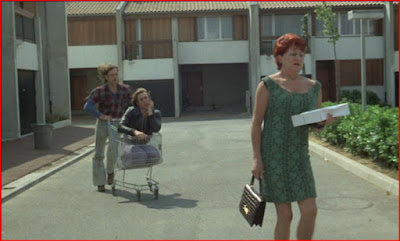
Bertrand Blier's picaresque sex comedy was imported into the U.S. with an arthouse audience in mind. That's probably why Les Valseuses comes to us under the relatively innocuous title "Going Places," though the poster designer had the right exploitative idea (see left) instead of the more idiomatically literal and thematically appropriate "Balls." If an American studio had released a film called Balls in the 1970s, people would have a pretty good idea of what they were getting, and Valseuses would mostly fulfil that expectation. It's what we'd call a road movie, but without benefit of a car most of the time. Gerard Depardieu and Patrick Dewaere -- the former became a star with this picture, back when he was a relative hunk rather than an absolute hulk -- play a couple of boneheads who seem to be led through life by their peckers. My first impression as they chased and groped women was that this must have been the original for Dumb and Dumber, down to the ugly hair on the men. The French title becomes painfully literal when the Dewaere character gets his balls grazed by an angry hairdresser's bullet and suffers impotence for some time afterward. But just as he gets better, the film somehow manages to grow on you. You stop waiting (or hoping) for the guys to get killed and you begin to feel a little sorry for them as they wander through a strangely barren landscape. Their original obnoxiousness remains somewhat obnoxious, but is increasingly exposed as a kind of endearing neediness. If they seem like cases of arrested development, their environment of grocery store parking lots, empty resort towns and deserted beaches seems to be partly to blame, along with the unresponsive, uptight majority of the French population.

Even as a baby (above), Depardieu was fairly husky, but he grows fast in Les Valseuses and is soon getting around all by himself.

Indeed, Blier probably goes too far in suggesting that Jean-Claude and Pierrot are a life force that France may need to revitalize itself. Their perpetual horniness -- at one point Depardieu seems likely to take it out on Dewaere -- is a kind of lifeline extended to a variety of unhappy women, from Miou-Miou's frigid yet frequently naked hairdresser to Jeanne Moreau's suicidal ex-con to, perhaps most alarmingly for Americans, Isabelle Huppert's 16-year old virgin. This last encounter, with Miou-Miou assisting, is staged like a literal rite of passage and treated as indisputably a positive event in the girl's life. The girl had impulsively run away from her parents with the trio who had stolen the family car, and is left by them on the road to hitchhike afterward.


It's all good, though -- though Blier has the maturity to remind us that sex can't solve everything. A threesome with the two oafs fails to revive the Moreau character's spirits, and she suicides by shooting herself through her vagina -- an unexpectedly gruesome sight that sends the boys running away like scared children to sob in Miou-Miou's bed. Even then, I suppose it could be argued that the woman had a last moment of pleasure, a blessing from the knucklehead nature gods.


Watching this as a foreigner, I had the impression that Blier intended his heroes to embody something essentially, folkishly French. The music contributed to that impression; instead of the rock soundtrack you might expect in the equivalent American film, Blier's soundtrack is performed by the jazz violinist Stephane Grappelli, whose music sounds as unmistakably French to me as anyone's can. Are these essentially innocent boors the soul of France? The French themselves may have thought so; they made the film a hit and Depardieu a star -- and they didn't type him as a moron, either.

Visually, Valseuses is very reminiscent of those American films of the Seventies that utilize landscape and cityscape to expose vulgarity and highlight personal alienation. You get plenty of pretty countryside, but you get a lot of grocery stores and bowling alleys as well. In either case it's our heroes who bring emptiness to crass yet hearty life. The cinematography of Bruno Nuytten consistently nails the mood Blier wants and makes this a movie of memorable images. Ultimately, it's a subtle, tricky picture that you can take either way, either as a satire or a celebration of a certain incorrigibility that's only human. It's the sort of film in which Miou-Miou can rush out rejoicing to tell the boys that she's finally achieved orgasm, only to have them throw her into a pond -- twice. If you can laugh at that, you should enjoy the rest of the show.

Sunday, January 1, 2012

On the Big Screen: WAR HORSE (2011)

It may be a new year in the real world, but it'll still be 2011 in movie theaters for at least another week, and probably for longer in the arthouses. To celebrate the holiday I took a walk to the Spectrum, Albany's cultural treasure, where Steven Spielberg's newest film (a matter of months or days, depending on where you live) received a heartfelt round of applause once the lights went on and the credits rolled. I note this to concede the objective fact that War Horse will move people exactly as Spielberg intended, however unmoved I remained. Let's make clear upfront that the great man has made a tearjerker. That fact alone is a bit of a disappointment to me, given that this is the first full Spielberg film since Munich, his brutal terror-vs-terror historical thriller of 2005. Since then, of course, he made Indiana Jones and the Kingdom of the Crystal Skull as an act of loyalty or charity, depending on the object, and more recently released the motion-capture Adventures of Tintin, which I haven't seen yet. War Horse is his first live-action movie on his own terms in six years, and while I'd rather he didn't revert to tearjerking I want to stress that I don't dislike it because of that. It doesn't fail as a tearjerker. Its failures are matters of form rather than content.

Spielberg's War Horse is the latest adaptation of Michael Morpurgo's 1982 novel, following a radio play and stage version. The title character is Joey, a semi-thoroughbred steed purchased on impulse by Farmer Narricott (Peter Mullan) despite his unsuitability for ploughing. Narricott's boy Albert (Jeremy Irvine) has had a sort of crush on Joey since the colt was foaled, which I assume factors into his dad's otherwise daft decision. He outbid his own landlord to get the horse, paying far more than any plow horse is worth and putting his farm's finances in jeopardy. Unless Joey can be trained to plow a rocky field for turnip growing, the Narricotts will lose their farm. Suffice it to say that Joey succeeds with a little help from nature, but what nature giveth, nature taketh away. A timely rainfall softens the earth for the plow, but a later torrent washes away the soil. It looks pretty bad for the Narricotts, but fortunately for them, Great Britain declares war on Germany and the Army is buying horses. Poor Albert can't bear being parted from Joey, especially with the horse being sent to war, but a friendly officer (Tom "Loki" Hiddleston) assures the lad, who's nearly fighting age himself, that he'll take good care of his new steed.

What follows might be described as Robert Bresson's Au Hasard Balthazar with explosions. Bresson's 1966 classic follows the tribulations of a donkey as it passes from owner to owner. Just so, Joey soon loses his rider -- cavalry charges even in the earliest days of World War I are not a good idea -- and passes through many hands, military and civilian, German and Entente. There are animal lovers on all sides, but despite everyone's best efforts Joey (after receiving several alternate names) ends up on hard duty haulign heavy artillery. Meanwhile, Albert has gone to war and suffered hardships of his own. As this is a motion picture based on a children's book, the odds of Joey reuniting with Albert are a lot better than you'd think. Indeed, since Joey has a Ben-Hur like tenacity, surviving practically the entire war in the thick of the action, I suppose anything else could happen....

Horse, schmorse, sez I. I went to this movie to see what the director and cinematographer of Saving Private Ryan would do with World War I. Spielberg and Janusz Kaminski are inherently limited by the director's desire for a PG-13 rating, but on the other hand realistic gore isn't the point of War Horse. What we get is a nicely staged cavalry attack on a German encampment, a bit of business that reminded me of the several raids on Indian villages staged in John Ford's westerns as horses charged through lines of tents. In a twist on the Ford formula, the enemy simply retreats to the edge of the forest, where their machine guns are waiting. At this point, Spielberg opts to evoke carnage rather than show it directly. We see horses and riders charging. We see machine guns firing. We then see riderless horses leaping over the gun nests. Something seemed unreal about this -- weren't the horses taking bullets, too? -- until an after-battle long shot clarified matters. A similar decorative reticence prevails throughout the picture, most notably when two deserters are executed in the shadow of a windmill. One of the blades gets in our way just as the squad fires, only to reveal the two dead soldiers. The artistry is too obviously designed for concealment to have the eloquence Spielberg hoped for, but the overall reticence isn't a crippling weakness. Since this is the story of the horse, we needn't dwell as much on the suffering of men as we might on another occasion. The highlight of the picture shouldn't be any combat of men but, as it actually is, Joey's sudden flight from retreating Germans into No Man's Land. We've already seen men fight here, and that's served to underscore Joey's peril. While the stunts Joey must perform in long takes inevitably require the use of a CGI horse, and the situation itself is fantastically unrealistic, the scene is still electrifying as Joey smashes through lines of barbed wire in his race for freedom as shells burst around him. This is the climax of the film, and one of the big problems with War Horse is that there's still about half an hour to go, and Spielberg makes that time seem even longer.

War Horse is a failure of pace, shockingly so for Spielberg. It suffers from an interminable first act and an insufferable human protagonist. Albert Narricott has no other attribute apart from his unconditional love for his horse. Nothing is done to make him interesting before he sees the colt born, and nothing is done afterward to make him seem anything but monomaniacal in his obsession with the animal. There has been no such devotion on film since Buster Keaton fell hard for a cow in Go West -- and Keaton meant it as a joke. I wanted to laugh when Albert vowed to find Joey in almost the exact same language Natty Bumppo uses for his beloved in Michael Mann's Last of the Mohicans, but I doubt whether Spielberg would have shared my mirth. War Horse would be a better story had Spielberg left Albert behind and simply followed Joey from owner to owner -- or caretaker to caretaker. But that would mean less tearjerking and less fidelity to the source novel ... though speaking of which, Spielberg may have made a fatal error by attempting to naturalize a story that was originally told from the point of view of the horse. I can't say, however, whether Spielberg and his writers or the orginal author is to blame for the way the film limps to its finish. I noted the film's climax a paragraph ago. To pick up the story (I'll try to keep spoilage to a minimum), Joey doesn't quite make it out of No Man's Land; he's still alive and upright, but sort of stuck. This becomes known to both the British and German forces, who in an utterly ridiculous scene attempt to entice the horse to one side or the other by whistling and clucking at it. Once they figure out the trouble, a friendly competition ensues to free the horse from its predicament. The novel may say differently, but cinema logic seemed to require that Albert be here. There's a good reason why he isn't, but that's a detail Spielberg should have tweaked. We have to endure another cliffhanger behind the lines before a reunion is even possible, but even from there the film stumbles from false climax to false climax as at least one of Joey's erstwhile caretakers (Niels Arestrup, the "Corsican" from Un Prohete) comes back for a bitter encore before our remaining heroes are safely settled back in Hobbitown -- I mean Devon. My confusion is somewhat excusable, given how Spielberg and Kaminski turn their rustic location into a pastel fantasy land. I had the awful feeling that Spielberg's Devon was a re-enactment village dedicated to classic Hollywood cliches -- emphasis again on the Fordian mode -- and that the director had no actual empathy for farming or village life. My alternate explanation is that Spielberg was really only interested in the war stuff and did the first and last parts on autopilot.

Here it's only fair to remind you of that applause I heard in the theater, though I'm no more bound to defer to it than I was when a Spectrum audience loudly protested the end of Meek's Cutoff. Flaws and all, this film moves people, and some of those people might not see the flaws I saw as flaws. Maybe my problem is that I'm not an animal lover and can't empathize with Albert Narricott. Even if I concede that, the fact remains that there's nothing to him but his love for Joey, which means that you either have the temprament necessary to enjoy War Horse, or you don't. If you do, you may well enjoy it in spite of its narrative handicaps. I'll write it off as a warm-up for the Lincoln movie Spielberg has wanted to make for some time and is only now shooting. The current picture has predictable moments of pictorial genius, but those aren't enough for me to recommend it. You can take my word for it or infer the opposite from other people's applause. It'll be no crime to like War Horse, but I want Spielberg to do better next time, and I hope you will, too.

Saturday, December 31, 2011

RIFIFI (Du Rififi chez les hommes, 1955)

"Don't strain your brain and grumble. All it means is rough-and-tumble." I paraphrase the English translation of the title song of Jules Dassin's French jewel-robbery thriller. The title is either gangland slang ("the battle cry of every real tough guy") or a nonsense word invented by the novelist Auguste le Breton, whose work Dassin adapted. The song, performed by a nightclub singer -- a glimpse of a floor show came to be obligatory in French crime cinema -- doesn't really represent the overall tone of the film. Dassin was American; he had made Brute Force, The Naked City, Thieves' Highway and Night and the City before being blacklisted. The blacklisters aspired to global sway, reportedly striving to stop Dassin from directing in Europe before Rififi launched his second career as a popular import for American arthouses. A crime story unconstrained by American censorship sounds like a golden opportunity to break boundaries, but Rififi is more a narrative breakthrough than a milestone of explicit frankness.


It does become clear pretty early that we're not in America anymore. You can tell when our protagonist Tony, aka "Le Stephanois" (Jean Servais), an ex-con jewel thief, reunites with his girlfriend. Turns out she'd formed new attachments while he did his time. The new boyfriend lavished her with jewels and furs, which Tony orders her to strip off. Not satisfied with humiliating her, Tony proceeds to beat her with a belt. To repeat: this is our hero -- but this is also a milieu where women willingly take their lumps as part of the rififi in order to partake of sexual paradise later -- or so the song claims. It's also a milieu where the men often end up taking what they dish out.


Freshly embittered, Tony reconsiders his refusal of a proposed jewel heist, except now he wants to up the ante. Instead of a smash-and-grab through the display window, he wants to take the safe where the good stuff is kept overnight. That means putting together an expert team and planning the operation in painstaking detail. After casing the place and identifying its security system, the four-man gang obtains an identical device so they can figure out how to disable or simply muffle its ultra-sensitive alarm mechanism. Confident of their ability to beat the alarm, they embark on the scene that made the film famous and influential: a step-by-step break-in through the ceiling, presented without unnecessary dialogue or music. Can they break in from above without setting off the alarm? Will their scheme to disable it work? Will they be able to break into the safe and get out before daybreak? Will the flics on the beat outside notice anything amiss? This is standard thriller stuff, but Dassin filmed it that way for the first time here, and Rififi has been a model for moviemakers and burglars ever since.


We may be in France rather than America, but crime still doesn't pay. In the U.S., the Breen Office dictated that result; in France it was a matter of fatalism, much as it was in many American films noirs. One of the gang gives a girl too ostentatious a gift and the sharks smell blood. To unify the plot threads, the lead shark is the same nightclub operator who stole Tony's girl. Methodically he breaks down the gang, forcing one to rat out another, killing the latter, kidnapping the kid of a third and demanding the loot as ransom. Here's where Tony most likely redeems himself for his misogynist violence early on, taking it upon himself to rescue the boy and rid himself of his rival once and for all. He takes a bullet in the process, setting up Dassin's second inspired sequence: a delirious drive through Paris as Tony rushes to get the kid home before he passes out, or worse, at the real. Dassin resorts to rapid-fire editing, compiling a disorienting montage to approximate Tony's reeling consciousness as he tries to keep his eyes on the road while losing blood, as all the while the brat treats it like a joyride. It's as brilliant in its own way as the break-in sequence, and it closes the film on a nice note of irony.


Dassin apparently couldn't resist a bit of American-style moralizing late in the picture, having a character question Tony's tough-guy standing by suggesting that all the downtrodden people who don't turn to crime are the real tough guys. It's an exceptional false note in an otherwise toughminded movie. Tony's execution of a stoolie was supposedly Dassin's way of venting against the blacklist and his Hollywood peers who ratted on him, but it's such a conventional scene for crime cinema that you could easily miss the personal political context and hear no axes being ground. Working with a much smaller budget than he was accustomed to as a Hollywood director, Dassin gets results nearly as slick and sleek, with huge help from cinematographer Philippe Agostini and production designer Alexandre Trauner. He's working with tawdry source material -- he apparently cut out lots of racism and other atrocities -- but infuses it with the vitality of the location noirs he pioneered in America. Rififi is more hard-boiled than noirish in many respects, and isn't quite as good as Dassin's best American noirs (Night and the City is his best), but it's not unfitting company for his work for the country that scorned him. If you're in a hard-boiled mood you could do a lot worse.

Thursday, December 29, 2011

Pre-Code: THE WET PARADE (1932)

In American history, Metro-Goldwyn-Mayer is often portrayed as Upton Sinclair's nemesis. When the muckraking novelist, best known to this day for The Jungle, his epochal expose of the meatpacking business, won the 1934 Democratic party nomination for Governor of California with a program to "End Poverty in California" (EPIC) by taking over shuttered factories, the "Tiffany studio," spearheaded by boy-wonder producer Irving Thalberg, made fake newsreels portraying hoboes waiting to swarm the state as crushing propaganda against Sinclair. Two years earlier, M-G-M had put money in Sinclair's pocket by buying the movie rights to his latest novel. Having done that, the studio seemed unsure of how to promote the resulting Victor Fleming production. They could sell it as an all-star production, albeit cast more with up-and-comers than with established idols. They could emphasize its current-affairs relevant without letting on what side they took. Sinclair himself promoted the picture by staging a debate on Prohibition between infamous evangelist Aimee Semple MacPherson (pro) and Wet Parade star and future satan Walter Huston (anti). People could figure out the context from the title, of course. Do a Google News Archive search of "Wet Parade" for 1932 and you'll get more references to the campaign to repeal Prohibition than you will reviews of the Sinclair movie. For the author, the phrase clearly meant something else, since his novel reaches back before World War I to show the ravages of American alcoholism and portrays the movement to ratify the Prohibition amendment, as well as the resistance that followed ratification. The novel's long out of print but not in the public domain, so it's hard to compare it to Fleming's movie the way we can weigh Sinclair's Oil! against There Will Be Blood. It seems likely, however, that the movie takes a more ambivalent stand on Prohibition than Sinclair did.

Sinclair was something we may find hard to imagine today: a left-wing Prohibitionist. There were many like him; it's worthwhile to remember that women wanted the vote, in many cases, so they could elect politicians who would ban liquor, though as it happened the deed was done before most women had a chance to vote. Prohibition wasn't part of every self-styled progressive's agenda, but it was one of the elements that gave progressives a reputation that persists to the present day as busybodies hostile to personal freedom. Sinclair wasn't impressed by the personal-liberty argument. There's a pointed scene in the movie when Huston's alky ward-heeler makes a Democratic stump speech (from the back of a truck) warning his 1916 audience that Republican busybodies were conspiring to take away their personal liberties. In mid-speech, Fleming cuts to a Republican orator (John Wray) making the exact same charge against the Democratic party. The point is obvious: in both cases the rhetoric is nothing but cant. In the novel (I was able to scare up some extracts) Sinclair remarks that neither party was as concerned about personal liberty when the government banned cocaine and similar substances. He may have explained this in the book, but the movie doesn't make the comparison and doesn't address what I suspect was Sinclair's main argument -- that wealthy, greedy capitalists made money off booze and so made sure that politicians opposed banning it. The film only hints at the link between capital and liquor in one scene, an organizational meeting for a national crime syndicate in which the ringleader gives the local thugs their marching orders, then visits with a group of more respectable men to thank them for their investments and promise them a quick profit. The overall message of The Wet Parade seems to be that greed alone allowed people to poison themselves -- but the movie emphasizes a point that may have seemed ironic to Sinclair, or else only underlined his main point: the cure of Prohibition was in some ways worse than the disease.


The movie oddly echoes The Birth of a Nation in its attention to the intertwined destinies of a Southern and a Northern family. Fleming opens down south with the declining fortunes of Col. Roger Chilcothe (Lewis Stone), who attempts to swear off alcohol at the urging of his daughter Maggie May, aka "Persimmon" (Dorothy Jordan) when she sees how it's ruining his health. He can't resist the temptation of sociability, however, and goes on an epic bender, gambling away most of his wealth in the process. He's finally brought home, despite a bartender's protest that he still has a few dollars in him, only to suffer the DTs ("I'm in Hell!") while begging Persimmon for a drink. It's a defining pre-Code moment to see the future Judge Hardy, the iconic paterfamilias of the Code-Enforcement era, meeting his end face down in a pigsty as his faithful colored retainers wail with grief. The Colonel's son, Roger Jr. (Neil Hamilton) is an aspiring author and a follower in his father's staggering footsteps. His own path leads to the big city, where he takes up residence in the hotel operated by the family of Mr. Tarleton (Huston), the aforementioned rummy spellbinder. Tarleton's long-suffering son Kip (Robert Young) really runs things, and hates booze for what it's done to his dad and many of their tenants. That makes him a kindred spirit for Persimmon when she moves up north to join her brother, who sets up a lavish society speakeasy (on the strength of whatever literary success) once Prohibition takes effect. The signifier of his decadence, as is often the case in pre-Code cinema, is Myrna Loy, bottle-blond here as his sneering consort.

Prohibition hangs over the characters' heads like a Damocles sword for many years. Tarleton passionately opposes Republicans (and appears, unlike other pols, to believe his own rhetoric) because he assumes that they'll ban booze; he and his tenants celebrate Woodrow Wilson's last-minute re-election by dancing ring-around-the-rozy like kids. When Prohibition comes (on Wilson's watch, spurred by wartime restrictions on grain use), the last day before the new regime is an epic pub-crawl, with four identically dressed mourners as our tour guides ordering every bad to play "Auld Lang Syne." The new law doesn't compel anyone to renounce liquor; instead, people empty out liquor stores and hoard as much as they can. Kip Tarleton's blithe assumption that they'll all go dry within a year proves profoundly mistaken.

The Prohibition section of the movie feels the most like an Upton Sinclair story. That's because the real exploiters come to the fore: the bootleggers who exploit newly-illicit desires by pouring any compound into a bottle and counterfeiting familiar labels. An impressive montage illustrates the process with the kind of muckraking realism that made Sinclair's name. Instead of drying people out, Prohibition has only driven them to literally poison themselves, though the movie leaves you wondering how anyone survived, since every bootlegger seems to be bottling poison. Old Man Tarleton is driven mad by the bad stuff and beats his wife to death when she smashes his last jug of hooch. Chilcothe Jr. literally drinks himself blind on rotgut procured by his bellboy. When he bemoans his loss of sight, Loy silently slinks away; chasing her, he falls down a flight of stairs. Outraged by the horrors he's witnessed, Kip Tarleton becomes a Volstead agent -- and speaking of horrors, he's teamed with ace agent Abe Shilling, a master of disguise who is himself but a thin disguise for the dreaded Jimmy "Schnozzle" Durante. Known today as the elderly cartoon narrator of Frosty the Snowman, Durante lives in movie infamy as the motormouth sidekick inflicted by M-G-M on Buster Keaton, but The Wet Parade proves that you don't need to feel sorry for Keaton to feel bloodthirsty toward "Schnozzle." Under normal circumstances, this might be called a "rare dramatic role" for Durante, but that would be false advertising; the comic simply employs his familiar shtick incessantly ("Hot-cha-cha!" "I got a million of 'em," etc) until a bootlegger mercifully puts him out of our misery. I am tempted to recommend The Wet Parade to anyone who has ever wanted to see Jimmy Durante killed, but alas, he doesn't suffer enough, nor does he die quickly enough. Instead, he expires in Kip's arms, after reassuring him: "You know how cats got nine lives?...[wait for it]... I've got...a million...of 'em..." While Durante's character may have been inspired by the real-life "Izzy and Moe" team of Prohibition enforcers, I suspect that Upton Sinclair wrote no scene in which an agent infiltrates the Chilcothe speakeasy disguised as a Bulgarian diplomat with a beard that was probably saved for the Russian aviators of A Night of the Opera three years later. If part of the studio's purpose for this picture was to promote Robert Young as a star, they did him and themselves no favors by yoking him to Durante for the final section. And by that point the movie's message has been muddled. Like many a pre-Code crime film, it pleads for a stronger crackdown on gangsters. At the same time, it practically concedes, in the year before Repeal, that Prohibition was a failed experiment, without accounting persuasively or even coherently for the failure.


However you interpret it, Fleming's Wet Parade is an often-entertaining ensemble piece, with Huston standing out as a lovable rogue whose roguishness becomes less and less lovable. Like many pre-Code pieces, its primary interest is probably as a historical document, especially since it's one of the apparent minority of films (M-G-M's Marie Dressler vehicle Politics is another) that actually endorses Prohibition, whether with Sinclair's full vehemence or not. The fact that M-G-M adapted a Sinclair novel two years before declaring war on him -- the only other adaption of Sinclair I'm aware of between this one and There Will Be Blood is Disney's The Gnome-Mobile (!) -- definitely marks The Wet Parade, whatever its politics, as a pre-Code event. At almost two hours, it's an epic by early-talkie standards, as probably befits Sinclair's expansive vision. I probably shouldn't recommend it on its own terms, but no survey of pre-Code cinema is likely to be complete without it.