Saturday, April 12, 2014

Pre-Code Parade: HE WAS HER MAN (1934)

In 1938 James Cagney returned to Warner Bros. after a two-year exile and made Angels With Dirty Faces. That film has one of cinema's most famously ambiguous endings. Cagney's con is going to the chair and is determined to put a brave face on. Pat O'Brien as his old pal the priest urges him to put on a different act: no matter how he really feels, he should pretend to die a coward so the Dead End Kids won't make a role model of him. Cagney refuses -- but in the actual death chamber he does exactly what O'Brien wanted. The question remains: did he have a change of mind or heart, or did he actually crack at the sight of the chair. However you interpret it, what seems beyond dispute is that playing the coward is the right thing for a gangster to do under the circumstances. Angels is a product of the Code Enforcement era; we need to go back to Pre-Code to understand better the significance of Cagney's performance.

Lloyd Bacon's He Was Her Man is one of Cagney's most obscure films. It shouldn't really be obscure given that it's a Warner Bros. gangster film teaming Cagney with frequent co-star and arguable female counterpart Joan Blondell. But it doesn't seem to be discussed much compared to the other Cagney films of the period. Is it so much worse? Having seen it finally, I don't think so, but it is different in mood from Cagney's contemporary pictures, in some ways looking ahead to noir and in some ways looking back to the melodrama of renunciation. Yet at the time of its release in June 1934 some critics saw this picture as one of the straws that broke the camel's back. For such a low-key movie as it actually is, the reaction seems excessive.

In one of the rare appearances of Cagney's moustache, the star plays Flicker Hayes, an ex-con safecracker who takes up his old profession only to set up his partners, who had set him up years before. Having done that, Flicker has to lay low to avoid mob vengeance. He makes his way to San Francisco and from there to a small California fishing village. On the way he picks up Rose Lawrence (Joan Blondell) after first mistaking her for a finger woman in his Frisco hotel room. Turns out she was the previous occupant and had returned to retrieve a wedding dress she'd secreted between matresses. Rose is a fallen woman who has a future in the fishing village, where a simple "Portugee" fisherman (Victor Jory) loves her. She's falling hard for Flicker, however, while an innocent-seeming tourist fisher (Frank Craven) is actually keeping an eye on Flicker after making him in Frisco until the gunmen can reach town. Flicker feels bad about betraying the friendly Portugee and worse about possibly embroiling Rose in his life of perpetual danger. The inevitable arrives, and the most Flicker can do is figure out a way to spare Rose from sharing his fate.

There's something noirish to the doom hanging over Flicker and the impossibility of escaping it, and in the overall subdued, rueful mood of the movie, not to mention the extensive location work anticipating the more naturalistic noirs. The mood extends to Blondell, who gives as morose a performance as I've ever seen from her. By comparison, as Flicker Cagney strives to keep up a cool front, and what keeps him a hero at the end is his renunciation of Rose to save her life and his ability to maintain his cool in the face of death. The gangsters are about to take Flicker for a ride when Jory's family and others of the wedding party arrive. Jory's mother is horrified because they all forgot the ice cream for the reception, but Cagney and his just-arrived "business partners" agree to pick some up for them. At the end of the ride and the start of a last walk into the wilderness, Flicker reminds his nemeses to pick up that ice cream. They'll have to do it, he tells them, because he's going in the other direction.

In many ways, then, He Was Her Man (an earlier title was Without Honor) hardly feels like a Pre-Code movie, and yet critics of the crisis year 1934 treated it like Exhibit A proving the need of Code Enforcement. For syndicated columnist Dan Thomas, the implicit fornication of Flicker and Rose, while she was betrothed to another man, no less, was but the latest reprise of a theme "that has aroused critics to a feeling that continual recurrence of unmarried love on the screen cannot fail to have a relaxing effect on the morals of the young men and women, giving them a warped view of life and the way it is lived today."

Meanwhile, Cagney's cool in the face of doom infuriated Pittsburgh Press columnist Kaspar Monahan, who saw in it a "glorification of evil." Movie historians are familiar with the critique of Pre-Code crime films for their "glorification" of criminals, however incredible that critique seems when movie gangsters so often end up dead or defeated. Monahan clarifies things a little; for him, "glorification" isn't a matter of rewarding crime but an attitude that romanticizes it and makes it appealing despite defeat in the end. "We witness it in James Cagney's 'He Was Her Man,'" he writes, "for at the end, although the gangster he is playing is put on the spot, he is depicted as going to his death jauntily and steel-nerved. Bunk again -- gangster rats facing certain death squeal, bawl and grovel."

While we might wonder about Monahan's firsthand evidence for his claim, it's clear that he represented a viewpoint that had an obvious influence in years to come. While we shouldn't overestimate institutional memory in the pre-video era, Angels With Dirty Faces now looks a little like a correction of or apology for He Was Her Man on the part of Warner Bros. Whether or not you believe that criminals are essentially "rats," are cowards without their guns, etc., you can't help but feel as if a party line, and not just the Production Code, was being enforced by 1938. That's why some of us regret Code Enforcement even if its sophisticated sublimation had artistic benefits of its own. It's especially regrettable if it meant damning an admirably modest picture like He Was Her Man as propaganda for evil. That makes you wonder whose values were most messed up in 1934.

Here's the original trailer from TCM.com

Thursday, April 10, 2014

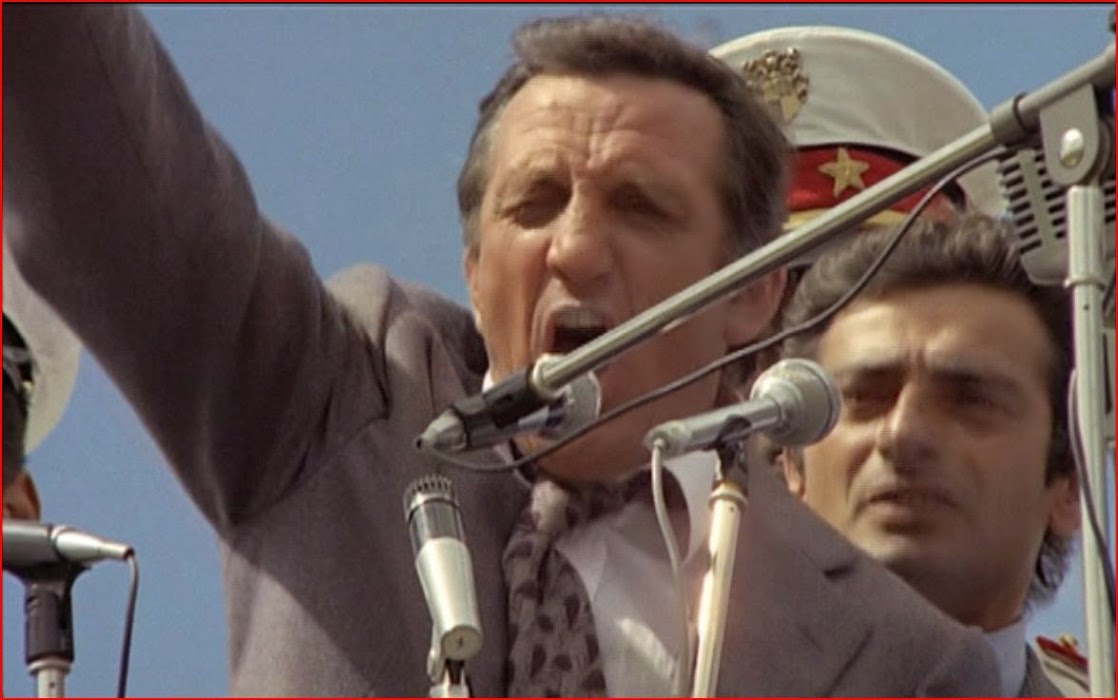
MONEY MONEY MONEY (L'aventure c'est l'aventure, 1972)

Claude Lelouch's L'aventure c'est l'aventure is France's answer to Otto Preminger's Skidoo: a heavyhanded comedy about oldschool gangsters adjusting to a radically new world. In less obscure terms, Lelouch's film is a send-up of radical chic. A bunch of dimwitted crooks -- Lino Ventura, playing an art forger, is the most high-functioning of them while singer-songwriter Jacques Brel is the other big name in the cast -- emerge from prison to learn that bank robbery, art forgery and other old standbys aren't where the action is anymore. The real action is political; all the old stuff is finished. Even the prostitutes are planning a general strike. Lino's son tells him that even cars are finished. Finding the lad's Molotov cocktail in his car, Lino accepts the premise and blows it up.


Lino's gang takes a crash course in radical politics, hearing talks from such extremes as uniformed Maoists to Salvation Army officers. The thing to do, they learn, is kidnap people in the name of some revolution or other. They start by pulling pop star (and eventually a movie tough-guy in his own right) Johnny Hallyday off the stage at one of his concerts after he sings the title song; Hallyday proves a most cooperative hostage. The gang then gets involved in an archetypal Latin American revolution, turning on revolutionary commandante Ernesto (Juan-Luis Bunuel, the director's son and a director in his own right) when he doesn't pay promptly. They kidnap a diplomat and impulsively play Russian Roulette with him while waiting for the ransom. They stage a successful hijacking, complicated only by their inept reading of an English ransom note. Finally they're living the high life until they're lured into a trap -- the bait's a boatload of topless girls -- set by the vengeful Ernesto, who wants his money back from them.


Eventually we return to the framing device of the gang's trial in Paris, but it's only a brief pause before the big finish as the boys make their break and flee to Africa, where they're feted as radical heroes. Each man takes a turn making nonsensical speeches as the masses cheer indiscriminately, living up to one character's early announcement that they were Groucho Marxists -- Skidoo covered this base by casting Groucho himself as a mob leader. Finally, there's no rest for revolutionaries, and our heroes are last seen sedan chair-napping the Pope, carrying their captive through the jungle and on to further adventures.


There are some funny ideas here and some decent moments of visual humor -- Ventura's facial expressions are priceless as he listens painfully to his cohort's labored rehearsals of his English for the ransom note -- but I suspect that a lot of L'aventure's humor is lost in translation. The whole point is the culture clash of gangsters and political radicals so the way the different sets of characters talk has to be a big part of the comedy that the DVD's subtitles don't really convey. The main point of the crooks' stupidity is made effectively enough with their compulsive gambling -- they take bets on which of them will crack as Ernesto tortures them one at a time -- and their idiotic attempt to seduce girls on the beach with their silly macho walks. But the comedy is silly rather than satiric and the film is fun but forgettable -- David Thomson didn't even list it on Lelouch's filmography for The Biographical Dictionary of Film. L'Aventure doesn't really deserve that sort of neglect, but it isn't exactly a vital document of its time, either. The impulse to satirize radicalism sometimes results in instant camp; if that intrigues you, this film will, too.

Tuesday, April 8, 2014

Real Pulp Fiction: ARGOSY, April 8, 1939

Reading a general-interest pulp magazine is often like watching TV. Series characters seem to predominate, so that with any given issue, especially of a weekly like Argosy you'd see several familiar faces. Authors strove to establish popular characters, hoping that they'd mean guaranteed sales. Some characters had whole magazines built around them; those were the "hero pulps" like Doc Savage and The Shadow. But series characters were prevalent everywhere, and this week's Argosy has three recurring characters along with Dr. Kildare wrapping up his second serial. Karl W. Detzer's Michael Costello may have been designed as a fireman counterpart to Kildare. This week's cover story, "Costello Learns to Take It," is Detzer's fourth story about the rookie firefighter. The title is self-explanatory. Costello sees his first major action, and his first corpse.

The smell -- the awful smell -- again caught Michael by the throat, pressed like iron fingers. The beam of the flashlight wavered briefly, steadied, wavered again. But Michael saw. He knew without seeing. 

There wasn't much left of the bed. Only a black mass of sodden ashes, wet down by the hand-pump and the spray from the engine-stream, a piece of wet blanked, and there in the center....

In short, Costello cracks under the early pressure, is reassigned to a quieter neighborhood, gets into trouble out of frustration, but redeems himself predictably enough with conspicuous heroism just as it looks like he's hit bottom. Like many pulp stories it's a rite-of-passage/test-of-courage scenario addressing the unspoken anxieties of young adult readers, and Detzer, who specialized in fire stories, has enough skill to keep it freshly readable.

One of my favorite series characters since I discovered the pulps two years ago is Frank Richardson Pierce's No-Shirt McGee. Introduced in 1937, McGee is a "sourdough," an old timer from Klondike days, still tough but more often a wise counselor to younger characters, and also the hero of tales from his own past. No-Shirt was popular enough to get a cover in 1938, and Pierce kept him going well into the 1940s, taking him to Short Stories after Argosy went slick. McGee is a first-person narrator who tells rather than writes his tales. That means that Pierce writes in a vernacular style with loose grammar. If you've read Robert E. Howard's boxing stories about Sailor Steve Costigan, No-Shirt McGee is written in a similar style, -- down to the present-tense narration -- while the character is a good deal smarter than Costigan. "The Bells of St. Mary's" is a dramatic tale of No-Shirt's youth, when he nearly freezes to death racing a claim jumper back to Portage Pass to help his injured partner. The title refers to the sound you allegedly hear as you're freezing, though No-Shirt has to decide whether he's actually hearing a real bell signaling his salvation. Here's a sample of Pierce's style:

Well, I'm on my feet again. I don't remember gettin' there, but I'm there and the bell is ringin'. It's off to the left now. It's makin' a sucker out of me. First it rings to the right, then to the left and I use up a lot of strength zig-zaggin' back and forth.

The wind is like something alive -- slapping at me and pushing -- but it is like knives, too -- a hundred buzz-saw blades cut through my clothes, slicing to the very bones. And it carries the sound of that bell in it so strong that the ringing seems to be a part of it. And I keep falling down and getting to my feet to stagger on again, walking to the endless pealing of that persistent bell.

The No-Shirt series is consistently entertaining and Pierce's style definitely elevates them. You can read some of these in the trove of Argosy issues scanned onto Unz.org. Here's one from earlier in 1939, for starters.

Another familiar series character in this issue takes Argosy in an even more comic direction. Dale Clark's J. Edwin Bell is a bottom-feeding Hollywood agent; the standard epithet for him is "the flesh peddler." Bell is constantly trying to jump on board a gravy train, whether by ripping off naive newcomers, studio executives or, preferably, both. In "The Liar and the Mouse" he learns from "Hardboiled Hannah," a never-was actress turned party-girl spy that a top studio special-effects man is taking credit for the work of an underpaid underling. Hannah's idea is to blackmail the studio man into giving the underling a big contract from which she and Bell then take a big cut. Bell's idea is to cut Hannah out of the equation by making his deal with the studio man, getting his percentage from the big guy by intimidating the meek underling into accepting his old contract. The Bell stories are when Argosy most reads like a sitcom, with the conniving Bell usually losing and often ending up on the run. The stories are amusing in their own right, and they're made more fun now by often-obsolete cultural references, e.g. "Hardboiled Hannah didn't know it yet but that signed agreement wasn't worth anything more than a Republican vote in the state of Texas!" It was a different world back then.

On the serial front, Max Brand's "Calling Dr. Kildare" closes with that gunshot victim cleared of a murder charge and his sister, a good bad girl, selflessly renouncing Jimmy Kildare's love at the urging of Dr. Gillespie, the dying man convincing Rosalie that he needs the young doctor more than she does. Soap opera stuff from a king of the westerns, complete with the pathos of renunciation, but movie audiences would eat it up when Metro-Goldwyn-Mayer released the movie version at the end of the month. Dr. Kildare would return for two more serials in the next two years. In chapter two of Norbert Davis's "Sand in the Snow" Jim Daniels must begin to solve a murder at the estate where he and his wife are vacationing while keeping his hapless new friend, on the run from another dubious murder conviction, from being framed for it, and keeping the suspicious gigolo Dak Hassan, who sees Daniels as a fellow practitioner, from making moves on his wife. This is the sort of mystery story where there's a surplus of eccentric if not suspicious personalities, including the literal comedy relief of a husband-wife team of alcoholic Hollywood gag writers. To clarify:

A joke is something you say -- a gag is something you do. Gags are lots funnier. Like when you sock a guy in the mug with a pie, or hit him with a baseball bat, or give him a cigar that explodes. Those are gags.

And so's the close of this chapter, when Jim's surprised to find his wife getting into a catfight with a complete stranger in a public street. I'm not a big mystery fan, but Davis's story is diverting enough to keep me turning the pages.


In the penultimate chapter of Arthur Leo Zagat's "Seven Out of Time," our team of time-lost humans captures one of the future-earth doctils and whips up a plan to destroy the doctils' colony on a distant planet in order to thwart their plan to take over Earth 1939, sacrificing themselves if necessary. The twofold plan involves destroying a barrier protecting the doctils from the planet's hostile indigenous life and killing the doctils' matra, the last true female preserved for breeding purposes.

She was far greater in size than any woman we had seen, but she was formed like the women we knew, and not like the grotesque beings who guarded her. Her skin was white as the fabric on which she was stretched, and lustrous. Great-bosomed she was, and huge-limbed, and tremendously wide of hip. Her eyes were closed in a deep slumber that somehow I knew was something other than sleep. The contours of her face had an almost unearthly beauty, yet she wore, like a mask, an expression of bovine placidity, of mindless calm, that made her somewhat less than human.

Why didn't they put that on the cover?


Rounding out this week are two stand-alone stories. Nat Shachner, who specialized in sci-fi for the pulps and historical sketches for The American Mercury, contributes "Test for a Tatar," which comes as close as anything in Argosy to the blood and thunder people associate with real pulp fiction. It's a gruesome tale of the rise of Temujin the Mongol to power and his taking of the name Genghis Khan. It's told from the viewpoint of Subotai, the Khan's loyal vassal, who sees his lord manipulated and set up for assassination by Targoutai the Taidjut, though who the real manipulator is proves open to question. A seemingly drunken Temujin tests the loyalty of his own tribesmen by ordering them to kill their favorite horses, and then their favorite wives. Luckily, Subotai is a bachelor, and the other men have wives to spare. Targoutai finally goads Temujin into killing his own father, but Subotai thwarts the Taidjut's plan to slay Temujin at his moment of triumph. Argosy is no kiddie pulp and its stories can take an amoral turn, but there really seems to be no point here other than mayhem -- but I suppose there was an audience for that, too. Finally, the editor predicts that A. M. Burrage's "Out to Rest" is "certain to become one of the most memorable short stories of the year." It's really a trifle, and I can't imagine its premise was much less familiar then than it is now. A soldier (or is it a former soldier) can't tell whether he's dreaming in wartime of his death in bed two decades later or dreaming in the present of his dead comrades from the war. Can you guess which it is?

*   *   *

There was at least one kind of story rarely or never seen in Argosy. As letter writer Mrs. Clay Clark of Camden ME writes in this week's Argonotes column: "ARGOSY has always printed a different type of story for each and every issue, a miracle, yet there is one type I cannot recall ever seeing ... the Negro stories." By which she means comical stories about those funny colored people who talk in Amos 'n Andy dialect. The editor answers: "We don't know why people don't write Negro stories for ARGOSY, but we are rather relieved, because unless a Negro-dialect yarn is very, very good, it is apt to be simply terrible."

I've found a few racist stories in Argosy, and a few -- fewer, sadly -- that actually count as anti-racist. I hope to share some of the latter with you sometime, but as for all my American readers, the April 15 deadline looms -- and I have more reading to do.

TO BE CONTINUED


Sunday, April 6, 2014

On the Big Screen: CAPTAIN AMERICA: THE WINTER SOLDIER (2014)

Spoilers everywhere. Trust no one.
 
You can excuse Steve Rogers getting a little paranoid. His next door neighbor turns out to be an Agent of SHIELD. The only living person he knows from his own time -- as far as he knows -- was a founder of SHIELD. And some people will tell you that the two women are related. Even the guy he banters with while jogging in the morning turns out to be a sort of super-soldier in his own right. And when a buddy from Steve's past turns up unexpectedly, he turns out to be tied up in some secret government program. Our boy's got to wonder whether he ever has dealings with normal people. But that's the life he chose when he volunteered for Project Rebirth back in 1942, and the life he's been stuck in when SHIELD thawed him back to life in 2011. Still, taking all this into account, should Captain America have had the knee-jerk reaction of distrust and disgust we see when Nick Fury shows him SHIELD's latest experiment in surveillance and pre-emption? In story terms it's right for him to have it, but if Steve's a throwback to the Greatest Generation and all that, shouldn't he be more likely to trust government, at least at first, than people who've actually lived through all the events that make 21st century people less trusting? The Winter Soldier would have had an extra level of moral complexity had Steve initially trusted SHIELD on this and gradually had to learn better. But Steve Rogers is our audience-identification figure and he needs to tell us right away, as if we couldn't figure it out for ourselves, that This Is Wrong. Because it is. I'm not saying this is a mistake by the filmmakers, but it struck me as slightly wrong -- too neat, just as it is to blame SHIELD's excesses ultimately on our old friends at Hydra. That scapegoating undercuts The Winter Soldier's claims, or the claims made for it by many reviewers, of contemporary critical relevance. Hydra, the enemy of SHIELD going back to the 1960s in comics, has become a convenient source of context-free evil. More evil even than Nazis, Hydra is the perfect fictional foil: an evil that no one on earth can claim is a reflection on them. Blame what happens in Winter Soldier on Hydra and you're really blaming nobody. This story's excesses in the name of surveillance and preemption -- a superweapon capable of simultaneously eliminating up to 20,000,000 potential enemies around the world -- are blamed on Hyrda's obsession with an "order" that is antithetical to freedom. But the excesses of surveillance and preemption on which Winter Soldier is supposedly meant to reflect weren't born of an obsession with "order," were they? Quite the opposite, some would say. If a Marvel movie dared to say that such a mad scheme resulted with an obsession with "freedom," than the reviewers would have something to write about. As things stand, I can't wait to see what Slavoj Zizek has to say about this movie, but while most of you ask "who?" let's move on.

On the terms it chooses for itself, Winter Soldier is one of the best Marvel movies yet. It brings the Marvel movies about up to speed with modern superhero comics, where you learn that "everything you thought you knew is wrong" just about once a month. It seems to prove that writing makes these films, while good writing makes them just about director-proof. The Russo brothers have a questionable resume for directing an action movie, but the writers of Captain America: The First Avenger are back, and Christopher Markus and Sean McFeely really deserve most of the credit for this film's success, my philosophical quibbles above notwithstanding. There's a meta-quality to the Captain America film series, the first film really evoking the Golden Age of Comics while the new one makes ample use of concepts from Ed Brubaker's 21st century revitalization of the character. Brubaker is an as-yet unsung pop culture hero of our time. He took over writing Captain America after a run on Catwoman at DC that definitively turned that character into an antihero if not an outright hero. The Selina Kyle we saw in The Dark Knight Rises arguably owes a lot to Brubaker and artist Darwyn Cooke's vision, but Brubaker's influence on Winter Soldier is more direct. Comics are a writer's market these days, with the star scribes expecting carte blanche to unprecedented degrees. On Captain America Brubaker broke one of Marvel's great taboos. The folk wisdom had been that at Marvel only three characters never came back from the dead: Peter Parker's Uncle Ben, Peter's girlfriend Gwen Stacey (I hope I'm not spoiling any future films!) and Captain America's wartime sidekick Bucky Barnes. In comics Bucky died somewhere in the North Atlantic while diverting a German rocket from its target, in the same incident that got Cap himself frozen in ice for many years. Bucky's reappearance was often teased, and other characters sometimes wore Bucky's superhero costume, but Barnes himself was dead, dead, dead -- until Brubaker said he wasn't.

Inevitably, Markus and McFeely have Hydra-ized the Winter Soldier's origin, Brubaker having made him a product of Soviet experimentation, and thus more closely associated with the Black Widow than in the movie. I don't really have an issue with the change, but a weakness of the Bucky angle for the movie is that its big revelation can't have the impact Brubaker's had in the comics, the latter coming as it did after forty years of modern Captain America stories with our hero missing his friend, and in defiance of a recognized if informal taboo. The movie writers tried to compensate by making Barnes a more important figure in Steve's early life than he ever was in comics -- in Simon & Kirby's original stories Bucky is a much younger camp mascot whom Steve meets only after his super-soldier transformation. But one movie couldn't substitute for years of Captain American & Bucky comics, and so the movie Barnes really can't be as important a figure for the audience as the filmmakers want him to be and can make him be for Steve Rogers. Superhero movies want to encapsulate up to 70 years of experience in a handful of movies, and they may get away with it with movie viewers who don't know comics, but for a Brubaker fan like me there was something lacking in the movie's homage. There was at least one moment when the writers tripped over the ever-evolving, ever-rebooting Marvel comics mythos. The Black Widow is repeatedly identified as a former KGB agent, but when her date of birth is given in one scene it turns out that the KGB ceased to exist when Natasha Romanova was seven years old. Marvel Comics wants the KGB to remain part of the character's past, so they've reimagined her as another kind of super-soldier who, like Steve, is much older than she looks, but the filmmakers probably didn't want to turn people off by having Scarlett Johansson play a woman in her eighties. Film adaptions of comics will never be perfect, and I'd actually rather not have them go too far in the Sin City direction. But the Widow's age as given here seems to be a mistake that may raise more questions than were intended.

Once I step away from both my comics-reader biases and my philosophical differences with the story I can recommend Winter Soldier as both an effective action movie and a showcase for character development. After a James Bond style opening pitting Cap against an old comics enemy, the film goes into slow-burn mode, illustrating both Steve's alienation and his guileless good nature. He may mourn all he's lost -- his encounter with the physically and mentally frail nonagenarian Peggy Carter is genuinely sad -- but happily doesn't put himself in an emotional box. He has an innate ability to win friends and their trust that pays off as his fellow jogger Sam Wilson unrolls his own formidable skillset. Winter Soldier may be more of an actors' film than any other Marvel movie, and Chris Evans, Anthony Mackie and Scarlett Johansson make the most of that. Samuel L. Jackson's Nick Fury gets more screen time than ever and manages not to wear out his welcome (look for the Pulp Fiction homage toward the end, by the way), while Robert Redford's late-life effortless mastery is mostly reaffirmed here. Marvel's getting quite good at building up mid-level villains (see also Iron Man 3) and in that category Frank Grillo takes the honors this time as a questionable SHIELD agent. The action scenes are all you could ask for, though I still wonder how much credit the credited directors deserve for them -- or are they glorified dialogue directors like you had in early talkies? I enjoyed the hand-to-hand combat and the car chases more than the inevitably overblown three-helicarrier climax, but the climax itself wasn't bad, either. I'm not ready to join those calling Winter Soldier the best Marvel movie to date -- it's not necessarily even the best Captain America movie -- but as a big improvement on Thor: The Dark World it's a reassurance that Marvel is probably far from exhausted either creatively or technically.

Epilogue: Winter Soldier follows a new pattern set by Avengers and Dark World of embedding the important extra scene in the middle of the end credits, while the actual post-credits bit is a comparatively anticlimactic coda to the film proper. This time the middle bit introduces some characters we'll be seeing in the next Avengers movie, while the coda is an encore for Sebastian Stan, whose reported multipicture deal with Marvel means not only the Winter Soldier's return, but possibly a promotion down the line if the films follow Brubaker's example. If you really need to go, you can leave after you see the twins.

Thursday, April 3, 2014

DVR Diary: BILLY THE KID (1930)

Metro-Goldwyn-Mayer made four films about Billy the Kid between 1930 and 1973, as if the purchase of the screen rights to Walter Noble Burns' Saga of Billy the Kid gave them ownership of the semi-legendary gunman. The character attracted considerable talent, three of the four pictures being made by arguably canonical directors: Sam Peckinpah (Pat Garrett & Billy the Kid, 1973), Arthur Penn (The Left Handed Gun, 1957) and King Vidor in 1930. Vidor was one of Metro's prestige directors. The massive success of his WWI drama The Big Parade entitled him, in Irving Thalberg's eyes, to make whatever film he pleased, as M-G-M's motto puts it, "for art's sake." The result of that policy, The Crowd, is regarded as a milestone of late silent cinema. His sound debut with an all-black cast, Hallelujah, was another critical and popular hit. In 1930 Metro entrusted Vidor to put over the latest cinematic innovation: a panoramic widescreen process called Realife, touted as the nearest thing to three dimensions on the movie screen. At the same time Fox Film was making a widescreen western, The Big Trail, using a different process. Both films stumbled at the box office, mainly because exhibitors didn't want to invest in more technology so soon after wiring for sound, and during the Depression, no less. The Big Trail has a toehold on posterity as the starring debut of John Wayne, and it survives in its widescreen form to impress audiences today. To my knowledge a Realife print of Billy the Kid does not survive, though you can still appreciate the effects Vidor was aiming at, and it's certainly the least known of Metro's Billy pictures. As for its  Billy the Kid, rather than the clumsy beginning of something great, Vidor's film is arguably when Johnny Mack Brown jumped the shark.

Whatever happened to Johnny Mack Brown? The Statler Brothers' rhetorical question grows more pointed if you know what Brown was and might have remained. Like Wayne (aka Duke Morrison), Brown was a football star, winning national attention as a Rose Bowl hero for the University of Alabama. M-G-M decided to make a star of him, putting him in elite company. In silent movies, billed as John rather than Johnny, he was a romantic interest for Greta Garbo, when people could only imagine what either of them sounded like. Such associations explain the ballyhoo touting Billy the Kid as a romantic figure, a western Don Juan. Vidor's Billy the Kid is probably the apogee of Brown's career in A pictures, but it was downhill rapidly from there, at least as far as Metro was concerned.

The movie comes prefaced with remarks from the governor of New Mexico who validates the project despite "liberties" taken with history, dubbing it a "true tale" of pioneer days. Much of it will look familiar to anyone who's seen the other Billy movies, but how true it seems to you depends as much on what you expect to see in a Billy movie as on what actually happened to the real man. I claim no expertise on the Lincoln County war and won't bore you with details. To sum up Vidor's film, it suffices to report that Billy is always right and has a happy ending. Pat Garrett (Wallace Beery) pretty much allows Billy to escape history's death trap and start over in Old Mexico, with his girl Claire Randall (Kay "Madame Satan" Johnson) following close behind.

My guess is that Vidor was more interested in the artistic opportunities made possible by widescreen framing than in the matter of his story or the work of his actors. On the existing evidence, he was more interested in using depth than width, taking full advantage of his locations and staging action on a huge scale. He works in long takes, both to let the depth of the image sink in and to maximize suspense in action scenes. One of the best shots comes when one of the men besieged with Billy races out, risking gunfire, to get water from a well. A doorframe frames our view of Roscoe Ates racing out to the well, getting a pail of water, and tripping as he heads back to the house. The shot continues, Billy and the others rooting him on, as Ates goes back to the well, gets another pailful, and is finally shot full of holes by Billy's enemies, just managing to crawl back inside before dying. It's a great scene and I can't imagine the scene working any better in Realife. I can only imagine how impressive the more panoramic shots would have looked, or the shots of villains on a rooftop commanding a small town and Billy's besieged bastion beyond. The most eye-popping shot is a scene inside a huge cave, with Billy a tiny figure holed up in an upper corner, his voice echoing as he negotiates with Garrett, who literally smokes his man out by frying a pan of bacon to entice the starving outlaw.  Vidor ends the scene with a subtle exclamation point -- oh, you thought this was a set, eh! -- cutting to a medium shot of Billy finally exiting the cave, clearly the same location we'd seen in long shot. Show-off moments like these contrast with dull stretches of dialogue and feeble attempts at comedy from Ates, monosyllabic Karl Dane and others. Some of the comedy scenes actually have a leisurely, digressive quality that look forward to westerns of generations later; other simply stink.

Of the four M-G-M Billies, Brown at 26 was the closest in age to the historical outlaw, and the most I can say for him is that he plays Billy more like an overgrown kid than does Robert Taylor, Paul Newman or Kris Kristofferson. This is mostly a happy-go-lucky Billy, but when he vows vengeance at the deaths of various friends, the effect is somewhere between a child having a tantrum and someone self-consciously playing the avenger to an audience. Brown's southern accent might seem fitting for a westerner, but the real Billy was a Manhattan native and the actor's mellow drawl only makes the outlaw sound soft. Brown projects no menace, no viciousness, no cool; he doesn't register as anything like Billy the Kid as we think we know him now. Meanwhile, if I didn't know better I'd say that Wallace Beery was underplaying as Garrett; whatever he's doing the role of a subtle authority figure suits the old ham surprisingly well. Beery had shot to a new level of stardom in 1930 and was billed above Brown in ads in some markets. While he doesn't really have enough screen time to steal the picture from Brown, he definitely makes a better impression, at least on a modern viewer and probably in 1930 as well.

Beery would last at M-G-M; Brown would not. His accent seemed to handicap him; audiences wanted fast talkers and harder voices. Clark Gable was his nemesis. In The Secret Six Brown's character is killed midway through and Gable's becomes the hero by default. Joan Crawford may have finished Brown at Metro by demanding his replacement by Gable as her leading man in Laughing Sinners. He did some A parts at other studios, but by the end of the Pre-Code era he was settling in as a star of B westerns. He did dozens of them deep into the Fifties, often playing "Johnny Mack Brown" later on. He was a durable brand name, a star of comic books, and certainly beloved among some if not many. He found his level and apparently made the most of it. Was that enough? Did he compare his six-or-so pictures a year for Monogram to his big chance at Metro? Would he be surprised at what's remembered and what's forgotten? As far as all that goes I don't know whatever happened to Johnny Mack Brown, but Billy the Kid shows us what might have happened, and also why it didn't.

Tuesday, April 1, 2014

Real Pulp Fiction: ARGOSY, April 1, 1939

Pulp heroes need a vacation every so often, whether they admit it or not. The vacation theme turns up twice in this issue of Arogsy. In the lead novelet, Richard Wormser's series character Dave McNally, a "bring 'em back alive" hunter in the Frank Buck mode, ends up taking a working vacation shipping elephants from New York to California via the Panama Canal. He never makes it to the Pacific. One of his animals gets drunk on a cargo of booze -- a running gag is the distiller's constant invention of bad ad slogans and jingles -- and ends up taking McNally and the requisite pretty girl over the side. The elephant swims to shore with the hapless couple riding it, the girl falling in love with McNally to his manly dismay. In the happy ending he sells the hero elephant to a circus and hires the girl to tour with it so she'll forget him as soon as possible. Like a lot of Argosy stuff at this time, it's pretty lightweight, lacking the edge or bite of prime pulp.


Also in need of a vacation, or so his wife claims, is attorney Jim Daniels. Norbert Davis, a crime and mystery specialist, created the character for the 1938 serial Mad Money, and "Sand in the Snow" is Daniels's second appearance. Daniels is married, however improbably, to an astronomically wealthy heiress who wants him to take it easy and enjoy life with her, but Jim's pride won't allow him to live off her money. He's also bothered by her suggestion that they visit and old rich friend of hers in California. After an argument she storms off on her own and he, crestfallen, soon follows. He encounters a number of odd personalities along the way -- a convicted and soon escaped wife-murderer who protests his innocence, an aristocratic European gigolo in search of a rich new wife, etc., while his wife's host proves an odd bird himself, disfigured in a car wreck in which the other passenger died. Your first hunch, if you've read a lot of this stuff, seems confirmed when Daniels encounters a mystery man with a bandaged face lurking outside the estate, but he first has to deal with the murder of the much-married moneybags who had offered him a job back east, and whom the gigolo had targeted for seduction, and there are four chapters to go. Davis turned thirty this month; at forty he would kill himself, allegedly frustrated that he had lost his popularity, if not his talent. He was noted for his humorous mystery stories in Argosy, Black Mask and elsewhere. Despite the improbably encounters in this opening chapters, the hero's status anxiety gets us interested early and gives us a stake in the story, whether the mystery proves compelling or not.

Young Doctor Kildare is still tending to the wounded gunman in the cellar in the second chapter of Max Brand's "Calling Doctor Kildare." This time Jimmy has to smuggle equipment for a blood transfusion out of his hospital dispensary, giving the gunman some of his own blood. His errand of mercy risks getting him in deeper trouble with his mentor Dr. Gillespie, but Nurse Mary Lamont helps cover for him. Brand, king of the westerns, works the romance angles here, developing both Mary and the gunman's sister Rosalie as potential love interests for the young doctor, while the girl he left behind writes a sad letter renouncing him. Rosalie seems to be set up as a tragic figure, a once-fallen woman expected by those who know her to fall again. There's only one chapter left in this three-parter so Kildare will have to make his mind up quickly unless the women make it up for him.


Arthur Leo Zagat gets down to the nitty-gritty in chapter four of the six-part "Seven Out of Time," in which we learn at last why each of our mismatched band of time-lost protagonists has been chosen for study by the doctils, the superintelligent monsters allegedly descended from human beings. Zagat lets rip an apocalypse, revealing a dystopian future history of an earth divided into castes of rulers, workers and scientists and the crash of civilization when a new ice age provokes a global war in which the worst weapon is a frequency device that drives multitudes mad. Escaping to a distant planet, the five surviving doctils determine that certain essential human traits were lost in their evolution, but are necessary if their new world isn't to end as the old one did. They need some combination of faith, loyalty, obligation, beauty and love and expect to acquire them through study of their mix of historical and fictional subjects -- our hero and heroine together represent love, of course. Having experienced more directly what Zagat has described at great length, our team isn't inclined to cooperate, especially since the doctils intend to change history by colonizing Earth circa 1939. As King Arthur puts it, "Rather than live as poltroons, we choose to die as men!" This "fantastic" is as fantastic as Argosy gets and gets more interesting as Zagat lets his imagination rip and leaves his prosaic protagonists to watch.

"Fantastics" are the exception in Argosy but this week's issue has one other weird tale. Garnett Radcliffe specialized in stories set in India and thereabouts; his previous Argosy contribution was called "Beast of Allah." This week's "The Magic Monkeys" has a colonial official tormented by the priest of a monkey cult, convinced that the priest has sent the title creatures to avenge his shooting of a temple monkey earlier. It ends with the priest getting his throat ripped out by the official's faithful dog. The only problem with that, our narrator tells us, is that the faithful dog died more than a year ago.


Rounding out the issue: western writer Bennett Foster has the other stand-alone novelet, "Two Tall Men," in which an outlaw and a sheriff converge on a corrupt town to rescue a mutual friend from a murder frame. The outlaw gets himself jailed so he can bust his friend out, but the old man won't go, while the sheriff pumps the local bartender for information by torturing him (see above). Don't worry, folks: "A horse will jump a man lying on the ground every time," but our lawman depends on his victim not knowing that. Meanwhile, the outlaw breaks out by himself with his trusty piano-wire escape kit and gets evidence from the obligatory corrupt banker. Justice prevails and the sheriff gives the outlaw a head start as a reward. The very prolific Frank Richardson Pierce (more on him next week) offers "Shake Hands With Davy Jones," in which a crew of old salts take offense at the sale of an antique windjammer to the Japanese and prove their superior seamanship. This week's best story, depending on your moral perspective, is Murray Leinster's bracingly amoral "The Pebble of Justice." Leinster is best known for his science fiction but also wrote extensively for the slicks under his real name, Will F. Jenkins. "Pebble" is a Mexican story in which the protagonist gets away with murder twice, framing his second victim for his first crime, then taking over the second victim's identity -- and his wife. Here's the moral, stated at the beginning and end of the story:

In Anhuac they have a saying ... In a mountain of law there is a pebble of justice. And with a fine high cynicism they have deduced from the saying a fable that somewhere there is a pebble which, caught in a man's shoe, ensures him true justice for as long as it remains. The cynicism lies in the fact that in Anhuac most people go barefoot. 

Our hero wears huarachos.

NEXT WEEK: Walk a few miles in a rookie fireman's boots, meet "No-Shirt McGee," and learn how Genghis Khan got that way. Also, "Seven Out of Time" are running out of time in more ways than one!

TO BE CONTINUED