Saturday, June 27, 2015

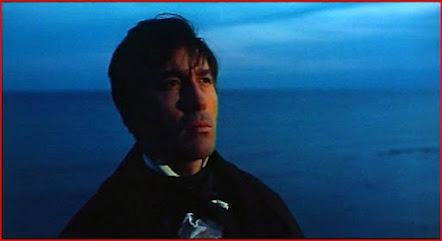
DVR Diary: VALENTINO (1977)

Hollywood had two disaster-movie cycles in the 1970s: the films about natural disasters and vehicle crashes, inspired by Airport, and the movie-industry biopics, flops all, reportedly inspired by the sleeper-hit compilation film That's Entertainment! Some of these had already come and gone by the time someone had the bright idea to have Ken Russell, who had already put his own peculiar spin on the biopic genre, make another. His wasn't the first biopic about the archetypal Latin Lover; its predecessor made little impression back in 1951. The producers could be certain, however, that Russell wouldn't simply go over old ground. The result is probably the most interesting of all these misbegotten biopics. Russell, the visionary who'd given us The Devils and Tommy among others, as well as biopics about Tchaikovsky and Mahler, handicapped himself by casting Rudolf Nureyev, pushing forty, in a title role he was way too old for in the early stages of the story. On the other hand, Valentino, like Nureyev, was a dancer and could be called "Rudy," while the Russian's generic foreignness gave him an advantage over Russell's earlier and potentially more catastrophic choice for the role, David Bowie. Nureyev gives a game performance but a natural flamboyance doesn't quite counterbalance the screenplay's mostly passive conception of the protagonist. The problem with any biopic is that biography doesn't automatically translate into plot. Without a commanding idea of a character arc for the subject, the necessity of following facts, sometimes honored in the breech, threatens to turn your historic hero or heroine someone to whom things happen rather than someone who makes things happen. Russell and co-writer Mardik Martin fall into that hole and dig it deeper by telling their story in flashback form, framing it with Valentino already dead and surrounded by fans, friends and former lovers at his riotous wake. The wake is a standard Russell set piece as a mob crashes through picture windows, trampling each other to get a look at their dead idol, and grows only more so as the self-appointed chief mourner, Valentino's onetime co-star and mentor Alia Nazimova (Leslie Caron) appears, attended by a host of veiled maidens -- or are they concubines? Nazimova here usurps the historic role played by Pola Negri, who made a big show of fainting at Rudy's bier. Here, Nazimova even gets up and does it over again so the newspaper photogs can get a decent shot. She's a perfect subject for Russell; more perfect, perhaps, than Valentino, who here is shown wanting to fit in and be recognized, his ancestry notwithstanding, as a typical American male. If Russell has a soulmate on screen in this picture, it's either Nazimova or her protege, later Rudy's wife, the pseudonymous cosmetics heiress Natasha Rambova (Michelle Phillips). Both women are pretentious aesthetes, ambitious to direct movies -- in a hilarious scene Natasha and the credited director of Monsieur Beaucaire sit side by side in matching director's chairs, she coaching Rudy, the man coaching his co-star -- until they call out "Kiss!" simultaneously -- and when these would-be superwomen lock Valentino in a romantic triangle they nearly eclipse the star. Fortunately, chronology allows Rudy (character and actor) to break free of them for the final act, which really deserves its own paragraph.

The final act is especially interesting for what it anticipates as well as for the way Russell and Mardik Martin use the death of Harry Houdini as a model for Valentino's demise. Houdini's fate was sealed, so it's said, when his vaunted ability to resist any punch to the body was tested before the master magician had braced himself; the internal damage led to peritonitis. Valentino also died of peritonitis, and as it happened not long before he had gotten into a fight. A precursor of Uwe Boll, he had challenged to a fight not a critic of his movies but an editorial writer who blamed him for the new availability of pink powder puffs in hotel restrooms and thus blamed Valentino for the moral decadence of American men. The author of the editorial never showed but another writer accepted the challenge and a fight apparently did take place, won by the actor. This legendary battle gives Russell an epic finish to his film. It's not as great as it could have been because Russell, here as elsewhere in the picture, undercuts Nureyev's virtuosity with editing. At least I think the great dancer could have done a sustained, choreographed boxing scene. But if I was thinking more of City Lights, what Russell does, more by focusing on the antics outside the ring than inside -- there's dancing around the ring between rounds and the crowd pelts Rudy with powder-puffs after a knockdown -- is turn the fight into an expressionist summation of Valentino's struggle for acceptance and his anger over critics of his masculinity. In other words, Russell uses boxing expressionistically a few years before Martin Scorsese's Raging Bull, although the real credit may belong to Mardik Martin -- who also co-wrote Raging Bull.

Valentino's flashback format made it hard to warm to the film, especially when the flashbacks are framed with deadly expositional dialogue, but the more Russell-like it became, the more I liked it -- not because I'm a mark for the director but because he was working hard, unlike the other Hollywood biopics of the time, to give this dead material some kind of life. I warmed to Nureyev as Valentino approached the actor's own age, and I also enjoyed the much-disparaged performance of Michelle Phillips, critics of whom seemed to miss the point that Natasha is meant to be seen as a talentless yet entitled poseur. I also dug the eccentric casting that gave former Bowery Boy Huntz Hall probably his most prominent later-life role as Paramount studio head Jesse L. Lasky. Russell's attempted pastiches of silent film, including re-dos of The Four Horsemen of the Apocalypse and The Sheik, are bad enough to leave you wondering what audiences saw -- as Russell shows them seeing -- in these films, but since the film is about Valentino, not his audience, though the latter play a prominent Greek-choral role in a climactic seance scene, his laziness in recreating archaic film style can be excused. Valentino can be seen as more than a relic of a futile film cycle. It can be seen as a characteristic auteur project, of course, and as long as that prepares you for what you're going to see you probably can appreciate the film on its own terms -- as an understandable yet undeserving flop.

Tuesday, June 23, 2015

Too Much TV: DAREDEVIL (2015-?)

Trailing badly behind DC Comics in the race to colonize network television with superheroes, Marvel has virtually yielded the field in order to plant its flag in the realm of streaming media. Fans responded virtually orgasmically when Netflix released the entire 13-episode first season of Daredevil back in April. The first of a sequence of interrelated series meant to climax Avengers-style in the debut of a Defenders team, Daredevil is the first superhero show designed for binge viewing, and that was a major factor in the rapturous reception it received. Inevitably the show was overrated. Some of that was partisanship; Marvel fans who despite their side's dominance at the movies resented DC's superiority on TV could now say that Marvel had outclassed the competition on its favored ground. Venue as much as format mattered in the comparison. It was just as important that Daredevil wasn't a CW superhero show as it was that it was a Netflix show. What this seemed to mean was that Daredevil wasn't saddled with the sort of soap-opera subplots that were necessary to make DC superhero shows attractive to the CW's female audience. Specifically, there was no love triangle involving Matt Murdock, his law partner Foggy Nelson and their new assistant Karen Page. But if these fans abhorred romance there was still plenty of that to overlook as attention was paid to Foggy's flirting with Karen while Matt focused obsessively if not self-destructively on crime-fighting. For some fans "love triangle" was shorthand for everything wrong with the DC/CW shows, but in some ways Daredevil was no different from them, particularly in its conviction that there's no such thing as a noble lie. Nearly an entire episode was dedicated to Foggy's anger at Matt over keeping his crimefighting and superpowers secret since their college days, and the season ended with Karen keeping a guilty secret from her bosses, while Foggy hypocritically kept her out of the loop about Matt's double life. This sort of thing is the CW's meat, but Marvel fans don't really find it distasteful. In fact, it fits perfectly with the show's sometimes oppressive self-importance.

I didn't binge-watch the series, which is why you're only reading about it now, but I imagine that binging would only exacerbate the potential oppressiveness that for fans confers serious respectability on the show. Binging may actually be the correct way to watch a show that rejects a major convention of series television. What it rejects most importantly is the necessity of having a Threat or Mystery of the Week, a particular problem that Daredevil must solve within an hour of showtime. More often these days I see people complain about the "of the week" obligations of longform series, which are necessary if each episode is to have any chance at viability as a standalone, out-of-sequence episode. The binge audience apparently isn't interested in any given hour's potential to stand alone. They're only interested in the one big story of the season, from which the threat or mystery of any given week can only be an irrelevant distraction. By an older standard not much happened in Daredevil's first season, but by a newer standard a lot did, though a lot of it was character development, often done via flashback. I'm not sure so many people would love Daredevil if they watched it one hour at a time, one week at a time, while I might have been more overwhelmed had I done it all in a weekend. Watching it at my own pace, I found it a very good show that didn't quite justify the hosannas it received over the first weekend.

For a while, Daredevil threatened to look little different from the first season of Arrow. We had an urban vigilante feeling uncertain about his resort to violence, and we had an antagonist with an ambitious project to rehabilitate a slum neighborhood. Fortunately, Wilson Fisk (Vincent D'Onofrio) didn't plan to rehab Hell's Kitchen with an artificial earthquake or other scorched-earth measures. The would-be Kingpin of crime -- once an arch-enemy of Spider-Man but deemed part of the Daredevil intellectual property ever since Frank Miller used him in his seminal 1980s stories-- wants to clean up the neighborhood the old fashioned way: by buying the tenements and driving out the tenants, with extreme prejudice if necessary. Daredevil is at its most creative in its fresh imagining of Fisk's background psychology. The comic-book Kingpin was first imagined by Stan Lee as a Sydney Greenstreet who could kick your ass or fry you with his laser-cane if it came to that, while Miller further underscored the big man's prowess as a martial artist. By contrast, D'Onofrio plays an awkwardly self-conscious Fisk, clearly uncomfortable in his own skin, whose fighting style is best described as "berserk tantrum." The show dares make him an object of pathos, flashing back to a tormented past when he killed his dad, a bullying failed politico, to save his mom from another beating. It gives its villain a romantic storyline as he courts the art-dealer Vanessa (Ayalet Zurer), whose abstract paintings calm him the more they resemble the stained, crumbling wall he used to stare at as a boy. In the comics Vanessa evolved from a long-suffering spouse -- we'd eventually meet an adult son who became the Kingpin's rival -- into a ruthless stand-by-your-man type who eventually had that son killed. Here she's an eccentrically, sympathetically amoral figure who seems to love Fisk for his telling her everything about himself and not in spite of his evil. The irony of the season is that, despite other setbacks, Fisk finds the love of his life while Matt (Charlie Cox) is reduced to tears at the thought of losing the few friends he has over the secrets he'd tried to keep.

Daredevil benefits from a solid ensemble, including Elden Henson in comedy relief as Foggy and Deborah Ann Wolf as Karen -- a character with bad news in store for her in the show follows later comics. It was admirably modest in scope in its first season, and if it probably could have shown us more villains it did well to keep Daredevil's two most important antagonists after Kingpin, Bullseye and Elektra, in reserve for future seasons. The show's fight scenes were highly praised, but I might praise them more if I could see them more clearly through the sometimes-stygian cinematography. In the end I was impressed in many ways, yet still felt something was missing. It never quite popped for me the way a superhero show should, and in its commitment to a certain pretentious grittiness the show probably didn't want to pop like that. It was certainly far better than Arrow's unfocused third season, and almost infinitely superior to Gotham's cumulative ineptitude, but I don't think Daredevil is better yet than Arrow at its best, and I enjoyed it less than I did the first season of The Flash. Write that off to personal taste if you wish, but I don't think that more spectacle and more fun would hurt the show. As someone with impeccable credentials with comics and movie fans once asked: why so serious? Another show that ran while I worked my way through Daredevil did a better job of balancing seriousness and fun, as I hope to prove in the next review in this series -- and to give you a clue, I found it in a familiar place.

Saturday, June 20, 2015

DVR Diary: MARCO POLO (1975)

The first time I saw Chang Cheh's historical epic, before I knew who Chang Cheh was, it was called The Four Assassins. I saw it on some local independent channel's kung fu theater time slot, and it was memorable for me because it was the first time (that I can now recall) I saw the sort of baroque training sequences that typified kung fu movies from the mid Seventies through the early Eighties. To me and my friends it was all laughably absurd, but on seeing it again recently (in the proper aspect ration on the El Rey channel) I found the training bits some of the most dramatically effective I've seen in the genre. The four Chinese heroes of the story, rebels against Kublai Khan, who has appointed the famous Venetian trader (American-Italian star Richard Harrison, who'd end up in more martial arts movies than he could ever imagine) a constable to hunt them down, are rusticating on the friendly estate of a former kung fu master. They hope for training but as the Mongols have made martial arts illegal, the best the old man can do is give them jobs as manual laborers. Some of these jobs can't be done in the conventional manner because the tools that are normally used have also been banned, since they can be used as weapons. In the worst case, one of our heroes must harvest bamboo without a blade; he must twist the tough branches between and around his legs until they snap, shredding himself in the process. Another hero has to sift some very coarse grain with his bare hands and arms; the stuff scratches even worse than iron failings. The others aren't technologically limited but are heavily burdened just the same; one must clear a field of heavy boulders, while the last gets comeuppance for peeing in Marco Polo's soup earlier in the picture by having to empty some open-air latrines. In what was the funniest bit for me, his boss -- all the heroes have taskmasters who clearly were  fighting masters in their day -- warns this guy not to fall into the pisspits. Our hero's not worried; he boasts that he could leap right out if he fell in, not realizing until the boss throws him in that the urine comes up to his ribcage. It is now his regular job to practice jumping out of the pit until he graduates into jumping straight from one pit into another, and from that to another. The long-term payoff for the story is that each hero develops extraordinary abilities from their labors. Jumping, obviously; Samson-like strength for the boulder guy; devastating hand strength for the grain guy, who also has to work the mill's whetstone with his hands until it's smooth; and a powerful, near-invulnerable lower body for the bamboo guy -- an aid to his "pugilism," which for this film doesn't seem to mean what we think it means. The short-term payoff is a great scene in which the heroes reunite after their first day at work and are utterly exhausted -- and in the case of the latrine guy, vile smelling. The four actors do a great job selling their exhaustion and initial bafflement at their new condition, and the separate chores do a lot to individualize them, as is often the case in Chang Cheh's tales of collective heroism. Those scenes stuck in my memory for thirty years or more not just because they were absurd, but because they were good.

The first time around I had no idea of when The Four Assassins was made or even of who Richard Harrison was, much less Chang Cheh. Watching Marco Polo now and knowing when it was made, I can't help seeing it as a critical allegory from Hong Kong of the west's detente with Communist China. While American Marco Polo movies often portray Kublai Khan as a wise, almost lovable old ruler, Marco Polo portrays him unambiguously as a despot whose Mongol repression of the Han echoes Mao Zedong's Communist repression of Chinese traditions. Bedazzled by the power and pomp of the ruler's court, the foreign trader-diplomat almost unconsciously becomes a collaborator. Did Chang Cheh and co-writer Ni Kuang mean to warn that a western rapprochement with the People's Republic would likewise further consolidate the tyranny that westerners claimed to deplore? If so, they also close on a hopeful note after the four heroes awaken Polo to the truth of Mongol tyranny as experienced by ordinary Chinese. Would you like it if the Mongols took over Venice and did the same thing? they ask. Marco gets the point and aids the good guys, albeit passively, in their final showdown with the Mongol enforcers who are the film's real villains.  The four-way climax is a nicely paced job of direction and editing punctuated by epic feats of strength from the boulder guy. I remember finding it hilarious decades ago how his weightlifting left him able to punch holes through and push down thickly mortared walls before taking dozens down with him Samson style. There's still a certain naivete to the effects but now that I'm more in the spirit of martial-arts cinema I recognize and respect the patriotic exuberance of all the heroic destruction. As a veteran of peplum (or "Hercules") films maybe Harrison gave the Chinese some pointers. It's unlikely the ostensible star -- the Venetian's transliterated name is the film's original Chinese title -- had much or any creative input but in a manner befitting his presence there's a peplum quality of virtuous heroism that fits nicely with Chang Cheh's typical concerns. One could argue, after all, that the kung fu genre was the true global heir of the peplum after Italy abandoned musclemen for amoral spaghetti westerners, and Harrison's presence here is like a belated acknowledgment of the torch having passed to worthy successors.


Tuesday, June 16, 2015

THE PLEA (Vedreba/Mol'ba, 1967)

During the mid to late 1960s Eastern European moviemakers created a cycle of black and white epics. Not necessarily epic in budget, they contemplated the past with gritty verisimilitude and an unflinching candor about the cruelties of centuries ago. I've categorized these as a "History of Cruelty" cycle, and at first glance Tengiz Abuladze's film, made in the Soviet republic of Georgia, resembles those films. It has the archaic architecture for authenticity and the eye for cruelty, though Abuladze's is a glancing rather than a staring eye. The Plea adapts the epic poetry of a Georgian literary hero, Vazha-Pshavela, and that gives the film its epic quality along with a more lyrical ambition. Abuladze aspires to cinematic lyricism, choosing his images to illustrate the spirit as much as the letter of the original verse. The screenplay itself is in verse, presumably repeating lines and stanzas from the original. Much of it is spoken in voiceover, and when Abuladze goes into montage mode his film looks like a precursor of Terrence Malick. He has the talent, and Vazha-Pshavela has the poetic authority, to make the resort to voiceover seem like the correct approach to the material. Malick's writing often falls short of poetry, to this ear at least, and this makes his use of voiceover, which when employed by anyone threatens to reduce image to illustration of spoken words, sometimes seem pompous. Somehow because Plea is based on real poetry -- and the English subtitles on the Ruscico DVD try to keep up metrically and in occasional rhyme -- word and image fit together better, more harmoniously.


Abuladze gets the plea of the title out of the way quickly. "Don't let me just live and breed," the narrator appeals to God. He asks for a divine madness, an unquenchable thirst for goodness, and "to grow the sprouts of joy" until death reunites him with his parents, the earth and stars. We know this narrator as a Pilgrim who wanders through the land if not also across centuries. We see him in ancient settings in a series of framing scenes in which he encounters a beautiful white-clad woman and a fat, hairy and sinister slob named Matsil. The Pilgrim idealizes the woman while he fears the bestial man, who himself covets the woman, as a devil. We return to this trio repeatedly after following other storylines. We learn when a farmer tries to shoo the Pilgrim off his land, that it had once been the Pilgrim's home, which burned down as only the woman tried to save it, while Matsil took water for himself. Later still, Matsil will marry the woman, and in short order the woman is hanged. It's pretty clear that these too are symbolic figures, but what they symbolize I'm not quite sure, except that the woman is the Pilgrim's (and the poet's) ideal of selfless love and his muse.


The real meat of The Plea is the two mirror-image stories of the feuding mountain folk, the Christian Khevsurs and the Muslim Kistins. In the first of these stories, Aluda the Khevsur hunts down Mutsil the Kistin horse thief. The two sharpshooters have a showdown that becomes a kind of epiphany for the triumphant Aluda. Discovering profound respect for the man he's killed, Aluda renounces the Khevsur custom of chopping off Kistin hands as proof of their kills. More scandalously still, he wants to sacrifice a young steer in memory of the man he now regards as a hero in his own right. For this sacrilege his own people ostracize him. They can't comprehend what's come over Aluda; it's not like he hasn't killed Kistins before. He can only be a heretic or a traitor. They order his home sacked -- which has led some observers to assume that the Pilgrim, who tells of his ruined home soon afterward, is an older Aluda.


Some even assume that Aluda is the Khevsur character in the second story, although another actor is credited with that role. This time a Kistin hunter, Dzhokola, encounters a fellow hunter, who happens to be a Khevsur, who hasn't had a good day. Dzhokola respects a fellow hunter as Aluda respects a fellow warrior and invites the man who calls himself Nunua to share his own kills as Dzhokola's guest in the Kistin village. The outraged villagers identify Nunua as an old enemy, Zviadauri, who killed two local brothers, for whom vengeance is demanded. If Dzhokola is embarrassed by his ignorance he doesn't show it. Instead, he doubles down on his hospitality principle; nobody's going to touch his guest if he has anything to say about it. But as it turns out, he doesn't. Instead, he's virtually lynched and left to watch Zviadauri die.


Abuladze's heroes are the men of both faiths who recognize humanity across sectarian lines. They're tragic heroes because they're ahead of their times, but Abuladze seems to question whether they were appreciated even in Vazha-Pshavela's time. I'm not sure how far in the past the two tales take place, though as noted Aluda and Mutsil have firearms, but the poet bridged the 19th and 20th centuries and the film occasionally segues to that era. The farmer who tries to shoo away the medieval-looking Pilgrim is a figure closer to our time, and as we return to the final scenes with Matsil and his "queen" we see more 19th century types as partygoers and spectators honoring the beast-man and watching the woman's execution. Out of nowhere Abuladze throws us a stunning scene of a march of beggars, led by a lame man, that scatters at the approach of sabre-swinging cavalry, leaving their leader to tumble to the cobblestones. Injustice endured, it appears, even as the culture celebrated the great poet, while the Pilgrim flees from a landscape of moderns digging graves. All he has to sustain him is the enduring vision of the woman walking toward him through a field, embodying love and goodness even after death.

I fear it would be a distraction to write down the jaw-crunching names of the Georgian actors, who do pretty good considering the constraints of Abuladze's format, but the cinematography of Aleksandr Antipenko and the powerful music of Nodar Gabunia really deserve credit for setting the director's mood with decisive eloquence. Gabunia comes through throughout while Antipenko really nails the moment when the doomed woman, as the ladder is taken from under her feet on the gallows, seems to transform into a shaft of light. They give The Plea the uniquely poetic flavor Abuladze intended, making it a uniquely successful exercise in translation from one medium to another. Indisputably pretentious, Plea also has moments of indisputable power and profundity. It deserves wider recognition as one of the great achievements of Soviet cinema.

Sunday, June 14, 2015

THE ARIZONIAN (1935): An American cinematic milestone?

Until its last few reels Charles Vidor's RKO western is a mostly undistinguished town-tamer film, with Richard Dix as an Earp type, Preston Foster as a badass Holliday type -- he introduces himself to Silver Cit by buying drinks for the house and tossing a shot in each man's face -- and Louis Calhern as a corrupt sheriff on the model of Tombstone's Johnny Behan. The film is burdened with a supposed comedy-relief subplot featuring Willie "Sleep 'n Eat" Best and Etta McDaniel, Hattie's sister, in an uncredited role as Best's would-be wife. Best is his typical cowardly self, scared even to play a ghost in a walk-on bit for some hack Shakespearean's recitation of a speech from Hamlet. He hardly seems a prize, but he may be the only black man in Silver City, leaving Etta few options. Best feels the mating urge less strongly and McDaniel has to win him in a dice game, more or less. All of this seemed like padding, not to mention pandering of the worst sort. And then Calhern reveals just how evil and cowardly his sheriff is. He's trapped the good guys, including the Dix character's brother, in the jail and has set it on fire. Forgetting his default cowardice, Best grabs a rifle and heads for the action, telling McDaniel he's not going to let those men die. Calhern shoots him in the back and Best dies in front of a stunned McDaniel. How low can you get, really? This man, this so-called sheriff, was afraid of Willie effin Best.

Well, the good guys get out of their predicament just the same, setting up an OK Corral style showdown. Now Vidor rises to the occasion, filming the action mostly in a single take, following the three heroes as they march guns blazing into a cloud soon thickened by gunsmoke until we can only hear the action. In time the smoke clears enough that we can see that Dix is the last man standing. But as he bends down to tend to his friends, we see that Calhern had found shelter in a building. He now emerges at the top of a commanding outside staircase to pick off the unsuspecting Dix. The classic moment follows: we see Calhern raise his rifle and we hear a shot, but it's Calhern that falls. But how did that happen? Now Vidor shows his ace in the hole.


I'd never heard of Etta McDaniel until tonight, so I was prepared to do the Mondo 70 equivalent of clickbait and title this post, "Hattie McDaniel Kills!" until I double-checked the casting. Regardless of which sister did the deed, there's still an important question to be answered. Is The Arizonian the first Hollywood film to show a black woman killing a white man, not to mention show it as a positive act? For all the political incorrectness of Gone With the Wind, I always want to give it credit for the scene in which Everett Brown, as Big Sam, rescues Scarlett O'Hara from a gang of white trash at a bridge, since it must be one of the first movies to allow a black man to beat up white men. Now we see that The Arizonian licenses a black woman to kill a white man, and not just to protect a white man but to avenge a black man's death, and does it four years earlier. I don't think they ever tried that in the Pre-Code era. Dudley Nichols came up with the idea the same year he earned an Oscar for the screenplay of John Ford's The Informer. He has far better known westerns to his credit, including Ford's Stagecoach (adapting Ernest Haycox's story), Henry Hathaway's much-underrated Rawhide (his westernization of the 1935 gangster film Show Them No Mercy) and Anthony Mann's The Tin Star. But Nichols may well deserve a place in western movie history for The Arizonian's breakthrough moment of inspiration alone.

Thursday, June 11, 2015

Christopher Lee (1922-2015)

 
From Mario Bava's The Whip and The Body (1963)
He may not have cared to acknowledge it himself, but Lee, whose death last weekend was just reported today, was the last of the Horror Men. We still have horror directors today but we no longer have stars like Lee who were typed as horror actors and around whom horror movies were built as star vehicles. The closest we've had to that in more modern times is Robert Englund, who has done what lately? Like many Horror Men, Lee's career ran a kind of inverse arc, dipping in the 1970s from his peak of Hammer and international stardom to a trough of for-the-money trash (look up his sci-fi bomb End of the World, for instance), for which he would make bitter excuses after the fact, only to rise again at the turn of the century. The irony is that while Lee's passing marks the end of an epoch of grand-manner horror and character acting, it was modern moviemaking and its computerized wizardry, along with the fond memories of fans turned moguls, that made him viable again in his last years. You could digitally attach his face to a fake body so that Count Dooku could battle Yoda with inhuman acrobatics, yet it was Lee's voice and his imposing presence that George Lucas remembered and realized he could still use. Likewise, Lee's longevity and the enduring power of that voice earned him the main gig of his latter career as Peter Jackson's Saruman. As an aside, I suppose Jackson has been kicking himself for the last dozen years for having thrown away the Saruman-centric "Scouring of the Shire" episode when he probably could have made at least one full-length movie out of it with his current methods, and it wouldn't surprise me if Lee had grimly reminded him of this while they shot his Hobbit scenes. Modern technology gave Lee an additional outlet in numerous opinionated and entertaining know-it-all DVD commentary tracks, though the advent of streaming video may soon reduce his remarks to buried treasures. Like Karloff and Vincent Price, Lee ended his career as a beloved icon, and was used as such not only by Tim Burton in several films but also by Martin Scorsese, to amiable effect, in Hugo. Lee's ultimate triumph is that he is remembered this week not just as a legend of horror but also as a contemporary movie star. He didn't have to depend on his old movies remaining relevant, though many are. He was part of this generation's pop-culture mythology as well as their grandparents', because his talent, and not just his material, remained relevant to the end.

Click here for a compilation of reviews of Lee's work.

Wednesday, June 10, 2015

Pulp on Film: HENRY GOES ARIZONA (1939)

Henry Harrison Conroy was about five feet, six inches in height, rotund, 55 years of age, with a spare growth of taffy-colored hair on his head. His face was moon-like, the muscles sagging quite a bit now, and adorned with a huge, putty-like nose which was forever red. In dress he was a typical down-at-the-heel vaudevillian, an old-time tragedian in manner.
- W. C. Tuttle

"Henry Goes Arizona" was published in the February 23, 1935 issue of the weekly Argosy pulp magazine, a copy of which I happen to own. The seeming grammar error presumes that one "goes Arizona" as one "goes Hollywood." W. C. Tuttle was a veteran pulp writer who specialized, to be specific, in the western comedy detective genre. He'd already been writing such stories for something like twenty years, with Hashknife Hartley being his most enduring character. Henry Harrison Conroy may have passed Hashknife in popularity. Before 1935 was over he had graduated from novelettes to "book-length novels," i.e. serials, and regularly won the Argosy cover when a new serial began. After Argosy underwent a format change in the early 1940s, Tuttle moved Henry over to Short Stories, a biweekly pulp, and continued writing about the so-called "Shame of Arizona" at least until late 1948.


Henry's first cover: Argosy, September 14, 1935.

A less flattering, more comical cover introducing a 1937 serial

This one's from 1938, after Argosy abandoned its signature red band cover format.

While Short Stories published numerous Henry stories, this 1947 issue has the character's only cover story.

By 1939 Metro-Goldwyn-Mayer had recognized Argosy as a source of likely screen material. The studio had launched a successful film series based on Max Brand's re-launch of his Dr. Kildare character in a series of Argosy serials. M-G-M made movies of two Marco Page serials, Fast Company and Fast and Loose, about yet another husband-wife team of detectives. As Henry Harrison Conroy was one of Argosy's most popular recurring characters, he must have seemed a likely prospect for the Tiffany studio. Once Metro acquired the rights, the only real question was whether the studio would do the obvious and hire W. C. Fields to play Henry. The original story practically begs Fields to play the part, harping often on Henry's red nose, and the pulp character never deviates from a Fieldsian ideal, albeit in benevolent mode. For all we know, this came close to happening. We know that Fields was in negotiations with M-G-M for the title role in The Wizard of Oz. Had the great man taken that part, and had a contract come with it, he very likely may have played Henry. But he signed with Universal instead and did a comedy western of his own, or of Mae West's, in 1940. And as it turned out, the man who played the Wizard, Frank Morgan, also played Henry Harrison Conroy.

Morgan shouldn't be blamed for the botch Metro made of Henry. Florence Ryerson and Milton Merlin adapted Tuttle's origin story, and Edward L. Marin directed it. Something clearly went wrong during the production. George Murphy and Ann Morris were cast as the story's romantic leads, and publicity items described the rigors they endured while making a western, but both ended up on the cutting-room floor. Someone had decided to make Henry Goes Arizona a kiddie film. This meant creating an original character, a little girl named Molly (Virginia Weidler) as the main figure for Henry to interact with. That move killed whatever distinctive quality the Henry stories have. They're really no great shakes. I've read some of the serials and they grow repetitive in a sitcom way as each of Henry's supporting cast comes in to do his particular comedy bit. Most of those characters are absent from the movie. We're left with Henry's principal sidekick, the alcoholic but still-sharp lawyer "Judge" Van Treece (Guy Kibbee), while the irascible cook Frijole and the stock Swede ranch-hand Oscar are nowhere to be found. Instead we have Boris (Tenen Holtz), who seems like nothing else but a nod to Mischa Auer's genuinely unorthodox Russian deputy in Destry Rides Again, which had come out earlier in 1939. While Kibbee may have made a good Judge Van Treece, despite the physical mismatch -- Judge is the tall man to the right on the Short Stories cover -- in the Pre-Code era, in the era of Code Enforcement there was almost no point in making a Henry movie at all. There's nothing especially violent or salacious about Tuttle's westerns, but if the Henry series has a particular spirit to it, that spirit can be described as whiskey-soaked. Henry and Judge are epic drinkers who imbibe at every opportunity. In our time, to get the same effect, they'd have to be stoners. Yet we can't have that innocent little girl consorting with a couple of drunks, so apart from occasional mentions of going somewhere for drinks we get nothing like Tuttle's characteristic scenes of his protagonists arguing sardonically in their cups, never as impaired mentally as people suggest. Instead, we get silly scenes in which Judge convinces Molly to hide in a hay loft so he can convince Henry that she's been kidnapped, and thus motivate him to stay in Tonto Town, where in story and film the over-the-hill vaudevillian has inherited a cattle ranch from a murdered brother, rather than flee from threats of violence, only to find Molly actually kidnapped by the time he brings Henry to the barn to tell him the truth. And we get pathetic scenes in which Molly tries to shame Henry into sticking it out despite his cowardice. To sum things up, Molly is an albatross around this film's scrawny, 66-minute neck, and there was no good reason for her to be there.

I think Frank Morgan could have played a more authentic Henry. Tuttle's character has a self-deprecating attitude toward himself and a bemused attitude toward everything happening around him, especially once, in later stories, he's made the sheriff of Wild Horse County. He has more cunning than most give him credit for, or else how could he solve all those mysteries, but his preposterous appearance and laid-back demeanor keep him on the brink of recall and earn the county the "Shame of Arizona" label that stuck with the series to the end. In short, imagine what Fields could have done as Henry, and I think Morgan could have done something similar. But the screenplay reduces Henry to a fuddy-duddy fraidy-cat until he's shamed into taking a stand and uses his makeup kit to lure his enemy into a trap. In the original story Henry charges into a burning bank because he suspects a corpse will be found inside. The film keeps some incidents from the story, including a banquet that ends with an assassination attempt and Henry mistaking catsup for blood. It also expands on a bit in which Henry takes a tumble while dismounting a horse, showing us his difficulties in climbing aboard in the first place, but Morgan isn't enough of a physical comic to keep the pratfalls interesting. Just about nothing is as it should be in this picture, and yet it shouldn't have been hard at all. For all the times when Hollywood improved on pulp or slick magazine material, there are also times like this one when Hollywood tried to improve on something that really was no masterpiece for starters and only managed to make it worse. As a result, Henry Goes Arizona stands forlornly alone while W. C. Tuttle kept on writing Henry stories for another decade. In this case, M-G-M should have left pulp fiction to the experts.