Wednesday, January 20, 2010

ONIMASA: A JAPANESE GODFATHER (1982)

Animeigo has released Hideo Gosha's film on DVD this month on the strength of a well-received theatrical showing during a Tatsuya Nakadai festival in New York two years ago. The American title makes Nakadai's yakuza boss the title character, which is a little deceptive. On the other hand, the original Japanese title translates to "The Life of Hanako Kiryuin," which is equally deceptive. The true main character and narrator of the story is Onimasa's adopted daughter Matsue, played by the tragically short-lived Masako Natsume. Nakadai inevitably dominates the film with a flamboyant performance, but we see his career and the life of his natural daughter Hanako through Matsue's eyes. This is a Toei production, from the studio I regard as Japan's answer to the Warner Bros. of the 1930s. But this feels more like a 1940s Warner film if the American studio had attempted a merger of its gangster and women's picture genres.

Fashions of Tatsuya Nakadai

"The Life of Hanako Kiryuin" opens with the discovery of Hanako's corpse in 1940. Matsue identifies the body and that launches a film-long flashback. In 1918 she and a brother were purchased from a poor and overpopulated family by Onimasa, aka Masagoro Kiryuin, and his barren wife Uta. The kids aren't keen on this idea and the brother runs away, but little Matsue sticks it out, in part because her father might die if she doesn't. She expects life to continue as before, but when she tells her new dad that she has to go to school, he tells her that education is no good for girls. Instead, he'll take her out for a good time -- at the dog fights.

Onimasa has no dog in this fight, but he takes the side of an upstart trainer whose dog scores an upset over the champion beast of rival boss Suenaga. When Suenaga and his wife cry foul, Kiryuin tells them to shut up and go home. When they later murder the winning dog, Kiryuin takes up the owner's cause and demands satisfaction from Suenaga, who has skipped town, leaving his wife to offer her body for sex to satisfy Kiryuin's grievance. He passes, preferring a man-to-man fight that gets broken up by the police and arbitrated by the bosses' common patron, Sir Suda (Tetsuro Tanba). This feud will simmer through the whole picture before coming to a boil toward the end.

Onimasa emerges as a charismatic, capricious character. He has a small harem of concubines in the hope of getting a true child, driving his sickly yet steely wife to drink. The concubines feud with each other, with little Matsue often ending up in the middle. In one typical over-the-top scene, Onimasa decides that a dispute between Matsue and one of the concubines should be decided through a trial-by-bitchslap. When another concubine intervenes on her side, Matsue pleads with Onimasa to make them stop fighting while he looks on with amusement. To top the scene off, Matsue gets her first period on the spot.

Matsue is a willfull and defiant child. Against Onimasa's wishes, she continues her education to the point when she can become a schoolteacher. We begin to notice that Onimasa admires her defiance. He admires defiance in general, a whimsical idiosyncracy that gets him in trouble. One of the less glamorous tasks of a yakuza is strikebreaking, and Sir Suda assigns Onimasa to break up a traction strike. He confronts a labor leader, Tanabe, who denounces him as Suda's pet dog. Onimasa dares him to say it again. Tanabe keeps saying it even as Kiryuin puts his head through a window and beats the crap out of him. Onimasa now respects his defiance and thinks hard about Tanabe's claim that the self-described "chivalrous" yakuza should take the side of the poor and helpless against their oppressors. He ends up taking Tanabe's side, defying Suda and putting his rackets in danger. He even decides that Tanabe, temporarily imprisoned, should marry his now-grown daughter Hanako when he's freed. But when Kiryuin sends Matsue as a messenger, her intellect (she reads the poetry of Rainer Maria Rilke in the original German) so impresses Tanabe that when the time comes for him to ask any favor he likes of Onimasa, he asks to marry Matsue, not Hanako. The boss freaks out, assuming that Tanabe has already been screwing the young woman. To defend her honor, Tanabe offers Onimasa one of his limbs, but the boss is content with the usual yakuza portion of flesh, the pinky.

Onimasa has a like-hate relationship with labor activist Tanabe (Eitaro Ozawa, lower right)

There's more to this than people messing up Kiryuin's marriage arrangements. How much more emerges when Matsue is sent to tend to a drunken Onimasa, who suddenly grabs her and attempts a bit of situationally incestuous rape. Only when Matsue threatens to cut her own throat with a broken glass does he relent, a little petulantly. "Do you really hate me so much?" he grumbles, "Well, sorry."

Despite this, we see a bond of genuine familial affection develop between father and adopted daughter, just as one develops between Matsue and her initially harsh and occasionally abusive mother, whom Matsue nurses through a fatal bout of typhus that nearly takes Matsue herself. For all his occasionally monstrous outbursts, we're supposed to like Onimasa. Even Tanabe, who has reason to hate the man, ends up admiring the down-to-earth sincerity that makes him strong. Gradually, we see the same quality in Matsue, who proves to be a better daughter to Kiryuin than Hanako, who develops into a childish ninny and ultimately betrays her father.

This is Her Life: Kaori Tagasugi as Hanako Kiryuin, the title character for Japanese audiences.

But all the things that make Onimasa arguably more admirable as a man are weaknesses in a yakuza boss, and the enemies he's made finally destroy his family, though not before he finally settles scores with Suenaga in a bloody showdown. By this time Matsue is a widow, but her time in Onimasa's household have made her tough and self-reliant. While Hanako spirals toward an early death, Matsue moves on with her life, but not before what the liner notes call the movie's most popular moment. Determined to pay her respects at Tanabe's funeral, she runs afoul of his aristocratic dad, who refuses to let her have some of his son's ashes. After a struggle she shoves him aside and faces down his flunkies. "I'm the daughter of the chivalrous man," she tells them, "I'm the daughter of Onimasa ... you better not fuck with me!"

Like father, like daughter: they don't take crap from anyone.

Onimasa is a colorful melodrama with multiple moments of Scorsesean excess that threaten to topple across the border of soap-operatic camp. This is not the film to see for a realistic portrayal of yakuza life. The main reason to see it is for Nakadai's flamboyant performance as the mercurial oyabun. Kiryuin is a showcase role that lets the great actor roam across a wide emotional range, from bloodstained badass to poignantly pathetic. Nakadai feasts like a gourmand on every opportunity, and Masako Natsume holds her own with him, winning a Best Actress award for her work here, three years before leukemia claimed her at age 27.

As a crime film this doesn't come close to Kinji Fukasaku's masterpieces of the Seventies, but Gosha isn't trying to make that kind of film. It's really a women's picture with yakuza trappings, with bits of intense yakuza violence included to keep men interested. The American title Animeigo's using may lead some viewers to be disappointed with what they actually see, but if you understand what you're going to get going in, you may well find the film quite entertaining. It's no classic, but fans of Japanese and global cinema who've admired Nakadai's work in films from Harakiri to Ran (not to mention his spaghetti western Today It's Me, Tomorrow You) should like what they see here.

The trailer uploaded to YouTube by evilwrenchman is pure Japanese, but the above should give you some clue as to what you're seeing.

Monday, January 18, 2010

Wendigo Meets FASCINATION (1979)

This is my friend Wendigo's first encounter with the vampire cinema of Jean Rollin. You'd think it was an inevitable match of a vampire movie buff with the most prolific director of vampire films in modern time. But Wendigo was anxious about approaching the film, even though I told him it was probably Rollin's most accessible film -- at least of those I've seen. We can blame Image Entertainment and Redemption Video for some of his reluctance, because the box cover promised a "cannibalistic vampire feast," and Wendigo is not into cannibalism. He can't explain it, but it's a common scruple. He has no problem watching zombies eat people, but live people eating people -- ecchh! So remind me not to show him Cannibal Holocaust.

Anyway, that adjective was enough to keep Fascination near the bottom of my to-do pile. He even wanted to watch Nightwatch, a film he'd been told was bad by people who'd seen it, before finally dealing with the French film. There's also his lingering aversion to European horror and its non-linear "dream logic." To his happy surprise, Rollin's film is quite linear and coherent, though that may not be true of all his work.


The setting could hardly be more civilized, and yet...

Fascination is a period piece set in the early 20th century, far enough advanced that we can open with two comely young women dancing to the music of a Victrola on a bridge over a moat. This is La Belle Epoque, or thereabouts, when imbibing fresh ox blood at the abattoir is all the rage. Art Nouveau might be the appropriate visual style but apart from the women's costumes Rollin enforces an austere look apart from the majesty of the chateau where Eva (Brigitte Lahaie) and Elizabeth (Franka Mai) are caretakers. The owners are away and the women have the place to themselves until a fugitive crosses the bridge. He's Mark, a criminal who's tried to swindle some accomplices out of their share of a gold heist. The situation is set up for a siege as Mark has only one way out, the way he came, and his pals are lying in wait for him with a four-to-one advantage -- not counting his hostesses. He asserts his masculine mastery over them to little effect at first; his little gun is not the most threatening thing. So unthreatened are Eva and Elizabeth by him that even when he strongarms them and locks them in a room, they see no reason not to make out and get naked. They have an extra key, after all.


"Mesdames, are you not threatened by my powerful weapon?"
"No, but we will gladly draw more unflattering analogies to your manhood, if you please."

The curious thing about the situation is that they seem in no hurry to get rid of their dangerous guest. They seem -- or Eva especially seems more interested in playing mind and body games with the guy, though that starts to trouble Elizabeth. But once the gang grows brazen enough to invade the grounds, Eva takes steps to resolve the crisis and save Mark. She offers the gang his gold, and her body. She lets one of the gang take her in a barn while exchanging her clothes with his moll.

This sets the stage for one of the most awe-inspiring scenes, within limitations, in all genre cinema as Eva gets the upper hand and wipes out the gang, first with a dagger, then with a scythe like a living angel of death. The sight of Brigitte Lahaie in black (after wearing white earlier) marching across the bridge for the showdown with the knife-wielding gang moll is an indelible image.


It still hasn't sunk in for Mark (who doesn't know what happened in the barn) that he's dealing with at least one extremely dangerous woman. And more are on their way for a "reunion" in which he's meant to play an unwitting role -- unless Elizabeth can overcome her own compulsions to help him escape....

Wendigo was impressed by both Rollin's direction and the acting by his ensemble, including porn-graduate Lahaie. He found it well-paced and incredibly atmospheric, especially given Rollin's limited resources. And on the "shut up, she's hot and she's naked" rule he compliments the entire female cast.

However, Wendigo was wondering until nearly the end whether Fascination was really a vampire film. Blood drinking alone doesn't cut it for him, though supernaturalism isn't necessary, either. What sealed the deal for him is the power of the bloodlust the cult women clearly show, first when Elizabeth leaves a wounded Eva for the rest of the cult to consume, and finally in Elizabeth's own overpowering response to the bloody spectacle. Though the women are mortal as far as we know, Rollin presents them as spectral, ethereal figures, often in diaphanous costumes, and for all intents and purposes supernatural beings. While Eva gets most of the screencaps, Wendigo found Elizabeth the more interesting character (and Franka Mai gets top billing, after all) because she goes through the sort of soul altering experience that largely defines a vampire movie for him. He also gives kudos to the leading man, Jean-Marie Lemaire, for an effortless portrayal of clueless chauvinist arrogance.

Elizabeth (Franka Mai) must choose between her supposed love for Mark and her more palpable love for the blood inside him. Below, her rendezvous with destiny.

Wendigo is also impressed by most of the cinematography and art direction, especially Rollin's use of red from Mark's crimson jacket and vest to the gore in the abattoir as the girls teasingly drink their mere ox blood while chided by a doctor. The cinematography is botched in a few candlelit scenes when the candelight is reflected on the lens, leaving little flames darting all over the room. The one area where Fascination arguably falls badly short, though we understand this is almost on purpose, is in its gore effects. Simple stuff like a knife going into a man's flesh is nicely done, but the scythe attacks are undermined slightly by Rollin's unwillingness to illustrate the damage with anything more than streaks of paint. It leaves you wondering whether the mere facial lacerations the girl criminal suffers were enough to kill her. But for some viewers Rollin's approach will have the advantage of tastefulness.


Objects of Fascination

Although he isn't ready to bump it into his top twenty list of vampire movies, Wendigo was impressed enough with Fascination that he'll probably acquire his own copy of it, and he's now interested in seeing more of Rollin's vampire films. That's as strong a recommendation as you can get.

For a recent alternative viewpoint on Fascination from elsewhere in the blogosphere, check out the review at Ferdy on Films.

Sunday, January 17, 2010

Nikkatsu Noir: A COLT IS MY PASSPORT (1967)

Takashi Nomura's thriller is nine years removed from I Am Waiting, the first film in Criterion Eclipse's Nikkatsu Noir collection. In those years the "borderless" genre inevitably, even purposefully absorbed influences from new genres around the world. The liner notes acknowledge the most obvious influence, the one we can hear in Harumi Ibe's music -- the influence of Ennio Morricone and his peers in the spaghetti western genre. The final showdown between Joe Shishido and his enemies in a desert-like landscape is probably partly spaghetti-inspired as well. But to my eyes the Italian influence doesn't end there. Nomura proves himself a widescreen master here, and the way he films architecture and landscape, especially when he emphasizes empty space or the absence of people or objects, reminds me more of Michelangelo Antonioni than of Sergio Leone.


Nomura gives Colt an imposing sense of vastness, but still keeps the focus on Joe Shishido as the archetypal hard-boiled anithero.


Nomura's approach results in some uncanny moments. The film opens with Shishido, a hitman, being shown the daily itinerary of his newest target. We get a sequence of the target's car pulling out of his driveway, then arriving at his office. The we cut to the man inside his office, his bodyguard at his side, and the camera pulls back majestically to show Shishido and his handler casing the scene from across the street. Nomura repeats the same sequence a few minutes later, holding each shot long enough to show us that Shishido isn't following the target or staking him out where we expect him. The director dramatizes Shishido's absence, making us wonder where he is until we see how the hitman will solve the problem of reaching his target in a way his employer can easily verify. Another brilliantly shot scene shows one gangster in a car trying to shake a tail. We see the action from the back of the gangster's car as he accelerates and the tail car disappears around a hillside. Nomura holds the shot for nearly a minute as the car keeps going until the tail car suddenly reappears.


The final showdown shows that Nomura isn't just a clever choreographer of non-action. But where the spaghetti directors emphasized close-ups, Nomura's showdown is all about long shots that emphasize the wide-open landscape and Shishido's almost hopeless vulnerability. After a lengthy buildup as Shishido prepares his ground for who knows what (it involves some TNT and digging what might be a foxhole or a grave), the scene explodes into rapid-fire cutting and a remarkable tracking shot as Shishido runs from left to right across a line of enemies, dodging bullets, switching weapons and blasting away.


Colt is easily the most ingeniously directed of the Nikkatsu Noirs, but the story is still basic crime cinema. Shishido's hitman is hired by one crime family to kill the head of another, but he does so in a way that puts too much heat on his employers initially. Worse for him, the families are quite quickly reconciled, on the condition that Shishido pay with his life, a pawn to be sacrificed. The rest of the film is his attempt to flee Japan (tying in to the "new start" theme of many of these films), or at least facilitate the escape of his sidekick and a waitress who's befriended them. The sidekick or protege is an unwelcome touch, since the actor Jerry Fujio seems to be in the movie only to sing a song and remind us that Japan could well have gone the way of Bollywood if some things had changed. But that's probably the only unwelcome touch in this terrific genre film. It's not as emotionally complex as I Am Waiting or Rusty Knife with their mirror-plots, but as pure entertainment and in especially in visual terms it's arguably the best of the Nikkatsu Noir set.

The no-frills nature of the Eclipse series means no trailers for the films. ctcasey has made up for that by uploading the A Colt is My Passport trailer to YouTube. The film's really a lot less crass that the pulpy ballyhoo of the trailer suggests.

Friday, January 15, 2010

UP (2009): A Haunted House and the Spirit of Adventure

There's a lot of outlandish action in the latest Pixar feature, and that's only to be expected. The outlandishness isn't usually worth remarking on. Ideally, you should feel no cause to question, for example, how a civilization of sentient automobiles without fingers or thumbs could build or use tools, not to mention cities. Nothing in Up is that outlandish, apart from the physics that lift the balloon-borne Fredericksen house off its foundation and allow it to outrace an engine-driven dirigible. Carl Fredericksen's athletic feats are pretty outlandish, I suppose, for someone I guesstimate to be in his early eighties, and normally that shouldn't bug me in a cartoon. This is, after all, cartoonish action, the kind of severe slapstick that doesn't really hurt anybody. A pack of dogs go over a cliff in failed pursuit of our heroes, but we soon see them all dogpaddling to safety. Three more dogs are piloting attack planes (it's a cartoon!) with hostile intent, but Carl tricks them ("Squirrel!") into crashing their planes together. We immediately see all three pilots parachuting earthward. Even the villain is sent off with enough helium balloons, by Up standards, to assure him a chance to plot his revenge. All of this should be normal, or par for the cartoon course, but this time it bugged me. This time the nobody-dies rule of Pixar's roller-coaster mayhem had me asking: in a cartoon world like this, why does anyone have to die? And yet...

I know a joke! A squirrel walks up to a tree and says, 'I forgot to gather nuts for the winter and now I am dead.'...It is funny because the squirrel gets dead.
- Dug the dog

The shadow of death stretches across the whole length of Up. As every reviewer notes, the film opens with a capsule narrative of Carl Fredericksen's life, focusing on his early friendship and lifelong romance with Ellie, a tomboy fellow adventure fan. Their love endured despite constant disappointment, from their failure to have children to their inability to follow their shared childhood dream to the lost world of Paradise Falls. This opening section closes with a grim reversal as Ellie, who could once outrace her fatbodied husband up their favorite little hill, grows too feeble to make the climb while Carl waits to surprise her with plane tickets for their belated adventure. In a moment of movie time Carl is a widower who feels that he failed his wife. For Pixar this downbeat business is almost a matter of showing off, fresh proof that they can hit all the emotional notes. It's the bleakest bit of theirs since Jessie's flashback of abandonment in Toy Story 2, and it can't help leaving the impression that Up has something to do with inexorable aging and eventual death. So when Carl goes on to perform practically superhuman stunts later in the movie, only betraying his age when it makes a good gag, that seems to belie or betray the message of the opening section. But that can't be what Pixar meant to do, could it? Some critics have complained about the film's relapse into conventional roller-coaster ride action, but there has to be a point to it, and that point has to have something to do with the first part of the film.

The adventure begins when Carl, once a balloon salesman at the local zoo, uproots his house with the help of thousands of helium balloons. He hopes to reach Paradise Falls and fulfill his late wife's dream of visiting the place. The house is where they first met back in the Thirties, when it was an abandoned eyesore that Ellie had turned into her private clubhouse. They bought it and cleaned it up after they married, and as Up proper opens it's the last residential structure on a block given over to large-scale development. It's a relic in more than one sense. For Carl, it's a symbolic representation of Ellie. In some scenes, he seems to address the house as if it was Ellie or housed her spirit. In a sense it does, but it also stands for Carl's unfulfilled dreams and his burden of grief. Its metaphorical weight shifts as the film goes on, from the inspiration that lifts him away from the mundane modern world to a burden to which he's tethered that gets in the way of his real responsibility. We're meant to eventually see it as something he has to let go as a way of finally letting go of Ellie, but he can't do that until he undergoes something like a mystical dream experience.

There's nothing so magical as an appearance by Ellie's ghost. In this respect, Up sticks to the rigor of the opening section; Ellie is gone and never coming back. But there is a little posthumous communication that becomes the decisive thematic moment of the film. If it's posthumous that's Carl's fault. Blinded by despair and grief, he missed a message Ellie tried to send him before she died. Anyway, Carl might not have been ready to accept the message or learn its lesson until he put himself through his ordeal at Paradise Falls.

A Fredericksen family talisman is "My Adventure Book," a scrapbook Ellie started compiling before she met Carl. The last page she touched for a long time was the one marked, "Stuff I'm Going to Do," which was meant to chronicle her lifetime of exotic adventure. The book is put aside for awhile after she marries Carl, but he puts it back in her hands to take her mind off the grief of losing her chance at children. It is now meant to chronicle their adventures that they were never able to afford. On her deathbed, Ellie passes the scrapbook back to Carl, but he can't bring himself to contemplate all the empty pages until he makes a final effort to straighten the house up after the latest disaster at the Falls. Then he discovers that the later pages weren't empty.

This discovery forces Carl to think hard about the meaning of the word adventure. If any word defined both his and Ellie's aspirations, that was it. It's a word they associate with their childhood idol, the explorer Charles Muntz, who flew in the dirigible "Spirit of Adventure" and had as his motto, "Adventure is out there!" The Fredericksens aspired to follow Muntz to Paradise Falls, where he disappeared back in the Thirties while searching for a rare giant bird. As it turns out, Muntz is still alive and still hunting, a hale and hearty centenarian, when Carl reaches his destination. He also forces Carl to reappraise the meaning of adventure. That's because Muntz, whom little Carl and Ellie saw as an unfairly treated martyr, proves to be a greedy, egotistical, paranoid exploiter and vivisectionist. Only now does Carl learn the modern lesson that an exotic giant bird isn't something for Muntz to capture and exhibit on stage, but a creature that has a right to its own life. And only after Carl comes to question Muntz's idea of adventure does he learn an alternate definition from Ellie.

Ellie had filled the remaining pages of her Adventure Book with photos of her married life. It's a collection of photos of their happy times together, closing with scenes of their old age. On the last page is her parting message to Carl: "Thanks for the adventure. Now go have a new one." Well, hasn't he? Not yet, he realizes, because he had still believed that adventure was something "out there," as Muntz says. To the contrary, Ellie says, like a gentler version of Marley's ghost, that mankind, or life itself, -- represented throughout the main story by Russell the well-meaning but annoying little stowaway, -- is the true adventure. But it's most likely that Carl couldn't fully absorb this lesson until he had his disillusioning encounter with Muntz. He needed to have a mystic experience in order to appreciate the life he still had -- and thus Up reveals itself as a variation on the theme of It's A Wonderful Life.

The remodeled house is the most obvious invocation of Capra's film, while the Fredericksens are a George and Georgette Bailey with a lifetime of deferred dreams. Like George Bailey, Carl needs to realize that he's had a wonderful life, and it might not have been enough for Ellie to tell him so. But the problem isn't that Carl wishes he hadn't been born. Things weren't that bad for him. His problem is that he thinks he hasn't fully lived. So his house (figuratively a vehicle for Ellie's soul) takes him to Paradise Falls to give him a belated chance at the adventure he craved as a child, and an opportunity to discover its limitations. And if we accept the entire balloon adventure as a spiritual intervention (albeit without a visible guiding spirit at work) then that resolves the apparent inconsistency in tone between the somber realism of the opening section and the essentially magical events later on.

Having established all that, I think Up is a pretty amusing film and the usual Pixar wonder of computerized animation. Dug the Dog's joke about the squirrel is probably the funniest thing I've heard in a 2009 film and it's all in the dumb deadpan and somehow plausibly alien delivery. The character animation and sight gags are great as always. Ed Asner, who voiced Carl, should get some sort of award for his work. But there are things I didn't like, like Russell; I never warmed to the little butterball and his too-obvious role as surrogate for the son that Carl never had. I especially didn't like the treatment of the Muntz character, whom the film transforms from someone like the original Carl Denham (his unveiling of the bird skeleton struck me as a quote of Kong) to something more like Peter Jackson's Denham, a callow weasel. Is the heroic explorer archetype so offensive to modern sensibilities that any such character has to be an oaf or a monster? But that's not an aesthetic judgment, just a personal one. Overall, Up is another solid hit for Pixar, but probably their least effective film since the studio adopted a yearly schedule. A weak Pixar still outclasses most of the CGI competition, though, and this film's peculiar difficulties actually provoked thoughts that ended up enriching the thing for me. Most of today's cartoon features provoke no thoughts at all. They don't exactly have to, but the fact that Up did earns it my critical approval.

Wednesday, January 13, 2010

Apology to Eric Rohmer

Reading the movie pages of magazines last year I often reflected that the French directors of the Nouvelle Vague (New Wave) were a long-lived bunch. New films by Alain Resnais, Jacques Rivette, Agnes Varda and the late Eric Rohmer, who passed away this week at the age of 89, had come out within the past couple of years, and Jean-Luc Godard is supposed to have a new film on the way. I don't rank any of them among my favorite directors, but I had favorite films from all of them that I rated quite highly -- except for Rohmer. At the time of his death, I'd only seen one of his films, The Lady and the Duke. I found that an entertaining trifle noteworthy for its sympathetically reactionary viewpoint and Rohmer's use of CGI to add some period artistry to his scenes. Some time before, I had tried to watch Perceval Le Gallois, but I don't think I lasted ten minutes. The film's pseudo-naive theatricality turned me off, which may reflect more on me and my tastes at the time than on Rohmer. As a movie historian I knew that in Rohmer a major figure had died, and there are plenty of blogs to say so, but I had nothing to say. I felt a little embarrassed by that. I did an obit for Art Clokey and not for Eric Rohmer. So to make up for my omission, I decided to watch another Rohmer movie. The Albany Public Library gave me two choices: 1. The Romance of Astree and Celadon, his last film, an evocation of ancient Greece that looked like Perceval territory to me, and 2. Chloe in the Afternoon, a self-contained film in his "Six Moral Tales" series. So...

CHLOE IN THE AFTERNOON (L'Amour l'apres-midi, 1972)

I can't really tell you anything about the "Six Moral Tales" except that this is the last of them. It consists of a prologue, a first act that actually comprises most of the film, and a half-hour second act. A voiceover identifies the main character and narrator of the film as Frederic, a young lawyer with a wife and daughter, with another baby on the way. We meet his partner and their secretaries and we learn that Frederic's the kind of guy who likes to be among people but not necessarily with them. He enjoys crowds. He goes shopping in department stores to escape the afternoon tedium of the office. He says he loves Helene, his wife, and while we don't necessarily doubt him he exhibits an odd sort of alienation that craves the anonymity and generality of crowds. That happens to be a kind of alienation I can identify with, so Rohmer has my interest for now.

Frederic feels that the anonymity of the public sphere enables him to ogle women and fantasize about them without crossing any border of intimacy that would make it cheating. What harm can there be in daydreaming of dalliances with ladies you'll probably never speak to or never even see again? These fantasies are pretty sweeping and detailed. Frederic imagines himself in possession of an amulet that gives him power over women. He stands on a picturesque Paris corner like a master vampire, the amulet around his neck, bending almost every woman he encounters to his will. This idea alone is the stuff of full-length sex comedies, but Rohmer lets the idea drop once he's established that his hero fantasizes about a conquering transgressive will that, as we'll see, he doesn't really possess.

Frederic works the amulet. A big hat and bigger more colorful lapels would probably be helpful.

Act One introduces a woman from Frederic's past, the Chloe of the film's American title. They were never lovers from what we see, but Chloe was apparently bad news for one of Frederic's friends who attempted suicide during their relationship. She's aggressive and brusque and back from years abroad. At different times she wants Frederic to hire her or help her find a job, to help her close on a new apartment, or to screw her. She's one of those almost stereotypical French persons who are philosophically articulate on the subject of adultery and its normalcy in human nature. She's not out to break up Frederic's marriage, but feels that he, like anyone, is entitled to cheat for the sake of variety. Polygamy or polyamory is her ideal.

At first she seems to come on too strong for Frederic's taste, but when she goes away for a while he finds himself missing her demanding attention. Protesting his love for Helene all the while, he heads to the border of transgression until at the climax of Act Two he's in Chloe's apartment contemplating her naked, inviting form -- and then he runs like hell. The situation has become too intimate to serve as fantasy, but it gives him an intimation of the real root of his alienated immersion in the multitude. It may be as simple as a reluctant recoil from the intensity of the emotional intimacy of marriage, a failing he strives to correct as the film closes.

One film is insufficient evidence for me to declare any director a master, so I'll content myself with saying I liked L'Amour l'apres-midi quite a bit. It's a modest movie filmed in naturalist mode apart from the occasional jarring jump cut and the irresistible temptation of an overhead shot of a spiraling staircase in Chloe's apartment building. The modesty extends to standard-frame imagery and a drab look (despite some ace cinematographers, but perhaps because of a bad Fox Lorber DVD transfer) inevitably enlivened by location work on the streets of Paris. It may be that as a director Rohmer was a great writer, be he gets good performances from his actors, Bernard and Francoise Verley as the couple and Zouzou as Chloe.

The illusion of intimacy in crowds is comforting to many a city dweller, Rohmer suggests.

I guess it's simplest to say that Rohmer was part of the humane tradition of cinema. He's a director for people who want an empathetic experience from movies, or insights into human nature and human relationships. As a rule I still tend more toward a spectacular or sensationalist aesthetic sense for which empathy isn't always the highest priority, so I doubt that Rohmer will ever become one of my favorite directors. But I felt that I owed it to history this week to verify for myself that he had the talent and insight others claim for him, and on the strength of this film, at least, I think that history will vindicate him.

Bonus: If you want more images from Chloe, check out Jeremy Richey's Moon in the Gutter for an extensive photo set.

Tuesday, January 12, 2010

THE BEAST (La Belva, 1970)

There's a tragicomic quality to Mario Costa's western, with a strong but possibly unintentional emphasis on the comic in its treatment of the presumptive title character. Crazy Johnny has no special skills with gun or knife or any other weapon, and nothing to avenge. All he has going for him is the fact that he's played by Klaus Kinski, which means, on this occasion, that Johnny pursues his interests with an elan that justifies the "Crazy" label. Over time, you can't help, though you probably should, feeling sorry for Johnny, who spends the film pining with a Wile E. Coyote-like hunger for poontang, but suffers from chronic rape-us interruptus.

"Ah cain't git no...sat-is-fack-shun." For some reason, a dubbed Southern accent has never seemed so appropriate for Kinski as it does in The Beast.


From the start of the show Johnny's on the trail of tail, and he has no time for courtship, dating or other civilized minutiae. Before the credits roll he pounces on a female, only to be driven off before he can consummate his crazed (crazing?) desire. This establishes the pattern for the rest of the film. Repeatedly, Johnny will have women in his power, only to be chased off, shot at, or otherwise repelled. Sometimes the women themselves fight back, exploiting an unbecoming naivete in our horndog antihero. In one scene, he pressures his prisoner for sex. She consents, but requires him to step outside so she can undress. He dutifully complies, and when he enters again, his victim breaks some furniture over his head.

Resistance only prompts his wrath, however, and when women fight back and flee, he ends up killing rather than raping them when he catches up. Asked to account for himself after one such murder, he affects righteous indignation. "She was killed because she wouldn't let me make love," he protests.

"You're beginning to bore me, old man," Johnny explains as he blasts a rare male victim who dared question his murder of the girl in the coach.

Sometimes the mere absence of women is enough to set him off. At one point, Johnny finds himself in a town and heads straight for the bar. Demanding women, he's told that the floor show won't start for another hour or so. That provokes a glass-tossing tantrum and a quick exit on the way to fresh adventures. Thus La Belva shapes up as a spaghetti epic (albeit filmed in Spain) of sexual frustration and its violent consequences.

But there's a plot beyond Johnny's perpetual lustquest, the sort of mundane storyline one might find in a Marx Bros. or early Abbott & Costello film to keep those people interested who are bored by the comedians. It involves the Old West form of identity theft, a labor-intensive business that requires you to kidnap a person before you can pretend to be her. In this instance, Johnny falls in with some conspirators who want to appropriate a young woman's inheritance. It's up to him to keep the girl captive while the female conspirator, proper papers in hand, goes to town to claim the money. This is where Johnny gets his head busted, and when he takes a lethal vengeance that has repercussions for his fellow conspirators. There are Mexican bandits involved as well, but the details seem secondary to the perverse pathos of Crazy Johnny's pilgrimage of failure.

In the absence of a master gunfighter or a revenge plot, and due to the odd imbalance of the identity-theft plot and Crazy Johnny's exploits, La Belva has a disorganized quality verging on randomness. It's almost appropriate, given the picaresque aspect of Johnny's adventures, but it more likely reflects the brute fact that Costa had a star and story that didn't quite fit together. For that reason I feel that I can only recommend this film to Kinski fans, but to them I definitely recommend it. For some reason it seems like a role he was destined to play, and it's certainly a part he seems to empathize with. Perhaps it struck closer to home than the great man might have cared to admit, but if so it didn't stop him from doing very watchable work.

It might be more watchable in some form other than the copy in VideoAsia's Spaghetti Western Bible Vol. 3 box set. It's the one film in that ten-film collection not to be letterboxed, if I remember right, and my poor screencaps testify to the quality of the transfer. Despite being identified as The Beast on the box, the film itself has latter-day opening credits that identify it as Rough Justice, a title of surpassing vagueness but one that at least wouldn't have caused people to mistake La Belva for a monster movie. See it this way if you must, but hold out for better if you can.

Take Back the West!

Monday, January 11, 2010

Wendigo Meets LIFEFORCE (1985)

Tobe Hooper's sci fi-horror hybrid is based on a book called The Space Vampires, but my friend Wendigo worries that some purists may say that Lifeforce isn't a vampire film because the vampire woman (i.e., "the space girl," played by Mathilda May) doesn't drink blood. To those critics he counsels: "Shut up! She's hot and she's naked."

Wendigo has read Colin Wilson's novel so he's a leg up on me and many people who saw Lifeforce in theaters. The film deviates from its source increasingly as it goes on, but apparently a reading of The Space Vampires would still be helpful in figuring out all that happens in this haphazard, often hysterical extravaganza.

I don't know which is a bigger stretch: the existence of space vampires or a manned European space program. It's a moot point, though, since Lifeforce gives you both. It starts with the ESA ship Churchill discovering a weird spaceship and its even weirder cargo of humanoids in what look like plexiglass coffins. An American shuttle (the Columbia, alas) finds the Churchill dead in orbit, all the crew apparently dead, an escape pod missing, and the three coffins and their occupants intact. We later learn that the pod got away with the American member of the Churchill's crew, Tom Carlsen (Steve Railsback), who tells conflicting stories of his escape from the death ship. Meanwhile, the bodies in the coffins wake up and start leeching away at folks, sucking up their life force and turning them into nasty little husks that wake up later seeking life force themselves. The British authorities try to get things under control, but as they track down the "space girl" London goes all to hell at a halfway point in British movie history between Quatermass and the Pit and 28 Days Later. It's up to a confused, irritable Carlsen and asskicking Col. Caine (Peter Firth) to send the space vampires back whence they came before they suck Britain dry of souls....

"Allow me to take you on a guided tour of scenic, historic London, city of colorful, friendly people who really love life!"


Wendigo won't go so far as to call Lifeforce a guilty pleasure, but he can understand if people don't like it. As a vampire film, it intrigues him because of its exceptional portrayal of vampires who don't drink blood. In tradition, he notes, vampires could feed off people in many different ways, but ever since Dracula writers and moviemakers have pigeonholed the vampire as a blood sucker. While Lifeforce and its source novel propose that the space vampires are the ancestors of the "vampires of legend," its own vampires are refreshingly free of the standard bloodlust.

"Is that a bat I see before me?" Someone has a bad dream in Lifeforce.


But while it's conceptually interesting, Lifeforce kind of misfires as both sci-fi and horror in Wendigo's opinion, working best as a roller-coaster type action-adventure film. In a way it's a typical post-Star Wars sci-fi film, in which the special effects are treated as a special attraction for you to gawk at. There are long shots of the exterior and interior of vast spaceships intercut with astronauts just looking at them. Filmmakers could not yet take FX for granted and simply integrate them into the film, and the heavyhanded emphasis on showing off both the FX and some admirably colorful and intricate set designs hurts the pace of the film. Both the beginning and end of the movie reminded me of Star Trek, the Motion Picture. Wendigo agrees on the resemblances, and that's not exactly a good thing.

By 21st century standards some of the effects work in Lifeforce has a Georges Melies look to it, and that's not necessarily a bad thing.


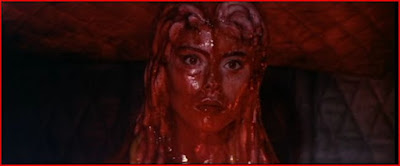
Arguably the film's best special effect is Mathilda May, the space girl. You will recall that she is hot and she's naked. She has the allure that a succubus needs to be a convincing seductress, and one of the problems with Lifeforce is that Hooper and the late Dan O'Bannon contrive to take May off the screen for much of the middle of the film.

Modes of Mathilda May. We elect to leave her less clothed scenes to your imagination.
Her hapless romantic interest, Steve Railsback, is the weakest part of the movie. He gives the sort of over-the-top performance we should like, raging and raving throughout, but there's an all-too-obvious air of desperation to his emoting, a sense that he doesn't really know what he's doing. Fortunately, Peter Firth takes much of the film's heroic weight on quite capable shoulders. In addition, Patrick Stewart screams a lot.

As a horror film, Lifeforce has numerous echoes of Dracula, more than the source novel. Carlsen is a little bit of Jonathan Harker, a little bit of Mina Harker and a little bit of Renfield, disappearing during a long journey, coming back a bit crazy and unwittingly aiding the space vampires. He and Cain and some others make up a crew of vampire hunters. The Churchill is an analog for the doomed Demeter, while the asylum where Patrick Stewart presides parallels Dr. Seward's asylum, and Stewart's character is arguably another Renfield. While Dracula sleeps in Carfax Abbey, the space girl sets up shop in a cathedral. And like the then most recent cinema Dracula, Frank Langella, the space girl seems to get away at the end. All of this almost subliminally reinforces the vampire archetype amid the sci-fi trappings. While Hooper looks back in subtle fashion, Lifeforce also contributes a new archetype, since Wendigo believes it to be the first film to feature exploding vampires.


If we're correct, you're looking at the second exploding vampire in cinema history. You can see the first in the trailer below.

Rather than let them explode, you can also kill a space vampire with a sword, as Peter Firth is studying to do here. Below, however, is a cleaner, more erotic way to be rid of the pests.

Lifeforce will most please people who turn it on looking for constant berserk action, and fans of cinematic skin will definitely appreciate Mathilda May. Wendigo suspects that many people who consider themselves vampire movie fans will dismiss this film, but as he always says, anytime anyone says something is the wrong kind of vampire, that person's the one who's wrong. Lifeforce is a film of its moment, down to the tie-in to the return of Halley's Comet, and its sexuality, of a kind hard to come by today, takes on the taboos that have always been vampire territory. Wendigo likes it better than I do, but I'll only add that it's a film that becomes easier to like with the right company to share it with.

The R-rated trailer was uploaded to YouTube by CrowTRobot1313. It lets you see more of Mathilda May and hear some of Henry Mancini's unusually muscular musical score.