Thursday, June 9, 2011

THE THIRD GENERATION (Die dritte Generation, 1979)

The title of Rainer Werner Fassbinder's satirical political thriller refers both to the three generations of the Gast family we see onscreen -- a retired grandfather with aristocratic longings, a police inspector and a terrorist -- and to what Fassbinder elsewhere identified as three generations of German terrorism. The terrorist gang we see here are presumably decadent heirs of the heritage of the Red Army Faction, aka the Baader-Meinhof gang, West Germany's counterpart to Italy's Red Brigades. I'm not sure what the second generation of terrorists was supposed to be like, unless we're meant to take the family as a metaphor for terrorism. What's definitely clear is that the third generation in either case is pretty screwed up.

After an ominous opening in which Fassbinder oh-so-slowly pulls his camera back to reveal Hanna Schygulla watching TV in an upper-floor office, we're introduced to the motley crew who make up a terrorist cell as the trigger phrase "The World as Will and Idea" compels them to converge on Rudolf Mann's spacious apartment. The trigger tips us off a little to Fassbinder's agenda. It's the title of a famous book by the philosopher Arthur Schopenhauer, a writer Grandfather Gast dismisses as one popular with people who feel they have nothing to live for. But it'd be going to far to say that our terrorists are motivated by Schopenhauer or any philosophy. They're polar opposites (perhaps intentionally so) from the devoted young ideologues of Jean-Luc Godard's La Chinoise in that Fassbinder's terrorists spend virtually no time discussing theory. In fact, the only character who seems engaged in ideological reading is a latecomer to the story whose reading of Bakunin makes him the subject of childish teasing. Whether that's because Bakunin was the arch-anarchist of the 19th century, or because the terrorists simply find intellectual aspirations contemptible is hard for me to say. But it leaves you wondering what cause they're fighting for, or if they're out for violence for its own sake.

Rudolf Mann shares his apartment with his girlfriend Ilse (Y Sa Lo), a heroin addict who seems oblivious to the allegedly revolutionary activities being plotted around her. It says something about Fassbinder's social vision that the wretched Ilse is the terrorists' link to the wider, "real" world. We're invited to see the cell through the eyes of Ilse's friend Franz Walsch (Guenther Kauffmann), a half-American ex-soldier who's having trouble joining the civilian workforce, and Franz's sidekick Bernhard Von Stein (Vitus Seplichal), the aforementioned Bakunin fan. These two join the uncomfortable troupe, but while Bernhard seems to be dismissed by everyone, Franz is eventually enticed into the group, being an almost archetypal explosives expert. But Franz isn't ready to be radicalized until he fails repeatedly to find work and Ilse finally OD's herself to death. At that point, he isn't radicalized as much as he's reduced to having nothing to live for.


Heroin is a terrible thing to waste

Franz joins up just as the revolution is about to devour its children. Left to his own devices as the gang fans out on various missions, Bernhard eventually discovers a conspiracy to make any paranoid blissful. The terrorists are planning to kidnap a businessman, P. J. Lurz (Eddie Constantine), for whom the Schygulla character works. Lurz jokes with Inspector Gast that capitalists may have invented terrorists to speed the creation of a more perfect police state -- but it turns out that Lurz wasn't joking -- or else was just toying with an ignorant cop. In fact, Lurz is paying one of the terrorists to keep the cell in operation, and to inform the inspector about their activities, without Gast knowing Lurz's full role in the drama. Now, even as the terrorists finalize plans to kidnap Lurz, dressing themselves up all too appropriately like carnival clowns and fairytale creatures, some members are being wiped out by the police. Can Bernhard catch up to his old buddy Franz and talk him out of walking into a deathtrap? Will the surviving terrorists take Lurz, and if they do, who'll actually be whose captive?...


The Third Generation is set in a world of shit. Fassbinder divides it into acts, each of which has for an epigraph graffiti or overheard conversations from Berlin's public toilets. The director hangs his portrait on an oppressive wall of sound. Nearly every scene has the sound of a TV or radio playing over it, on top of multi-character dialogues, and on top of that Fassbinder piles on Peter Raben's droning score. It actually adds a layer of reality to the cheaply shot scenes -- many of which were clearly filmed in unheated locations -- while furthering the impression that there's nothing but noise in everyone's lives and minds. Fassbinder's terrorists don't stand outside this world to prepare themselves to change it. They're completely immersed in it and embody in themselves all of its corruptions. The result is as complete a deromanticization of revolutionary terrorism as a reactionary could want -- and Fassbinder was no reactionary -- more effective than portraying them as evil masterminds or pitiless fanatics.


P.J. Lurz is ready for his close-up

Fassbinder died not long after his 37th birthday. Had he lived, he would be all of 66 years old today. His early death might be considered one of the tragedies of world cinema -- and could still be thought so -- if not for the fact that in a 13 year career he made 27 films. That's several careers of canonical directors put together, a formidable lifework with which I've just made my first acquaintance. Third Generation seems to have been a reversion to an earlier manner of guerrilla filmmaking after some international arthouse successes, but it shows a directorial eye attentive to the aesthetics of space and the subtleties of both human and camera movement. It combines dispassion and disillusion while touching the depths of Seventies pessimism and paranoia, making it an important cinematic document of its time. Fassbinder himself was arguably one of the most important directors of my favorite decade, so I expect to check out more of his filmography very soon.

Tuesday, June 7, 2011

Wendigo Meets NOSFERATU (1922)

My friend Wendigo has seen nearly ninety years worth of vampire movies, but when all is said and done, he still considers the first one the best. While he's the first one to say that the vampire(and vampire movies) can be all things to all people, he still feels that F. W. Murnau's seminal silent gets closest to the essence of the vampire -- the bogeyman in the night. The legendary Max Schreck's verminous interpretation of the role best approximates folklore's image of the vampire, and it's closer to Bram Stoker's description of Count Dracula than many people suspect or give it credit for. Just add a moustache, Wendigo says, and Schreck is Stoker's vampire come to, er, life. At least it comes closer than the evening wear and opera cape of Deane, Balderston, Browning and Lugosi. Schreck's Graf Orlok is meant to look unnatural and inhuman because the character's supposed to be inhuman, spawned as he was from "the seed of Belial."

Nosferatu, of course, is infamously an uncredited, unauthorized adaptation of Stoker's novel, a criminal enterprise in the eyes of Stoker's widow, who strove to have Murnau's film wiped from the face of the earth. But despite the Stoker superstructure Nosferatu is very much a Germanic vampire film reflecting Germanic vampire lore. It differs from the Stoker story by being set a century or so in Germany's past rather than during Stoker's approximate present. It ditches many Stoker elements like the vampire's invisibility in mirrors and his vulnerability in running water. Count Orlok casts reflections and crosses streams without second thoughts. One of the biggest deviations from Stoker, of course, is the climax, which requires a virgin sacrifice that never occurred to the Irish author. The change may have been an attempt to conceal the movie's source material, but Wendigo argues that it also brings Germanic lore to the surface to give this German film a distinctive national character.


Often imitated, never equaled

Murnau and his writers ditch a lot of characters and minimizes others -- his Van Helsing counterpart, the "Paracelsian" Dr. Bulwer, has very little to do and never confronts the vampire -- and does without a lot of Stoker's plot. There's no Lucy Westenra counterpart, for instance, and Wendigo argues that the necessity of Ellen Hutter (Greta Schroeder) -- the film's Mina Harker -- offering herself to the vampire as an attractive female renders a Lucy redundant. Orlok is in fact relatively uninterested in women; there aren't any "brides" at his castle, for instance. All of this may be meant to make Ellen's sacrifice unique, but are we to assume that Orlok hasn't attacked women -- or at least virgins -- until that point? Wendigo doesn't necessarily think so, but he does think it was important for Murnau not to show Orlok attacking other women. To make her sacrifice even more important, Orlok is shown having no other vulnerabilities than to daylight -- and this happens to be the first vampire story, Wendigo claims, to make daylight fatal to the undead. Holy symbols mean nothing to him, and he can stroll past a church with his coffin in his arms with no ill effects. That requires Murnau to minimize the role of his surrogate Van Helsing, who really seems to know no more about vampires than that they resemble venus flytrap plants.


Ellen Hutter: the original vampire fiction fan
The most important instance of Murnau's creative infidelity to Stoker for future vampire cinema is his use of Mr. Knock, his Renfield counterpart. Nosferatu is the first adaptation of Dracula, to our knowledge, to link Renfield to both Dracula and Harker by making Knock Hutter's employer and the man who arranges for Orlok's emigration from Transylvania. It also sets a pretty high benchmark for future Renfields thanks to Alexander Granach's energetically crazed performance. Next to Max Schreck, Granach is the most memorable performer in the picture. He was certainly my favorite when I first saw the film as a kid and assumed he was the comedy relief. In a different way, Gustav von Wagenheim also sets the standard for future clueless buttheaded Harkers with his giddily stupid performance as the hapless Hutter. Wendigo says that there wouldn't be as moronic a Harker until Keanu Reeves seventy years later. That's a grim tribute if ever there was one.


"Hey, Mr. Knock! You are a funny guy!"


To the present day, Max Schreck serves as a template for a certain feral subspecies of vampire. While it's tempting to give most of the credit for his performance to Murnau's makeup artists and costumers, there's a physicality to Schreck's work, to his bearing and the way he moves, that really sells Orlok's unsettling eeriness. It's no wonder that people ever since have imagined that Schreck was in fact a supernatural creature, and that an entire film could be made around that premise. But it's also unfair to the real man, who didn't do as many movies as he might or should have.


Actors aside, Nosferatu is Murnau's show, and the director's pictorial gifts make it a picture that Wendigo and I can return to constantly to discover new details or appreciate previously unappreciated nuances of composition. We most recently watched Kino's richly restored DVD, but we've like the movie ever since we first saw it on public television in battered prints that gave the characters their Stoker names. There are qualities of action and editing that generations of treatment could not obscure. Seeing a more complete version of the film with more authentic title cards is occasionally disappointing -- we missed the generic simplicity of The Book of the Vampires, that Gideon Bible of Transylvania, amid the verbiage of the book's true title, Of Vampires, Terrible Phantoms and the Seven Deadly Sins. But it was also a treat to hear the film's original soundtrack, see something like its original tinting, and watch things move at something closer to the speed that Murnau intended.


Even as a ragged, fuzzy film on TV, Nosferatu disturbed Wendigo when he first watched it, on a night when he was the only person awake in his house. He hadn't read Dracula yet and hadn't even seen the Lugosi film, so he knew the vampire only from a handful of Hammers and a few other films. Orlok was the freakiest thing he'd ever seen, not just for the way he looked but for the way he moved, whether aided by an undercranked camera or not. All of it gave him the creeps in a way no horror film had done before, especially given that he didn't yet know how the effects could work to make Orlok spring bolt upright from his coffin on the boat. If anything, the speeded-up motion of misprojected silent film added to the unsettling eerieness. It genuinely frightened him and gave him a bad dream later, and that set his standard for an effective horror film.


Wendigo finds it hard to believe me when I say that I've hardly ever been scared by horror movies, and he's asked me pointedly why I don't think a film like this is a failure if it didn't actually frighten me -- a horror film is meant to horrify, after all. In this particular case, what I appreciate is a sense of the uncanny that doesn't frighten me or have me looking over the shoulder as I leave the theoretical theater but still affects me on a level somewhere between the intellectual and the emotional. Nosferatu inspires a sense of unease that I don't equate with fear and is, if anything, augmented by a film's age and the knowledge that everyone involved is dead. Being horrified isn't the same thing as being frightened -- it doesn't fill me with a sense of personal danger or empathetic fear for the people on screen -- but it's still a profound (as in "from the depths") experience. And whether you prefer to be horrified, frightened, or simply awed by cinematic virtuosity, Murnau's symphony of terrors will probably always satisfy you.

Sunday, June 5, 2011

MONTANA BELLE (1948-1952)

After all the scandal and controversy surrounding Howard Hughes's "adult" western The Outlaw, which launched Jane Russell's career, it wouldn't have been surprising if moviegoers identified Russell with the "outlaw" label. That'd explain her casting as Calamity Jane in the Bob Hope comedy The Paleface, as well as her star turn in Alan Dwan's more dramatic attempt to showcase Russell as a western superwoman. Having done Calamity already, Belle Starr was an inevitable role for Russell, and Dwan delivers a glamorously hard-boiled Trucolor romance, surrounding his star with several suitors while almost convincing you that she's smarter and tougher than all of them.

The historic Belle Star was the prototypical gun moll, elevated after her violent death at age 40 to the status of a female Jesse James -- Wikipedia asserts that she was a childhood friend of the James boys. Where the internet reference claims that her outlaw career ended -- with the death of her husband, Sam Starr -- Montana Belle begins. In the movie, Belle is rescued from a lynching by the legendary Dalton gang and allowed to share their hideout -- the home of the Indian Ringo (Jack Lambert) -- out of respect to the late Mr. Starr.


Belle causes trouble just by being there. Her main rescuer, Bob Dalton (Scott Brady) has a crush on her, but so does Ringo's pal Mac (Forrest Tucker). The two men have a brutal fight for her favors in a barn while she looks down on them scornfully. Her sympathies, however limited, are with Mac and Ringo, who are associates of the Daltons but not really part of the gang. Left behind while the gang prepares to rob Tom Bradfield's gambling den, Belle and her new buddies believe that the Daltons have ratted them out when a posse raids Ringo's land. Barely escaping, Belle proposes that the trio get back at the Daltons by stealing a march on them and hitting the Bradfield joint before the gang does. Bradfield's been tipped off about the Dalton attack by unwashed alky informant Pete Bivins (Andy Devine) and has men waiting to nab them when they come into town, but Belle's raid takes him completely by surprise. Her little gang makes a clean getaway, while the Daltons barely escape the ambush, only to be baffled when Pete shows up to compliment their slickness, inquire about their winnings, and ask for his cut.


Jane Russell is a gangsta!


The only problem with Belle's plan was that she left Bradfield's early when she heard gunshots outside and didn't get to break into the gambler and former bounty hunter's safe. So she decides to try again -- this time by infiltrating the joint as a bottle-blonde rich widow, the Montana Belle of the title. But Bradfield (George Brent) recognizes her eyes, the only part of her face that he'd seen before, and begins to bait his own trap for her. He lets her win big at cards and convinces her to invest her winnings into a partnership in the saloon, with Mac and Ringo as her right-hand men. Answering her partners' skepticism, Belle says the place is a perfect plain-sight hideout and the setup ideal for an inside job. Their cover's nearly blown, however, when Bob Dalton reappears and recognizes Mac. To save his own neck and plan for the future, Mac convinces Bob that Belle has become Bradfield's kept woman. Bob attacks Bradfield, who proves a tough customer with his fists, and when Bob goes for his guns, Belle shoots his holsters off his belt before he can draw. To bring you up to date, Belle can ride, shoot, sing and dance; she provides the entertainment at Bradfield's as well.


The Gilded Lily (see audio below)
Belle decides that Bob has to be broken out of jail, because otherwise he might rat her out. She hints that Mac and Ringo might want to finish Bob off afterward but eventually softens toward him as she learns that the Daltons had not tipped off the posse; a random Indian had noticed Belle and Ringo shooting target practice and informed the authorities, as we'd seen in the first place. Also, Belle needs the Daltons' help for a big job: the robbery of a $1,000,000 deposit at a local bank. What she doesn't know is that Bradfield has set up the deposit as a trap, assuming all along that Belle and the Daltons had been working together all along. But he's softening toward Belle as well, as she is toward him. Once she finally confesses to him what he already knows about her, he arranges for her to cross the border into Mexico until everything blows over, but just as she tries to get out, she gets pulled back in. Given an ultimatum by the Daltons to go through with the robbery or die on the spot, she agrees in order to protect Bradfield from harm, still not realizing the lethal trap that's been set for the gang -- the trap Bradfield doesn't expect Belle to walk into....

Montana Belle is minor stuff but effectively and entertainingly executed. Originally filmed in 1948 but inexplicably shelved for four years -- this time it wasn't Howard Hughes's fault, apparently -- it's decisive proof of Russell's star power as well as an amusing interplay of shifting loyalties that leaves you scrambling to keep track of who knows what. Russell is as convincing as she needs to be as a glamorous mastermind who can take care of herself in just about any situation, and for a while the film does have you wondering which of her three suitors, if any, she'll end up with. Interestingly, all three men end up ennobled by the experience. In a remarkable sequence, Bob and Mac help a wounded Belle onto a horse for a quick escape from the ambush, then shoot their way to shelter to keep up the fight. Once out of ammo, their situation is hopeless. They respond with admirable stoicism. "Let's walk out of this town," one says to the other as they holster their pistols, before walking into the middle of the street to be gunned down in cold blood by the posse. Classic Hollywood fans may groan with the realization that somehow, at this late date, George Brent again ends up with the girl. But he's just doing his archetypal job of seconding dominant females without stealing movies from them. He's especially unconvincing as a romantic interest for Russell, and her ending up with him is a regrettable final gesture of domestication. Worse, since the Code is still being enforced, Belle has to pay for her crimes with some sort of jail term, though we should be grateful that the enforcers didn't demand her death. Montana Belle might have been a better film had it been made two decades later, but as it is it'll make eighty minutes or so pass by pretty easily if you're a western or a Russell fan.

In lieu of the actual clip of Russell singing her big song in this picture, the swaggering, finger-snapping "Gilded Lily," here's an audio recording of her uploaded to YouTube by medtner1970.

Saturday, June 4, 2011

THE GREEN HORNET (2011)

As the Green Hornet passed through numerous creative hands on its long road to the big screen, flitting from Kevin Smith to Stephen Chow and finally to Seth Rogen and Michel Gondry, it was clear that the end result would be seen as a travesty by those purists who still revere the old-time radio show, the Universal serials or the short-lived TV series. At the very least, the finished product would be different in tone from any prior version of the legend. But every new version of the Hornet has deviated from what came before, so why should the newest version be different? In fact, what surprised me when I finally took a look at Gondry's film on DVD wasn't how much it arguably desecrated the character and concept, but my ultimate disappointment that Gondry and Rogen didn't quite mess with it enough.

In a DVD interview, Rogen makes his satiric intentions as the movie's co-writer clear enough. He wanted to send up the superhero genre by grounding it in the insecurities and impulses on which much of his own comedy is based. That is, he wanted to see costumed heroes behave like "real" people, at least as he sees them. Heroes and villains alike are consumed by this core insecurity, which has its biggest impact on the relationship between Britt Reid (Rogen) and Kato (Jay Chou). In Rogen's version, both men have chips on their shoulders and issues with Britt's dead dad (Tom Wilkinson). Moreover, they both have the hots for Britt's new secretary, the amateur criminologist Lenore Case (Cameron Diaz), and that rivalry exacerbates simmering issues between the partners over their contributions to the team. All of this is well and good, and gives Gondry's movie a distinctive vibe among comic-book films. If anything, Rogen is most creative in his approach to Kato, but it's here where his comic vision seems most compromised by perceived audience expectations and the blockbuster expectations of Hollywood.


Rogen and Chou's Kato is a synthesis of different versions of the character, combining the technical wizardly of Keye Luke's Kato from the serials and, most obviously, the martial arts mastery of Bruce Lee's Kato from the TV show. As far as I know, the original radio Kato had none of these attributes, so whatever Rogen does with the character is no more a deviation from some standard than anything the serial and TV writers did. What Rogen does is to turn Kato into something of a nerd. The technical know-how (which extends from car design to coffee making) makes that plausible, but Rogen adds telling touches like a sketchbook Kato fills, not just with mechanical designs, but with drawings of hot chicks ("You pervert!" Britt says with friendly mockery) and drawings of Bruce Lee. Chou's Kato is a bit of a fanboy and a dreamer, and Britt's mad idea of a random night of vigilantism, which escalates into an even madder career as a pseudo-criminal preying on criminals, gives structure to Kato's dreams and resentments while further fueling some of them. This ambitious yet insecure Kato shouldn't be the cool creature Lee was, and for the most part Chou isn't. At the same time, he has to live up to the Lee template because -- let's face it -- Bruce Lee is the main reason why anyone would ever make a Green Hornet movie in modern times. People around the world will be seeing this film to watch an Asian guy do kung fu. So Rogen and Gondry must give the audience what they expect, but Kato's fight scenes are actually some of the film's dullest moments. The most Gondry can do to enliven them is to add video-game effects to make Kato's targets glow as he becomes aware of them in Sherlock Holmes-style analytical fight choreography. The entire logic of Rogen's concept seems to point to Kato not being as good as all that, and it makes more sense when Kato brawls with Britt in more slapstick fashion, with Chou channeling Bert Kwouk rather than Bruce Lee, or when Lenore lays Kato out with a head butt, a knee and a can of Mace. In the end, Rogen and Gondry want to eat their cake and have it too, to do their comedy but give audiences the action they expect.

Rogen's approach really fails when it comes to the villain. Christoph Waltz should have sensed something wrong when Nicolas Cage quit the role just before shooting started, but the Oscar-winner was still new to Hollywood and may have been impressed by the idea that the role of Chudnovsky would be rewritten to suit him. But Chudnovsky starts and stays lame. The idea that he's insecure in his standing as the big bad of L.A. and made more so by the appearance of the Hornet as a supposed rival, doesn't really have any payoff, because Waltz simply doesn't have much comedy to do. The idea that a hero's emergence provokes the emergence of a super-villain was done better just last year in Kick-Ass, and "Bloodnovsky," whose gimmick is simply to dress in red, is a lame supervillain. It may have been Rogen's point that he be lame, but neither he nor Waltz manage to make the lameness funny. Waltz is never as broad or over-the-top as Cage would have been, and that may be what dooms the character. The action picks up toward the end, with plenty of gags involving Kato's souped-up car and whether he incorporated any of Britt's design suggestions, but Waltz has pitifully little to do with it. You could be excused for thinking that a subordinate villain, whose villainy is secret for most of the story, was actually the big bad of the entire piece, while Chudnovsky was just a MacGuffin on legs.


As a performer, Seth Rogen clearly abhors a vacuum. Since I don't go out of my way to watch comedy, this is my first real look at him, and a little of him really goes a long way. He has an interesting persona, but he always does too much: too insistent, too demonstrative, too repetitive. He seems to need to always be saying something, but his invention doesn't match his compulsion. Overall, I can't really fault his interpretation of the Green Hornet, but I can fault his execution of it and Gondry's apparent failure to control him. The film is an interesting misfire, but still a good deal better than I expected.

Thursday, June 2, 2011

THE DEADLY AFFAIR (1966)

The Albany Public Library, already an eclectic trove of DVDs, has further endeared itself to me by beginning to acquire films from Sony's burn-on-demand library of Columbia Pictures releases. One of their first acquisitions from this growing collection gives me an opportunity to look at one of the lesser-known films of the late Sidney Lumet, who died last April. This adaptation by screenwriter Paul Dehn of the John le Carre novel Call For the Dead came to fruition just after one of my favorite periods of Lumet's long career, following such brutally intense black and white films as Fail-Safe, The Pawnbroker and The Hill. The director works in color here, with innovative cinematography by Freddie Young, but this is still a pretty dark and intense film, and in some ways perhaps Lumet's most European film.


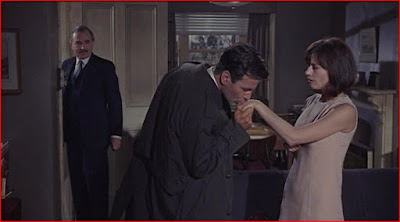
The story strikes me as standard le Carre stuff. James Mason stars as Charlie Dobbs, who we first see casually interviewing some bureaucrat in a park about his Communist past. Dobbs decides that the man is over his youthful dalliance with radicalism and recommends that he be given security clearance for a promotion. Naturally, he's stunned to learn that the man has killed himself. His superiors fear embarrassment if anyone assumes that the poor man had been hounded to death by Red-hunters, while his widow (Simone Signoret) reproaches Dobbs for doing just that. Dobbs's impression had been that theirs had been a friendly interview, but the widow, a Holocaust survivor, tells him otherwise. It's as if everyone wants to throw Dobbs under the bus for this fiasco, and just at a time when his private life is falling apart. His marriage to an apparent nymphomaniac (Harriet Andersson) has been understandably uneasy, but Dobbs has felt that it would remain bearable as long as Ann didn't fall in love with anyone else. But he soon learns that Ann has fallen in love with a protege of his from World War II days, Dieter Frei (Maximillian Schell). We appreciate Dobbs's eye for detail when he deduces the affair from the fact that Dieter kisses Ann's hand when she offered him her cheek instead. That was the act of someone with something to hide.


Dobbs may have noticed something else: the damning suicide note may have been typed on the same Olivetti machine as the anonymous letter denouncing the bureaucrat that provoked Dobbs's interview with him. Frustrated with a lack of higher-up cooperation, Dobbs resigns from the agency, while still receiving help from a friendly colleague, and hires a retired police detective, Mendel, (Harry Andrews) to do some investigating for him. Andrews had been Lumet's monster martinet in The Hill, and he's the best thing in The Deadly Affair. Mendel seems very retiring, easily lost in his hobbies and prone to falling asleep. But he has ways of getting information, and some of those are pretty brutal. After raging through the entirety of The Hill, Andrews runs hot and cold here in a tautly modulated performance, dozing comically at one moment and in another beating the snot out of a blubbery Roy Kinnear. For Lumet, Andrews in his bowler and overcoat is a special effect, an iconic silhouette and a constant promise of violence who heightens our suspense just by walking around. Lumet films Andrews's violence violently, shooting the attack on Kinnear with a handheld camera slowly advancing on the action. Poor Kinnear takes a lot of abuse in this picture. After Andrews is through with him, the mystery man named "Blondie," to whom the Kinnear character had rented his car, beats the slob some more and dumps him to his death.


Blondie had been following Dobbs around suspiciously, but the film would end too soon if he were the main menace of the picture. This is the sort of film where a suicide has to be suspect, and anyone involved with the victim -- and Dobbs -- becomes a suspect. In fact, the story resolves itself a bit too neatly for my taste once Dobbs's personal and work crises prove to be intimately related, but The Deadly Affair can be enjoyed as an exercise in style and emotional substance. I've already praised Andrews, but Mason deserves a lot of credit for making his hapless but not hopeless character credibly vulnerable and intellectually resourceful. While Andersson is something of a stereotype and Schell is little more than a pretty face, Signoret impresses with an aggressively poker-faced performance that keeps her character an enigma throughout. Somehow Lumet makes a scene that consists of nothing more than Andrews following Signoret onto a bus and through the streets of London one of the film's most thrilling episodes simply because you know what Andrews is capable of and you don't know yet about Signoret. But there's another element in that scene that bears mentioning.


What makes The Deadly Affair feel very much like a European film -- a continental film, that is -- is the soundtrack by all-American pop composer Quincy Jones. Jones and Lumet use music much like European genre filmmakers were, or would. The music is tuneful, light yet soulful, with some of the bachelor pad flavor yet restrained well short of Austin Powers-inspiring excess. Sometimes the music has an on-screen source (a record player in Dobbs's home) and sometimes its pure soundtrack. Sometimes it works as wistful counterpoint to the Dobbses' crumbling marriage, and sometimes it works to heighten suspense simply by picking up the pace in scenes like the Signoret-Andrews walkabout I mentioned above. Like many a Euro score to American ears, it sounds almost inappropriate to the story yet entrancingly atmospheric at the same time. In short, it's great stuff, and The Deadly Affair might have been more deadly (in a bad way) without it. As it is, the film is middling Lumet, coming between those harsh films of a few years before and the Seventies films from his return to America that form the core of his canon. But it's still a fine piece of craftsmanship with an overall feeling that's something more than the sum of its parts, and a fine representative of its cinematic time and place.

Tuesday, May 31, 2011

HOLY FLAME OF THE MARTIAL WORLD (1983)

Think of Chinese kung fu movies and, if you're my age, you think of the stuff that used to play on the local independent channel on weekend afternoons. This was almost always pretty mundane material: dudes punching, kicking, leaping and avenging their masters. You didn't see as much of the swordplay movies, which often got much more fantastical. In part, that's because Chinese folklore and pop culture imagine a "martial world," something like an American comic book "universe" where men and women with amazing superhuman abilities battle one another. American audiences started to get more of a feel for this world as 21st century Chinese filmmakers took advantage of modern CGI to stage their fantasies on a competitively epic scale. But they'd been trying to render those fantasies on film for decades before, and Lu Chin-ku's 1983 extravaganza shows the influence of FX-driven American films like Star Wars and Superman that opened new possibilities for heroic fantasy cinema. Movies like Holy Flame exerted their own influence on global genre cinema. The rapid cutting and frantic, dynamic wirework on display here clearly influenced Sam Raimi's early work, which would exert a further influence of its own. Holy Flame also resembles a Raimi movie in its relentless inventiveness and an overall tone bordering on delirium. It'll often seem absurd, but you won't think it's stupid -- you'll think it's crazy.

The Holy Flame is, at least as far as this film is concerned, the ultimate weapon of the martial world, the one that'll give its owner mastery over all rivals. Naturally, it's coveted by all the major factions of the realm. It's an interesting feature of this film that the Shaolin Temple is presented as just another of these factions, and nowhere near first among equals. The Shaolin grandmaster we see is, like his peers, an egotistical blowhard and a bit of a coward. The exception to the rule is the all-female Taoist order of Erh Mei, or more specifically its grand master Jing Yin (Leanne Lau). She's more ruthless and apparently more powerful than her peers, and she has a balance-tipping ally in lone-wolf menace "Monster" Yu (Jason Pai Piao). They lead the hunt for a heroic young couple who know the "creed" of the Holy Flame -- knowledge of its secret location and how to acquire it. With their infant son and daughter in tow, this pair opens the film on the run, and they are quite doomed. The children survive, however. The son is rescued through the heroic intervention of "The Phantom," aka the "Yama Elder" (Phillip Kwok), who repels Jing Yin and Monster with his overwhelming Holy Laugh. In a good humor he can summon a tempest that can rip you apart from the inside out if it doesn't dash you against some solid object. He might have destroyed the bad guys if he didn't fear harming the baby boy, whom he takes under his wing and trains to avenge his parents on a date set 18 years from now. The baby girl, meanwhile, had been thrown clear when her mother was killed, and is found by Jing Yin, who raises her as a Erh Mei nun who believes that the Phantom killed her parents.


Meet the villains: Jing Yin (Leanne Lau) and Monster Yu (Jason Pai Piao)


After teaching the boy the Holy Laugh, the Phantom sends Wan Tien Sau (Max Mok) on a mission to fetch the Holy Flame, which he'll need to take revenge on the still-more powerful Jing Yin and Monster Yu. A charismatic young minion of Monster is also on the trail of the Flame, but our hero saves his life and earns his friendship while rescuing him from some animated flesh-dissolving ghosts. After Wan gets the Flame after a lengthy battle with giant flying Chinese ideograms, he and his new pal get sidetracked when the lovely daughter of a friendly snake wrangler is kidnapped by the Blood Sucking Clan.


It turns out that too many cartoons are bad for you.


Regrettably, the Hong Kong edition of The Electric Company was cancelled due to excessive violence.

They don't do any blood sucking themselves, apparently, but use the blood of virgins to awaken a green, English-speaking undead whatsit just in time to fight the good guys -- and that's after the clan leader had brought monsters painted on banners to violent life. After much mayhem, the Holy Flame serves as a stake to take out the quasi-vampire. The snake wrangler's daughter (Mary Jean Reimer) ceases to be a helpless damsel once she gets infected by the blood from a snake bladder. As often happens in such cases, she acquires the power to shoot bolts of energy from her infected "Mighty Finger," and Phantom agrees to train her in using her new power.


At the Erh Mei temple, Jing Yin carefully guards her adopted daughter Wan Dan Fung's virginity, in keeping with the order's vows of chastity. Holy Flame is a family film, albeit an extremely violent one; there isn't the least hint of lesbianism within the Erh Mei ranks -- though as if to make up for that the young anti-heroine is befriended by the Peter Pan-like Golden Snake Boy, the resemblance consisting of "his" obvious portrayal by a woman. Dan Fung's virginity is essential because it'll enable her to read the instructions for the other Holy Flame that Jing Yin already has in her possession. The girl will be the abbess's instrument for ruling the martial world and her safeguard against whatever vengeance Phantom is planning. The masters of the other orders still don't realize that Jing Yin already has a Flame and continue to pester her for information. They end up as the comedy relief of the picture, lamely threatening the abbess by running in a circle around her, none of them brave enough to make the first attack. All the while the bored villainess fans herself while her minions complain that the other masters are leaving puddles of sweat on the floor. While this is going on, Monster sends his increasingly conflicted protege to steal Jing Yin's Flame from Dan Fung to give himself more leverage with the abbess. Despite this betrayal, the two villains team up to finally exterminate the other annoying masters.

Once Golden Snake "Boy" sets Dan Fung straight about her history, she reacquires the Yin Flame and teams up with her long-lost brother and his Yang Flame for the ultimate 18th anniversary showdown with Jing Yin and Monster. The siblings are going to need all the power they can muster, because the bad guys have developed an immunity to Phantom's Holy Laughter, making them potentially invincible. That may neutralize the old man, but the snake girl and her Mighty Finger are ready to even the odds if the villains try anything funny. The stage is set for climactic minutes of non-stop superpowered mayhem, filmed with the naive enthusiasm of a child throwing his action figures at each other and making up new abilities as he goes along.


Holy Flame powers, activate!


There's a certain childlike joy about the whole film that transcends some of its technical limitations. Wirework wasn't what it would become, and the flying characters often look out of control as they careen about the often-impressive sets. The Holy Flames themselves are very unformidable looking. In fact, they look like plastic paddles with detachable fake diamonds in the middle. But their existence is really just a pretext for special effects that are flung about with infectious glee. Holy Flame has a lot of the inventive nuttiness of more horrific contemporary films like The Boxer's Omen, without anyone vomiting snakes and worms. It also benefits from a cast of committed performers who sustain the story's fairy-tale quality. Leanne Lau, a 23 year old actress playing a middle-aged "hag," makes a great villainess, menacing and amusing at the same time in a Wicked Witch of the West sort of way. She's so charismatic that you're tempted to root for her against the comparatively bland good guys -- the better fantasy movies often leave you this option -- but you don't mind her getting a well-deserved comeuppance. This is the sort of movie that keeps you wondering what the filmmakers will come up with next, and keeps you eager to find out. Arguably a classic of its kind, it's one of the most purely fun movies I've seen in a long time.

Sunday, May 29, 2011

TRACK OF THE CAT (1954)

As a movie producer, John Wayne deserves credit for, among other things teaming up Randolph Scott and Budd Boetticher and releasing William Wellman's film version of the novel by Walter Van Tilburg Clark, whose The Ox-Bow Incident Wellman had directed a decade earlier. Wellman had made to airborne dramas for and with Wayne, Island in the Sky and The High and the Mighty, but neither those nor anything else the furiously prolific director had made over more than a quarter-century since Wings really prepares one for the in-your-face aesthetic experimentation he unleashes here. That it bears the Wayne (or Wayne-Fellows) imprimatur is perhaps even more staggering. While one can imagine the Duke taking Randolph Scott's place in Seven Men From Now, the mind reels at the prospect of Wayne playing Robert Mitchum's role in this almost freudian "psychological" western.

On the other hand, Mitchum seems to fit the weird world Wellmen and art director Al Ybarra designed for him like a glove. Something about Mitchum seemed to inspire expressionistic excess in the Fifties; Track of the Cat is one of the few films that looks like it might have taken place on the same planet on which Charles Laughton filmed the legendary Night of the Hunter. There's a deliberate artifice to Wellman's presentation that seems still more stark and more deliberate whenever he cuts from the blatant soundstage where the Bridges family lives to the tremendous, man-dwarfing wintry mountain locations where the "black painter" lurks. Without knowing too much about the production history, I presume that the stagy look of the home scenes is absolutely intentional, highlighting the theatrical exaggeration of the snowbound family drama and contrasting the stunted, stifled fate that threatens the younger Bridges children with the gigantic landscape where Mitchum, as the eldest son, hunts the cat and strives to reaffirm his mastery.


Nurture (above) and nature (below) contrasted in Track of the Cat.


The Bridges are perhaps the most miserable family presented in a Fifties Western. We're told that they're powerful ranchers and landowners, but cooped up at home for the winter they appear petty and pathetic, with only the semi-crippled Indian Joe Sam as a servant and young Gwen Williams (Diana Lynn) as a guest for the season. The paterfamilias is a drunk. The mother is a bible-reading harpy whose only concern seems to be with preserving the ranch intact for Curtis (Mitchum) to inherit. The two younger brothers and their sister seem repressed by the attention given Curtis, while Curt himself seems resentful and spoiled at the same time, lording it over his siblings but preferring to roam the mountains. The rampage of a "painter" becomes a family crisis, as Curt's brothers in turn seek to prove themselves, the youngest, Harold (Tab Hunter) torn between duty to family and desire for Gwen, who sees clearly that he'll be crushed by family pressures if something doesn't give.


A view from the grave: Tab Hunter faces a choice between love and death.


A documentary on Clark on the disc makes the novel sound more symbolically pretentious than it probably is, but the main drama of the movie is clear enough. As a spoiled heir and aggressive hunter and enforcer -- we're told he's driven numerous squatters off the ranch -- Curt has convinced himself that he's the master of his fate and capable of anything on his own. He's become a kind of incubus on the rest of the family, the parents focusing their hopes and his siblings sacrificing theirs for his sake. He intends to prove himself again by killing the cat, and seems contemptuous of brother Arthur, even after Arthur is killed by the "painter." Having borrowed Arthur's coat, Curt finds a copy of John Keats's poetry. The most use Curt finds for the pages is as kindling. He's as stunted as his siblings in some ways, but his tragic flaw is his assumption that, however dependent he's been all along on his family, that he is a lone champion and provider. But when he loses his provisions and faces the prospect of starvation, he breaks quickly, while the surviving brother, Harold, rises against the odds to both crucial occasions of his life: standing up to his mother for Gwen's sake and taking up the hunt for the cat.


The story is a little heavyhanded, portraying Curt perhaps too literally as an incubus whose departure promises to redeem his entire surviving family. But that's the kind of thematic excess that seems to go with the visual excess of Wellman's direction in both directions, from the staginess of the home scenes to the god's-eye view of the winter landscape. Wellman testified that he meant Track to look as much like a black-and-white movie as was possible for a color film. Cannily, he accentuates what he's up to by throwing in isolated bits of blazing color like Curt's red coat or the distant glow of a watchfire. He also jolts us with unexpected moments of pure pictorialism, as when he cuts from the family bringing in Arthur's body to a screen-spanning view of the monochrome quilt on which the body will lay. Cinematographer William H. Clothier does a mighty job realizing Wellman's vision, though contemporary viewers might not have appreciated the experiment.


Black and white in color


As a Warner Bros. release, Track of the Cat would have made a fascinating (or infuriating) double feature with another exercise in stylization, Victor Saville's The Silver Chalice. While the adoption of widescreen processes and the hegemony of color drove demand for heightened realism, these films defiantly and recklessly aimed for often alienating pictorial effects. Of the two, Track maintains a steadier balance between style and substance because Wellman is just too good of a classical storyteller to let the film get out of control. In the end, however, style is what makes Track stand out among Fifties westerns. While Boetticher, Mann and Daves strove for naturalistic expressionism, Wellman took the "psychological western" label seriously and tried for the best of both worlds: the abstract aesthetic of the interior world and the turbulent romanticism of western landscape. How well it succeeds is probably a matter of taste for each viewer, but the overall power of Wellman's direction and Mitchum's performance are indisputable.