Wednesday, December 14, 2011

Wendigo Meets GANJA AND HESS (1973)

My friend Wendigo is a vampire-movie fan but not necessarily a cult-movie fan. When I mentioned that Bill Gunn's notorious (and in some quarters admired) black vampire film was being shown on TCM last weekend, he confessed that he had never heard of it. Obviously a DVR appointment was in order, since for all that I'd heard of it, I hadn't seen it either. Except for seeing it on TV instead of in a theater, this would be an optimum presentation: letterboxed and uncut -- including full frontal male nudity for the finale. We could obviously have done worse. After its failed New York premiere (which followed a triumphant world premiere at Cannes), Ganja and Hess was cut down drastically, retitled several times over and marketed for exploitation. Now, however, there would be no excuses if the film failed to impress us.

From the beginning, apparently, audiences have had a hard time following Gunn's story. He had to write an angry letter to the New York Times correcting the reviewer on a fairly important plot point, and to this day the synopsis on Wikipedia doesn't quite jibe with what we saw. This is odd, since the movie spells things out pretty bluntly, and twice over at that. A set of title cards relate that Dr. Hess Green (Duane "Night of the Living Dead" Jones) has become an immortal blood drinker after being stabbed with a ritual knife from the legendary African kingdom of Myrthia. The fact of Hess's blood addiction is restated in the narration of a gospel preacher who doubles as Dr. Green's chauffeur. But some people clearly believe that what follows, the first act of the film, flashes back to how Green became a blood addict, though nothing that we can recall actually identifies the sequence as a flashback. What we saw showed Green's awkward interaction with his new assistant, George Meda (Gunn). Meda is suicidal; Green has to talk him out of a tree in one scene as a noose hangs prominently from a branch. Suicidal thoughts become homicidal as Meda does stab Green with the famous knife, but the doctor pops back up promptly. Finally, Meda shoots himself. As a puddle of blood forms beneath him, Hess hits the floor to lap up the stuff in a matter-of-fact manner. If this is his first vampiric act, he give no indication that he finds it unusual or disturbing.

Enter Mrs. Ganja Meda (Marlene Clark), who makes a dismal first impression on viewers by insulting Green's long-suffering butler and not seeming overly impatient about her husband's return from wherever he went. Where he went, she finally learns, was to Green's wine cellar freezer. By this point, Hess has already started putting the moves on the unwitting widow -- though he restricts his blood drinking to strangers whenever he hears the ancient Myrthian chanting on the soundtrack. Her shocking discovery only accelerates things. Soon enough Ganja becomes Mrs. Hess Green, and a blood drinker, thanks to Hess's work with the Myrthian knife.  It's your standard romantic-vampire eternal-love fantasy, except it doesn't last. Hess gives Ganja a boy toy to play with, but seems to lose interest in the lifestyle -- if you can call it that. He ponders over Myrthian and Christian lore in search of the secret of self-destruction and seeks the reverend chauffeur's blessing, more or less, in church. Having offered Ganja eternal life, Hess now invites her to join him in death -- whether as an ultimate proof of love or as a moral imperative, but Ganja isn't so sure....

Putting it mildly, Wendigo calls Ganja and Hess "a strange movie." He appreciates what Gunn wanted to do and admires his ambition, but he suspects that the director got caught up in an art-for-art's sake approach that didn't do justice to his story. His various cinematic tricks only made the story difficult to warm to, and his lack of real visual style makes many scenes just plain dull. Gunn is a better writer than he is a director, and his actors are clearly talented -- anyone who's ever seen Night of the Living Dead would regret how few opportunities Duane Jones got, and Wendigo remembers Marlene Clark fondly from The Beast Must Die -- but Gunn the director leaves his cast and his own script at sea. He's really not very good at composing images, however fond he is of symbolism and decorating his sets with masterworks of art. A few scenes are nicely staged, like the suicide tree dialogue, and the closing shot of a naked running man has some real power, but too often the frame seems lifeless despite the actors' best efforts. Some aspects of the film are almost inscrutable. For instance, Wendigo has no idea where the film was supposed to be taking place. Everything seems American -- especially the church scenes -- but then you hear an obviously European siren all of a sudden. Was that just some avant-garde trick or joke? That would fit Gunn's sense of his own place in world cinema. Sadly, he had a higher opinion of his craft than the film justifies; he complained to the Times that he would have been hailed as a master had he been white and European -- but had that been the case he might only have been Jess Franco. That's not necessarily a bad thing, but it probably wouldn't guarantee you a good review in the New York Times.

As a script, Ganja and Hess offered Wendigo more to praise. As always, he likes alternative visions of the vampire, and he likes that Gunn got through the film without ever calling Hess or Ganja a vampire. Since folklore gives us countless ways in which people can become vampires, Wendigo has no problem at all with the Myrthian knife backstory -- if anything, he would have liked more of that background. Speaking for myself, I'll throw in my admiration for Gunn's deromanticized approach to the vampire-seduction archetype and his denial of solace through love for his accursed protagonist. Overall, however, this vaunted artifact of Seventies cinema reminded us both to a distressing extent of Vampire's Call, the Nigerian vampire tale we reviewed a few weeks back. That was another case, albeit more extreme, of talent falling short of ambitious vision. Bill Gunn was clearly more ambitious, or at least more pretentious, than his Nigerian counterpart, but ambition, however impressive, doesn't translate automatically to realization. Ganja and Hess has to be judged by execution, not intention, and Wendigo has to judge it a failure as a film. At its worst, it struck him less as a feast for the eye than an icepick aimed at it. That may be too harsh, but on the other hand, the film has probably been given too much credit for intentions over time. If the idea of a good movie is enough for you, Wendigo might recommend Ganja and Hess to you.

Monday, December 12, 2011

Pre-Code Parade: HIGH PRESSURE (1932)

William Powell and Warren William arrived at Warner Bros. around the same time, late in 1931, and shared the lot for about two years until Powell signed with M-G-M in 1934. Watching their Warners work this month -- Powell is TCM's Star of the Month, while the movie channel did a birthday tribute to William on Dec. 2 -- you get the impression that they must have competed for a lot of roles, since they often seem to be playing the same basic type. Each did take a turn at playing the then-popular detective Philo Vance -- Powell had been playing the role at Paramount earlier -- but the snob sleuth wasn't typical of either man's work at Warners. More to the point, Warren W. biographer John Strangeland relates that W.W. at least once inherited a role from W. Powell. The Dark Horse, one of W.W.'s signature films, was originally meant for W.P., but Powell was pulled, Strangeland relates, because his presence made it all too obvious that Dark Horse was a thinly-veiled and apparently unauthorized remake, with a change of milieu, of Mervyn LeRoy's High Pressure, Powell's second film for the studio. Does that make Warren W. and W. Powell interchangeable parts? Not necessarily. Knowing the inside story, and having seen High Pressure, I can see how the Dark Horse role was more a W.P. than a W.W. part.

Powell had a sort of bipolar screen persona, embodying contradictions and swinging between extremes, especially during the pre-Code era. Even afterward, he could be typed as a detective and a master thief at the same time. He could also be the embodiment of suave sophistication and a bum. W.P could play the extremes more broadly than W.W., from the evidence I've seen. Look at The Dark Horse again. W.W.'s flunkies tout him as the master political promoter of the age, but have to bail the star out of jail before he can go to work. W.W.'s offense is non-payment of alimony, and even behind bars he's fully functional and alive with schemes, working the cons into a frenzy to make an impression on his likely new clients. Compare that introduction with High Pressure. In the earlier film Frank McHugh plays basically the same role he does in Dark Horse as the great promoter's stooge. High Pressure opens with McHugh hunting the speakeasies for his master with an uneasy Jewish businessman, Mr. Ginzburg (George Sidney) in tow. The search has already gone on a while; "Worse than a needle in a haystack is a goy in a gin-shop," Ginzburg laments. They finally find Gar Evans (Powell) in a back room, dead drunk -- I mean Weekend at Bernie's drunk. Rumpled and unshaven, Powell is an effigy of himself, something McHugh can drop on the floor when the bartender informs him that Gar has run up a tab of over $100 -- and that's in 1932 money. "We don't want to buy him," Ginzburg protests, "We just want to rent him." Powell can touch bottom in a way I haven't yet seen Warren William do. His abjection, which proves to have something to do with romantic troubles, is a kind of metaphor for the country's depressed entrepreneurial spirit. But do we want this spirit awakened?


Gar Evans is a master promoter. He whips up interest in a business venture by giving it the appearance of already-achieved success and surefire growth. Properly groomed and sharply dressed after a lengthy steambath, he becomes an embodiment of prestige. A similar function is served by his stooge Clifford Gray (Guy Kibbee, who was retained and built up for The Dark Horse), little better than a bum himself out of season but an inexplicably impressive presence in suit and toupee -- he looks presidential. With Gray as front man, with rented space in a skyscraper, a pretentious board of directors (only short a few bank presidents; they've "been committing suicide so often there's only a few of them left.") and aggressive promotion -- Evans makes ethnically-coded pitches to Italians, Jews, Greeks, etc. -- the team drives up the stock price of "Colonel" Ginzburg's Golden Gate Artificial Rubber Company -- Evans dubs Ginzburg a colonel "because you don't look like a Southern gentleman." Gar's pitches are like revival meetings as he reminds his marks of the great men skeptics laughed at like Columbus and, indeed, the Warner Brothers. The whole purpose of it all, the reason Ginzburg pours a small fortune into Evans's coffers, is to drive up the stock before the company produces any rubber from sewage through Ginzburg's miracle process, for which he depends upon an eccentric professor with a degree in chemistry from the University of Northern Jefferson at Detroit. It's a name Gar knows well -- it is, in fact, a diploma mill he ran as a racket back in the Twenties. Suddenly under pressure from the Better Business Bureau to produce rubber, and with the established rubber interests (represented by Charles "Ming the Merciless" Middleton) eager to eliminate a challenger, Gar and Ginzburg's future, and perhaps their freedom, depends on a madman....or does it?

High Pressure certainly takes a conflicted view of entrepreneurship. Gar is our undoubted hero, but he's also an arch huckster, a promoter whose efforts are disproportionate to the worth of the products he promotes. He's a con man, but Mervyn LeRoy and his writers seem to be saying that the nation may well need some of the confidence hustlers like Evans can instill. Pushing Golden Gate Artificial Rubber may be "the rummiest thing you've done yet," as Gar's long-suffering girlfriend (Evelyn Brent) says, but the movie still gives him a bluffer's chance to save Ginzburg and cash out a winner. The bluffer (so the separately-filmed French version was called) may be the archetypal pre-Code hero, be he a high-pressure promoter like W. Powell or W. William or the Groucho Marx sort who can double-talk foes into submission. There's a clear-eyed cynicism behind the bluffer's canonization, a hard admiration not for the lie, but for the risk he takes. There's also a recognition that the con man has to con himself or else become a living corpse like Powell is at the start of this picture. Today's idolaters of entrepreneurship might not see High Pressure as a flattering picture, but in its peculiar winking way its as much a vindication of the entrepreneurial ethos, almost, as Atlas Shrugged. It probably helps to have William Powell as your hero, as much one here as when he plays the unstoppable bandit in Jewel Robbery. He keeps the picture hopping, and LeRoy puts him through his paces with punchy efficiency. It's another exemplary amoral romp from the days when all conventional moral bets seemed off -- and as for whether W. Powell or Warren W. could romp amorally with more gusto, the jury's still out, and I demand more evidence.

Sunday, December 11, 2011

CITY OF LIFE AND DEATH (Nanjing! Nanjing!, 2009)

The "Rape of Nanking" has been a hot topic in Chinese cinema lately. China's official nominee for the Best Foreign-Language Film Oscar this year is Zhang Yimou's Flowers of War, a high-profile international project thanks to the participation of Christian Bale. The presence of helpful Europeans (even Nazis) in the ravaged city has made the Massacre a popular subject worldwide. The German businessman John Rabe, the equivalent for China of a righteous gentile and a minor but important character in Lu Chuan's epic, was the subject of an entire Sino-German film in his own right a few years before Nanjing! Nanjing! appeared. The Massacre has the same appeal for Chinese, apparently, that the Holocaust has for Europeans and Americans, and its recent popularity as a cinematic subject may well reflect a little "Holocaust envy," that supposed feeling of jealousy toward Jews over their having suffered the worst thing that could possibly happen to a people. It's more likely, though, that the Chinese suffer from Holocaust Movie Envy, given how City of Life and Death is visually imitative of Steven Spielberg's Schindler's List -- with a little Pvt. Ryan ultraviolence thrown in. On the other hand, filming the Nanking story in black and white makes sense, since it reproduces the immediacy of newsreels. Anyway, it's not the first Chinese film in recent times to take the monochrome approach; the more controversial Devils on the Doorstep did the same thing. Moreover, Lu Chuan's first object may not have been so much to imitate Spielberg but to answer a more recent, nearly monochrome film: Clint Eastwood's paean to the valiant Japanese, Letters From Iwo Jima. Nothing gets a Chinese riled up, I suspect, as a sympathetic account of Japan's war, and the recent spate of Nanking movies may be meant as a reminder to the moviegoing world of why Japan deserved everything it got by war's end. Chinese cinema has been unforgiving toward Japan for generations, from the stock Jap villains of kung fu films to the atrocity porn of films like Men Behind the Sun. Nanjing! Nanjing! takes the trouble to give us a "good Japanese," but he appears so exceptional that he does little to humanize the enemy in general; if anything, his example damns the majority further -- and that may be the point.


Kadokawa (Hideo Nakaizumi) is one of a number of characters, mostly Chinese of course, followed by Lu as the Japanese tighten their grip on the erstwhile capital city in 1937. We also encounter a plucky (not to mention lucky) Chinese child soldier and some members of John Rabe's Nanking staff, among others. I found Kadokawa the most compelling character simply because he wasn't just an archetype of resistance or suffering. He's not the first cinematic soldier to seem too sensitive for his job, but you can hardly blame him for his reactions -- you can blame his buddies for their complacency, their casual viciousness, their treating it all as a lark once the last patches of resistance are wiped out. By comparison, Kadokawa seemingly can't help forming personal bonds with people, especially the unfortunates, Japanese and Chinese alike, recruited or impressed into being "comfort women." A curious effect of this film is that, for all the wartime violence, which is, after all, the sort of stuff we've all seen before, what horrifies the most, more than the explosions, the hangings and the severed heads, is the treatment of the female victims. What the Nazis did for mass murder, it seems, the Japanese did for mass rape -- not so much industrializing it as systematizing it. Rape trails war everywhere, but the Japanese in World War II seem unique in apparently asserting their soldiers' entitlement to sex. Rape may have happened on a comparable scale as the Soviets drove through Germany, but we don't get the same impression of perverse order portrayed here, where the Japanese occupiers can flatly demand that the Chinese deliver up a quota of women for "comfort." The most profound moment of pathos in the picture is when, one by one, women raise their hands to volunteer so that the rest of the captive community will at least be promised food and supplies for the winter. Kadokawa encounters one of these women and, as usual, makes an attempt to be a gentleman. As usual, it's in vain. These women's experience is summed up when their naked bodies are dumped into a big wheelbarrow and hauled away by swastika-wearing flunkies. Never did the Japanese seem fitter allies for the Nazis.


Since resistance by the Chinese seemed futile at an early point, I spent the film waiting for Kadokawa to snap or rebel. The moment finally comes when it can help the child soldier and another of the main characters, and it's thankfully not overstated. It's more of a simple refusal followed by a more profound refusal. The effect remains contradictory; if Kadokawa is meant to give the Japanese a human face, the failure of the rest to emulate him, one way or the other, arguably dehumanizes them even further. But you can probably excuse a Chinese filmmaker for drawing that conclusion, history being what it is. People like Kadokawa will probably be exceptional in an army, however Chinese (or Americans, for that matter) might want to flatter themselves otherwise. That point easily gets lost in an atrocity film, the point of which is to highlight one nation's crime against another. City of Life and Death really hasn't much story to tell apart from the atrocity. Some characters survive, some don't; hence the American title. Kadokawa goes a long way toward breaking up the monotony, but viewers may find the film hard to get through just the same.


This is a stark triumph of production design and black and white cinematography, and Lu Chuan shows some mastery of widescreen composition in just his third feature. Nanjing! Nanjing! is definitely an eye-opening film for people unfamiliar with the Chinese theater of World War II and one of its vilest episodes, but it may make you avert your eyes as well. In any event, it sets a formidable standard for Flowers of War to match, and proves another compelling chapter in the global revival of World War II cinema.

Friday, December 9, 2011

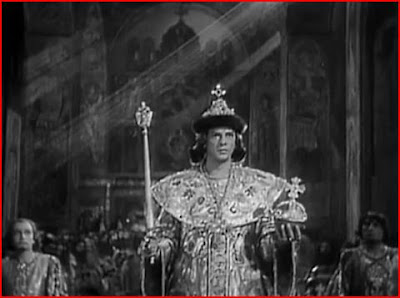
IVAN THE TERRIBLE Revisited

When I was a kid the local PBS station regularly ran the then-canonical works of early global cinema: the German Expressionist silent films and the Soviet montage movies. The station occasionally ran sound films, including the talking pictures of Sergei Eisenstein, the Soviet montage pioneer of Battleship Potemkin fame. While my memories of his Aleksandr Nevskii are, unsurprisingly, much stronger, I feel certain that I first encountered his Ivan Groznii at this time. I have stronger memories of Part I from frequent showings on A&E, way back when the cable channel took the "Arts" part of its name most seriously. Oddly, I can't remember the channel running Part II, but the sequel always lagged behind the original more than normally. As film historians know, Stalin was a big fan of Part I, but had Part II put on the shelf and halted production on Part III, mainly because the sequel seemed to make Ivan IV ("Groznii" signifies something more like "awe-inspiring" than the modern sense of "terrible") simultaneously weak and vicious while discrediting by analogy the dictator's own project of consolidating absolute power. He famously complained that Eisenstein had made the Orpichniki, Ivan's corps of enforcers, into something like the Ku Klux Klan, the complaint being phrased in a way that proved Stalin no fan of The Birth of a Nation. Curiously, the despot suppressed the film but did not destroy it, and within a few years after Stalin's demise Part II was finally authorized for release. Its world premiere came in 1958, fourteen years after Part I appeared and ten years after Eisenstein's death. Turner Classic Movies recently ran the two parts back to back, and I took advantage of the opportunity to reacquaint myself with the original and finally see the sequel in its entirety.


Part I reconfirmed my years-old impression that it was a stylistic step backward for Eisenstein after the epic power of Aleksandr Nevskii.  It's an unsettlingly mixed bag, combining some of the most brilliant and powerful images in cinema with some of the worst. Deepening his collaboration with composer Sergei Prokofiev, Eisenstein envisaged the Ivan films in operatic rather than epic terms. The performances, especially that of star Nikolai Cherkassov, are far more theatrically stylized than even the bombast of Nevskii, and Part II is very nearly a musical in its reliance on song, dance and performance. At the same time, Eisenstein, filming Part I in 1943, is still thinking like a silent film director. He too often forces gestures and facial expressions to do the work of dialogue when speech could and should have done the work better. My case in point is a painfully extended two-shot of Lyudmila Tselikovskaya as the Tsarina and Mikhail Nazvanov as Prince Kurbsky, Ivan's vacillating vassal and would-be lover of the Tsarina. Ivan himself is on the brink of death from fever, and Kurbsky is making his case for himself as her next husband and Tsar. Into the frame looms Serafima Birman as Euphrosina, Ivan's wicked aunt, who wants her idiot son Vladimir to succeed to the throne. Interminably, the three actors roll their eyes at each other, the two women on either side of Nazvanov leaning closer together to intensify their staredown, while none of them says a word. Instead of Prokofiev, the sort of sound effects you might hear on the Cartoon Network seem more appropriate at this moment. It's unnaturalistic without any real artistic compensation; Eisenstein put too much faith in the ability of facial expressions to tell the story. He might have gotten away with it in an actual silent film -- it would at least have looked less freakishly awkward. Here, however, it marks him as a director who hasn't yet caught up with the times.


Were these actors ever tempted to kill a take by turning a baleful eye on the director?
He certainly deserved it.


Fortunately, the good moments outweigh the awful in Part I, which covers more time in more episodic fashion than the sequel. The main story thread is Ivan's effort to centralize power in his hands and break the traditional power of the boyar nobility, which is shown to have crippled Russia in the face of ambitious enemies to the west and east. The main story in movie terms is Cherkassov's intensely physical performance, an extreme departure from his relatively standard heroics as Aleksandr Nevskii. The influence of two John Barrymore films on Cherkassov's look and manner -- the silent Dr. Jekyll & Mr. Hyde and the talkie Svengali, have been widely noted. The Russian actor isn't impersonating Barrymore, however; Eisenstein's inspiration seems to have been purely visual, though you could argue that Cherkassov's gradual transformation from golden youth (he was 40 when he filmed Part I) into goat-bearded, lank-limbed gargoyle echoes Barrymore's degeneration from Jekyll to Hyde. Ivan's theatricality is more justified than that of the other characters, since the Tsar is always "on," so to speak, and always playing to the farthest reaches of any crowd he finds. An absolute medieval monarch is a strangely perfect match for a director more or less committed to Communism throughout his career, but then again, look at what, or more excatly, who Bolshevism resulted in in Russia. Historical context and Hollywood influence aside, Cherkassov's performance still goes down as one of the greatest ever by a movie actor.


Part II, as I hinted, is a more concentrated narrative and more successful as drama. Eisenstein proves himself an effective if slow learner as he proves himself capable of building and sustaining tension through sound and image.  Early fears of anticlimax after Kurbsky abruptly disappears from the story (he was meant to return in Part III) are dispelled as Euphrosina makes her move to destroy Ivan and the Oprichniki in order to make a very unwilling Vladimir a pliant "boyar Tsar." Watching the story play out, I began to suspect that Stalin had been irked by the extent to which Eisenstein turns Vladimir, the Tsar's "worst enemy," into a tragically sympathetic character.


As the fool, Pavel Kadochnikov nearly steals the second half of the film from Cherkassov. As a  guilelessly infantile antagonist, he pitches the part somewhere between Harry Langdon and John Cazale, readily revealing once plied with drink that some folks are out to get rid of his pal the Tsar. "And do you know who they're going to replace you with," he asks in the one truly funny moment in the picture, "You'll never guess!" Meanwhile, the oily Ivan is cooly preparing to send Vlad to his death, dressed in Ivan's own robes to confuse the assassin known to be lying in wait. The slow buildup to Vladimir's inevitable destruction anticipates Coppola's technique in the Godfather films, much as Vlad himself somewhat anticipates Fredo. Eisenstein's use of color heightens the tension as Vladimir trembles at the exit of Ivan's exceptionally colorful Oprichnik party pit while the assassin waits back in the black and white world of the rest of the movie -- the lurid color becomes Vlad's last security at the brink of the abyss.


Better still, Eisenstein knows how to top himself. The climax comes not when Vladimir is whacked, but when his mother, having seen someone in royal robes go down, charges in to declare the country liberated, practically kicking the corpse. The director knows how to milk this for all it's worth, not letting Euphrosina discover her mistake until after the living Ivan shows himself, letting her have a moment to ponder who that might be on the floor before she goes mad from the truth. That last act leaves me leaning toward Part II over Part I as the better film, but it's still a close call. Both films have their false notes but they're probably to be expected from an unorthodox director's unconventional approach to historical drama. While all Stalinist art has been said to really have an audience of one, I think the rest of us can still find something of value in the Ivan films. Even under the thumb of the dictator, Eisenstein made movies that are unmistakably his -- and the dictator even liked one of them. Whether that's a triumph or not, history must judge.

Wednesday, December 7, 2011

Wendigo Meets THE WISDOM OF CROCODILES (1998)

Does it shock you that an American DVD distributor didn't think that The Wisdom of Crocodiles was a marketable title for a vampire movie? That's why it came out here as Immortality, which is actually, as Wendigo notes, a fairly questionable title. On cable TV Po-Chih Leong's movie has its original title back, and it was under that name that Wendigo and I saw the film for the first time last weekend.

It opens starkly with a car hanging from a tree and a narration by Jude Law recounting the time when he fell from a tree as a boy and hung desperately from a branch. On screen, Law plays Steven Grlscz ("grillsh"), who is next seen saving a distraught woman from suicide. This begins a romance consummated when Grlscz bites her neck, sending a spray of blood across a bedroom wall, and drinks her blood. He doesn't seem to benefit from it much. In some agony, he passes a strange crystal, which he saves alongside others, each matched with a woman's name. In a notebook he writes "despair."

The remainder of the film sees Grlscz close in on his next target, the asthmatic intellectual Anne (Elina "Nadja" Loewensohn), while police inspector Healey (Timothy Spall) pursues links between Grlscz and the previous victim, whose submerged body had turned up in a low tide. Grlscz does little to shake his pursuer, actually saving Healey from a street gang so he can have chats about good and evil. Meanwhile, he tells Anne that he needs not just blood to survive, but blood infused with healthy emotions like love. Without loving blood, his body will fall apart -- he already needs to wear a monitor to warn him when he forgets to breathe. The problem is how to get that right kind of blood. It seems as if he'd like Anne to offer herself freely, out of love -- but I bet we'd all like lots of things. The problem for Anne is that Steven's life does seem to be in her hands. He can't quite bring himself to just take her, and if she doesn't give herself to him, he'll die. Will love prevail? -- and should it?

Wendigo realized quickly that this wasn't the typical vampire film. Steven Grlscz isn't a folkloric or fantasy vampire; he comes without mythos, seeing himself as a genetic "mistake." He has none of the traditional vulnerabilities, freely handling crosses and wandering about by day. This makes him more of a generic predator, but also a kind of outsider by virtue of his unique condition. Wendigo recognized his profound alienation, expressed in his typical observer's stance and his habit of taking notes on things. There is no "why" Grlscz is the way he is; there's no medical mystery for us to put together and no hint of a cure. To the extent that it let you draw your own conclusions about Grlscz's condition, or his nature, Wendigo felt that the film respected our intelligence. He found it well written (author Paul Hoffman adapted his own novel), naturalistically plotted and well acted across the board. He was especially impressed by Loewensohn, who was much better here, he thought, then in her own turn as a vampire in Nadja. As this film's vampire, Jude Law gave an interesting, understated yet physically well-imagined performance. He seems to have a very clear idea of what makes Grlscz tick and how to express it to emphasize his alienation and alien-ness without submerging his natural charisma. Whether he's crouching in preparation for an attack or showing off his ability to write with one hand and draw with another, Law's every move seems carefully thought out, whether on the reptilian, mammalian or human level, as is appropriate for someone who apparently needs to will himself to live sometimes. Timothy Spall is also very good in a rare un-weaselly role with homoerotic implications -- at least Wendigo inferred some from the closeness that develops between detective and suspect.

There's no question as far as Wendigo is concerned that Steven Grlscz is a vampire. He meets the minimum criterion: he needs to feed on blood to the point of another person's death in order to survive. It doesn't matter whether he's dead or not, nor is any magical, religious or xenobiological explanation of his state necessary. Grlscz joins a long, distinguished list of fictional "living" vampires, and his lonely singularity makes The Wisdom of Crocodiles another intriguing variation on that theme.

But as the DVD distributor must have asked: what is the wisdom of crocodiles, anyway? Wendigo isn't certain of a single answer -- it could refere to Grlscz's cunning, or to the superior wisdom of predators who don't get their emotions confused, or to the supposed prevalence of the "reptilian brain" in every person. But since we all have a crocodile in us, if you believe Steven Grlscz, Wendigo leaves it to you to see the film and figure it out for yourselves.

Check out a quickie trailer uploaded to YouTube by Vanillaicecream87.

Harry Morgan (1915-2011)

The last surviving performer, in all likelihood, from many a classic Hollywood film of the 1940s, Harry Morgan could have drunk many a tontine toast like Col. Potter did in one episode of M*A*S*H. Morgan, who died today, long outlived even the memory of the radio humorist Henry Morgan, whose claim on the name obliged the younger actor fresh from Broadway to adopt the more familiar Harry to avoid confusion. He'll be remembered for his television work, particularly for the Dragnet role he re-created for Dan Aykroyd's travesty and his second role on M*A*S*H following an early guest turn as an insane racist last seen singing "Mississippi Mud." But his runty intensity made him an attraction throughout the Forties, whether as Henry Fonda's sidekick in The Ox-Bow Incident, Charles Laughton's unlikely yet mutely menacing bodyguard in The Big Clock, the easily-turned simpleton bandit in Yellow Sky, or the lame idiot conscience of Dark City. Others could name many more memorable performances in film and TV alike. They'd be enough to merit mourning for the actor even had Morgan never been promoted to Maclean Stevenson's replacement on the beloved service sitcom. He was a great character actor who might have been lost to posterity in an era thick with greatness had not his later TV success led people to recognize him in movies and discover his full range. With his passing, the golden age of Hollywood seems just a little further away.

Monday, December 5, 2011

Pre-Code Parade: the world of Warren William

Judging by his career arc, you could argue that pre-Code cinema made Warren William a star, while the coming of Code enforcement by the Breen Office late in 1934 doomed him to decline. Joining Warner Bros. late in 1931, after having briefly worked the movies nearly a decade earlier, the 37 year old William rose like a rocket through 1932 from character roles to stardom, arguably peaking in that year and remaining a top star for at least another two years before slowly descending into B-moviedom as the star of Columbia's Lone Wolf series and one of the overqualified supporting cast of Universal's The Wolf Man. Turner Classic Movies noted William's 117th birthday on December 2 (he died in 1948) with a daytime festival of his films, several of which allowed me to trace the step-by-step rise of the man many deem one of the definitive pre-Code stars.


Appropriately enough for an actor typed as a charismatic rogue, William started 1932 by virtually stealing a film from its intended star.  Archie Mayo's UNDER EIGHTEEN was designed, the publicity tells us, to launch Marian Marsh as a top-billed star. Perhaps best remembered today as Trilby, the victim of John Barrymore's Svengali (also directed by Mayo) Marsh got a high-profile push from Warners throughout 1931 as a prelude to her debut as a leading lady. In Under Eighteen Marsh is a teenager (the actress herself was just 18) scarred or scared by her sister's unhappy marriage into a precocious cynicism and a contempt for marriage, despite her boyfriend's insistence that you can't predict or assume what'll come around the corner in your own life. Her brother-in-law is a bum more interested in billiards than working, until he and his wife have to move back in with her family. Traumatized by a fight that ends with the hubby hitting her sister offscreen, Marsh takes it upon herself to facilitate a divorce by raising the necessary $200 in legal fees. Neither her boss at the clothing store (she's a seamstress) nor her boyfriend are willing to give or loan the money, so she takes a desperate chance to get the dough from Raymond Harding (William), a high-living Broadway producer who mistook her for a fashion model when he visited the store. Marsh takes the elevator to a pre-Code wild party by a penthouse pool, -- someone throws a string of pearls into the pool and practically everyone dives in after them -- is made a little tipsy, and is propositioned by William before the boyfriend (Regis Toomey) storms in and punches William in the chest. "You hit rather low," William remarks before collapsing. Disaster impends before a series of lucky cop-outs close the picture: William recovers and sends Marsh the $200 -- he had actually suffered food poisoning; the boyfriend had already decided to give her the money; and another $200 from her boss arrives moments later. But none of it is necessary: her sister and brother-and-law are reconciled after he wins more than a grand in a billiards tournament, finally proving the boyfriend's point about not presuming the worst. It's a silly finish and the film clearly deflates after William, fourth-billed here, leaves it. There's a charge, of menace or something else, between him and Marsh that is absent from her scenes with the callow, self-pitying Toomey -- the attitude seemed to come with the actor, since it cost him Loretta Young in She Had To Say Yes, a prime piece of pre-Code work in its own right in which the usually underwhelming Lyle Talbot got the girl. As for William and Marsh, Warners promptly set to work refining the chemistry that sparked briefly here.


For Roy Del Ruth's BEAUTY AND THE BOSS, released four months later, William has moved up to second billing behind Marsh, but his is really the dominant character of the film. He's Baron Josef von Ulrich, a Vienna-based captain of finance who doesn't know the meaning of Depression. We see him give dictation to his secretary, (Mary Doran) despite the distractions of her blatant beauty and her slow shorthand. Flustered, he first issues orders dictating more modest dress for his female employees, then fires Doran -- and then promptly invites her out on a date. The Baron apparently has a small dispersed harem of secretaries turned lovers -- in a running gag, one of them never seems to leave her bathtub. He wants both beauty and efficiency, but doesn't think them possible in the same package. Enter Susie Sachs (Marsh), a meek, modestly dressed little "churchmouse" who proves unexpectedly to be a superwoman of office organization who soon has the Baron's already high-powered operations running at hyperspeed. She's the woman of his office dreams and a fit mate as well, if he'd only realize that there's a beautiful woman under the drab trappings who's obviously crushing on him. His brother and uncle see it and encourage her not only to glamorize herself but to compete with her predecessors, not just by manipulating Doran out of the picture but by flirting with them. This is another giddy power romance about a nervy girl falling for an omnipotent man, and the script unleashes William, allowing him full display of what was probably his most attractive attribute during the pre-Code era: his drive. Pre-Code audiences responded to confident mastery, the ideal alternative to Depression despair, and William at his height radiated mastery, whether as an aristocratic financier or as the shadier sort of character for which he became best known. Marsh responds to his challenge with a hyperactive performance that nearly matches William's charisma. Classic horror fans will be amused by the convergence here not only of William and Marsh but also David (Jonathan Harker) Manners and Frederick (Baron Frankenstein) Kerr as William's mischievous relatives. Overall it's a highly enjoyable comedy that climaxes, I dare say, with the most symbolically orgasmic dictation of a letter the screen would see for decades to come.

Sometime in 1932, Marian Marsh dropped out, quitting Warners and heading for Europe. She worked at a slower pace thereafter and retired in the 1940s, living until 2006. But if Marsh didn't pan out for the studio, William did.

Warren William has a marvelous personality. Dashing, handsome and with a reckless gleam in his sparkling dark eyes, he wins and holds the attention of his audience, making his triumphs their triumphs, his setbacks, their setbacks.
- Dubuque Telegraph-Herald & Times-Journal, June 27, 1932.

Even when he's the unambiguous hero of the picture, there's something of the predator about William, perhaps reflecting something not necessarily predatory but survival-minded that seemed right for crisis times. There was something similar in the "hard-boiled" attitude of so many Thirties heroes and heroines. Warren was a little too flamboyant to do hard-boiled (though he did sort of play Sam Spade in a names-changed version of The Maltese Falcon) but he could do the comic mountebank, the charismatic schemer with a gift of gab, like a champion. A case in point is Alfred E. Green's THE DARK HORSE, a political comedy that proves hilariously prescient without even intending to predict the future. The film takes place in a mirror-universe U.S. in which the Democratic and Republican parties exist, but real power in an unnamed state is contested between the Progressive and Conservative parties. When the Progressive state convention is deadlocked between two candidates for governor, one faction tries to divide-and-conquer by proposing a randomly-selected supporter of their opponent as a compromise "dark horse" candidate. The other side figures out what's up, but to spite their rivals throw all their support to the dark horse, securing him the nomination. The nominee is Zachary Hicks (Guy Kibbee in his star-making role), a small-town boob who proposes abolishing capital punishment six months after the bill was signed. The Progressives despair of their predicament, but a surprisingly aggressive secretary (Bette Davis, the next "sensational discovery") has the answer. She was planted in the party office by master campaign organizer Hal S. Blake, whom she now touts as the Progressives' only hope to sell Hicks to the masses. The only thing they need to do to secure his services is bail him out of jail -- he's there for non-support of his estranged wife. The Progressives find Blake already rallying his fellow prisoners on Hicks's behalf, and he's non-stop from there. 21st century viewers will shudder with recognition when Blake tells the party that rather than hide Hicks's utter idiocy, he'll exploit it to the maximum, portraying him as an "Honest, Simple and True" ordinary joe -- a literal "Hicks From the Sticks." Fortunately, the competition is no more intelligent or scrupulous. One of the funniest moments in the picture comes after Blake has coached Hicks for his first debate by making him memorize a short campaign speech by Abraham Lincoln. If anyone recognizes the rhetoric, of course, the campaign will be screwed, but the Conservative candidate gets to speak first -- and plagiarizes from the exact same speech. While this threatens to leave Hicks with nothing to say, Blake saves the day by jumping to the podium and accusing the Conservative of blatant plagiarism. From there, the plot threads converge as Blake struggles to rid himself of the ex so he can marry the Davis character, Hicks stupidly escorts the ex into Blake's office after an assistant (Frank McHugh) had said he was out of town, and the ex ultimately plots a set-up, luring Hicks into a strip-poker game that will ruin him when tipped-off reporters arrive, if Blake can't ride to the rescue himself. Dark Horse is the best and funniest (and most pre-Code) of the films reviewed here, with Kibbee's personable moronism nearly stealing the picture from a fire-breathing William, with a dues-paying Davis providing able support. The Pre-Code Play of the film comes when McHugh is guiding Kibbee to safety after escaping the strip-poker trap. Caught in a barbed-wire fence, Kibbee's union suit is torn to bloody shreds. Fortunately, McHugh has an old-fashioned sleeping gown in a suitcase. As Kibbee slips it over his head, McHugh remarks, "Now you're sure to get the Ku Klux Klan vote!" Guy Kibbee deserves his own Pre-Code Parade float; he so convincingly establishes himself as a bourgeois bumpkin here that he got to play Sinclair Lewis's Babbitt two years later. For this one I can show you a trailer; skipjackturner uploaded it to YouTube.


Before 1932 was over Warners was loaning William out to other studios, such was the demand for his type.


M-G-M borrowed the "new idol" (as another ad called William) and top-billed him in Edgar Selwyn's SKYSCRAPER SOULS, an institutional soap-opera on the Grand Hotel model. Selwyn's film is a Deco epic in which the mighty Seacoast National Bank tower dwarfs the Empire State Building and is virtually a character in the film. William is David Dwight, the man who built the building, and while the power and position may have made William an obvious choice for the role, M-G-M seemed to miss the point of his stardom. Rather than a comedy, Skyscraper Souls is a tragedy, with some inane slapstick from Norman Foster (he keeps crashing into stuff and people) as occasional comic relief. It opens with the William character on the ropes, with added gray in his hair, and it almost immediately feels wrong. David Dwight behaves erratically, first desperately soliciting funds to save the building from creditors, then turning thoughtlessly against his own partners in a scheme to inflate Seacoast stock and sell short before its value crashes. Nearly all the characters in the picture get caught in the mania for the stock, as if they'd all forgotten what happened in real life just three years earlier, and many are ruined. Meanwhile, William must play the predator, attempting to intoxicate and seduce an office girl (Maureen O'Sullivan) while his own infatuated secretary, the girl's superior and mentor, seethes with potentially lethal jealousy. There's a pointless recklessness to William's behavior here that doesn't seem right -- the drive that animates his Warners roles is largely missing -- and the seriousness with which the picture usually goes about its business really lets the air out of the William persona. The movie's always terrific to look at, but if it proves anything it's that Warren William was one of the great comic actors of the pre-Code era. He gives a strong performance on the picture's own terms, but he's only a shadow of the Warners Warren William, while the grim climax of Skyscraper Souls may have marked the beginning of the end of his dominance of the screen. A look at William's filmography, however, suggests that some triumphs were still to come,  -- his casting as Julius Caesar in Cecil B. DeMille's Cleopatra isn't really a bad idea in context -- and I still haven't seen some of his best work from his wonder-year of 1932 like The Mouthpiece and The Match King. With luck, this won't be my last word on Warren William, and I hope I've given readers enough of a taste that they'll give him a try while I wait for my next chance.