Sunday, June 29, 2014

DVR Diary: COLLEGE HOLIDAY (1936)

Looking at Pre-Code musicals over the years, I developed the notion that Fred Astaire and Ginger Rogers saved the genre from evolving into live-action cartoons by stressing virtuoso talent rather than mass choreography a la Busby Berkeley -- often brilliant visually but always potentially soulless -- or outright cartoonish stories with little real feeling, much less romance in them. But while Astaire and Rogers certainly revolutionized musicals in their own way, as Berkeley had revolutionized and "saved" the genre shortly before, the fact remained in the era of Code Enforcement that there were fewer virtuoso performers than could satisfy the demand for musical comedy films. As a result, you still saw musicals that were essentially human cartoons. Paramount seemed to specialize in these, as they seemed most committed to using musicals to putting over radio comedians as movie stars. As a result, here is a musical, directed by Frank Tuttle with a script by many hands, headlined by a performer best known as an anti-virtuoso. Jack Benny made a running gag that lasted almost his entire long career, until he staged some serious performances to set the record straight, that he was a lousy violinist. Benny must seem an enigmatic figure today, having risen to stardom on a perceived absence of talent. The gimmick worked on his radio program, in which he made himself the butt of jokes from his supporting players. But Benny didn't bring his radio support network to this project, and that exposes him somewhat as a personality with relatively little to offer. At the time, when people knew all he wanted them to know about his character, audiences presumably got what was funny in his mannerisms. At the same time, you get the idea that any comedian could have played Benny's part: a bandleader-turned-manager of a failing resort, dodging creditors and law enforcement until an improbable patroness (Mary Boland) gives him a gimmick that can turn the place's fortunes around.

Boland was a queen of misrule in the Pre-Code musical comedy Down to Their Last Yacht and her role here has the same potential. She's Carola P. Gaye, a wealthy widow determined to bankroll the enthusiasms of her latest paramour, Hercules Dove (Etienne Giradot). Hercules is a feeble old man with a Greek fetish. He dresses in classical garb and wants to revive classical ideals of human perfection through the new science of eugenics. He and Carola take over Benny's hotel -- he runs it for the film's ingenue (Marsha Hunt) -- and hope to turn it into a breeding ground for the best specimens of American youth, recruited from colleges across the country. They send Benny to do the recruiting, accepting his suggestion that they make it into a talent search for entertainers. They are adamant, however, that the breeding not begin until all the subjects have arrived at the hotel. There, boys will be paired with girls through the oracular intervention of Hercules's daughter Calliope, whom he touts as the perfect modern woman, and for whom he seeks a suitable mate with the dimensions of the famous Apollo Belvedere sculpture. It's up to Benny to keep the college kids from necking and petting on the transcontinental train trip. He then hopes to use the kids in a modern musical revue despite Carola and Hercules's eugenic intentions.

Presumably it was up to Benny to determine the kids' suitability, and he chose a lot of entertainers. Classical standards of beauty were waived, apparently, for the darling of Corn City College (Martha Raye), whose main attributes are a loud mouth and superhuman strength. She flings heavy suitcases as if they were softballs and does a Samson stunt -- not in the script! -- during the rehearsal of a number set in a classical temple. But classical standards are moot once we are introduced, after some build-up, to the vaunted Calliope. She is none other than Gracie Allen, a peer of Benny's as a radio comic and the wife and partner of George Burns. We first see her driving a four-horse chariot on the wrong side of a California road, with George riding along in panic. I think Burns and Allen survive better today than Benny. In part that's because people today still remember Burns from the days of his very late blooming solo stardom. It's also because the couple act, or Burns's role in it, evolved and improved over time. They reached their peak on television, where Burns made himself a kind of master of reality who was in on all the gags, watched the other characters' activities on his personal TV set, and addressed the audience regularly. Here Burns is still Gracie's exasperated stooge -- though Burns probably lays on the exasperation thicker in movies than in vaudeville or radio. Even so, Gracie carries the act because, unlike Benny, who may seem like a human void, she comes across as a legit crazy woman. The crazy rather than merely scatterbrained aspect of the character is more pronounced here because of Calliope's deranged upbringing and her obsession -- she carries a tape measure everywhere -- with finding her destined Apollo.

The female comics -- Boland, Allen and Raye -- really dominate the picture and give it whatever life it has. Raye gets the best musical moment, too, belting "Who's That Knocking at My Heart" out of the park. Her performance is so powerful that you can almost forgive the goddamn blackface. Yes, Benny's big idea to draw crowds to the hotel is to stage an f'in minstel show. He doesn't blacken up himself, and George and Gracie are also spared that indignity, but Raye's big number features a disturbing moment when tricks of lighting (and makeup) allow her to switch back and forth between white and "black." Still, her song is a showstopper, and George and Gracie, assisted by Ben Blue, can't quite top it with their knockabout minuet, which is still good enough to remind us that Burns and Allen had some talent as physical comics as well. After that, Benny descends to address the audience and declare the picture closed. It simply stops rather than ending properly, but things have sorted out as you'd expect. George turns out to be Gracie's perfect Apollo after all -- since she can only ever get a "32" measurement with her tape, who can say otherwise? Carola has dumped Hercules for a Hindu swami with powers of hypnosis and an astral-body gimmick. The girl who owns the hotel is reunited with the young man she encountered fleetingly at the start of the picture -- this is Leif Erickson, whom I'm used to seeing thirty years older on the High Chapparal TV show, and whose unlined features and singing here freaked me out a little. So it's not like they didn't bother resolving the plot, but it's not like they really cared, either. I couldn't help thinking how the filmmakers might have run amok with the eugenics and Greek concepts in the Pre-Code era, though I remind myself that Search for Beauty, the film I was most reminded of, was no great shakes. College Holiday is merely silly rather than salacious, and if you're going to like it it'll be for individual performances and not as a whole. The thing barely exists as a whole without a real virtuoso -- I guess Raye comes closest -- to hold it together. It has its moments, in short, but this sort of madcap musical may already have seemed obsolete to audiences in early 1937, when it opened wide, and it definitely looks obsolete today. Not that there's anything wrong with obsolete, but it'd definitely be an acquired taste today.

Friday, June 27, 2014

DVR Diary: DILLINGER (1945)

It's hard to believe that the King Bros's poverty-row biopic, a prestige picture for lowly Monogram, was once controversial. Compared to John Milius's 1973 Dillinger and Michael Mann's 2009 Public Enemies, Max Nosseck's picture is a harshly unromanticized view of its subject, emphasizing John Dillinger's essential viciousness and pettiness as Nosseck's successors do not. The viciousness was part of the problem, however. By 1945 standards Dillinger is a very violent movie, and violence has always been crucial to movies' alleged glamorization of criminals. For those who decried that glamorization, and saw it at work in Nosseck's film, the way a gangster story was told often belied its moral. A wise old man of Hollywood saw the danger.


What gangster film doesn't want to tell the audience that Crime Does Not Pay? The proof was the dead gangster at the end of the picture. It was the same way in comic books. At the time Dillinger came out, a comic called Crime Does Not Pay was arguably the most popular title in the country. Yet crime comics were as controversial as crime movies, and for the same reason. The problem was sensationalism and violence. No matter what your ostensible message is, all the shooting and killing could make a different impression on impressionable youth. What does it matter that crime does not pay if violence becomes an end unto itself? From the time of the first crime movies, the great fear has been that violence will inspire violence, that impressionable youth will imitate what thrills them on screen. In more modern terms, Dillinger may die at the end, but while he's killing and robbing kids may find him cool.

Later Dillinger films practically invite you to find the man cool,but Nosseck's film takes more of a Crime Does Not Pay approach. As you can read above, Monogram defended its picture as "the greatest indictment of crime ever produced." And to be fair, the picture goes out of its way to portray Dillinger as a loser, a broken man in his last days, talking big briefly about forming a new super-gang but quickly deferring the event to the following year he'll never see. As played in his introductory role by Lawrence Tierney -- given unusal billing apart from the other actors and after all the other opening credits, with a fanfare of thunder and lightning - John Dillinger is a jerk who never forgets a slight, the kind of man who remembers being called a chiseler by a waiter years afterward and returns to kill the offender who had probably forgotten him within hours. He's an ingrate who bullies and eventually kills his bank-robbing mentor Specs Green (Edmund Lowe). He's kill-crazy in a way the real man really wasn't. I doubt anyone watching the film found him admirable, but some may still have enjoyed the film's violence for its own sake, tame as it is by 21st century standards.

It's tempting to treat Dillinger as a film noir since Dillinger is undone by a woman. Nosseck and writer Phillip Yordan sacrifice history to dramatic unity by making the "Lady in Red" who betrayed Dillinger in Chicago a longtime girlfriend (Anne Jeffries). She's one of his first stick-up victims, a ticket seller for a movie theater -- there's a movie motif throughout, befitting the man who met his end outside the Biograph Theater -- who's turned on by him enough to back out of identifying him in a police lineup. She proves as cynical and materialistic a customer as her boyfriend, blatantly taking up with another man after Dillinger's arrest in Tucson and finally betraying Dillinger for no other reason than the $10,000 reward money once she realizes he's washed up. In a way Dillinger starts as a Crime Does Not Pay morality play and ends up as something closer to a noir. It's telling that the film forgets its initial framing device. We open in a movie theater watching a newsreel account of Dillinger's exploits. Then an old man walks onstage and identifies himself as Dillinger's father. He explains that his son grew up like any ordinary kid, but as an adult simply never got used to the routine of doing the same thing every day. You may assume that we'll return to Papa Dillinger for the moral of the story, but the film ends with the cops' blunt inventory of the dead Dillinger's worldly possessions. On the surface this is a Crime Does Not Pay moment, but Yordan and Nosseck, or a studio editor, decided against giving anyone a definitive last word. As a result, the last we see of Dillinger is a broken man betrayed by his girl once he's used up and out of money. It looks almost as much like victimization as retribution. Rather than glorifying Dillinger, the picture makes him almost pitiable at the end. It was perhaps too subtle a statement of the Crime Does Not Pay argument for the movie moralists to recognize, and the audiences those moralists were afraid of probably only cared for the violence.

The 1945 Dillinger sets itself up as an epic with that thunder-and-lightning opening, but it falls short of the folk-epic quality of the Milius and Mann films. While the role of Dillinger made Tierney a short-lived star, and earned him a part in Reservoir Dogs nearly forty years later (his character says someone is "as dead as Dillinger"), the young actor is neither the perfect fit that Warren Oates was for Milius nor the cool icon Johnny Depp was for Mann. Tierney simply contributes a degree of brutality that was unusual and thus fresh for the time, but hasn't dated well. Nosseck surrounds him with ace character actors: Specs Green's gang includes Eduardo Ciannelli, Elisha Cook Jr. and Marc Lawrence, who are all fine, though the final scenes with Tierney and Jeffries probably have the best acting in the picture. I would say this Dillinger has value for illustrating what the culture thought of the man a decade after his death, but the controversy suggests that the culture still wasn't sure what it thought of John Dillinger. It was easier simply to treat him as a legendary outlaw the further we got away from his own time. This Dillinger also illustrates a new uncertainty about how to portray criminals in general, and that tension between moralizing and noirification will probably keep the film interesting to film buffs for as long as the categories matter.

Wednesday, June 25, 2014

Real Pulp Fiction: ARGOSY, JUNE 24, 1939

Writers to the "Argonotes" letter column were always asking when their old favorite authors would be showing up again in Argosy. There seems to have been considerable turnover in writing talent in the mid-to-late 1930s. Some of the most frequent contributors during the first half of the decade had stopped contributing. The biggest loss of all was George F. Worts, who wrote three popular series characters: the defense attorney Gillian Hazeltine, the adventurer Singapore Sammy, and fellow adventurer Peter the Brazen -- the last appearing under Worts's Loring Brent pseudonym. After 1936 Worts wrote almost exclusively for the slicks. All these characters, and others, were missed by longtime Argosy readers, but one of the most pined-for authors was the fantasy writer A. Merritt. People familiar with Merritt's work, if not his biography, might have taken him for a Weird Tales writer, but most of his best known stories first appeared in Argosy. None had appeared, however, since Creep, Shadow! had been serialized in the summer of 1934. Merritt may simply have gone dry; he certainly took on more responsibilities as editor of The American Weekly, a Sunday supplement that ran in William Randolph Hearst's papers and published many pulp authors. Considering how often readers requested more Merritt, and how fondly his past work was remembered, it must have seemed a good idea, and a way to save money, not just to reprint a Merritt novel, but to give the reprint this week's cover. Thus Argosy trumpets the reappearance of Merritt's 1927 novel Seven Footprints to Satan, at a time when many pulps preferred to boast that all stories in any given issue were new. This actually may have been useful to curious readers who, before the paperback era had really gotten under way, may not have been able to find a used copy of the novel in hardback, much less the Argosy back issues with the original serialization. Still, I can't help but see this as a gesture of weakness. The weekly had already reprinted Merritt's Ship of Ishtar, and John Buchan's The 39 Steps, the previous year. Given the Munsey company's failing attempt at brand extension and its consequences for Argosy's budget, reprints can't have been a good sign no matter how they were hyped. In any event, I intend to let Seven Footprints pass with no further notice, since my plan here has been to see how pulp writers see the world of 1939, or see the past through the prism of their present. It'll make the next few weeks easier to get through on time.


The continuing serials get quite intense this week. Walter Ripperger's Man From Madrid goes off on an eccentric tangent as the mysterious Mr. Nibbs who runs the mission for fugitives pretty much takes over this week's installment. He and his minions horn in on our hero's attempt to recover the treasure stolen from the Spanish Loyalists, Nibbs offering our man his assistance in return for one-fifth of the treasure, i.e. one million dollars. Nibbs and his stooges are fiends out of Edgar Wallace; the whole gimmick of a mission as a front for sinister doings is pure Wallace. They intend to find the stolen treasure by catching one of the conspirators -- recall that they are pretended Franco sympathizers who are really out for themselves -- and torturing him, while our hero continues to question whether his mission is worth carrying out. Meanwhile, Howard Rigsby's Voyage to Leandro really catches fire with an intense installment in which our young runaway hero is finally disillusioned with the legendary mutineer with whom he shares a desert isle. The highlight of this week's chapters, and probably of the whole serial, is a wild scene in which the drunken Jeremy Robb dares our hero's weaker, wealthier partner to drive a spike through his shoulder, to prove how tough Robb is. It reads like a scene from a Scorsese or Tarantino movie, only PG rated. It's not the most fantastical or violent moment I've read in these magazines, but it is raw pulp fiction at or near its best.


The headline stand-alone story this week is Theodore Roscoe's latest tall tale of the Foreign Legionnaire Thibaut Corday. "Corday and the Seven-League Boots" is self-explanatory, unless I need to tell you that "seven-league boots" allow you to walk vast distances at superhuman speed. Corday's unit becomes convinced that their commander has acquired such a pair of boots, but the boots become a curse as they're handed down the chain of command after each previous wearer is killed. As is sometimes the case in the Corday stories, the "real" explanation for fantastical-seeming events is more preposterous than the myth. In this case, each man who wears the boots claims to have seen exotic sights from around the world, but all turn out to have fallen under the influence of contraband opium hidden inside the soles. It's not Corday's finest hour. More entertaining is E. Hoffman Price's "Allah's Infidel," in which a white trader retrieves a rare green pearl found by his crew yet stolen by the story's villain. This is only Price's second appearance in Argosy under his own name, though the Fiction Mags index credits him with earlier work under the pseudonym Martin McCall. Over the next two years Price, who had been a mainstay of the so-called "Spicy" pulps and a rare author for those disreputable periodicals to do without a pseudonym, would be an Argosy mainstay;his career would continue deep into the 1980s. Also making his second appearance in the weekly, and also a future star writer, is Louis C. Goldsmith. He was an aviation specialist, but this week's "Shovel Skinner" deals with the dangerous work of steam shovel operators and a veteran's reluctant mentorship of a seemingly ill-qualified novice. I've read some later Goldsmith and can assure you he gets better later, though this story isn't terrible, only mediocre. In addition, Baynard Kendrick's "Standing Orders" is another relevant story set during Hitler's takeover of Austria the previous year. A closeted dissident in Wehrmacht uniform helps smuggle the final writings of a more famous dissident out of the country. Curiously, there's a strong implication that the soldier hero is not just a closeted dissident but a closeted Jew, but maybe I'm reading too much into it. Finally, Murray Leinster contributes this week's Oddity, "The Kidder," in which the best friend and girlfriend of a condemned criminal feel a mistaken need to confess to his mother their blame for his imminent death.

Next week, Voyage to Leandro concludes and we travel to the South Sea islands, the Florida Keys, the Afghan hills and dear old Chinatown. Stay tuned!

TO BE CONTINUED

Eli Wallach (1915-2014)

Wallach got a late start in movies but stayed late; his debut came at age 40 in Elia Kazan's Baby Doll. He had already made a name on stage in some of Kazan's stagings of Tennessee Williams's plays and was a member of the vaunted Actors' Studio. In an exceptional early film role he projected pure menace as a psycho hit man in The Lineup. But he soon became one of Hollywood's all-purpose ethnic types and is best remembered for playing Mexican bandits in The Magnificent Seven (he outlived all but Robert Vaughan) and The Good, The Bad and the Ugly. In the latter he defined a spaghetti-western archetype as not so much a good-bad man but a less-bad man, redeemed (at least for the audience) by an improbably likable personality. Figures like Tuco Ramirez are spaghetti westerns' audience-identification figures, more so than the godlike or too-cool heroes or the demonic (and sometimes also too cool) villains who so often seem impervious to the ordinary pains and stresses of frontier life. Tuco feels; he protests, even whines, but he muddles through, sometimes losing, sometimes winning. Even if things look bad at the end of the Leone film -- Tuco is left in the middle of nowhere with his hands tied -- you feel certain that he'll live to fight another day.

The actor always moved freely from big to small screen and back to the stage, and from the U.S. to Italy and elsewhere. His passing leaves John Astin as the last surviving male Batman TV show villain, for instance. Not every role could be memorable or good; there probably wasn't much anyone could do with the philosopher in a vat of oil in Circle of Iron, for instance. But he was always a welcome sight in movies, especially when each new appearance was proof that he still lived.  He hadn't worked since 2010 according to IMDB but I expected him to make 100 and enjoy the honors that would have been his due. The honors are coming just the same and he deserves them.

Sunday, June 22, 2014

THE GIRL ON A MOTORCYCLE (1968)

Jack Cardiff was the cinematographer for The Archers -- Michael Powell and Emeric Pressburger -- for three of their greatest films: A Matter of Life and Death, Black Narcissus and The Red Shoes. Cardiff won an Oscar for Narcissus and should have had another for Shoes. He went to Hollywood and continued to do impressive work. Just this weekend I saw his photography of The Master of Ballantrae for director William Keighley and it was spectacular. But I guess what he really wanted to do is direct. It's a common affectation of cinematographers once they get credited for the look of their directors' work. Of the many who took the step up in responsibility and prestige, arguably only Mario Bava and Nicolas Roeg transcended their cinematography as directors. But Cardiff got off to a good start and got an Oscar nomination for directing Sons and Lovers. Still, nothing he directed was on Michael Powell's level and at last, with this Anglo-French adaptation of an acclaimed French novel, it became clear that Cardiff wanted to be Powell. Here was the vehicle, for which he gets an adaptation credit, in which he would prove himself as much a visionary as his erstwhile mentor. He sure wasn't going to do that with his previous film, the badass mercenary drama Dark of the Sun, which was released the same year -- even though Dark is easily the better film of the two, and Girl is really a bit of a disaster.


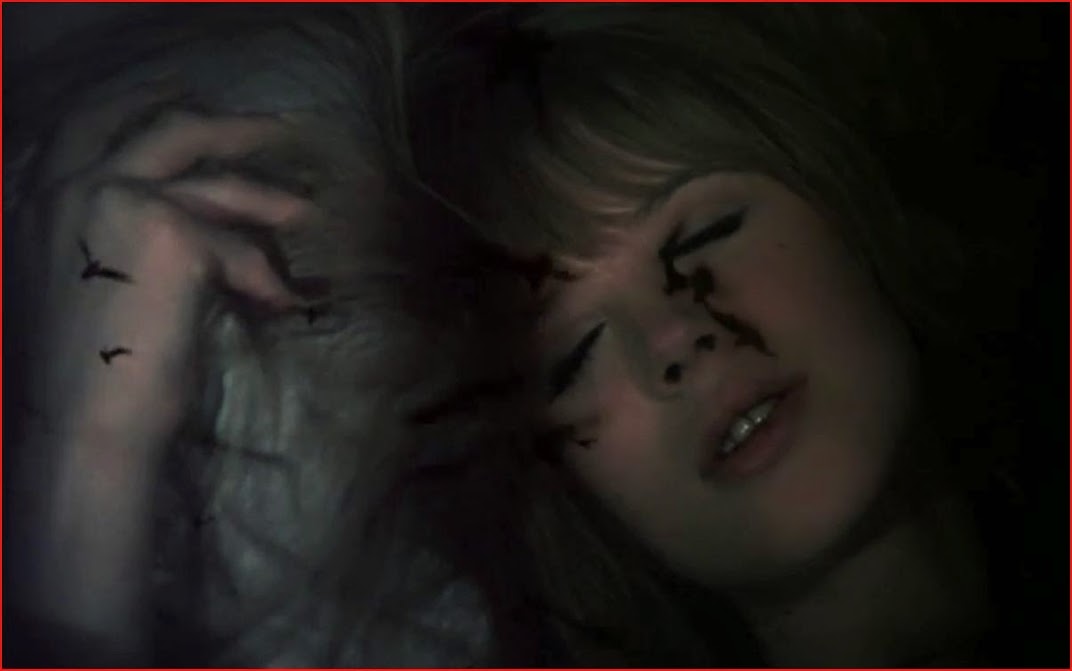
Boasting direction and photography by the legendary Jack Cardiff, Girl opens with a horrid effects shot of birds hovering over a house that's only slightly redeemed once identified as part of the title character's dream. Rebecca (Marianne Faithful) is having a restless night: she also dreams of doing a bareback act in her motorcycle costume in a circus, with Alain Delon as the ringmaster. He patiently whips her suit to shreds. Later, looking contemptuously professorial -- it turns out he is a professor -- Delon laughs at Rebecca in an abstract background. And there's solarization. Very visionary, Cardiff.


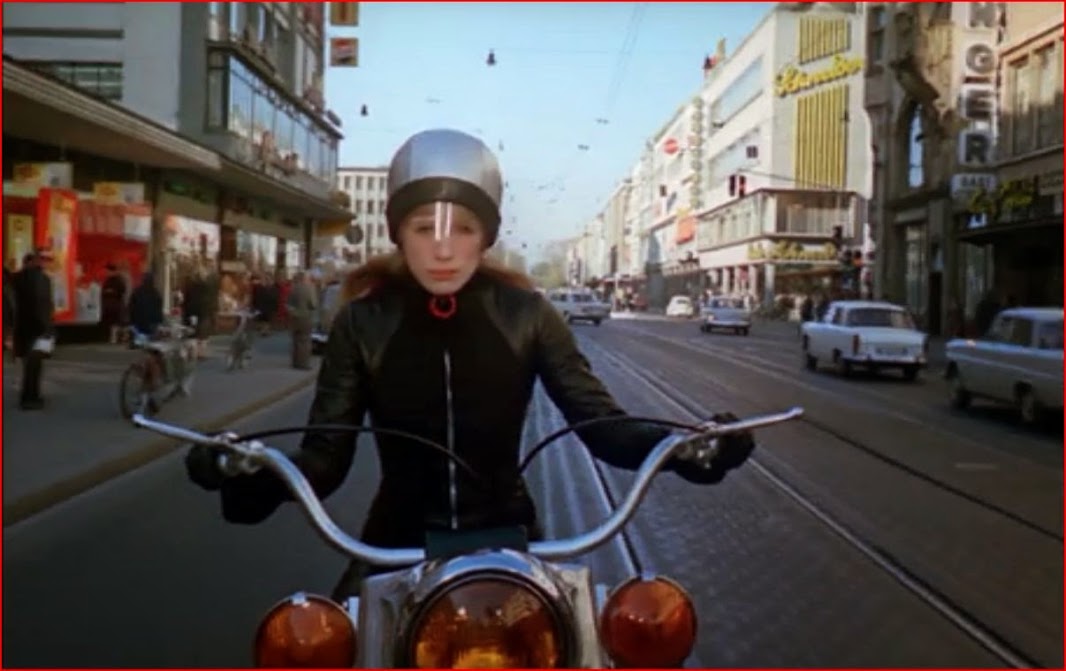
Fortunately, our auteur is on surer ground when he goes on location with the girl and the motorcycle. Rebecca is unhappily married because she pines for Delon. Compared to the sadly-named actor Roger Mutton, who plays her hapless schoolteacher of a husband, who wouldn't pine for Delon. While Mutton can't control a classroom of small boys, Delon commandingly lectures college students on the Playboy Philosophy or something along those lines. Sporting a professorial pipe, he could be teaching them Slack for all I know. The intellectuality of it all no doubt appeals to Rebecca the bookseller's daughter -- and it may be no accident that Archers icon Marius Goring plays the bookseller. Delon is extravagant, giving Rebecca the motorcycle as a wedding present. Where she got her moto-catsuit I don't know, but it looks like the cartoonist Darwyn Cooke got at least some of his ideas for his 21st-century redesign of Catwoman from Rebecca's costume. Wearing the costume, with boots and helmet and nothing else (hence the alternate title Naked Under Leather), Rebecca rides from France to Germany to reunite with Delon while indulging in voiceover monologues and flashbacks that make Cardiff's work seem a little like a caveman version of Terrence Malick. Cardiff indugles in the illusion that Rebecca is riding a motorcycle. To me it looks suspiciously like she's being towed in some shots, though that may be only to make it easier for Cardiff to show off by doing a 360 degree spin around Rebecca's head while she's riding. In other scenes, those where she and Delon must share a bike and talk to each other, or close-ups in dangerous conditions, Cardiff resorts to process shots, though he strives, with mixed success, to make them more convincing than normal. And in some long shots, the stunt rider is clearly wearing a bulkier costume than Rebecca's.  You can't help noticing these things because this is a pretentiously visionary film by a legendary cinematographer. The inconsistencies can't help but distract the mind -- but from what?


The most dated thing about The Girl on a Motorcycle is that Rebecca's plight is considered a subject for a feature film. Nearly fifty years ago I suppose her adventures did seem daring, but it's hard to imagine anyone caring even then. So she's adulterous and worries about being a nymphomaniac. What of it? What of it, indeed, given this film's dull thud of an ending, which seems to reduce Rebecca's drama to a cruel joke. In short, she's ecstatically closing the kilometers between herself and Delon, bouncing on her seat and otherwise stimulating her libido, when she's killed in a traffic accident, in slapstick fashion. Bam! Her bike hits the side of a vehicle and she goes flying. Cardiff cuts to a flying shot and a brief close-up of Rebecca's shot. Then she goes head-first through a windshield, presumably killed instantly. A VW swerves to avoid this wreck, flips and explodes. In many of the shots Rebecca's dead legs are still visible sticking out of that windshield, our heroine reduced to no more an object than the cars on the road. I suppose it put Cardiff ahead of his time, since I was reminded partly of the gruesome finish of Daughters of Darkness and partly of the comedy accident scene in Jacques Tati's Trafic -- both films from a few years later. The really funny part is imagining that Cardiff thought this numb spectacle was akin to Moira Shearer's death scene in Red Shoes. But maybe there's a moral, too? Has transgression been punished? Or, more objectively, has liberation been proved transient at best? Or should Rebecca have been wearing her helmet, no matter how white and ugly it was?


Some people may give Cardiff a pass on style-over-substance grounds, but the film's tackiness makes that difficult. Sure, many shots are as brilliant as you'd demand from Cardiff, but some show horrendous bad taste. One scene I've snipped, with Delon's privates obscured by a flower vase, looks like something Benny Hill would have come up with. For every truly gorgeous moment there's a ghastly one, at least. And throughout, we have Marianne Faithful and the unresolved question of whether Rebecca is insane or simply an idiot. Faithful will leave you guessing, if not wondering about her real self.  As for Delon, his quest for English-language stardom had taken him to strange places already (Texas Across the River, anyone?), and at least he seems to enjoy himself here. That's more than I can say for the audience.


Cardiff wouldn't work in movies again for another five years, and would direct only two more films before reverting to full-time cinematography. To this day cinematographers crash and burn when they turn into directors; Wally Pfister is the most recent victim. It's a shame that they don't get enough recognition -- or compensation? -- for their true talents. Fortunately, the very best like Cardiff are remembered for their real triumphs, while failures like Girl on a Motorcycle fade in time.

Friday, June 20, 2014

Real Pulp Fiction: ARGOSY, JUNE 17, 1939

This week's cover story is Arthur Leo Zagat's sequel to "Tomorrow," from the May 27 issue. The cover even uses the previous cover as a background image, which tells me that "Tomorrow" must have gone over big. That fact isn't flattering to Argosy readers, since you'll recall that "Tomorrow" is a fantasy about a race war waged against a presumptively white United States by a vague yellow/black coalition. It becomes more clear in "Children of Tomorrow" that the Asians run things, while the blacks -- it's unclear whether they're Africans or African-Americans -- are the foot soldiers of the occupying power. You can almost excuse a "yellow peril" fantasy in 1939 given the rising power of Japan, but Zagat's fantasy is doubly offensive because he so plainly imagines it as a race war pitting the whites against everyone else. It's pretty clear that there were no black children in the little group that found a haven in the mountains to become "the Bunch" led by our hero Dikar. In the previous story he made his first foray down from the mountain to find Americans enslaved in concentration camps by the non-white oppressors. In "Children" Dikar is back in charge of the Bunch, but his old rival Tomball -- for some reason the kids, grown up without adult supervision, call themselves by their old full names -- is behaving suspiciously, apparently trying to signal the airplanes that sometimes fly over the mountain. It develops that Tomball also knows of the occupiers below, and in his jealousy of Dikar is willing to betray the Bunch to the enemy. Dikar and his friends have to stop him from contacting the occupiers. Zagat adds an unexpected complication, allowing us to suspect that Marilee, Dikar's mate, has betrayed him in favor of Tomball, driving our hero to contemplate killing them both. That would probably have been slightly too hard-boiled or noirish for Argosy, so Marilee turns out to have been Tomball's hostage, not his accomplice. In any event, Dikar goes back down the mountain, stops Tomball, encounters a vicious black soldier, and discovers the existence of an underground resistance organization operating near the concentration camp. Dikar and his new friends must outwit the wily commander Li Logo -- almost deliberately, this sounds like no actual Asian name -- before he can begin to transform the Bunch into a ragtag resistance army. At least they start out with the rags already. The Bunch will take most of the summer off to train before returning to Argosy in September; by then there'll be a real war on.


If the "Tomorrow" stories express a sort of patriotism, Robert Cochran's "Americans are Different" expresses a different kind. Cochran has a good idea that depends on a punchline for the payoff. A disgruntled D.C. bureaucrat finds himself kidnapped by spies for an unnamed European power who are willing to pay him to acquire confidential documents, but are also willing to torture him if he won't cooperate. He won't cooperate, and ultimately the foreigners go soft on him. They can't comprehend why he's willing to endure torture and unwilling to take money to betray the government he appears to hate. The moral is that his country is one thing, his job another. After his bizarre adventure, he returns to work the next day and promptly resumes his griping. American patriotism, then, is a matter neither of unconditional love nor unconditional obedience -- but it means unconditional loyalty just the same. That's an interesting point to make at a time when Americans were struggling to differentiate themselves from totalitarians and violent nationalists around the world. Readers today would get this, I suspect.

Pulp writers aspired to write for the slicks -- the larger-format magazines on better-quality paper like Collier's and the Saturday Evening Post. Sometimes when pulp writers reached the next level they quit the pulps. In some cases, Frederick "Max Brand" Faust being a notable case, writers who cracked the slicks preferred the pulps because of looser editorial policies. Jacland Marmur, a sea-story specialist, moved freely between the two levels. His "Salt Water Hick" in this issue falls between stories published the month before and two months later in Collier's. It's reasonable to guess that "Hick" had been rejected by the self-styled National Weekly, but Marmur may have tailored the story to the market. Usually the difference between a "slick" and a "pulp" story is more romantic interest in the former to please the slicks' larger percentage of female readers. There's no romance angle in "Hick." Instead, as the title suggests, we have a fish-out-of-water situation and a neat gimmick in the hero's ingenious use of a cargo of wheat to save his ship from sinking. I like Marmur's more exotic sea stories but this was entertaining enough. The other stand-alone story this week is C. F. Kearns's "Gold at Black-Knife," featuring Two-Horse Swen, a supporting character in Kearns's more popular Handsled Burke series. It's notable for the extent to which Kearns resists the temptation to go overboard with Swen's accent. It's there, but this isn't a dialect story, and the difference matters. Kearns is less interested in writing a character who talks funny than in telling a story, which is more than I can say for some pulp writers.

On the serial front, John Stromberg's "Wild River" closes with anticlimactic notes as the hero's Red pal settles down to be a schoolteacher on the hero's grandfather's ranch, while the hero himself, predictably enough, gets the girl he'd been pining for all along. Stromberg has been critical but not condemnatory of leftism throughout; his remedy for radicalism, it seems, is that people need personally fulfilling work, though he leaves no assurance that everyone can find it. While Stromberg has made sure to season his story with action scenes, the so-called "Great American Novel of 1939" never really felt like a pulp serial. It really did seem more ambitious than that, though its appearance in Argosy, and apparently noplace else, indicates that Stromberg's ambition exceeded his talent. Meanwhile, Howard Rigsby's "Voyage to Leandro" evolves into a battle of wits and a tale of temptation as its young hero seems to befriend the mutineer he had idolized from afar while worrying over the fate of his sick companion. We learn more about the island's mystery hermit and his still more mysterious daughter, the elusive "Nautilus." This week gets us past the halfway point and the story's still developing nicely. Walter Ripperger's "The Man From Madrid" goes into whodunit mode, introducing one of those folksy policemen types that people always underestimate to solve the mystery of last chapter's killing. Our hero fears a frame-up, since he had, after all, threatened to kill the dead man, and he can't tell the truth about himself without making himself the most obvious suspect. The eccentric if not sinister Mr. Nibbs, the mission minister from last week, takes an interest in our hero and hires one of the city's top defense attorneys to keep him out of jail. Most likely he smells money, whether or not he realizes the size of the treasure our hero's trying to recover. Already we're pretty much past the Spanish Civil War political context of the opening chapters, and it looks like the story will evolve in more conventionally strange directions. We'll find out next week, when Argosy seems to raise a warning flag by giving its cover to a reprinted story. Is the mighty weekly cheaping out of us, or is it simply responding to popular demand?

TO BE CONTINUED

Tuesday, June 17, 2014

DVR Diary: WOMAN ON PIER 13 (I Married a Communist, 1949)

It's hard to imagine many Hollywood movies more reflexively reviled than this Howard Hughes agit-noir from his recently-acquired RKO studio. According to legend, Hughes tried to make participation in the project a test of loyalty for studio talent -- loyalty to himself, I suppose, as much as to the American Way of Life. In general, overtly anti-communist movies get a tougher rap from critics than the overtly anti-Nazi films of a few years earlier. This is because the anti-commie movies are perceived to target not a fighting wartime aggressor but an underdog dissident faction. Regardless of recent histories demonstrating the complicity of American communists in espionage and crimes against international communists, most people's image of an American communist, if they have one at all, is not of a terrorist gangster actively pursuing the violent overthrow of the U.S. government. Posterity has deemed the anti-red rhetoric of the scare years disproportionate to the actual threat. As a result, films like I Married a Communist are dismissed as absurdities if not offenses against truth. The fact that the film's title was changed quite quickly to the almost-pointless Woman on Pier 13 suggests that movie audiences during the actual Red Scare may have felt the same way. But rather than debate whether the film was fair to the actual Reds I want to pay attention to what the screenplay (credited to Robert Hardy Andrews and Charles Grayson) actually says and how it may belie our expectations.

I Married a Communist is a bit of a cheat title. It should have been I Married an Ex-Communist, because the object of the title, Brad Collins (Robert Ryan), quit the party in disgust more than a decade before the story starts. Since his street-fighting days as a labor agitator, Brad has risen, with the help of a name change, from stevedore to shipping executive. He's successful and just married to Nan (Laraine Day), the I of the title, when the trouble starts. Just when he thought he was out, the Reds pull him back in. Christine Norman, an ex-flame (Janis Carter) has the dirt on his Commie past, and so does the Party boss Vanning (Thomas Gomez). Since the revelations will ruin his career, and his role in a strike killing may condemn him to the electric chair, Brad must submit to blackmail. The simple part is the 40% of his salary he has to kick back to the Party. But then it gets interesting.

Brad's company is negotiating a new contract with the union. This being a Hollywood picture, the union honcho Jim Travers (Richard Rober) is a former flame of Nan's. But he's a good guy -- the most positive male character in the entire picture. He's not going to start a strike on his own; he believes in negotiation and compromise. But the Party wants Brad to precipitate the strike -- it presumably serves some international strategic purpose, since it will tie up the San Francisco docks -- by taking an intransigent stand against the union, against compromise. Here are two things worth noting. First, the right-wing propaganda of 65 years ago is different from the right-wing propaganda of today in some significant ways. Most notably, and maybe most surprisingly given Hughes's agendas, his anti-communist movie is not hostile to organized labor. In fact, as I suggested, Jim the union leader is the nearest thing to a hero after Nan herself. Meanwhile, the script seems to be telling us that employers who refuse compromise with unions are doing the Commies' work for them. Robert Stevenson directed this film at the cusp of the "Treaty of Detroit" era when management and labor agreed to share the wealth to an unprecedented extent in return for peace on the shop floor and the elimination of communist influence. 1949 was not a period of economic decline for which unions could serve as a scapegoat as they do now. Some observers might expect anti-communism in the McCarthy era -- the Senator from Wisconsin made his big splash into celebrity a year later -- to be synonymous with hostility to organized labor, but on this evidence it simply wasn't so.

While Brad reluctantly carries on his insincere negotiations, Christine jealously turns her seductive attentions to Nan's younger brother Don (John Agar), whom Brad had given a job before the trouble started. She gradually transforms Brad into a radical union agitator who shouts Jim down when the moderate leader pleads for moderation. This process apparently took longer in an earlier cut of the film, since Brad's radicalization and its role in provoking the strike is shown as part of a lengthy montage of snippets of scenes that clearly had important dialogue in them, while ominous music plays. Left intact is Brad's first introduction to communism at one of Christine's parties. This scene is as ideological as the movie gets. It tells us what the writers (if not Hughes) thought communism stood for. What it stands for, apparently, is "the scientific management of society," as one well-fed intellectual asserts. Nothing here about the proletariat or property or capitalism. An initially skeptical Brad senses that this is a form of elitism and tells his interlocutor that "I prefer democracy." So another thing missing that we in 2014 might expect in an overtly anti-communist propaganda movie is a defense of capitalism. Nothing here about "free enterprise," nor even about "freedom." The opposite of communism is "democracy." Communism, then, appears to be a political system above all, characterized by the rule of an elite justified by an appeal to science. This is actually a fair hit against Bolshevism or Leninism and the concept of necessary, incontestable leadership by a vanguard party who would do the dictating during Marx's "dictatorship of the proletariat." Sixty-five years later you may be more likely to hear someone say that democracy and capitalism contradict each other, with capitalism getting the better of the argument. 1949 was a different world.

Where the 1949 film gets most outrageous is in its portrayal of blatant gangster tactics by American communists. Some were certainly involved in the sort of labor-dispute street fighting Brad took part in as a young man, but I Married a Communist goes beyond that. Communists are shown murdering a suspected informant, in part as a way to intimidate Brad. The victim is tied up and dumped off a pier as he begs for mercy. Brad, being Robert Ryan, is unimpressed by the attempt to scare him. Later, the Communists begin to devour their own. When Don begins to get wise to how he's been manipulated, Vanning orders a hit on him. The local Reds farm out much of such work to a carny who runs a shooting-gallery concession on the pier. Eschewing the obvious, the hit man kills Don by running him over with a car. Later still, Christine threatens to turn on Vanning, but he dumps her out a high window. The film's conflicts are ultimately resolved by gunplay, Brad killing Vanning while suffering a mortal wound so he can give Nan back to Jim, from whom he took her. In history, you often hear of "purges" among the American communists, but these weren't the sort of purges you had in countries where communists controlled the state and enforced their own laws. American communists who got purged usually formed their own splinter parties, even more futile than the original party. Mine wasn't the most thorough Google search, but I found nothing indicating that American communists killed each other on American soil to enforce party discipline or to punish informants. Actual labor unions seem more likely to have done such things. American communists seem to have been more "community organizers" in the pejorative sense than men of action or the sort of hard cases who carried out revolutions elsewhere. In Russia, Stalin robbed banks and Lenin condoned it. The category error of American anti-communism was to assume that America's communists were the same sort of people, that to be a communist was to be a criminal at heart. That feeling still persists, and so I Married a Communist will not seem quite as alien or surprising in its overall attitude as I'm suggesting here -- and I must also admit that a non-violent finish would have made a weak film only more dull. But my main point remains: to be against communism doesn't mean automatically that you'll also be against other things, or for other things still. An anti-communist movie of 1949 isn't necessarily a right-wing movie by today's standards -- and it's not really a good movie by any standard. But it's very interesting as a historical document and a great example of what movies can tell us about the culture they were made in and how it differs from our own.