Wednesday, July 15, 2015

Pre-Code Parade: NOW AND FOREVER (1934)

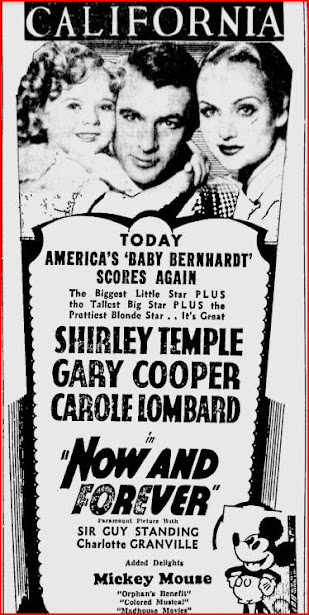
Henry Hathaway's film for Paramount opened across the country over the late summer and early fall of 1934. It was the end of the Pre-Code era and the beginning of the Code Enforcement or "Classic Hollywood" period. Its title is appropriately vague for this liminal moment. The picture was going to be called "Honor Bright," as I guessed after stars Gary Cooper and Shirley Temple had said the phrase about a dozen times over. Maybe that was still too corny for 1934, but in any event the vagueness of the final title is also appropriate for three stars -- the other is Carole Lombard -- who still weren't quite fully formed by this transitional year. You might think of Shirley Temple as a nemesis of Pre-Code, but she wasn't born that way. She was actually a creature of Pre-Code, the star of the bizarre Baby Burlesks series of short subjects, in which she often played miniature vamp types, before she hit the big time. Her transformation was under way -- Stand Up and Cheer and Little Miss Marker had come out earlier in 1934 -- but if she is virtually the Shirley Temple we know, Now and Forever is not yet a Shirley Temple picture. She got the most publicity, but Gary Cooper is the star on the title card and Lombard is billed ahead of Temple, and Hathaway dares to cut away from a Temple song and dance bit -- she performs "The World Owes Me a Living" -- to follow Cooper's more interesting activities. More importantly, the particular Shirley magic that prevails in her own star vehicles doesn't work here. Now and Forever is a last-gasp Pre-Code film not because of anything outrageous but because it resists her power to inspire (or compel) happy endings. Her spunk and cuteness does not bring a family together.

In the Pre-Code era Gary Cooper had not yet been cast as a cowboy or cowboy in modern dress. Here he is an international con man, Jerry Day, who we meet trying to con his way out of heavy hotel bill in Shanghai. Having been warned that an auditor is expected who will deal with delinquent guests, Jerry goes out to a print shop, has a business card made, and introduces himself to unfamiliar hotel staff as the auditor. They give him their ledger to inspect, and he uses it to intimidate other deadbeat guests into making settlement payments to him personally. After paying his own bill he and his girlfriend Toni (Lombard) quit town as Jerry seeks his next score. He's expecting a big payday that'll let them settle down for a while. He had a daughter by a first wife (he's a widower) now being raised by her relatives. Jerry thinks the in-laws will be glad to be rid of him for $75,000, but when he arrives at the family compound to cut the deal, he finds himself captivated by little Penelope (Temple) and decides to keep her. At first glance it's a triumph of family values but it's also further proof of Jerry's recklessly impulsive nature. That ambiguity persists as Jerry and Toni -- initially skittish but soon won over, wanting to settle down herself -- struggle to raise Penny as a good little girl. "Honor bright" is their code for truth-telling as Jerry and Penny test each other constantly.

Now and Forever dares raise the possibility that Shirley Temple can be corrupted. It's a mild corruption, admittedly, but when Jerry sees Penny conning another kid out of a pair of roller skates it's our first inkling that things aren't going to work out for this would-be family. He honor-brights her into giving the skates back, but then it's his turn to go bad again as he falls under the influence of an unsavory character who recruits him to steal a prestigious necklace from a prominent society woman. That's what he's up to while Penny sings the story of the grasshopper and the ants. Finding Penny's teddy bear in the same room as his prize, he stuffs the necklace inside the bear, assuming that it and Penny won't be searched. Getting the bear back, Penny suspects something funny but with an "honor bright" Jerry denies doing anything to her toy. When the bear falls out of her bed and the necklace pops out of its poorly sewn pocket Penny is devastated; her dad is a liar. Now Toni steps in; unable to stand the thought of Penny hating her father, she takes the blame for the robbery, but this only starts a race of renunciation that the studio originally meant to end by literally sending Jerry over a cliff. Jerry now realizes that he's not right for Penny and he arranges for her to be more or less adopted by the same society lady he'd robbed, but not before having a gunfight with the man who set him up. The film climaxes on a note of pathos as Jerry and Toni see Penny off, telling the girl that they're going very far away and won't be able to contact her for a very long time, Jerry all the while struggling to hide any evidence of the grave wound he suffered in the gunfight. Penny goes off none the wiser and oddly untraumatized by this impending long separation, and Jerry collapses in Toni's arms. Jerry's death reportedly was filmed but rejected by appalled preview audiences. Instead, the film ends with Jerry apparently recovering and assured of at least Toni's company in years to come, while Penny presumably finds her own destiny on another path.


If Cooper and Temple became avatars of goodness of different sorts soon after this, a coincidence of movie history saw Carole Lombard unleashed to go wild at the very moment of Code Enforcement thanks to the advent of her defining genre of screwball comedy. Now and Forever catches her before that happened, leaving her the least interesting of the star trio. Cooper doesn't seem like the con-man type, but if you think about it, why should con men conform to a type? In any event, his main role here is the self-aware irresponsible dad who realizes at last that he's not going to get everything he wants in life, and he plays that pretty well. Shirley Temple was simply a freak, more than holding her own against proven charismatic stars at the age of six. In its resistance to her momentum this film is like a rock against the tides, submerged repeatedly but always reappearing. Ultimately it's a movie of more historical than aesthetic interest, but its capture of a transitional moment for its stars and American cinema as a whole makes it kind of compelling to watch all the same.

Sunday, July 12, 2015

DVR Diary: THE EMIGRANTS (Utvandrarna, 1971-2)

 
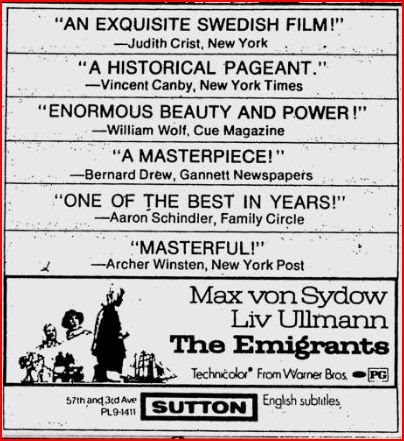
If at first you don't succeed, try, try again. Jan Troell's Utvandrarna was nominated for the Academy Award for Best Foreign-Language Film of 1971, but lost to Vittorio De Sica's Garden of the Finzi-Continis. Nevertheless, Warner Bros. saw something marketable in Troell's tale, adapted from the first in a series of Swedish novels by Vilhelm Moberg, of immigrants struggling for a better life in America than they'd endured in the old country. Warners lopped something like 40 minutes off the original running time, leaving it approximately 150 minutes long, and re-released it both with English subtitles and in a full English dub to which stars Max Von Sydow and Liv Ullmann contributed their own voices. As The Emigrants Utvandrarna became one of the few movies nominated for Oscars in multiple years, with Troell nominated for direction and his contribution to the adapted screenplay -- he also did the cinematography and editing -- and Ullmann nominated for Best Actress. There was a nomination in the main Best Picture category as well this time, but awards night was a wipeout, as 1972 was the year of The Godfather and Cabaret. Still, Warners felt they had found something in Troell, who already had a sequel ready to roll and would finally report to Hollywood to make a real western, Zandy's Bride, with Ullmann, for the studio. Well, it was the Seventies and the public was in the mood, so it was resumed, for revisionist views of the American experience. Troell was the man for the job, for if anything his portrait of his homeland, presumably reflecting the viewpoint of an author who would commit suicide at arguably the moment of his greatest global fame, in 1973, is far less flattering than what little we get of America in the final act of The Emigrants.

The early acts, set in some rural backwater, are reminiscent of the more sordid revisionist westerns made by Americans. Equally far from the Swinging Sweden of the X-rated imagination or the austere Symbolist landscape of Ingmar Bergman, the Sweden of Utvandrarna is a filthy place from which anyone in his right mind would want to escape. Farmer Karl-Oskar (Von Sydow) can't support his wife Kristina (Ullmann) and their growing brood of kids -- they argue frequently over who's to blame for the expansion -- on his rocky soil. The couple ends up leading a little band of losers and outcasts -- two brothers, one of whom is cruelly accused of making love to his heifer, as well as dissident members of a local church congregation -- across the Atlantic in a wretched, life-threatening passage. In America, they struggle to make their way to the open, fertile country, depending on one man reading phrasebook sentences to strangers in the hope of getting directions. It's here that the absurdity of an English dub becomes apparent. In this format, we get the emigrants asking their English expert, in English, to ask for directions; he asks and is answered, and the emigrants ask, in English, what the American, in English, had said. That aside, I can see why Warners went for it, especially since Von Sydow and Ullmann were by then fluent in English, though it also means that the dubbed film suffers a little from the sense that the words are spoken in a vacuum, while the obvious presence of omnipresent voiceover actor Paul Frees among the voice artists undercuts the naturalist authenticity Troell was aiming for.

Around the world, it seems, the Seventies were a golden age of cinematic naturalism, providing aesthetic justification for the pervasive mud and dysfunctional personalities of revisionist westerns and genre revisionism in general. Audiences seemed to want to see the world and its people warts and all, scrubbed clean (ironically speaking) of the romanticism of generations of genre. Before the decade was out, the rigors of such films as Utvandrarna left audiences ready for romance again, but if the squalor of Sweden wasn't alienating enough, Troell filmed the story in an anecdotal rather than dramatic narrative manner, without character arcs or film-length conflicts or courtships to tighten its focus. Perhaps appropriately, that narrative style may have made the film authentically foreign for Americans, whether they saw it subtitled or dubbed. In any event, audiences were more adventurous then, or so we think when idealizing the Seventies, and Troell's grim chronicle is convincing and compelling enough to make me eager to see The New Land, the sequel, at some point. More immediate on my agenda, however, is a TCM showing later this month of Zandy's Bride, which should make for interesting comparisons if nothing else. Watch for a DVR Diary review, coming soon to this blog.

Friday, July 10, 2015

Omar Sharif (1932-2015)

 
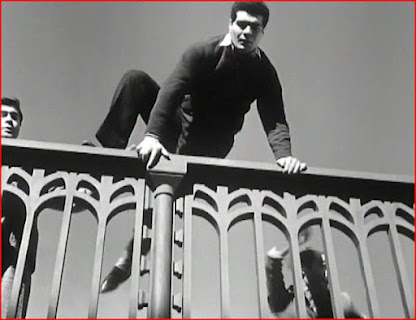
Sharif had the sort of career that may be impossible today. In the 1960s the Egyptian became the all-purpose ethnic type par excellence. His like hadn't been seen since silent movies. From then to his time there had been plenty of all-purpose ethnics, but most of them were character actors. Eli Wallach was a late example of this sort. Sharif was an all-purpose ethnic leading man, as he had been a leading man in Egyptian cinema (as in Man in Our House, above) before David Lean called him to glory. Lean did the obvious thing and cast Sharif as an Arab in Lawrence of Arabia, and then did a more daring thing and made Sharif the lead in Doctor Zhivago. He was a Russian in a film where the other principal Russians were played by English or American actors. From that point he was all over the place. In the same year as Zhivago he played Genghis Khan. During the remainder of the decade he played a German officer (in an American film), a Spaniard (in an Italian film), a Jewish-American, an Austrian prince, a Mexican bandit, an Italian lawyer, and Che Guevara. Any part other than a black man or an outright WASP seemed open to him. At his peak, Sharif was an embodiment of the globalization of cinema, but that may have undermined his credibility over time. He may have seemed deracinated, a kind of artificial person, the more he became an exemplary citizen of cinema. In later life he was reduced to "authentic" Arab roles, for Americans most prominently a decade ago in Hidalgo. Would his sort of chameleonic versatility be permissible today? Most likely not on his scale. We're inconsistent in our desire for authenticity. The more fantastic we get the more permissive and "inclusive" we become. Certain ethnicities probably would have been off-limits to him, either on aesthetic principles or because he would otherwise be depriving a more appropriate actor of a paying job. He might have been allowed to play a Norse god or do Shakespearean roles, but if he did Mackenna's Gold or Che! today he'd probably be picketed. It's disheartening to imagine a young Sharif today typecast as a Muslim terrorist (he was born Christian), yet that most likely would have been his fate without the daring of a Lean who could see him, as most directors see Englishmen, as more than his ethnicity. In his peak years Sharif's versatility and success surely seemed progressive. His passing leaves us wondering whether we've progressed much further since then.

Wednesday, July 8, 2015

DVR Diary: THE TOLL OF THE SEA (1922-85)

Chester M. Franklin's film was neither the first color feature nor Anna Mae Wong's film debut, but its place in history depends on its early use of both Technicolor and Wong. It's not just a technological milestone but a document on race relations spotlighting a pioneer Asian-American actress. Wong was only 17 when Toll of the Sea came out, making male lead Kenneth Harlan a transgressor by modern standards as well as one, for different reasons, by the standards of his time. The story, by future Oscar winner Frances Marion, is kin to stuff like D. W. Griffith's Broken Blossoms in its presentation of a sympathetic Oriental as an object of pathos. It's more obviously kin to Madame Butterfly in its portrayal of an American who loves and leaves an Asian woman. The redundantly named Lotus Flower (Wong) gets Harlan virtually dumped in her lap when he washes ashore without explanation in her coastal village. He's handsome, she's pretty, and in 1922 Hollywood lets nature take its course. Inevitably the white man's idyll must end and he must take up responsibilities, including marriage, back home. He must leave Lotus Flower, and their son (who takes after the father) behind with a blithe promise of his eventual return. Lotus Flower's faith in that promise, and her hope that he'll take her to America with him eventually, makes her something of a laughingstock in her village, where one woman boasts sardonically that she's been forgotten by four American husbands already. LF doesn't help her situation by writing fake letters to herself to read to her boy, in which "hubby" boasts of his success and promises anew to return. Who's laughing now, however, when Harlan does return? Unfortunately, he's brought his wife along with the thought of making a clean breast of everything to both the women he's loved. Naturally, LF is crushed, but selflessly she seeks to avoid further embarrassment for Harlan by denying that the little white kid who clings to her is her (and thus his) son. He's the kid of the neighborhood missionaries, she says -- but Mrs. Harlan (Beatrice Bentley) isn't buying that. Fortunately, she's a good sport, and the film, to its credit, emphasizes that both women are good women whose natural empathy allows the American to understand the truth without rancor. The right thing to do seems to be for LF to turn the boy over to the Harlans, her noble lie now being that she was only ever his nurse. That done, we come up against the title of the film. The white man had been the sea's gift to Lotus Flower, and now she must pay the sea's toll with her life. In the new footage shot in 1985 (with 1922 tech) to replace a missing final reel, we have tasteful shots of the ocean waves and a title card explaining what LF is going to do. I don't know whether the original ending was as tasteful, and in any event this resolution can't help but be distasteful by modern standards.

In its own time I suppose the film was progressive in its solicitation of sympathy for a Chinese girl, though it is also inescapably condescending toward her naivete, which extends to her antiquated notion of American fashion. But insofar as Toll of the Sea is a tearjerker and a textbook example of silent-era pathos, it exposes the complacency behind pathos. Whether it's the hopeless dream of a Chinese girl or the hopeless dream of a tramp, the point of pathos seems to be: you don't have a chance; you never can; you never will. Pathos stands quietly weeping at the insurmountable social barrier separating otherwise deserving heroes and heroines from their due. There may have been something realistic about it, but it's the sort of realism that often takes too much for granted. It's one thing to pity Lotus Flower, as 1922 audiences certainly did, and another, most likely, to think she deserved better and should have demanded it. It's the difference between watching this and thinking it's sad and watching it and thinking it's wrong. That Marion and Franklin didn't necessarily intend the latter response doesn't make Toll a bad film --especially given Wong's precocious star quality and the spectacle of its blazingly restored (or enhanced) Technicolor -- but it does mean they could have made a better one, morally if not aesthetically. But if you concede that they could do no better back then, I suppose that only adds to the pathos of the thing.

Sunday, July 5, 2015

DVR Diary: THE GREAT LOCOMOTIVE CHASE (1956)

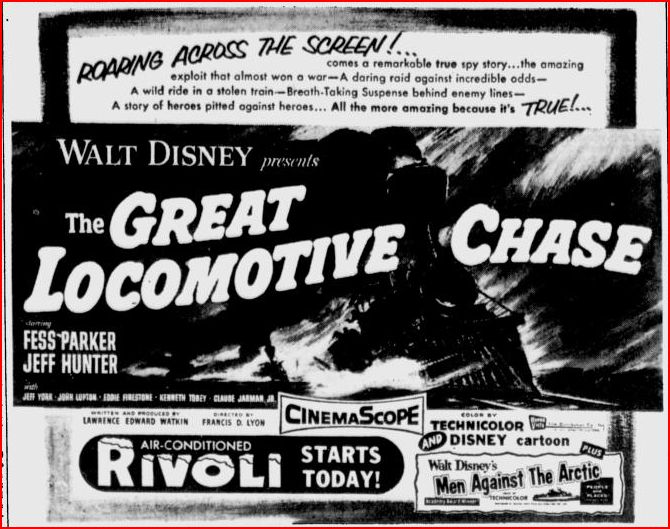
Walt Disney was a notorious political reactionary, but at least he knew which side was the right side in the Civil War. By comparison, Buster Keaton, who made arguably the greatest film set in the Civil War, once said it was hard to make the Union the good guys in that setting. His thinking seems to have been that the Confederacy was the archetypal underdog battling gallantly against overwhelming force, and that no one wants to root for the overwhelming force. In Keaton's defense, The General is no brief for the Confederacy; you root for Buster as the Reb hero because he's one guy against overwhelming odds, not out of any belief in states' rights or the goodness of slavery. Disney's Great Locomotive Chase, directed by Oscar-winning editor Francis D. Lyon and a product of an era when "Disney live-action film" meant "cool adventure movie" rather than "tasteless pabulum for the whole family," is a mirror-universe version of The General, based on the same historical events but choosing the Union men who stole the train known as The General as its heroes. While Walt's heart was in the right place, it's still a strange decision because Lyon ended up making a film about failure. This time we see that the Union team led by James J. Andrews (Fess Parker) went up against overwhelming odds themselves, and lost.

It must have been a worrisome film for Parker, Disney's Davy Crockett, to make so soon after seeming to become a superstar, because it must have seemed as if Disney was typecasting him as a doomed hero. More worrisome still may have been the way Jeffery Hunter, in effect playing the Keaton role, not only steals the train back but quite nearly steals the film from Parker, as if to prove that Keaton's choice of hero was more dramatically correct if not politically correct. Using the character's real name, William Fuller, rather than Keaton's Johnnie Gray, Hunter plays it straight and more realistic, yet with some of Keaton's indomitable determination. Keaton was making a comedy that is also arguably the first action movie as we understand the concept today, and it was important in both respects that he retake his train alone. As Fuller, Hunter has help every step of the way, but is the indisputable leader and motivator of his little band. He's at his most Keatonesque early on in the chase, when he initially, madly goes after the General on foot until he and the men trailing behind him find a handcar. The film as a whole is often Keatonesque in its commitment to authenticity -- Disney sent Lyon down to the actual historic locations in Georgia -- and an aversion to fakery for the most part. The history simply lends itself to a certain epic manner of filmmaking, but while Keaton made it into a comic epic Disney, Lyon and screenwriter Lawrence Edward Watkin made a thriller undermined by that same history, lurching from suspense to suspense as the Union team is nearly exposed or fails yet again to thwart Fuller's pursuit, until it succumbs to cumulative anticlimax, while Keaton used the actual events as a springboard for advanced slapstick.

Shackling themselves to history, the Disney team must give up the locomotive chase with something like a half-hour left in the picture. We're set up to expect a desperate escape back to Union lines, but Parker's whole gang is promptly captured -- most of them, including Parker himself, offscreen. The film then builds toward a mass prison break that serves only to resolve the character arc of a supporting player -- Jeff York apparently was cast in this role because he'd been Mike Fink to Parker's Crockett -- and while the idea is for Andrews and the other guy to give the others time to flee, most of them -- though not the relatively dull fellow who narrates the story and receives one of the first Medals of Honor -- are rounded up offscreen and herded back to prison to be hanged. It was all worthwhile, we're told at the end, because it diverted Confederate troops to railroad guard duty, but the film leaves you with not so much an appreciation of heroic sacrifice as pity for Andrews and the other losers. The film's self-defeating quality, its many pictorial virtues notwithstanding, leave you wondering whether Disney, eager as a train enthusiast to make a film about the chase, felt he couldn't make Fuller the hero because he thought Keaton might have been able to sue. In the end, historical accuracy is the only advantage Great Locomotive Chase has over The General. The later film can't help but look like a rough draft of the former, despite Technicolor and Cinemascope, in part because Keaton was so far ahead of his time as an action filmmaker but also because, thirty years before Disney, he had already remade tragedy as farce.

Friday, July 3, 2015

Too Much TV: iZOMBIE (2015-?)

DC Comics' conquest of broadcast television has been a multipronged assault. After establishing a beachhead for mainstream superheroes with Arrow, and while The Flash and Gotham consolidated that front, the comics empire tageted the supernatural audience with characters identified with its more adult Vertigo imprint. First came the unjustly neglected and canceled Constantine, featuring a character who's bounced between Vertigo and DC proper since Alan Moore created him. Infinitely better than the Keanu Reeves movie by virtue of Reeves' absence, the TV Constantine suffered from its placement in the genre death zone of Friday night; NBC had tried a Dracula show in the same slot the year before and failed. The CW was more careful with its Vertigo show, debuting it in the spring with the already-established Flash as its lead-in on Tuesday night. In another respect CW was more reckless. iZombie can at most claim to be inspired by the comics series written by Chris Roberson and drawn by Michael Allred. The inspiration extends this far: like the comics, the show features an attractive, sentient zombie who acquires the memories of the people whose brains she eats. I've only browsed at the comics, and I'm glad for that because I had no cause for prejudice when TV creator Rob Thomas (of Veronica Mars fame) departed so nearly completely from the comics concepts. The iZombie comics take place in a full-scale supernatural demimonde, in which the heroine shares an apartment Being Human style with a ghost and a friendly lycanthrope -- or canithrope, I guess, since he's called a were-terrier. Right there I think the comics were getting a little whimsical for my taste. By stark contrast, Liv Moore (former Power Ranger Rose McIver) -- that isn't even the comics character's name, though it should have been! -- and the fellow zombies she eventually encounters are, so far as we know by the end of the first season, the only monster phenomena in their city of Seattle. That seems appropriate; the modern-day flesh or brain-eating zombie is usually a phenomenon unto itself rather than part of any paranormal fantasyland, the better for the zombie horde to serve as metaphor for societal breakdown or something likewise relevant to the world we live in. Early ads offered Liv as "the face of the zombie apocalypse," and the show presents Seattle as Ground Zero, or more accurately a Ground Zero waiting to happen. The show's masterstroke is this slow-burn approach to its metaplot. Things seem anything but apocalyptic, but as the show marches on the feeling grows that one false move could change things drastically. The sting to it is that that false move could well be the thing we've wanted to see happen: the villain's comeuppance.

iZombie is a traditional genre show of the sort that Daredevil and like programs threaten to render obsolete. It's very much an "of the week" program, giving us a problem to solve that is solved in every episode while building the metaplot gradually. While the comics protagonist gets her brains because she works in a cemetery, on TV Liv, once an aspiring doctor, becomes an assistant coroner for the police department, almost immediately revealing her condition to her supervisor, the sympathetic Ravi (Rahul Kohli), who goes to work seeking a cure. Because she ends up eating the brains of murder victims, Liv finds that their memories are useful to solving their murders. She becomes an informal adviser to Detective Clive Babinaeux (Malcolm Goodwell), who accepts her account of psychic powers since it seems to work. Liv helps Clive solve a mystery each week, and each episode is made more distinctive by her acquiring personality traits of the murder victims, which may be another idea original to the show. This gives McIver plenty of comic opportunities to do broad character types, though not in a overboard sitcom way. Liv has become a gun nut, an alcoholic, a stoner, reverted to teenage, and so on. All of this complicates her personal life, already problematic because of her initial alienation following her infection and "death." She distanced herself from her lawyer roommate Peyton (Aly Michalka) and broke off her engagement to Major (Robert Buckley), an affable but increasingly hapless lunkhead of a social worker. Having found purpose in her police work, she becomes more outgoing again, but this only puts the people she cares for most in danger.

There's a murderer every week, but the villain of the series and its most ingeniously conceived character is Blaine (David Anders), who may or may not be the Patient Zero of the coming zombie plague. He starts out as a drug dealer pushing the show's mystery drug, Utopium, which may or may not be a factor in his becoming a zombie. He infects Liv by scratching her at a boat party, and at first he's the only other zombie she knows of. In time, we learn that he has become a zombie master, refreshingly on a gangster model. He's less interested in eating brains, which he must just the same, than in infecting people and making them dependent on him for their new necessities. He's turned a diverse group of people, from the predictably wealthy to a police lieutenant for protection purposes to a rock musician who becomes Liv's lover. He gets his brains from street kids, mostly -- which eventually puts Major on his trail -- though as more people discover the effects of brain-eating he begins to take requests. Immediately you can see the precariousness of his situation. What stops anyone from getting brains on their own? The simple answer is Blaine and his enforcers, whom we see eliminate both minions who try to go freelance and an impatient client who kills one of his couriers. But as Liv begins to realize the truth about Blaine and gains extra motivation to take him down, as his more powerful customers grow more demanding, and as Major pieces together the evidence, at the risk of his sanity, and tries to become a monster hunter, we begin to worry about the implications of Blaine's removal, which he's glad to explain to save his neck. And of course the season ends by bringing us to the crumbling edge of that cliff, though not in the way we necessarily expected.

iZombie still hasn't shown its full hand yet. The next season, starting this fall, is sure to take up the unfinished business of the dangerous energy drink Max Rager, its sociopathic entrepreneur (Steven Weber) and its possible role in the zombie outbreak. Its initial short season was nearly perfectly paced to get us waiting for more while wrapping up its initial storyline in a way that managed to be both satisfying and worrisome. On a week-to-week level, the show mostly succeeded in balancing its comic, procedural and fantasy elements, while retaining an ability to surprise if not shock us. The summer break leaves us asking mostly the right questions, the ones the writers want us to ask. If there's any serious flaw in their conception, it's the way Liv and other zombies can go into "full zombie mode," and out, seemingly at will. At moments of stress, Liv goes red-eyed and seems to Hulk out, gaining superhuman strength and agility and acting on almost mindless instinct. The first few times we saw this, they teased that Liv was on the brink of losing control and attacking innocent people, but increasingly it seemed that she could simply turn it off, or else it turned itself off, as if an adrenalin rush burned off the zombie rage in her. This seems a little too convenient, unless the writers have an answer up their sleeve tied in to the actual source of this show's zombieism. But this is a show that encourages you to trust the writers to come up with something. It's been a great showcase for Rose McIver and a redemption, as far as I'm concerned, for David Anders, whose storyline in the second season of Heroes was the beginning of that show's steep decline. As Major, Robert Buckley really came into his own as his storyline became more intense and he became the one character who saw things in their true horrible dimensions and tried, at first almost pathetically but later with something like Travis Bickle's zeal, to do something about it. For me, this was the best new genre show of the spring, and the best thing about is that after thirteen episodes it feels like it's just getting started.

Tuesday, June 30, 2015

DVR Diary: THE SUPER COPS (1974)

Gordon Parks's cop movie -- the pioneer black photojournalist turned director's follow up to Shaft and Shaft's Big Score -- is a kind of missing link between Batman and Batman. Consider: the screenplay, based on a book glorifying the exploits of two New York City cops supposedly nicknamed "Batman and Robin," was written by Lorenzo Semple Jr., one of the key creators of the 1966 Batman TV series and the screenwriter of the follow-up feature film. And as if pointing toward the future, Pat Hingle, Tim Burton's Commissioner Gordon in the 1989 Batman film, joins the show late as a hardcase Internal Affairs inspector. Did Hingle's performance here as an buttheaded bureaucrat going after the wrong targets influence Burton's casting of him a generation later? Hard to know, unless Burton has spoken on the subject, but it'd be interesting to make a short subject using his scenes in Super Cops in a Gotham-style prequel to Burton's Batman. Super Cops itself is a curious hybrid of two seemingly contradictory Seventies genres: the tough-cop picture and the vigilante film. Dave "Batman" Greenberg (Ron Leibman) and Robert "Robin" Hantz (David Selby) were vigilante cops. While the TV ads I remember from childhood gave me the impression that they were "Batman and Robin" because of their acrobatic stunts, they probably earned the epithets at least in part because they did much of their crimefighting on their own time, after uniform hours, because they were impatient with the minutiae of police training and the tedium of rookie assignments. New to their neighborhood, the run-down 21st Precinct, Greenberg and Hantz went undercover at night to make citizens' arrests of drug pushers, working their way toward the local kingpins, the Hayes brothers. In their naive enthusiasm they don't realize how their activities make them look like shakedown artists, drawing the attention of Internal Affairs while earning the hostility of most of their co-workers who don't like to be made to look bad by their aggressive arrest record. All of this proves less provocative than many other cop or vigilante movies, largely because the film foregrounds the police bureaucracy, not the local criminals, as our heroes' primary antagonists. Super Cops has no political or cultural axe to grind. In fact -- and one would like to credit Parks with this, but why not Semple if he deserves it? -- the protagonists feel pity rather than hate for the ghetto underworld they patrol. An early sequence establishes the impoverished squalor of the precinct as our rookies see it for the first time. Their conclusion: if people can't make it out of places like this, why wouldn't they turn to crime? That one modest observation may have put audiences on their side even where we might have expected hostility to two Jewish hero cops.

The Super Cops story was too good to be true to some extent. Neither "Batman" nor "Robin" proved as incorruptible in later life as they were shown here. Wikipedia reports that Greenberg, after leaving the force for politics, did time twice for fraud, while Hantz quit the force after getting busted for pot possession in the Bahamas. All of this was in the future when the film came out, however, and Super Cops can be accepted as unapologetic entertainment. Leibman earnest aggression dominates the film, leaving Selby (the erstwhile werewolf of Dark Shadows) even more of a second banana than Burt Ward was to Adam West. Greenberg reveals himself a comic hero from the beginning, when he raises himself on tiptoe to justify his place in the front row of a graduation ceremony after the tallest men -- "Batman" is shorter than his "Robin" here -- to the front. His confrontations with the Hayes brothers and other foes are more comical in their banter than menacing. Parks directs the action with admirable clarity and with almost swashbuckling gusto during the climactic chase through a building that's falling apart all around them under the wrecking ball. And in a way the film itself acknowledges that its story may be too good to be true by showing us that the initial official story of "Batman and Robin" was too good to be true. Parks opens the picture with documentary footage of the real Greenberg and Hantz being honored for their conquests. He closes with a recreation of that scene with his cast of actors, having shown us in the meantime how the police establishment had to be brought kicking and screaming to acknowledge the officers' achievements. There may well have been further layers to peel away, but Super Cops is content to stop here. Audiences were presumably content to be entertained by an ideal of crimefighting too rarely lived up to in the real world of the time, or since.