Monday, October 15, 2012

Now Playing: OCT. 15, 1962

Our one and only stop for today is New York City for a major American premiere.


Itself allegedly derived from Dashiell Hammett's Red Harvest, Yojimbo would become a template in its own right, most famously for Sergio Leone's Fistful of Dollars (Kurosawa sued) and subsequently for any picture in which a tough guy intervenes in a feud with the intention of destroying both parties.  If not Kurosawa's definitive film -- there are too many choices -- it's probably Toshiro Mifune's definitive performance, at least for audiences outside Japan. He would play the role again for Kurosawa in a sequel and a very similar "yojimbo" in a comics team-up with Shintaro Katsu's Zatoichi a decade later. Fifty years ago today he reached American shores, and he has never really left.

So here's an English-subtitled version of the Japanese trailer from the Criterion Collection.

Saturday, October 13, 2012

BLOOD BATH (1963-66)

With hyperbole rare for a non-controversial subject, Wikipedia says of Blood Bath that it "had possibly the most convoluted production history of any horror movie ever made." Over three years, under the worried stewardship of Roger Corman, a Yugoslavian-American spy picture called Operation Titian transformed first into a Jack Hill slasher picture, then into a Stephanie Rothman vampire movie. The finished product is reported by Wikipedia to be 69 minutes long, but more footage was added so the picture could fit into a conventional TV time slot, while the version available for streaming on Netflix is a minimalist 61 minutes. It must have seemed far out of date by the time it was released in 1966, being in black and white and burdened with comedy-relief beatniks. But despite everything it has its moments.


Confusion sets in early after a stylish opening that appears to establish the location as somewhere in Europe. Yet the story seems to be set in Venice, California, rather than Venice, Italy. Saying otherwise, you could still explain the beatniks by calling it an artists' colony for expatriate Americans, but you'd have a harder time explaining the beaches facing the Pacific Ocean. Some scenes of stalking and chasing were shot in Europe for Operation Titian, and one of the stars of the first draft, William (Squire of Gothos) Campbell, returned for the California shoot. Whatever he was in Titian, he's now the painter Antonio Sordi, the envy of his pretentious beatnik rivals and lately acclaimed for a series of paintings portraying women in their death throes. Little do the connoisseurs realize that these scenes were modeled from life ... or death. But Sordi is no mere madman, as he had been in the Jack Hill version. He is a vampire, an accursed Renaissance artist haunted by the taunting spirit of his original muse. Sordi's vampirism was Rothman's idea, but Campbell didn't come back for the third round of filming, so Rothman films transformations that allow another actor to play the grey-haired, puffy-faced bloodsucker. The vampire idea sits well, however, with a storyline filmed by Hill in which Sordi falls in love with a woman he doesn't want to kill. One of Campbell's scenes with the girl (Linda Saunders) can even be taken, in the new context, as a riff on Nosferatu. During a picnic, the girl struggles to slice a loaf of bread. Watching a vampire movie, you expect her to cut herself and tempt Sordi with her blood, but Sordi himself seems to anticipate that possibility and snatches the bread and knife from her before any mishap can occur.

 
Portrait of the Vampire as an Artist
 

According to Wikipedia, while Rothman shaped the final story, most of what we see is Hill's work. Before reading the reference, I assumed the beatnik scenes were Hill's because Hill protege Sid Haig is one of the beatniks. The joke is that the beatniks are vacuously pretentious, led by Max (Carl Schanzer), the inventor of gun-toting "quantum painting" and Sordi's rival in the local art market. The beatniks squabble over "formalism" and go into raptures over random splashes of color. In his one scene with the beatniks, Campbell contemptuously squirts ketchup from a bottle onto Haig's newest work, and Haig feels the picture's been improved. Oddly, the beatniks emerge as quasi-heroes in the final version, temporarily rescuing the Saunders character from a vampire attack while Max chases the monster and seems to defeat him. The beatnik material seems to brand Blood Bath as an AIP product, evoking memories of A Bucket of Blood in particular because of the art-horror angle, but at this late date it looks like a case of AIP nostalgia for itself.


Highlights include most of the stalk and chase scenes, including a Felliniesque encounter with masked revelers that has Sordi briefly confronting a fake vampire and a man in a skeleton costume innocently dragging Sordi's target from her hiding place; the beach chase scenes with Campbell's daywalking stand-in; the impressionistic flashback to Sordi's origin, climaxing in the desert as the camera hurtles back from the painter's easel to reveal corpses all around him. Dare I suggest, by the way, that Blood Bath's final concept of a vampire cursed by a witch and obsessing over a presumed reincarnation of his lover anticipates some elements of Barnabas Collins, who first appeared on Dark Shadows the year after Blood Bath finally appeared?


The lowlight, regrettably, is the out-of-nowhere EC Comics finish in which those victims of Sordi whom he'd preserved as pseudo-sculptures come to vengeful un-life. However you distribute the hits and misses, the film is a mess, and no one is more to blame for that than the hard-to-please Corman, who may have been too conscious of rapidly changing tastes and too desperate to adjust. The film we have is a shambles of potential, and I wouldn't mind someone trying to remake it as a more coherent whole. It wouldn't be hard.

Thursday, October 11, 2012

DANTE'S INFERNO (1935)

If any one movie can serve as an epilogue to the Pre-Code era, Harry Lachman's film fills the bill as well as any. Released a year into the era of Code Enforcement, it's not only a last brazen yawp of the old audacity but something of a summation or at least a closing of an epoch. It's one of the last films released by the Fox Film Corporation, which merged this year with Daryl F. Zanuck's Twentieth-Century company, and it's the last Fox release with contract player Spencer Tracy. It's like a ghost at the party; there's something deeply antique about it despite its largely being able to pass as a Pre-Code. In many ways the DeMille picture Cecil B. himself never made, it's reminiscent of a storytelling style and sensibility the great showman himself had outgrown. And yet I couldn't help being reminded of The Master as the film introduces Tracy as a malcontent, malingering ship's stoker feeding fuel to a furnace from the fire's point of view. Like Joaquin Phoenix's Freddy, Tracy's Jim Carter seems an aimless, irreconcilable drifter, losing the stoker's job and only briefly holding another as a blackface ball-dodger at an amusement pier. In retrospect, of course, the spectacle of Tracy parading around in burnt cork for a reel or so is one of Inferno's most transgressive elements, but even at the time there must have been a sense of vagrant menace as the miserable minstrel is treated to a hot dog and a tour of an all-too-sedate Inferno concession by the fatherly Pop McWade (Birth of a Nation's Henry B. Walthall). How this earnest moralist ended up a carny barker, albeit a bad one, is an unsolved backstory mystery, but Jim Carter is just the man he needs. Turns out Jim did some barking back in the day and after his own walk-through he has a rough idea of how to sell the attraction -- by now the black is off -- and impress Pop's pretty daughter (Claire Trevor). From this point Dante's Inferno is as much a satire of DeMille as a pastiche, implicitly criticizing the Paramount director's trick of using sin to sell morality -- or is it vice versa? And from this point we leave The Master behind, since like most classic Hollywood antiheroes Jim has much more ambition than Freddy Quell. Carter is more like a Quell who turns into a Lancaster Dodd, though he does so for the money more than for emotional fulfillment.

Inspired by Pop's portrait of Alexander the Great severing the Gordian Knot, Carter makes the Inferno the foundation of an entertainment empire, transforming McWade's modest display into a sprawling theme-park complex that dominates the pier. Like many a Pre-Code striver, he doesn't know when to quit and takes too many risks with other people's money while trampling those who stand in his way. He outwits the owner of a Shoot-the-Chute whose property he needs, ruining the man and driving him to suicide during one of Pop's first tours of the new-and-improved Inferno, a mountainous outrage entered through a devil's maw, with horned and muscular trident-wielders as your guides. Jim doesn't let that bother him. He's more concerned with getting accepted in society and making sure his son gets admitted into the best school. He gets his foot in the door by making the Inferno available for a charity benefit despite warnings from a building inspector that the structure is unsound. A bribe takes care of that guy, but wouldn't you know? The very night of that benefit the whole thing comes crashing down. Miraculously, Pop survives -- he's the sort of character who gets killed to make a point in this sort of film -- but that bribed bureaucrat does himself in a way that implicates Carter. Two suicides in one picture is pretty strong stuff.

I almost shot past the main point of the picture. The big selling point was that it would show you Dante's vision of Hell in lurid detail. That it does, but how it goes about it will seem strange to anyone unfamiliar with silent cinema. From the synopsis so far, where would you think this Hell stuff would fit in? You might figure it'd be the big attraction at the bigger-better Inferno show, and if this had been Busby Berkeley's or David O. Selznick's Dante's Inferno that would probably have been the right guess. Not here. Instead, after Pop is hospitalized after the Inferno disaster, Jim visits him as the old man reads an illustrated edition of Dante. Pop then explains the poem to his son-in-law, and the film illustrates this by dissolving to an eight-minute vision of Hell. Some of it is taken, supposedly, from an earlier, unrelated (apart from the poetic inspiration) Dante's Inferno movie Fox made in the 1920s, and much of it is clearly inspired by Gustave Dore's classic 19th century illustrations, but it all looks Pre-Code to me. This is the way DeMille used to do things, including his 1923 Ten Commandments, in which the Moses stuff is only prologue to a modern story about the ways flaming youth breaks the commandments. Michael Curtiz did the same thing in the 1928 part-talkie Noah's Ark, in which the pseudo-biblical spectacle is framed by a story set during World War I. Lachman's Inferno reminds me of DeMille not just because of the roundabout way he goes about getting to it, but also because there's something oddly orgiastic about the director's writhing oily assemblages of nearly or just-plain naked bodies, Hell as a bacchanal, the border between pleasure and pain broken down. And it has no effect! Carter is unrepentant, going on to perjure himself in the trial that follows the last suicide and its surrounding revelations. It's like Gene Kelly pitching his mammoth Broadway Melody number to Millard Mitchell in Singin' in the Rain, only to have Mitchell say that he can't quite envision it. No wonder Pop wasn't getting anywhere before Jim came along. He has neither the fire nor the brimstone, and maybe you can't have what it takes to put all that over, in the age of fictional Elmer Gantries and Miracle Women and real Aimee Semple Macphersons, without inhaling the fumes and getting high on your own supply. Except that Jim never falls for his own buncombe.

The trial destroys his marriage, though, after his wife voluntarily perjures herself in order to spare her son the shame of having a jailbird for a dad. Jim gives up on her, once she walks out, the way he gives up on the Inferno after the disaster. His new big idea is the Paradise, a floating casino for gambling outside U.S. territorial waters. But if he's given up on the Inferno, the Inferno hasn't given up on him. It comes back with a vengeance when a drunk sprays a flambĂ© with champagne during a Rita (Hayworth-to-be) Cansino dance number and starts a conflagration that turns the film into a disaster movie, just as Jim discovers that his son has stowed away on the ship with the help of Jim's overzealous stooge. The effects here are just about as impressive as the Inferno scenes, and Tracy really goes all out after a scab crew abandons ship, leaving him to remember his old stoker skills so the captain has the power to run the ship aground. Despite this superhuman heroism, he's chastened at last, admitting once reunited with his wife that he's been in a Hell of his own making. I get what the film's trying to say, but Tracy doesn't really put the rage into the role that he hints at in the beginning. According to some stories, he saved his rage for when the cameras weren't rolling. He brings nothing special to the rise-and-fall, hubris-nemesis pattern that others had followed before him. Warren William could have pulled this off if you could have believed him as a stoker or ball-dodger. But the acting is just one of the puzzle pieces that lie jumbled about instead of forming a truly visionary or visceral whole. For all that, it's an instant epic ruin, its indisputably spectacular set pieces easily justifying the 90 minutes spent on this death song for Pre-Code cinema.

Now Playing: OCT. 11, 1962

Here are the two big wide releases of the week, both opening today in Miami.


Heston in a comedy was a definite change of pace at this point in his career, though I can't testify to how funny this actually is. Or how funny this is:


Baltimore has these theaters beat, however. They have a real live spook show in town.

The Last of the High Priests of Karnak

Turhan Bey, who died on September 30, had been one of the very last surviving actors from the classic Universal horror cycle, appearing most prominently as the villain who inherits the priesthood of Karnak and custody of Kharis from George Zucco in The Mummy's Tomb. The Austria-born Bey also figured in the studio's cycle of Technicolor adventure films, later acclaimed as the height of camp, appearing in Arabian Nights and Ali Baba and the Forty Thieves. He cut an exotically boyish figure in wartime Hollywood and endured to work sporadically into the 1990s, when he appeared as an alien emperor on the Babylon 5 show. With his passing, his time and his cinematic world are more past than ever.

 
1922-2012

Wednesday, October 10, 2012

Now Playing: OCT. 10, 1962

What is it about Jack Palance that typed him as a barbarian? We saw him just last week as a Lombard, and now Schenectady NY sees him as a Mongol.


Let's take a closer look, thanks to SomethingWeird's YouTube channel.


Now for a high-toned literary adaptation, of a sort, in Palm Beach.


So it's the nudie-cutie answer to Gunga Din, I guess.

And here's a double-feature opening in Salt Lake City.


It's always interesting to see how a sad little picture like Phantom Planet gets ballyhooed as a "Science Shocker of the Space Age."It's still amazing sometimes to imagine something like that actually playing somewhere as a first-run attraction. Back to SomethingWeird for the trailer; remember, this is the film putting its best foot forward.


It isn't even in color! But Assignment: Outer Space is, as The FearChannel demonstrates.

Monday, October 8, 2012

PRE-CODE PARADE: A Spencer Tracy trilogy

Just about a year ago I read James Curtis's massive biography of Spencer Tracy. It was fascinating not just for its harrowing accounts of Tracy's midlife alcoholic binges and the ways that Hollywood stardom spoiled him but for its wealth of detail of the actor's dues-paying years from repertory theater to his largely thankless years as a contract player for Fox Film. For most classic movie fans, Tracy may as well have sprung full-grown from the head of Louis B. Mayer around 1936, but he had been toiling for Fox since 1930, and the results were long hard to see. Certain films were highly touted by historians, but those films were seen only by a lucky few at festivals and retrospectives. Practically the only evidence of Tracy's Pre-Code career was his loan-out appearance for Warner Bros. in 20,000 Years at Sing Sing, though Fox Movie Channel still occasionally shows his actual film debut -- and Humphrey Bogart's --  John Ford's rotten prison comedy Up the River. It wasn't Fox Movie but Turner Classic Movies that dug up some key early Tracy pictures for broadcast last October 1.  Three of those films, two Fox releases and a loaner for Columbia, have acquired reputations as early highlights for the actor, and I saw all three of them for the first time last week.

The first of them chronologically was Raoul Walsh's waterfront cop comedy Me and My Gal. It's an irreverently hard-boiled romance with Tracy as a cop turned plainclothes detective courting Joan Bennett as a hash and insult-slinging waitress. The future Father and Mother of the Bride are a low-rent Pre-Code Beatrice and Benedick whose courtship consists of busing one another's chops constantly. But in this picture everybody busts each other's chops. Everyone's a smartass except for Henry B. Walthall's paralyzed uncle of the heroine. There's a purportedly dramatic storyline involving Bennett's sister and her former boyfriend, an escaped convict out to silence her, but the tone of the film is such that it and nothing else can really be taken seriously. I enjoy the hard-boiled style but I can see how this one may have laid it on too thick even for Pre-Code audiences. According to Wikipedia it was a historic flop and an irreverence bordering on the cartoonish may have alienated people. Fourth-wall breaking moments like J. Farrell McDonald (as Bennett's belligerent dad) addressing the camera (and usually inviting it for drinks) and Tracy and Bennett doing a voiceover parody of Eugene O'Neil's Strange Interlude (also targeted by Groucho Marx in Animal Crackers) probably didn't help then but make it more interesting now. Tracy is good but I can see why he wasn't becoming a star. Even when he became a star he was admired for underplaying, and you can see that in his Pre-Code work, but there's something beyond underplaying, almost introverted in his work that may have left people cold who weren't connoisseurs of acting. M-G-M solved that problem by mostly casting him as goody-good types (his cold avenger in Fritz Lang's Fury notwithstanding). As it did with the Marx Bros., the studio made him likable by having him help people. Before Metro, it was easy to cast him as essentially self-centered people, as in the two following films.


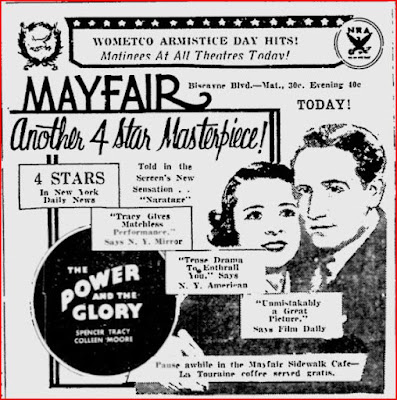
For William K. Howard's The Power and the Glory, Tracy starred but ranked second in the promotion to Fox's promotion of a new cinematic storytelling technique. This was "Naratage," which boils down to having someone narrate a story told in flashback vignettes. It may have been one of the earliest films with substantial voiceover narration, but its claim to history is that it's also one of the earliest non-linear narratives. Written by future comedy specialist Preston Sturges, it's now seen as a prototype for Citizen Kane because it uses its flashbacks, jumping back and forth in time, in an attempt to solve a mystery: why did railroad tycoon Tom Garner (Tracy) kill himself? Unlike Kane, we only see Garner's life from one vantage point, that of his childhood friend and later business partner (Ralph Morgan), who defends his friend's memory against his wife's denunciations of Garner as a cruel boss and an unfaithful husband who drove his own wife (silent superstar Colleen Moore) to suicide. Unfortunately, the childhood scenes don't really do much to illuminate Garner's adult misdeeds. We see an ill-educated but energetic man who rises through force of will and asserts his prerogatives against his workers (facing down a gang of strikers and forcing a labor war in which hundreds are said to have died) and the long-suffering wife who first fell in love with him while tutoring him in math. Tracy is convincing but not compelling as the coldly dominant Garner, lacking Charles Foster Kane's narcissist charisma, while Sturges's vaunted innovations feel like little more than gimmicks that get in the way of a more forceful narrative. The would-be avant-garde structure sabotages any effort Tracy may have made to act out the character's evolution and keeps the audience at a fatal distance from the character we ought to identify with. It only reinforces that remoteness that kept Tracy from catching fire for so long.

Fox was a troubled studio, kept afloat by Will Rogers, Charlie Chan and Shirley Temple, that let other studios try to figure out what to do with Tracy. Columbia paired him with Loretta Young, igniting a short-lived but intense affair, for Frank Borzage's Man's Castle. The title is ironic for a tale of life in a "Hooverville" shantytown. It has a clever opening with Tracy, decked in top hat and tails, feeding popcorn to pigeons from a park bench as Young looks on hungrily. Tracy decides to take her to a fancy restaurant and after dessert brazenly informs the manager that neither she nor he has any money. In classic Pre-Code style, he manages to get away without paying by threatening to make a speech denouncing the restaurant's selfishness in the middle of a Depression. Turns out that a coffee company hires him to walk the streets in the formal wear -- his dickey lights up with the company name -- for $2 a day. That's just one of the odd jobs this "bindlestiff" takes to get by. He's content to do just enough to survive and is ready to move on at a moment's notice, but Young yearns for stability and a real home, or at least a real stove. Tracy scrambles from job to job, jumping onstage to serve singer Glenda Farrell with a summons and walking the streets in stilts, where he encounters Farrell again through a second-story window. He beats that temptation, but when Young announces her pregnancy he feels a stronger temptation to hop a freight and get as far away as possible. He actually boards the train but has second thoughts and returns to marry the girl. Pre-Code means you can acknowledge that folks will have sex (and kids) before marriage. But providing for a family means taking more drastic steps, including robbing the toy store where the lay minister who performed your marriage ceremony (Walter Connolly) works as a night watchman. After some melodramatic complications and the elimination of a rival, the film ends with both Tracy and Young in a boxcar, on the run together. Pre-Codes that actually address the Depression and the struggles of poor people get bonus points from me, and the obvious chemistry between Tracy and Young is a bonus. Borzage and screenwriter Jo Swerling come closest to solving the Tracy problem by making the actor's seeming aloofness a problem within the film that the character has to overcome. He's the same sort of self-satisfied smart aleck he was in Me and My Gal, but while the Walsh film was perhaps too breezy for its own good, at least from a box office standpoint, but a more serious romance that challenges Tracy's affable complacency makes Man's Castle easily the best of these films. All three are worth seeing, even Power and the Glory for history's sake, but it's still safe to say that Spencer Tracy's best work was yet to come.