Monday, September 30, 2013

Pre-Code Parade: GIRL CRAZY (1932)

 
Even the advertising is outrageous for this one.
I like a Gershwin tune; how about you? Hollywood liked them plenty, but there was somewhat less love for the Broadway shows for which many of George and Ira's standards were written. As hit shows their names had commercial potency, but the movie studios really just wanted the songs. Not all of them, though: for William A. Seiter's film of Girl Crazy RKO kept the two towering hits "I Got Rhythm" and "But Not For Me," but did without "Embraceable You." On the other hand, the Gershwins contributed a new (or hitherto unused) song for the film -- but "You Got What Gets Me" hardly counts as even third-rate Gershwin. What did the studio -- producer William LeBaron, director Seiter, and a team of adapters headed by Herman L. Mankiewicz -- think they were getting, and what did they think they were doing? It seems to have boiled down to this: the show that made stars of Ginger Rogers and Ethel Merman on stage struck somebody as an ideal movie vehicle for Bert Wheeler and Robert Woolsey.

Wheeler and Woolsey are one of the acquired tastes of the Pre-Code era. They made a hit as comedy relief in the big-budget musical Rio Rita and became RKO's answer to the Four Marx Bros. At least that was the idea, and it seemed to work for a time, at the time, but in retrospect the duo seem more like RKO's precursors to the Ritz Brothers. Disclosure: I hate the Ritz Brothers. I've never hated Wheeler and Woolsey, but I didn't get them. Woolsey looks and sounds like George Burns's dyspeptic uncle while Wheeler looks the part he played, a pleasant idiot. Together they were "nut" comedians, which means that, like the Marxes, they acted in films not to tell a story, but to act crazy. Like nearly all the Marxes' rivals, they lacked the personalities to make their craziness interesting. But maybe I'd just managed to miss the good Wheeler and Woolsey movies. They did quite a few before Woolsey died in 1938, but I haven't seen many of them -- definitely not enough to get them. Until now.

Reviewing some of RKO's Pre-Code, pre-Astaire musicals, I've noted that they verge on the cartoonish in everything from their comedy to the staging of the songs, that something human is lacking in the absence of a virtuoso performer like Astaire or Rogers. Because we identify RKO musicals with that pair, that inhuman cartooning effect seems like a flaw. In a Wheeler and Woolsey musical, it's a supreme virtue. Shaped to their needs, Girl Crazy comes about as close as early sound comedy could come to a live-action cartoon. You'll feel sure that you've seen some of the gags in cartoons from your youth. You may even see a hint of Blazing Saddles and its town's worship of Randolph Scott in the way everyone in Girl Crazy's western town removes his hat at the sound of the word "west." In all its versions, Girl Crazy is something that happens Out West, but the Seiter Girl Crazy is a ruthlessly irreverent travesty of the West, of the Broadway musical, of whatever you've got. It respects nothing, and in time you realize that it has to take the same attitude toward its source material, to the point that "But Not For Me" becomes but a platform for the obnoxious pre-teen Mitzi Green's long threatened imitations of stage and screen stars. These are actually quite good to the eyes and ears of a Pre-Code buff, but her riffs on the likes of George Arliss, Enda Mae Oliver and Roscoe Ates (a stuttering specialist) only make the film more defiantly obsolete today, adding an F.U. to the modern viewer on top of its similar salutes to everything else. If you can appreciate the way this picture doesn't give a damn what you think of it, then you'll get Wheeler and Woolsey.


Once upon a time there was this musical on Broadway called Girl Crazy. It was about a wastrel scion of a wealthy family sent west to run a ranch. The boy turns the place into a proto-Vegas, though maybe without the gambling. That's as much as I can get from Wikipedia. That character is still in the Seiter film; Eddie Quillan, a future Ellery Queen, plays him. But his story quickly recedes into the background. What counts is that his plan to turn his ranch into an entertainment destination -- with gambling, draws the professional gambler Slick Foster (Woolsey) westward to run Quillan's tables. Traveling with his nagging wife, Slick seeks the cheapest way to travel and chooses to go by taxicab. The driver is Jimmy Deagan (Wheeler), introduced preparing to drive a nail through his windshield, the sign on it aptly identifying car and driver as "Vacant." Jimmy unquestioningly drives the Fosters across the country as the slapstick gets off to a slow start. Leaving a gas station, the cab somehow ends up dragging a cardboard cutout of a motorcycle cop behind it. It takes a while for Jimmy to realize that the cop isn't passing because he isn't real. The payoff comes after he finally gets rid of the cutout, when he and Slick mistake authentic motorcycle cop Nat Pendleton for the persistent piece of cardboard. Poor Pendleton does his own stunt riding as Woolsey hurls objects at him, hoping to knock the offending attachment loose.

Finally our antiheroes arrive in the self-revering west, where Slick decides that the best way to avoid paying hundreds of dollars in cab fare is to have Jimmy lynched. Quillan's ranch is located in a community hostile to law and order; the sheriffs measure their tenure in minutes and one has just been shot when the taxi rolls in. From here Slick and Jimmy must help Quillan fight the local bully (Stanley Fields) who decides to run for sheriff himself, after killing many of his predecessors, in order to put the screws on Quillan and his resort. Our heroes need a candidate to run against the bully, but know that any candidate is doomed. Naturally, Slick and Quillan agree that Jimmy is the perfect candidate. With the help of Mitzi Green, who seems to have some crush on Jimmy (the actress was 12) and has followed him all the way out west, the good guys steal the election. No matter: the law will have little say in the outcome of the story. Instead, Wheeler and Woolsey will be compelled to disguise themselves as Indians (Woolsey playing a squaw) in a self-consciously outrageous bit made more funny by the presence of a real, "articulate" Native American witnessing the travesty -- until he speaks Pig Latin to the boys and proves himself a true brother, linking arms with them as they dance offscreen. They will plot to poison the bully with hooch spiked with gasoline, but must drink it themselves. Recovering from temporary stupefecation, an intoxicated Woolsey will recall his powers of hypnotism -- the reality of which is demonstraed when a bartender wanders offscreen sleepwalker style. And he will manage to mesmerize himself when the mirror on a door swings into his path as he prepares (he must count to five first) to overpower the bully. In the end, men will again pause to remove their hats in honor of the West, and ceramic urns will fall on their skulls. Quillan will propose to his girlfriend, only to be flattened once, twice, and a third time by a swinging door in the middle of a chase scene -- even the Marxes didn't treat the romantic lead like that.

In this manner Girl Crazy devours itself. Self-immolation might be the better metaphor; it gives you the idea of a spectacle, and the Wheeler & Woolsey Girl Crazy is spectacularly, amorally, triumphantly stupid. I've only described the tip of an iceberg of bad jokes and brazen gags, and I'm only now describing the film's "I Got Rhythm" number, which devolves in RKO style from Kitty Kelly's performance to some attempted artistry with light and shadow to all-out cartoon lunacy as everything from the cacti in the desert to the stuffed and mounted head of a buffalo keeps time with the tune. That's the kind of adaptation this is. It flopped at the box office; even Pre-Code audiences didn't get it -- or couldn't take it. For good or ill, this is one nut comedy that is indisputably nuts.

Saturday, September 28, 2013

DVR Diary: THE OKLAHOMAN (1957)

Joel McCrea is linked in movie history with Randolph Scott, his co-star in Sam Peckinpah's Ride the High Country. By the time they made that film together, swapping roles early in the production, McCrea's star had fallen to Scott's level. Both had been starring in B westerns for years, McCrea in part from the belief that he was no longer plausible as a romantic leading man. While the B westerns Scott made with Budd Boetticher have been canonized as masterworks of the genre, McCrea's westerns were arguably more prestigious at the time, however forgotten they are now. McCrea simply didn't age as well as Scott, who was nearly a decade his senior. Scott acquired a leathery gravitas, took more creative control over his films, and made his great alliance with Boetticher. McCrea acquired a paunch, and his major partnership was with the producer Walter Mirisch. Few of their directors were auteurs; the closest you get is Jacques Tourneur on Wichita (1955). Most of the films were written by Daniel B. Ullman. His screenplay for The Oklahoman was directed by Francis D. Lyon, who directed McCrea in Gunsight Ridge that same year. He spent most of the next decade working in TV. His direction of The Oklahoman is at least competent, but Ullman's script probably does more to make the film watchable.

McCrea plays Dr. John Brighton, a widower who settles in an Oklahoma town near where his wife died in a covered wagon giving birth to their daughter. He becomes the town physician, befriending both the tomboyish Anne (Barbara "Della Street" Hale) and the blooming Maria (Gloria Talbott), the daughter of a Charlie (Michael Pate), a homesteading Indian. Charlie worries that some swampland on his property is toxic, but local cattle baron Cass Dobie (Brad Dexter, best known, relatively speaking, as that other guy in The Maginificent Seven) suspects that Charlie has oil on his land. He hopes to buy Charlie out cheap, but isn't above more underhanded tactics. After Charlie kills Dobie's brother in self-defense and turns himself in, Dr. John takes a stand for him and puts himself on the road to the archetypal showdown in the street.

It's a simple story but Ullman knows how to use limited screen time economically to develop characters and relationships so that The Oklahoman seems paced more like a novel than an action movie. There's some intelligent commentary on the ambivalent feelings whites had toward Indians in the late 19th century. A group of older men discuss Charlie's surrender, one stating that the killing proves that you can't trust an Indian. That provokes a discussion of the ways whites have mistreated the red men, the group conceding that someone like Charlie, otherwise utterly benign and trustworthy, would have good reason to hate whites -- which is why you can't trust him. The script is the film's strength, though Lyon stages the drama effectively in Cinemascope. He gives the film a slightly surprising climax, the final gunfight proving something more than the usual exchange of single shots with one of them lethal. Instead, Dobie and Dr. John empty their weapons into each other until neither can fire anymore. McCrea wins simply by surviving. The showdown is a touch that helps render The Oklahoman not quite a generic western. It's more expansive in its modest way. If not a neglected treasure, it will still hold and reward your attention. As for McCrea, his dispassionate moralism is nothing more than the film needs. As for his self-consciousness about playing a middle-aged lover, here he is loved by women who are 17 years (Hale) and 26 years (Talbott) his junior, though we should note that he courts neither woman aggressively. McCrea isn't an iconic figure like Randolph Scott, but while his Fifties westerns aren't in Scott's league, The Oklahoman reminds us that they're not without their virtues.

Thursday, September 26, 2013

DVR Diary: OSAKA ELEGY (1936)

1936 is still the early talkie era in Japan, even though Kenji Mizoguchi had first experimented with sound all the way back in 1930. Yasujiro Ozu was just releasing his first talkie the same year, for example. I haven't seen many Japanese films from this period, but on the evidence of Osaka Elegy I'd believe that the discovery of sound anywhere encouraged a certain vernacular irreverence. Another way of putting it is that Osaka Elegy reminds me a lot of American Pre-Code movies. What sets it apart is that in 1936 Japan modernity (as Americans knew it then) was still in the making. Mizoguchi shows us dramatic contrasts, the most notable being the way the two sexes dress. Many if not most of the men were western-style suits, while most of the women still wear traditional dress. That's true even of the switchboard operator in a modern office, and when Ayako (the late Isuzu Yamada) adopts chic western fashion late in the film it's a bit of a jolt. If anything it symbolizes how she's been stigmatized after some melodramatic sacrifices for her family. You could just about tell her story in Hollywood. Her father's a crook, her older brother's in college whining for tuition money and her younger sister's in school. She's the provider of the family by default and does what she has to do to keep everyone going. That means working overtime as a mistress for two of her bosses. Finally she plays the game too long, pushes too hard and gets slapped down, and her own family cuts her dead. Where's the gratitude? Dad, brother and sister are too busy being ashamed of the scandal she created. It seems convenient, somehow, for them to throw her out of the house. Fine, then. She takes a walk out to a bridge, but before you get ideas she walks right off and into the camera with an enigmatic expression somewhere between resignation and resolve. It might generously be described as defiance.

Mizoguchi is probably best beloved outside Japan for his late period pictures, the stuff of art houses: The Life of Oharu, Ugetsu, Sansho the Bailiff. But he always came back to the theme of the fallen woman, ending his career with Street of Shame. He did enough of these stories to fill a Criterion Eclipse box set, and he felt that Osaka Elegy in particular was one of his first really good movies. I can't blame him for thinking so; it's a brisk, jazzy, discordant picture. The thing that might remind you most of Pre-Code is the way the women talk back to their men. Where's that modest deference you might have expected from pre-war Japanese women? The women of this picture answer with a collective scoff. Defer to these guys? It's enough that they get their way and get away with things a woman can't. The difference in dress between the modern men and the traditional women illustrates a double standard, and the mostly modern cityscape reminds you whose world this is, while Ayako's story shows the danger of a do-gooder gold-digger garbing herself in the same modernity. Hollywood's heroines of the time would hail her as a sister, and probably hire her as a maid.

Tuesday, September 24, 2013

Lady For A Day: NOW PLAYING, Sept. 24, 1933

Milwaukee, I have not forgotten you. It's just that the resources available on the Google News Archive aren't so great for September 1933. The Sentinel is almost completely missing, while the digital pages of the Journal are often of poor quality. Fortunately, whoever scanned the Journal cleaned up their act somewhat for the days leading up to the release of Lady For a Day. That film is now remembered as Frank Capra's breakthrough film, though Capra had been Columbia's ace director just about since the coming of sound. What's different about Lady -- which Capra would remake as his final feature, Pocketful of Miracles, nearly thirty years later --  may be that, as an ensemble piece, it was the first one thought of primarily as a Capra picture rather than as some star's vehicle. Speaking of ensemble, this is virtually a Warner Bros. co-production with three of that studio's hottest personalities -- Warren William, Glenda Farrell and Guy Kibbee -- in the mix. They can't hurt.

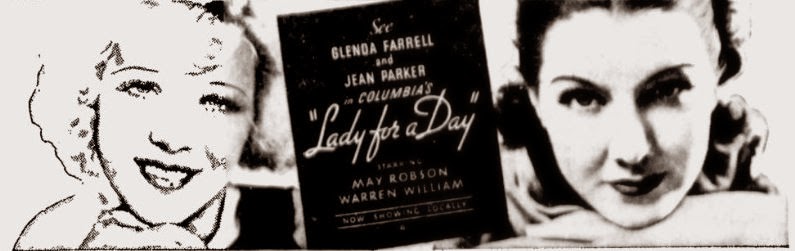
Columbia and Milwaukee's Palace theater went to town promoting Lady for a Day. Here's a double-page spread of movie ads from the Journal for the film's opening day, September 22.


The theater itself puts two ads in the spread, while the makers of Lux soap join in with a tie-in ad promoting (but not actually featuring) Glenda Farrell. Let's take a closer look:


What's Glenda's secret? She uses soap!


The film itself is inescapably a bit Capracorny, but it has plenty of Pre-Code attitude, too. Let's let Glenda demonstrate, with help from Farrell fan extraordinaire WB Kelso:

Sunday, September 22, 2013

SOLOMON KANE (2009)

The Puritan wanderer Solomon Kane was one of the early creations of the short-lived, now legendary pulp writer Robert E. Howard, predating Conan the Barbarian in print by four years. In the movies, more than a quarter-century passed after the first Conan movie before Solomon Kane made it to the big screen, and then three more years passed before Michael J. Bassett's Euro production was released in Howard's homeland. At first glance, the picture owes its existence less to John Milius's Conan the Barbarian than it does to Gore Verbinski's Pirates of the Caribbean. I don't mean to suggest that Bassett's film is a comedy -- it takes itself very seriously -- but the Pirates films made the 17th century setting of the Kane stories a safe period to set a fantasy film in. In fact, Solomon Kane takes inspiration from many sources. Some of the interior sets and creature designs may remind you of Pan's Labyrinth, while some of the outdoor action suggests Tim Burton's Sleepy Hollow. A scene in which Kane (James Purefoy) is crucified will even remind you of the Milius Conan, if not of another 1982 film, The Sword and the Sorcerer, in which the hero decrucifies himself. Alas, it can't live up to that picture's glorious idiotic moment when the hero leaps off his cross, catches a sword in mid-air, and goes to work slaying his enemies. Instead, Kane bellows with rage and flops into the mud.


It might be argued that writer-director Bassett takes influences from everywhere but the Howard stories, but we have to concede that Bassett got the look of the character pretty much right. Like Milius's Conan, Bassett's Kane doesn't adapt a particular Howard story. Instead, Bassett gives us an overdetermined origin story, and while Milius's film is also an origin, it had the simplicity of a revenge tale as well, while Bassett ensnares himself in nearly every origin-story plot thread that could be imagined. For starters, it's a tale of redemption, starting with Kane as a freebooter sacking a North African fortress, only to find himself attacked by a Devil's Reaper claiming his soul. His narrow escape leads Kane to seek shelter in a monastery, adopting ways of peace in the belief that the devil will take him should he ever kill again. But Solomon Kane is also about "fathers and sons," but more about sibling rivalry. Flashbacks reveal that Solomon, the second son of honorary Englishman (and Conan alumnus) Max Von Sydow -- is it that the great Swede now speaks the language better than most natives, or do some people think he is English? --  was to be relegated to the priesthood (a dangerous profession in Elizabethan England) but ran away from home after accidentally shoving his bully of an older brother off a cliff. This pretty much gives away the identity of the bad guy stomping around in a leather mask, but Bassett muddles things by insisting that this menace is only a minion of the real big-bad, the priest-turned-sorcerer Malachi (Jason Flemyng), whom we don't even see until the film's last act. His face is tattooed with Latin script in another apparent homage to the Milius Conan, and that's the most interesting thing about him. He ends up overshadowed not just by Solomon's final duel with his brother, who gets set on fire during the fight, and by his own summoning of a giant fire demon out of a mirror. Needless to say, by now Solomon has done a lot of killing, but he's been assured by the dying vow of the late Pete Postlethwaite that any killing he does to save Pete's daughter is O.K. with God.


Is there an original idea to be found in Solomon Kane? It seems not, though there are a few creatively directed moments. One of the best, it turns out, is a tangent from the main story in which Solomon encounters a minister whose congregation has been cursed by Malachi and transformed into flesh-eating subhumans. The slow torchlit reveal of the lot of them, both sexes bald and greenish in the light, packed in a cellar beneath a trapdoor, is the most genuinely creepy moment in the picture. The main story is a dispiriting muddle of "begins" cliches, again begging the question of why modern movie audiences supposedly can't accept the idea of a hero walking the earth without knowing how or why he does so, or being reassured somehow that he is reluctant, conflicted, etc. To my knowledge, Robert E. Howard never felt a need to account for Solomon Kane's childhood or family rivalries. Bassett's attempt to do so doesn't enhance the legend but serves only to make his film more like all the other modern films that find heroism so exceptional that it must be explained by factors other than a commitment to justice or the common good. This grows tiresome and seems to reflect a distrust of moral certainty, if not heroism itself, at least among self-styled creators. There's certainly room for skepticism about moral certainty (or certitude) in movies, but by now it's gotten monotonous. Solomon Kane is itself a monotonous picture, more often merely miserable than spooky and too predictable to be epic. The picture isn't awful, but it's disappointingly uninspired and a disservice to Robert E. Howard's legacy.

Friday, September 20, 2013

Pre-Code Parade: TODAY WE LIVE (1933)

William Faulkner was Snoopy: a dogged writer who dreamed of being a World War I flying ace. Faulkner had the double advantage over the bipedal beagle of actually existing and doing so during the war. He went to pilot school but no further, but let the folks at home believe more than that. He was good at fiction, or so the Nobel committee said. He was less good at movies, but found a patron in Howard Hawks. Maybe Hawks sat on his doghouse roof in turn and dreamed of writing famously. He sought the company of great writers. Hemingway kept him at arm's length (he liked Gary Cooper better), allowing him a free (in spirit if not in price) adaptation of To Have and Have Not scripted by none other than Faulkner but never consenting to write for film. Hemingway may have stayed away from movies so he could sneer at his rivals for writing them. Faulkner needed the money more, I suppose -- though by the time Hawks got hold of him he had become a bona fide bestseller by virtue of his novel Sanctuary, filmed without his input as The Story of Temple Drake, and enough of a celebrity that his name could be mentioned in some of the advertising for his adaptation, directed by Hawks, of his own short story "Turnabout." The story appeared in the Saturday Evening Post, another workplace Hemingway avoided and another he held against his rivals, even the friendly ones like F. Scott Fitzgerald, who supposedly wasted his gifts working to commercial formulae. For what it was worth, "Turnabout" was well read in the Post, but required enhancement in the adaptation to cinema. Faulkner is credited with the story (of course) and the dialogue of Today We Live, but the "screen play" itself flowed from other pens. Edith Fitzgerald and Dwight Taylor ought to be mentioned here, because their additions to the magazine story might otherwise convince people (like me) who know the story only through the movie to think that the story itself had been written by Snoopy.

It is like this: Gary Cooper is a rich American who moves to England and becomes Joan Crawford's new neighbor, introducing himself with an almost national instinct at the worst time, Joan having lost her father to the war. That leaves her with a brother, played by future husband Franchot Tone, and a future husband, played by Robert Young, whose possible intimacies with Crawford are unknown to me. You can tell the other three are British while Cooper isn't, however alike all four sound, because they're already there when the picture starts. They're fighting in the war, too, and in his turn Cooper catches the war bug, around the time Crawford catches the Cooper bug.  Joan herself crosses the water to play nurse, only to learn that Cooper, a flier himself, has crashed and died. Audiences with memories of William Wellman's Wings would by this point be reluctant ever to fly with Gary Cooper, unless they realized that it was too soon in the picture, at this more advanced point in his career, for Cooper to be dead. Joan herself doesn't realize this and hooks up with Young for consolation. As was predictable, Cooper reappears expecting to pick up where he left off with Crawford and realizing his error, and her deceit, only when he delivers a drunken Young to his living quarters, which are Crawford's, too.

Faulkner thus adds, or is provided with, an additional motive element of romantic rivalry for the scenes that are the real material of "Turnabout" and the stuff that must have attracted Hawks to the story. Cooper and Young, the latter seconded by Tone and the former by Roscoe Karns, engage in a contest of one-upmanship, debating whose is the braver work in the war. While Cooper bombs cities, Young and Tone operate a torpedo boat that doesn't fire torpedoes but guides them -- hauls them, really, toward their targets. Young gets a plane ride, Cooper a boat ride; each is impressed. The sea scenes are somewhat more convincing, Hawks's setbound planes lacking the scale and mobility of later fakery in films like Too Hot to Handle. Through editing and simple directorial persistence Hawks manages to give these scenes some dramatic momentum. Hawks was also obviously enthused by scenes of barracks camaraderie, the great sport of First World Warriors during their downtime being the training and matching of fighting cockroaches. But there is nothing Hawksian, and hardly anything Faulknerian, about the wrap-up. Would either of them have assumed on their own that once Cooper returned from the presumptive dead that either he or Young must die the big death? Yet audiences and/or producers assumed just that, and so did our creators. So Young gets blinded in battle. By movie rules that means that Crawford will give up any further thought of Cooper to take care of Young, while Young will not want to be a burden to her, as he imagines a blind man must be. He convinces Tone to take him out for one more mission, while Cooper, learning of Young's adventure, rushes his plane into the air to pretty much watch as a mishap with the torpedo boat's firing mechanism, to describe it generously, compels Tone to take on a suicide mission. Following movie rules himself, he's going to spare Young by tossing him overboard, but this is the moment Young has been waiting for, so rather than take a dive he wraps himself around Tone (some scholars see subtext in "Turnabout," but some people see subtext everywhere) and together the buddies send a shipload of Heinies to Valhalla, blowing Crawford a clear path to her romantic reunion with Cooper.

Faulkner would return to themes of flying in his novel Pylon, adapted by Douglas Sirk during Faulker's second round of celebrity as The Tarnished Angels, and to themes of World War I in A Fable, infamous during his lifetime as an overhyped pretentious post-Nobel dud. Hawks hooked up with him next for another war picture, 1936's The Road to Glory. Their best-loved collaborations are To Have and Have Not and their Raymond Chandler adaptation, The Big Sleep, for which they and co-writer Leigh Brackett, according to legend, had to ask Chandler whodunit, in vain. Later, Hawks identified Faulkner as the perfect man to write an Ancient Egyptian epic -- the idea hadn't occurred to Norman Mailer yet -- and the end product, Land of the Pharaohs, reached DVD as a "Cult Camp Classic." Today We Live was the only time Hawks adapted his friend's own work, which is probably a good thing for both men's reputations, which were better off when this film was more thoroughly forgotten.

Thursday, September 19, 2013

Ken Norton (1943-2013)

 
Sports fans will remember Norton as the man who broke Muhammad Ali's jaw in the first of three split-decision fights, but readers of this blog know him as an icon of the 1970s: the star (in two separate roles) of Richard Fleischer's slavesploitation epic Mandingo and its sequel, Steve Carver's Drum. According to my stats, my review of Mandingo is by far the most popular thing I've written here, though most people probably look it up for the screencaps. For similar reasons, my review of Drum is also a top-ten item. Norton's death at age 70 from complications following a stroke is, however sad, as good an occasion as any to refer people to two films that strongly influenced Quentin Tarantino's Django Unchained -- most obviously in the form of "mandingo fighting" -- and are arguably superior in their unselfconscious exploitation of the mood of their time. Look up Mandingo here, and Drum here -- and give Ken Norton some props along the way. As actor and fighter, he literally talked the talk and walked the walk. Ave atque vale.