Monday, December 10, 2012

EROS PLUS MASSACRE (1969)

Sakae Osugi and Noe Ito could be called the Karl Liebknecht and Rosa Luxemburg of Japan: leftists murdered by military thugs not long after World War I. Rather than Marxists, Osugi and Ito were anarchists, which might make them more the Alexander Berkman and Emma Goldman of Japan. Like Goldman's anarchism, theirs was laced with once-scandalous "free love" ideas. In particular, Osugi developed into an individualist anarchist influenced by Max Stirner, the author of The Ego and Its Own and an arch-enemy of Marx. It's impossible for me to say how large these martyrs loomed in Japanese leftist culture in the late 1960s, but for Yoshishige (Kiju) Yoshida they were painfully relevant. It was not just for budgetary reasons that he shot many of the scenes of their story in the modern streets of Japan. They are with us today, he seems to say. To illustrate the point, not only does he have two self-dramatizing modern students making a film (or preparing some sort of project) about them; he has his modern young woman attempt to interview an uncooperative Ito. At the end of the picture, the modern couple gather the cast of Osugi and Ito's story for a commemorative photo, and the assumption is that these are the historical people, not actors (played by actors) playing those people. Eros Plus Massacre is the reverse of the nearly contemporary Goodbye Uncle Tom, the historical persons haunting the present rather than the filmmakers invading the past. The effect is theoretically similar to but far less comical than Marco Ferreri's staging of the Custer massacre in 1970s Paris in Don't Touch the White Woman. It's meant to be problematic if not traumatic. Why should it all end with a film director (I presume) making a noose of celluloid, climbing onto a pile of film cans and hanging himself? It's a powerful set of images, but did what we've seen justify it? I sense some sincere new-wave anxiety on Yoshida's part over whether he has done justice to history, to ideas, to human relationships. I can't help thinking of Jean-Luc Godard's struggles to express ideas, though in particulars E+M reminds me more specifically of Alan Resnais' La Guerre est Finie, another juggling act involving political commitment and sexual yearning. If one thing is clear after three and a half hours, it's that the political is the personal -- or that the one is inseparable from the other. How free can we be when needs drive us together but can't hold us together? For Yoshida, it seems like the personal conflicts that led one of Osugi's lovers to stab him are a greater tragedy than the political conflicts and confusions that led to Osugi's death.


Eros Plus Massacre is a deliberately difficult film, but it's also the work of a pictorial genius. Nearly every frame is an impeccable composition incorporating meticulous set design. Even if the ideas elude you and the actors don't earn your empathy, the picture is thrilling to look at. Working with cinematographer Motokichi Hasegawa, Yoshida films in an often deliberately washed-out monochrome evocative of faded photographs, giving an impression of pastness even while filming on modern locations. He plays freely with space and proportion, often placing the actors far left or right of center, or near the bottom of the screen, daring emptiness to dominate the frame. He also films action brilliantly, from a surreal rugby game with an urn of Osugi's ashes as the ball to the labyrinthine tracking shots as Osugi's attacker stalks him through a house whose walls eventually collapse in all directions.


Toshi Ichiyanagi's score perfectly expresses the film's juxtaposition of romanticism and moder discordance. The cast, led as usual by Yoshida's wife Mariko Okada as Noe Ito, is solid. The film's too long for me to go on synopsizing it, and to be honest, I don't feel that I got all of what Yoshida meant to say. But I feel confident that there's more to get, and that Eros Plus Massacre is a film that will reward multiple viewings both visually and intellectually.

Saturday, December 8, 2012

Pre-Code Parade: WINNER TAKE ALL (1932)

James Cagney was an unprecedented movie star, a distinctive produce of talkies and Pre-Code cinema, a sexy thug. Think of the tough-guy stars of silent movies, or Cagney's tough-guy peers in the early Thirties: hulking slabs of beef like Wallace Beery or George Bancroft. A certain burliness was expected of film's top brawlers. By comparison, Cagney was a runt, but he made up with ferocity (making "Tarzan look like a sissy") what he lacked in mass. In fact, he overcompensated. Cagney's stardom is impossible today, insofar as violence against women, exemplified by that grapefruit smashing into Mae Clarke's face forever, was a key part of his persona. It was something Depression audiences wanted to see, and I don't think they had something against women. Sexy brutes like Cagney and Clark Gable were the sort of charismatically ruthless survivors -- interestingly, "caveman" was a popular label for them -- that audiences wanted to be or wanted to have in hard times. They were suited for those new hard times in a way many slightly older matinee idols -- John Gilbert, Ramon Novarro, Richard Barthelmess -- weren't. Roy Del Ruth's Cagney vehicle emphasizes the contrast between its star and the older type by showing Cagney the scrapper succumbing to the temptation to become a "powder puff" -- a pejorative associated with Rudolph Valentino, the dead exemplar of the old stardom.

Introducing Winner Take All on a night dedicated to child actors, TCM host Robert Osborne strained to emphasize Dickie Moore's role in the picture as proof of the influence on Warner Bros. of The Champ, M-G-M's Oscar-winning hit about a boxer and a kid. But Winner is plainly a riff on Cagney's persona, and Moore's role is relatively insignificant and unsentimental. Cagney plays Jim Kane, a contender taking a sabbatical from the ring, implicitly to dry out. We first see him as the beneficiary of a benefit night at the arena, the fight fans throwing money into the ring for him as he makes a halting speech of thanks. He's sent west with a friendly warning from his manager (Guy Kibbee) and his second (Clarence Muse) to lay off the high life and keep out of trouble. In his exile he falls for a young single mother (Marian Nixon) who'd once waitressed at Texas Guinan's legendary nightclub, and takes a tough fight to raise money for her when her insurance company stiffs her. Once word gets out that he's fighting again, Kibbee calls him back to the big city, where his handsome brutality captivates a socialite (Virginia Bruce) who invites him to a high class party and otherwise seduces him. Bruce shows off some seriously low-cut lingerie to get the job done, and our hero soon forgets the mother and son out west.

Not realizing that the socialite is turned on by his freakshow value as a broken-nosed, cauliflower-eared brute, Jim decides that he should make himself more attractive to her and has plastic surgery. To preserve his new good looks, he adopts a dancing defensive style in the ring, winning fights easily but displeasing fans who want a good old-fashioned scrap. His new habits earn him the "powder puff" tag, and Kibbee warns him that he's risking his career. In one tremendous moment, Kibbee shows who's boss by laying out the intractable Cagney with one punch. Still, Jim's determined to do things his way, even when he learns that he's begun to bore the socialite, who walks out on him in mid-fight one night. Desperate to impose his will, he insists that she sit in the front row for his next bout, but learns just as the bell rings that she's taking passage on an ocean liner instead. Learning that he has only 20 minutes to reach the ship and stop her from leaving, he abandons his new style in a hurry to knock his man out as soon as possible. Ruining his new face in the process, he gets the job done and rushes to the docks in his boxing trunks, only to find the socialite trysting with another man. Now knowing the score, he kayoes the interloper, gives the socialite a kick in the rear, and heads home to make his apologies to the little mother from out west, who'd followed him back to New York only to be blown off shortly before. The film ends with adorable little Moore bopping our hero on his bandaged nose.


Winner Take All puts Cagney into some fish-out-of-water situations with predictable results. Asked for his opinion of the Soviet Five-Year Plan, Cagney tells a society gathering that he doesn't trust those installment schemes and always pays in full up front. When a butler laughs at this, Cagney lays him out. Apart from Public Enemy, Cagney was mainly a comic figure in the Pre-Code era, a transgressor who gets away with what we wish we could -- usually smacking the sort of people we wish we could. Again, it says something about the era that his victims so often include women (he gives his niteclub date in the flashback a face full of seltzer water), but it doesn't look like many women objected back then. His violence was essential to his manhood, and Winner underscores this, stressing that it's not merely the physical grace that Cagney was praised for later but his willingness to mix, to put his chin out, get as good as he gives, that defines him. Cagney himself apparently disagreed, and the publicity for Winner acknowledges that it led to conflict between star and studio. Money may have been the provocation -- Cagney didn't like that he was making less money than Dick Powell -- but the actor was also unhappy with the limited range of roles that Winner seemed to enforce. A year later, he was singing and dancing for Busby Berkeley in Footlight Parade, but Winner showcases his dancing skills in the squared circle. The ballyhoo had you believe that Cagney was so convincing as a boxer that you'd assume he'd fought professionally. But Winner's fight scenes are not much less pantomimic or risible than those in City Lights. They don't exactly remind me of period fight films. But they express the idea that Jim Kane is first a nonstop scrapper, then an untouchable dancing master. In any event, the film is a comedy, so we probably should seek pugilistic realism elsewhere. What we have in Winner is a relatively minor Cagney comedy that nevertheless ought to be essential viewing for his fans for the way it struggles to figure out who exactly Jimmy Cagney the movie star persona was: lover, lout, or both.

We can't wrap this up without the original trailer, provided as usual by TCM.com

Thursday, December 6, 2012

Pre-Code Parade: THE CIRCUS QUEEN MURDER (1933)

 
Pre-Code pictures from Columbia Pictures are still a rarity even on Turner Classic Movies, so I shouldn't kick if Roy William Neill's mystery movie turns out to be a sequel. It's the second and last film in which Adolphe Menjou plays Thatcher Colt, a New York City police commissioner who solves mysteries on his own. Colt was the creation of Anthony Abbott, and Abbott himself was the creation of Fulton Oursler, the author and editor best known under his own name as the modest writer of The Greatest Story Ever Told, his novelization of the Gospels. His Abbott books about Thatcher Colt were popular enough for Columbia to adapt The Night Club Lady in 1932, and that was promising enough to get us to The Circus Queen Murder. Neill didn't direct the first Colt picture, but for me, knowing nothing about Thatcher Colt, the director was the most promising feature of Circus Queen. He was one of Columbia's secret weapons, amid all the acclaim for Frank Capra, and responsible for two of the studio's most successful 1930s experiments in horror, the voodoo thriller Black Moon and the Karloff twin act The Black Room. For Circus Queen Neill got to work with Dwight Frye, who here gets one of the biggest roles of his career. Whatever Circus Queen's flaws it's a must for fans of Frye, because it gives him a chance to play the villain of the piece -- not a stooge, not a red herring, but the actual villain, the one who dunnit.

The problem with the picture is that there isn't really any mystery about who dunnit. For it's first half, Circus Queen is more of a who'll do it picture. It opens with Colt deciding he needs a vacation from crime and reporters. Throwing a knife at his map of New York State, the commissioner decides to take his vacation in the town of Gilead ("There is balm in Gilead," he recites hopefully), with his faithful secretary Miss Kelly (Ruthelma Stevens, returning from Night Club Lady) in tow. They arrive in town at the same time as a circus and watch the parade through Gilead. Colt has been teaching Kelly lip reading, and as the parade passes by she notices star aerialist Flandrin (Frye) arguing with his wife, fellow aerialist Josie La Tour (Greta Nissen). She makes out that Flandrin is threatening to "kill both of you," moments before a burst balloon spooks Josie's horse, forcing Flandrin to rescue her. Turns out that Josie's been cheating on Flandrin with a third aerialist, the Great Sebastian. Sebastian is no Cornel Wilde, however. Rather, he's played by that seductive devil, Donald Cook. If you remember Cook as Jimmy Cagney's semi-shellshocked, self-righteous brother from The Public Enemy, you may be wondering about that "seductive devil" idea, but remember: he's competing with Dwight Frye! 

Once it comes out that several circus performers have received death threats, Colt reluctantly gets involved in the local investigation, but no one will listen to his advice to cancel performances. Surprisingly, Flandrin appears to be the first victim, suddenly disappearing with only bloody clothes left behind in his wagon. Suspicion focuses on a troupe of "Congo cannibals" who double as circus musicians; there's some confusion over whether they started with thirteen or fourteen men, but there's only thirteen now, and people worry about number fourteen. For your information, these aren't just a gang of American blacks in costumes; we're to understand that they're all authentic Africans, and I learn that Oursler/Abbott treats them more sympathetically in his novel than they're treated here. On film they seem about as authentic as the wheezy man in the gorilla suit portraying a caged brute in one scene. In any event, they're a bunch of black herrings.

Thatcher Colt's gimmick was that he used modern scientific police methods to solve crimes, the Abbott novels being proto-procedurals. In the movie, Colt quickly figures out that Flandrin has faked his death, planting animal blood (from his wife's murdered dog) to fool the marks. Colt also deduces that Flandrin spent a night in blackface among the cannibals, having counted fourteen rather than thirteen men in their tent. The problem is that Flandrin hasn't committed any crime yet -- it can't even be proven that he killed the dog. All Colt can do is try to keep an eye out for Flandrin, the man having taken his leave of the cannibals, and again urge the circus to cancel the next show. Nothing doing on that front; this is a movie, after all.

You'll notice that the newspaper ad above informs us that we can't guess how Josie La Tour is going to die. Don't you believe it. We see a shadowy figure climb the outside of the big top, with no one watching while the show is on. This is Flandrin, who watches from the literal big top as Sebastian narrowly escapes a sabotaged trapeze. As Josie starts her act, Colt is caught up in the paranoia over the cannibals. As they play while she performs, Colt notices that their reed instruments could pass for blow guns, the recognized cannibal weapons, and are aimed right at the aerialist. Not that he tries to stop them, of course. Meanwhile, Flandrin continues to watch from above, and I guess we're not supposed to notice him blow his wife a fatally pointed, poisoned kiss with his own weapon. Neill builds up some decent suspense in this sequence, but it dissipates with the hero's utter failure to discover or thwart the real threat.

In fact, Miss Kelly is the only person who seems to notice a shadow crawling down the tent. She leaves the tent to investigate, but that only sets up the final confrontation, as Flandrin takes her hostage to force Colt to give him a free shot at Sebastian. Flandrin has nothing to lose and tells Colt he plans to kill himself afterward, so the real mystery is how Colt can get Kelly out of his mess. That I won't spoil in case someone wants to see this for Frye's sake. He's in sullen, surly mode, more like his Wilmer Cook in the original Maltese Falcon movie than his Universal hysterics, and his glowering resentment actually makes him an effective menace. The one thing the story does well is establish Flandrin as a single-minded yet unpredictable loose cannon, and Frye lives up to the opportunity. By contrast, Menjou practically sleepwalks through his bland hero role, though his innate charisma remains irrepressible. Overall, Circus Queen Murder goes out of its way to alienate the audience. 1933 moviegoers may have been practiced lip-readers from the silent era, but I suck at it and had no idea what Menjou and Stevens were saying silently to each other in their early practice. On top of that, Josie and Sebastian play one scene out in German, apparently only so Colt can demonstrate that he also knows the language. Maybe these scenes make the movie a mystery, since they're the most effective at leaving us utterly baffled about what's going on. At least it all looks good. Columbia Pre-Codes are strong on cinematography, and Joseph August (who worked with Neill on Black Moon) works the contrasts quite nicely.  He helps make a pleasantly dumb picture that much more pleasant to watch. I recommend it for the star turns, Frye's especially. He didn't get that many chances in the spotlight like this, so you may as well enjoy it.

Wednesday, December 5, 2012

Now Playing: DECEMBER 5,1962

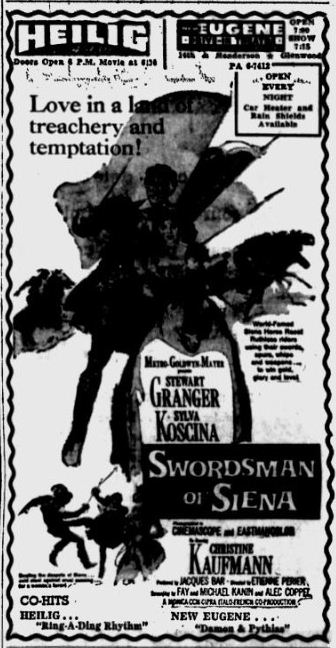
Opening wide today is a picture I saw a few weeks ago on Turner Classic Movies. Here's an ad from Eugene OR.


And here's one from Miami.


Etienne Perier's picture is an old-school swashbuckler -- the term also applies to its star, Stewart Granger -- set in Spanish-occupied Italy in the 16th century. Like many films from this period when the Europeans were aping American genre conventions instead of finding their own ways to express them, Swordsman suffers from a certain stodginess. Working in Europe was a step down for Granger, who would soon be starring in German westerns, but he delivers what's expected of him as a roguish English soldier of fortune. In its original French version this was called The Mercenary, but as I've noted elsewhere Americans seemed uncomfortable with the M-word until around the 1970s. Whatever you call it, the movie's tale of conspiracy and insurrection builds to a climax tied to Siena's famous annual Palio horse race, though Perier stages a rather pallid imitation of the actual event. It's a rather uninspired film but better than many similar Euro-swashbucklers from the period imported by U.S. exhibitors -- and none of them hold a candle to the more thoroughly Euro Cartouche, made in France this same year but not seen in America until 1964.

Here's the M-G-M trailer for Swordsman, from the TCM website.


Also opening wide is an UA double-bill, topped by Roger Corman and Vincent Price wandering off the AIP rez.  Here they are in Baltimore.


And, more equitably, in Reading PA.


Here's what's perhaps now a better-known double bill, thanks to the wonders of public domain and MST3K, opening in Toledo.


And here's a "twisted" triple-bill in Charleston.

Take Five

Here's a musical interlude in memory of Dave Brubeck (1920-2012), uploaded to YouTube by Astrotype.

Monday, December 3, 2012

Pre-Code Parade: DOWN TO THEIR LAST YACHT (1934)

RKO promoted Paul Sloane's musical comedy as "from the creators of Flying Down to Rio," but modern viewers will find Down To Their Last Yacht missing two of Rio's core components: Fred Astaire and Ginger Rogers. Of course, Astaire and Rogers were still seen as mere ensemble players at the time, or at most a specialty act, but they're the main reasons Rio is remembered today, and their absence has a lot to do with why Yacht is forgotten. That the studio saw Yacht as a fitting follow-up to Rio indicates that it hadn't yet learned what Rio should have taught it: that the future of movie musicals lay with virtuoso performance. Instead, Yacht is in the cartoonish mode of RKO's earlier Melody Cruise. Songs are shared out among multiple performers, the camera cutting from one singer to another with every line. Yacht is a musical without musicians, unless you count Sterling Holloway's scheming saxophonist who discovers a method of making a roulette ball jump by playing certain amplified notes. If Astaire's ascendancy marked the advent of the classical, Code-Enforcement era musical, Yacht, which appeared in the summer of the transition year, is one of the last Pre-Code musicals. And if "screwball" is the comedy style of the next era, Yacht is just screwy.

The once wealthy Colt-Strattons open the picture literally down to their last yacht. They're living on it while eking out livings in menial jobs, until Nella Fitzgerald (Polly Moran) rents the ship for a Pacific cruise for the nouveau riche, with the Colt-Strattons -- father, mother and pretty daughter (Sidney Fox) as part of the crew -- "the social register serving the cash register." The passengers are a mix of crude businessmen, Italian gangsters, aging gold diggers and a late arrival, the gambler Barry Forbes (Sidney Blackmer), who falls for the younger Colt-Stratton. Yes, in this picture the actors playing the romantic leads share the same first name: not necessarily a good sign. A cynical spirit prevails on board, expressed in the collective performance of "Funny Little World:"

You have to take it or else.
That's the slogan of today.
That's the game you have to play.
Funny little world!
 
You have to like it or else.
It's the or-else stage for you.
It's the or-else age for you.
Funny little world!

It gets funnier when the ship's captain hired by Nella (the baleful Ned Sparks) appears to deliberately run the ship aground on the Polynesian island of Molakamokalu, where the handsome, scantily clad natives sing of the lack of anything to do but love. The passengers expect to encounter a "blackface Zulu" ruler, but this is no Skull Island. Its queen is a white woman (top-billed Mary Boland) of flighty malevolence, recalling a husband she'd poisoned as the one she loved best. She and Captain Jim have a racket where he brings victims to the island to be looted by the queen and her army of tommy gun-toting natives, but when he proposes taking all the passengers' money himself and leaving the queen with only their possessions, she has him hurled into a cage as future shark food. She has the same fate in mind for all the passengers, whom she forces to exchange clothes with the natives. Their only hope for salvation is the queen's sudden infatuation with Barry Forbes, who convinces her that the worst punishment she can inflict on her victims is expelling them from her island. That sounds like a good idea to her, but just to make a point she has bombs planted on the yacht to explode at sea while her loyal natives celebrate her latest nuptials with a big, quasi-Berkeleyan "South sea bolero" number, "Beach Boy," which skirts the border of surrealism and just plain camp.

Down to Their Last Yacht is a "nut comedy" of a sort that was already nearly obsolete by 1934. Even for nut comedies its ratio of obnoxious personalities to boring lovers is alarmingly high. Sidney and Sidney have zero chemistry, and you have little rooting interest in anyone else. There's something inhuman about Yacht's anarchic impulse, which comes across less as a yawp of freedom than as a refusal to give a damn about anything. For some, that may make Yacht one of the most authentically anarchic efforts from Pre-Code Hollywood, but even then the mentality to which it tailored itself was a minority taste. It's a comedy that probably looks more intriguingly subversive on paper than it is on the screen, and it's hard to say whether a better cast -- Sparks is always welcome but we don't get enough of him -- or better direction may have helped matters. In many ways the imposition of Code Enforcement thwarted Hollywood's creative evolution, but Down To Their Last Yacht is a Pre-Code product that is clearly an evolutionary dead end. As such it could prove fascinating for Pre-Code buffs, but people looking for plain entertainment will find little to see here.

Saturday, December 1, 2012

On the Big Screen: KILLING THEM SOFTLY (2012)

First things first: the most commented on aspect of Andrew Dominik's adaptation of George V. Higgins's Cogan's Trade is the writer-director's politically pointed decision to update the time of the story from its original setting in 1974 to 2008. The location apparently has not changed, though Dominik filmed the picture in New Orleans rather than Higgins's Massachusetts. He set the story in 2008 rather than "Present Day" so he could use speeches by George W. Bush and Barack Obama as part of the soundtrack. In Dominik's imagination, the nation hung on every word of that year's presidential election; speeches and political commentary can be seen or heard everywhere, including at a mob card game. While Dominik's own political commentary is not, with one bludgeoning exception, as heavyhanded as critics have claimed, his constant invocation of the 2008 election and the economic crisis that preceded it is understandably seen as an invitation to see his adaptation of Higgins as a mirror of history, an analogy of the crisis. But what does Higgins's tale from 1974 tell us about 2008 or 2012?

Grant that Cogan's Trade has relevance beyond the time it was written, and grant that Dominik saw relevance to the present. Here's what happens: two lowlifes knock over that card game at the instigation of an ex-con who depends on any robbery being blamed on Markie Trattman (Ray Liotta), the man who actually hosts the game, since Trattman actually had staged a robbery of his own game in the past, but had been forgiven for it when he confessed some time later. Cogan (Brad Pitt), a fixer for the regional boss, the moribund Dillon, is called into town to get to the bottom of the mystery, and quickly decides that Trattman needs to die even though he probably isn't guilty this time. Trattman needs to be sacrificed in order to restore confidence in the card game so people can make money again. Of course, the perpetrators and their instigator need to be tracked down and killed as well. For Dominik, I assume, the idea of killing a scapegoat to reignite confidence in a crooked economy rang with awful contemporary relevance. Does that make poor Trattman a symbol of someone or something in our time? It's hard to tell. We know where Dominik stands politically thanks to an ugly appendage he attaches to Higgins's conclusion so Brad Pitt can rant contemptuously at Obama's victory speech, reject the idea of Americans as a united people, and make the shocking -- shocking!-- observation that "America is nothing but a business." Rest assured that Dominik doesn't put these words in Pitt's mouth to make us agree with them. Rather, if Pitt equates America with Cogan's peculiar idea of "business," then Dominik equates Cogan's trade with "business" as practiced in 2008. Yet the 2008 context invites a reading of Killing Them Softly possibly far from whatever Dominik intends. For those few apparently bothering to watch and interpret the film, Killing could just as easily be seen as a critique of the great bailouts of 2008 and 2009, not by equating any event in the story with the bailouts, but by seeing Markie Trattman as someone who, in another context, might have been seen as "too big to fail," given his card game's role in the underworld economy, yet is not bailed out. The clean sweep carried out by Cogan -- one of the robbers escapes with his life only because he gets arrested for heroin dealing -- could well be seen, by analogy, as what should have happened with the big banks, but didn't. Is that what Dominik wants people to see? Somehow I don't think so. The problem with Killing Them Softly from a political standpoint isn't that it's partisan or heavyhanded, apart from that Chaplinesque finish, but that its political symbolism is hopelessly muddled.

Fortunately, Killing Them Softly is otherwise a reasonably faithful translation of Higgins's novel, though it lacks much of Higgins's distinctive atmosphere. Perversely, Dominik, whose last film was nearly three hours long, gets his latest done in little more than 90 minutes. But a truly faithful adaptation of a Higgins book needs more time to breathe. We won't see too many faithful adaptations, however -- this is the first one in almost 40 years -- for the simple reason that any writer who adapts Higgins's prose faithfully will be accused of aping Quentin Tarantino. Cogan's Trade is full of rambling, digressive, occasionally trivial conversations that literally are the atmosphere of Higgins's underworld, but Dominik prunes most of these scenes to the bone. The nearest things to exceptions are the scenes Pitt shares with James Gandolfini, the latter playing a hitman having an alcoholic breakdown just when Cogan needs him the most. These scenes come closest to the authentic Higgins flavor and keep alive a spark of Higgins's true theme, which is that many self-styled badasses don't live up to their hard-boiled talk. Coming to Higgins from conventional crime fiction is like walking into a trap. You expect someone like the novel's Russell, a thuggish sounding Vietnam veteran -- transmuted by Dominik into a wretchedly-addicted Australian, to be a dangerous badass, and the gradual revelation of him as a hopeless idiot comes as a surprise, if not a disillusionment, that's diluted by the actor Ben Mendelsohn's portrayal of him as a wreck from scene one. Because Gandolfini is still Tony Soprano to many people, and Dominik gives him a portentous slow-motion arrival at the airport, you do expect him to be some kind of super hitman, and his breakdown has just the right shock value for anyone expecting a conventional crime movie.

Higgins left Dominik a sturdy hook to hang a movie on, and Dominik leaves us a sturdy if thorny little picture. He's guilty of more than rhetorical excesses. Most of the action is well-shot and bluntly effective, but there's a big exception in mid-picture. Shooting the murder of Trattman, Dominik succumbs to the temptation to turn at least one killing into a cinematic set piece. For no obvious reason, once Cogan starts firing everything goes slo-mo, including the bullets going through Liotta's head. Liotta himself is reduced to a slo-mo mannequin as a tow truck smashes into his car. For Dominik this is an ecstasy of exploding plexiglass, but it's also blatant self-indulgence and show-offery at odds with the tone of the rest of the picture. He works more simply and to the point when Cogan finally catches up with the mastermind of the cardjacking, filming the first shot from a distance as the man gets it through a car door. Higgins seems better served by relatively objective direction, as in Peter Yates's Friends of Eddie Coyle. Bits like Liotta's death scene make Killing Them Softly more Dominik than Higgins. But there's still enough of Higgins there, and enough strong performances from Pitt -- a star who I can say honestly vanishes into his vile role -- Gandolfini, Liotta, Richard Jenkins as Cogan's local liaison, and others, to make the picture worth sitting through its awkward moments. It doesn't live up to Dominik and Pitt's epic western The Assassination of Jesse James by the Coward Robert Ford, but the talent is still there, and despite the new film's apparent flop -- it was a small crowd at the multiplex this afternoon -- I look forward to the two working together again someday.