A randomly comprehensive survey of extraordinary movie experiences from the art house to the grindhouse, featuring the good, the bad, the ugly, but not the boring or the banal.
Friday, February 20, 2009
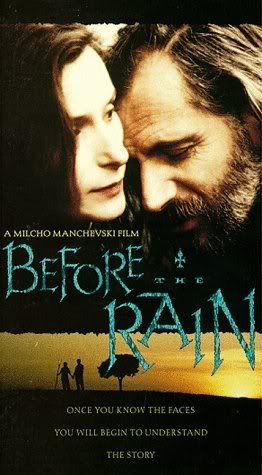
BEFORE THE RAIN (Pred Dozhdot, 1994)
Tuesday, February 17, 2009
THE YELLOW ROLLS ROYCE (1964)
This is another film of which I had only dim childhood memories before the DVD release, mostly of the posh theme music, which turns out to be the work of mondo maestro Riz Ortolani. He knows how to stick a theme in your head, because the opening music was just as I remembered it. Of the story (or stories) I remembered virtually nothing, except for the obvious, that the film was about the adventures of a particular car. But unlike the coat that links the stories of Tales of Manhattan, for instance, the car has no special quality that charms the lives of its owners -- though the manufacturer might disagree.
Anthony Asquith's film of Terence Rattigan's screenplay is an odd collection of star couplings, starting off with Rex Harrison and Jeanne Moreau. He's a diplomat and horseman who's perhaps not as attentive to the wife as he should be, but wants to make up for it by buying her a certain car. She ends up using it for a tryst with her paramour. You might understand Jeanne Moreau straying from "Sexy Rexy," -- but with Edmund Purdom? I've seen The Egyptian and the man is a block of wood. I suppose he may be a pretty block of wood, but I'm not qualified to judge such things. In any event, Rex discovers her and is heartbroken despite his horse winning the big race, and Jeanne is stricken with guilt, for she does love her husband, after all. Harrison ends up sending the car back to the RR showroom because "it displeases me."
After 20,000 miles, including mentioned but unrecorded ownership by a gambling-addicted maharaja, the car ends up in an Italian showroom, where it's purchased by Paolo Maltese, an Italian-american gangster who's come with his moll and his flunky to marry the former in the old country. George C. Scott is the gangster, Shirley MacLaine the moll, Art Carney the worldly-wise flunky, and Alain Delon is a young hustler with a street-photographer racket. The interplay among the Americans is the highlight of the film, and Asquith seems most inspired by filming on location all over Italy. This seems to be the only episode of the film in which characters actually ride in the car on location. Much of the first episode is done on soundstages, but this middle segment, the longest, takes full advantage of the widescreen scenery. Ortolani also seems more energized on his home ground, and with MacLaine as a muse (see also his score for Woman Times Seven). MacLaine is initially bored by the tourist bit despite Scott's belligerent enthusiasm, but when Scott has to speed back home to take care of business, Delon's charms awaken her sensual appreciation of all Italy has to offer -- including a rather fake looking grotto set where Delon woos her most ardently. She and we also learn the difference between immoral and amoral (pronounced "ah-moral") personalities from Carney, whose good work here makes me wonder why we didn't see more of him in movies in this decade.
I nearly forgot about the car. Once again it's used for a romantic tryst, but that big moment might as well have taken place anywhere. The unifying concept of the film is undercut by the lack of any sense of magic, even metaphorically speaking, in the title vehicle. Unless we really are meant to be simply awed by the presence of an actual Rolls Royce automobile on our movie screens, the car has little to contribute and can hardly be called a "character" in any episode. You might at least perceive a common thread in the car being a site of tragicomic trysts, for that's how the second episode turns out, too, but there's little tragic or comic about the final segment.
By 1941, the yellow Rolls has fallen on hard times in Trieste, but can still be banged into shape for use by a famously wealthy American widow, played by Ingrid Bergman. Learning of a coup in neighboring Yugoslavia that has overthrown the pro-Nazi regime, she decides against advice from the American consulate, in the not exactly authoritative form of Wally Cox, to cross the border and pay her respects to the new regime. Bergman's political sympathies are hard to grasp. She seems happy at the change of government in Yugoslavia, but otherwise seems to be a reactionary and a hater of FDR. Reluctantly she allows a Yugoslav national with a shadowy agenda to accompany her. This is the ethnically versatile Omar Sharif, adding a Slovenian, I believe, to his repertoire. He and Bergman are to be a couple, for a time, but there is no chemistry between them. She is radicalized when the Germans dare to bomb her hotel during dinner, forcing them to serve herself from the salad bar. She's also a take-charge person with a humanitarian bent. Her natural impulse is to help the wounded and injured, and that instinct inspires her to use the YRR to ferry Sharif's partisan pals back and forth along dangerous roads. Here I was expecting a heroic demise for the car, if not for the characters, but there is no such consummation, and the film ends with the venerable vehicle arriving in New York for further domestic service.
By its nature The Yellow Rolls Royce is a mixed bag. The middle episode could almost stand alone with a little elaboration, while the first one isn't really bad but seems constrained by its brevity, and the closer is just silly. I would recommend it most enthusiastically to people who like a certain kind of 60s glossiness, including the music. Ortolani got a kind of hit out of the song "Forget Domani," which sounded more familiar to me as an instrumental than with lyrics. Overall, though he lets it rip a little in the middle episode, this is a relatively tepid score, though the theme still has its grandeur. The film as a whole aspires to grandeur but works best when it aspires least.
Sunday, February 15, 2009
EL TOPO (1970)
Saturday, February 14, 2009
Memories of Missing Movies
Here's a clip from a Greek fan. I can't vouch for the subtitles.
TARZAN'S GREATEST ADVENTURE (1959) Back when American Movie Classics was a worthy and sometimes superior rival to Turner Classic Movies, the station had the rights to all the Tarzan movies. That gave me my first opportunity to see Gordon Scott as Tarzan, including this penultimate effort, which revolutionized the series. Director John Guillerman and screenwriter Les Crutchfield finally abandoned the "primitive" archetype that MGM had imposed on the character with Johnny Weismuller, permitting Scott to become a fully articulate Tarzan while at the same time giving him a more rugged story to perform in and pitting him against an incredible roster of villains including Anthony Quayle and Sean Connery. Scott rose to the occasion as "the man who lives in the jungle." He struck me as more of a Natty Bumppo type than a noble savage, though this film is arguably quite savage compared to previous kid-oriented efforts. I was knowledgeable enough about movies by the time I saw this to realize, once I saw the climactic fight between Scott and Quayle, that this was probably the nearest we'd ever get to an Anthony Mann Tarzan movie. Scott reprised this interpretation in Tarzan the Magnificent before trying his luck as a peplum star -- a career dead end, as it turned out. If the topic were top movies of my imagination, one would be the third Scott Tarzan for Sy Weintraub, a full-scale transposition of The Last of the Mohicans into post-colonial Africa. Think about it, then take a look at the trailer.
HOUSE OF CARDS (1968). I remember seeing this one fairly frequently on one of the local channels in Albany. John Guillerman returns to direct a thriller set in Paris and starring George Peppard and Orson Welles. About the story I actually remember very little. What I do recall is a very memorable score, which I learn was the work of Francis Lai, and a climactic scene on a bridge in which Welles tries to goad a brainwashed child into shooting Peppard, only to end up going over the side himself. Perhaps because it involved a killer kid, or a kid intended to be a killer, that scene made a strong impression separate from its actual cinematic merits, which we cannot verify today. While the reviews on IMDB, based on longer memories than mine, are mixed, the cast and crew list and the bare description of the story make me think that this particular landmark of the wild world of cinema might be reopened profitably. No trailer for this one, I'm afraid.I hope I've managed to stake my own territory of absence with this post. I may return to the general subject with a different emphasis on films that I've never seen, but would like a chance to see. Until then, Jeremy has a running list of contributors to the topic at Moon In The Gutter, where he's adding to his own list on a regular basis. I highly recommend a visit.
Friday, February 13, 2009
FIVE DOLLS FOR AN AUGUST MOON (5 bambole per la luna d'agusto, 1970)
Let's nail down the genre up front. Some call it a giallo, I suppose, but it hardly qualifies. As I understand it, gialli are all about creative ways of killing people. Five Dolls, however giallesque [?] the title sounds, is all about finding bodies that have already been killed, except for a few very conventional shootings at the end. Bava is said to have liked this least of all his work, and the lack of creative killing may be the reason. Still, he found ways to occupy himself, and the film is a triumph of style over substance. I suppose we could also call it a body-count film, since apart from ogling the scenery -- outdoor, architectural and female -- there's not much to do but count bodies. But body-count films are always sort of a subset of black comedy, given how audiences usually respond to them, and we're clearly meant to laugh at this film.
How couldn't you? We have ten people in the cast, four couples and two singles. The island belongs to George Stark, married to Jill, and his guests are Nick and Marie Chaney, Jack and Peggy Davidson, and Fritz and Trudy Farrell. They're gathered so George, Nick and Jack can schmooze Fritz, a professor, into selling them his important secret formula for three million dollars. The prof. isn't interested in selling; a pall hangs over the formula for him because a colleague died while they were working on it. The men's united front doesn't last long, as Nick angles to get exclusive rights to the formula and urges Marie to seduce the Professor, while people start dying, starting with Jacques the houseboy. George's yacht has vanished and his wireless telephone isn't working, so there's no way off the island and no way to communicate with the mainland. There's nothing to do but put Jacques in the meat locker, wait for other people to die, and drink. Nick does most of the drinking, since "Death makes me thirsty." He has opportunities to get quite sloshed.
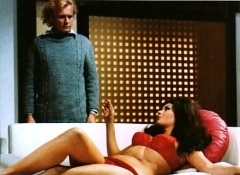
Professor Farrell (William Berger) struggles to resist all temptation in FIVE
DOLLS FOR AN AUGUST MOON (picture from images.movieplayer.it)
So who's the killer? Is it Isabel, the lone single female, who we see shooting the Professor with a rifle during a break from romping on the beach and stalking people? Well, this is the sort of movie where seeing someone shoot somebody else pretty much guarantees that she didn't kill everyone else -- or does it??? Any further elaboration of the synopsis would only spoil a plot that's pretty gamy already. This isn't the sort of film you watch for the story, and if efficient storytelling is your sole criterion of cinematic quality, you may as well stop reading.
The reasons to look at Five Dolls are the lush outdoor scenery, photographed by Bava and Antonio Rinaldi, the colorfully decadent indoor sets, and the uniformly luscious female cast, from Justine Galli as Isabel to the great Edwige Fenech as the particularly depraved Marie Chaney. The date is 1970, but this is still very much the swinging 60s, put to music by Piero Umiliani's swanky lounge score. It's still the era when it was hard to find an Italian film in which the music, at least, did not sound good. And Bava can't help but make the whole production look much more lavish than it actually was. However he felt about the story, he gets in a few excellent set pieces, including the mock human sacrifice bit at the beginning and a later sequence where we follow some spilt glass balls from the scene of a drunken fight down a flight of stairs into a bathtub where we find the latest victim. There's also one big scare moment near the end when Isabel has to nab a piece of microfilm (I think that's what it is) in the aftermath of a shootout in the meat locker -- which by that point is very well populated.This is a body count film where you're almost certainly meant to root for nearly all the characters to die. They're such scumbags, such cartoonish incarnations of the idle yet greedy rich, that you most likely will cheer on whoever's doing the killing. But at the same time you can revel in their depravity, from cavorting on a rotating circular bed to puffing a cigarette from between a woman's bare toes. This film is eye candy: pure cinematic junk food that won't make you fat -- and it's okay to laugh. If you didn't, I'd wonder....
Try this clip on for size. It's Edwige Fenech dancing, stripping, and playing the sacrifice for Kraal. While I saw the Anchor Bay DVD in Italian from the Bava Vol. 2 box set, this clip is dubbed into English for your enjoyment.
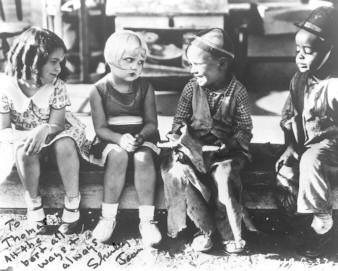
"Our Gang's" Shirley Jean Rickert (1926-2009)
(photo from www.streetswing.com)
Wednesday, February 11, 2009
Steve McQueen in NEVER LOVE A STRANGER (1958)
Francis is raised in a Catholic orphan asylum and becomes an industrious bootblack and boy of all work for one of the local pool halls. He's running with the wrong crowd, but that doesn't stop him from stepping in when the gang menaces a harmless Jewish boys. Their anti-Semitic sensors seem to be off, though, because Steve McQueen hardly seems like a Jew. Frankie saves him by putting him down with one punch, which Steve, who we'll call Marty Cabell for our purposes, appreciates as a reasonable alternative to a protracted beatdown. Marty invites Frankie to his place to teach him how to box. Frankie also gets to meet Marty's sister Julie (Lita Milan). Those clever Jews: Julie doesn't even look or sound like she's from the same country as Marty. Frankie, however, is unprejudiced, for who could be prejudiced against such a dish.
Two representative men of the 1920s: Steve McQueen thanks John Drew Barrymore for knocking him out in NEVER LOVE A STRANGER (photo from www.mcqueenonline.com)
Things are looking up for Frankie on both the romantic and criminal fronts until a shocking discovery is made. The old landlady finally hauls Frankie's mom's suitcase out from behind the closet, and inside finds a book written, as Frankie puts it, "in Jewish." A terrible mistake has been made! The well-meaning authorities seem to think it was unfair of them to raise as a Catholic someone who should have been a Jew, but Frankie sees it all differently. "I don't want to be a Jew!" he cries, and rather than face transfer to a Jewish school, he hops a freight, leaving behind a bankroll he's been keeping for his mentor Silk Fennelli (erstwhile Mike Hammer Robert Bray), with instructions for Julie to return it to Silk. Fennelli shows his gratitude by making her a nightclub singer and kept woman, while Frankie has timed his hobo adventure for the advent of the Great Depression, and lean years follow for him.
As Frankie, he returns to New York to take a WPA job, during which he is hit by a truck during a moment of inattention. He's hospitalized just as Marty, a rising young prosecutor, is visiting the building. Marty gives his old pal $20 to get him started again, and once on his feet Frankie restores himself to Silk Fennelli's service as a most trusty gunsel. After three years as Silk's right hand, Frankie's impatient to take over and establish some order in the underworld. He makes his move at a gang conference, clobbering Silk into submission and declaring himself the guarantor of peaceful crime. For reasons known only to Harold Robbins, Frankie does not exterminate Silk, but retains him as an underling while reclaiming his relationship with Julie. It will be increasingly apparent that Frankie is sort of soft.
He runs the New York bookmaking operations from the safety of New Jersey, where newly-minted special prosecutor Marty can't touch him. Marty is not exactly Thomas Dewey. His campaign to defeat Frankie consists largely of meeting him at restaurants or calling him on the phone and asking him nicely to turn himself in. Otherwise, he waits for Frankie to slip up and step across the river. Meanwhile, Silk looks for some way to avenge his humiliation. He doesn't like Frankie's indulgence toward Mosh, a Jewish numbers man who wants to retire. Silk thinks Mosh should die because there's too much chance of him turning rat, but Frankie trusts the old man. Finally, Silk weaves a plot to eliminate Mosh, Frankie, Marty and his sister in one Corleonian swoop, with help from Flix the hitman (Peckinpah stalwart R.G. Armstrong). I'll skip to climactic details except to bring us back to that careening car from the opening, then forward once more to another birth and the continuation of the Kane lineage.
I think this is meant as some sort of gangster tearjerker. Everything from the omniscient narration and the lachrymose theme song to the sentimental score by Raymond Scott (otherwise a powerhouse composer) and the circle-of-life finale point that way. It certainly tries harder at that than it does to recreate the 1930s on screen. Maybe the filmmakers thought the period was close enough to the present that people wouldn't notice anachronisms, but more likely they just lacked money. The director, Robert Stevens, worked mostly in television. IMDB credits him with 44 episodes of the Alfred Hitchcock show. Going to 90 minutes may have been beyond his powers. His direction here is efficient but uninspired, lacking forcefulness or momentum.
The acting throughout is pretty green. If you didn't know McQueen on sight you might not accuse him of stealing scenes. His job is to be dully earnest and he earns his pay. He is at least competent. It's hard to judge Barrymore apart from the implausibilities of the character he plays, but I think he could have handled better material. Neither actor embarrasses himself, but they look pretty silly anyway, trapped in such a silly story. The title should have told me not to expect anything really raw or violent, but the DVD did hint at something like that. This film probably exists in digital form only because McQueen is in it, playing what's apparently his first billed role, so it's historical interest is obvious, but I'm afraid that there's little of interest apart from that unless I've made it sound campy enough for an unintended laugh.
Of the book, its original publisher reportedly said: "it was the first time he had ever read a book where on one page you'd have tears and on the next page you'd have a hard-on." If so, Robbins did not do justice to his own work this time.