Showing posts with label Kobayashi. Show all posts

Wednesday, September 11, 2013

Masaki Kobayashi's BLACK RIVER (1957)

Kobayashi's black river is an asphalt road servicing an American military base in occupied Japan. On one side, the sort of establishments that attract soldiers looking for a good time, almost a stripmall of sleaze. On the other, the small timers, the losers, the hustlers. Along this street of dreams and nightmares two men vie symbolically for the soul of Japan. Nishida (Fumio Watanabe) is a poor but earnest engineering student with a cartload of books. He meets cute with Shizuko (Ineko Arima) when she picks up some of the books that fall of the wagon as he moves into the neighborhood. But Joe, aka Joe the Killer (Tatsuya Nakadai) has eyes on her as well. He's the local gangster fattening off the corruption around the base. He wants to cut a deal with the landlady across the street (Isuzu Yamada) to buy her property, drive out Nishida and the other poor tenants, and build a "love hotel" for the GIs. He wants Shizuko for himself and he's got enough dangerous charisma -- this is reportedly the part that made Nakadai a star -- to get what he wants. Joe's old girlfriend makes it a quadrangle by latching onto Nishida, leaning on him like a crutch in the woozy quasi-chase scene that climaxes the picture, just as Joe leans on Shizuko further up the road.


Modern jazz plays over the Shochiku logo and the abstract, collage-like credits. The funky shapes of the English-language clippings may remind you as much of Picasso as of Saul Bass, and we see and hear it all as cool -- but does Kobayashi see it the same way? Black River is a loathing portrait of an abject nation or people on the make or on the bum, where getting someone to stand up for someone else is like pulling teeth. In defeat, solidarity is dead. You can't even get a wife to give blood to her dying husband without her throwing a fit of protest. Even Nishida, our nearest thing to a good guy, is reluctant to give blood. The miasma of desperate selfishness is catching. The efforts of a Korean tenant to rally his neighbors in defense of their rights are hopeless. Culture is dead; America's mark is everywhere. A neighbor asks to borrow some of Nishida's books, but he doesn't care which ones. He just wants to make an impression on his visiting dad. Another neighbors idea of a housewarming gift is a nudie poster. You get the idea.

 
Ineko Arima and her suitors:
Fumio Watanabe (above) and Tatsuya Nakadai (below)


Amid the grime Nakadai is radioactive, though it's another character who identifies himself, in a belligerent mood, as Godzilla -- and that's twice in two movies in the Criterion Eclipse box set that Kobayashi has invoked the Toho blockbuster of just a few years before. You can see why Nakadai caught fire here; next to his thuggish sexuality Watanabe looks feeble, and in the end it's Nishida but Shizuko who destroys Joe. She pushes the drunk in front of a truck, metaphorically drowning him in the black river that keeps on flowing despite the demise of the scapegoat. They killed the bad guy but the tractors still knocked down the apartments.


This is half Streetcar Named Desire, with Nakadai as Brando, and half Grapes of Wrath, with Watanabe as an intellectual, ineffectual Tom Joad. You get the poverty and wretchedness and demolition scenes without the speechifying about the people, so maybe some will like this better. There's plenty to like in this noirish skid-row screed against a nation of sellouts, but there's something generic about it that Kobayashi and Nakadai would transcend in their greatest films together and other directors would top when contemplating the corruption of occupation. This jazzy jeremiad may be too cruel to be cool but Nakadai gives it the juice to stand the test of time.

Friday, August 16, 2013

I WILL BUY YOU (1956)

What's the best baseball movie ever made? American fans have many possible answers -- my own pick would be John Sayles's Eight Men Out (1988) -- but foreign baseball films never enter the discussion. Who here has seen any? The American release of I Will Buy You with the Criterion Eclipse collection Masaki Kobayashi Against the System was my first chance to see one. I knew that Japan had made baseball pictures -- the American game is one of their national pastimes. Even Toshiro Mifune put on a uniform in the 1955 film No Time For Tears, and for all I know the Kobayashi film is just the tip of an iceberg of Japanese baseball films. There may be baseball movies from Cuba and elsewhere in Latin America worthy of consideration as well, but that's a subject for another time. For now, it's arguable that as the auteur of The Human Condition, Harakiri, Kwaidan, etc., Kobayashi is the greatest director ever to make a baseball movie -- unless you count John Ford for the two baseball-themed TV programs he directed. Everything depends on how you define a baseball movie. If you define it narrowly as a film in which the dramatic climax is a baseball game, the field becomes very limited and Kobayashi is out. I Will Buy You is actually something closer to Sweet Smell of Success on the baseball diamond: a rat-race noir lamenting the corruptions and compromises of commercialized existence.

 
A noirish entrance into a twisted world

Kobayashi's film chronicles the intense competition among several professional clubs for the collegiate star player Goro Kurita (Minoru Ooki). College baseball in Japan was apparently a bigger spectator sport in the Fifties than its American counterpart was -- or is today, compared to college football or basketball. Speculation over whom Kurita will sign with becomes a sports-media obsession, making this black-and-white movie seem very contemporary for modern viewers. We root by default for the Toyo Flowers, whose scout Daisuke Kishimoto (Keiji Sada) is our protagonist. We first see him on a long trek to sign another prospect from the provinces, who ends up useless because he's lost a finger in an accident. That adds to the pressure to bag Kurita, but to do so Kishimoto has to butter up Kurita's personal coach, the dyspeptic Ippei Kyuki (Yunosuke Ito). Kyuki claims to hate everyone except his meal ticket Kurita. He spurns Kishimoto's gift of fine sake because he's on medication, but Kobayashi allows a suspicion to build that Kyuki is at least partially shamming as part of his emotional manipulation of Kurita and his family. Goro's brothers are self-interested negotiators in their own right -- Kishimoto equates one of them with Godzilla in a telling early acknowledgment of a rival studio's blockbuster from two years before. Kyuki claims that the family authorized him to negotiate exclusively on Goro's behalf, but opportunities arise for everyone to change their minds. Complicating the negotiations further are the Taniguchi sisters, girlfriends of both Kyuki and Kurita. The rival clubs will play Kurita's friends and relatives against each other, each thinking he or she has a special influence on Goro, but none having as much as any thinks.

 
Above, Kishimoto makes Kyuki an offer he can refuse.
Below, is Kyuki's agonized farewell at the train station just a game?


Resuming its modern role as America's top pupil after World War II, Japan shared Americans' postwar perplexity at the rise of the "organization man" or "salaryman," as if the white-collar vanguard were Nietzsche's dully decadent Last Men if not something more sinister. There's something quaintly naive in the shock expressed in this era at the prevailing "business is business" attitude, and I Will Buy You can't help but seem very quaint in its horrified discovery that baseball is a business. The real horror, however, isn't so much the system but the way the cogs turn on one another in pursuit of personal advancement. Kobayashi remains conscious throughout of the emotionally manipulative nature of the material, and he manipulates it cleverly, keeping you wondering how sick Kyuki really is and thus walking a melodramatic tightrope.  The payoff feels almost unintentionally ironic; after everyone has tried to manipulate Goro's choice to suit their selfish interests, he ends up making a decision pretty much for his own baseball-based reasons. Yet Kobayashi has so immersed us in the emotional urgency of all the competing interests that Goro ends up looking like a selfish bastard. The moral can only be that the "system" has made a tragic outcome inevitable by pitting everyone against each other and flourishing on that competition. Inevitably it seems overwrought, but maybe our judgment is jaded. It's possible that in our complacence over what "business" requires of us that we need to go to the past to see the present with fresh eyes. I Will Buy You is minor Kobayashi and no rival to the best American baseball movies, but to the extent that this Japanese picture mirrors our own sports culture, it may still make you think about how our culture or our attitudes have changed in half a century or so -- for better or worse.

Sunday, July 28, 2013

THE THICK-WALLED ROOM (1953-56)

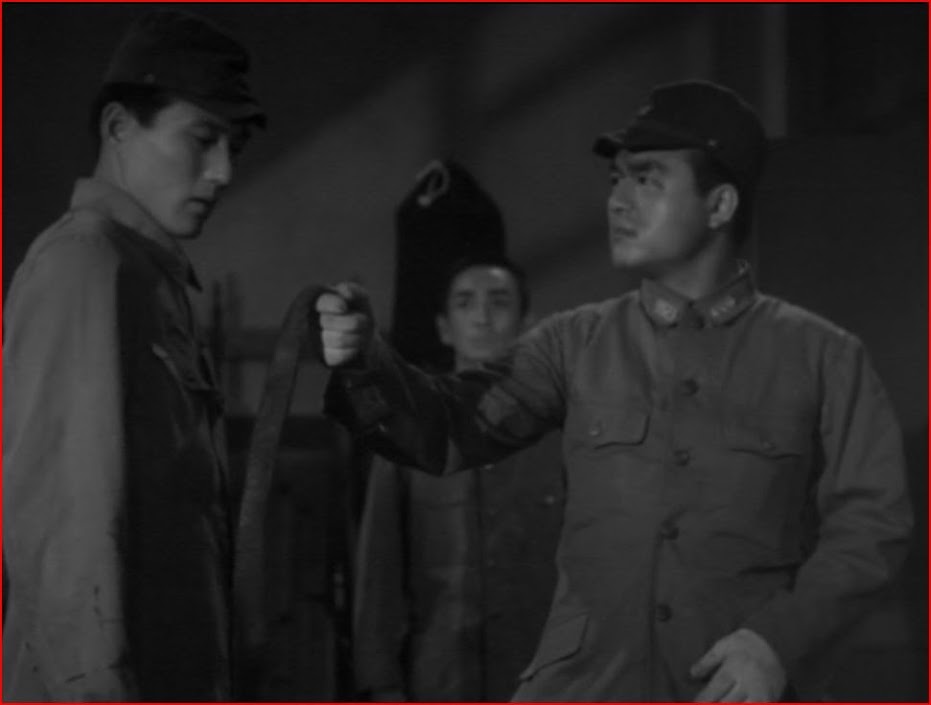
In some ways, Masaki Kobayashi's Kabe atsuki heya is a dry-run for his three-part World War II epic The Human Condition. Set in a prison for "Class B" and "Class C" Japanese war criminals, it may be best grasped as a film noir variation on themes from the longer film. Its protagonists, as Kobayashi sees it, are taking the fall for their superiors. Sure, some of the top guys took the fall themselves -- in an early scene some prisoners indulge in literal gallows humor in the chamber where Tojo was hanged -- but but many others are prospering while the men who obeyed the orders rot in prison. The liner notes for the Criterion Eclipse DVD claim that the Shochiku studio shelved Thick-Walled Room for three years from fear of offending the American occupiers, but while our boys aren't exactly flattered by the film -- and some of us have strangely Slavic accents when actors speak English on screen -- Kobayashi is really pointing the finger at his own people.


The film focuses on the six occupants of one cell. The two main characters are Yamashita (Torahiko Hamada) and Yokota (Ko Mishima). Yamashita's unit took shelter in a native hut on a South Pacific island late in the war and accepted dinner from its friendly occupant. Yamashita's commanding officer doesn't trust the "savage" not to rat them out to the Allies, so he orders a reluctant Yamashita to kill him. When he's somehow fingered as the killer after the war, Yamashita hopes that his commander will absolve him by admitting responsibility at the trial, but the officer, who soon becomes a peacetime politician, proves a rat and a liar. Yokota is an intellectual who served as a translator in a camp for American POWs. His commander forces him to flog a prisoner who dies soon afterward. Whether for that reason or simply for being a camp guard, Yokota is stuck in prison, where he reads Oscar Wilde's prison writings and causes a scandal when he smuggles news of an escape attempt by Yamashita to his brother, a Communist agitator.


Yamashita longs to take revenge on his old commander, and he seems to get his chance when, despite his escape, he gets a one-day furlough. He confronts the frightened man but sees the face of the native he killed when he thinks of killing another man. Conscience-stricken, and also conscious of the trust his fellow prisoners placed in him, he spares the old officer and closes the picture by telling his buddies, "I'm back."

If you've ever seen the American film noir Act of Violence, think of Yamashita's storyline in Thick-Walled Room like that film told from the point of view of Robert Ryan's avenger rather than Van Heflin's guilty victim. 


If Yamashita ends up on the road to readjustment, others aren't so lucky. Another prisoner in the cell is tormented by surrealist dreams of atrocities and finally hangs himself, while Yamashita had only joked of growing a beard -- despite a warning that Americans don't like facial hair -- so he could use it to hang himself. Symbolically, he shaves the beard for his furlough. If Kobayashi himself seems to sympathize with the opinion that the war-criminal prison doesn't purge crimes from humanity, but purges humanity from the crimes, Yamashita's story gives cause for hope, demonstrating that not everyone need be crushed by the ordeal. The Thick-Walled Room is an effective appeal for equitable treatment of Japan's veterans, a plea against killing the spirits of the rank-and-file while the higher-ups make different kinds of killings in the new economy. In his third-directed (though not third-released) film, Kobayashi is stretching his pictorial muscles -- maybe even invoking Citizen Kane when a prisoner sees snow inside a crystal to trigger a flashback -- while keeping the film grounded in the personal stories of the principal prisoners. It ended up one of three 1956 releases for the director now included in the "Masaki Kobayashi Against the System" collection, followed by the baseball drama I'll Buy You and the more noirish-sounding Black River. Look for reviews on this blog in the weeks to come.