A randomly comprehensive survey of extraordinary movie experiences from the art house to the grindhouse, featuring the good, the bad, the ugly, but not the boring or the banal.
At age eighty, and after more than fifty years of filmmaking Marco Bellocchio is arguably the elder statesman of Italian cinema. In the 21st century he's become an intermittent chronicler of Italy's 20th century. His latest film is a companion piece with his 2009 Mussolini film Vincere and his 2003 Aldo Moro-Red Brigades picture Good Morning Night. The "traitor" of this one is Tommaso Buscetta (Pierfrancesco Pavino), Italy's answer to Joe Valachi: the first man who spilled the beans on organized crime in his country in a major way. This happened in the 1980s, after Buscetta, a career criminal and ex-con, decided to leave the business and move to Brazil, where he had done "business" before. Relatives who remain in Italy, including two sons, are killed in a Mafia war, while the Brazilian government accuses him of drug trafficking. The Brazilian government of the day didn't play around; they try to force a confession by threatening to throw Tommaso's wife (Maria Fernanda Candido) from a helicopter into the ocean. Whether he had anything to confess or not, Buscetta ends up back in Italy, where he decides that he has actual stuff to confess to crusading prosecutor and eventual martyr Giovanni Falcone (Fausto Russo Alesi). He becomes the star witness at the so-called Maxi Trial, which becomes the film's central spectacle. For non-Italians, the unusual trial procedures stand out, particularly allowing defendants to cross-examine witnesses. This makes possible dramatic confrontations between Buscetta and his former colleagues, who naturally call him a liar when they aren't heckling him as a cuckold from their cages in the rear of the vast courtroom. Buscetta holds his own in these encounters -- though he fares less well later when he lobs accusations at politicians who clearly can afford better lawyers than mafiosi can -- but he hardly can enjoy his victories when the bosses are convicted. He knows all too well that the Mafia's reach and memory are long. Exiled in an American witness-protection program, he retreats from New Hampshire to Colorado after a restaurant singer in a Santa costume serenades him in Sicilian dialect as if he were the coward Robert Ford. To the day of his peaceful demise he has to remain on guard, because he knows the Mafia like he knows himself....
Accustomed as U.S. audiences have become to expansive, seemingly comprehensive Scorsese-style chronicles of crime, Il Traditore can't help seeming incomplete no matter how well made and performed it mostly is. We're likely to become conscious of gaps or omissions as Buscetta clarifies his motives for informing. He tells Falcone and the judges at the Maxi Trial that he still considers himself a "man of honor" but that his peers, particular Salvatore Riina (Nicola Cali) were the true traitors to the traditional values of La Cosa Nostra by going all in on the heroin trade, regardless of its cost to their own families. Something can't help but seem missing when Buscetta repeatedly reiterates how Riina has ruined La Cosa Nostra, yet Riina has a relatively minimal presence in the film and we see very little of the "golden age" Buscetta idealizes -- which we definitely would see in a Scorsese epic -- before Riina took over. Rather than show this idealized past, Bellocchio challenges us to take Bruscetta's word for it or question his actual motivation. The director presents the past in non-linear fashion rather than giving us a conventional rise-and-fall narrative. The film's flashbacks aren't self-consciously narrated by Bruscetta, but arrive more like unfiltered memories, though one important reminiscence midway through the picture is interrupted and only taken up again at the very end. An exception to the general rule is a flashback to the murder of Buscetta's sons, based on the testimony of a new informer who took part in the killing. This scene, and Buscetta's reaction to the testimony, suggest guilt over abandoning his children to almost certain death as the his ultimate motive, since his indifference to whether they joined him in Brazil belies his claim that his real family ultimately mattered more to him than the Mafia family. In the end, I think, Bellocchio is too careful to offer a perfect "Rosebud" explanation for Buscetta's "treason." He keeps a certain distance from his subject that is arguably European if only by comparison to Hollywood's insistence on definitive answers. Overall, I rather like Favino's performance for its comparative understatement. He makes Buscetta seem like a real person rather than an archetype. I don't know if Favino and Bellocchio have given us the "real" Buscetta -- alternate presentations seem possible -- but they did make me want to know more about the man, and that should count as some kind of success.
It's good to see that the Italians can still come up with wacky verbose titles to their movies. This time we have to assume that the title sounds funny on purpose, since Pierfrancesco Diliberto's film is a comedy. As "Pif," Diliberto is a popular TV personality in Italy, apparently a satirical news reporter of the sort we see on cable TV in the U.S. His first movie as writer, director and star is a satire of Italian crime and politics from the 1970s into the 1990s, as well as a kind of romantic-comedy bildungsroman that equates coming of age with coming to terms with truth. Pif takes a potentially treacherous path juxtaposing comedy and real-life tragedy, as if Forrest Gump had been witness to the political assassinations of the American Sixties, and he manages to pull it off with style.
La mafia uccide tells the story of Arturo (played by several actors, finally by Pif himself), whose life has been shaped since conception by proximity to crime. Pif means this literally. As Arturo's parents consummate their marriage, a St. Valentines-style massacre -- with hitmen disguised as cops -- is being staged nearby. As a CGI cartoon demonstrates, nearly all the father's sperm are frightened away from the mother's egg by the gunfire, but one little sperm, the slowest of all, carries on to fertilize the egg that will become Arturo. Throughout, Arturo will be something of a slow learner, but when he finally speaks his first word, it's the most dangerous one possible in Palermo.
Arturo grows up in a land where everyone evades the truth. Mafia killings happen all the time, it seems, but are always blamed on disputes over women. In this environment of awkward evasiveness, Arturo becomes an awkward child with a strange fixation on Giulio Andreotti, the longtime leader of the Christian Democratic Party. Between this film and Paolo Sorrentino's Il Divo, an outsider can conclude that Andreotti was Italy's Nixon, a figure defined as much by his physical and emotional awkwardness as by his ethical shadiness. It's hard to tell whether Pif is riffing on the real Andreotti or on Tony Servillo's Andreotti in Il Divo by having Arturo dress up as Andreotti and mimic his peculiar mincing, hands-folded shuffle for a costume party. The boy looks a little like a vampire with Andreotti's pointed ears and wins the costume contest, albeit by mistake; the judges thought he was the Hunchback of Notre Dame. Arturo seems to empathize with Andreotti's awkwardness, starting with a TV appearance in which the premier describes making a marriage proposal in a cemetery. The rest of the film will trace Arturo's very gradual disillusionment with a man who did much, it seems, to keep Italy in denial about the Mafia. Andreotti was a cold character, apparently. When other politicians flocked to the funeral of a Mafia victim, he told reporters, "I prefer to go to baptisms."
Illusion.
Diliberto establishes a pattern and sticks to it, keeping Arturo (and his lifelong beloved, Flora) at the edge of violent history. Arturo aspires to be a journalist and wins a reporter-for-a-day contest for one of the city newspapers; the award ceremony is interrupted by news of the latest killing. In his new role, the boy will sneak into a government compound to interview an important police official, challenging him with Andreotti's assertion that the real crime problem is anywhere but Sicily. Arturo will be one of the last people to see him alive. Later, Flora (Ginevra Antona as a girl) has to leave the country with her father on short notice, while Arturo scrawls a love note on the sidewalk in front of her apartment building. We see her finish packing her clothes and dragging her suitcase out of her old room; seconds later her window shatters from a car bomb. Later still, the adult Arturo, making ends meet as pianist to a Franco-Italian talk show host, is passed by motorcyclists while riding in a car with his employer, whom the bikers recognize as a celebrity. The camera follows the motorcycle as it turns onto another street so the bikers can kill a politician. Again, it's a delicate balancing act in terms of tone, but the comedy is actually funny and the history is appropriately horrific.
Reality.
As the mafia wars escalate with the rise of a particularly nasty boss, Toto Rinna, Arturo can no longer believe Andreotti's evasions and denials. In turn, he has to disillusion Flora (Cristiana Capotondi as an adult), who has become a naive Christian Democrat operative handling a particularly unpromising candidate. Arturo gets involved in the campaign but proves incompetent as a partisan stooge. He nearly blows his latest chance to score with Flora by criticizing the anti-crime speech she's written for the candidate. He's never said anything like this before, he says bluntly, so why should he start now. Yet for all the candidate's weakness he's still unacceptable to the mafia; he's the man the motorcyclists kill. There are still more killings to go before mass revulsion spills becomes mass action that finally unites hero and heroine for good. Diliberto closes the show on a note of earned poignance. Arturo is going to raise his own son differently from how he was raised. We see him taking the boy on a tour of all the memorials to the people murdered -- characters he's met and others in the background -- by the mafia, and we end with a collage of news clippings honoring Italy's anti-crime martyrs. Pif's mix of comedy and grim history might seem insensitive to overly sensitive audiences in the U.S., but his success on his first try as a cinematic satirist has me looking forward to whatever he may do next.
Consider the source: Duke Mitchell was a Sinatra wannabe marketed as a Dean Martin clone and paired with a Jerry Lewis clone, Sammy Petrillo, at the height of the original pair's popularity as a team. Early on, Mitchell staked a claim to cult-movie history by co-starring with Petrillo in Bela Lugosi Meets a Brooklyn Gorilla, one of the most sublimely self-explanatory titles ever. After Jerry Lewis litigated Petrillo into oblivion, Mitchell stuck to live performance, declaring himself "King of Palm Beach." By the 1970s, the man born Dominic Micelli was a Johnny Fontane who wanted to be Sonny Corleone. He had caught something of the zeitgeist of the time, both prideful and defensive about his Sicilian heritage. Massacre Mafia Style seems intended as an answer to The Godfather, a film criticized by Mitchell's character, who bears the actor's real family name. Mimi Micelli feels that the character of Don Vito Corleone is based on his own father, "the Padrone," who's been insulted by Brando's clownish portrayal of the don in retirement. Mimi rails against the stereotype of the Sicilian as a gangster, complaining that none of the other ethnic types with whom Sicilians interact in the underworld are so stigmatized. At the same time, he condemns himself and his peers for giving enough reality to the stereotype to disgrace their innocent, long-suffering mothers. This self-criticism comes in the middle of a mad-dog spree during which Mimi tries to muscle his way into control of the numbers and prostitution rackets in Los Angeles, escalating his tactics from kidnapping to indiscriminate slaughter. Part of his campaign is the murder on live television of the spokesman for a Sicilian anti-defamation league modeled on Joe Colombo's quixotic real-life movement in New York and Colombo's near-assassination at a public rally. As a filmmaker, Micelli/Mitchell protests the stereotyping of Sicilians as gangsters by making as nearly stereotypical a Sicilian gangster film as possible. His is a conflicted message, though less generous observers might call it incoherent.
But the funny thing about Massacre Mafia Style is how much the neophyte Mitchell's work resembles that of not just Coppola but Scorsese. The resemblance to the latter, whose most recent film was Mean Streets while Mitchell shot his picture, is stronger yet almost certainly coincidental. Mitchell opens his film in what we'd now recognize as Scorsesean fashion, with a shock sequence that actually takes place in the middle of the story, scored to ironically chosen pop music, from which he flashes back to the beginning of Mimi's American adventure as narrated by the protagonist. The opening is a brazen if not bravura sequence in which Mimi and his partner Jolly (Vic Caesar) walk into a high-rise office to kill a businessman. They set him up to be electrocuted by the flush of a urinal, then decide that they leave no witnesses in the entire office suite. The film earns its true title -- it was also known as Like Father Like Son and, most popularly on videotape, The Executioner -- right here. Whatever budgetary limitations Mitchell labored under, he was never short of squibs and blood packs. This film is almost absurdly bloody, but Mitchell stages other creative kills, from the crucifixion of a pimp (scored to the Hallelujah Chorus and staged near the Hollywood Bowl) to the impalement of an enemy through the back of the head with a meathook that comes out through his eye ("He's hanging around in there," Mimi quips bondishly). Mitchell was clearly trying to have it both ways, as if the exploitation-level violence would cover the tirades against Sicilian stereotypes, or vice versa -- or else he never really figured out what he was trying to do or say. But Mitchell clearly has something to say, and that's something that distinguishes the truly great bad movies. I'm not ready after one viewing to say this is one of that group, but Massacre definitely touches a lot of the bases.
Mitchell's own unintimidating personage -- balding on top but hair all he way down his neck, enhanced later in the story (thus already present in the opening) by a moustache that made him resemble late-stage Rock Hudson slightly -- maintains a constant of absurdity through the whole picture, especially when Mimi scores with babes who go nude for him. Memorable moments abound; another is a rival's attempt to intimidate Mimi and Jolly with a karate-expert bodyguard who chops through a coffee table, only to be riddled immediately with bullets by the unimpressed pair. The script is baldly racist, at least in the words it puts into Mimi's mouth, and in a manner not necessarily alien to the style of Mitchell's Italo-American peers, and Mitchell dependably carries the bigotry to an absurd extreme by having Mimi rant about the proliferation of blaxploitation films with "Super" characters. Some of this is genuinely ugly, like the crucifixion of the black pimp with the commentary, "He said Jesus was black; maybe he can get a resurrection," and Mitchell isn't good enough a writer to make clear whether this represents his own deplorable attitude or an attitude he deplores in Mimi. One way or the other, it's still a kind of truth-telling that makes Massacre a perhaps-unconscious self-revelation and enhances its cult-film credentials.
Films like this are often mocked for their low-budgets, though in this case Mitchell often manages to maximize his production value with decent location work, but the true cult-film fan is more impressed by the ability of marginal figures like Mitchell to get feature films made at all. On that level, Massacre Mafia Style is a kind of epic achievement, and its rise-and-fall narrative (including Mimi's attempt to go straight by becoming a shot-on-yacht porn producer) has an appropriate sub-Scorsesean sweep. For every Scorsese or Coppola there may have been a million Mitchells monkeying around on typewriters trying to do the same thing. You'd have to figure some of them would come close to something, and seeing how close Mitchell came in many ways was a fascinating experience.
In Little Italy a man meets in secret with a policeman, risking his life to inform on la mano nera, one of the extortion gangs that terrorized Italian-American communities at the turn of the twentieth century. The man describes two individuals who threatened him, only to see them step out of the closet. The dead body in the closet belongs to the cop who's been killed, and whose uniform is now worn by a gang leader (Marc Lawrence) who watches the informant die by the knife. The Knife was the working title of Richard Thorpe's period thriller for M-G-M, a picture whose reputation has suffered due to the presumed-inappropriate casting of Gene Kelly as the initial victim's son, grown up and returned from a sojourn in Italy to seek revenge. True, Kelly is ethnically inappropriate for the role of Johnny Columbo, but those who think him unfit for the material may never have seen his turn as a psychopath in Robert Siodmak's singular noir musical Christmas Holiday. Kelly can do grim, and he does it nicely here in a tense early scene when he plies a mobbed-up bartender with drinks while pumping him for information and promising a later meeting that can not go well. But when he goes to the man's apartment, the bartender is already dead and a cop is waiting for him. J. Carroll Naish plays the policeman largely based on real-life Italian-American crimefighter Joe Petrosino, and the actor, normally nutty with accents and soon to be reviled, so it's said, by real Italians for his stereotyped performance on the Life With Luigi show, does something surprising here. Surrounded by actors doing Italian accents (Kelly isn't one of them), Naish tones down his own mannerisms, opting for more of a tough-guy New Yorker voice with variable hints of accent. His character tries to steer Columbo from the path of vengeance and toward lawful crimefighting through the patient collection of evidence. Together they try to start a citizen's group to combat the Black Hand, but the gangsters give Kelly a savage beating to make an example of him, breaking a leg (as if to signify that there'll be no dancing this time) and leaving him scarfaced for the rest of the movie.
As Kelly recuperates and studies law, Naish increasingly dominates the picture, stating its editorial viewpoint in a heavyhanded courtroom speech as he tries to convince a terrified witness to identify his tormentors. Luther Davis's screenplay actually attempts a sophisticated analysis of immigrant attitudes, asserting that they don't trust the state to protect them because they had no experience in the old country of government looking out for their interests, but adding that American government circa 1908 wasn't really doing all it could have to protect the poor from predators in their midst. Davis's problem is that he puts all of this in Naish's big speech rather than illustrating it through incidents and dialogue. But the picture is a thriller, not a social critique, so it can survive that shortcoming. Kelly reclaims the initiative after Naish is killed in Palermo just as he mails documents identifying certain New Yorkers (including the Lawrence character, now posing as a concerned citizen) as wanted criminals in Sicily. After the Black Hand kidnaps the baby brother of Columbo's girlfriend to intimidate Columbo into surrendering the documents, our hero realizes that he has time, before the package actually arrives, to track down the kidnappers and rescue the boy -- as long as he and his knife can get frightened or stubborn people to talk....
Kelly isn't very convincing as an Italian-American, unless you accept him as a model of assimilation, and his character is written erratically, careening between the paths of law and revenge, but he still makes an effective thriller hero, while Thorpe makes an effective thriller director. He stages several suspenseful sequences of people stalking each other along noirish streets, as well as one brilliant bit when Kelly is clocked over the head with a full, open pail of beer. The beer splashes over the camera lens, quite effectively representing the hero's slide into unconsciousness. Paul Vogel's cinematography is appropriately shadowy and menacing, while the overall production design makes a nice effort at recreating the slum environment on the M-G-M lot. Black Hand is a well-meaning movie intended to honor Italians' Americanization, but some may detect a whiff of McCarthyism (in advance of the Senator's own emergence as a Red-hunter) in its insistence on the need to testify against enemies in our midst. It should have a place in cinema history as an early and earnest attempt (not counting films from the actual period) to portray gangsterism before crime really got organized.
A dramatic sequence of events in the fall of 1957 made the existence of a national Mafia more difficult for public officials to deny. Reports of the barbershop assassination of Albert Anastasia and the police raid on an apparent crime conclave in Apalachin, NY, whetted appetites for more information about the shadowy crime organization. But before Joe Valachi's 1963 testimony before a congressional committee very little was known about the institutions and inner workings of the Mafia. Into the breach stepped the Premium Pictures company, screenwriter Orville H. Hampton and director Edward L. Cahn, who released Inside the Mafia in 1959. Cahn was a Poverty Row visionary with a vast filmography of hackwork and a handful of primitively prescient pictures. His sci-fi film It! The Terror From Beyond Space has been recognized as a precursor of Ridley Scott's Alien, while the mindless marching masses Cahn directed in Creature With the Atom Brain and Invisible Invaders anticipate the zombie attacks of George A. Romero's films. Does Inside the Mafia similarly anticipate The Godfather and the mafia genre that followed Francis Coppola's film? The answer is a flat no. Working apparently from utter ignorance of the actual Mafia, Cahn and Hampton can't hope to approximate the ritual dynamics and familiar intimacy of post-Valachi movies. Instead, Inside is strange not in any premonitory way but as a work of crass naivete, and insulting in its pretense of telling the true story of the events leading to the Apalachin conference. The tone is set from the start when Apalachin is redubbed "Apple Lake," while Anastasia is replaced in the fatal barber chair by one Augie Martello (Ted de Corsia), who does not die, at least not right away. Secreted from an insecure hospital to a safe house, Augie lives to give his blessing to a plan of his lieutenant Tony Ledo (Cameron Mitchell) to take over the entire national crime organization. Ledo's idea is a decapitation strike against the long-exiled mastermind Johnny Lucero (Grant Richards) -- whacking him when his plane lands at the Apple Lake airport. Lucero is an amalgam of real-life boss Vito Genovese and the already-legendary Lucky Luciano, whose stature as an exile longing to return to America haunts a number of postwar crime films. For Ledo's plan to work, he must take control of the little airport. That means taking the man who runs the place and his family hostage, making them operate as if nothing is wrong so as not to alarm Lucero or anyone else. Instead of a Mafia expose, the picture becomes a rip-off of Suddenly, the picture in which Frank Sinatra takes a household hostage so he can shoot the President from their window. The imperiled family and their unlucky friends are a dull lot, but the gangsters are hardly less dull. The often manic Mitchell, here at the tale end of his peak period of Hollywood stardom and on the verge of a more productive sojourn in Europe, brings little to his role, while Robert Strauss (best known as Animal from Stalag 17) contributes most of the violence, including a few karate chops. The plot twists when Ledo learns from the TV that Augie has finally succumbed to his wounds. His plan takes a 180 degree turn; he now intends to convince Lucero that he's the man best qualified to run the organization in Lucero's name. His ploy seems to work, but there are a few twists left in the tale, while the hostages strive to free themselves, knowing that they must die otherwise. Everything ends in an Apple Lake bloodbath that the film claims "actually happened." Don't you believe them. Their claim is as viable as Criswell's at the end of Plan 9 From Outer Space, and their film is far less entertaining from that one. Inside the Mafia is exploitation of the worst time, completely lacking in inspiration and seemingly guided by the assumption that once their title had you hooked, they owed you nothing more. That kind of filmmaking ought to be a crime.
Damiano Damiani's based-on-real-events Mafia melodrama is a kind of companion piece to his earlier literary adaptation Day of the Owl (aka Mafiain the U.S.) in its emphasis on the power of organized crime over ordinary people. It differs from the pessimistic Owl in its celebration of one young woman's rebellion not just against crime but an entire social order. Damiani and his writers were inspired by the story of Franca Viola, who defied taboos by accusing of rape a mafia crony who had kidnapped her and violated her in the expectation that she'd marry him or face unendurable shame at the loss of her honor. Viola and her parents defied mafia intimidation to see Franca's attacker brought to justice, and her case led to changes in Italian law eliminating a man's right to absolve himself of rape charges by marrying his victim. In Damiani's version Francesca Cimarosa (14 year old Ornella Muti in her film debut) has a more lonely struggle for justice that suggests an attempt to identify her with the larger radical youth movement. She's targeted for marriage by an ambitious young mafioso, Vito Juvara (Alessio Orano), whose mentor has advised him to take a wife as soon as possible, preferably a poor girl. Vito goes through the motions of courtship, chasing away one possible rival, but expects Francesca to fall for him unconditionally. But especially after she witnesses a mob hit in the middle of a busy street, the girl has qualms about her suitor. His increasingly impatient dismissal of her questions doesn't exactly endear him further to her, and finally she jilts him on the day they were supposed to get their marriage license. By then he's willing to blow it all off, finding her more trouble than she's worth, but after rival gangsters mock him he decides he's got to regain respect by taking her by force.
Vito takes some godfatherly advice (above) and applies it to Francesca (below)
Owing to Muti's age (she was given her stage name to evade child-labor laws) the rape is presented with almost classical reticence. The real horror comes afterward, when Vito practically drags her to an "engagement party" surrounded by piggish relatives and criminals. Damiani and Ennio Morricone make an interesting choice here to score the engagement party to the same music that played over the mob hit, emphasizing the moral horror of the experience for Francesca. Finally she can't take any more and runs away. Defying not just Vito but the expectations of the entire community, including her parents, Francesca denounces Vito to the carabinieri for kidnapping her. The cops have been trying to bring Vito down throughout the picture but initially refuse to take Francesca seriously. They take her less seriously, however sympathetic some officers may be, when her parents and little brother -- he was kidnapped with her -- contradict her account of the incident. The parents plainly fear Vito, while the brother has a fantasy of killing him when he grows up. Meanwhile, the community regards Francesca as a dishonorable stool pigeon.
After reading the Wikipedia account of Franca Viola, I noticed a significant difference in Damiani's fictionalized variation of the theme. In the movie, Vito threatens to burn down the Cimarosa family barn, where the results of a year's labor are stored, unless Francesca recants her testimony. In the Viola case, the mafia did burn the barn. In Most Beautiful Wife, Francesca herself torches the place as a scorched-earth rebellion against her cowardly father. Her thought is that if they have nothing to lose, her parents will no longer fear testifying against Vito. It's the film's most radical statement, a repudiation of the materialism that reduces people to dependence upon injustice, and for her trouble her father repudiates her utterly. The townsfolk continue to shun her as both a stoolie and a fallen woman, and even the local priest advises her to submit, marry Vito, and not worry about finding happiness in marriage. The only people willing to take her side are Vito's gangster rivals, who talk about bringing him to justice but actually want her to set him up for a hit. He survives the attempt, but can't prevail over Francesca. When her parents finally crack after seeing another girl beaten up for siding with their daughter, their corroborating testimony dooms Vito to prison. The film ends on two curious notes. Preparing to depart for prison, Vito smacks one of his cronies who calls Francesca a filthy whore. Then Francesca sees Vito taken to jail, and as her friends gather round to hail her as a hero, she bursts into tears.
La moglie piu bella is more concerned with emotional than physical violence. It's less an exploitation picture than an unlikely blend of the mafia genre and the sensibility of Samuel Richardson, the 18th century English novelist who specialized in portraying young women of embattled virtue. It works largely because of Muti's precocious intensity as a girl whose compassionate outrage -- she's the only one who approaches and attempts to comfort the hit victim in a panicking crowd -- is stronger than fear. Damiano isn't a flashy stylist, but in collaboration with cinematographer Franco Di Giacomo and production designer Umberto Turco he frames the action for maximum dramatic impact in authentic locations.
The picture pays respect to an ideal of justice but ends up a kind of tragic thwarted romance as well. Why does Vito never have Francesca killed, after all? Alessio Orano gives a suggestive performance as a character trying to play a role but ultimately tiring of it, incapable of following through one way or another. Throughout the picture Vito and Francesca argue over how to respect each other. The film leaves the impression that Vito finally respects her, and that the respect may be mutual, and even more than respect, however late it comes. Damiani may have a larger point to make about the true basis of the real respect on which a just society must be founded, but his film should work for any viewer -- even the English dub is passable -- as a personal drama of courage prevailing against heavy odds.
TheGialloGrindhouse has uploaded an English-dubbed trailer to YouTube. Take a look.
In the 1970s, it seemed to be a commonplace of movie criticism that any movie, whether American or Italian, that advocated tougher police methods against crime was "fascist." The charge probably carried more of a charge in Italy, where fascism was born and living people knew what it looked like. As if to make a point, director Pasquale Squaltieri made Il prefetto di ferro about a cop getting tough on crime during the actual Fascist era. It's hard to be sure what the exact point was meant to be in the original pop-political context of Italy's turbulent Seventies, but from a distance the point seems at least partly to do with dissociating crimefighting with fascism, to show that real fascists weren't necessarily the most enthusiastic or relentless crimefighters. The ironic effect is to give us a real-life hero who, by the standards of Seventies critics, was more "fascist" than the fascists themselves.
Cesare Mori was not a fascist himself, and a point made in his favor during the film is that, in his years as a prosecutor he had been willing to go after fascist lawbreakers. Despite his perceived opposition, Mussolini sent Mori to Sicily to recreate some success the incorruptible official had had years before the fascist takeover. As prefect of Sicily, Mori (Giuliano Gemma) had carte blanche to root out the Mafia and all bandit gangs who plagued the island. In the film, Mori's task is complicated by how deeply embedded organized crime has become at every level of society, and how dependent so many poor people are on bandits and mafiosi. Mussolini's mandate goes against the interests of local businessmen, landowners and clergy, who rely on gangsters to keep the peasants and rabble in line. The local bishop asks mafiosi to help put protesting farmers back to work, complaining that Mori's efforts may make common people unafraid of traditional intimidation. But nothing stops the "iron prefect" until after he's routed the low-level gangsters, having cleaned one hilltop town out house by house and tunnel by tunnel, and begins to go after the upper echelons of society, picking up a trail that leads to Fascist officials. Fidelity to facts prevents the typical Seventies finish, as Mori is merely kicked upstairs into a powerless Senate, while the very official he was pursuing is appointed to his place in Sicily.
From the confrontations of horseback bandits and farmers (above) to the posing of dead bandits for publicity photos (below), I Am the Law often resembles a spaghetti western actually set in Italy.
Given Sicily's backwardness, only the occasional shots of automobiles and fascists remind us that I Am the Law takes place in the twentieth and not the nineteenth century. That makes for a picturesque period piece with much more action on horseback than I expected, given a modern thrust and urgency by Ennio Morricone's score. An aged-up Gemma is impressive as the unflinching Mori, who is not above calling out and blowing away a mafioso all by himself. He gives the part the right blend of stiffness and stubbornness for the rest of the cast to play off of -- particularly Claudia Cardinale as a bitter mother who sees more harm than good done for the poor by the prefect even while decrying mafia rule. The overall impression is that, in Fascist Sicily, the Mafia is just one among many contending and occasionally collaborating predators. Destroying one doesn't liberate the people, and it may be impossible to destroy them all by police methods alone.
From the perspective of Italian cop and crime movies, Il prefetto has it both ways. It gives audiences a hard-ass, no-compromise lawman to cheer for, while assuring skeptics that any war on crime is just a clash between styles of authoritarianism. By taking the leftist equation of crimefighting with fascism to its historical reductio ad absurdam, Squaltieri arguably refutes it.
As a young Warner Bros. producer, Hal Wallis helped get the studio's legendary gangster genre going with Mervyn LeRoy's Little Caesar. More than forty years later, Wallis was the one surviving producer of that era to get a post-Godfather crack at the genre, producing this adaptation of a Marvin H. Albert novel for his independent unit at Universal. As a matter of fact, there's something old fashioned about The Don is Dead, a melodramatic element and an emphasis on romance, however brief, that dates the picture just as much as its aping of The Godfather in other respects.
Directed by Richard Fleischer in the midst of his last interesting run of films -- it follows Soylent Green and precedes Mr. Majestyk and Mandingo -- the film traces the repercussions of a don's death. The late Don Regalbuto was one of three Mafia family leaders in his unnamed city, and while his son Frank (Robert Forster) is poised to inherit, members of the national Commission question whether the reckless hothead -- he'd nearly been ambushed making a heroin deal in the opening scene -- is ready for the responsibility. Orlando (Charles Cioffi), the consigliere of a jailed don, proposes dividing the Regalbuto territory between his boss and Don Angelo (Anthony Quinn), while Angelo himself sweetens the deal by naming Frank heir to his own family. During the transition, the Fargo brothers, Vince (Al Lettieri) and Tony (Frederic Forrest) are allowed to become independent operators, albeit on call when the dons need their services. The Fargos are Frank's friends and had saved him from that ambush, but Tony is tiring of the life and wants to get out of the business.
Almost at first sight you can tell that Orlando is a backstabbing schemer -- he talks too smoothly, for one thing -- and he's soon at work driving a wedge between Angelo and Frank. His master plan, if you can believe it, is to provoke a romance between Angelo, a lonely middle-aged man, and Frank's girlfriend Ruby (Angel Tompkins), an aspiring singer-songwriter, while Frank's in Italy making a drug deal. Angelo is implausibly moved by the treacly tune he hears on Ruby's demo tape, and she reciprocates his promise to promote her career by sleeping with him. Had Angelo been as central a character as Quinn's star billing promised, we might have gotten more buildup of his emotional life or prior lack of one, to make his crush on Ruby plausible. But since there's no real main character here, and no one person's perspective dominates, Angelo's romance looks exactly like what it is, a creaky plot device of the sort you might well have seen during Wallis's salad days in the Thirties and Forties.
Of course, when Frank returns he gets an anonymous note telling him that Ruby has moved into a new apartment provided by a new sugar daddy. He tracks her down, trashes her apartment, and beats her to a pulp. An enraged Angelo orders a hit on Frank, then has second thoughts, but too late to prevent a parking-garage ambush that kills Frank's consigliere and makes a gang war a certainty. The Fargos are drawn into it, Tony very reluctantly, and when Frank agrees to a meeting that's an obvious deathtrap without waiting for Tony's advice, he ends up getting Vinnie killed. From this point, Tony emerges as the central character, tracing a Michael Corleone-like character arc from smart, reluctant hood to cold, ruthless crimelord, with the unctuous Orlando standing in his way....
The Don is Dead struck me as a doubly old-fashioned film, despite Seventies style bloodshed and a suspenseful, often sinister modernist score by Jerry Goldsmith. There's something hokey about the whole using-a-woman-to-manipulate-rivals storyline, all the way through to the abrupt, almost arbitrary deduction that exposes Orlando's scheme. At the same time, this film, made in the shadow of The Godfather, reminded me of the obsolescence of the Puzo-style narrative focusing on the highest echelons of organized crime. Fleischer's film is like Coppola's in its formality, emphasizing the often stilted rituals of mafia deliberations as an illustration of the "just business" parallels of crime and corporate culture. In the same year, 1973, Martin Scorsese's Mean Streets would begin to make that style of crime film obsolete. From then on, American cinema's focus would begin shifting toward working-class organized crime and its vulgar excesses. American audiences seemed more interested in seeing criminals claw their way up than in watching them reign as a shadow ruling class. By the standard Scorsese set, Don is lacking in aggression and animal spirit -- even a proverbial Seventies beast like Al Lettieri is toned down while playing a relative good guy. Nor, of course, does Don stand comparison with the Godfather films. Fleischer puts together a few suspenseful moments, but some parts are shockingly inept, like Lettieri's death scene that obliges the actor to stumble into and topple over not two but three stacks of crates. The film has a terrific cast of character actors who do well here, with the conspicuous exception of a pretty bad Robert Forster as Frank, but Don never accumulates the power it should have. Given its historic pedigree and the opportunity Hal Wallis had to realize a synthesis of the Warners tradition and the Seventies sensibility, that's a damn shame.
Fans of WildEast's spaghetti western and Eurocrime DVDs may be disappointed by Damiano Damiani's adaptation of Leonardo Sciascia's literary mystery novel The Day of the Owl, just as American moviegoers may have been disappointed when it hit U.S. screens under the utterly generic title Mafia in 1970. For Americans, that name carries connotations of urban crime -- indeed, of American crime -- that have nothing to do with Sciascia's story of small-town Sicily. "Eurocrime" fans, meanwhile, are unlikely to be satisfied with a story that has very little action of violence beyond its opening killing. As well, fans of Claudia Cardinale -- the star of this WildEast double-feature disc -- may be disappointed with the relatively little she has to do in a film that gives her top billing, made at the peak period of her stardom, at the same time she got top billing over Fonda, Bronson and Robards in Sergio Leone's Once Upon A Time in the West. But having laid down all these caveats, I found Damiani's film modestly effective as an atmospheric mystery and a critique of systematic corruption in Italy.
The mystery is the shooting of an honest contractor in the road-construction business in a sun-baked Sicilian town. Most people's first instinct is to ignore the crime; a busload of passengers would have looked right past the corpse had a carabinieri officer not also been on board. A young detective from "the north," Bellodi (Franco Nero) is the new officer in charge in town, a position that we soon realize is a revolving door to futility. The local mafioso, Don Mariano (an unwell-looking Lee J. Cobb) has seen the authorities come and go while he remains in power. I mean that literally: Mariano's house in the center of town and carabinieri headquarters look out at each other across a little public square. Bellodi presumes Mariano to be behind the killing of a businessman who wouldn't play ball with the mafia, but he has no evidence yet. However, the killing took place in plain view of the Nicolosi house, and as it happens the man of the house has disappeared, leaving his wife Rosa (Cardinale) alone. Has he left because he was the killer, or was he removed because he saw something he shouldn't have?
It's good to be the Don; Lee J. Cobb presides over his Mafia fiefdom
Bellodi's methods are manipulative if not Macchiavellian. With further evidence unlikely to turn up, he has to resort to trickery and outright lying to get people to open up or betray themselves. He tells Rosa that her husband has been found dead -- a lie -- just to see how she'll react, who she'll instinctively blame. Later, he'll confront crooks with fake confessions, hoping that they'll tell the truth if they think their pals are tossing them under the bus. His strategy is to compel someone into thinking their only option is to finger the real killer of the contractor or reveal where Nicolosi can be found. But his adversaries are just as good at lying as he is, if not better. They want Bellodi to believe that Nicolosi killed the contractor because the victim was having an affair with Rosa. When Bellodi deduces a different story and has Mariano and his cohorts arrested, the remaining mafiosi form a united front with an indifferent criminal justice system (Mariano is on good terms with the local ruling party) to overwhelm Bellodi's case with their own perjuries. Before long there's a new sheriff in town, so to speak, but a victorious Mariano finds himself missing Bellodi, whom he could at least respect as a worthy foe. The new man, like so many others, strikes the Don as just another "quack-quack-quack" -- like his own minions who quack in amused chorus when the worst is over. Maybe the story should have been called Day of the Duck.
Franco Nero goes incognito (right) for his meetings with the informer Parrinieddu (Serge Reggiani, left)
Given the cast and the literary pedigree, Mafia is no B-movie or genre picture and doesn't strive for sensationalism. We have the one shooting, and one corpse found later, and an attempted rape of Cardinale's character that doesn't go very far. Damiani's film stands or falls on conventional dramatic terms. On the director's part, the real strength of the picture is its sense of place. The square with the police station and the Don's house at opposite ends and characters constantly going in and out of jail or paying court to Mariano, is an ideal and picturesque dramatic space. On the outskirts of town, Tonino Delli Colli's cinematography gives you a strong sense of the wide-open, sun-blasted and grungy environment of road construction, the mundane business of a small-town mafia.
The cast is a mixed bag. Cardinale maintains a sullen glare for most of the picture, though she wears it well, but her character's ultimate helplessness makes little lasting impression. Cobb operates well short of full-blast, but with that voluble character actor that can sometimes be a good thing. It's wise to underplay, too, when character actors like Serge Reggiani (as an informer), Nehemiah Persoff (as a sleazy contractor) and Gaetano Cimarosa (as a really voluble gangster) are acting up a thespian storm around you. The real weak link in the cast is Franco Nero, who strikes me as too young for his role and too lacking in authority or cunning. He spends most of the show in his carabinieri uniform looking smug. That may be how his character was written in the original novel, but in the movie it provokes a feeling of pointlessness. For its original Italian audience, the most disappointing thing about Il giorno della civetta may have been the co-starring of Nero and Cardinale with a complete lack of romance between the two superstars.
Mafia is not a great mafia movie, but it's an interesting pop-culture artifact of 1960s Italy. In a way, it may have been a necessary prelude to the tough-cop movies of 1970s Italy, since it can't help leaving audiences frustrated at the triumph of injustice and probably wishing that someone would just lash out at organized crime. Damiani's film portrays something closer to the glum reality against which cinema would react with a vengeance.
As censorship receded around the world in the 1960s and afterward, the U.S. embraced sex while Europe embraced violence. This is a very broad generalization, but I'm still grappling with the importance of cruelty and brutality in European popular cinema and some of its art cinema. In many cases, it seems to be a kind of reality principle, a sign that the filmmaker is trying to tell it like it is. It's a conscious rejection of romantic idealism and enforced optimism, a crude antithesis to the romanticism often expressed in the films' own lush and soaring scores. What were audiences supposed to make of it all? We assume that they got a kick out of the violence, but how did they react to the worldview, the cynicism and pessimism that so often prevail in these films? In historical films, I've described it as an acknowledgment of the injustice that prevailed in the past, whether in medieval Europe or in the savage border country of spaghetti westerns. What about cruel pictures set in the present day? Did audiences accept those as truth-telling exposes of modern injustice? Were these films consciousness-raising exercises or did they contribute to conservative complacency? Did they tell viewers that there was no hope in a violent world, or did they suggest that violence was the only answer?
Watching Andrea Bianchi's brutal Mafia potboiler, whose Italian title translates literally as "Those Who Matter," I couldn't help wondering whether people were meant to enjoy the experience, or whether they were supposed to be satisfied by recognizing some sort of violent truth in the derivative story. In fact, the story is derivative of spaghetti westerns. It has the Fistful of Dollars/Yojimbo/Red Harvest element of a protagonist playing two factions off each other. It also has the Once Upon a Time in the West element of a killer who performs his own theme music with mysterious significance. Instead of playing a harmonica, Tony Aniante (Henry Silva) whistles an enigmatic, strangely amplified tune while enemies stand about stupefied or confused until Tony steps out of cover and shoots them. He's an American gangster sent to Sicily to settle a local squabble over heroin, some of which was being smuggled inside of "cut up babies." He also has an agenda of his own, hinted at by the whistling and the occasional black and white flashback to some scene of uncertain relevance. Tony is not quite a spaghetti western bounty hunter transplanted to Seventies Sicily, however.
Silva gives a laconic, tightly wound, uncomfortable performance. He talks (dubbing his own voice) in a stilted way, as if keeping in sync with the rest of the cast (dubbed with other people's voices). His delivery gives lines like, "I am a damn good driver!" an unintentional mock gravitas. Silva seems to have worn the same yellow shirt through the entire shoot in steamy Sicily, often under a jacket, and you can believe that every sweat stain is real. There's something robotic about Tony Aniante, but you eventually realize that this is self-restraint, that he's keeping something essential about himself in check -- and not just his secret revenge agenda.
Margie (Barbara Bouchet) hints ever so slightly that she's attracted to Tony
Margie (Barbara Bouchet), the trophy wife of one of the rival gangsters, challenges Tony's resolve with some of the least subtle come-ons in movies. She comes across like a character out of a soft-core sex comedy, pouring milk over herself and sucking a banana to get Tony's attention. She gets it, in spades. Tony likes it rough, it turns out, if he can even be said to like it. It's enough to drive her wild the first time, and he can't get her out of his mind. He daydreams of her while her husband plots strategy with him, but he clearly resents his own desire. Maybe it just gets in the way of his job and his secret agenda.
He warns her to stay out of his way but she won't listen. The next time he gives her all he's got. He beats the crap out of her with his fists and both ends of his belt before raping her in a barn. Not long afterward, she kills herself. Notified of this in the middle of a final showdown with her husband, Tony says, "I'm sorry," but by then his own problems have escalated and he's a bloody, sweat-stained mess in his own right. Even if he gets out of this predicament, he still has his own business to settle, and that flashback to explain....
But how can you root for Tony after what he does to Margie? Is it a mitigating circumstance that he has a murder in his past to avenge? I doubt it. But I also question whether Italian (or later American) audiences were meant to cheer as Tony destroys Margie. The rape scene strikes me as an instance of cruelty as a reality principle, a refusal to turn this tough crime picture into a romance. We're supposed to be satisfied to have it confirmed that Tony is a vicious beast, and that such men tend to prevail, however implausibly in plot terms. Tony's behavior probably serves to confirm a worldview viewers already had. They could tell themselves that this film didn't insult their intelligence -- though their sense of cinematic taste might still be a casualty.
It's hard to judge Quelli che contano as a cinematic experience on the evidence of the Substance DVD. This pan-and-scan edition of the American dub looks like a VHS tape that's been dragged out of the earth. The picture quality is on the level of a Mill Creek DVD -- though many Mill Creek editions actually look better. Somehow, the presentation seems appropriate to the content. Cry of a Prostitute is an experience that should be as little aestheticized as possible. Whatever virtues it has shouldn't be dependent on lighting, vivid color or balanced compositions. At its worst, morally speaking, it's riveting in an appalling way, as if part of the point is the way the film dares you to watch. That's in keeping with Italian exploitation, if not with the wider European cinema of cruelty. Whether you care to watch depends on whether you think the truths of these films are worth telling, or whether they're the truth.
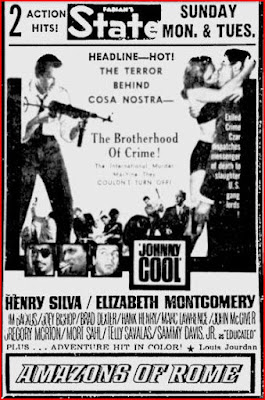
Here's a minor example of the Rat Pack aesthetic, produced by Peter Lawford and featuring Sammy Davis Jr. on screen and on the soundtrack, as well as Joey Bishop as a car salesman. The director is an odd choice for what proves to be a very hard-boiled crime story: William Asher is probably best known for the AIP "Beach Party" cycle of eccentric teen comedies. Those films have their virtues (I watch 'em for Harvey Lembeck, the celebrity cameos and girls in bikinis, in no particular order) but those don't necessarily translate to a tough Mob tale. Asher may explain why we see such unlikely gangsters as Jim Backus and John McGiver, though by comparison they manage to make Elisha Cook Jr. look respectable as a higher-ranking mafioso. Asher definitely explains why we have Elizabeth Montgomery as the ingenue. They were married and on the brink of Bewitched at this time, so this is the Montgomery who showed dramatic potential (to me, at least, in retrospect) as the mute soldier waging a solo postapocalyptic war against Charles Bronson in a Twilight Zone episode. All of these people seem like strange company for the star of Johnny Cool: the mighty Henry Silva in a rare bit of top billing. Silva had built up a nice resume of action roles (we've seen him in The Tall T and The Bravados, among others), but he may also count as a sort of protege of the Rat Pack, having been one of the original Ocean's 11 and an antagonist for Sinatra in The Manchurian Candidate. Asher's film may have been Lawford's attempt to boost a deserving player's career, but it didn't quite work out.
Adapted from a novel, The Kingdom of Johnny Cool, by John McPartland, the film follows the fortunes of Salvatore Giordano, a thinly disguised version of Salvatore Giuliano, of whom I'll have more to say after my next Netflix shipment arrives. Giordano is a bandit who grew up in the hard climate of World War II Sicily and has ever since defied both the government and the mafia. An American reporter (Richard Anderson) manages to land an interview with him just before the hammer finally comes down. Silva in beard and sunglasses is a strange, Joaquin Phoenix-like visage, albeit more personable, but that thankfully doesn't last. Giordano somehow ends up on foot chased by a helicopter. Brought down, he's replaced on the ground by a double whose impersonation is enhanced by having his face blown off, while Giordano himself is whisked away and left in the opulent study of one John Colini (Marc Lawrence), a deported American gangster on the Lucky Luciano model. Colini likes Giordano's style, ruthlessness and resiliency and has deemed him the right man for a mission of revenge against the gangsters who ratted him out and stole his power and fortune. The exile still has the power and means to send Giordano on a Grand Tour to learn the ropes of international organized crime. To make his intentions clear to the Americans, Colini gives the cleaned-and-duded-up Giordano both his name and his nickname, "Johnny Cool."
From there, the film is a cross-continental rampage as "the new Johnny Cool" takes out Colini's enemies, the biggest of whom is played by Telly Savalas, which is more like it for this kind of movie. Along the way, Salvatore/Johnny picks up a groupie, Dare Guinness (Montgomery), a society girl who falls for him after watching him beat a man up in a nightclub. Her vulnerability complicates his mission, especially when two goons pretending to be cops (Joe Turkel's one of them) employ the tried-and-true rape method of interrogation on her while Johnny's busy cleaning out a gambling den by forcing eyepatched dice-master "Educated" (Davis) to roll winners at gunpoint. Discovering Dare is dishabille and disarray, Johnny coolly marches back where he came from, finds the two offenders in a parking garage, and gets medieval on them. Undeterred, Dare becomes Johnny's accomplice and driver in a plot to blow up another gangster. She weakens, eventually, as a traffic ticket causes her plans for a final rendezvous with Johnny to unravel. For his part, Johnny's resolve is jolted when another victim warns him that Colini will destroy him eventually the same way he's using Johnny to destroy his old allies. He decides to double down, following through on Colini's revenge while plotting Colini's own demise so that he, Salvatore Giordano, will rule the American Mafia, little realizing that Dare has already sealed his fate, one that seems accurately described as living death....
Johnny Cool plays out like a delusion of grandeur, with Silva an impossibly invincible army of one until he's betrayed by a woman. It's a story in the Public Enemy or Scarface mode, measuring how far one man can go on guts, cunning and violence, but it never feels as deceptively convincing as those films. It's not Silva's fault; he proved himself quite capable of playing such a role in numerous Italian crime films during the 1970s. The problem with Asher's film is its overall tone. From the casting of comic character actors to the Batman-like music from Billy May and the godawful theme song sung by Davis, Johnny Cool seems to want to be a straight drama and a send-up at the same time. When it finally settles on the former with a brutal finish and a grim coda as Dare turns herself in, it doesn't have the tragic power it should have. Johnny's reversal of fortune is so abrupt and absolute that it only leaves you stunned. I'm sure everyone involved felt badass ending the film that way, but I just felt manipulated in a way that wouldn't be as bad if the film had maintained a more consistent mood.
Silva is perfectly fine at what he does, while Montgomery is stuck with a thankless job playing a character that audiences will despise by the end of the film. At least she's attractive and reasonably convincing in the role. The depth of character acting here is impressive on paper, but not many of the actors have that much to do. Savalas isn't yet fully himself as a personality (he isn't fully shaved yet, either) and doesn't get to do much beyond giving orders and dying. Sammy Davis makes a weird impression in his one scene, while Bishop makes none beyond his car pitch. If the Rat Pack (albeit the B team) really brought anything to Johnny Cool, it was most likely bad taste, or a quality that we recognize from a distance of decades as camp. Henry Silva deserved better.
Italians loved to put long titles on their movies back in the day. The original tag for this Alberto de Martino film is I familiari delle vittime non saranno awertiti -- "The families of the victims will not be notified." It didn't reach the U.S. under its present handle until after Telly Savalas had become a TV star on Kojak several years later. Earlier in the decade he was doing a lot of interesting or at least eccentric work in Europe, from the flamboyant Cossack in Horror Express to the title psychopath in Redneck. Here he plays what would eventually become the title character in a story about the yearning for family and the related obsession with betrayal and revenge within the Sicilian Mafia.
Antonio Sabato the Elder is the actual star of the picture. He plays Antonio Mancuso, a young man who grew up outcast in the underworld because his father had been whacked for being a traitor. He's desperate for acceptance by a mafia family, but when he finally gets an opportunity he grows suspicious. He's ordered to kill a man who just happens to be the person who denounced Antonio's father years ago. Antonio figures out that the target's actual enemies want to hide their hand and blame the killing on Antonio's own urge for revenge. It would be better for them if Antonio were killed after doing the deed, but he outsmarts his employers and gets paid before leaving the country for Hamburg, where his brother Nicola has been operating as a pimp.
The Mancuso brothers aspire to more honorable work, but how do they earn their way into the orbit of Don Vincenzo (Savalas), who runs the local mob? They come up with an elaborate scheme to trick some of Vincenzo's drug runners, stealing their drug bag and replacing it with a duplicate, "losing" that in a police chase, and then "retrieving" the real bag and returning it to the Don at his estate. Vincenzo sees no reason to befriend Antonio, and slugs him when the upstart insults his underlings, but his gut feeling tells him to trust the young man and bring him and Nicola into the family.
The brothers do a lot of dirty work for the Don, including delivering one offender to a soap factory to be sent home to his mother by the bar, but they feel like men of respect at last. Antonio's family ties promise to grow closer as he falls for Vincenzo's niece Monica (Paola Tedesco), an insolent young woman who openly defies her guardian and even snatches cigarettes out of his mouth. We learn that she bears her uncle a grudge because she blames him for the death of his brother, her father. Antonio responds to her vengeful spirit, fends off her attempt to flog him, and has his way with her, crowing that they share the same blood. It doesn't seem like the thing to say to a woman you're screwing, but he doesn't mean it that way.
Paola Tedesco and Antonio Sabato in post-coital conversation
Don Vincenzo has a bad heart and it seems to be making him behave erratically. The other European bosses become convinced that keeping him in charge in Hamburg is bad for business. Despite Antonio's warnings, Vincenzo insists on doing things his way. Determined not to be a betrayer, Antonio convinces himself that Vincenzo is the real traitor to the organization and agrees to plot his destruction. Monica betrays Vincenzo by revealing his location in a private hospital, and Antonio and Nicola hijack a Feuerwehr ambulance to storm the facility and take out the Don. In the end, Antonio will lose one family and gain another, but the film concludes on an abrupt note of uncertainty about his future and his need for children to avenge him just in case....
Compared to de Martino's crazed Canadian crime epic Shadows in an Empty Room, Crime Boss is a temperate if not tepid film. It never goes over the top, but as a character-driven film it doesn't really need to. De Martino and Lucio Battistrada's story's major flaw is its overstatement of the relationship between Sabato and Savalas. When the latter, cornered and about to die, tells Sabato that he loved him like a son, and Sabato cries in reply that "I loved you too!" we haven't really seen much in the film to prove these claims. Most likely de Martino needed such a scene to sell the parallel between Sabato as a reluctant betrayer of a father figure and Paola Tedesco's Monica as a ruthless betrayer of blood kin. Tedesco, whose career began as Pier Paolo Pasolini's Salome in The Gospel According to St. Matthew, steals the picture as a sexy schemer with a frustrated lust for power. If she had only used a gun she could have earned admission into the international Seventies pantheon of amazons and valkyries. By comparison, Savalas gives a relatively restrained performance by his Euro standard, while Sabato is acceptable but not compelling as the antihero. Francesco de Masi contributes a likable score, and the film is full of (for me) fascinating footage of Rome, Hamburg and other points of interest.
On a stylistic note: Now that's a jump cut!
A public domain item in the U.S., Crime Boss is available in several cheap packages. It can be found in VideoAsia's Thug City Chronicles collection, along with several superior Euro-crime items, but Mill Creek Entertainment's version in its Suspense Classics collection is preferable for being letterboxed, though it starts the film in the middle of the opening credits, leaving out the actors' names. I familiari delle vittime lacks the intensity and panache of the most entertaining crime movies from the place and period, but it has just enough story to hold your attention for an hour and a half that passes easily enough.
Alain Delon was talented enough as a performer that he did not get typecast as a hitman despite his tremendous and iconic success in such a role in Jean-Pierre Melville's Le Samouraifrom 1967. Yet here he is as a hitman again in a Franco-Italian co-production directed by Duccio Tessari, the maker of Three Tough Guys, and it's another role that stresses the Delon character's isolation. This time, though, the isolation is forced upon him, and the film roots for him to transcend it.
Tony Arzenta has a wife and a small child. On the day of the boy's birthday Tony has to leave in the middle of the party to kill a man. Since he is not some fantasy character who can successfully juggle a career of murder with bourgeois family responsibilities, he lets his boss (Richard Conte) know that he wants to retire. Both men realize that this is a cliched situation, and that however Conte feels, the mob isn't going to let Arzenta just walk away. Sure enough, despite some feeble protest from Conte, Arzenta is targeted for death by car bomb. Guess who borrows the car?
Conte is disgusted by the botched hit, but presses forward, telling an underling that the blood of Mrs. and Master Arzenta can be washed away only with Tony's blood. At the same time, he admits openly that if Arzenta kills him he'll deserve it for killing Tony's family. And that's what Tony intends to do, despite the warning from a friendly priest that "God's anger is far greater than yours, and so will be his revenge." Unfortunately, Tony has nothing else to do with his life. His family and his killing work had been everything. He lets his home go to pieces as he broods and plans his revenge, so that even his one remaining buddy can't help noticing the dust on the coffee table. This is a film with very conscientious art direction that emphasizes Arzenta's spiritual emptiness and his inability to function normally without a good woman in his life. One will come along (in the form of Carla Gravina), but until then a cat-and-mouse game spreads across Europe from Milan to Copenhagen as the cops look on, rooting for Tony to do their work for them, and mobsters use him as a pawn in their own power games. But as Tony warms to a potential new love, Conte tires of the game, having never really liked it, and looks for a peaceful resolution. The promise of reconciliation and a return to normal life, however, leave Arzenta at his most vulnerable to men's revenge if not to God's....
Delon leaps into action more than once during a vigorous stint as Tony Arzenta.
Videoasia's widescreen copy of Tony Arzenta in the Thug City Chronicles collection is a revelation of Duccio Tessari's directorial vision. I knew him only for Three Tough Guys, which Videoasia presented some time ago in a nasty looking standard-frame copy. Here we can see the command with which he can film stylish or barren interiors as well as vast urban spaces. He's an energetic director who really puts Delon through his paces, but he also effectively envisions Arzenta's muted yet self-consuming grief. He also gets a fine performance from Richard Conte, who lent gravitas to all manner of crime roles in the Seventies, most notably as Barzini in The Godfather but in numerous Italian films as well. Conte did his own dubbing, while Delon, who at least mouthed the film's English dialogue, is dubbed by another actor. That's probably what makes Conte's work stand out, but he also has an intriguing character to work with, one who's unrepentant about the vicious things he does or orders people to do, but still clearly doesn't like having to do them.
Duccio Tessari worked with cinematographer Silvano Ippoliti and production designer Lorenzo Baraldi to achieved the diverse settings of the film, from the coldly modern to the richly sleazy.
The action scenes are terrific, most notably an ambush in a Copenhagen square and a brutal shooting on a train that sends Arzenta's victim halfway through a window, to be smashed repeatedly against passing pillars and posts. Tony Arzenta can be elegant at one moment and vicious in the next, but that's the character's world, or the one he's stuck in once his dream of domestic bliss is destroyed.
Like many European crime or horror films, this movie has some almost incongruously sentimental theme music, this time from Gianni Ferrio. But Tessari's film may be the textbook example of why this music works. The sentimental (and in retrospect almost heartbreaking) theme song expresses Tony's own romantic hopes, and we find him playing some similarly sentimental music on what I take to be a primitive Euro 8-track player later in the film. The music expresses the emotions and longings that Tony can't, or can't allow himself to, and if some Euro movie music has something close to a Muzak feel, that's probably not accidental either. In those days, here in America as well, we were surrounded by lushly romantic, sentimental music as we went about our shopping or our office work. That music expresses an idealism that mocks our everyday experience, and we can imagine Tony Arzenta hearing it everywhere he goes, not on the soundtrack but in his own landscape, as he tries to assuage his emptiness with vengeance.
Tony Arzenta is one of the better European crime movies I've seen from the Seventies. It may not seem very ambitious at first glance (especially if encountered under its official alternate title, Big Guns), but fans of Alain Delon, at least, will not be disappointed with it, nor will Euro crime fans. And having looked at it twice in two days, the second time on the computer to harvest screen caps, I can say that it rewards multiple viewings with nuances that may be overshadowed by the spectacular mayhem the first time through. Not everyone needs to see a lot of European crime films; for them, Tony Arzenta should be on the short list for the genre.
Here's an Italian trailer uploaded by jonnyredeyes and including that theme song.


 I
I


 C
C