Showing posts with label Rollin. Show all posts

Tuesday, October 16, 2012

LIPS OF BLOOD (Levres de sang, 1975)

While the rest of Europe made what I call "swinging Gothic" horror films in the 1960s and 1970s, Jean Rollin comes closer to just plain Gothic. His is a Gothic manner befitting his own time, however. Some of his films are period pieces, but Lips of Blood in particular portrays nostalgia, and arguably criticizes it, rather than being a mere exercise in nostalgia. It creates a fitting setting for nostalgia: a modern France of bland parties, workmanlike sexuality and abandoned storefronts. The present day, for Rollin, already seems to be in a state of decay, dark and empty but for monuments where killers living and undead stalk the few hapless seekers. Why not yearn for a fantastic past as Frederic (Jean-Loup Philippe) does, like a sleeper awakened, when he happens to see a photo of an old castle at a party? The picture stirs long-buried memories of a night spent huddled under a borrowed shawl in the castle, and a friendly girl who comforts him and sends him home in the morning. Yet Frederic's mother says he never spent a night at such a place. And what's up with her? We saw her during the opening credits supervising the disposal of several bodies, still-breathing figures dumped into coffins that are nailed shut. It looks like sinister work, but is it?


For some strange reason Frederic isn't satisfied with life in Seventies France (above), but longs for a gothic past.

The rest of the film is Frederic's struggle to fully recover his memory of the chateau. He begins to see the mute girl from the chateau, at among other places a movie theater showing Jean Rollin's Nude Vampire. The visions draw Frederic to open the coffins we saw at the start of the picture, which have bats inside them now. Before long, vampires are stalking the city and helping Frederic in his quest when not feasting on victims. Frederic needs help because people are out to get him. A woman confronts him and claims to be the girl from the chateau, now middle-aged; she leads him to a house and locks him in a room until the vampires rescue him. He's shadowed by a gunman who corners him at a large fountain until the vampires distract him by turning on the sprays. He's thrown into a mental hospital until the vampires disguise as nurses and spring him. But dumb luck puts a postcard in his hand that identifies the old castle, still the mystery girl's home. He find her in a coffin as his mother finds him, and the truth comes out. The girl is a vampire who infected the other vampire girls who've been helping Frederic. Mom and her vampire-hunter pals will take care of them, but Frederic has to resist the temptation to free his memory, or else the plague of vampirism will break out anew.


Spoiler: Frederic doesn't resist. That's what makes it a horror film.


And what's horrific about it -- chilling sounds like the right word -- is the way Rollin roots horror in nostalgia. If Frederic feels victimized by the repression of a memory, Jennifer (Annie Briand), the object of his longing, has been condemned to a regime of enforced nostalgia. Her coffin is surrounded by treasures of her childhood, including storybooks and Donald Duck comics. She can project her consciousness outside the coffin even before he's freed -- that's how Frederic could see her -- but she was stuck reading the same stories over and over. In later films, especially Two Orphan Vampires, Rollin will again summon nostalgia for a storybook world, but there his is the elegiac nostalgia of an old man. In Lips of Blood nostalgia comes with a threat of corruption, with a warning that some things should not be remembered or longed for so intensely. Frederic doesn't start seeing Jennifer until the random encounter with a photo jogs his memory. Once he sees her, his fairytale quest to rescue a sleeping princess threatens to cost him his sanity or his soul. If Jennifer's liberation can look like an escape from the past, Frederic's quest and his final choice seem like a retreat to an imagined past that can only render the seeker undead. The ambivalent mood of the movie may be as much Philippe's idea as Rollin's; the actor co-wrote the screenplay. That ambivalence still allows the possibility that Frederic's choice is the right one in his dead-end world, though that makes the conclusion no less horrible.


Lips of Blood is Rollin's most accomplished work as a director of his films that I've seen. His atmospheric instincts are assured, whether he films amid the ruins of the chateau or the modern ruins and monuments of the city. A strong sense of dread pervades everything once Frederic's quest begins. The film's one galling weakness is in the casting of the vampire girls. Briand is fine as an actual character, but the four subordinate vampires seem to be utter amateurs with no instinct for the camera whatsoever, stumbling about vacuously as if they've just staggered out of a nightclub or fallen out of bed, barely capable of grimacing or baring their fangs on cue. They are so many does in the headlights, and I feel sorry for the two who had nothing to wear but big diaphanous veils that blow wildly in some surely cold winds. They're all expendable, of course, but they undercut whatever mood Rollin is aiming for whenever they appear. Fortunately, they don't undercut the mood fatally; the director's vision here is too profound and expansive to be so easily ruined, and few great horror films are without awkward elements. I'm not ready to call Lips a great horror film after one viewing, and it'll never rank as any great scarefest. But if you're looking for a certain gothic creepiness rather than raw fright, Lips of Blood has something special to offer.

Thursday, December 16, 2010

Jean Rollin (1938-2010)

The reaper comes for all of us eventually. I mean that figuratively, of course; some visualize a reaper and some do not. Jean Rollin, the surrealist gothic auteur who died yesterday, did as good a job of visualizing the reaper as anyone.

Brigitte Lahaie in Fascination isn't a literal embodiment of death, but she'll do for today. She's probably the definitive representation of Rollin's fascination with female beauty and morbid appetites. Maybe he saw her yesterday. I saw her as soon as I saw the news.

Click the Rollin tag below for reviews of his films and reflections on his distinctive sensibility. However you judge him, he was a unique and by definition irreplaceable cinema artist. Now he belongs to the ages -- but then again, he always did.

Monday, September 20, 2010

Wendigo Meets FIANCEE OF DRACULA (2002)

Once again, Wendigo meets Dracula, and it should be a big moment, since this is the first time that Jean Rollin, the definitive director of French vampire films, has used Dracula in a movie. Unfortunately, though perhaps not surprisingly, Dracula is probably the weakest element in a film that's otherwise wild with weirdness and really quite entertaining. With vampires, insane nuns, cannibalism and a dwarf, how could it not be?

The concept of Dracula, as we've seen it handed down from Bram Stoker to generations of filmmakers, doesn't really seem to mean anything to Rollin. He brings nothing of Dracula's accumulated mythology to his story. Instead, the blandly handsome creature in the puffy shirt who seems to live in a grandfather clock is "the Master," worshipped by the "parallel people," the strange, happy-go-lucky evil folk who are the true protagonists of the picture. Wendigo sees Rollin's Dracula as little more than a Latin Lover in gothic trappings, that little more being something like the fairy-tale Beast whom Beauty must free from a curse.

Dracula is imprisoned in the clock, or else the clock is his only portal for communicating with the world, but he can be freed if the parallels can get him married off to Isabelle, the self-styled "Queen of the Sabbath," an attractively insane young woman in the custody of the Sisters of the White Virgin, an order of nuns who find her madness contagious. Their goal is to keep Dracula permanently imprisoned by keeping Isabelle confined in the convent. Presumably sharing their objective are a pair of, shall we say, parallel hunters, The Professor (a modestly imposing old dude) and Eric (a dolt with a Boltonesque shock of hair). We meet them as they watch the dwarf Thibaut,in his jester's uniform, summon the love of his life, "the Vampire Woman," from her tomb to drink some of his blood. Our hunters later interrogate a local madwoman, little suspecting that by night she is "the Ogress," a buxom baby-eating bitch. Dwarf, vampire and ogress are parallels dedicated to getting Isabelle out of the convent and out of the mad nuns' clutches. They're abetted by a couple of elderly witches who try to convince the nuns that Isabelle is their daughter. She may be for all we know.

"Are we there yet?" The Professor and Eric wait impatiently while the Dwarfmobile (below) races to get Isabelle to the crypt on time.

Isabelle manages to break out and is sped by midget-driven motorcycle to some of Rollin's typically picturesque ruins. Thibaut has brought a baby basket along with an offering for the Ogress, who gives them directions (between bites) to a grandfather clock through which Isabelle can communicate with Dracula with the help of "the She-Wolf" (Brigitte Lahaie), a tall lady in a red dress and press-on talons. The hunters have followed and manage to rescue some imprisoned nuns, whom the Professor entrusts to Eric with directions to take them to safety. The next thing we know the nuns are on their own, one gets her heart cut out by the witches, another succumbs to apoplexy after watching Lahaie swallow a Rosary, and another is bitten by a bare-assed Vampire Woman.

Above, a wounded Ogress -- Shrek never had it so good.
Below, the Butt of the Vampire.

Where's Eric? Why did he leave the nuns in peril? Search us, but he never does seem like the sharpest stake in the coffin. He does manage to shoot the Ogress (a marksman, he puts a hole in each breast) but she manages to recover by allowing the Vampire Woman to drink her blood. They're parallel people, so maybe things work backwards for them; if someone drinks your blood, you gain strength. Maybe we just shouldn't think about it. Instead, think back to that nun we left with her heart cut out. She gets better, sort of. The witches didn't have any particular use for her heart, so they left it sitting on her chest. When she comes to, she gets up, grabs the heart, wanders about the ruins for a bit before finding a fireplace she can throw it in. Well, she doesn't seem to need it, does she?

Heartburn

After the parallels went to all that trouble to get Isabelle out of the nuns' clutches, Dracula tells her that she has to turn herself back over to the White Virgins so they can perform a sacrifice to a local Beast. They'll think that doing so will seal Dracula's permanent imprisonment, but he tells Isabelle that going through the ordeal will actually bring her to the place where she can free him once and for all. But first, the parallels have to get her back from the hunters, who took her home amid all the confusion. The female witch heads over and utters the significant incantation of the picture: "The presbytery has not lost its charm, nor the garden its colors." It sounds like the sort of cryptic instruction the BBC used to give resistance fighters during World War II, but if you say it with just the right emphasis and hand gestures, you can knock Eric out cold. Honestly, it doesn't seem like that much is ever required to stop the poor man's brain. With him out of the way, the parallels pack her on a boat and send her to an island where the nuns have been sacrificing their own to the Beast for quite some time. They tie her to some ruined pilings at the water's edge, expecting the high tide to take her.

Talk to the hand, Isabelle, or talk to the water.

The hunters try to thwart the sacrifice, the Professor storming the scene with a gun while Eric is sent into catacombs to contemplate a chess game between skeletons in bishops' finery. The Prof can communicate with Eric telepathically, we now learn, which probably explains some of Eric's higher functions like driving, shooting and so on. Once the parallels do away with the Professor, Eric's on his own, which means wandering around the vicinity of the Clock Chamber in his natural state of confusion. Meanwhile, just when the tide should carry the diaphanously clad Isabelle away, she vanishes. This irks the nuns, who take their annoyance out on the parallels, who despite their various supernatural abilities are no match for angry women with knives. "Be careful!" Thibaut warns, "These nuns have gone totally berserk!" You know, as opposed to when they were only sacrificing their own and collecting the remains for religious relics. Be that as it may, his warnings are in vain, though while Dracula's parallel minions suffer at the hands of the sisters, Isabelle has made it to her crucial tryst with the Master, which happens just as Eric blunders into the chamber to complicate things, perhaps....

So we have Dracula, sort of, and we have a Vampire Woman (if not the Vampire Woman), but Wendigo deems Fiancee of Dracula less a vampire movie than a fantasy movie that happens to have vampires in it. In simplest terms, it's a Jean Rollin movie, taking place in the director's personal fantasy world. Vampirism as such isn't especially relevant to the story. Dracula does nothing vampiric, and the VW's vampiric behavior isn't exactly crucial. We're not dealing with vampires as cursed or evil monsters. They're really just magical creatures, parallels for the present purpose. Their blood drinking is exploited to kinky effect occasionally, but Fiancee isn't about the lust for blood by any stretch of the imagination. Wendigo's willing to believe that Rollin only used the Dracula name as exploitation, to play on people's diverse images of the legendary vampire.

Wendigo would rather call Fiancee a "dark fantasy," which was what folks read before there was "urban fantasy" or "paranormal romance" in bookstores. The fantasy here is definitely dark, and who the heroes are has nothing to do with goodness or virtue. After all, we're apparently supposed to be rooting for the parallel team, which includes a baby-eating cannibal, for crying out loud. She's no hero, of course, but the charisma is all with her and her pals. This is one of those stories where you have monsters, and then you have real monsters -- the nuns, and to a far lesser extent the hunters. You're invited to empathize with the hunted, the hated, -- "monsters to be pitied, monsters to be despised" as one writer put it. They can't help what they are and, as Wendigo observes, they never really seem mean spirited in their wickedness.

In a way, the parallel world is also the world of the fantastic literature Rollin read as a boy, invoked here like it was in his previous film, Two Orphan Vampires. Isabelle flaunts an old book called La Reine de Sabbat and the Ogress, under hypnosis, recites a litany of fantastic scenarios as the stuff of her dreams. The world of fantasy, of genre fiction overall, pervades our real world, and Rollin may be saying that, just as Isabelle's madness infected the nuns, he himself, through his films, is contaminating us with a similar fantastic madness. Wendigo and I agree that Rollin achieved a more powerful homage to his childhood influences here than in Two Orphans, which had a pretentious, last-testament quality to it that the director has thankfully outlived. The one key thing Fiancee has that Orphans lacks is a strong narrative thread. Rollin does more justice to the power of his fantasies when he makes a story from them rather than a collection of reveries. Orphans suffered in Wendigo's opinion from Rollin's casting of overaged actresses in the title roles; they often seemed retarded rather than childish to him. In Fiancee we're definitely dealing with adult women, and Rollin can dispense with the inhibition that had kept nudity to a minimum in Orphans.

Fiancee looks like a bigger production than Orphans because Rollin uses more locations. As ever, he has a great eye for ruins and relics, often coming up with striking compositions. Wendigo still prefers Rollin's mid-period, comparatively impersonal vampire films, Fascination and The Living Dead Girl, but Fiancee has a strong enough story to lead you through Rollin's world and leave you willing to accept what you see. Wendigo recommends Fiancee as an interesting, idiosyncratic dark fantasy that proves that Rollin can still tell a compelling tale.

For a while while watching the film, we wondered what the hell Rollin meant by "The presbytery has not lost its charm, nor the garden its colors." Wendigo will close for this week by suggesting that Rollin refers to the memories that persist after the presbytery has fallen into ruin and the garden loses its color. In simpler form, he could have said, "We'll always have Paris." At the end of Fiancee, Isabelle tells Eric that he won't be able to follow her until he learns the meaning of the cryptic phrase. She seems to be saying that Eric needs to learn to treasure both memory and fantasy while accepting change. She may also mean that Eric has to learn to go wild or mad in some way beyond his simple capacities for now. She says it all to him, but she's saying it to us as well. Wendigo is actually amazed that he came up with an interpretation for this gibberish. It may only prove him a good BS artist, but maybe he's got a little bit of the old madness himself.

Monday, August 2, 2010

Wendigo Meets TWO ORPHAN VAMPIRES (1997)

Before this weekend my friend Wendigo had seen two films by French fantasist Jean Rollin: Fascination (1979) and The Living Dead Girl (1982). Based on those he was eager to see more Rollin movies, but those didn't quite prepare him for this relatively late work from the still-active director. He wonders whether the other two weren't really representative, or whether Les Deux Orphelines Vampires represented a more philosophical, reflective turn in Rollin's career. Wendigo was most reminded of the later stories of Ray Bradbury, which he says have the same phantasmagorically reminiscent quality. I've seen some early Rollins, and this one bears some stylistic resemblances to those rather than to his mid-period films, but Two Orphan Vampires definitely has an almost valedictory quality to it, as if he was summing up some of the major themes of his work and taking a final bow. He continues to work and released a new feature last year, but his health was precarious for a while, so his impulse was understandable.

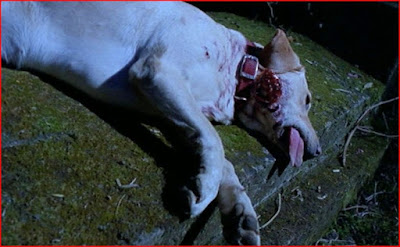
The "Vampire Orphans" is how Louise (Alexandra Pic) and Henriette (Isabelle Teboul) describe themselves, which probably makes for a better, more flattering gang-of-two handle than "France's Oldest Orphanage Inmates." The poor girls may seem a bit old to be under nuns' care, but they were 14-year olds in Rollin's own source novel. Anyway, give them a break: they're blind -- but only during the day. At night, they can see quite well, the color blue especially. They use their talent, in the opening scenes, to romp about a graveyard and drink the blood of a dog. As vampires, they don't seem to have many powers or enhanced abilities. They have few of the traditional vulnerabilities, either, though they can be shot dead as easily as you or me. They seem to remember a past life or lives that they've shared, always together until a "mishap" does them in for the moment. They don't seem to really remember their origins, but they develop an elaborate fantasy of having been Aztec goddesses and glutting themselves on the blood sacrifices of thousands of victims. They also remember visiting New York City, biting a dude on the Brooklyn Bridge, and having one of those "mishaps," though what happened exactly isn't shown.

A real gore hound

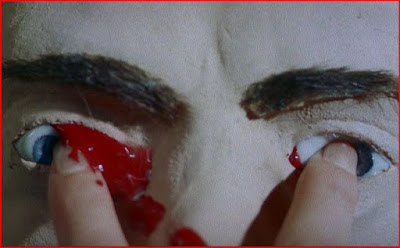
Help is on the way for our little unfortunates. Dr. Dennary, a leading eye specialist, has taken an interest in their case. He takes the rather extreme step of adopting them so he can study their condition further in the hope of restoring their eyesight. An exceptional aspect of this Jean Rollin film is that their new father's interest in the nubile orphans does seem to be entirely innocent. The erotic is kept to a minimum here, though it's always implicit in the director's fetishistic employment of a pair of heroines. Rollin felt he was toning it down himself, feeling consicous of the girls' ages, but the cast and crew took it upon themselves to tone it down further, pressuring him to cut a scene that would have shown the girls nude in a bathtub.

Of course the girls continue their little games in their new homes. When "dad" goes away for a medical conference, they decide to go out on the town, intending to ride the subway while they're at it. At one of their "real homes," -- a cemetery, they attack a robust young woman, but must flee when caught in the act. Seeking shelter unproblematically in a church, they encounter "the Midnight Lady," another sort of vampire who offers them shelter in a coffin for the night. The girls enounter a number of eccentrics over the course of the picture, including a "She-Wolf" with a Noo Yawk accent whose lycanthropy we must take on faith and a "Ghoul" who likes to throw dirt at people.

Anyway, the girls barely manage to get home, getting wasted on brandy along the way ("Alcohol isn't as good as blood, but it's stronger," they note). One of the girls has been shot, though, and to save her life her friend spins her most elaborate fantasy yet of Aztec sacrifices. It's just what the doctor ordered, except that the doctor doesn't even know about their dangerous escapade. When he stumbles upon them browsing (remember, he thinks they can't see well at any time) through his prized copy of a Fantomas novel, however, he knows too much. It's time for the Orphan Vampires to move on, with a little quasi-patricide for breakfast. Why they stab him instead of biting him we don't know, but the way they run away from the scene the instant the knife hits home felt authentically childlike, in keeping with Rollin's presentation of his vampires this time.

They head back to their old orphanage, where the nuns in charge would have been perfectly happy to have them back except for this business of killing two of the other orphans. They don't have many there to begin with; this is a pretty low-budgeted film. So it's off to the countryside, where they befriend a guileless if not idiotic farm girl who finds the news that she's met vampires simply fascinating. They reward her with a picture book full of old theater posters featuring Houdini and his peers, telling her that she'll find them in its colorful, lurid, exotic illustrations after they leave. This is pretty plainly a message from Jean Rollin to his fans, the picture book showing the childhood sources of his dreams and fantasies, and it manages to be a moving moment despite all the amoral mayhem perpetrated by the girls, for which they are about to pay the price, yet again....

Wendigo isn't sure after the fact whether he can call this a vampire film. The vampires are more symbolic than folkloric; they represent difference, deviance, the outcasts from reality in general. They stand for magic and fantasy and embody Rollin's imagination. Appropriately, the film is really a simple story with some disjointedness and some dream logic. Dreams have their own logic, as Christopher Nolan can tell you, and they always seem logical to the dreamer, even when someone says, "All gods are real because they're imaginary."

One thing Wendigo recognized in common with the other Rollins he's seen is the director's consistent eye for evocative locations. The orphanage is a typically impressive setting, as are the various cemeteries Rollin films in. For budget reasons or otherwise, he shoots many scenes day-for-night, including that odd bit on the Brooklyn Bridge where a painter is trying to work in the middle of the night. Strange to say, Rollin's attempt to tone down the sex element made the few topless scenes look only more gratuitous to Wendigo. The girls' natural charm aside, he thought this effort had all the eroticism of a rotten cabbage. He thinks Rollin should have kept the bathtub scene if only to establish a habit of nudity for the girls. As for the script, we listened to the English dub, so we don't know if the French dialogue is as erratic. In the dub, the girls at one point claim to be Inca goddesses but insist on their Aztec pedigree in every other scene. We also couldn't judge the actresses' natural voices until they did their interviews, at which point they came across as complete bubbleheads.

Wendigo feels obliged to give Two Orphan Vampires a thumbs down, in part because it was too transparently a statement by Jean Rollin rather than a strong story or a compelling set of images. This one is a little too choppy and a little too sloppy to work on all the levels Rollin wanted. Wendigo accepts that this was a very personal project for Rollin, but suspects that the author-director may have been too uncritically close to his material this time. He respects the man's viewpoint, but there has to be something more than viewpoint in a film, and that wasn't quite there this time. But Wendigo will be giving Rollin another try soon, if only because Fiancee of Dracula was in the same box set I got for $9.99 at the local FYE store. Stay tuned.

Don't blink or you'll miss this abrupt excuse for a trailer, uploaded to YouTube by gotohelltown.

Wednesday, April 7, 2010

Wendigo Meets THE LIVING DEAD GIRL (1982)

After he saw and enjoyed Fascination a few months ago my friend Wendigo was willing to try more films by the French vampirist Jean Rollin. One of those most frequently recommended to us was La Morte Vivante, which appears to have been shot at the same estate as the earlier film. We've noticed a little uncertainty about whether The Living Dead Girl counts as a vampire movie, however. Some say it's more of a zombie film, and Salvation Films included it (along with Rollin's somewhat less ambiguous Night of the Hunted) in a Zombie Collection box set. Since I happen to own a copy of this collection, we decided to let Wendigo make the call.

Catherine Valmont is dead and minding her own business as the story begins, but her repose is disturbed by shady types using her family crypt as a dump for toxic waste. They've been dumping barrels for a while, but on this auspicious day the dumpster decide to get into the grave robbing business. No sooner has one of them cracked open Catherine's coffin and declared the but-recently deceased young woman beautiful than an earth tremor strikes, causing some barrels to burst open and disturbing some bats. The ghouls' driver up on the surface doesn't notice, however. One barrel leaks some liquid glop that burns one man's face, while fumes from another have the magical effect of reviving poor Catherine. Did these fumes transmit the angry spirit of Moe Howard? We never learn the truth, but somehow her first impulse is to poke her visitor's eyes out with her Press-On Nails of Death.


Those nails are sharper than they look. They can gouge a guy's throat out with her hardly trying. Indeed, Catherine seems more confused than anything else, merely poking people and moving on in an admittedly zombielike manner. Instinct takes her back to her home, which is being shown by realtors to potential American buyers. There's a lot of English dialogue in this picture, which made us wonder whether Rollin was hoping for U.S. theatrical distribution. To our knowledge, he never got it. But we're stuck with an obnoxious American character and his French actress-photographer wife as nosy near-heroes for most of the film. She sees the strange white-clad barefoot girl wandering through a meadow and takes pictures. Townspeople recognize them as shots of the lately late Catherine, inspiring our mundane heroine to further snooping while hubby can barely be bothered.

Memories of childhood link Catherine and Helene

Back at home, Catherine begins to remember things. Photographs and a music box remind her of her dearest childhood friend, Helene, with whom she once made a blood pact to die as nearly together as possible. Helene is still in town, and when she calls the Valmont estate and hears only the music box, she begins to get spooked enough to go there to investigate. She finds the naked exsanguinated corpses of the realtor and her boyfriend, who'd been trespassing after hours. Then she finds a naked bloodstained Catherine reacquainting herself with the piano.

What would you do? Helene's response is complicated by the fact that she missed Catherine's funeral and has never seen her dead. This allows her to convince herself that Catherine was never dead, that her reported death was some sort of hoax, and that something's wrong with her friend that she can help her with. That something seems to involve a frequent need to consume blood in order to fend off agonizing neck pain. How about pigeon blood? Catherine politely declines as we note increasing sentience after every kill and feeding. Human blood it is, then, initially small portions of Helene's own, then that of victims lured to the house by the hitchhiker con from Vampyres.

By this point Wendigo had concluded that Catherine is a vampire. There are scenes when she bites quite messily into victims' flesh, but it looked to him like she was spitting out the meat and biting mainly to get at arteries, with Rollin rewarding her with lovely sprays of the red stuff. Wendigo hesitates about defining La Morte Vivante as a "vampire movie," however, because it's not so much about Catherine's vampirism as it is about Helene's obsessive, oppressive dedication to her living-dead friend. Helene and Catherine travel opposite character arcs. Unusually for a vampire, Catherine becomes not only more sentient but also more conscientious, more remorseful, more moral the more she feeds. She starts out as a mindlessly zombielike killing machine, but as she regains her memories and power of speech, she becomes an increasingly reluctant vampire. She evolves from a traditional, almost animalistic vampire into a more modern "noble" vampire, ultimately performing a heroic act of will in rescuing a victim left for her by Helene. At the same time, Helene becomes much more and much worse than a "Renfield" type. She quickly abandons all scruples to become a ruthless enabler, a kidnapper and accessory to murder. Helene is monomaniacally obsessive; keeping Catherine "alive" is all that matters, even if Catherine wants to die. "I'm evil," Catherine protests, though her later actions arguably belie the claim, while Helene ends up a remorseless torturer.

The horror watches in horror as her friend besmirches their childhood idealism.

Rollin has in fact ingeniously reversed the traditional vampire-romance formula and given us a film in which Renfield, rather than the vampire, is the master. The appeal of the romantic vampire is the promise of eternal love, for the sake of which the victim subjects herself to the vampire's power. Here, the mortal's desire for eternal union effectively enslaves the vampire. It's the abomination who sees what's wrong with this picture, which the enabler refuses to acknowledge.

Wendigo suggests that Helene may be overcompensating for her apparent failure to be there during Catherine's fatal illness, or to attend her funeral. He speculates that they had actually drifted apart some time before, and that Helene began feeling remorse after the fact. How close were they? We know enough of Rollin's career to find it significant that this film never has a lesbian love scene between Helene and Catherine, either in flashback or in the present. Wendigo thinks it possible that they were lovers in the past, but he doesn't think it decisive one way or the other. Most likely, this being a Rollin film, if he wanted us to think they were lovers he would have showed a love scene. On the other hand, it may have been a deliberate withholding of what we expect from him to build up anticipation for the profoundly different sort of consummation that comes at the end of the film.

Like Fascination, this is a great looking film with an ideal found set, though Rolln finds enough new angles to make you almost forget that we've been here before. As the leads, Francoise Blanchard (Catherine) and Marina Pierro (Helene) are easy on the eye and easy to accept in their roles. They have to act more with their emotions than with their bodies and do a good job. The other actors are mostly good, though those playing the American couple are a little over the top.

Anti-American violence in La Morte Vivante: an unconvincing stand-in takes fire for Carina Barone, while Mike Marshall discovers the treachery of those freedom-hating frogs.

Rollin's script arguably leaves too many questions unanswered, and his direction is marred by occasional continuity gaffes. Bloodstains on Catherine's burial dress appear and disappear or move about from shot to shot. Catherine clamps her nails on a victim's tongue, squeezing out a rush of blood, but in a later shot the victim's face is clean and her mouth uninjured. At another point Catherine's nails seem suddenly trimmer than they should be. The photographer says she saw Catherine's bare feet when it would have been impossible to tell as she walked through tall grass. These are quibbles, but there are enough of them to make this at least a sloppier film than Fascination. It's also not as visually inspired as the earlier classic, with fewer iconic moments like Brigitte Lahaie marching into battle with her scythe. There are still some powerful moments, however.

It's not exactly damning a film to say it's not as good as Fascination, of course. In fact, Wendigo found this a very good film with an impressively different approach to the vampire concept. Jean Rollin is now 2 for 2 in his book, and there are many more vampire films, and others, yet to be seen.

The trailer was uploaded to YouTube by impossiblefunky:

Monday, January 18, 2010

Wendigo Meets FASCINATION (1979)

This is my friend Wendigo's first encounter with the vampire cinema of Jean Rollin. You'd think it was an inevitable match of a vampire movie buff with the most prolific director of vampire films in modern time. But Wendigo was anxious about approaching the film, even though I told him it was probably Rollin's most accessible film -- at least of those I've seen. We can blame Image Entertainment and Redemption Video for some of his reluctance, because the box cover promised a "cannibalistic vampire feast," and Wendigo is not into cannibalism. He can't explain it, but it's a common scruple. He has no problem watching zombies eat people, but live people eating people -- ecchh! So remind me not to show him Cannibal Holocaust.

Anyway, that adjective was enough to keep Fascination near the bottom of my to-do pile. He even wanted to watch Nightwatch, a film he'd been told was bad by people who'd seen it, before finally dealing with the French film. There's also his lingering aversion to European horror and its non-linear "dream logic." To his happy surprise, Rollin's film is quite linear and coherent, though that may not be true of all his work.


The setting could hardly be more civilized, and yet...

Fascination is a period piece set in the early 20th century, far enough advanced that we can open with two comely young women dancing to the music of a Victrola on a bridge over a moat. This is La Belle Epoque, or thereabouts, when imbibing fresh ox blood at the abattoir is all the rage. Art Nouveau might be the appropriate visual style but apart from the women's costumes Rollin enforces an austere look apart from the majesty of the chateau where Eva (Brigitte Lahaie) and Elizabeth (Franka Mai) are caretakers. The owners are away and the women have the place to themselves until a fugitive crosses the bridge. He's Mark, a criminal who's tried to swindle some accomplices out of their share of a gold heist. The situation is set up for a siege as Mark has only one way out, the way he came, and his pals are lying in wait for him with a four-to-one advantage -- not counting his hostesses. He asserts his masculine mastery over them to little effect at first; his little gun is not the most threatening thing. So unthreatened are Eva and Elizabeth by him that even when he strongarms them and locks them in a room, they see no reason not to make out and get naked. They have an extra key, after all.


"Mesdames, are you not threatened by my powerful weapon?"
"No, but we will gladly draw more unflattering analogies to your manhood, if you please."

The curious thing about the situation is that they seem in no hurry to get rid of their dangerous guest. They seem -- or Eva especially seems more interested in playing mind and body games with the guy, though that starts to trouble Elizabeth. But once the gang grows brazen enough to invade the grounds, Eva takes steps to resolve the crisis and save Mark. She offers the gang his gold, and her body. She lets one of the gang take her in a barn while exchanging her clothes with his moll.

This sets the stage for one of the most awe-inspiring scenes, within limitations, in all genre cinema as Eva gets the upper hand and wipes out the gang, first with a dagger, then with a scythe like a living angel of death. The sight of Brigitte Lahaie in black (after wearing white earlier) marching across the bridge for the showdown with the knife-wielding gang moll is an indelible image.


It still hasn't sunk in for Mark (who doesn't know what happened in the barn) that he's dealing with at least one extremely dangerous woman. And more are on their way for a "reunion" in which he's meant to play an unwitting role -- unless Elizabeth can overcome her own compulsions to help him escape....

Wendigo was impressed by both Rollin's direction and the acting by his ensemble, including porn-graduate Lahaie. He found it well-paced and incredibly atmospheric, especially given Rollin's limited resources. And on the "shut up, she's hot and she's naked" rule he compliments the entire female cast.

However, Wendigo was wondering until nearly the end whether Fascination was really a vampire film. Blood drinking alone doesn't cut it for him, though supernaturalism isn't necessary, either. What sealed the deal for him is the power of the bloodlust the cult women clearly show, first when Elizabeth leaves a wounded Eva for the rest of the cult to consume, and finally in Elizabeth's own overpowering response to the bloody spectacle. Though the women are mortal as far as we know, Rollin presents them as spectral, ethereal figures, often in diaphanous costumes, and for all intents and purposes supernatural beings. While Eva gets most of the screencaps, Wendigo found Elizabeth the more interesting character (and Franka Mai gets top billing, after all) because she goes through the sort of soul altering experience that largely defines a vampire movie for him. He also gives kudos to the leading man, Jean-Marie Lemaire, for an effortless portrayal of clueless chauvinist arrogance.

Elizabeth (Franka Mai) must choose between her supposed love for Mark and her more palpable love for the blood inside him. Below, her rendezvous with destiny.

Wendigo is also impressed by most of the cinematography and art direction, especially Rollin's use of red from Mark's crimson jacket and vest to the gore in the abattoir as the girls teasingly drink their mere ox blood while chided by a doctor. The cinematography is botched in a few candlelit scenes when the candelight is reflected on the lens, leaving little flames darting all over the room. The one area where Fascination arguably falls badly short, though we understand this is almost on purpose, is in its gore effects. Simple stuff like a knife going into a man's flesh is nicely done, but the scythe attacks are undermined slightly by Rollin's unwillingness to illustrate the damage with anything more than streaks of paint. It leaves you wondering whether the mere facial lacerations the girl criminal suffers were enough to kill her. But for some viewers Rollin's approach will have the advantage of tastefulness.


Objects of Fascination

Although he isn't ready to bump it into his top twenty list of vampire movies, Wendigo was impressed enough with Fascination that he'll probably acquire his own copy of it, and he's now interested in seeing more of Rollin's vampire films. That's as strong a recommendation as you can get.

For a recent alternative viewpoint on Fascination from elsewhere in the blogosphere, check out the review at Ferdy on Films.