Sunday, March 7, 2010

PALERMO ODER WOLFSBURG (1980)

I was up for a challenge this weekend and I accepted more than one. Yesterday I spent the afternoon at the Spectrum Theater for a double-feature (interrupted by lunch) of Shutter Island and The White Ribbon -- more on those films later. The Albany Public Library issued a different kind of challenge. Among their new arrivals in the foreign-film section was the co-winner of the 1980 Golden Bear at the Berlin Film Festival, a 175-minute saga of a hapless gastarbeiter from Sicily who meets misadventure at the Volkswagen factory town. I was game and I think I'm better for the challenge.

Werner Schroeter's name meant nothing to me before this, but he's a figure in the "New German Cinema" movement of the 1970s, one who's still active today. He cast a non-actor, Nicola Zarbo, as a poor Sicilian named Nicola Zarbo who follows a trail blazed by fellow Sicilians to Wolfsburg, where he hopes to raise money for his family with a job at Volkswagen. His father is a drunk, demoralized by the fact that the local landlord arbitrarily raised the asking price for a piece of land that Dad had been saving for for many years. This first of three roughly equal episodes is effortlessly picturesque, Schroeter and cinematographer Thomas Mauch (a frequent collaborator of Werner Herzog) showing a strong eye for the landscape and the dessicated architecture of the island. He has no illusions about the quality of material life there -- Nicola must emigrate to find a decent-paying job, after all, -- but he seems to see Sicily as the site of an authentic, humane culture, if only to set it up for a favorable contrast with a soulless bourgeois utilitarian Germany. His Sicily is a place where people really do burst into song nearly all the time, albeit not in musical-comedy fashion. This is not a musical, and if anything the Sicilian section is an exercise in neo-neorealism, but Schroeter (an opera director on the side) wants to show that Sicily has a music in its soul that has, presumably, gone silent in his own homeland.


Nicola reaches Wolfsburg without having secured a job, knowing only that he has a cousin living there already. But the cousin's German wife won't have relatives flopping in her apartment. The best the man can do is hand Nicola 20 marks and tell him to head for a hostel that other Italians had already recommended to him. But our hero has no idea of how to get there in the dark, and our first hint of how alarmingly unworldly he is comes when he spends the night in some bushes and idly burns the money, just to watch it burn. Come the morning, he falls in love at first sight with Brigitte Hahn (Brigitte Tilg, another first-and-only time actor), a teenage mechanic who steers him to a nearby pub run by an Italian woman, Giovanna (professional thespian Ida di Benedetto). She doesn't take scheissen from bigoted Germans, including an old boyfriend of Brigitte's, and she'll enforce discipline with a broken bottle if necessary.

Above, Brigitte mimes "Sicily" in an effort to communicate with Nicola. Below, their date at the amusement park.


Joanna not only runs her own pub; she's her own bouncer, too.

Nicola does land a job at VW, but has a hard time learning German. He regards Brigitte as his girlfriend, and even writes home claiming that he's engaged to her, but she's only using him to make her old boyfriend jealous. It works, but it results badly for him and his pal, because by the time they cross his path again he's feeling pretty jealous himself. This segment ends with an anarchist pal of Nicola's messing with a crime scene to help him set up a self-defense claim.

The final hour of the film is Nicola's trial for double murder. It comes with a drastic shift in style to illustrate the protagonist's disorientation amid the German babble and rapid-fire Italian translation, and his incomprehension of the local legal process. Social realism yields to surrealism and subjectivity. It leaves you wondering how much is playing out in Nicola's crumbling mind and how much is the director's objective absurdity. But it actually fits in with the clips from an amateur Passion Play we keep cutting back to throughout the picture. I've read a review that accuses Schroeter of making Nicola into a Christ figure, but I think the director only means that this is how Nicola has come to see himself, as a martyr if not a messiah. In fact, his isn't a Christlike fate. He's actually on the brink of acquittal when he suddenly claims responsibility for the crimes, as if grown sick and tired of efforts by defense attorney and witnesses like Joanna to portray him as a victim of German society or larger economic forces. This third episode skirts the edge of over the top, but it's really a smart ploy by Schroeter to freshen up his audience for the last long haul of the show.


Schroeter's title seems to force a choice on viewers: the soulful, intimate poverty of Sicily or what Joanna describes at the trial as "this land without light, without sun, without song, without chatter." But she seems finally to protest too much, and one sympathizes slightly with the prosecutor who says we're due to hear some German emotion after all the Italian emotion expressed already. Schroeter makes it clear that anti-Italian bigotry is rife in his country, not to mention patronizing minstrel-show like representations of Italian culture like the song a woman sings at an amusement-park talent contest. His main point, I think, is not to say that Palermo is better than Wolfsburg, but to say that the cultures are simply incompatible, a state of affairs exacerbated by the economic circumstances that bring Sicilians like Nicola to Germany. Nicola may have been deranged by his time in Wolfsburg, but the derangement began back at home.


From the length alone, maybe, you can tell that Palermo Oder Wolfsburg is a hugely ambitious film, and this is one of those cases where the ambition alone may justify cinema buffs in giving Schroeter three hours of their time. Whether you decide that he jumps the shark during the trial or not, you'll see some remarkable images and performances in a vivid document of its time in two nations.

There's no trailer available, but http://www.ovguide.com/ claims that you can watch the film free on its site.

The Damndest Things: Betty Hutton in "Hamlet"

Imagine my reaction. I'd just finished watching nearly three rigorous hours worth of Palermo Oder Wolfsburg (about which more later), and when I ejected the disc and switched back to cable, this was what I saw. It's a scene from John Farrow's Red, Hot and Blue, and TCM must have known that people would react as I did, because MoviesOnTCM has the clip available on YouTube. Like a lot of people, I suppose, I'd only seen Betty Hutton in action in Cecil B. DeMille's The Greatest Show on Earth, not in one of her own star vehicles. though I'd heard some hair-raising accounts of her work. Now here's this. My first impulse was to call her a female Danny Kaye, but that's not really fair, since she got into movies first. Actually, a female Curly Howard may be more like it from the way this finishes. In any event, it's one of The Damndest Things I've ever seen, and possibly the first in a series of such things I may post here. Take it away, Betty.


Saturday, March 6, 2010

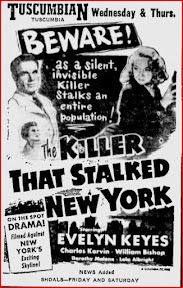
THE KILLER THAT STALKED NEW YORK (1950)

Meet a different kind of femme fatale. Sheila Bennett (Evelyn Keyes) is "the blonde death," a diamond smuggler on a mission in New York City. The mission is revenge. She brought the hot diamonds from Cuba for her husband, Matt Krane (Charles Korvin), not knowing that the rat has been two-timing her with her own sister (Lola Albright). She's arranged to have the rocks delivered discreetly by mail to her impatient lover-boy, but he takes advantage of her apparent illness to take the diamonds and run without telling her they'd arrived. She learns from Willy, a sleazy nightclub owner (Jim Backus) about her boyfriend's cheating. After confronting her sister, she goes to a sympathetic fence to learn that hubby's still holding the diamonds, which were too hot to unload because the feds had followed Sheila into the city. He told Matt to come back in ten days, so if Sheila can wait it out she can have it out with her husband. It's more than sister Francie can do; she killed herself in a fit of guilt while Sheila was out. It's just something else Matt will have to answer for, if only Sheila can stick out those ten days. It won't be as easy as it sounds, because Sheila brought something back from Cuba besides diamonds -- smallpox.


Sheila is soon the subject of two separate manhunts. First, the feds are still after her for diamond smuggling, but their investigation is handicapped by their lack of a photo image of her. Why the agent who followed her back from Cuba couldn't sit down with a sketch artist at any point in the pursuit is an unsolved mystery of this picture. But at least they have the memory of a face to work with. The doctors who discover a smallpox outbreak don't even have that. They only get clues to the carrier's identity as more people get sick. Ironically, the doctor leading the hunt (William Bishop) saw Sheila in his clinic the night she arrived in the city. At the time, "Agnes Dean" was only complaining of headache and weakness. Dr. Wood hands her a bottle of "medicine" off the shelf and tells her to use it regularly. Whatever this medicine is, it must be a wonder drug, because it keeps Sheila careening through Manhattan in search of clues about Matt well beyond a point when a normal smallpox victim, we're told, would be flat on her back, or dead. On the other hand, this amazing medicine may have been no more than a placebo, since we're also told that "drive" can make cripples walk, or make the sick keep walking.


Men: They'll pay in different ways for messing with the Blonde Death.

While she moves from place to place, just keeping ahead of the feds over the ten days until Matt returns, New York City is mobilized to vaccinate as many people as possible as more of those whose paths she crossed start dropping: a Penn Station porter; a little girl in Dr. Wood's clinic; Willy the nightclub owner, and so on. Vaccine supplies are limited, since hardly anyone anticipated a smallpox outbreak in the U.S.A., so as long as Sheila runs free, thousands if not millions of lives are in danger.

A remarkable piece of title-card art for The Killer That Stalked New York.

This slick Columbia B picture is clearly hoping that two great tastes will taste great together: the medical-procedural thriller a la Panic in the Streets and the mortally-doomed protagonist of D.O.A. It has many of the major film noir trappings, including impressive location shooting in New York by Joseph Biroc and, regrettably, an omniscient narrator who speaks in the first person but never becomes a character in the story. The narrator (Reed Hadley) lays the rhetoric on real thick during the first few minutes, but his presence becomes thankfully more intermittent afterwards. Loosely inspired by a real-life smallpox scare, the story often lapses into agitprop for immunization, and I have to admit I was ruefully amused by scenes of paranoid skeptics protesting against the shots when I know that people like that still exist in this country.


Evelyn Keyes stands out in a mostly-competent cast that includes a young Dorothy Malone as a nurse and future teenage monster maker Whit Bissel as Sheila's flophouse-operating brother. Keyes bravely submits to the deglamorizing effects of smallpox and effectively portrays a woman betrayed by family and fate alike, as well as the obsessive drive that animates many a noir hero or antihero.


Earl McEvoy directed only three features, this being his second, after serving time as an assistant director at M-G-M. He's no great stylist on this evidence, but he makes good use of the locations on several occasions, particularly two sweeping shots, one at Penn Station, showing one character watching another from high above and far away. Harry Essex's script credits range from Man-Made Monster to The Sons of Katie Elder, but this time there are too many story-prolonging contrivances (the incompetent feds, the miracle medicine) for it to be one of his finest hours. But while logic may have made the story shorter, the film still comes in at a lean 75 minutes and is never dull. The location work and Biroc's cinematography as a whole make The Killer That Stalked New York at least worth looking at, and Keyes's performance is definitely one worth watching.

This is one of four films in Bad Girls of Film Noir, Volume 1, another extraordinary release from Sony Pictures Home Entertainment in defiance of industry trends. Each film (the others are Henry Levin's Two of a Kind (1951), Irving Rapper's Bad For Each Other (1953) and Maxwell Shane's The Glass Wall comes with a theatrical trailer, while Two of a Kind is supplemented by an interview with co-star Terry Moore, and the set as a whole comes with a presumably noirish episode of the All-Star Theater TV series. Volume 2, similar equipped, is already available. These are priced comparably with Sony's Icons sets of Hammer and Toho films, a relief after the company's somewhat overpriced Film Noir set and it's way overpriced Samuel Fuller collection. I'll let you know about the rest of the films as I see them. They may be B movies, but I'm hoping for the best.

Here's the trailer, courtesy of TCM:

Friday, March 5, 2010

In Brief: DRAG ME TO HELL (2009)

Once upon a time, Sam Raimi was going to direct a movie called Spider-Man 4. It only made sense, since he'd directed the first three, only there was a bit of a problem. The problem went back to the third film. The way I hear it, Raimi wanted to use the Vulture as a villain in that film. It made sense; the Vulture is a good old Spidey villain, one of the first. But there was the problem; the Vulture is an old villain, not because he dates back to 1963 but because the Vulture is an old man. At least that's how Steve Ditko and his successors drew him. The money men didn't like the idea of an old guy as a villain, even if Ben Kingsley was going to play him. Raimi capitulated and used a more recent, cooler villain instead alongside the Sandman. Apparently, Raimi tried again. This time, he was supposedly talking to John Malkovich about the role (and if you've seen Burn After Reading, and you've read the comics, you'd say, "yeah!"). But the studio people still weren't interested. I don't know if they thought an elderly villain would be offensive or just not cool. I don't know if they really felt strongly about this or were looking for an excuse to drive Raimi away and do the re-boot they're now planning. It's all over now, anyway, and it might be for the best as far as Raimi's career is concerned.

Another thing I don't know is how long Drag Me to Hell was germinating in the minds of Sam and his brother Ivan before they filmed it and released it last year. Regardless of the answer, I can't help but think that the finished film gives us at least an inkling of what Raimi was thinking when he wanted to use the Vulture in a Spider-Man film. While his latest movie is superficially about the struggles of a bank loan officer against a gypsy curse, Drag Me to Hell is essentially about a forced confrontation with old age and all the discomforts it imposes on other people. Instead of being pummelled and deformed like Bruce Campbell is in the Evil Dead films, Alison Lohman is defiled and soiled by the slop of age and death. A corpse vomits formaldehyde on her. In a nightmare, it vomits maggots on her. Later, she's nearly drowned in a flooded, muddy grave. And this is all because she won't show the proper respect to an elderly person. The curse of the Lamia is the revenge of age on youth.


While the story requires Lohman to figure out some way to deflect the curse by bestowing her accursed coat button on someone, the emotional message of the movie really requires her to apologize to Mrs. Ganush and admit responsibility for denying her an extension on her mortgage payments. The climactic graveyard scene in which Lohman makes a ritual of bestowing the button on the dead woman is also the furthest thing from an apology. If anything, Lohman is her most Ash-like in her furious determination and self-righteous sarcasm in this scene, and while Ash's attitude is always cool, it nearly always gets him in more trouble than he started with. When we consider that all Lohman's really doing is desecrating a grave, she's only added insult to injury, or insult to insult.


Her disgust over the messy embarrassments Mrs. Gunesh and the Lamia have imposed on her drives her to rage when repentance is what she should show. At the very least she could admit that it was her own decision to deny the old woman the extension, instead of blaming her boss or the pressures of office competition. As it is, she can only admit this to her boyfriend, not to the offended party, and only after the graveyard scene. It's as if her anger at her situation blinds her to what she owes to the wretched crone, not as a matter of business ethics but of human decency and respect for her elders.

So much for the preaching. Drag Me to Hell represents a partial return to Raimi's classic form, taking into account the differences in emphasis between the new film and the Evil Deads. There's one moment in which the old spirit indisputably returns, when a man possessed by the Lamia dances a hellish jig while levitating over a fire. That jig represents the demonic vitality, the exuberant, almost infantile evil of Raimi's monsters.

Meanwhile, one gets the impression that Raimi's been influeced by Asian horror of about a generation ago, when vomiting up all sorts of gross stuff was a big thing. It's still a novelty in America, as far as I know, and it helped give this film a fresh quality -- if that's really the right word in this context. The story could have been sharper and more subtle in spots -- I suspect that most people saw an important plot twist coming from miles away, for instance, and I thought that the Lohman character grew credulous too quickly when more comedy-horror might have been milked from a more stubborn refusal to acknowledge what was happening to her. But for a B horror film of our time, it wasn't even half bad.

Thursday, March 4, 2010

THE DIVINE WEAPON (2008)

Back in the fifteenth century the hottest arms race on Earth was being waged by two nations that didn't even know what century it was. The Ming Dynasty of China and the Korean kingdom of Joseon kept their own time, which is only fair, since they were way ahead of Christendom when it came to technology. Dwarfed by the Ming, Joseon sought any advantage available, despite the efforts of appeasers who counseled submission to China. The equalizer was the "divine weapon," which was a rocket-powered delivery system for masses of arrows. Joseon has been working on such a system for a while as Kim Yoo-jin's film opens, and one powerful family has been demoted for failing to perfect a weapon. Sul-ju, the scion of the disgraced family, now hustles for a living as head of a merchant clan. Fate, if not national strategy, makes him the host of Hong-li, the daughter of the current Divine-Weapon designer. He was killed by Ming agents, who took his design manual and are now after his daughter. She was her father's assistant and has much of his technical know-how. Hong-li and Sul-ju are reluctantly thrown together in an emergency effort to build Divine Weapons before the Ming figure out how to build them first. In the process, Sul-ju will get over his grudge against his government and his now-mercenary impulses, Hong-li will come down off her high horse and lose some of her self-righteous attitude, each will learn from and fall in love with the other, and a hella lot of Mings and barbarian Jurchen tribesmen will find themselves in a pointy metal deathstorm without their umbrellas.

Woman of learning, man of action: together they conceive the Divine Weapon.

This Korean production doesn't have the budget Zhang Yimou had for Curse of the Golden Flower, though Divine Weapon is an expensive film by national standards (costing something like $10,000,000). The limitations show when Kim resorts to subpar CGI, but for the most part the film benefits from its smaller scale and more personal, sometimes more visceral violence. It's a patriotic film, arguably an epic, but far less pretentious than the Chinese film. Divine Weapon has more of a Hollywood feel in its focus on two attractive, initially mismatched protagonists who fall in love, and the personable quality of the leads, Jeong Jae-yeong and Han Eun-jeong, keeps you interested during the buildup to the big battlefield unveiling of the title device.


Your Divine Weapon comes in three models. Your basic Divine Weapon will shoot scores of arrows through the air to punch holes in the enemy, but their penetrating power's not so great. A guy on horseback carrying a small shield in one hand can take a hit on the shield and keep on riding. That's when you want your Standard Divine Weapon. This is actually the original version before it was redesigned, and the objective originally wasn't to pin some enemy mook to the earth. The idea here was to blow him up. This baby comes with an explosive charge on each arrow that'll bring down the man and the horse. Stick a guy with four or five of these and it ain't pretty.

But sometimes it's just not enough to blow up a barbarian on a horse. Say you've got a bunch of the enemy all in one place. That's when you can really use the Grand Divine Weapon. Let's keep this simple: it's a ballistic missile. Joseon had'em three hundred years before Europe did, the film says, and when our heroes bring it on to mop up the retreating enemy, it's a genuine "you have got to be shittin' me" moment, but in a good way -- apart from the botched CGI of the explosions. By comparison, the clouds of arrows on the first volleys have a certain lethal elegance.

Choose your poison.

Some critics (particularly Chinese) have questioned the accuracy of the film and the claims made for Korean inventiveness, but Divine Weapon is guilty of no more than the usual cinematic license. Before watching, I wondered whether a film that shows Koreans sticking it to China would have contemporary political overtones, but having watched it I don't think so, unless some Chinese have real thin skins. The English subtitles, at least, scrupulously refer to Joseon's oppressors as "the Ming" rather than "China" (and it's a great name for a villainous entity, isn't it?) and the enemy could just as easily be seen as a generic tyrant rather than as specifically Chinese.

If anything, I had a stronger impression that the Jurchen barbarians were meant to stand in for North Korea, in which case the film's focus on wonder weapons has obvious relevance. The subtext might be that the South could match the North bomb for bomb, missile for missile, and even overmatch the dismal bolsheviks if not for geopolitical constraints. Strangely, Divine Weapon reminded me of 1950s sci-fi movies in which the Japanese save the world with super weapons in subconscious do-overs of the end of World War II. In this case, South Korea looks to its historic past for assurance that it can deal with the Northern enemy if it comes down to a fight. But you don't need to read any politics into it to enjoy this unartistic but effective adventure film. It isn't on the cutting edge of Korean or Asian cinema by any measure, but it's a piece of pop cinema that might be popular anywhere, depending on how you translate it.

This English-subtitled trailer was uploaded to YouTube by ArtsAllianceAmerica.

Tuesday, March 2, 2010

Wendigo Meets DRACULA THE DIRTY OLD MAN (1969)

Either way, it was going to be an ordeal. The next movie on my friend Wendigo's to-do pile for our vampire series was Vampirella. I was steeling myself for the task when he reminded me that it was my turn to provide a film, the Larry Talbot movies having come from his collection. That meant it was finally time for him to discover William Edwards's attempt at softcore horror-comedy.

What did he see? "Honestly, not a whole lot," he reports, "Basically, we have your standard plot of European vampire moving to America, establishing himself in a run-down location, picking some schmoo to be his local lackey and sending this poor retard to maim, kill, and retrieve food for him."

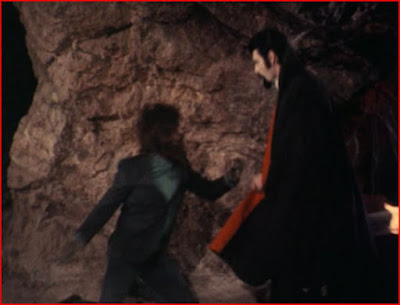
"Food," in this case, is women. "They are food for Dracula and for his lackey, who is transformed from hapless reporter to novice jackalman simply by the vampire's will. Dracula may as well say 'poof!' and make it so. But like Andreas from The Return of the Vampire, Irving Jackalman eventually resists the vampire's will. In this case it's because he wants a woman to rape, and Dracula won't let him. So they slap one another around, Dracula bashes in Irving's head with a rock (that already has Irving's blood painted on!), then just happens to stagger backwards out of his cave into the sunlight. Noticing his peril, he staggers back inside, and into his coffin. But it's too late. His hand becomes a skeleton, and then his whole coffin disappears, as do the female victims he's left hanging naked on scaffolds, and the scaffolds -- for a while. The vampire's demise cures Irving of jackalmanhood, and he celebrates by screwing his girlfriend in the cave, just after she's finally thrown her clothes back on after running through the cave for long minutes, never noticing the cave entrance within twenty feet of where she'd started. That may sound silly, but the scenes of the woman running through the cave clad only in her shoes is actually one the few highlights of the film."

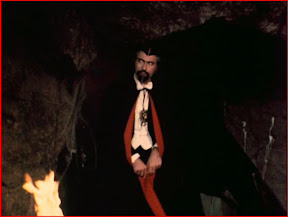
Werewolf (well, jackalman) and vampire on a collision course of terror!
As far as Wendigo is concerned, the main highlights of the movie are some of the semi and unclad women, and the highlight of the Something Weird DVD, in his opinion, are the trailers for other movies. "On a scale of 1 to 5," he says, "I give it shit." He declares it the worst feature-length vampire film he's ever seen, topping the recently crowned champion, 2008's The Thirst: Blood War and the legendary Polish Vampire in Burbank. These films, at least, didn't nearly put him into a coma -- though one of the short subjects, the brain-calcifying Dracula and the Dirty Old Witch, pulled off that coup.

Dracula the Dirty Old Man is a singular film. Its original soundtrack was scrapped at one point and replaced with a dub track designed to make it the comedy it had to be. The comic inspiration of William Edwards was to give his vampire the voice of a generic Borscht Belt standup comedian rather than the stock "blah, blah" Bela accent. There's no attempt to claim that "Count Alucard" (which a title card helpfully explains is "Dracula spelled backwards") is Jewish. It's just that Edwards's idea of humor had a Jewish accent, or a dim recollection of one. The dubbing artist seems to be making it up as he goes along, and just barely at times, repeating stock phrases like "I'm gonna [do something to you] like you won't believe!" and returning to the one original concept of the movie, the idea of a hierarchy of jackalmen. Irving, being just created, is only a novice jackalman. If he pleases his master by delivering cute girls for him to ravish before biting them on "the good place," he can be promoted to the rank of second-class jackalman. This is entirely up to Dracula's whim, but Irving learns fast. When he accidentally kills a woman while raping her in her apartment ("I musta bit too deep again") he realizes that "it's back to novice jackalman," despite his heroic attempt to resuscitate the woman by humping her some more.

Victims: Stricken by the jackalman's claws (above) and the vampire's bite (below!)

While I respect the female form at least as much as Wendigo does, I think Irving Jackalman is the best thing about the film. He's so ludicrously cute as he goes about killing and raping and muttering like Popeye that you don't mind that he's never punished for his crimes. The dude tore up at least four people (it's hard to keep track when you were nodding off every so often), leaving some gory scenes behind, and only revolts against an admittedly revolting master because he wants to rape another girl. It's not exactly Andreas finding his goodness at the point of death, but I suppose you can argue that the poor reporter wasn't himself when Irving was on the prowl.
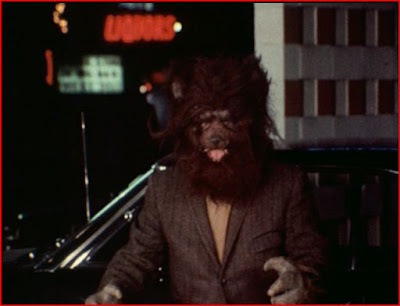
"Irving Jackalman strikes again -- heh heh!"

Make no mistake: this film is inept at every level. The cave set barely qualifies as a set, the bat effects (on a stick!) are indisputably the worst ever, and (our admiration for some of the actresses aside) it fails almost completely as softcore porn. As a failed comedy it's in the danger zone of eligibility for Worst Movie of All Time, but I think it has just enough distinguishing eccentricity to save it from infamy. Just bear in mind that this is a comedy you'll be laughing at rather than with.
* * *


Dracula the Dirty Old Man headlines a Something Weird DVD from the good old days of their Image Entertainment deal, packed with extras. Along with the trailers and promo art galleries, there's a second feature (Guess What Happened to Count Dracula, to be covered later), the aforementioned debacle Dracula and the Dirty Old Witch and another good-sized short, Sex and the Single Vampire. This one is worthy of note because it compels me to report that a young John C. Holmes as the disgruntled-then-(slightly) aroused vampire, is probably the best actor on the entire disc. Judge the contents accordingly.

Or simply judge from this clip uploaded to Dailymotion by scootaway:

Sunday, February 28, 2010

CISCO PIKE (1972)

"He's a prophet, he's a pusher..." These are the lines of a Kris Kristofferson song that Cybill Shepherd quotes to Robert de Niro, to Travis Bickle's indignant confusion ("I have never pushed!"), in Taxi Driver. Moviegoers first heard the actual song in Bill L. Norton's Cisco Pike, which "introduced" Kristofferson in the title role (he had already performed in Dennis Hopper's The Last Movie)while giving top billing to then red hot but here relatively little-seen Gene Hackman. Kristofferson is credited with writing and performing four songs on the soundtrack. This one in particular raises questions. Was it composed by Kristofferson for the picture? If so, is it Kristofferson's commentary on the character he plays, or should we think of it as a song written by Cisco Pike? In that case, is it Pike's way of truth-telling on himself or is the song an ironically unselfconscious commentary intended for someone else? The song itself describes its subject as "a walking contradiction, partly truth and partly fiction," so perhaps we should leave it at that.

Cisco Pike is a singer-songwriter and onetime band leader who had at least one hit song ("Breakdown") and a few successful concerts around 1966 before declining into petty drug dealership and jail time. Out of prison for now, but still in some legal jeopardy, he's determined to go straight and return to the music business, encouraged by his aspiring yogi girlfriend Sue (Karen Black). Since creative success wouldn't make much of a movie, Cisco finds himself bedeviled by a corrupt narc, Leo Holland (Hackman), who's nabbed 100 kilos of pot from a drug dealer and wants to make money from it. We'll learn that he's about to be dumped from the force due to a medical condition one year short of eligibility for a pension. The $10,000 he expects to make from the pot will be his nest egg, but Cisco will have to sell it for him, over a three-day weekend, or else Holland will make sure the musician ends up back in jail.

Good and bad influences: hippie Karen Black and cop Gene Hackman.

The plot is a scaffold for a series of episodes illustrating Cisco's descent back into the drug demimonde on the borderland of the music scene our hero hopes to re-enter. He visits recording studios and nightclubs and hooks up with old cronies and colleagues, but his main purpose is to move "keys," and he finds quite a few customers in his old milieu. Sometimes Holland screws up deals by lurking too close for buyers' comfort, and sometimes Cisco has to abort sales when he recognizes other narcs from details like polished shoes. He tries to give the dope back to Holland at one point, but the cop convinces him at gunpoint to resume his salesmanship. The weekend carries Cisco further away from Sue's presumably positive influence until he's cheating on her two women at a time. Worse, his old bandmate Jesse Dupre (Harry Dean "H.D." Stanton) turns up in a very needy state. He'd be happy to reform the band or score some major drugs. His main problem is that, while he feels the pressure to sell before Holland's deadline, he also finds his adventures too much fun for his own good, for a while.

Norton's episodic script has a cumulative atmospheric effect, immersing you in the hazy border zone between the world Cisco wants to reclaim and the one to which he must return. Their close proximity, the effective borderlessness of the scene, is part of his problem. How he responds to the challenge brings us back to the question of the correspondence between Cisco Pike and Kris Kristofferson. The real man was not the first choice for the role, from what I've read, but his presence and his song contributions tempt us to ask how good a musician Cisco Pike is supposed to be. If a different actor played the role, we could more easily assume that Pike's talent is actually pretty limited and that his early success may have been all he could have expected. Either way, of course, Cisco Pike is a tragedy of thwarted potential, but if Pike is supposed to have written the Kristofferson songs, and is stuck where he is, then it's arguably a tragedy of a different order. As an actor, Kristofferson further obscures matters. I've never really cared for him but others clearly respond to his perceived authenticity or his gravelly-voiced masculinity. He was obviously a talented songwriter, but could he play one on film? What would one look and sound like, anyway? Obviously there's no set type, but Kristofferson playing Pike still leaves me wondering whether the actor was effectively portraying a relatively untalented artist or ineffectively portraying a superior talent.

Familiar '70s faces: Harry Dean Stanton and Antonio "Huggy Bear" Fargas


The Kristofferson enigma doesn't necessarily determine whether Cisco Pike is good or not. As a Seventies buff, I was impressed by the locations and the ambiance, and the lead is supported by a strong cast of period stalwarts and iconic performers. Hackman doesn't really earn his top billing despite striving to make his character eccentric; nevertheless this is from a period when his presence is always welcome. Overall, I think any Seventies enthusiast will find items of interest in this folk-rock noir. If you think that decade was a golden age of American cinema, it can't hurt to give this representative film a try.

Fans of Seventies violence won't be disappointed either; Cisco Pike climaxes with a gunfight between a man (center) and a helicopter.

With no trailer available, here's Kristofferson's original performance of "The Pilgrim, Chapter 33" from his 1971 album The Silver Tongued Devil and I, as uploaded to YouTube by woudshoorn.