Wednesday, March 17, 2010

THE TAKING OF POWER BY LOUIS XIV (1966)

I'm a historian by vocation. In practice my work has ranged from writing a thesis on antislavery politics in Massachusetts to teaching a film history course in a community college once upon a time. In the end I didn't feel myself cut out for academia, so I find outlets for my continuing interest in history elsewhere. To cut to the chase, I was just the sort of mark the Criterion Collection had in mind when they started releasing the the late-career docudramas directed by master neorealist Roberto Rossellini. La Prise de Pouvoir par Louis XIV was the affordable lure, and if you're hooked you'll go for the Eclipse collection of three more history films. Me? I bought the Eclipse set during a Barnes & Noble 50% off sale even before I got around to watching Louis XIV. I might have found myself feeling a little foolish if I didn't like the earlier film.

As it happened, I found it fascinating. French history isn't one of my specialties, so it was a rewarding challenge to be immersed in the 17th century without benefit of narration. The situation establishes itself soon enough. The prime minister, Cardinal Mazarin (like Rossellini an Italian in service to France), is dying. The leading nobles and courtiers are maneuvering for position, literally in the sense of proximity to the dying man and politically in order to exploit an expected power vacuum. As doctors ponder whether to keep bleeding the poor cardinal, no one really takes the King of France seriously. Louis XIV is considered a callow young man more interested in courting mistresses than in court politics. As Mazarin is considered the power behind the throne now, so Superintendent Fouquet expects to take over once the cardinal dies. While most of the nobles are out for personal gain, Mazarin and his right-hand man Colbert serve the national interest. They encourage Louis to assert himself and bring the nobles to heel, but the king is cautious. Mazarin wants to bequeath him his massive personal fortune to help make the monarchy independently wealthy, but Louis refuses, thinking it will arouse suspicions. He has his own ideas, however.
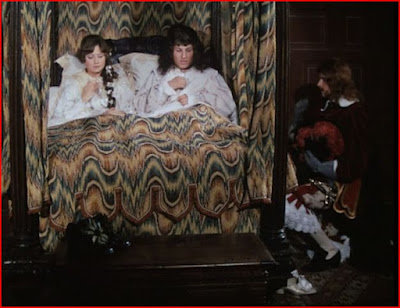
Just another day in the life of a king. Somehow he doesn't seem happy.

Once Mazarin finally dies, Louis starts making his move. He keeps the nobles off balance by moving from province to province, never holding council meetings in the same place. He lays down the law by having the corrupt Fouquet arrested. Now the master plan kicks in. He wants to undermine the economic independence of the nobles in their regional power bases. He does it by exploiting their desire for the prestige that derives from proximity to the king. He's seen it all his life, and now he takes it to the extreme. He becomes a fashionista revolutionary, setting a budget-busting standard of personal style and dress that anyone who wants to be anyone has to emulate. He makes it mandatory that they stay near him at his new palace at Versailles, breaking their local ties and making them more dependent on him for everything. He makes himself the lender of first resort to help them meet the mounting expenses of courtly living. Meanwhile, his living large kickstarts the French economy, making the bourgeoisie as well as the nobility more dependent on him. His goal is to make the king the source of all the country's wealth, the one who gives life to all things like the sun does in nature.

While most scenes are filmed straight ahead, Rossellini adopts the olympian perspective of the king watching from a window for the crucial arrest of Fouquet, shown here discovering his doom.

There's an artful artlessness in Rossellini's telling of this story. Every shot is very carefully composed and the cinematography is gorgeous, but the director does little to dramatize his scenes in the manner we expect from period pictures. He throws in occasional bits of exposition to explain things like why Louis doesn't go into Mazarin's room after the cardinal dies, and he has the main characters state their motives rather baldly. But like Jack Webb he strives to minimize the theatricality of the drama. His Louis is a non-actor who usually reads his lines off cue cards, giving his utterances an unaffected quality that passes for naturalism. Characters don't emote in this film, allowing you to suspend disbelief and imagine yourself back in time among real people.

Despite the illusion, Louis XIV is a carefully crafted story. Rossellini establishes a visual parallel early, linking Mazarin's deathbed scenes with Louis's marriage-bed scenes and contrasting the dying minister and the rising monarch. The film's big outdoor scene, a deer hunt during which Louis takes his mistress into the woods for a quickie, is a metaphor for the main storyline. By continuing to play the self-indulgent wastrel after Mazarin's death, Louis is throwing Fouquet and other power players off his scent just as a deer tries to throw hunting dogs off its scent by swimming across a stream.

Le roi pimpedelique

Rossellini's most important directorial decisions are matters of pace. He films in long takes and lets scenes breathe. The deliberate pace helps perpetuate the illusion of living in the past, and it fits the ceremonial pace of court life. It lets you see how important physical proximity to power is to the nobles, whether they attend the king when he wakes up in the morning or compete to be the first to view Mazarin's corpse. He's setting up a big payoff, and it comes in a scene that plays out to almost oppressive length -- on purpose. Louis's triumph is represented in a stunning scene in which the nobles are obliged to stand about watching the king eat a meal of more than a dozen courses -- without a fork, mind you. He knows how to use one, we're told, but he doesn't like to and he doesn't like others showing off. Course after course is conveyed from the kitchen in elaborate processions and put into the hands of courtiers for whom it's a mighty honor to serve the monarch this way. Most viewers have probably been rooting for Louis up to this point, but now you have to question whether he's taken things too far. The "Sun King" becomes a despot here, and the scene is sure to have a dystopian quality for American viewers, particularly those of a certain ideological bent who probably imagine such scenes playing out in the White House today. Anyway, here's some of the scene, as uploaded to YouTube by hvolsvellir

To be honest, the film's stately pace and dry feeling aren't going to work for everyone. It'll help if you're interested in history, though I can't vouch for the accuracy of Rossellini's account or the fairness of his emphasis. But if you love film for the sake of pure imagery I can tell you that, at the least, this film's a visual feast. Made for TV it may have been but it's gorgeous to look at, and the costumes take it to another level altogether. Louis XIV is a mesmerizing trip in a cinematic time machine that makes me look forward to future travels with the director.

Tuesday, March 16, 2010

Wendigo Meets CIRQUE DU FREAK: THE VAMPIRE'S ASSISTANT (2009)

My friend Wendigo is pretty widely read in vampire fiction, but he was barely aware of Darren Shan's 12-book series of young-adult novels before he heard of Paul Weitz's movie adaption. He's only just forging into the young-adult realm (Twilight being the gateway), but Shan's books hadn't really caught his attention, most likely because they don't fit the Twilight archetype. Based on what we've now seen, the "Saga of Darren Shan" seems intended for a slightly younger and more male audience than Stephanie Meyer's books. So all Wendigo knew about The Vampire's Assistant was what he saw in the commercials. They made the film look like a vampire comedy, a subgenre that has produced little good, and that it had freaks in it. I traumatized my poor friend once with a Halloween showing of Tod Browning's Freaks (a double feature with The Texas Chain Saw Massacre!) so he was uneager to see more freaks on film.

On that point he needn't have worried. The freaks of Cirque du Freak are more like Marvel Comics mutants than "Nature's Mistakes." Most of them have abilities that border on super powers, one woman being able to dismember herself and instantly regrow her limbs, another being able to devour all substances, digest them in his two stomachs, and spit out finished custom goods. Selma Hayek plays a fortune teller who can grow a full beard instantaneously when entranced by dangerous visions of the future.

The nearest thing to an old-school freak is the impresario, Mr. Tall (Ken Watanabe), who has height and a sort of lopsided Metalunan forehead. The next nearest thing is "the wolfman," an endearingly mangy beast who partners in the dismemberment act and, if anything, looks more like a Baboon Man to me. He's played by a guy in a suit. I adored him at first sight.

As far as I was concerned, the guy in the suit nearly stole the movie.

But enough about freaks, except to note that one of them is Larten Crepsley (John C. Reilly), who performs with his trained spider Madame Octa and seems romantically linked with Hayek's oft-bearded lady. Steve, an alienated delinquent and vampire buff, recognizes Crepsley as a famous vampire he's read about in some modern illustrated edition of The Book of the Vampires. He's so alienated that he wants Crepsley to bite and turn him, but his "bad blood" disqualifies him. Instead, Crepsley turns Steve's friend Darren Shan (the author's name is a pseudonym) as a condition of saving Steve's life when Madame Octa bites him. For Darren (Chris Massoglia) this is a too-sudden escape from stifling family life and meaningless overachievement, as he must appear to die in order to take up his role as Crepsley's half-vampire assistant. Through him we meet more of the freaks, including a lovably dumb snake-boy who fancies himself a rock star and a comely monkey girl (it's all in the tail) who may be Darren's first romance if he isn't swept away in the swirling conflict between the vampires (Crepsley's kind) and the renegade vampaneze.

Larten Crepsley (John C. Reilly, above) and his partner, Madame Octa (below)

In Wendigo's eyes there's nothing uniquely original about the attributes of Darren Shan's vampires, though they make an interesting combination of familiar details. The most visually distinct thing about them is their super-hard fingernails, which they use for climbing and for slashing attacks. Larten Crepsley is a more interesting individual vampire. He's neither a beautiful creature nor a bat-faced monster. He ages (slowly) and bears scars that haven't healed. Personified by John C. Reilly, one of today's great character actors, he often looks like a clown in the right light, but is also sad, sometimes cynical, and definitely not the standard master vampire. Wendigo hasn't seen much of Reilly's work but is impressed by this performance. While Cirque du Freak is yet another modern movie theoretically focused on the quasi-Renfield vampire-wannabe character, the film's success really depends on Reilly, and he succeeds in making Crepsley a representative of a plausible fantasy world. He's as noble a vampire as we've seen these days, having invented techniques of non-lethal blood drinking that inspired most of his kind to swear off killing (it's more like mugging instead), but in fantasy terms he's more of a reluctant mentor figure, someone trying to remain aloof from the looming conflict hinted at throughout the film.

Religion won't shield Darren Shan from his destiny (above), but he wouldn't have a chance at hot monkey-love otherwise.

This movie, which apparently combines the first two books of Shan's "saga," has an unavoidable rite-of-passage quality. For the most part, the film doesn't come on too strong about it after some dodgy early scenes portraying Darren's parents as cartoons of bourgeois conformity. You can forget about the metaphors as you get into the slightly-Burtonesque fantasy or enjoy the slightly Raimi-esque goofy action. But the symbolism comes roaring back towards the climax, when Darren must finally overcome his reluctance to drink live blood in order to gain the strength to defeat his old friend Steve, who was finally turned by the vampaneze and is now a bad guy. It's his new friend the monkey girl who offers her blood (from the shoulder), and the symbolism of the moment is obvious yet not overstated. The target audience of early teenage boys might miss the meaning altogether, but Wendigo couldn't help but see this as the moment when Darren finally becomes a man. It makes for an interesting contrast with Twilight, which is all about delaying the big moment as long as possible, but that may be all about the different audiences for each series of books.

While Mr. Tall is tall, Mr. Tiny (Michael Cerveris) is false advertising by comparison. What's his game? I guess you'll have to read the books, since the film leaves the answer to a sequel that will probably never be made.

The Vampire's Assistant is a textbook case of low expectations easily exceeded. We'd heard nothing but bad about it going in, but in Wendigo's opinion it's one of the more satisfying horror comedies of recent times, benefiting from a distinct quirkiness, and occasionally an endearing goofiness, that unfortunately satisfied none of the major target audiences for modern vampire movies. Weitz's movie fell between two stools, losing the female audience through its lack of romantic passion, and the male audience through its lack of cool or extreme violence. Reviewers probably resented having to learn yet another mythos, even though it isn't that hard this time. And from the bonus materials it looks like the film deviated from the novel in ways that may have left its most reliable target audience alienated. But Wendigo hasn't read the books yet, and judging the film on its own merits he found it quite entertaining and original. His philosophy of vampire cinema is "vive la difference!" and he thinks more people might enjoy this one if they set aside preconceived notions of what a vampire movie ought to be or should have in it. There's no gore, no killer chicks in leather, no heavy-breathing beauties, but lots of good films over time have done quite well without any of those things. This film is easily one of the most underrated films of last year. Though no classic, it's an enjoyable oddity for viewers with open minds.

This version of the trailer was uploaded to YouTube by darkmater101.

Monday, March 15, 2010

GOD'S LITTLE ACRE (1958)

Anthony Mann's production of Erskine Caldwell's once-famous novel has a pretty memorable theme song. In fact, it was practically the only thing I remembered from when I used to see the film on cable TV as a kid, before I knew who Anthony Mann was. All I knew back then was that it was about hillbillies -- and I hated hillbillies. It was nothing personal against Southerners or mountain folk. I mean I hated all the hillbilly-type stuff they had on TV in those days. I hated The Beverly Hillbillies and shows of that kind. I just didn't find it funny, and I figured that God's Little Acre was going to be another hillbilly comedy, so I zoned it out whenever it was on.

I'm grown up now, in theory, and Anthony Mann is one of my favorite directors, so when TCM scheduled it for tonight as part of an evening dedicated to Tina Louise, who made her movie debut for Mann, I decided that I owed it a look. It's one of two films Mann produced for Security Pictures (Men In War is the other), and I can see the book's appeal to him. Mann's unrealized dream project was an Old West staging of King Lear, something that could well have been an American Ran. You can see hints of it in films like The Furies, The Man From Laramie and Man of the West, and in Caldwell's story Mann found a patriarch who starts out at least half mad and has the requisite three sons, along with two daughters.

Ty Ty (Robert Ryan) is a cotton farmer who's abandoned his cash crop because of his obsession with a treasure of gold his father supposedly buried on the family property. He's cratered the land in search of the gold, but proudly spurns his sons' (Jack Lord and Vic Morrow are still on the farm) advice that he consult a conjurer. Instead, he takes up the suggestion of Pluto Swint (Buddy Hackett), a candidate for sheriff and for the hand of Ty Ty's remaining unwed daughter (Fay Spain), that he find himself an albino to dowse for the gold. Since albinos have an innate sense for gold, this option strikes Ty Ty as respectably scientific. The infallible willow branch is soon in the hands of Dave (Michael Landon), and in the one other scene I remember from childhood viewings the "all white man" spasmodically stumbles across the pockmarked landscape, finally settling just in front of Ty Ty's front porch. But this is "God's Little Acre," the proceeds of which Ty Ty has reserved for the benefit of the church. However, Ty Ty had only just relocated God's Little Acre to that spot on a whim earlier in the picture, so it's easy enough for him to move it the river's edge now on a fresh divine inspiration.

If it sounds like I'm describing a broad comedy, that's what the movie is for its first two-thirds. If that doesn't sound like Mann is playing to his own strengths, you're right again. Pictorially he's as good as ever, filming on location with fine compositions in depth and good cinematography from Ernest Haller. Mann and Haller do all they can to make Louise and Spain look as alluring as their print counterparts were for titillated readers. But there's clearly a problem with tone that becomes more apparent as the film turns more serious. One major subplot of the story is the repressed romance between Ty Ty's daughter-in-law Griselda (Louise) and his son-in-law Bill Thompson (Aldo Ray). At first this just seems part of a general landscape of Southern lustiness, no different from sister-in-law Darling Jill's flirtations with Pluto and the albino. But Bill evolves into a tragic figure. He was a foreman at a textile plant (making him a "linthead" in his brother-in-laws' eyes) that has long been shut down for business reasons. Bill becomes obsessed with reopening the mill, upon which multitudes of poor folk depend for their livelihoods. I get a feeling that Erskine Caldwell meant us to see an analogy between the mill left idle and the farm left idle by Ty Ty, but while Ty Ty's story is never anything but absurd, Bill's storyline turns deadly serious as he defies the mill owners in a quixotic quest to put his neighbors back to work. Once that storyline plays itself out, Mann tries to import that more serious tone to Ty Ty's story, and it just doesn't work. Robert Ryan has been playing the character as such a complete clown until then that we just can't take him seriously when Mann wants us to. We're meant to understand that he has a kind of blow-to-the-head induced epiphany while two of his sons try to kill each other that leads him to renounce the error of his ways, but the change in tone is too drastic, and Mann may be too insistent on superimposing his ulterior tragic theme where it doesn't fit. I don't mean to say he ruins the film here. The problem is that he'd already ruined it to the point that his efforts to save it probably only confused people.

God's Little Acre has an additional problem for 21st century viewers. While the 1958 ballyhoo billed the Caldwell novel as the best-selling novel of all time, it hasn't stood the test of time since then. The film is now a remnant of an obsolete pop-culture phenomenon. It simply can't resonate with us the way it was meant to do (it flopped) with its original audience. Worse, apart from the novel itself, our perception of hillbilly or Southern culture has changed profoundly since Mann made the film or Caldwell wrote the novel in the 1930s. Back then, with mainstream American culture still officially repressed, hillbillies embodied a titillating regression to a less inhibited state of earthy intimacy and looser morals -- something to deplore for the record yet fantasize about. In the wake of the Civil Rights movement, and after Deliverance (cinematically speaking) the eccentricities and perceived pathologies of the region are harder to contemplate with the kind of wink-nudge complacency displayed in Mann's movie. The film is probably more awkward looking now than it seemed 52 years ago, but I think it's an objective failure no matter how or when you look at it.

Is it Anthony Mann's worst movie? That's hard to say when I haven't seen everything he made, but I think God's Little Acre is the weakest of what I've seen. I have a lot of problems with Fall of the Roman Empire, but that doesn't come close to this film. If anyone's seen worse, maybe I don't want to know.

This YouTube upload from jacklord1920 combines several promos for the film, so forgive some redundancy.

Sunday, March 14, 2010

Wendigo Meets THIRST (Bakjwi, 2009)

There's my friend Wendigo's vampire collection (big), my collection (small), and then there's the Albany Public Library, which gave us a fresh subject when it acquired Park Chan-wook's recent horror film. Wendigo has never seen a Korean film before, (except, as he corrects me, for A*P*E) but there isn't really that much of a cultural hurdle here. It's very much a western-style vampire film, as might be telegraphed by the protagonist being a Roman Catholic priest. His vampiric attributes don't seem particularly Korean or Asian, though he doesn't have the complete Euro-American package either. He has no fangs and, as far as we know, no aversion to holy symbols, but he does have superhuman strength and leaping ability, as well as a vulnerability to daylight.


Song Kang-ho as the afflicted priest in Thirst.

The most distinctive thing about the movie, in Wendigo's opinion, is our hero's dysfunctional co-dependent relationship with the female lead, an orphan girl raised like a drudge in the household of the priest's sick friend, now her husband. They descend into a kinky romance that is really more reminiscent of modern "urban fantasy" fiction than many American vampire films. It spirals out of control after she goads him into killing her husband, when he kills then turns her. While he struggles against his growing temptation to "all kinds of sinful pleasures" and refuses to hunt for blood (he siphons it in small portions from hospital patients), she instantly embraces her predatory nature -- a nature that was arguably there all along.

Kim Ok-bin as Tae-ju first experiences the thrill of the ride across the rooftops, then the thrill of the hunt on her own.


Vampirism is an escape for her, and she's not the only character who sees the accursed priest as an ironic source of salvation. Because of his "miraculous" survival of the Emmanuel Virus via the infected transfusion during his sojourn in Africa, our hero has a small cult that craves his healing touch, little knowing of the real power inside him. A senior priest learns of the curse and its physical benefits and asks for some blood to cure his blindness.

Everybody wants a piece of our hero, whether they know what they're getting or not.


Overall, it's a film of its time in its portrayal of the perverse attraction of vampirism. For the priest himself the curse is like a consequence of a masochistic compulsion to contract the virus that he sees tormenting patients at his local hospital. Whatever his conscience tells him, he has an impulsive instinct to ask for trouble that dooms others (including almost all of the mah-jongg club he joins) no matter how he tries to control the consequences. In a way, the hero is another "noble" vampire, but Thirst shows that nobility will only go so far when pitted against all the insatiable impulses of our time and condition.

Vampirism has an erotic power at times (above), but a vampire's own dreams are sometimes less than erotic (below).


Wendigo also notes that vampirism here might be seen as a sick parody of Catholicism, with our hero as a kind of anti-Christ figure who returns from the dead, who performs miracles, whose blood is power, yet can't help destroying other people's souls. I don't know if Park is Catholic himself, but he wouldn't be the first person to equate the mass with vampirism, I suppose. Catholicism may be an exotic element to him on which vampirism can piggyback, but we don't think the film is anti-Catholic. The priest's flaw isn't his religion but his masochistic streak, his embrace of suffering as a kind of self-indulgence.

Wendigo finds a resemblance between Thirst and Let the Right One In in their common emphasis on the troubled nature of whoever might become a vampire's follower. Just as Oscar in the Swedish film is profoundly maladjusted, victimized yet alienated in a way that limits our sympathy for him, so goes Thirst's female lead. A feral girl who runs through the night barefoot (leading us to intially wonder whether she was supernatural herself), she's troubled and hostile in a way that telegraphs that turning her can not be a good idea.

Technically, Wendigo likes the way the film looks, including its mix of wirework and CGI for the leaping and strength-feat effects. He also likes the location work and art direction for its portrayal of the girl's confining living space and neighborhood. The screenplay succeeds in making character development make sense, and from what he could tell not knowing Korean, he liked the performances. As far as global vampire cinema goes, Wendigo still prefers Let the Right One In as a creepier film, but he thinks horror fans will enjoy Thirst, too.

Here's the official English-language trailer, uploaded to YouTube by TheMovieJunk:

Friday, March 12, 2010

THE GLASS WALL (1953)

If there were eight million stories in the naked city by the conventional reckoning of 1953, Maxwell Shane's film tells the 8,000,001st. It's the story of Peter Kuban (Vittorio Gassman), a Hungarian refugee seeking political asylum in the United States. He's gone about it the wrong way, though, by stowing away aboard a ship carrying documented refugees and displaced persons. He speaks good English and tries to explain to the immigration authorities that he's spent most of the past ten years in camps and could end up in another, or worse, if he's sent back to his homeland. He claims that a New Yorker can vouch for him: a paratrooper he knows only as Tom whom he rescued from the Germans. All Peter knows about Tom is that he plays the clarinet and lives in New York. That's not specific enough for the feds, who keep him confined on board ship until it heads back across the Atlantic.

Overnight, however, someone does a very strange thing. Whoever it is talks to a reporter for the New York Daily News, and the next morning, for some reason, Peter's face is on the front page. A sailor tells him that this could work in his favor, as women will feel sorry for him and people in general will want the government to give him a break. But Peter's not taking chances. He overpowers the sailor and manages to leave the ship, but not without breaking a rib along the way. From there he hops on a truck that takes him all the way to Times Square, which is where he expects to find Tom the clarinetist. As the feds warned him, that's not as easy as he supposed. The futile searching through streets and jazz clubs gets to him, as illustrated in a classic Hollywood montage of delirious symbolism.


Peter has to take a break in a cafeteria, and there he meets our Bad Girl of Film Noir for tonight. It's Gloria Grahame, just off winning an Oscar for The Bad and the Beautiful, playing Maggie Summers. Shane introduces us to Maggie in a scene of almost Chaplinesque poverty. She fills a teacup with hot water, then heads to a table where a man has left behind a half-eaten donut. She discreetly eases the remnant over to her side of the table, then daintily extracts a used tea bag from her change purse to dunk in the hot water. This is poverty, folks, of the kind I didn't think people saw much of in Fifties movies, and the next thing you know Maggie's bolting out the door with somebody else's coat. This is where Peter's chivalry kicks in, as he uses his refugee skills (the man escaped from Auschwitz single-handedly) to help her evade the cops in a park.

"Did you ever put tips on shoelaces?" Gloria Grahame demonstrates.

Maggie lives in an attic hovel and has to endure a hag of a landlady and the romantic attentions of her gorilla of a son. She's late with her rent and the hag wants it now. Maggie has nothing, but Peter hands her his last $7 to keep the hag at bay. He wants to go on his way, but passes out from his injury. Maggie keeps him overnight and bares her soul (at least) to him. She lost her awful job in a shoelace factory after falling ill and hasn't found work since. This news rather clouds Peter's vision of America as a land of unanimous prosperity, but he still intends to stay. But the hag and the gorilla are on to him and finally drive both him and Maggie out. Now they have to fend for themselves on the streets. For Maggie that means having to steal two dimes from a couple of busking children as Peter looks on in horror. But that change will get them onto the subway, where they can ride all night and get some sleep -- except for the fact that the cops recognize Peter from the papers and give chase, nabbing Maggie in the process. He barely escapes by dashing across the tracks just before a train plows through.

The cops aren't the only ones looking for Peter by now, because none other than Tom the clarinetist (Jerry Paris)has seen this morning's News and recognized his erstwhile wartime buddy. He wants to contact the immigration people, but this is the night of his big live audition with the Jack Teagarden Orchestra, and his girlfriend pressures him to keep a date that can make his career. As soon as the set is over, however, Tom makes a beeline for the authorities. Once he vouches for Peter, the manhunt becomes a race against the legal clock. With Tom's good word the feds will let Peter stay here, but they have to bring him back into custody before the ship he came in on leaves New York, or else he'll be permanently ineligible. There's also the matter of his broken rib and potential complications....

The Glass Wall is the final film in Sony Pictures Home Entertainment's Bad Girls of Film Noir Vol. 1 collection. As the previous film I reviewed, Two of a Kind, demonstrated, the films from the Columbia Pictures library have been selected mainly on the name value of their female leads: Evelyn Keyes in one, Lizabeth Scott in two, and Grahame here. Two of a Kind had a lot of the right ingredients but lacked the spirit of a true noir, while the film I won't bother reviewing, Irving Rapper's Bad For Each Other, is little more than a class-anxiety soap opera with a lot of people arguing with each other for no good reason. So how does Glass Wall rate on the noir meter?

Judging by looks alone, it'd be a noir. Columbia sent cinematographer Joseph Biroc back to New York (he'd done The Killer That Stalked New York) for some impressive nighttime footage of Times Square and early morning midtown footage. Sometimes the footage is used in process shots when it's time for Gassman's close-up, but the Italian actor is actually at the Crossroads of the World and appears to try to catch some Zs in a real penny arcade at one point. Some of his Times Square scenes appear to have been shot with a handheld camera to avoid public attention to the shoot, while the morning scenes are shot on largely empty but clearly real streets and are impressively composed. There are other moments, whether shot on set or location, that look and feel like echt noir. In story terms, there's also a social realism and attention to poverty and low life that argue for the film's noir standing.


Location, location,...location? Joseph Biroc's cinematography is excellent regardless.

But if anything disqualifies Glass Wall from noirdom, it's the fact that Peter Kuban is an unambiguous good guy. Given the time period, you might have suspected the writers to tease that Peter might actually be a fugitive from justice or a Commie spy, but our hero has nothing on his conscience except his failure to go through proper channels to enter the country. It's entirely appropriate for him to get a happy ending (though we may ask how he intends to support himself and, one presumes, Maggie), but it's so thoroughly deserved that there's no room for the moral ambiguity that often defines noir.

Now ask me if it's a good film. It certainly is, and I'm inclined to call it the best film in the set. While the whole newspaper business is a contrivance to make it easy for Tom to get into the story, The Glass Wall is otherwise constantly inventive, throwing important new characters into the mix quite late in the game, as when a Hungarian-born stripper ("She's Atomic!") befriends Peter and decides to shield him from the law at a point when he most needs the law to find him. This causes a scene when the stripper's criminal brother (Joseph Turkel) finds out about the fugitive and makes a loud case for turning him in that only earns him slaps in the face from sister and mother. Turkel, later of Paths of Glory and Blade Runner fame, storms through his one scene as if he's out to steal the whole movie, and he helps keep the film fresh as it heads into the homestretch. Glass Wall is close to being one of those "night from hell" movies that became fashionable decades later, and those films could be seen as evolutionary offshoots from film noir. In general, it may be best to say that noir is a subcategory of a larger genre of socially-conscious lowlife dramas to which Shane's film also belongs -- hence the resemblances. Grahame is effortlessly good here, and Gassman nails the desperation of many a noir hero even if he isn't one exactly. This film was his introduction to American movie audiences, but the trailer (currently unavailable online) undercuts him a bit by emphasizing first and foremost that he was then Shelley Winters's husband. He went on to have a distinguished international career but could have had a stronger Hollywood sojourn on the strength of this effort, which was regrettably released in most places, from what I could tell, as a second feature on double bills. It deserved better than that.

Along with all the features I've mentioned in the previous posts, Bad Girls of Film Noir Vol. 1 has one more extra that makes a nice square-up for viewers disappointed in the films' noir content. "The Payoff" is a half-hour episode of the anthology series All Star Theater (aka The Ford Television Theater minus the ads) starring Howard Duff as a private eye hired to receive a mysterious envelope at a boxing card. It's written by Blake Edwards (just prior to Peter Gunn) and proves a quite entertaining case of who's double-crossing who. It's another detail that persuades me to give Volume 1 a recommendation for old-movie fans in general, if not necessarily for noir specialists. I'm just about persuaded to give Vol. 2 a shot as well.

Thursday, March 11, 2010

TWO OF A KIND (1951)

Of the four films in Sony Pictures Home Entertainment's new Bad Girls of Film Noir Vol. 1 collection, only one, The Killer That Stalked New York, is listed in Alain Silver and Elizabeth Ward's "encyclopedic" reference book on noir. Has Sony unearthed some deeply buried treasurers for restoration to the noir canon, or are they selling us a bill of goods? Moving on to the second film in the set, chronologically speaking, Henry Levin's Two of a Kind looks promising up front. It teams up two noir icons, Edmond O'Brien and Lizabeth Scott, in a hard-boiled tale of a scheme to sell O'Brien as a fake heir to a fortune. It starts off very hard-boiled. After looking for a likely subject across the country, Scott, conspiring with lawyer Alexander Knox, recruits O'Brien from a Bingo hall. He's an orphan, a grifter, a fighter and a sort of a war hero, an irresponsible sort except in a pinch. His recklessness matches Scott's ruthlessness. He's game for easy money even though it means getting the tip of one of his pinkies amputated to cinch his resemblance to a rich old couple's long-lost boy. He's got to do it the hard way, too. He can't just waltz into a doctor's office and say, "Cut that for me, will you?" He's got to mess his finger up so the doctor has to operate. That means letting Scott slam her car door on his doomed digit. He takes it like a trouper, though.


What would you rather do? Check other people's Bingo cards or get the tip of a finger lopped off on the chance of inheriting a fortune? Ask Edmond O'Brien in Two of a Kind.


One virtue of this script by Lawrence Kimble and James Gunn is that all our schemers are smart cookies, O'Brien included. They know better than to plant him on the old folks' doorstep in a bassinet. Instead, they work their way in through a relative, the couple's comely niece (Terry Moore) who's a friend of the Scott character. O'Brien is just a friend of a friend, taking his time and letting Moore notice the pinkie and ask questions about his past. Our hero enjoys taking his time, or making time, with the girl, and Scott finds herself feeling a little jealous.


Terry Moore is plenty tempting but too much of a "screwball" for O'Brien's taste. Howard Hughes thought differently, of course.

When Moore finally introduces O'Brien to the old man, his approach is a masterpiece of reverse psychology. He tells mostly the truth about his legitimately disreputable past and expresses profound skepticism about possibly being the old man's kid. Of course this makes the codger all the more impressed with O'Brien's sincerity, while a more rehearsed scene with the old lady appears to seal the deal. The old man tells the lawyer that he'll recognize O'Brien as his son, but adds that he'll leave the lad nothing, fearing that wealth would steer him back on the wrong road. Learning the news, O'Brien is resigned, Scott incensed and Knox murderous. A nice twist here is that, come the crisis, it's not the grifter nor the femme fatale but the weaselly lawyer who turns bloodthirsty, determined that his employer should meet an "accidental" death and somehow end up intestate, leaving it to Knox to divy up the estate to his satisfaction. O'Brien and Scott draw the line at homicide, but with all the dirt Knox has on both of them, what can they do?...


While Two of A Kind is a good, entertaining little hard-boiled comedy-drama, noir it is not. Stylistically, it doesn't come close. As for the story, in a way it's too hard-boiled to be noir, because in noir people hurt. In this film everyone's too smart to get hurt (except intentionally, of course, when you have a chance to make money from it), and the one character who gives in to a compulsion is the one least capable of carrying out his intentions. In the end, O'Brien and Scott are too intelligent to give in to temptations, unless you count their attraction to each other. I honestly didn't see the story developing that way from the first ten minutes. In a way, it was a charming surprise, with the leads doing some of their most likable work, but it is a bit of a cheat to have this film in a film noir collection -- though it's still far more worthy than the set's other Scott movie, Bad For Each Other. Both films are included solely because Scott is in them and is, career-wise, a Bad Girl of Film Noir. But don't hold Sony's sales tactics against Two of a Kind. It's not noir, but it's not bad, either.

Wednesday, March 10, 2010

DEATH FORCE (aka Fighting Mad, 1978)

Cirio H. Santiago's trash epiphany from 1978 is not to be confused, by using its re-release title, with Jonathan Demme's film from two years earlier. The Philippine film made little impression Stateside under its original label, but was put back in theaters in 1982 to exploit co-producer Leon Isaac Kennedy's success in Penitentiary and his wife and co-producer Jayne Kennedy's recent Playboy magazine layout. The print advertising for "Fighting Mad" inevitably fudged the details a little, giving the unwary reader the impression that Mr. Kennedy (originally billed only as "Leon Isaac") is the hero of the picture when he's actually one of the villains.

(Check out that double-bill to the left. Cirio H. Santiago and Sonny Chiba on the same program for one price! Too bad I was too young back then.)


The real hero is played by James Iglehart, who may be best known to American cult film fans for his appearances in Russ Meyer's Beyond the Valley of the Dolls and The Seven Minutes. He plays Doug Russell, a Vietnam vet wrapping up his tour of duty with a side project that involves smuggling contraband in coffins. It's not drugs, but gold, and it means a big score for Doug and his accomplices, Morelli and Magee (Leon Isaac). But Morelli, a veteran criminal for whom 'Nam was a vacation, figures that the payoff splits easier two ways than three. As he pitches it to Magee:


Morelli: That man's going back to a wife and kid. He ain't ready for what we're getting into. You could be going home to that lady. He could be just another war casualty.

Magee: You asking me to kill one of my own kind?

Morelli: Oh, don't give me that brother shit. The only brother's the man on the dollar bill -- and he ain't black.


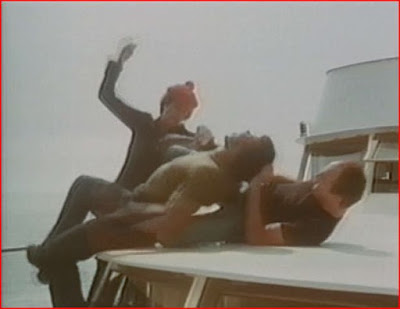
It's a pretty convincing argument. One moment Doug's sunning himself on the deck of their boat, and the next he gets stabbed, gets his throat cut, and gets dumped into the ocean. For Morelli and Magee it's on to LA, where they wage a two-man mad-dog war on the organized crime establishment, quickly muscling their way to the top while Magee tries to make his move on the allegedly widowed Mrs. Russell (J. Kennedy), a struggling nightclub singer. Hear her sing and you'll see what I mean by "struggling."


Meanwhile, Doug washes ashore barely alive on an island somewhere in the South Pacific. Now, what might you find in such a place at this time in history? That's right: Japanese soldiers who don't know that World War II is over. Their unit is down to one officer and one kvetching enlisted man. Rather than kill the enemy on sight they endeavor to nurse him back to health in the hope that he'll make a Man Friday for them. Both men happen to know English, though of course they can't have kept track on changes in the idiom.


Doug [reviving from delirium]: Those mother-humpers...

Officer: You said that in your sleep. What does that mean?

Doug: Nothing...some 'friends' of mine....

Enlisted Man: Hmmm, they do that to you? They ain't no friends. We your friends. We mother-humpers!

Discipline's broken down on Occupied Island, as the poor grunt Ichikawa back-talks to his superior all the time. He tells his commander that, had they stayed in Japan, he'd be a general by now, but the commander comes back by noting that by now he'd be Emperor. All the officer really has left is the personal discipline of the samurai, which he improbably imparts to the recovering Doug. As our hero regains his strength, the Japanese teaches him some martial arts and shows him how to chop coconuts with a sword. With this comes a moral lesson: "It's not for you to learn how to fight," the officer says, "but learn how to live."


"Where I came from, learning how to fight was learning how to live," Doug replies. So while the Japs have fatalistically reconciled themselves to spending the rest of their lives on the island, Doug lets himself get captured by the Philippine Navy. Before you know it he's back in LA, still carrying the samurai sword his mentor gave him, i.e. armed for payback. Now it's his turn to wage a one-man guerrilla war on Morelli and Magee, who prove much less effective now that they command scores of goons than they were on the offensive. While Morelli instigated the whole affair, Magee ends up the final antagonist, holed up in a heavily guarded Mexican compound with Doug's wife and son held hostage as our hero blazes a trail of severed heads toward the final showdown.


Santiago is a master chef of cinematic junk food. He keeps things going at a good clip throughout, constantly intercutting between the villains' conquest of LA, Magee's menacing courtship of the now-jobless Mrs. Russell, and Doug's samurai training. He makes sure that not too much time passes without some action or bloodshed, and he knows to save the best (or worst) for last. He knows that the one thing that can top an hour's worth of machine-gun mayhem is some serious head-cutting. The effects are awful, of course, but Santiago builds enough momentum to get you caught up in the spirit of the exercise. When you're ready to see heads roll, heads will roll. What more can you ask from exploitation cinema? In this case, I have to give the Filipino filmmakers credit for a perhaps-unusually sympathetic portrayal of Japanese soldiers, and for an idiosyncratically sentimental soundtrack featuring a love theme sung by J. Kennedy and a cute motif for our Japanese friends.

Mill Creek Entertainment presents the film as Fighting Mad (with an obviously spliced-in title card a la Death Proof) in its 50-film Martial Arts box set. As you can see, the presentation leaves a bit to be desired, and it's a bit of a stretch to call this a martial arts film (or at least to put it alongside kung fu and ninja movies), but somehow this seems like the way that Death Force was meant to be seen. I wouldn't mind seeing a properly-restored DVD, but I can safely recommend this item to fans of Seventies trash as is.