Friday, April 2, 2010

ONE GIRL'S CONFESSION (1953)

Hugo Haas first came to my attention in The Psychotronic Encylcopedia of Film, in which Michael Weldon included quite a few of the movies starring and produced, written and directed by him. From the descriptions, he seemed an unlikely candidate for psychotronic status. The films were melodramas, it seemed, in which Haas often cast himself as a victim, a dupe or a cuckolded husband. He was obviously an auteur of some sort, and Weldon professed to be entertained by most of his movies, but it looked like Haas was in the book because he was a "bad" filmmaker on some level.

I finally saw my first Haas movie this week. One Girl's Confession stars his main muse Cleo Moore, and is one of three Moore movies in Sony Pictures Home Entertainment's Bad Girls of Film Noir Vol. 2 collection. Sony is pitching these films as camp, crediting Moore with "earnest, if stilted, portrayals of dim-witted gals who can't catch a break." The "can't catch a break" part promises at least a noirishness to her vehicles, and Confession arguably is a noir. Something doesn't quite seem right about it, though -- but see for yourself.

Haas meets his cheesecake quote straight away by opening with Moore in a swimsuit sunning herself on a soundstage beach. She rises from her reverie to resume her miserable job as Mary Adams, a waitress in a waterfront dive run by her late father's business partner, who she feels has conned her out of an inheritance. Sick and tired of it all, she conceives a master plan. She steals her boss's strongbox, which he keeps under his pillow, hides the money somewhere offscreen, and confesses her crime the moment the cops arrive. Her idea is that, so long as she never divulges the location of the money, she'll be able to recover it and keep it once she finishes her sentence.

It's a little unrealistic, I thought, for the law not to be constantly pressuring her to reveal where the money is, or for fellow prisoners not to try and find out from her. I'd think that they wouldn't even think of an early release until she shows them the money, but once she proves a model prisoner, away she goes. Back on the waterfront, she finds the old dive under new management. Determined to lie low and not make a quick move for the money, in case anyone's watching her, she goes back to work as a waitress for Dragomir Damitroff (Haas), a gregarious gambler of a man with hair that's somehow artificial (color or texture) and a girlfriend constantly trying to skim off his winnings. While she's more romantically attracted to fisherman Johnny (Glenn Langan),whom some suspect of being an undercover cop, Mary likes Dragomir, and when he loses his shirt and his business in an all-night card game, she decides to bail him out before a bad check bounces him to prison.

Hugo Haas counts his winnings as Ellen Stansbury in her only film role looks on. As a director, Haas makes a decent effort at composition in depth here and in reverse shots from Cleo Moore's table (background).
Here Cleo Moore enters the pantheon of dumb blondes. She has a secret stash of loot and wants to help out a boss who's proven himself reckless with money. Would you:

a) Go recover the loot and give Dragomir some of it
b) Give Dragomir directions and let him find it.

The movie won't go much further, alas, if your answer isn't (b). So off Dragomir goes while Mary anxiously waits out the night. He returns in the morning, dirty from digging -- without the money. He accuses her of changing her mind and somehow getting there ahead of him and moving the moolah. She denies this as he throws her out.

Understandably, Mary's perplexed. She's more perplexed when she goes back to the dive to find that Dragomir hasn't lost the place, but has abruptly decided to go on a long vacation after somehow striking it rich. He's staying at a swank hotel where he parties all day while Mary does a slow burn outside. At night, after his guests go home, she sneaks in and confronts him. Half-unconscious from booze, he wraps his arms around her neck and presses her head against his chest. It takes the careful application of a wine bottle to his skull to free her. The bottle doesn't break, but maybe his skull did. So Mary thinks as she flees the scene.

At last we see where Mary buried her money, and where Dragomir dug in vain. Will she find the money (there's a clue in a prison flashback)? What will she do with it? Pay for what she did to Dragomir? I leave these questions open because One Girl's Confession is a pretty entertaining film in spite of, or because of its laborious plot twists and reversals. Hugo Haas, on this small evidence, is a very manipulative moviemaker, determined to convince you of one thing and say "psyche!" the next. But I found him an amiable personality and a halfway decent actor in his own right, while Cleo Moore is endearing as one of film's most hapless femmes fatales. The film looks as good as it ever did, I suspect, and Haas's heavy reliance on loud music and voiceovers to cover Moore's emotive limitations only add to the film's charm. Its oddball narrative hints at an idiosyncrasy to Haas's work that may justify his place in the psychotronic canon after all.

Another example of nice Columbia title-card artwork. This one makes Cleo Moore look a littlemore fatale than she actually is.

Thursday, April 1, 2010

In Brief: THE HOUSE OF THE DEVIL (2009)

Ti West's retro horror film seems to me like a more successful attempt at what Quentin Tarantino was trying to do in Death Proof, his half of the Grindhouse double-bill. Each film has a two-act structure with a slow, talky first half designed to get you interested in characters who'll end up in extreme jeopardy. But while Tarantino depended pretty much on his dialogue alone to build and maintain your interest, West does a better job building up sympathy or empathy for Samantha (Jocelin Donahue) and Megan (Greta Gerwig). He nicely establishes Samantha's isolation on the college campus and her need to get away from an obnoxious roommate, as well as the quirkiness that leaves Samantha and Megan, two otherwise attractive if not hot young women, as each other's best if not only friends. West's deliberate pacing also works to establish the distance Samantha has to travel to reach the house where she expects to do a night of babysitting. He set his film in the 1980s not only as a homage to that decade's horror films, but because it was nearly the last time when a person could be cut off from friends, without recourse to cell phones, Twitter, etc. Once Megan drops her off and drives away, Samantha is on her own in an already dubious situation that seems certain to get worse.

You could argue that West's approach is too low-key to be a true Eighties homage if you identify the decade and the genre with cartoonish killers. This film's head menace is Tom Noonan, who's menacing because of his age, his height, and his history as an actor, but also, paradoxically, of how soft-spoken he is and how fragile he seems. He's professorial in manner and the type of person you could believe is at least some sort of obsessive character. Again, West takes time filming Noonan's scenes with Donahue, letting his creepiness sink in gradually after an already creepy first impression. He has you feeling pretty certain that Samantha is making a terrible mistake staying over, no matter how much money Mr. Ulman offers her, but since he's also established why Samantha needs the money so badly, you don't automatically condemn her as stupid, even if Megan does. If you're watching the film in the first place you have an idea of what's in store for Samantha, but West and Donahue have made her enough of a sympathetic character that you want her to survive the night.

For me The House of the Devil is a big improvement on West's last auteur effort, the sniper thriller Trigger Man. That film struck me as pretty pointless, while the new film is more focused and more effective. To the extent that Trigger Man was a gore showcase, House matches it pretty well with one especially nasty gun-damage scene and plenty of bloodshed during Samantha's showdown with the devil's housemates. Some of the action wasn't as convincing as it could have been (Samantha gets loose from her bonds too easily at one point), and the climax has to stretch to reach the desired evil-wins ending, but overall it's an effective little film with enough heart to make it genuinely horrific. Despite the period music, it struck me as more like a Seventies horror than an Eighties effort -- but that's a good thing as far as I'm concerned.

Tuesday, March 30, 2010

YOKOHAMA UNDERWORLD: MACHINE GUN DRAGON (1978)

It shouldn't have surprised me to find out that one of the four films in VideoAsia's Sonny Chiba collection isn't really a Sonny Chiba movie. VideoAsia isn't exactly the most scrupulous purveyor of obscure movies. But in this particular case I perked up quickly as I realized that Akihisa Okamoto's film was, in fact, a Bunta Sugawara movie, with Chiba in a cameo role. Sugawara became one of my favorite Japanese actors when I saw Kinji Fukasaku's five-part Battles Without Honor and Humanity series (aka Yakuza Papers, 1973-4). If the Toei Studio in the 1970s is Japan's answer to Warner Bros. in the 1930s, and if Chiba, as I've suggested before, is Toei's James Cagney, then Sugawara is more like Toei's Bogart -- a stoic survivor in the Battles films or a tragic figure in Fukasaku's Cops vs. Thugs (1975), in which his cop protagonist makes a doomed bid to become a yakuza kingmaker. I was instantly glad for the chance to see another Sugawara film. This time, however, he has more of a Cagney role -- a very specific one.

A stylized opening shows Sugawara off in retro duds as he blasts away with his titular weapon, making me think I was going to see a period piece set in the 1920s or 1930s. Instead, the story starts in the modern day in subdued, suspenseful fashion as three monster-masked figures in a car await a rendezvous with gangsters at a dock on a rainy night. It's an ambush: the monsters kill the gangsters and grab their suitcase, but one of them is wounded. As he whines in pain, the driver unmasks, revealing a middle-aged woman berating the victim, telling him to be a man and shut the fuck up. Bunta Sugawara is the third person in this trinity, and the old lady is his mother. Together, leaving their partner to writhe in the car, they stash their loot -- an estimated one billion yen worth of drugs -- in a hollowed out section of a sewer wall. When they return to the car, Sugawara kills the wounded man.
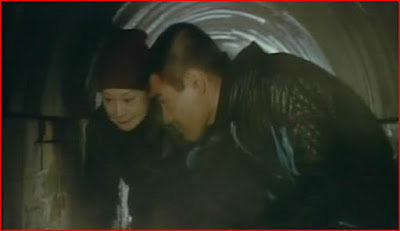
A gangster and his mother. As soon as Aiko Mimasu took her mask off I started asking myself, "They're not going to go there, are they?" But when Sugawara and Mimasu celebrate their score by sharing a bath I was pretty sure they were going there. Later events bore out my suspicion in stunning fashion: Machine Gun Dragon is a Japanese do-over of White Heat, one of James Cagney's most legendary gangster films -- the one where he plays a borderline psycho with a heavy mother fixation.

James Cagney and Margaret Wycherly in White Heat. Below, their Japanese counterparts.


Nearly thirty years later, Okamoto and writer Hiro Matsuda elaborate on the main points of Raoul Walsh's classic. There's more tension in the mother-son relationship this time. She's possessively jealous of any female attention to her boy, and he still resents her driving off a former girlfriend years ago, before he did a stretch in jail, even though he picks up a new one early in the picture. All women are whores, mom says. You should know, Bunta ripostes angrily; you were one yourself. But she only did it for his sake, she says, to keep him from growing up into a shiftless yakuza like his dad. Just like that she guilt-trips him into submission.

Nice work, mom! Instead of a shiftless yakuza, your boy is a reckless misfit who robs from the yakuza. While other characters affect the same retro fashions Bunta likes (we're probably seeing a Godfather influence) his preference for an anachronistic costume and a distinctive weapon (we're told that he's a prime suspect in the drugnabbing because not many Japanese use machine guns) suggests an arrested development, stunted by his suffocating mother. It's left him a big, crazy kid who spends his life role-playing with lethal consequences for others, as when he stages a St. Valentine's massacre of gangsters who tried to blackmail him.

This is all too much for the yakuza, who (perhaps having seen Fernando di Leo's Manhunt) send a distress call to America and get a black-and-white team of hitman to hunt down Bunta and his ragtag gang. The yaks run down Bunta's biker pals with garbage trucks, while the Americans take to throwing them off tall buildings, but none of these losers know where the drugs are stashed. There's nothing to do but storm Bunta's hideout, but he sees them coming, sees he's outnumbered, and quickly thinks up a way out. He has his new girlfriend slash her own hand and call the cops. Bunta saves his neck by getting himself arrested for domestic battery right in front of his enemies.

Americans have no manners. Look at the mess they leave behind when they go out.

That's not going to stop the yakuza. They have a man in the department, and they have men in jail. While their goons work over Bunta, the corrupt detective brings in Bunta's Mom and gives her the third degree. She's a tough old bird, but you can only go without food, drink and sleep for so long. Since I've already told you this is a remake of White Heat, you should know what's coming, but give Okamoto credit for a creative buildup.

In the original, Raoul Walsh sets us up by having Cagney pass a request for info on his mom across a row of cons in a prison dining hall. We see the query relayed one way, and the answer sent back the other way until the news hits Cagney, who takes a moment to absorb it before (as a full-of-it George C. Scott says from the grave on TCM) he becomes an animal and runs amok.
The do-over in Machine Gun Dragon is less elaborate but arguably more devastating in the set-up. It's visiting hour for our protagonist, who rushes from cell to visiting chamber anticipating Mom. Instead, it's his girlfriend with some sort of package under her jacket. Bunta immediately realizes something's wrong. He's having a "what's in the box?" moment already before the girlfriend unveils the package: a box of Mom's ashes.


The sight sends Bunta reeling back the way he came, quoting Cagney explicitly in the way he neatly slugs guards on the jaw during his animalistic tantrum of bereavement. He gets to howl and cry and throw things as cons cheer him on and his girlfriend watches in horror. The scene has a topper unavailable for White Heat when she lets loose a cry of agony when Bunta is finally carried away. This team of filmmakers gave themselves an awesome challenge here, and I think they acquitted themselves admirably.


Bunta is extremely vulnerable emotionally now, and it's the perfect moment for this film's counterpart to Edmond O'Brien to make another move to win Bunta's confidence. This guy had turned up already to save Bunta from a beating by yakuza goons (Bunta got his back by causing an "accident" that saws a goon's arm off and drowning another in a group bath). He's a police plant, presumably a good guy, hoping to track down the stolen drugs. Toward that end, he and Bunta are allowed to escape. Sure enough, after Bunta deals with the corrupt cop who interrogated his mom to death, he, his girlfriend and the plant recover the plunder.

Edmond O'Brien (right) and his Machine Gun Dragon analogue (below)


Now imagine if, three-quarters of the way through White Heat, Humphrey Bogart suddenly pulls up outside Cagney's hideout and says "Hey Cody! That guy's a copper!" before drilling Edmond O'Brien. That's basically what happens here when the fixer who counterfeits passports for our trio recognizes the plant, karates the hell out of him and shoots him. Yes, Sonny Chiba has made his belated appearance with revenge on his mind, but Bunta basically says, "Step aside, Butch," and finishes the rat himself. Now the filmmakers have nicely cut themselves loose from White Heat and are free to go their own way, whether it leads to a refinery or not.

The way leads north to a snowy coastal town where Bunta hopes to buy passage on a boat out of the country. He picks the town in part because he knows that's where he'll find his old girlfriend, the one Mom had driven off. That's a little rude of him, since his current girlfriend is along for the trip, but you can tell that Mom's death has liberated him a little. He's feeling nostalgic and eager to undo past mistakes, but that leaves him crassly indifferent to his current squeeze. When she falls in the snow, he doesn't help her up.


When he looks up his old flame in the inn where she tends bar, he leaves the other one outside until the old flame goes out to invite her in. You get the sense that it's too late for him either way, that he doesn't deserve either of them. But I guess there's a momma's-boy quality to him that inspires fanatic loyalty in women. After affecting to blow him off (she waves "bye" to him in English), the old flame ends up killing herself with an icepick rather than rat Bunta out to the closing yakuza and Americans.

We can tell, however, that Bunta isn't the hardcase he pretends to be. He took his mom's death too hard for that to be true. He faces one more test when his pursuers capture his new girlfriend. He's got his boat and his drugs, but they have a straight razor to the girl's throat. They propose an exchange: her for the drugs. In an appalling moment, he tells them they can have her and leave him alone. You can almost believe that he didn't expect them to do what they do.


There's no refinery for Bunta Sugawara to romp in, and no explosive finish, but the finale of Machine Gun Dragon is in its way as apocalyptic as the end of White Heat. Confronted with the horror his enemies have perpetrated, Bunta throws everything away but his machine gun. There's nothing left for him to do but kill, kill and kill in a fireworks festival of bloody squibs.

And with that accomplished, there nothing more to do than gather up his last beloved for what looks like a long walk off a short pier as Sugawara the actor (this being a certain period in Japanese cinema) croaks the film's end theme. There's a real note of despair in his singing, whether it expresses his character or his despair at having to sing, and it actually fits the mood of the moment.

I was floored by the audacity of Okamoto's Warners-Toei synthesis and the panache with which he pulled it off. If I keep seeing performances like this, Bunta Sugawara is going to end up as my favorite Japanese actor. It's a shame that his incredible work here goes out to the public in Sonny Chiba camoflauge, but now that you know the truth, VideoAsia's Chiba set may be the most economical way for people to discover Sugawara for the first time. Machine Gun Dragon is an amazing genre film and a must-see for fans of global crime cinema.

Sunday, March 28, 2010

Wendigo Meets NEW MOON (2009)

Catherine Hardwicke's Twilight was one of the last films my friend Wendigo saw in a theater, due to his advancing invalidism, and one of the first films reviewed (based on his report) on this blog. He had to wait until this week to see Chris Weitz's sequel when the DVD arrived in his mailbox, and to an extent he's been spoiling for a fight with all the Twi-haters out there. He yields to no one in his vampire fandom, and his isn't bound by any notion of what a vampire should be, since there is no such thing as a vampire. It's essentially a fantastical creature, and from his reading and viewing Wendigo finds that vampires fit as well in fantasy or romance stories as they do in horror films. Horror fans don't have to like non-horror uses of vampires, but they have no business arguing as if such uses are inherently wrong. Folklore from the Middle Ages forward, he claims, is full of vampire lovers who are not simply bloodthirsty bogeymen, so today's trend is really nothing recent or decadent. Call either film bad if you must, or all of Stephanie Meyer's books, but be sure you mean that they're badly written or directed or acted, not simply that they're stories you're not interested in.

Wendigo's fighting spirit is dampened a bit, however, because he must report that New Moon is not as good as the Twilight movie and doesn't live up to its source novel. More than the first film, the sequel seems intended for book fans only. It offers less of a hook for people like me who haven't read the novels. My own feeling was that the novelty that kept the first film interesting had worn off, despite the introduction of new elements. Wendigo objects to the new film's overemphasis on Taylor Lautner as Jacob the werewolf, whose coming of age, so to speak, is the main novelty of this episode. At the same time, it seriously overemphasizes Robert Pattinson as Edward the vampire, who is absent from most of the New Moon novel.

The scariest men in movies today? Robert Pattinson and Taylor Lautner certainly seem to give lots of folks the willies for some reason or other.

In the book, Wendigo says, Bella Swan often hears Edward's voice when she approaches dangerous situations. To keep Pattinson on screen as much as possible, Weitz visualizes these interventions so that Edward appears as a ghostly image who serves as Bella's personal GPS system. It's one example of Weitz's too-obvious approach to the material. There's little visual imagination here, especially in the special effects scenes of vampire-vs.-werewolf battles. The novel itself keeps the violence mostly offstage, but the film does nothing to make these scenes more dramatic or cinematic.


A potentially big scene in which the werewolves chase Victoria the evil vampire through the forest is slowed down to tedium in order to go with the chosen soundtrack song, for instance. The movie always cuts to the obvious to the point of being primitive. One well-designed shot meant to illustrate Bella's despair after Edward's departure sends the camera circling around her thrice over as she mopes in her room while the seasons change from summer to winter outside her window. Nicely done, but it gets overstated by the addition of titles announcing the passage of each month. Wendigo actually excuses this scene a little because it's the closest translation possible of Meyer's portrayal of Bella's despair with three blank chapters, each headed by a month of the year.


Overall, though, Wendigo faults New Moon for losing focus on Bella, who has to be the central figure of the series despite all the Team Edward/Team Jacob hype. You lose track in the movie of the fact that the story is supposed to be told from Bella's point of view, but there aren't enough moments here to establish her viewpoint. Instead, the camera drools over the two supernatural hunks without similarly glamorizing Kristen Stewart. The proper fairy-tale aspect of the story is lost, Wendigo says, if you don't keep her at the center. In New Moon she seems like just one of many characters careening about, and not the most interesting. For my part, I don't think Stewart was well served by what struck me as a rushed screenplay by the same writer who adapted Twilight. The dialogue seems more wooden this time, more expository, maybe because there's more mythos to reveal here.

While Wendigo is disappointed by the sequel, he doesn't disapprove of it entirely. He's happy to see Kristen Stewart on screen, for starters, and he thought the film fairly portrayed the novel's werewolves, instant transformations and all. Weitz's direction isn't all inept, and Taylor Lautner did come through with what was meant as a star-making performance. Wendigo was happy to see that Weitz took the trouble to shoot the Italian scenes in Italy, but for the little the production took advantage of the landscape and the red-robed extras I felt they may as well have done it all on a soundstage. Dakota Fanning makes a promising appearance as pain-inducing Jane, the Volturii's precocious minion, but Michael Sheen isn't as menacing as he should be as Aro the Volturii spokesman.

Future bandmates Kristen Stewart and Dakota Fanning, among others, in New Moon. You simply can't go wrong with sticking a bunch of mismatched people in an elevator. Below, vampire Tony Bla--I mean Michael Sheen asks, "What are you looking at?"

Wendigo is a little worried about the choice of David Slade, the director of 30 Days of Night, to direct Eclipse, the next film in the Twilight series. While he liked Slade's earlier film, that was more an action film than anything else, and with him at the helm Eclipse may well lose even more of the distinctive viewpoint that defines the whole Meyer series. Summit Entertainment may have doomed its long-term project, in his opinion, when it insisted on too fast a schedule to accommodate Catherine Hardwicke. He intends to stick it out and see them all, but he doesn't plan to look at New Moon again anytime soon.

***

While the big-budget vampire show was a bit of a letdown, Wendigo would like to send you home with a low-budget recommendation. He recently saw Mark James and Phil O'Shea's Vampire Diary in an edited-for-TV broadcast on the Chiller channel. It's a British pseudo-documentary about the accidental discovery of a real vampire that is pound-for-pound (or dollar-for-dollar) much more effective than New Moon. An unedited version includes a lot of hot lesbian action, which makes it something I'll watch some day, but Diary isn't just prurient. Wendigo saw some real imagination both in the writing and the direction that New Moon was too often sorely lacking.
Take a look at a trailer for Vampire Diary, uploaded by monarch movies:


And as a change of pace, here's the Eclipse trailer, uploaded by clevverTV

Saturday, March 27, 2010

BLISS (Mutluluk, 2007)

Here's a romantic drama from Turkey about rape and honor killing. Abdullah Oguz's film opens with shepherds discovering an unconscious girl on a beach. They wrap her in a rug and bring her to town, where it soon emerges, or it's assumed, that Meryem has been raped. That's a scandal that could hurt the prestige of the clan presided over by the Agha and local factory owner, Ali Riza. He summons Meryem's father and orders him to do the right thing for the extended family, which is to put Meryem to death to expunge the collective shame. But you can tell right off that Dad's a softy who won't have the heart to do it. Meryem's stepmom is probably a different story. She tosses Meryem a rope and suggests that the girl hang herself; God might be more forgiving that way. Meryem almost does it, but finally refuses, if only to spite the wicked stepmom. Fortunately for the Agha, there's a likely man for the job arriving in town: his own son Cemal, back from military service as a commando battling "terrorists," -- Kurds, presumably. Ali Riza tells his boy to take Meryem to Istanbul to do the deed away from local prying eyes. When Cemal balks briefly, the Agha reminds him that, as his dad, he's his commanding officer now. So it's off to the big city for a gravely mismatched couple.


When Meryem (Ozgu Namal) can't bump herself off, Cemal (Murat Han) is ordered to take her for a ride, but he sometimes isn't sure whom to bump off.

It'd be a short movie if Cemal could do the deed. When he can't goad her to jump to her death, he breaks down before he can pull the trigger on her. He clearly has issues of his own, at least with his dad (who we'll see has driven at least one other son away from him) if not with his wartime experiences. In any event, neither he nor Meryem can go back now, so they begin a picturesque picaresque adventure that takes them to a fishery and its adjoining shack, then to work as mate and cook on a college professor's sailboat. Cemal doesn't want Irfan the professor (Talat Bulut) to know their real identities and relationship, and he grows jealous as Irfan, who we see served with divorce papers in one scene, gives Meryem presents and tries to teach the backward girl about the wider world. Meanwhile, Ali Riza assumes the worst -- that Meryem hasn't been killed -- when Cemal doesn't come home, so he hits the trail to track them both down. Will Cemal's jealousy make the Agha's effort redundant?


Mutluluk is based on a novel, but cinematically it reminded me of some semi-waterborne tough-love stories like Sunrise and L'Atalante. It's distinguished by lovely land and seascape cinematography by Mirsad Herovic, who crafts pastoral images of almost archaic quality. The story may be a tough sell as a romance, in America at least, because of Cemal's occasional thuggishness. He's a man who, when provoked, will call Meryem a "whore" and sometimes slap her, but he's our hero, and as Irfan sees it, Cemal is only lashing out because he won't admit that he's in love with Meryem. Irfan is almost too good to be true in his disinterested benevolence, despite the director's attempt to incite suspicion with the divorce subplot. Nearly strangled by Cemal at one point, he drinks and has a heart-to-heart with him shortly afterward. I suppose it's part of the romantic tradition to have a benevolent eccentric around to steer the leads into each other's arms.

It's not until more than halfway through the film that we realize that there's a mystery to be solved. Meryem has constantly refused to name whoever raped her, and she sometimes insists that nothing actually happened. She may be keeping silent on purpose, but it seems more likely that she'd repressed the memory. In any event, the identity of the culprit seems irrelevant to the story for some time, since the rape dooms Meryem no matter whodunit. On the boat, however, Irfan throws her some rope, intending to teach her to tie a special knot, but it sparks a flashback to her near-hanging, and that leads to the first of several fragmentary scenes from her rape. Once we notice that the rapist's identity is being withheld, we know a big revelation is in store that is actually pretty predictable. And once that anticipation sinks in, you notice how a certain unconscious cultural prejudice may have kept you from anticipating it earlier, if you're a western viewer. Watching a film by and about a Muslim country, you may assume that honor killing is just what's done, especially in a backwater like Meryem's town. Scandalized by the concept, the issue of who raped Meryem may become irrelevant for you until Oguz gradually brings it back to the forefront. There may be a lesson in this film. When we see deplorable things in the Muslim world, we're tempted to blame them on Islam or Islamic culture in a way that makes the whole culture collectively guilty, but Bliss refutes that assumption by showing how religion or tradition can be exploited for pure self-interest. The best thing about the lesson is that Oguz doesn't make a lesson of it. It isn't a point that anyone has to make explicitly, but it's one that makes this sometimes-melodramatic story worthwhile.

Here's a trailer with English subtitles uploaded by the American DVD distributor, firstrunfeaturesnyc: