Wednesday, March 23, 2011

Conversations With Scorsese

Martin Scorsese's motormouthed enthusiasm for movies can be grating sometimes, but the man often has interesting observations to make. That makes Richard Schickel's new collection of conversations a promising volume: you get the observations in reasonable doses without the cartoonish voice. The book is a survey of Scorsese's career up to the surprise hit of Shutter Island (a public endorsement Schickel and to a lesser extent Scorsese himself find "astonishing"), bracketed by reflections on the director's upbringing and education and general comments on his techniques and artistic principles. Memories being what they are, and the earlier canonical works having been well gone over elsewhere, there's less talk about Taxi Driver or Goodfellas than about The Aviator and The Departed. This book is no substitute for a comprehensive artistic autobiography, and the nature of the format makes the book a hit-and-miss proposition, but it's an entertaining read.

With such a project the whole is inevitably less than the sum of its parts, but you probably read it for the flashes of insight (or their opposites) and the odd bits of trivia. You learn here, for instance, that Leonardo DiCaprio considered Out of the Past "the coolest film I've ever seen" when Scorsese screened it for him prior to The Departed. You also learn that Akira Kurosawa panned The Age of Innocence, complaining that "I do not like movies about romances" while chiding Scorsese for using too much music in his films. That news reminded me that I missed a discussion of Scorsese's career as a character actor, including his role as Vincent Van Gogh in Kurosawa's Dreams. The two directors clearly had some sort of artistic relationship that barely gets touched on here.

On his own work Scorsese is most interesting when most critical of himself. Shutter Island is clearly a touchy subject for him, especially since Schickel doesn't seem to have liked it. Scorsese was still smarting from a perceived betrayal by the studio that pushed the release date from Fall 2009 to February 2010, even though he has to admit that they must have had the right idea based on box office. Going back a few years, it seems that Scorsese still doesn't understand what went wrong with Gangs of New York. He tells Schickel that his dream project might have gone over better had he not run out of money while staging the New York Draft Riots. That sounds like a way to blame the money men for his own story problem. He could have filmed the riots with thousands of extras, but it would not have helped the picture as long as the riots remained irrelevant to the final showdown between DiCaprio and Daniel Day-Lewis's gangs. The deeper flaw in the often-brilliant Gangs is its insistence on a hero implausibly innocent of bigotry in such a bigoted age, its option for a generic revenge storyline instead of something more challenging.

Taking a larger view, I was intrigued by Scorsese's acknowledgment that Bringing Out the Dead marked the end of something for him. I didn't think much of the 1999 film, but I'd agree that there remains something essentially Scorsesean about that project that's missing from his films of the new millennium. While he still clearly has a creative passion about the making of images, the passion often seems to have gone out of his stories, leaving them the work of a master craftsman, but without his signature drive. Shutter Island is probably his best film of this period, but it's Dennis Lehane's story, not Scorsese's. While the director says nothing to confirm my hunch, I still feel that he hasn't been the same since 1995, when the public rejected Casino because it seemed too much like Goodfellas, which was like saying you'd allow John Ford only one cavalry movie. The most interesting thing Scorsese says about Casino is that he considers Joe Pesci's death scene the most brutal thing he's ever shot, and doesn't want to do anything like that again.

By the end, I recognized kindred spirits in both Scorsese and Schickel. I mean that almost literally, since it's on page 356 when the following exchange occurs regarding a film I haven't yet seen. I could hardly express better the value of film beyond its aesthetic or literary merit as a mirror of its time and place in history.

Schickel: The artifacts of history in film are terribly important. I mean, the worst movie in the world will contain clues to how we lived, how we dressed, how we talked.


Scorsese: That is what I was pointing out in 1979. There was a film called The Creeping Terror, a silly sci-fi film shot in the Midwest. They got everybody in some town to act in it. So you actually saw the way people dressed. And you saw how they behaved in everyday life. They were 'acting,' but they really weren't. The plot was not the point. What was important to me was what it said about America, and about our culture. It was very moving.


And sometimes so is this book.

Monday, March 21, 2011

Wendigo Meets DAYBREAKERS (2010)

My friend Wendigo is entertained by ideas and concepts. If a movie takes a novel noteworthy approach in building a fictional world, whether intellectually or aesthetically, he's more likely to be forgiving of any shortcomings in narrative or direction. If he can take an idea away that he can ponder afterward, or if he can see where the creators are getting their ideas or how they're adapting or evolving them, he considers the time spent worth his while. It's sometimes enough for a movie to be interesting, especially if a vampire movie takes the vampire motif in a new direction.

Michael and Peter Spierig's Daybreakers is the kind of film where imagination redeems other creative flaws in Wendigo's eyes. Its drastically different approach to vampires takes the concept out of the realm of horror and into the uncomfortable domain of dystopian science fiction. For that reason, presumably, Lionsgate treated the movie like a hot potato, letting it sit on the shelf for two years before dumping it in theaters in January 2010. Like Let Me In later in that year, it was a vampire film that didn't cater to currently popular fantasies of vampirism, and that doomed it at the American box office. What's cool about being a vampire when the world's full of them, after all? So much for Daybreakers, but while the film has its problems, but it deserved a better fate.

The time is 2019, ten years after a random bat bite started a global pandemic that transformed the great majority of humans into vampires. While some people opted for suicide, most did not find this fate worse than death. By the time of the story, vampire is the new human. Bloodsucking has been normalized to an alarming degree as humanity's new condition created new opportunities for businesses (subwalk platforms for daytime pedestrian travel, digital screens to take the place of mirrors and windshields, etc.). What may surprise viewers is that Daybreakers is dystopian, not post-apocalyptic. Society hasn't collapsed into the clans of fantasy or all-against-all warfare. The normality of it all is really the most horrific element of the movie, making it something like an evil Hanna Barbera cartoon.

Apocalypse is in the cards, however, because the supply of uninfected humans, who are herded and farmed for blood in the film's most dystopian images, is inevitably running out. For big business, crisis equals opportunity, and the Bromley Marks pharmaceutical firm is in the race to develop an artificial blood substitute. Edward Dalton (Ethan Hawke) is part of the team experimenting on substitutes, often with explosively bloody results. Ed has a personal motive to work hard. A reluctant vampire in the first place (he was turned by his military brother to save his life), he's been abstaining from human blood, just as society is starting to discover that forced abstention due to shortages can have dangerous consequences. Stay off the juice too long and you start mutating; Ed's ears start to get pointy, for instance. Things get worse if you get desperate and start drinking your own blood or another vampire's. Then you're on the short track to becoming a "subsider," one of the feral, batlike vampire underclass whose numbers are growing as shortages get worse. One interesting thing about Daybreakers is how "normal" most vampires are. While they can't see themselves in mirrors and are vulnerable to sunlight, they don't have super strength unless they turn into subsiders, and they seem to be on even terms with humans in fights, both sides resorting to weapons adapted to their strengths and weaknesses.

Subsiders, the lowest of the low among vampires (above), are the physically strongest as well, while normal vampires have to wear special clothes (below right) just to have a fighting chance against humans in the daytime.

When a traffic accident gives him a chance to rescue a band of fugitive humans from the vampire military, Ed is rewarded with an opportunity to meet an extraordinary person. Lionel "Elvis" Cormac (Willem Dafoe -- I said extraordinary, right?) is a former vampire. Through his own freak accident, Elvis learned that a cure for vampirism was possible.

T.C.B.

First you starve yourself like Ed has. Then you expose yourself to sunlight for a very limited time. The vampirism will literally burn off you in very painful fashion, and as long as you have some means of dousing the flames (Elvis was pitched through the windshield of his car and into a river) you'll be a new person. While steering clear of the military, including Ed's brother, the gang figures out a way to recreate the conditions of Elvis's cure in a more controlled environment. Ed subjects himself to an excruciating but successful treatment.

Once upon a time, Ed was scared by a little shaft of light. Look how brave he becomes!

You'd think a cure for vampirism would be the ideal resolution of the blood shortage issue, but some people, like Ed's boss (Sam Neill) like being vampires and the money they can make off vampirism. Daybreakers hammers home the point that greed is really the worst form of vampirism, and entrepreneurs the most dangerous vampires. Not even the discovery of a second cure mode (Elvis's purified blood cures Ed's brother) guarantees humanity's redemption as long as the alternative is wealth and power for someone else....

For almost the full length of the film, Frankie Dalton (Michael Dorman) is the only vampire who bites humans in the neck. Why is that?

In its portrait of a society unsustainably dependent on a finite resource, Daybreakers has some obvious contemporary relevance. Wendigo admires the depth of the Spierig's imagination, but he sees some holes in the concept. The crisis seems to come too suddenly, in his view, with no one having anticipated the crisis and taken steps beyond blood farming. Hadn't anyone thought of cloning humans? For my part, I thought that a vampire majority might resort to p.r. to redefine themselves as the "real" humans, while the actual human minority might get stuck with some dehumanizing nickname to make their exploitation easier. There are bigger holes in the narrative. For instance, a group of humans are traveling in a convoy toward a rendezvous with Elvis's band, but against all common sense, they travel at night, when they'd be most vulnerable to vampires. Wendigo also thought that the entire idea of gathering all the humans together was a dubious idea, since it'd allow them all to be taken in one fell swoop.

Somewhere past the halfway point, Daybreakers turns into a more conventional if not cliched action thriller with too many predictable plot twists. It also becomes more redundant, with a repetitive succession of vamp-on-vamp attacks to supposedly spread Cure No. 2. It becomes redundantly gory, too, as if the Spierigs needed to square up for a relative lack of it earlier. Once starving vampires tear into Sam Neill and other actors, the film comes closest to being a kind of horror film. Wendigo wasn't really bothered by the repetition, but felt that the actual effects, including a flying Neill head, left something to be desired. The various appearances of subsiders are handled better; they're scarier for the depths to which they've sunk than for how they look or act. The directors make a point of reminding us that the subsiders were all people once, though they're less successful with a subplot that takes the Neill character's daughter on a rapid arc from fugitive human to executed subsider.

There's a tragic grandeur to the fiery demise (above) of Charles Bromley's daughter, and a farcical fakeness to Charles's own undoing.

Wendigo approached this film with a little trepidation because he isn't an Ethan Hawke fan. Ever since Reality Bites he hasn't really cared for the actor, but this time out Hawke impressed him as a personable and sympathetic hero. Willem Dafoe is Willem Dafoe, but that's a good thing. Sam Neill is too obviously a villain from the onset and doesn't hide it with his performance, though he has one good scene when he actually seems to regret what he's put his daughter through. The rest of the actors, including Michael Dorman as Ed's brother and Claudia Karvan as the human heroine, are underdeveloped, the brother especially given how important his changing motives are to the story.

The Spierigs are at their best as satirists and manipulators of suspense. Wendigo singles out two scenes for praise: a riot at a coffee stand when consumers discover that the blood content has been cut and Ed's daytime drive into the shade of a large tree for a meeting with fugitive humans. The first exemplifies the satiric, dystopian element of the film, how the artificial normality of the vampire majority can fall apart over petty things and turn purported people into battling animals. The second, an early episode, is convincingly tense because the directors have put over their concept and made clear what a huge risk Ed is taking by traveling to the middle of nowhere in broad daylight, with only the shade to save him from burning death. Whenever the action follows from the concept, Daybreakers is on sure ground. When there's action for action's sake, the film is less sure. But for a concept man like Wendigo, the film is a unique enough take on vampires to earn a bloody thumb up.

Sunday, March 20, 2011

DETECTIVE BUREAU 2-3: GO TO HELL BASTARDS (1963)

Nikkatsu noir this isn't. It's the same studio, and a lot of the same personnel, but Seijun Suzuki's film takes us about as far from noir -- or its putative Japanese equivalent -- as a crime film fan can imagine. Designed to launch a series (there was only one sequel), it presents Suzuki protege Jo Shishido as Tajima, a private detective who convinces the cops to let him infiltrate a new gang that's been robbing yakuza weapons smugglers. Our chipmunk cheeked protagonist (frequent readers will recall that Shishido had himself surgically, er, enhanced to make himself more distinctive looking) is given the identity of a prisoner, with all the resources of the police dedicated to backing it up. That's a good thing, since the gang proves quite diligent about background checks.

Jo Shishido (right) gets pretty cheeky with the cops, as only he can.

Tajima attempts to ingratiate himself to the gang by rescuing an imprisoned member from a yakuza lynch mob lurking outside the local jail, but the crooks never fully trust him. Complicating things further is his budding romance with the gang leader's moll and the fact that the star performer at the nightclub frequented by the gang is Tajima's ex-girlfriend. She's in the picture to justify some song-and-dance numbers, one of which our hero joins in. It's that kind of film.

Christmas in Japan

To be more precise, there's a kind of Rat Pack vibe to the whole project. If they remade it in America I could see Dean Martin as the detective. No one really takes it seriously, and the picture is pretty overtly comic, anyway. Tajima has a couple of comic sidekicks, one of which is a mannish female who doubles as a scandal-sheet publisher. The production numbers are purposefully tacky, all the more so given the Christmastime setting. The Japanese celebrate the holiday with one of the world's ugliest trees and a chorine performance of "When the Saints Go Marching In." There's a bemused engagement with Christian culture throughout, as when Tajima must explain why his alter ego "Tanaka Ichiro" lives in a Catholic church. The priest there is his father, he explains, and no one bats an eye.

Did I mention that there was violence in this movie? Hell yes there is!

The story isn't really that engaging once you realize you can't take it seriously, but if style trumps substance you can still enjoy the movie. Suzuki toes the line between taste and tackiness, and his strong sense of color keeps him in a state of candy-colored balance. The urban locations are an added attraction for time-traveling tourists like me. Detective Bureau 2-3 gives you a definite feel for a specific moment in Japan's pop-culture history. It's not in the same league with Suzuki's more intensely dramatic films like Youth of the Beast or Gate of Flesh, nor is it as nuttily inspired as his bridge-burning Branded to Kill, but it'll do for a 90 minute pop diversion to an exotic stop in the wild world of cinema.

Friday, March 18, 2011

Anthony Mann's THE LAST FRONTIER (1955)

Anthony Mann is widely regarded as the best directors of westerns during the 1950s, the golden age of the genre in America. But while his run of films with Jimmy Stewart have entered the canon, and his one film with Gary Cooper, Man of the West, is often ranked on the same level, The Last Frontier is for some reason the neglected cousin of the Mann western family. To be more specific, the reason it's neglected is Victor Mature. Compared to Stewart and Cooper, not to mention Henry Fonda (The Tin Star) or Glenn Ford (Cimarron), Mature is a much less credible actor. He remains identified with Cecil B. DeMille's Samson and Delilah, which despite its blockbuster popularity made Mature a laughingstock as legends spread of his cowardice on set and Groucho Marx's comment that Mature's breasts were bigger than Hedy Lamarr's. If he's remembered at all now, it's as a bad actor, but I've liked some of his performances, from the film noir Kiss of Death to another sword-and-sandal saga, Delmer Daves's Demetrius and the Gladiators. It might help Last Frontier's reputation if more people knew that it features one of Mature's best performances, but the film has problems of its own that aren't the actor's fault.

Mature plays Jed Cooper, a trapper who works the Sioux country with his mentor Gus (James Whitmore) and his full-blooded Indian pal Mungo (Pat Hogan). They get a cool introduction in which they react to the menacing arrival of a war band by sitting down for a snack to show that they're not scared. They may not be scared, but it's not like they can face down these suddenly hostile warriors. Instead, they're compelled to give up the furs they've accumulated, the horses they're loaded on, and their guns, now that Chief Red Cloud has decided that white men are no longer welcome on tribal land. They're no longer welcome because the bluecoats have built a fort, and it's to the fort that Jed and his crew head in search of compensation, despite Gus's reservations.

The cavalry can't repay them for what the Indians took, but it can pay them to become scouts. Jed likes the idea of the power and status that comes with a uniform, while Mungo is happy as long as he can get booze. Jed is also turned on by the lady of the fort, Corinna Marston (Anne Bancroft), the commanding colonel's wife. Like his men, or most of them, Col. Marston (Robert Preston) is stationed on the frontier because he's not good enough to fight in the Civil War. He'd had his chance, actually, and earned the nickname "the Butcher of Shiloh" with it. It wasn't Rebs he butchered, but his own men through reckless leadership. Marston is unrepentant, telling anyone who'll listen that he'd take the same chance again, and wants redemption through a decisive victory over Red Cloud. With typical bluecoat arrogance, he underrates "savages" as strategists and makes arrangements to lead his men into a Little Bighorn style slaughter.

Jed confronts the Marstons: Corrina (Anne Bancroft, above) and the Colonel (Robert Preston, trapped below).

Jed recognizes Marston for a fool but is torn between a growing sense of responsibility to the fort and a desire to be rid of the Colonel in order to have Corinna for himself. He claims to have nothing against Marston personally, but he'd plainly be happy to see him dead. The feeling eventually becomes mutual as Jed leaves Marston in a bear trap, only to be guilt-tripped by Corinna into going back and rescuing him. Annoyed by her mixed signals, Jed slaps her before he leaves. Afterward, he becomes increasingly disruptive, finally quitting the fort after Marston's henchman tries to kill him. He knows that Marston will lead his men to destruction, despite the efforts of a lone sensible officer (Guy Madison), but that's none of his business anymore, except that Gus is still with them (Mungo followed Jed out but went his own way) and the opinion of at least one other person at the fort still matters to him....

Mature gives his all in a boisterous, swaggering performance -- at least it's a lot more than he often gave in movies. Jed symbolizes the eventual civilization of the Last Frontier as he gradually learns loyalty to things larger than himself and disciplines himself accordingly. He's not unlike the typical conflicted Mann protagonist, but without Stewart's cool grimness; Mature's a wild man by comparison and the best thing in the movie.

Mann makes the most of his locations, of course, as does cinematographer William C. Mellor. The fort setting and the frontier warfare with "barbarians" anticipates what Mann would do on a larger scale, if not with much more success, in The Fall of the Roman Empire nearly a decade later. What hurts him here is a romance angle that has no good reason to exist, except that Columbia Pictures probably insisted on it. If there's a weakness in Mature's performance, it's that he has no chemistry whatsoever with Anne Bancroft, who doesn't seem herself in this episode from her first, failed tour of duty in Hollywood. Jed's affair with Corinna is an artificial complication that his conflict with Col. Marston doesn't need. We know it doesn't need the extra stuff because it's been done before. The conflict between Mature and Robert Preston is basically the conflict between John Wayne and Henry Fonda in John Ford's Fort Apache, only more forcefully expressed across a greater social gulf.

In the end, however, The Last Frontier is a strange synthesis of Fort Apache and, of all things, Gunga Din. Imagine a Gunga Din remake in which the title character not only survives but wins, and you have the finish of Mann's movie. A lone figure is about to ride into an ambush that'll preface a general slaughter of unsuspecting troops. The uncivilized Jed can save the day (and his friend) and alert the troops by firing his rifle. In the end he saves neither Gus nor Marston, but instead of a dead honorary corporal, Jed ends up a live sergeant. Mann usually opts for the redemptive happy ending in his westerns, but this time it seems too neat and too convenient for the hero. The film is simply too romantic to rank among Mann's best work or the great westerns of the decade, but even an inferior Mann western has a lot going for it. Between Mann and Mature, this one has enough to justify a look.

Thursday, March 17, 2011

Michael Gough (1916 - 2011)

Sad news today for genre film fans. The actor once known for his scenery-chewing villainy in numerous British horror and sci-films (Konga, Horrors of the Black Museum, etc.), whose image mellowed into that of Batman's wise old butler in four films, has passed away at a great and venerable age. Gough was present close to the creation of Hammer Horror as a supporting player in Terrence Fisher's (Horror of) Dracula and was a fixture in the English genre for more than twenty years thereafter. He remained creatively associated with Tim Burton until just last year, when he contributed a voice to Alice in Wonderland, and he made it before the end into the latest edition of David Thomson's Biographical Dictionary of Film. Gough was an instantly memorable figure who'll be just as immediately missed by his many fans around the world.

Wednesday, March 16, 2011

PANIC BEATS (Latidos de Panico, 1983)

Growing up in Franco's Spain, Jacinto Molina was steeped in American horror culture. His enthusiasm for Universal Pictures is most obvious in the Waldemar Daninsky werewolf films he wrote (and later directed) for his Paul Naschy alter ego. Latidos de Panico shows a broader American (or Anglo-American) influence, since the core story echoes Patrick Hamilton's play Gaslight, which was made first into a British movie, then into the more famous George Cukor film for M-G-M, which earned Ingrid Bergman her first Oscar. Was the American influence broader still? Could Molina have read translated EC Comics? I have my doubts, but after seeing Panic Beats you'd see why I ask.

Influences aside, Molina's film is a sequel to one of Naschy's most popular movies, Carlos Aured's Horror Rises From the Tomb, for which Molina created the character of Alaric de Marnac, one of his variations on the Gilles de Rais theme. Molina's script and Aured's film borrowed from Mario Bava's Black Sunday the idea of an executed villain's curse coming to fruition centuries later. It also enabled Naschy to play two roles: Alaric and a doomed 20th century descendant. Latidos is a sequel to this film the way any Daninsky film is a sequel to its predecessor. That is, Panic Beats is more a reprise than a continuation of the de Marnac character, an opportunity for Naschy to do again something that had proven cool before, with variations.

For those unfamiliar with Gaslight, I can sum up the situation quickly: Paul de Marnac (Naschy)wants to get rid of a sickly wife (Julia Saly) so he can live with another woman and the wife's money. His plan is to scare the wife to death by convincing her that the ancestral home is haunted by the evil spirit of Amalric (Naschy), a wife-murderer who occasionally returns from the grave to lay into unfaithful women with his trusty flail. Molina wisely opens with a stylish sequence establishing Amalric's viciousness. In armor and on horseback, the villain chases a naked woman through a forest before dismounting to beat her to a pulpy death. This is the first of Molina's directorial efforts I've seen, and the opening impressed me. He invests it with more moody artistry than Naschy's previous directors were usually capable of. Those early films have their own raw virtues, reminiscent of the "history of cruelty" films I've been watching lately, but Molina seems to have more control over tone, and that'll serve him especially well at the end.

It's just a matter of time before Paul's plot pays off, and his success moves us away from strict Gaslight territory. In that film the more modest object is to drive the wife insane, and the villain fails. In Panic Beats the modern villain's victory only launches a grim endgame that puts Paul in another league altogether. His comeuppance comes at the hands of his paramour, or more literally from the working electric heater those hands dump into Paul's bathtub. That leaves the femme fatale the winner, if not for the EC ending.

As an actor-director, Molina has to keep the suds and dirty water carefully placed to hide the "full Naschy" from sensitive audiences, if not from actress Pat Ondiviela.


Whether the femme fatale counts as the required unfaithful woman or not, who should show up to pay her a call but Amalric de Marnac in full armor, an embodiment of Paul's revenge from the freshest of graves? Underneath his helmet is a rotting skull, which re-coheres into the familiar fearsome and bearded visage as Amalric's armor steams with rage. He is a silent, remorseless avenger, more like one of EC's gruesome avatars than a self-interested villain. He avenges his descendant with uncompromising finality, and unlike an EC comic, there's no gallows humor to lighten the mood.

Molina shows us Amalric's handiwork in detail, and the shots of the woman's pulped face would seem gratuitous if they didn't somehow seem appropriate instead. Molina controls the tone so that we (maybe I better say I) feel that we need to see this, that we need to see the woman's beauty utterly destroyed by a force beyond the reach of seduction or appeals to mercy. Much of what falls in between the bookending scenes of horror lacks the usual outrages that make me a Naschy fan -- though that bathtub scene is a typical showcase of the actor's sometimes misplaced vanity -- but the beginning and end should be enough to redeem Panic Beats for Euro horror fans.

Monday, March 14, 2011

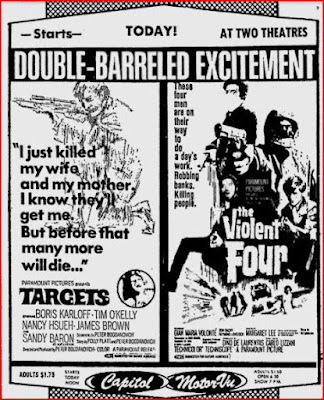
BANDITS IN MILAN (The Violent Four, 1968)

A young man walks past a bank. Through the window, he sees what looks like a robbery in progress. The first thing he asks the man standing in front is, "Is it a movie?" "Yeah," the other guy answers, "those guns are empty." We know better; the robbery is real and this guy is a lookout for the robbers. The kid asks him, "Can I stand here and watch?" The lookout shoos him away, and the kid sulks, "Oh, I had someplace to go, anyway."

Like I said, we knew better -- or did we? Our confusion isn't necessarily a credit to the tricky structure of Carlo Lizzani's docudrama, which comes on early more like a mockumentary, or a mock mondo, based on an actual September 1967 bank robbery and police chase that left several Milanese citizens wounded and two dead.


September 26, 1967.

The film opens at the end of a car chase, with a mob threatening to lynch a man pulled from a car and the police, led by Commissario Bassevi (a clean-cut Tomas Milian) intervening to save him. Inside a squad car, Bassevi interrogates his man, demanding to know the names of his accomplices. But from here the film digresses, following a rhetorical question asking how things had gotten so out of control in Milan that the events of September 1967 could have taken place. Bassevi becomes a narrator, and is shown directing or supervising scenes that our original narrator has identified as recreations of actual crimes for the purpose of illustration. We are reminded repeatedly that we are not watching real events, and I think Lizzani meant us to remember that when the kid shows up outside the Banco di Napoli.

The long, disorienting digression takes us into mondo or pop-art territory. The subject is mob infiltration and intimidation of nightclubs, and we're shown a protection racket horning in on a club owner who already pays off another gang. He's warned to play ball with the new people, and when he hesitates, Lizzani cuts to clippings from Batman comics, including their infamous onomatopoeia, before cutting back to show the owner's office wrecked. From there we segue to the story of an aspiring model exploited and eventually set on fire by the mob.

While all this is going on, we learn, Piero Cavallero (Gian Maria Volonte), an ex-leftist who's turned from Communism to crime after his expulsion from the party, is assembling a crack robbery gang. Thinking himself a kind of guerrilla general, Piero's strategy is to stretch police resources thin by hitting a series of banks in a single day in rapid succession. He envisions the Banco di Napoli robbery as his last big score in Milan, but it's one bank too many. Bystanders identify the license plate of the getaway car and the chase is on.

Gian Maria Volonte vs. Tomas Milian on the streets of Milan.

The chase is epic. Lizzani seems to have had the run of the city to film it. Piero turns mad dog, blasting away at cops and civilians alike, hoping to create distractions and obstacles by hitting the latter. Hoping to get out of town, he changes his mind once he realizes that Bassevi won't have his men fire within city limits. He exploits the cops' fear of hurting civilians, having no such scruple himself, and the chase continues. Even in the truncated fullscreen version available for streaming on Netflix, it's pretty stupendous. It isn't a collection of stunts but a sustained race against an insane man as Volonte (best remembered in the U.S. for his villainous roles in Sergio Leone's Dollars films) and his men hurtle down streets blasting away at all and sundry. In the prologue, Lizzani had shown us Piero's victims. During the chase, he reintroduces us to them as they get up in the morning and go about their daily routines, each appearance a milestone of irreversible doom. You're rooting for Bassevi to somehow ride down the bad guys, but you know (and the original Italian audience knew better) that it can't end until all the victims are accounted for. The chase is by far the highlight of an otherwise muddled movie.

History forces Lizzani into anticlimax. While future Italian cop films would have scripted an appropriately violent end to Piero's gang, Bandits sticks to the facts. All of the robbers are taken alive, Piero and his last accomplice readily surrendering when cornered in a small town barn. The film ends with Piero lording it over the media as he's booked, boasting of his generalship and cynically downplaying his killings compared to Vietnam, while the accomplice sullenly denounces Piero to anyone who'll listen. That's it. No moral, no catharsis, no closure. Just the facts -- if you can believe what you see on film.

Lizzani began his career and has apparently finished it (as of 2008) as a documentarian, so the docudrama approach, the mockumondo elements notwithstanding, may be a matter of personal style. The mondo influence (down to Riz Ortolani's score) shouldn't be underrated, since it probably explains why the film doesn't seem to have a dramatic point, and why such a film would have been made in 1968 Italy. Italian audiences were accustomed to the enhanced actuality approach of mondo movies, so Bandits probably didn't seem as strange to them as it must have seemed to most Americans when Paramount released it in the U.S. as The Violent Four. Lizzani also has roots in neorealism as an assistant to (and later biographer of) Roberto Rossellini, and his apparent commitment to urban verisimilitude serves him well in the crowd and chase scenes. But Bandits ends up an odd, unassimilated hybrid of styles without the real thematic payoff all the establishing stuff about recreating crime with cops in control seems to be pointing at. Despite that, Italian crime-film fans should definitely check out this precursor to the Seventies cop-film cycle for the big chase scene, Volonte's voluble villainy and Milian's understated authority as the commisario. But they should probably try to find it in a format that does Lizzani's vision real justice.