Tuesday, November 6, 2012

Weird Noir: THE NAKED ROAD (1959)

According to gossip columnist Dorothy Kilgallen, William Martin's independent feature, now included in Something Weird Video's Weird-Noir collection, was inspired by an Edward R. Murrow radio report on prostitution rings operating near the advertising industry district on Madison Ave in New York City. Writing in July 1959, Kilgallen predicted that The Naked Road would "cause quite a stir" in the metropolis later that summer. This was probably the best publicity the film ever got. If it caused a stir anywhere it played, it was probably nothing a square-up reel couldn't fix. An exhibitor would have been wise to have one on hand, as Naked Road is a textbook case of delivering much, much less than a movie might promise.

The ad-industry angle consists of an agency man taking the heroine, Gay Andrews (Jeanne Rainer), out on a date, only to learn that she won't put out. Taking her home, our Mad Man is pulled over for speeding and conducted to the home of a local justice of the peace, who levies a stiff fine. Mr. Big Businessman doesn't have the ready cash, but the judge lets him go get the money, as long as Gay stays in his custody until the driver returns.

 
The Majesty of the Law

Hours later, another sympathetic speeder sees that Gay's been abandoned, confined to the judge's couch. Taking pity on the girl, he pays the ad guy's fine as well as his own so the girl can be let go. This Wayne Jackson (Ronald Long) takes Gay to a fancy restaurant (see below), but it soon becomes apparent that his motives are even more ulterior than those of the ad guy. Wayne intends to recruit Gay into his "public relations" racket, enticing her with a promise of $1,000 a week and threatening her with "the Treatment." Gay has a pain in her arm when she wakes up in Wayne's apartment. That pain was the first prick of the needle, the first round of the Treatment. But if she agrees to become a whore voluntarily, Wayne will spare her the horror of drug addiction.

 
Wayne takes his victims to the finest places.

A waiting game now begins that rivals Beckett for existential futility. Wayne and his stooge impatiently await Gay's surrender, going so far as denying her food -- though cigarettes are still okay, since they'll help her think. The threat of the Treatment always looms, and Gay finally surrenders. At this point Wayne sets up an impromptu training session, ordering Gay to show his stooge a good time. As the jazz music builds on the soundtrack, Wayne steps into the other room, and we watch him wait until Gay screams. Back in the bedroom, she's smacked the stooge in the face, and Wayne sends him away. Angrily, Wayne reminds Gay of the Treatment, but then informs her that the initial shot had only been penicillin. The waiting game resumes, and might go on forever were Wayne's stooge not caught by an eyewitness, one of Wayne's own hookers, dumping a dead girl's body out a window to simulate suicide.  Wayne rightly chides his flunky for letting someone see him, and warns him that the consequences will be dire if the girl talks -- but the thought of silencing the girl never takes root in either mind. Finally, it's only a matter of waiting for the cops to come....
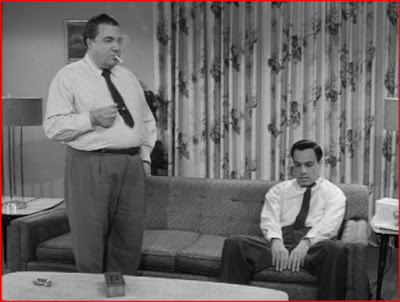
 
After an hour or so of Naked Road,
you'll probably be ready to chuck it.
 

The weird thing about this would-be noir is how absolutely ineffectual its villains are. Their recruitment process for prostitutes stops short only at saying "pretty please with sugar on top" to poor Gay, whose torture by tedium can only inspire empathy from audiences who watch it, so long as they stay awake. Martin may have convinced Dorothy Kilgallen, without showing her the film, of its relevance, but Naked Road is more nearly a film about nothing.  It appears to have been filmed in people's houses, various rooms passing for offices and restaurants, apart from the closing coup de cinema, for which Martin arranged for the denouement, settling the fate of Wayne's official co-conspirators, to scroll across a New York TV station's electronic sign. If Something Weird deems it "Weird-Noir," that's in spite of Martin's effort to purge the tale of any weird vitality. I suppose there is something weird about Wayne's desultory attempts to dominate Gay, but it's dumb-weird, not weird-weird, if you appreciate the distinction. Naked Road is a truly bad movie, a celluloid void that friends and intoxicants are unlikely to redeem -- though that probably won't stop people from trying.

Sunday, November 4, 2012

MAIDSTONE (1968-70)

Norman Mailer lived long enough to see his generation's ambitions become irrelevant. As an ambitious American writer after World War II, he grew up in the shadow of Ernest Hemingway, who rose from avant-garde obscurity to become a celebrity while largely retaining his literary reputation. Hemingway was a model and a target for those who would write the Great American Novel, or be the Great American Novelist. Mailer struck early, his war novel The Naked and the Dead making him famous at age 25. For many, he never surpassed that first success, but some credit him for becoming one of the greatest non-fiction writers of the latter 20th century. Beginning with 1959's Advertisements for Myself, Mailer became his own great subject, and in a way he may have written the Great American Novel without realizing it, or maybe without wanting to admit it in the form it took. In Advertisements he promised the G.A.N., but after another decade, despite two more novels, the Great One had not come. Mailer struck out in two directions simultaneously. He published a "non-fiction novel" about his adventures at an antiwar protest, and The Armies of the Night won a Pulitzer Prize. During the same period he became a movie director, but cinema seemed to require a different approach.


Most movies are made as a corporation product. You know, they're planned, and there's a corporation behind them, and they're turned out. Now what we did is, we made a movie as a military operation. When you have a military operation what happens is you set out to take a given town, and your objective is to take that town, and as you go forward all sorts of unforeseen contingencies arrive, and as they do you go around them, or you go through them, or you go under them. But the whole idea is, in a military operation that you get a certain amount of force, moving, and then you move with it, and you discover what the reality of your attack is by attacking. So what we've been doing in the last five days is making an attack on the nature of reality, on what is reality. You can't say that this is real now, what we're doing; you can't say what we were doing last night is real. The only thing you can say is that the reality exists somewhere in the extraordinary tension between the two extremes of the relationship....

You're still thinking of movies that are made when you very carefully structure them, you follow? And you get the maximum out of each moment. But what I'm arguing about in this method is that you can't make a movie that way and get something even remotely resembling the truth. What you can get is, you can get a unilinear abstract of one man's conception of how something might happen. But what I'm saying is that's not the way anything happens. The way anything happens is that it has five different realities at any given moment which then swing around to there, you see?
 
 
Or like this, you follow? And in other words it's sort of a tumbling, odd thing....There's not anyone here, including myself, who finally knows what went on in that movie.

By the standard expressed here Mailer couldn't hope to capture reality in a novel which could only be his own "unilinear abstract." But his operation, as described in a fourth-wall breaking moment near the end of Maidstone, his third feature film, points toward a dead end for modernism at an opposite extreme from art, which to be meaningful must distill experience or "reality" into something comprehensible and ideally vindicated by relevance if not verisimilitude. Mailer's notion of cinema is a recipe for chaos, and Maidstone is a pie in his own face. Something more substantial than a pie, actually.


Mailer apparently conceived Maidstone as a kind of role-playing-game for his cronies, the challenge being whether someone would assassinate Mailer's character, a director turned presidential candidate named Norman T. Kingsley. The author assumes that this Kingsley's candidacy would be taken seriously enough by the power elite that they would contemplate murdering him. We are to understand that Kingsley is an art-house success with a following (of potential voters) in the millions, and a talent comparable to Bunuel, Dreyer, Fellini and Antonioni. The director Norman Mailer isn't the same as the director Kingsley, but from what we see of Kingsley's methods the comparisons are insulting to all of the above. Kingsley's work, which seems to deteriorate from a Bunuel homage to some rather lifeless porn, seems no less amateurish than Mailer's; the latter, it must be said by a fan of the writer, has almost no pictorial sense at all, and at most some aptitude for montage if not narrative. Where there are glimmerings of a visual imagination, Mailer (not Kingsley) seems most influenced by Antonioni in scenes of actors wandering aimlessly through an airy countryside. The wandering may seem Felliniesque, but the space is used more in Antonioni style. But the effect is the opposite of Antonioni's evocation of emptiness, since these excursions feel like idyllic respites from the claustrophobic paranoia chez Kingsley. I'll even give Mailer credit for intending them that way.


Politically, Maidstone is vacuous, its main premise, as far as I can tell, being that Norman Mailer is a legitimate threat to the establishment. Kingsley articulates no political vision, telling a skeptical interviewer only that he has the qualities of character necessary to steer the nation through crises. Mailer sees Kingsley, despite his artistic vocation, as a representative politician, but one guileless enough to allow the contradictions Mailer perceives in all politicians crack the surface -- though while the author sees politicians as potentially part angel, part devil, Kingsley seems mostly devil, a misogynist manipulator who makes an epic ass of himself during an encounter with an ex-wife. With recently-enhanced hindsight, this particular scene, in which actor Mailer scats childishly to some radio music just to fill the air around the estranged couple, reveals Kingsley, if not Mailer, as a real-life Lancaster Dodd, one who we see later admitting that he's made things up as he went along.


If Mailer/Kingsley is Lancaster Dodd, than Rip Torn, the professional ringer in the cast, is Maidstone's Freddy Quell. Torn doesn't get many opportunities to act extensively, but he's still obviously in another league than all the hopeless participants improvising without method or conviction. In the story or game, Torn plays Kingsley's disgruntled or disturbed brother, the person most likely to be turned into an assassin. Apparently, any assassination attempt was expected at a party Kingsley stages, and during Mailer's Q&A after the fact a cast member expresses surprise that no one tried anything then. But if the rap session was meant to show that the game was over, Torn didn't get the message. Maidstone closes with an apparently spontaneous surprise attack by Torn, in character, on Mailer, with a hammer. A bloodied Mailer instantly falls out of character and fights Torn, who protests that he has to kill Kingsley, not Mailer. After the men are separated by Mailer's legitimately frightened family, they go on arguing as Mailer denounces Torn's betrayal of his trust. Yet Mailer left the attack in the picture, in lieu of an assassination within the game, and may have inserted the Q&A to set up the new ending as a proof of his method, Torn's attack reshaping the reality of Maidstone as an event rather than a narrative. But the wrap-up is more an admission of defeat, a confession that Maidstone could never be anything more than a documentary about itself, less a commentary about anything than raw material for future commentators on Norman Mailer, who had more literary triumphs to come but only one more film to make, the comparatively conventional adaption of his own detective novel, Tough Guys Don't Dance, in the 1980s. Maidstone remains relevant as long as Mailer does, but no matter how much Mailer fascinates me, his ambitions no longer impress many people, -- who expects novels to imitate life now? -- and despite the welcome arrival of three Mailer films in a Criterion Eclipse box set, those films' time is probably running out. But Maidstone seems worth mentioning on the brink of a presidential election, if only to remind you that there are always other candidates than Row A or Row B on the ballot, and some of them are at least more plausible than Kingsley.

Saturday, November 3, 2012

On the Big Screen: FLIGHT (2012)

At the risk of appearing to review the wrong movie, let me open with a little story about Abraham Lincoln. The way I heard it, Old Abe was fixin' to promote General Grant for taking Vicksburg when people warned him that Grant was a heavy drinker. Let me know what he drinks, Abe said, and I'll prescribe it for my other generals.

Robert Zemeckis would have court-martialed Grant.

To be fair, Zemeckis's first film in a dozen years not to turn its actors into cartoons has a different way of looking at a similar situation. Flight presents us with the seeming paradox of a man, an airline pilot, who for at least one day achieves just the right balance of booze and drugs in his system that enables him to react with perfect calm and expert poise in a mortal crisis. Running on cocaine and screwdrivers, Whip Whitaker (Denzel Washington) executes an ingenious midair maneuver that allows him to glide his stricken, nosediving jetliner to a crash landing and save 96 of 102 people on board. We are told repeatedly, and reports of simulator tests after the fact appear to confirm this, that no other pilot could have managed Whip's heroic feat. It's easy to argue, of course, that he pulled it off in spite of his intoxication, but a modern movie wouldn't dare claim that his drinking and drugging actually enhanced his abilities at the crucial moment. Yet the fact of his deed remains in front of us, forcing us to ask why the film insists on prodding Whip toward some seemingly necessary self-abnegation. What is he guilty of apart from ruining his marriage sometime earlier because, as he insists defensively during the picture, "I choose to drink!"

Zemeckis and writer John Gatins would argue that we shouldn't give Whip too much credit for his heroism. Their view of the episode is implicit from their film's unusually religious undercurrent. It turns up in comic moments, including the three-way chat in a hospital stairwell involving Whip, the recovering addict Nicole (Kelly Reilly) who'll become his love interest, and a comedy-relief cancer patient who discourses on whether God willed his illness on him. It re-emerges in a more satiric context when Whip's pilots'-union lawyer (Don Cheadle) succeeds in getting the NTSB to attribute the plane's failure and crash partly to an "act of God." It's asserted most unsettlingly by Whip's co-pilot, recovering from a coma and resentful of his disablement, who nonetheless insists that, while the plane was doomed the moment Whip took the controls, it was also God's will that Whip had the controls in order to save the day. Of course, I should include every reference by ordinary people or the news media to the "miracle" that took place in that field by the church, since my guess is that, as far as Gatins and Zemeckis are concerned, that's exactly what happened. I don't mean to say that the film suggests any recognizable divine intervention; the crash sequence, one of the director's great set-pieces, is all too intensely and suspensefully plausible to permit such an interpretation. But Flight's message seems to be that Whip shouldn't take credit for and shouldn't be credited with the "miracle" as a personal achievement if doing so perpetuates some sense of invincibility that would keep him using.  To use questionable political metaphors, Whip "didn't build" that. At the very least he had his co-pilot and a veteran flight attendant helping with the controls. Just possibly, God helped too.

Once we get past the spectacular opening, Flight is just another alky movie, albeit distinguished by a powerful star turn from Washington and complicated by the legal maneuvering among the NTSB, the pilots' union and the airline. The union is determined to protect its own, and Cheadle strives to suppress any evidence damning to an ungrateful Whip, while union and airline alike seem to blame the manufacturer. What we've already seen suggests that they're right, but as reporters wonder why Whip's lying so low for a hero it seems like the stage is set for a show trial of the pilot for the sin of drinking. This is fair to the extent that it's illegal endangerment for a pilot to drink on the plane, but the real trial is the ordeal required to break down Whip's barriers to acknowledging a problem. He seems on the verge of doing it all himself after his lucky escape -- we see him flushing a houseful of booze down the drain early on -- but the movie predictably insists that he can't do it simply as a matter of will, just as he mustn't credit his landing to will alone, without a confession of error. To get him to that point, Flight becomes much like some of the Warren William films I've reviewed in the Pre-Code Parade -- the ones (The Mind Reader, Bedside) that seemed to sabotage William's stardom by making him play wretched frauds who can only redeem themselves by admitting the frauds and taking their punishments. I was reminded of those movies by Flight's climax, a clever bit of manipulation that feigns anticlimax before hitting Whip with an unexpected moral dilemma that finally breaks him, or redeems him.

Stardom gives some actors a certain authority -- the actors might prefer to say that a certain authority gives them stardom -- and Denzel Washington has all the authority necessary to play a heroic drunk and make a kind of near-tragedy of Whip's defiance the rest of the way. It's probably the best male acting I've seen yet this year outside The Master. As his dealer, John Goodman seems to charge in from another movie every so often -- and from the way he dresses some have guessed it's The Big Lebowski -- but high-functioning pop cinema like Flight allows for big broad outbursts like his. The fact that he never changes from a comic to an evil character, and is actually needed to get Whip in shape for a crucial hearing makes the film a little more than one-note AA propaganda. Cheadle is effective as the lawyer and Bruce Greenwood is equally so in an equally low-key turn (compared to Goodman) as the union rep. As Nicole, Kelly Reilly is set up as a virtual co-star when her first scenes as a junky crashing a porn shoot looking for a fix and OD'ing in her apartment are intercut with Whip's big adventure. The character is perhaps too mechanically set up as a love interest for the rebounding Whip, but Reilly is charismatic and her character is missed when she flees the picture. In his return to live-action, Zemeckis reaffirms his standing as a pop master. He can create moments of incredible pictorial or emotional intensity that redeem the earnest banality that usually comes with them in his movies. Much of Flight may seem very familiar (if not banal) once you get past the initial hype and the opening spectacle, but Zemeckis's skill and Washington's power give the familiar a shot of something extra that other more ordinary pictures could use.

Friday, November 2, 2012

GIRL ON THE RUN (1953)

It was just about ten years ago when I bought my first DVD player. It was a golden age when amazing new titles appeared in book stores and electronic stores every week. A dependable highlight of each month was Something Weird Video's multi-feature releases, distributed by Image Entertainment, and it was an early sign that the golden age was ending when Image stopped putting them out and Something Weird reverted to mail order and online sales. So it was a nostalgic, heartwarming moment when I learned that Something Weird and Image had rejoined forces, and I now have one of their new releases, a two-disc, six-film collection of Weird Noir B-movies made between 1953 and 1963. There aren't any incredible supplements or easter eggs like there used to be, but when you figure that you're getting six features for the price of two or three back in the day, I can't complain too much, and I'd rather celebrate this mighty team of yore getting back in the retail game.

The oldest film of the six by a good six years is Joseph Lee and Arthur J. Beckhard's carny noir Girl on the Run. This Astor Pictures release (the company later distributed Plan 9 From Outer Space and La Dolce Vita) clocks in at 65 padded minutes, and what story there is seems like an excuse for carnival cheesecake -- not that there's anything wrong with that.


There is a girl on the run in the picture, but the story is more about her boyfriend, journalist Bill Martin (Richard Coogan), who's just lost his newspaper job after seeing his vice-ring investigation squelched by his editor. When the editor turns up dead, presumed-disgruntled Bill becomes a prime suspect, but girlfriend Janet (Rosemary Pettit) has information that points to a hit ordered by the local political boss, Clay Reeves (Harry Bannister). The good guys need more solid evidence to clear Bill and hope to find it at the carnival. Failing that, they hope to infiltrate the show and cross the state line with it to escape Reeves's police goon squad. Meanwhile, Reeves is in a war of wills with the carnival's dwarf boss, Blake (Charles Bollender), who has dirt from a source close to the mysterious vice boss that implicates Reeves and subjects him to blackmail.

 
Little big man: Charles Bollender rules the carny in Girl on the Run.
 

Our heroes manage to infiltrate the carny, Bill as a volunteer fighter who beats the champ and gets hired as a shill, Janet as a reluctant showgirl. In the claustrophobic, cop-ridden environment the characters circle one another, loyalties are uncertain, and every corner promises a twist in the plot. But who cares about all that when the girls are on?

 
Above: Cat-Women of 1953;
Below, Renee de Milo steals the show.
 

Girl on the Run probably passed for "adults only" product in the innocent early Fifties and probably played at the same theaters that ran the burlesque features collected by Something Weird in the past. For such audiences, the highlights of the film have nothing to do with the plot. The main attraction was more likely Renee de Milo as Gigi, the carny's star dancer, who gets two long solo numbers that get the film over the hour mark. Otherwise, she's a spectator for the main story. The rest of the girls are a motley bunch with realistically mediocre figures and talent. They fit in the semi-documentary environment of the picture, which combines actual carnival footage with a bare-bones set representing the space between the tents where characters lurk and stalk each other. The film's been remastered from a 35mm print and looks almost impossibly good, showing off the cinematography of Victor Lukens in its best possible light and darkness. The acting leaves a lot to be desired, with veteran character actor Frank Albertson the only real name in the cast and a high number of bungled line readings from the rest. Steve McQueen is said to be an extra, but I neither sought him out nor noticed him in the film.

The remaining films in the set were made between 1959 and 1963 and will likely show a different sensibility, coming closer to the "Weird Noir" organizing principle than Girl on the Run. The older film has a quaint appeal, albeit more camp than noir, and to say the very least the dancing girls perform with enthusiasm. Think of it as a warm-up for the deeper weirdness to come, but come back soon to see whether Image and Something Weird really live up to their tremendous heritage.

Wednesday, October 31, 2012

Tuesday, October 30, 2012

KURONEKO (1968)

For American movie fans, perhaps the most preposterous element of Tim Burton's Batman Returns was the idea that a woman who had been thrown from a high window of a skycraper, albeit with awnings partly breaking her fall, could be restored to health, if not life itself, by getting licked by cats. Such was Burton's reputation already that most people -- I was one of them at the time -- probably assumed that the idea was his own, or that of his screenwriter. More likely, Burton had remembered Kuroneko, a film by the late Kaneto Shindo that has a few more elements later to be seen in Batman Returns. Like Burton's Catwoman, the vengeful ghosts of Kuroneko can take gymnastic tumbling runs. Like Burton's movie, Shindo's has a tragic finish in a wintry setting. Like Batman Returns, Kuroneko is a fairy tale in which a happy ending is impossible. But while Burton presumably grafted elements of Kuroneko somewhat awkwardly on comic-book archetypes, Shindo's film has the deeper integrity of authentic myth.


Shindo also has Burton beat, two cat women to one. Yone (Noboku Otowa) and her daughter-in-law Shige (Kiwako Taichi) are on their own on the farm because Yone's son Gintoki (Kichiemon Nakamura) has been conscripted into an army. Unprotected, they're helpless prey for a foraging band of samurai. Claiming their usual prerogatives, the men rape the women; for extra measure, they kill the hapless duo and burn their house down. But lest you think war is hell, hell has something in store for the warriors.

 
I am Kuroneko, hear me roar.
 

Enter the cats, who give our victims a licking and starts them ticking again. But there's an implicit pact with a "god of evil" who sets them up in a mystery house and tasks them with luring wandering samurai, seducing them, and biting their throats out. Soon, tales of a monster preying on samurai are the terror of the region.


Meanwhile, Gintoki becomes a hero and a samurai by slaying a Goliath-like warrior. Thanks to his new reputation, he's entrusted with slaying the local monster. Instead of encountering a monster, of course, our hero encounters two women who inexplicably resemble his wife and mother, who they claim not to know. They know better, of course, and Shige is troubled by her renewed desire for her husband, while Yone warns her either to do her job or steer well clear of Gintoki. But neither Shige nor Gintoki can resist the old attraction, nor can Gintoki fail to see the obvious for long. For love, Shige spares him, but pays a price. Meanwhile, Yone keeps on killing, and the pressure grows on Gintoki to get rid of the monster once and for all....

 
Love conquers all? Not this time.
 

The monochrome melancholy of Kuroneko seems very preminiscent of Tim Burton, but the mother-daughter menace more clearly refers back to Shindo's best-known global art-house hit, the somewhat more grounded Onibaba. Kiyomi Kuroda did the cinematography honors for both films, and makes the more fantastical Kuroneko one of the very last great black-and-white horror films, alongside its late contemporaries Night of the Living Dead and The Cremator. The three principle actors really sell the tragedy, while Kei Sato as Kintoki's overlord is a grandly hateful portrait of inhuman samurai arrogance. While there are several shock-attack moments early on, the real horror of the picture is the predicament imposed on the ghosts and the hero alike, since you could well decide that the samurai as a class deserve what they get from the ghosts. A supernatural afterlife doesn't really right the wrongs of life, and when evil claims the rights of vengeance where's the good anywhere? Like the last of the ghosts in Kuroneko, it's not to be found in the snowy sky, even if you search unto death. For all his refusal of happy endings, Burton set Batman Returns at Christmas and closed with the slightest hint of redemption, or at least resurrection. Kuroneko ends in the depths of winter, but it's really a Halloween movie at heart.

Saturday, October 27, 2012

HOW TASTY WAS MY LITTLE FRENCHMAN (Como Era Gostoso o Meu Francês,1971)

The Vietnam War and the final throes of European imperialism inspired a wide range of revisionist views of confrontations between "civilized" and "primitive" peoples in 1970s cinema. While the benevolence of the white man was, to say the least, not taken for granted, the nobility of savages wasn't always taken for granted, either. Cinematic aboriginals ranged from the idealized Native Americans of revisionist U.S. westerns to the utter savagery, albeit provoked, of Italian cannibal movies. Nelson Pereira dos Santos's movie comes early in the wave and is more likely influenced by the global interest in the primal kulturkampf than by other countries' movies. While it may have given world audiences the fashionable thrill of seeing a white man undone by tribal folk, it doesn't exactly offer a blueprint for a Third World uprising. Como Era Gostoso is a grim, unheroic affair that sees brutality and selfish ambition everywhere, though its main attraction is probably its abundance of nudity, male and female.


The little Frenchman (Arduino Colassanti) never gets a name. Condemned by his own people, who are competing in 1594 with Portugal in the colonization of Brazil, he is weighed down with a ball and chain and dumped into the sea. He somehow makes it to shore and eventually falls in with some Portugese who make him their gunner. He gets captured by the Tupinamba tribe, to whom he struggles to prove that he is French, and therefore an ally, and not a Portugese enemy. They may not know either language, but they think they can tell the two apart when Europeans speak. Their chief, Cunhambebe (Eduardo Imbassahy Filho) decides that his prisoner is Portugese, mainly because he wants a slave to sacrifice as a ritual meal -- and the French trader who visits the Tupinambas regularly has no interest in correcting the chief's error. The most he'll do for his fellow Frenchman is hold out hope that Cunhambebe will eventually free him before he decides to kill him.


For the moment, the Frenchman is useful. The tribe has salvaged two small cannons from their raid, and their prisoner knows not only how to fire them but how to make more gunpowder. Cunhambebe hopes for a decisive victory against his tribe's traditional enemies, the Portuguese-allied Tupiniquins. While he prepares for war, the Frenchman introduces the tribeswomen to new ideas in agriculture, sheds his European clothes and cuts his hair tribal style. This last bit actually makes it easier for Cunhambebe to grab him and yank him around, to assert his dominance. You can see concern in the chief's eyes even as everything seems to go his way -- a suspicion that his slave and his cannon might get more credit for the eventual victory over the enemy tribe. Meanwhile, the Frenchman has been given a woman, Seboipepe (Ana Maria Magalhães) and notices that the "bead" she wears in her navel is actually a silver coin. He and the trader find a buried treasure but squabble over the split, our hero killing his momentary partner. He's still hoping to make a break, maybe with the woman and definitely with the treasure. Everything comes to a head when Cunhambebe decides abruptly, after brooding in the middle of a victory celebration, that it's time for his slave to die. The girl explains the role the Frenchman must play in a scripted ritual, and stops him from escaping with his loot. The climactic question is whether the ritual is symbolic only, whether a Pocahantas scenario will be played out, or whether Cunhambebe ain't playin'...


The objectification of the Frenchman is the starkest fact of the story. If the French think of him as a criminal, and the Portuguese as an enemy, the Tupinambas see him as food, albeit a special kind of meal they can taunt as he's dragged into their village. This taunting may make the Tupinambas seem more evil or depraved, if not more savage, than the mindless-seeming cannibals of Italian gore films. The more that we see that the Tupinambas have a culture, from their elaborate rituals to their purely ornamental fashion sense, the more disturbing their cannibalism seems and the more, perhaps, we want to think that they don't really mean it, that all this talk of eating someone is just a game. Seboipepe;s attitude may be the most troubling of all; does she grow truly affectionate toward the Frenchman, or is she simply turned on by the idea of playing with her food? Despite any horror we feel toward his fate, it remains hard to root for the Frenchman, as he remains viciously greedy in a way the filmmakers may have felt was characteristically European for the time. Como Era Gostoso is a film without a hero, since Cunhambebe seems hardly less odious in his egotistical ambition and readiness to exploit the white man and his weapons. As the chief, Filho practically steals the film from Colassanti, his surly ambition trumping the title character's somewhat generic traits. He manages more than anyone else to convey a performance with body language and facial expressions while speaking a language foreign to him and parading about practically starkers. The cast as a whole manages to transcend self-consciousness in portraying the topless and bottomless tribespeople, probably because they understand that feathers and bodypaint are as much their clothing and their identity as shirts, pants, etc. are ours.


Dos Santos films in appropriately spare style, stripping the story of any European romanticism while showing off impressive art direction in the Tupinambas village. While the quotations from contemporary writers commenting on native savagery really only interrupt the story, except for a probably predictable epilogue, they don't disrupt the viewer's immersion into an authentically alien human environment. The picture's invocation of a dead culture is convincing, though one might wonder whether dos Santos meant ultimately to show that it deserved death. No paradise was lost, it seems, and primitive life promises no refuge for a drop-out from European civilization, whether accidental or deliberate. How Tasty Was My Little Frenchman is a vision of human nature in the raw, in more than one sense, and has a place in movie history as a discordant variation on the savage-vs.-civilized theme.