Saturday, November 24, 2012

Pre-Code Parade: DAYBREAK (1931)

Ramon Novarro is an actor identified with silent film who may be thought not to have survived the transition to sound. But like many of his peers his decline was slow and not initially perceived as a decline. He remained a top-rank star at M-G-M until 1934 but faded soon after leaving the studio. Of his talkies, the one most likely to have been seen by modern audiences is the Greta Garbo vehicle Mata Hari, which doesn't really show Novarro to advantage. Garbo was arguably too much woman for the boyish Mexican, despite his billing as a great Latin lover. If Jacques Feyder's film of an Arthur Schnitzler story -- the same author provided source material for Kubrick's Eyes Wide Shut -- proves anything, it's that Novarro works better, seems more plausible, when paired with more winsome, even mousier leading ladies. His partner here is Helen Chandler, the leading lady of Tod Browning's Dracula, and there's some pathos for the knowledgeable in watching these two, both doomed to gruesome futures -- Chandler disfigured by fire, Novarro tortured to death by hustlers -- as a charming couple in this bonbon of a picture. Chandler is a humble piano teacher who catches the eye of Novarro's irresponsible young officer in the waning days of the dear old Habsburg Empire. Novarro makes a conquest of her, as if to prove something to himself, and makes the calamitous blunder of leaving money for her the morning after. The shame hardens Chandler, who soon hooks up with the wealthier but profoundly less attractive Jean Hersholt. When Novarro has a run of luck at the gambling table at Hersholt's expense, Chandler changes loyalties again. When luck turns against Novarro, and he goes deep into debt to keep playing, he faces the gentleman's dilemma. In Franz Josef's army, a gentleman is expected to pay his gambling debts at daybreak the following morning. We've seen an example of what's to be done if you can't pay; a brother officer has killed himself earlier in the picture. Novarro's rich uncle (C. Aubrey Smith) is willing to put up the money, but demands that the boy clean up his act and make a respectable marriage to a woman who repels him. Novarro decides he would rather die, but will he?...

Feyder, an acclaimed French director playing out his M-G-M contract before returning home, does nothing special here. There are hints from publicity that Novarro had considerable creative control over this project. Whether that's true, there's definitely a sense, absent from Mata Hari, that Novarro is in his element. While Ben-Hur is by far his best known silent success, a more characteristic triumph was Ernst Lubitsch's Student Prince in Old Heidelberg. Though not a European, Novarro somehow seems a natural as a military man in times and places where armies seemed more like college fraternities and duty required little more than looking good in uniform. As Smith reminds him in Daybreak, Novarro has no training for any other work and would probably be hopeless in business. In uniform, he's a strutting charmer, and one suspects that the actor's own enjoyment of uniforms shines through in his costume pictures -- though he was also popular nearly naked as various kinds of "pagan." In this talkie, at least, you can understand some of Novarro's peak popularity. He's masterful in a scene when he climbs a table to hustle money from his brother officers to cover the hospital expenses of one's clandestinely pregnant girl. With Garbo he couldn't be the aggressor, but in one of his own star vehicles he has a cocky vitality that plays well against the initially meek Chandler. There's something adorable about her embittered attempt to play a kind of vamp (was she typed?) after her humiliation; you know she doesn't really have it in her. She and Novarro have good chemistry, particularly in Feyder's best-shot scene: a sequence of tracking shots as Novarro first rides a coach down a street, pursuing a huffily walking Chandler, then trades places to walk as she rides, only to run stumblingly to keep up as Chandler orders the coachman to drive faster until she finally relents and lets him ride with her.

This is the sort of material that was assumed obsolete with the Depression, but Daybreak proves that it still had life in it. There's even a whiff of genuine Pre-Code -- though it may come straight from Schnitzler for all I know -- in a barracks bath scene where Novarro, soaking in a tub, notices that his orderly, who's been helping scrub him, is wearing a pair of Novarro's underwear over his own trousers. They'd shrunk in the washing, the lackey explains, and he was only trying to stretch them back out. Do you like them? Novarro asks. "They're wonderful," the minion confesses before Novarro throws a wet towel at him. Given Novarro's own reported homosexuality, modern viewers may involuntarily activate their "gaydar" when watching his movies, but a scene like this throws any gaydar on another character, and regardless of what you know or otherwise suspect about the actor an openminded viewer should find his romance with Chandler easy to accept. The man could act. Daybreak is feather-lite fare despite its tease of suicide, but it could well knock over a skeptic's resistance to Ramon Novarro's starry charm.

Thursday, November 22, 2012

Now Playing: THANKSGIVING, 1962

Here are the holiday attractions opening across the country on Wednesday and Thursday, depending on the territory. Hollywood depends on some of its biggest draws this November, from Elvis ...


...to Tennessee Williams.


Disney hopes to lock up the family audience ...


...but has competition this Thanksgiving.


This counts as family fare as well, I guess.


In some places, there is an alternative. Toledo, for instance:


Meanwhile, moviegoers in New York City get a special treat, though it means not much of a holiday for Shirley MacLaine.


After the holiday comes "Black Friday." I don't know if the term was used in 1962, but here's a show in Charleston that lives up to it.


Happy Thanksgiving and Happy Shopping!

Tuesday, November 20, 2012

Weird Noir: THE SEVENTH COMMANDMENT (1961)

With Irvin Berwick's Crown International release from 1961, Something Weird's new Weird-Noir collection really starts living up to its label. The Seventh Commandment is the sort of film that has to have a low budget; it would lose its impoverished, grimy authenticity otherwise. It looks and feels like the movie the characters in the picture might make, filmed in a flophouse, given the opportunity. There's no glamour here, and that makes the femme fatale's pretensions to glamour all the more pathetic and vile. Berwick's picture takes place in a pathetic, vile universe unredeemed by the faith that also pervades it. Here, faith is an accomplice to murder.

The story starts with a plot device out of Gabriel Over the White House: a mediocre man acquires strange, divine powers after surviving a car wreck. Ted Mathews (Jonathan Kidd) is celebrating his graduation from a night-school course in business administration by joyriding with his impatient girlfriend Terry (Lyn Statten) when they collide with another car and go over an embankment. Barely hurt, Ted checks on the other car after verifying that Terry's still alive. He sees an unconscious, bleeding driver and, convinced that he's killed the man, seems to suffer traumatic amnesia, heralded by watery dissolves. He barely acknowledges the still-unconscious Terry before wandering from the accident scene.


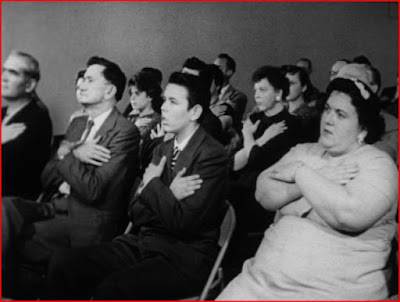
Ted's wandering takes him to the trailer of an itinerant preacher with a Noah's Ark on wheels. This modern Noah takes Ted and sets him up as a faith healer. Now called Tad Morgan, he has talent for his work. We see him give hearing to the deaf and life to the limbs of a lame boy as a devout crowd watches slackjawed, arms prayerfully and creepily crossed over their chests. Tad's power keeps the cash flowing in, which he hopes to convert into a children's hospitals.


Soon, however, Terry reappears. She's been on a downward spiral since taking the rap for the car wreck. She keeps house with Pete (John Harmon), a wretch who rolls rummies to keep the couple in booze. She approaches Tad for some money, but when she realizes that Tad, barely remembering the accident, still believes that he killed the other driver, who only suffered a concussion, she also realizes that Tad is ripe for long-term blackmail. When she gets impatient with occasional checks -- the booze seems to run out faster and faster -- she decides to marry Tad, to Pete's jealous dismay. But first she has to get Tad seriously, profoundly liquored up. This lubricated courtship climaxes in a travesty of a marriage, Terry propping up a barely conscious Tad while a skeevy JP performs the ceremony, then dumping him to the floor the moment the man pronounces them husband and wife. Through it all, her strange if not inexplicable attraction to Pete persists. Codependence is a hell of a drug.


Having touched bottom, Tad struggles to free himself. Drastic action is necessary. The moment comes on a dark stretch of bridge as a weary Terry sits on the stone ledge and demands a foot rub. Tad complies but starts pressing too hard, until he heaves her over the side and into the drink. He runs repentant back to church, but as if she, too, had been transfigured by that original accident, Terry seems unkillable. Like a raunch Rasputin, or like a wet rat, she rises from the waters and returns home, where Pete has made himself at home, put on Tad's robe, and passed out drunk in the marriage bed. Seeing only the robe, and probably seeing red, Terri gets a gun out of a drawer and fires four shots into her true love.


Realizing her mistake, Terry stalks Tad at the church and through a cemetery as the film nears its dark epiphany. Confronting him at last, Terry fires her last two shots, but praise God! Tad's Bible absorbs the bullets. As if possessed, Tad begins reciting the Lord's Prayer as he puts his hands over Terry's throat and chokes the evil life out of her once and for all. He had been given the power to heal, but maybe his mission on Earth was to kill, after all. For now that his work is done, the heart attack hinted at earlier strikes him on the church steps, and his soul departs his body for parts unknown.


The synopsis speaks for itself: The Seventh Commandment suffers from a spiritual confusion that could only come from deep if not uncritical faith. It's all too straightfaced and guileless, if not artless, to be written off as cynical exploitation. It's like a tale told by a raving, repentant drunk, while he's still drunk. Naively depraved, its exploitative moralism is laughably appalling. You may be content to laugh, but you should be appalled. You may be appalled, but you ought to be laughing, too. This film is a genuine nightmare, but for someone to have this nightmare is sort of laughable. What I'm saying is that if you have a taste for something other than good taste, if you're morbidly fascinated by the sometimes feverish sincerity of bad cinema or just like to laugh at it, The Seventh Commandment comes highly recommended.

Elsewhere in the blogosphere: OUR HOSPITALITY

A Top 100 countdown of the greatest comedy movies, based on lists contributed by a diverse sample of fans, continues at the Wonders in the Dark collaborative blog. Blog-wrangler and generous soul Sam Giuliano invited me to contribute another essay to the countdown -- the previous one covered Laurel & Hardy's Big Business -- to mark the Buster Keaton film Our Hospitality's place at No. 24 on the list. I watched the film for the first time in several years earlier this month and saw thematic elements I hadn't noticed before, particularly how Buster's train journey serves as a coming of age in a symbolically young America, right down to the train severing a symbolic (and dangerous) umbilical cord. Lest that make the film (or my essay) sound pretentious, rest assured that Hospitality is still one of the funniest features of the silent era. To read more, and to see the complete countdown to date, follow this link and find your favorites! If you don't find them, they could be yet to come.

Monday, November 19, 2012

THE HILLS RUN RED (Un fiume di dollari, 1967)

Like his American forebear, the spaghetti western cowboy is typically a laconic figure, if somewhat more sardonic than the original. He is a man of few words and many bullets. But every rule has its exception, and Thomas Hunter is an exceptional spaghetti western star. Carlo Lizzani's western was Hunter's second essay in the genre. He plays a wronged outlaw, one who sacrifices himself to the army, having stolen from them, in the expectation that his partner, who gets away with the loot, will take care of his family while he does time. He does some pretty hard time, as an opening credits sequence illustrates, and when he's released he finds his family home a ruin and his family gone. His wife's journal reveals her declining fortune and a betrayal by the hero's partner, who has not shared his plunder. The truth hurts, and Hunter wants you to feel it with him.


Before long, men are out to kill our hero, Jerry Brewster. Right at that time, Jerry discovers a squatter on his desolate property. The squatter, Winny Getz (Dan Duryea), is armed, but finding Jerry the underdog under siege takes his side. Jerry learns that his old partner has taken another name and used his ill-gotten gains to become a big rancher. Winny gets a job as a ranch hand to spy on the wealthy Mr. Seagull (Nando Gazzolo) while Jerry heads into the nearest town and picks a fight with some of Seagull's bullying ranch hands in a saloon. He impresses the saloon keeper, who complains of Seagull's oppression of the town and agrees to back Jerry's scheme to ruin the rancher. But before things can go further Jerry is waylaid by more of Seagull's goons, led by foreman Mendez (Henry Silva). Not knowing Jerry's real agenda, Mendez is impressed enough by the man's toughness against heavy odds to give him a job on Seagull's ranch. Along the way, Jerry befriends a boy being raised by Seagull's sister; the kid's mannerisms strongly remind our hero of his own long-lost son. He also makes an enemy of the local saloon singer, who resents the way his lucky gambling streak distracted from her performance his first night in town. She pines for Mendez while Mendez himself has eyes on Seagull's sister.

 
It sometimes seems like every Henry Silva movie has a shot like this.
If they don't, they should.

Jerry's now ideally placed to stage a large-scale robbery of Seagull's horses and to send the town intelligence on Seagull's plans. When Seagull orders a reprisal against the town, and Mendez expects him to ride with the other hands, Jerry entrusts a warning message to the kid, only to find that it never reached the saloon keeper. No longer able to rely on the town's support, Jerry finds the odds growing against him when the singer, having nabbed the kid, rats him out to Mendez. Our hero will need Winny's help if he hopes to get his revenge on Seagull.

 
Dan Duryea (below) is our hero by default just for getting Thomas Hunter (above) to shut up.
 

Thomas Hunter didn't do many spaghetti westerns, though he did return home to do a Gunsmoke episode and play Ike Clanton in a TV movie before making his most substantial contribution to cinema as author of The Final Countdown. His approach is all wrong, though director Lizzani, making his first western, probably should share the blame. Lizzani at least learned his lesson and followed up with Requiescant (aka Kill and Pray), a more highly regarded effort. Showing your emotions shouldn't be forbidden in spaghettis or any western, but Hunter's emoting goes way over the top. It would be over the top in any genre, and it's not a good idea for a western hero to sound like a whiner. Worse, Hunter's histrionics encourage the worst hammy impulses in Silva, with little apparent effort from Lizzani to check either actor. By default, Dan Duryea, a great villain in Hollywood westerns, comes off best, despite his age and apparent illness, as a comparatively laconic, enigmatic figure. Duryea doesn't really have much to work with but it's still cool to see him play a hero -- and ride off into the sunset -- in one of his last roles.


Lizzani -- still working at age 90, with a film out last year -- doesn't have the same pictorial genius as Sergio Leone or Sergio Corbucci, but he stages two impressive large-scale action scenes: the horse-rustling scene, complete with flaming logs reminiscent of Spartacus, and a gunfight in the deserted town pitting Hunter and Duryea against Silva's goon squad. Hunter's more personal showdowns with Silva and Gazzolo are anticlimactic by comparison. Ennio Morricone contributes a score that's characteristic but not much more than that. He's credited as "Leo Nichols," and you could believe that "Nichols" was just a Morricone imitator. The music still sounds good, but it's really just another day at the office for the maestro. At least he got a respectable pseudonym. Lizzani was stuck with "Lee W. Beaver." Hills Run Red isn't a top-flight spaghetti western; whether that's the fault of the star subverting the story or the story subverting the star is hard to say. But it has its moments and you definitely can do worse.

Saturday, November 17, 2012

On the Big Screen: LINCOLN (2012)

Steven Spielberg and Tony Kushner's history play was many years in the making, in part because the once-mightiest Spielberg had a hard time getting backing for a history film. The delays cost him a star -- Liam Neeson -- who is ironically more bankable now than he was when Spielberg first proposed him for the title role. Given Lincoln's long road to the big screen, it's another irony that people this November are debating its relevance to current politics -- and a further irony that it is relevant. As it happens, Spielberg and Kushner have made a cinematic intervention, intentional or not, in a debate, not between the Democratic and Republican parties, but within the Democratic party and the larger liberal movement. This debate has gone on since the 2008 presidential primaries and will certainly continue into Barack Obama's newly-won second term. It's less a debate over personalities, though it originated in comparisons between Obama and then-Senator, now-Secretary Clinton, than over practical politics. Critics of Obama -- one of the most persistent and verbose is the historian Sean Wilentz -- worry that the President is too much a creature of rhetoric and the favorite of people too enamored with the supposed power of rhetoric. These critics feel that many liberals naively expect to rely too much on the power of ideas and argument, and are reduced to bitter helplessness when their eminently reasonable arguments fail to persuade intractable dissidents. Wilentz himself wrote a long, somewhat controversial piece that could serve, perhaps as much as Doris Kearns Goodwin's best-selling Team of Rivals, as a source text for Lincoln, criticizing a perceived perception among liberals that Abraham Lincoln relied entirely on his admittedly formidable powers of persuasive rhetoric -- that he saved the Union by delivering the Gettysburg Address and the Second Inaugural, and found answers to all problems in his speeches, if not in the funny stories he loved to tell. Wilentz invokes a more Machiavellian Lincoln, one who wasn't above various forms of sub-rhetorical persuasion and manipulation when those were necessary to realize his goals. For Wilentz's Lincoln, a noble goal justifies a broader, more effective range of means than many liberals permit themselves or think appropriate in politics. Wilentz's article was virtually a preview of Spielberg's film.

Kushner's screenplay focuses on the month of January 1865, after Lincoln's re-election but before his re-inauguaration, which under the old rules would take place in March. The Union is on the brink of attacking the Confederacy's last functioning port city, while the Confederate government has dropped hints of readiness to sue for peace. The President (Daniel Day-Lewis) is determined to get the 13th Amendment to the Constitution, already approved by the Senate, approved by the House of Representatives on its second try. Lincoln's Republican party controls the House, but he needs a two-thirds majority for a constitutional amendment and thus needs support from a largely-racist Democratic party for an amendment banning slavery. Lincoln faces a dilemma. There's a possibility that the war could end that month if he meets with the Confederate negotiators. But he worries that, should the war end before the amendment is ratified, ratification will never happen because he has justified action against slavery, including his earlier Emancipation Proclamation, as wartime measures. He worries especially that should the law revert to the status quo ante bellum, blacks already freed under the Proclamation could be returned to slavery. On the other hand, perpetuating the war for any period of time carries a personal risk. His eldest son Robert (Joseph [are you sure that isn't Robin Todd Lincoln?] Gordon-Levitt) is ashamed of missing the war in college and wants to enlist, while the prospect of losing another son -- a younger child died of illness in Abe's first term -- could well break Mrs. Lincoln's (Sally Field) mind, if not the Lincolns' marriage. The President's plan is to stall the peace negotiations and deny the existence of Confederate negotiators as long as possible while cajoling the necessary Democrats into supporting the amendment and dissuading Robert from enlisting.

What did you expect Old Abe would do? Wrap everything up with one big speech? History isn't so easy, and he must find different ways of persuading those Democrats. Since many are lame ducks, having lost their re-election bids last November, he hopes to entice them with promises of federal patronage. For further enticement Lincoln relies on some experienced political fixers summoned by Secretary of State William Seward (David Strathairn), a former party boss in New York State. When Seward tells the President that he's going to Albany to recruit some experienced ruthless scoundrels for the work, the Albany audience with which I watched the movie broke out in knowing laughter. The fixers, led by James Spader, are the comedy relief of the picture, but they prove a serious point: the end of slavery justifies these means. On occasions like this, you don't necessarily need to get everyone to share your opinion; you just need them to vote your way for whatever reason. This is the point modern writers like Sean Wilentz think that most modern liberals miss. Those modern liberals are represented on screen by "Radical" Republican floor leader Thaddeus Stevens (Tommy Lee Jones in a Gene Hackman-Lex Luthor apparatus), an uncompromising firebrand who favors complete and immediate racial equality, beyond what most politicians in 1865 could support. The Radicals oppose the "conservative" Republicans led by eminence grise Francis Preston Blair (former Lincoln Hal Holbrook) and consider Lincoln an unprincipled trimmer for failing to go all out for full equality. Lincoln's men in Congress fear that Stevens's support for the amendment could drive conservative Republicans away and make it impossible to close deals with those Democrats. The challenge for Lincoln is to get Stevens to tone down his rhetoric -- in fact to deny what he really believes -- in order to convince wavering legislators that the amendment institutes only equality before the law, not "equality in all things." Even after securing Stevens's humiliating compliance, Lincoln must still resort to a "lawyer's dodge" at the last minute as rumors of peace negotiations threaten to postpone the final vote on the amendment....

Spielberg sometimes strains within the self-imposed straitjacket of Kushner's screenplay. He wants to show more than the script requires and gets away with a brief opening battle scene that proves a flashback narrated by a black soldier in the true opening scene. Interestingly, Spielberg invokes The Godfather by pulling back from a close-up of the soldier to reveal the back of the star's head while the soldier goes on with a functional equivalent of an "I believe in America" speech, which Lincoln finally answers with small talk and a joke about his untrimmable hair. Lincoln's notorious jokes become a kind of Tarantinian device, serving as showoff business for Day-Lewis and within the story as a distancing and delaying tactic, stuff to fill the air as Lincoln contemplates his true answer or his next move. At these moments Day-Lewis approaches the enigmatic Lincoln of Gore Vidal's novel, perhaps the definitive fictional representation of Old Abe. But the main work of the film is to show a Lincoln made neither of marble or pure spirit, an intimately vulnerable man who can slap his son in public and threaten his wife with the madhouse in moments of anger -- someone who couldn't find an answer for everything with words. In a year of strong male star turns Day-Lewis, already a two-time Oscar winner, deserves consideration for a third along with such likely front-runners as Joaquin Phoenix (for The Master) and Denzel Washington (for Flight). People have commented about the age difference between Day-Lewis and his Mary, Sally Field, not to mention the age difference between Field and Mary Lincoln circa 1865, but as a two-time winner herself Field is a worthy consort and definitely delivers on whatever promise Spielberg saw in her. They're supported by a sprawling ensemble operating in different modes, from Jones's grandilouqent bluster to Spader's clowning, yet combining for a mostly convincing evocation of 19th century speech. The few anachronistic exceptions ("Slavery, sir? It's done.") can be forgiven.

Kushner and Spielberg succeed indisputably in making the points they want to make about Lincoln and the art of political persuasion. If there's a problem with Lincoln, it's that, after the point is made, the film goes on -- and as it goes on Spielberg slips his restraints and goes hunting after epiphanies. Worse, the director decides he can't leave without addressing the assassination, but goes at it indirectly, focusing on a child's grief in a theater other than Ford's before flashing back to the Second Inaugural, Lincoln reappearing in a flame for some parting comments as if this were The Greatest Story Ever Told. A more persistent problem for Spielberg is his inability to imagine a movie without hearing the music of John Williams. The old maestro contributes an understated yet predictably Ken-Burnsian score, intruding politely yet predictably at all the predictable moments, that proves again that Williams hasn't had much new to say musically for some time now. The music, however, is a superficial flaw, and the film's other faults keep their distance from an impressive core, leaving Lincoln as one of the superior American history films of recent times. It isn't as powerful as Spielberg and Kushner's previous collaboration because Lincoln doesn't give Spielberg as many opportunities for creative, forceful pictorial storytelling as Munich did, but after seeing Lincoln the word from Kushner that he's started work on a third screenplay for Spielberg comes as welcome news.

Thursday, November 15, 2012

THE 7TH DAWN (1964)

According to author Patrick Macias, Tetsuro Tamba basically conned his way into his first English-language movie by exaggerating his knowledge of the language. The Japanese star reportedly served as an interpreter during the Allied occupation of his country, but Macias says that his real service was as a tout pointing the hottest niteclubs, etc. If Macias's account in Tokyoscope: The Japanese Cult Film Companion can be credited, Tamba, knowing his limitations once cast by director Lewis Gilbert, seduced an English woman into becoming an informal tutor. However it happened, Gilbert was impressed enough to cast Tamba in his most famous English language role as the "modern ninja" Tiger Tanaka in the James Bond film You Only Live Twice. Watching The 7th Dawn, you can see why Gilbert was impressed. Tamba's English is stiff but he invests it with personality and he makes a charismatic villain in Gilbert's tragedy, adapted by Karl Tunberg from an Australian novel, of the last throes of English imperialism.


Tamba opens the film fighting his own people. He plays Ng, a Malayan resistance fighter against the Japanese occupation of his British-ruled country. Fighting alongside Ng are a schoolteacher, Dhana (Capucine), and an American adventurer, Ferris (William Holden). The film begins with the end of World War II, as our trio of heroes celebrate and separate. Ferris intends to buy up rubber plantations and wants Ng as his partner, but Ng is going to college in Russia. The alarm bells obviously started ringing right there for 1964 audiences, but despite Ng's transformation into a ruthless revolutionary, the film never becomes anti-communist propaganda. I can't even recall the word "communist" being used, though everyone will assume that Ng has become one.

We jump forward to 1953, by which time Ferris has largely realized his dreams of land and wealth, Ng has become a guerrilla leader fighting the British, and Dhana heads a teachers' union while leading nonviolent protests against repressive British measures like a ban on bicycles. Our trio remains bonded in subtle ways. Dhana is Ferris's mistress but pines for Ng, while Ng has exempted Ferris's property from guerrilla attacks and is happy to see Ferris when the American finds his way to Ng's base in a vain attempt to discourage violence. Ferris takes Americans' preferred position in the middle, questioning the sincerity of Britain's desire for a peaceful withdrawal while deploring Ng's increasingly terrorist tactics. There's plenty to deplore on the British side. In reprisal for a grenade attack on a party for the new Resident, the army burns down a village. Failing to prevent this atrocity -- admittedly, the Brits evacuate the residents first -- Dhana briefly takes refuge in Ng's arms, and thus seals her own fate.


Dhana is soon arrested for carrying grenades in her bicycle pack, despite her protestations of innocence. Knowing her relationship with Ng, the Brits pressure her to reveal his whereabouts -- Ferris won't tell them -- to save herself from the death penalty. For a while it's possible to believe that the British framed her, but whatever the truth is -- we'll find out eventually -- Ferris decides chivalrously that he'll personally capture Ng in order to save Dhana. Complicating the story is Candace, the Resident's daughter (Susannah York), who's crushing on Ferris but feels sorry for Dhana, the mistress she's supplanting. After the arrest, Candace seeks out Ng, proposing to make herself a hostage to force her father to order Dhana's release. Ng is willing to play along, of course, but makes the conditions clear: if Dhana dies, so will Candace.


It seems that anyone can find Ng if they really want to, and before long his camp is hit with an air strike and invaded by paratroopers. Ng barely manages to escape, keeping Candace as a personal hostage, only to run into a gun-toting Ferris. A race against time begins as the trio must hack their way through the jungle and deliver Ng to the authorities before Dhana is executed. I won't spoil any more, but remember that I did call the movie a tragedy earlier.


The 7th Dawn could be a generic William Holden movie, merging Holden the self-interested cynic with Holden the Asiaphile. The pulpy political context makes Holden almost Bogart-like here, Ferris being torn between an instinct for prosperous neutrality and the need to take a side, if only for one person's sake. The best thing about the movie, in story terms, is how the main characters never reduce to types, but remain more defined by their relationships with each other than by anything else. Ng is probably the most enigmatic character of the group. No matter how ruthless he's shown to be, he still seems to want Ferris's friendship almost to the end and to play fair with him, to an extent. You could get the impression that he cares more for Ferris than for Dhana, but I don't think the movie actually means to go there. What makes Ng a tragic villain is that he wants to be friends (or more) with his old comrades-in-arms even as he stands ready to use or sacrifice them for his revolutionary ends. His sin isn't Communism as such -- he has no plans we hear of for after the British leave -- but the ruthlessness that Cold War propaganda identified as an essential Communist trait. His fate doesn't discredit the anti-colonial cause, which has Dhana as a more positive model, but the film ends with a pessimistic prophecy, perhaps more relevant to other countries than modern Malaysia, that things will get worse rather than better. Fortunately, an American like Ferris can just walk away this time.


Gilbert proves himself an able wrangler of masses of people and munitions in exotic settings, 7th Dawn no doubt serving as a kind of audition for his Bond gig. It has that authentic feel that few modern adventure films can manage in our CGI-ridden era, and Freddie Young's cinematography highlights the diversity of locations, from the imperial swank of the Resident's party to the green prison of the jungle. Riz Ortolani contributes a characteristically lush score, its romanticism a constant counterpoint to all the violence and tragedy. The 7th Dawn is no classic, but its narrative clarity and conviction are enviable compared to many more pretentious or supposedly more psychologically sophisticated movies made today.