Friday, July 11, 2014

Pre-Code Parade: a note on violence against women

Three years after Alice White and Chester Morris co-starred in Playing Around, they teamed again in King For a Night, a Universal picture directed by Kurt Neumann. I found out about this movie while doing a Google News Archive search for the actors' names to find ad art for Playing Around. That search turned up this bit of publicity for King For a Night:


I'm as big a cheerleader as anyone for the transgressiveness of Pre-Code cinema, but this story took me aback. Hitting women had been Jimmy Cagney's particular gimmick, I'd thought, and something for which Cagney seemed to be forgiven. But this story tells us that hitting women was more than one actor's eccentricity. I actually find it a little disturbing that punching dames was a thing and that people were keeping score. I dare say Nagel v. Tobin in Free Love is no longer famous, but what does it mean that it once was? Free Love turns out to be a 1930 picture and thus nearly three years old when this story was written, yet Nagel's right uppercut was well remembered without the aid of video recording. Iron Man was a 1931 Tod Browning boxing film, again well if not fondly remembered by the author of the article. Meanwhile, what's become of Alice White? Back when Playing Around came out she was a Next Big Thing. By the time of King For a Night she had found a more comfortable level as a comedy character player -- and, apparently, as a cinematic punching bag. I didn't manage to find a news story about her hospitalization for "screen blows," but I did find another cute publicity piece promoting Cagney's Picture Snatcher, in which he asks White which side of her face he should slug and she asks for one side because the other's still sore from the last punch she took. Damn... It looks like the "hospitalization for screen blows" may have been a cover-up for a beating she later blamed on her actor-boyfriend John Warburton, but still. To be objective, all these blows may have been struck for a Pre-Code standard of realism -- men did do this to women, after all -- but the relish with which this anonymous writer reports these movie punch-outs may make a reader slightly queasy.  And all this being said, if TCM evern schedules King For a Night -- a picture, by the way, that reportedly had to go back to the studio for reshoots after early audiences hooted at the original ending -- I'm cranking up the DVR.

Thursday, July 10, 2014

Pre-Code Parade: PLAYING AROUND (1930)

Chester Morris was the bad boy of early talkies. He probably gained his greatest fame in the Forties as the reformed crook Boston Blackie in movies and radio, but he was far from reformed in 1930. The rediscovery in the home-video age of Morris's three films for director Roland West -- Alibi, Corsair and the amazing The Bat Whispers -- reestablished an edgier image of the actor in the minds of movie buffs. He seems a natural fit for director Mervyn LeRoy, who was a year away from releasing Little Caesar and launching the official Warner Bros. gangster cycle. Morris's character in Playing Around, Nicky Solomon, may be LeRoy's first cinematic gangster, but while he has some of the charisma Morris gave his antiheroes in the West films, he ends up being a small-timer and something of a loser. He takes second billing to Alice White, whom Warner Bros. and First National were trying to turn into a major musical-comedy star, and you could believe that Playing Around is one of those relics from the first backlash against musicals that had most of their numbers cut out. There's still a disproportionate amount of attention paid to the floor shows at the Pirate's Den, the popular nightclub to which Sheba is taken by her penny-pinching soda jerk boyfriend Jack (William Bakewell). We're not so deep into the Depression yet -- the film was released in January 1930 -- that we can sympathize much when Jack insists on ordering a glass of buttermilk, the cheapest item on the Pirate menu. At the same time, Sheba seems shallow for resenting Jack's economies. In any event, they're about to leave the place when, on impulse, Sheba decides to participate in a Prettiest Legs contest for which Nicky Solomon is cajoled to act as judge. When Sheba wins, the master of ceremonies convinces her to sing a song, supposedly the only one she knows. Her silver loving cup becomes the talk of her neighborhood -- the gossip of two immigrant housewives becomes a running gag -- and this hint of fame goes to her head, as does Nicky.

Everybody seems to know Nicky and he seems to be a big man in his milieu, so it's a surprise to find him begging to borrow money from a  restaurant proprietor to pay for Sheba's dinner. He doesn't let on about it to her, and he assures his creditor that he has a big deal in the works that makes him a good risk. I hope he didn't mean the job he actually does, which is to knock over the store where poor Jack and Sheba's father both work. Nicky has to shoot the father when the old man goes for a gun -- don't worry; it's just a flesh wound! -- while Jack makes him because Nicky honks his car horn as he pulls out for his getaway. Nicky's four-note car horn sounds like just about every cartoon car horn you've heard from this period, yet Jack assumes -- correctly! -- that Nicky Solomon and only Nicky Solomon has such a horn. Nicky is all too easily tricked -- by Jack, no less -- into lamming out of town and is caught at the train station, but mercifully this is not the end of Nicky. As befits an Alice White vehicle he's taken alive and will only get five years for his crimes, and Morris reclaims some of his bad-guy charisma by joking with the cops as they take him away.

Playing Around isn't yet a gangster picture because it isn't really about the gangster. He isn't the menace of social problem that needs to be exorcised violently in Little Caesar and The Public Enemy. Instead, Nicky Solomon is just the villain who tempts the heroine with a lifestyle of easy money but is thwarted by Jack, our ultimate virtuous and resourceful hero. Morris is the best thing about the picture but given the competition that isn't saying much and his role does him no favors. The crime plot is nearly overshadowed by the Pirate's Den production numbers -- the place has segregated choruses, the black dancers getting their turn to perform late in the picture -- and the odd ending reinforces the feeling that this was meant to be more of a musical than it actually is. Some pictures of the period have exit music, but to date Playing Around is the only one I've seen that accompanies the exit music with a recap of the story, the sort of montage that might play over end credits decades later. Whether LeRoy was trying something new for novelty or the studio was trying to pad the picture out, I can't say. But while little makes Playing Around particularly good, this last moment definitely makes it different.

Wednesday, July 9, 2014

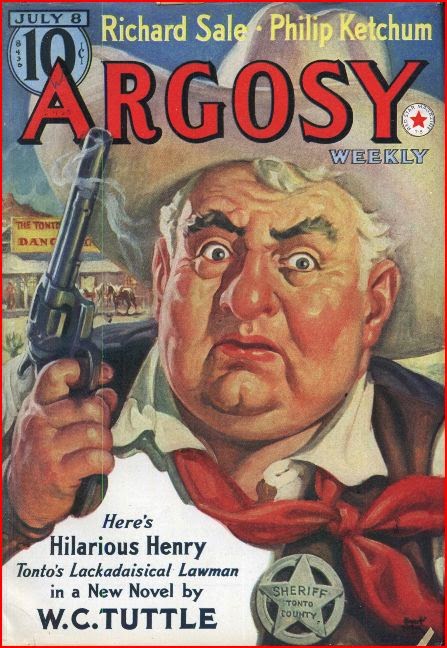
Real Pulp Fiction: ARGOSY, JULY 8, 1939

Nothing says pulp fiction like a fat old cowboy, right? For Argosy, however, "Hilarious Henry" was a major drawing card. Henry Harrison Conroy had become one of the weekly's most popular recurring characters since his first appearance in early 1935. His creator was W. C. Tuttle, by then a star writer for twenty years. Tuttle specialized in comic western detective stories and kept several different series characters (or teams) going for decades. Henry's stories were set close to the present day; he is a refugee from the death of vaudeville who ends up inheriting a ranch in Wild Horse Valley, Arizona and becoming the sheriff of Tonto Town. From the look of him, and the heavy emphasis Tuttle places on his red nose, you'd think the author, who did a lot of movie writing as well, was begging for his near-namesake W. C. Fields to notice the property. As it turned out, Frank (Wizard of Oz) Morgan played Conroy when M-G-M filmed the origin story, Henry Goes Arizona, later in 1939, while Fields finally made a different kind of western the following year. Fields as Henry would have been more like The Bank Dick out west than My Little Chickadee, but reading a few of Tuttle's stories makes plain why the great man, had he ever read them, would have left where he found them. Henry is too often the straight man for a large cast of recurring, allegedly funny characters. At least that's how "Thirty Days for Henry," the new serial this week, shapes up. Tuttle's writing has a sitcom quality; the recurring characters show up like clockwork to do their respective shticks. Worse, Tuttle is fond of dialects. One of Henry's deputies is a stereotypical yumping-yimminy Swede. Two of his ranch hands are clownish Mexicans, "Thunder" and "Lightning" Mendoza, who exist only to mangle the English language. Tuttle twice over this week has one of them utter the mighty oath, "I cross his heart, I hope you die" to vouch for his own veracity. The author at least recognizes that not all Mexicans are alike. Another Mexican talks with a similar accent, but is more intelligent and articulate than the Mendoza brothers. The Henry stories strike me as an act that grew tired fast, but for fans they were probably more like comfort food, each familiar character's reappearance a welcome event. As for the actual story, Henry has to solve two murders that may have to do with a shady saloonkeeper with a vengeful rival and a long-lost daughter. In this sort of story, you don't mention a long-lost daughter unless we've already met her, and there's one glaringly obvious candidate for this role. It's all by-the-numbers, but Argosy readers clearly enjoyed it. Tuttle would keep writing Henry stories for another decade, moving him from Argosy to Short Stories during the upheaval that resulted in a major format-change in the 1940s.

Since Argosy is still reprinting A. Merritt's Seven Footprints to Satan, that leaves Walter Ripperger's "The Man From Madrid" on the serial front. By now the Spanish Civil War has almost nothing to do with the story of stolen treasure, which has become a three-way battle of wits involving our hero, his ruthless ally Mr. Nibbs, and the surviving member of the group that stole the treasure. This penultimate installment finds Ripperger in endgame mode, teasing a shift in alliances as each player weighs the best way to get the biggest share of the loot, while the smarter-than-he-acts policeman struggles to piece the plot together. Ripperger does this sort of intrigue and psychological warfare fairly well and his story remains one of the year's better serials.


Our above-the-title writers this week should be familiar names by now. Philip Ketchum's "Scourge of the Severn" is the latest in his Bretwalda cycle, and his weakest story so far. The latest wielder of the mystic axe helps Henry Plantagenet win the English throne and wins a bride for himself to make up for the defeats and sorrows to which Bretwalda's owners are doomed. Ketchum doesn't do much to make the period interesting and really seems to have phoned this one in. Richard Sale closes the issue with a grim short, "I Want to Be Like Lefty." It's the rise and fall of a young fighter who despite his skills shuns scientific boxing to slug things out like his idol, not knowing that Lefty ended up punch-drunk in a sanitarium, as he himself will.


Meanwhile, Arden X. Pangborn brings back the crafty Chinatown jeweler Wong Soo, who in "The Eye of the Crow" solves a masked robbery of the archetypal charity collection, for which an innocent man is framed. As usual, Wong Soo proves himself a better detective than the white cops assigned to Chinatown, showing up their obvious racism even while Pangborn's stories are arguably racist themselves in their stereotypes of Chinatown. Louis C. Goldsmith, a rising Argosy star, has a decent novelet, "We're Running Line," about hazardous surveying work subject to sabotage. This was a big improvement on the last Goldsmith story I read, but I felt handicapped in my appreciation by my ignorance of surveying. I have to assume that Argosy's target readership was more familiar with the jargon of the job than, say, the average paperback reader would be today. Obviously Goldsmith felt no need to explain exactly what the surveyors were doing, but you don't need to know all the details to get the drama of the story. Last if not least, William Foster Elliot makes his Argosy debut with "Ten-Thirty and Red," a trifle about an undercover cop infiltrating a drug ring. This issue was an improvement on last week, with Ketchum the weakest link and the Tuttle not exactly awful. Next week Robert Carse brings the Foreign Legion to 19th century Mexico and "The Man From Madrid" concludes. Stay tuned.

TO BE CONTINUED

Sunday, July 6, 2014

Pre-Code Parade: I'M NO ANGEL (1933)

Mae West was the Madonna or the Lady Gaga of her time, a provocateur, a missionary of scandal if not that much of a singer. She got herself arrested for staging a play called Sex on Broadway back in the Roaring Twenties and thus was a celebrity well before she hit Hollywood in 1932. Unlike her spiritual descendants, West was also a kind of nostalgia act. The Twenties may have been our first moment of pop-culture nostalgia. Amid so much that was new in that decade, there was a fond recall of the "Gay Nineties," which weren't quite as scandalous as the adjective now suggests, but were remembered by survivors, and idealized by their children, as a wide-open time of fun before the Anti-Saloon League ruined everything. For her first star vehicle at Paramount, which had tried her out in a character part in another picture, West (and grudgingly acknowledged screenwriters) adapted her nostalgia piece Diamond Lil into She Done Him Wrong. That picture opens with a loving depiction of those good old days before the turn of the century, including an abundance of beer. West returned to that period several times, as if inscribing herself as a pioneer of sex in the time of her own childhood. But for her second Paramount starring role, and her first original screen story -- she gets a "Story, Screenplay and All Dialogue" credit while Wesley Ruggles directs -- she made herself a modern woman.

That may have been taking a chance, since her nostalgia appeal probably helped her get away with playing a sex goddess without the figure that required in 1933. On the other hand, her sex appeal was less a matter of physical perfection -- obviously! -- and more a matter of attitude based on experience. That makes her recasting of herself as a relative underdog a further stretch. She Done Him Wrong presumes a Mae West already idolized, an unflappable master of events. In I'm No Angel she's not exactly more vulnerable -- West seems incapable of vulnerability -- but she starts at a disadvantage. Tira (pronounced "Tyra") is a carnival performer who has to think fast when it looks like someone has been murdered in her room. Afraid that she'll be implicated -- one of her carny cronies had tried to blackmail her gentleman caller but had to brain him -- she agrees to take on the dangerous work of lion taming for her boss Big Bill (Edward Arnold) in return for the services of his high-priced lawyer (Gregory Ratoff).

Big Bill had been pushing her to do the lion act because he knew it'd make her a star and his show a sensation. Events prove his hunch correct. Lion taming was easy work in those days; flick a whip and fire a gun every so often. West also has the aid of process shots, including an ambitious traveling matte that lets a lion follow her around the cage. Anyway, the act (and her costume) goes over big and Tira soon settles into the typical Mae West lifestyle: extravagant clothes and a whole corps of fawningly sassy black maids -- Hattie McDaniel gets the least dialogue of the four, and no screen credit, while one another is famously ordered to peel a grape. Tira is one of the era's super gold diggers -- but can it be? Is she actually falling in love with one of her men? Well, it is Cary Grant, whom she'd made a star in She Done Him Wrong, so why not settle for the best?  She's ready to give up the circus gig, but Big Bill can't lose his meal ticket. He finds their old carny crony who'd made trouble earlier in the picture, and now he makes more, establishing himself in Tira's apartment like he's the old boyfriend. As Big Bill expected, Cary calls off the engagement. As no one expected, Tira, who appears at least stunned and possibly hurt at the news, sues him for breach of promise.

And now Mae West, the ghost of the Gay Nineties and a survivor of the Roaring Twenties, becomes a true Pre-Code heroine. Big Bill's lawyer agrees to handle her case, while Cary's attorney (Irving Pichel is uncredited but there's no mistaking that mellifluously sinister voice) assembles a small army of former lovers to detroy Tira's credibility. Their relationships are Tira's area of expertise, not the lawyer's, so she convinces him, and the judge, to let her cross-examine the defense witnesses. Any woman playing the lawyer's part on screen was still a rarity at this time, and Mae West as a mock-lawyer must have been dynamite for 1933 audiences. She lives up to the moment, brilliantly demolishing Pichel's case man by man, vindicating herself without denying or renouncing anything, including the gifts she accepted -- but did not solicit, she insists -- from all the men. It may be her greatest scene on film because it requires her to really engage her interlocutors -- she often seemed oddly aloof, as if walled up behind her own one-liners, in She Done Him Wrong -- but in a confrontational setting that allows her to assert her preferred dominance. Through it all, Pichel still has a trump card to play: Grant's own testimony about the man in her room will ruin Tira despite everything. But as he watches her fight for her due and her good name, Grant gains new respect for her and pretty much falls in love over again. He finally orders Pichel to stand down, refusing to contest the suit any further. As it turns out, he won't lose anything because he shortly proposes to her and she tears up the settlement check. That is, he won't lose any more than comes with supporting Mae West's lifestyle, but that's a happy ending for Mae and her fans, and the apogee of West's movie career. The advent of Code Enforcement the following year delayed the release of her follow-up picture and forced its transformation from It Ain't No Sin to Belle of the Nineties. It was still a hit -- there was new reason, even after Repeal, for nostalgia for those wide-open days -- but it was downhill from there. As her movie star declined, she survived as a living legend, re-emerging occasionally -- for the last time, perhaps most notoriously, at age 85 -- to assert that her sex appeal was a matter of pure will. If others haven't followed that path to its end yet, some inevitably will. Mae may have hoped to be timeless, but she belongs to Pre-Code Cinema, and with I'm No Angel she certainly earned her spot.

Meanwhile, how about dessert?

Friday, July 4, 2014

On the Big Screen: SNOWPIERCER (2013)

Despite all the positive buzz this spring I couldn't bring myself to see Edge of Tomorrow. I just couldn't shake the feeling that I had seen it all before, time and again. I didn't feel that way about Snowpiercer, but while I went to the local arthouse to see it today, its American distributor felt that Bong Joon-ho's wintry apocalypse would have the opposite problem: it would not seem familiar enough to American audiences. As genre movie buffs know by now, Snowpiercer has been "dumped" into arthouses in its director's cut after Miramax could not compel Bong, one of South Korea's star directors, to cut the film and make it more U.S.-friendly in some way. For all I know, the controversy was a clever ploy that may salvage what otherwise might have been a catastrophic bomb had it rolled out wide in the multiplexes. It had a good holiday crowd in my town, at least, but it probably never would have been a blockbuster, even with Chris "Captain America" Evans in the lead. It simply isn't cool in the right way. Instead, it's weird in a way that has become a sort of Korean national style, even though Bong nods quite obviously to Anglo-American influences. Put another way, it's weird in a way that makes it genuinely fantastic rather than merely cool, but that may take it out of many people's comfort zone. One person's weird is more people's "stupid," alas.

In case Korean cinema is all a blur for you, Bong Joon-ho is the one who made the classic procedural Memories of Murder and the monster comedy The Host, among others, both of which star Song Kang-ho, who is the lead Korean in Snowpiercer. Bong and American writer Kelly Masterson adapted a French graphic novel that at first glance might appeal to Republican conservatives, since it portrays the disastrous unintended consequences of an attempt to reverse global warming. The effort to cool the atmosphere proved too successful, causing a global deep freeze survived only by those thousands who managed to board the Snowpiercer supertrain, which now circles the globe constantly. The story proper begins a generation later, when the train's designer, Mr. Wilford (Ed Harris) is worshipped, to use a Korean analogy, like someone from the Kim dynasty. Wilford is no communist, however; the Snowpiercer is segregated on class lines, an elite living luxuriously toward the front, the majority living like shit toward the rear. The poor live in filth and feed on a daily allowance of "protein blocks" that look nasty even before you learn their key ingredient. They haven't taken it lying down, however. There have been periodic uprisings and Curtis Everett (Evans) is planning the latest. The spark is the armed seizure of two small children for purposes unknown and the atrocious punishment of one child's father (Ewen Bremner) for throwing a shoe in protest. His right arm is put through a porthole to freeze while Mason (Tilda Swinton), a spokesperson for Wilford, lectures the rabble on accepting their predestined places in life and on the train. The man's arm is removed and shattered with a hammer; it turns out that many older passengers in the rear cars are missing limbs, though not for the reasons we first assume. Under Curtis's leadership, the rebels weld barrels together into a part battering ram, part tunnel for the moment when three security gates open simultaneously. To go further, they must liberate imprisoned security expert Namgoong Min-su (Song) from a morgue-like prison. He knows how to open the gates all the way to the lead cars and the Great Engine, but he's hopelessly addicted to Cronol, a form of industrial waste with hallucinogenic properties. As long as the rebels can keep him and his daughter in the nasty stuff, they'll keep pressing forward with Mason as their hostage.

The Snowpiercer is a microcosm of our class-based society with spectacular luxury cars that stun the rebels and the movie audience alike. The film occasionally loses its sense of urgency as the rebels pause to eat sushi, gape at an all-encompassing aquarium car and sit in on an elementary class teaching the genius of Mr. Wilford, but the spectacle almost justifies the delay. While the dystopia train tells a pessimistic story of the perpetuation of inequality even at the brink of human extinction, the reduction in scale inspires Curtis's thought that now, finally, it's possible for the masses to "take over the engine" and finally control society. To do so, they have to go through well-armed guards -- though not so well-armed as they wanted people to think -- and one nearly-indestructible badass boss (Vlad Ivanov), before Curtis has his Apocalypse Now-meets-2001 encounter with Wilford and has his sense of mission subverted by some unexpected revelations. Fortunately, just as Curtis has his moment of doubt, Namgoong has an alternate idea: instead of trying to take over the train, why not just leave? Wilford preaches that it's death to detrain, but Namgoong has noticed from year to year that the ice is actually melting. Mankind could actually start over again, but it may be necessary to abandon the old society altogether to get a proper start.

Naming Curtis's mentor (John Hurt) "Gilliam" is a pretty obvious homage to a fairly obvious influence on Bong, but there's also a lot of superficial Kubrick elements here, including a direct musical quote from The Shining. Bong is clearly closer to Gilliam's sensibility than Kubrick's, though Snowpiercer as a whole looks like an attempt to acknowledge influences while leaving them behind. Somewhat more dimly, I was reminded of Roger Corman and Nicolas Roeg's Masque of the Red Death by the spectacular transitions from car to car, while any violent cinematic quest to meet a mad mastermind, as I've already noted, harkens back to Apocalypse Now. So Snowpiercer actually is "familiar" in some ways, at least to movie buffs. But Bong synthesizes all these influences to serve a vision that is distinctly his, in a film that has the freshness of a distinctive visual imagination. Cinematographer Hong Kyung-pyo, who worked with Bong on his previous film, Mother, and production designer Ondreij Nekvasil, for whom this is a major step up in stature, deserve their shares of credit for realizing Bong's vision. In front of the camera, Snowpiercer further confirms Chris Evans's maturing into an authoritative leading man and action star, just as he's contemplating retirement to behind the camera. In a role more showy than substantial, Tilda Swinton echoes Jodie Foster's invocation of Margaret Thatcher, or a generic reactionary female, in last year's disappointing dystopia Elysium, but Swinton is unafraid to go for over-the-top caricature and gives a far more memorable and entertaining performance. Song Kang-ho makes a solid impression without having to speak English -- apparently the need for subtitles was one of Miramax's problems with the director's cut -- and despite his relatively late appearance becomes a virtual co-lead with Evans, getting a big speech in his own language to match the American's showcase confession of cannibalism and admission of sacrifice-envy. A global ensemble of character actors fill out the picture with the broad-stroke portrayals it needs. Overall, Snowpiercer is as much a roller-coaster ride -- often literally -- as any Hollywood sci-fi adventure, but I suppose it's too blatantly and honestly carnivalesque about it to be blockbuster cool, and that makes it an arthouse film in America. Ironically enough, Miramax thinks that this parable of inevitable class struggle, climaxing with the utter destruction of luxury and the idle rich, would only be enjoyed by the people in the front of the train.

Thursday, July 3, 2014

DVR Diary: BRAVE WARRIOR (1952)

Many westerns with historical figures as characters play fast and loose with history, but this Sam Katzman B western for Columbia Pictures, directed by serial specialist Spencer G. Bennett, is like a Bizarro history lesson. The utterly generic title refers, I presume, to Tecumseh (Jay Silverheels), the great Shawnee chief. In this picture, Tecumseh feuds with his violent brother, the self-styled Prophet (Michael Ansara), because the Prophet wants to wage war on the white men in the Ohio Valley, while Tecumseh only wants peace. Tecumseh is passionately devoted to the idea that white and red man can live together. For him, the ultimate proof of racial harmony will be his marriage to Laura (Christine Larson), a white woman and his dear friend since childhood. Toward this end, he wants to build an American-style town for the Shawnee. Called New Tippecanoe, it will prove that Native Americans are as capable of bourgeois civlization as the whites. But the Prophet will have none of it; nor will the British, for whom the Prophet is a pawn in their plan to wage war on the former colonies. The town is built with the encouragement of Gov. William Henry Harrison and Harrison's man on the scene, another of Tecumseh's boyhood white friends, Steve Rudell (Jon Hall), who also loves Laura -- none of the young people knowing that her father is in league with the Brits to arm the Prophet and make mischief. At the climax, the Prophet's braves attack the Americans, but are repulsed. In a fit of vindictive rage, he and his remaining braves burn New Tippecanoe to the ground. Tecumseh survives to see his dream reduced to ruin. In his despair, he doesn't even press his claim to Laura against Steve's obvious advances. Instead, he bids them farewell and heads north to face his lonely destiny.

I'm not going to bother giving you a history lesson, but NO!!! Suffice it to say that many today regard Tecumseh as a hero because of his resistance to American expansion, that when people called William Henry Harrison "Old Tippecanoe" it was not to compliment his peaceful ways toward the Indians, and that the town that was burnt was called "Prophetstown," and it was burnt by whites. Brave Warrior is flabbergasting in its indifference to facts. To an extent I can understand moviemakers taking liberties with the lives of the famous outlaws and gunfighters for dramatic or "print the legend" reasons. But Brave Warrior seems determined to make a new legend of Tecumseh from whole cloth, and it seems like there should be a reason for this, but for the life of me I can't figure it out. I get that the film whitewashes the Americans, blaming the violence in the Ohio Valley on the Prophet and the British, but why -- so to speak -- whitewash Tecumseh? Why make him the friend of the U.S. when he wasn't? The only good reason I can see is to give Jay Silverheels a virtual leading man part, even though top billing goes to the dull Hall. It's always cool to hear "Tonto" use that great voice in complete sentences, but that's just about the only cool thing in this ahistorical misfire. Ansara is wasted in what should have been a great role, the script doing very little to play up the Prophet's mystical pretensions. Here he's basically a thug with bad war paint and an eyepatch. While Ansara was establishing himself as one of Hollywood's all-purpose ethnics, he hardly looks like Jay Silverheels's brother. When the brothers take their shirts off to fight for leadership, Ansara almost looks like Bolo Yeung compared to the authentically wiry Silverheels. Worse still, we never get the final showdown between the brothers everything seems to be pointing toward. Tecumseh should be hell-bent for revenge on the Prophet for burning New Tippecanoe, but instead he mopes into the horizon, an appropriate symbol of this idiosyncratic yet uninspired project.

It says something about the studio system that Columbia still made an effort to promote this plodding programmer. The studio sent leading lady Larson -- purportedly a paramour of Ronald Reagan -- on the road with a troupe of Indian extras to plug the picture. Here are some relics of their trip to Pittsburgh.


Somehow it didn't surprise me to learn that Larson's career didn't last long.

Tuesday, July 1, 2014

Real Pulp Fiction: ARGOSY, JULY 1, 1939

This week's cover story, Allan Vaughan Elston's "East of Fiji," doesn't really deliver the exoticism the cover promises. There isn't the sort of culture clash you might expect, but simply a murder mystery focusing on the so-called Cockroach Inn, where people may or may not have been killed and some sort of treasure may or may not have been stashed years before. It isn't very memorable; I honestly could remember nothing about it until I ran through the pages again tonight looking for screencaps. They said that was true about a lot of pulp fiction but I didn't believe it until I started this project.


I had better luck remembering Garnett Radcliffe's "The Rifle of Feroz Khan." Radcliffe was another exotic author, specializing in tales set in India or thereabouts. This time we hear a tall tale from the title narrator relating the greatest shot he ever made. William Tell was nothing compared to Feroz Khan, who has to shoot a pebble off the head of a friend to prove his own veracity -- he had boasted of his marksmanship -- and exonerate the friend, who had been falsely accused of a crime. Radcliffe ratchets up the tension as the nervous hero stalls by demanding a more difficult shot, steadily placing himself further and further away from the target. It has a resolution that made me cackle a little with satisfaction.

With Walter C. Brown's "The Lost Pigtail" we return to the Chinatown of the pulp imagination. On our last visit, I suggested that the pulp Chinese with their strange customs and proverbial idiom were ancestors of the magical beings who populate today's "urban fantasy" stories. I stand by that, but at the same time Chinatown authors too often substituted proverbs (or dialects) for dialogue and actual characterization. Everybody talks and pretty much acts alike in most of these stories. In this one, we learn why it was handy for one old-timer to keep his queue of hair that others had shorn off to keep up with the times. In a typical plot of this period, someone's stealing money that had been collected for war relief in the mother country, then under attack by "the brown monkeys" from Japan. Our hero's hair helps him defeat the villain, though he did not use his pigtail to strangle his foe, as I expected. How'd he do it? Someday you may find out for yourselves.

Charles Tenney Jackson's "The Island That Died" is a story in his series about Mase McKay, a swamp man who lives on the edge of the law in the Florida Everglades and thereabouts. He hires out for an expedition looking for fossils and gets caught in an old feud over treasure. It's fairly action-packed but, like "East of Fiji" it hasn't proved particularly memorable. McKay was a popular enough character, however, that we'll see more of him this year.

This week's Argosy Oddity is John Ames York's "Thunderbolt." In short, it's about a German flier dive-bombing Hitler, and both men showing up in the afterlife. That sort of speaks for itself.

On the serial front, the last installment of Howard Rigsby's "Voyage to Leandro" can't hope to live up to last week's hair-raising episode, but Rigsby makes a valiant effort by having his hero's delirious partner chop his own gangrenous foot off. From there it's on to an all-too predictable happy ending as our hero finally meets the mysterious girl called Nautilus and ends up marrying her, while his tarnished idol, the mutineer Jeremy Robb, is tossed off a cliff by his own moronic sidekick. Overall, "Leandro" is a superior serial and an interesting coming-of-age-through-disillusionment story. Meanwhile, Walter Ripperger's "The Man From Madrid" kills off more of its cast without yet solving the mystery death from the first installment. Our hero, who you'll recall is trying to recover a stolen treasure for the beleaguered -- and by the time of publication, obsolete -- Spanish Republic, is caught between the increasingly desperate, murderous leader of the thieves and his increasingly brazen self-appointed helper, Mr. Nibbs, who has left one of the thieves a gibbering wreck after last week's torture. There are two weeks to go now, and it still looks like things are going to get worse -- for the hero, not the reader -- before they get better. The serials (not counting the reprint of A. Merritt's Seven Footprints to Satan) and the Radcliffe story are the saving virtues of a largely mediocre issue.

Next week brings back Philip Ketchum's magic axe Bretwalda and Arden X. Pangborn's Chinatown jeweler Wong Sun, while one of Argosy's most popular authors, and one of his most popular characters, make their debuts in our survey. Stay tuned!

TO BE CONTINUED