Alexander Sokurov has become quite the cosmopolitan since his 2002 one-take epic Russian Ark made him an art-house star. Since then his subjects have included the American occupation of Japan and the German Faust legend, while his latest film is a sort of critical sequel to Ark, taking the Louvre museum in France. Francofonia strikes me as a sort of homage to Jean-Luc Godard in its mix of scripted scenes, essayistic narration and other meta elements, and while it's an homage to French cinema to that extent it also shows that you can take the boy out of Russia, but you can't always take Russia out of the boy. The nearest thing to a plot in the piece is the relationship between Jacques Jaujard, the French national museum director (Louis-Do de Lencquesaing), and Franz von Wolff-Metternich (Benjamin Utzerath), the German official in charge of preserving occupied France's cultural heritage. Jaujard had already evacuated most of the Louvre's contents to auxiliary chataeux by the time Wolff-Metternich arrived, but as it turned out the German took his cultural preservation mandate more seriously than his Nazi masters probably intended, eventually earning the French Legion of Honor for his trouble. Their story, punctuated for some quasi-Godardian reason with a visible soundtrack, is interlarded with a Russian Ark-style tour of the Louvre, Sokurov's Skype (?) chats with someone transporting precious art by stormy sea on a freighter, and comments on the museum's history. The museum tour is reminiscent of Sokurov's earlier triumph not in its lack of editing but by the appearance of a historical figure, Napoleon Bonaparte (Vincent Nemeth). He haunts the Louvre, childishly pointing out paintings of himself and explaining that much of the museum's classical collection was plundered by him from the Middle East. The museum has another resident spirit, Marianne (Johanna Korthals Altes), France's counterpart to Uncle Sam. She frolics about in her liberty cap shouting the French Revolutionary buzzwords, "liberty, equality, fraternity," but in a telling moment the tour narrator urges her to get rid of the obnoxious Napoleon after he's grasped her hand, but neither she nor we can shake the Little Corporal.
You may have recalled by now that Bonaparte was a great enemy of Russia, perhaps second only to Hitler, but it's in Sokurov's discussion of what his people call the Great Patriotic War, particularly the treatment of the Louvre and Paris compared to the treatment of Leningrad and the Hermitage museum -- the setting of Russian Ark -- that particularly Russian hurt feelings come to the surface. You get the impression that Sokurov holds it against France that Paris didn't suffer the devastation that Leningrad endured. Never mind that France had surrendered before the Germans had to consider bombing Paris, while Leningrad became a symbol of continued Russian resistance to the Nazi war machine. What really bugs Sokurov, it seems, is the idea that Paris and the Louvre were spared because on some level Germans like Wolff-Metternich saw France as part of European civilization, but didn't extend Russia the same courtesy. I suspect that Sokurov suspects that that wasn't just because of Nazi anti-communism, though that clearly had something to do with it, and to do with why he closes the film with a loud, discordant version of the Soviet national anthem. Francofonia is subtitled An Elegy for Europe, but the overall tone isn't really elegiac. It use of Napoleon links France and Germany together in a culture of imperialistic aggression against the East, in the name of a Europe defined by its exclusion of Russia. You may not like or agree with that message but at least it shows that Sokurov hasn't sold out by returning to his museum motif. This newest film isn't as good as Russian Ark or Faust, but it still proves Sokurov one of the most consistently interesting filmmakers working today.
A randomly comprehensive survey of extraordinary movie experiences from the art house to the grindhouse, featuring the good, the bad, the ugly, but not the boring or the banal.
Sunday, February 12, 2017
Wednesday, February 8, 2017
NEXT TIME I'LL AIM AT THE HEART (La prochaine fois je viserai le coeur, 2014)
Cedric Anger's film is based on an actual crime spree in 1970s France perpetrated by a gendarme who took part in the investigation of his own crimes. The fictionalized movie murderer likes to kill with his car, either running women down or taking them on joyrides, shooting them and dumping them on the side of the road. The real-life killer lives today, having been deemed psychologically unfit to stand trial. La prochaine fois seems to challenge that verdict; at least it left me questioning it. Franck (Guillaume Canet) struggles with his impulse to kill, mortifying his flesh with barbed wire among other measures, but can't stop himself -- with one important exception. He falls in love with a woman named Sophie (Ann Girardot), or as near to love as he can get, only to learn that she's already married with no plans to leave her husband. He never kills or even attacks her. Maybe she's become too much of a distinct individual, or maybe his motives for killing have nothing to do with the anger he presumably feels toward Sophie. But you're left with the fact that he does not attack the one person he might have some reason to lash out at. For all that the film provokes empathy for the torment Franck puts himself through, even as you're repulsed by his crimes, his treatment of Sophie could convince you that the fictional killer, at least, had some capacity for self-control, at least, that makes him responsible for the crimes he did commit.
Canet was nominated for a Cesar award for his work as Franck and I'd say he deserved it. The film as a whole is pretty bleak, playing out in a blank landscape of empty roads and parking lots, with a sense of inevitable comeuppance for Franck compounding the dread you might feel every time he takes a woman for a drive. You could find yourself rooting for Franck. against your better instincts, to avoid capture during the film's big car chase, or cheering for him when he outwits the gendarme assigned with him to an all-night stakeout of his own getaway car. At the very least you feel his anxiety, his fear of getting caught as well as whatever he really feels about killing people. La prochaine fois is one of the more successful efforts I've seen lately at getting inside a serial killer's head without vicarious or voyeuristic intentions. It's a more modest and more convincing portrait of evil than many more sensational pictures.
Saturday, February 4, 2017
SARAJEVO (Das Attentat: Sarajevo 1914, 2014)
The U.S. will soon observe the centennial of its entry into World War I. With that in mind, Netflix is currently streaming Andreas Prochaska's Austro-Czech TV film, which looks to be the JFK of World War I movies. It's about the investigation by Austrian authorities in Sarajevo, the capital of Austrian-ruled Bosnia, of the assassination there of Archduke Franz Ferdinand, the heir to the dual monarchy of Austria-Hungary. The Archduke and his wife were killed on the second try that day by Serbian nationalists. Holding the Kingdom of Serbia responsible for their action, Austria issued an ultimatum most observers feel was designed to be rejected so that the Hapsburg empire, backed by Germany, could invade Serbia. Historians are certain that rogue elements within the Serbian government, if not the government itself, supported the conspiracy, but the assassination, given its world-historical consequences, has been an overdue target for more creative conspiracy theorists. Why, they might ask, was the Archduke allowed back on the street after the first assassination attempt, a bombing, failed? Why did the second motorcade seem to stop right in front of Gavrilo Princip, the gunman who succeeded where the bomber failed? And why would any Serbians carry out a conspiracy that amounted to national suicide?
Prochaska and writer Martin Ambrosch go for the solution that probably seems most obvious to the modern conspiracist. Since Austria's ultimatum seemed to show that they were spoiling for war, might they not have tried to create a pretext for war themselves? Franz Ferdinand was a controversial figure thought to desire greater rights for the empire's ethnic minorities; that would make him expendable, presumably, to some in the Hapsburg establishment. But according to Ambrosch the ultimate motive is more venal. Investors wanted to build a railroad linking Germany to the farther reaches of the Ottoman Empire, reaching from Berlin to Bagdad. To be feasible the road would have to go through Serbia. Better than if Serbia were subject to the German powers in Berlin and Vienna. Serbs had reasons of their own to lash out at Austria -- they resented the perceived subjugation of fellow Serbs through the Austrian annexation of Bosnia in 1908 -- but given how obvious it now seems that Austria would punish Serbia with war, the Serbs can only seem patsies furthering what looks like an Austrian or German agenda.
So it comes to seem to Leo Pfeffer (Florian Teichtmeister), the magistrate put in charge of the initial investigation. He comes under increasing pressure to produce a report blaming the Serbian government as soon as possible, as if a timetable had already been determined. But as Pfeffer sees the apparent implausibilities in the events as they played out, and as he falls in love with the daughter of a Serbian industrialist who has fallen under suspicion, he begins to stall for time to get at the truths that his superiors seem increasingly uninterested in learning. As he keeps raising questions, and keeps pressuring Princip and the other Serb prisoners to tell all they know, he is made more conscious of his outsider status as a Jew who's in love with a Serb. Pfeffer was a real person who isn't highly thought of by historians who see him as an underqualified provincial. Das Attentat imagines a more conscientious Pfeffer who's forced to sign the required indictment of Serbia -- his motive here is to secure his lover's release from prison -- while continuing his own dogged quest for the truth to universal indifference. The filmmakers can change the historical Pfeffer, but their more heroic Pfeffer still can't change history. Teichtmeister gives a good slow-burn performance that permits some sympathetic suspension of disbelief as you hope he'll find something that might stop the war in its tracks. Inevitably Das Attentat must take the form of tragedy, and that tone seems appropriate to the tragic truth of the Great War, even if the filmmakers' historiography is unsound.
The assassin's creed: If at first you don't succeed, try, try again.
A mere functionary like Leo Pfeffer can be told what to think; he has less luck convincing others.
Tuesday, January 31, 2017
Too Much TV: LUKE CAGE (2016 - ?)
The Marvel shows on Netflix are meant to bring superheroes to the small screen without the "cheesiness" of the DC shows on The CW. They appeal to the readership of "gritty" comics with a pretense of urban realism and a disdain for the humane idealism of traditional superhero comics. The ideal is an illusion of real life at street level, combined with the usual fantasies of superhuman strength or other impossible abilities. If that's the mandate, then Luke Cage fulfills it better than any Marvel show to date. At it's best, it's good because it's a good crime show more than it is a superhero show. It pits Luke (Mike Colter, perfectly haunted yet stoic), to whom Netflix viewers were introduced during the Jessica Jones show, against a Harlem crime family with tentacles in the worlds of politics and entertainment. The Paradise nightclub is the headquarters of Cornell Stokes, aka "Cottonmouth" (Academy Award nominee Mahershala Ali in the first strike of his one-two breakout punch in 2016). He's the local kingpin,while his cousin Mariah (Alfre Woodard) is a city councilwoman. The subtext of almost-sibling rivalry between these two, Cornell proving to have been a reluctant heir to gangsterdom, Mariah proving a ruthless replacement, almost overshadows Luke's interventions, which escalate after beloved barber Pop, for whom Luke works as sweeper, is mowed down as collateral damage. Corruption at every level of government permits Cottonmouth to flourish, while Luke's own criminal past -- born Carl Lucas, he was framed, convicted and subject to experiments giving him almost-invulnerable skin before escaping prison -- puts him in danger as the hoodie-wearing vigilante becomes a public hero. He gains allies in righteous cop Misty Knight (Simone Messick, who must have wondered why some viewers hoped to see her character lose an arm) and Netflix mascot Claire Temple, the "night nurse" (Rosario Dawson), but gains more powerful enemies as Cottonmouth seeks the means to take down a superhero.
Regains is probably the right word, since the man with the special bullets that can hurt Cage is Willis Stryker, aka Diamondback (Erik LaRay Harvey), Carl Lucas's ever-resentful half-brother and the man who framed him. In the second half of the series Diamondback -- did you know that Marvel Comics has a "Serpent Society" filled with snake-themed villains? -- becomes the big bad, and the show suffers a little for that. While Cottonmouth evolved into a tragic figure, Diamondback is all about simplistic family issues, and is finally offered up as a sort of square-up for viewers who wanted to see Luke fight a costumed supervillain. Fortunately, Woodard's Mariah and her henchman Shades (Theo Rossi), inherited from Cottonmouth, remain cold constants, maddeningly adept at working the system and exploiting every mistake by the good guys. Part of the whole "gritty" thing is a profound skepticism (that often escalates into "grimdark" horror) toward heroes' ability to overcome pervasive corruption. In keeping with that, Luke Cage has no happy ending, though viewers' dismay or frustration with the outcome will be eased by the knowledge that Luke is schedule to return in Fall 2017 as one of The Defenders. The show's biggest success is its creation (credit is due here to mastermind Cheo Hodari Coker) of a milieu in which the outcome seems all too correct. It's dark but happily not humorless; the show can find time to make fun of Luke's original comic-book costume, for instance, which makes Colter look like a "damn fool." But like all the Netflix shows, the humor is toned down considerably from the quipping imperative of Marvel's movies.
I'm not going to get into a flame war over whether Marvel/Netflix or DC/CW is superior; they are different enough in intentions to make them almost like apples and oranges. But while quality control in the Berlantiverse remains erratic, the Defenders project has maintained a consistent level of quality. It's a point in their favor when you can still say that Daredevil season one, their very first production, is their weakest product. While Daredevil inevitably veers into outright fantasy (most of which derives from Frank Miller's vision, despite his grim/gritty reputation) and Jessica Jones is almost Dostoevskian in its preoccupation with personal wretchedness, Cage sets the standard for quasi-realistic superhero television that others will have to meet -- if they care to, that is.
Saturday, January 28, 2017
PHANTOM OF THE THEATRE (2016)
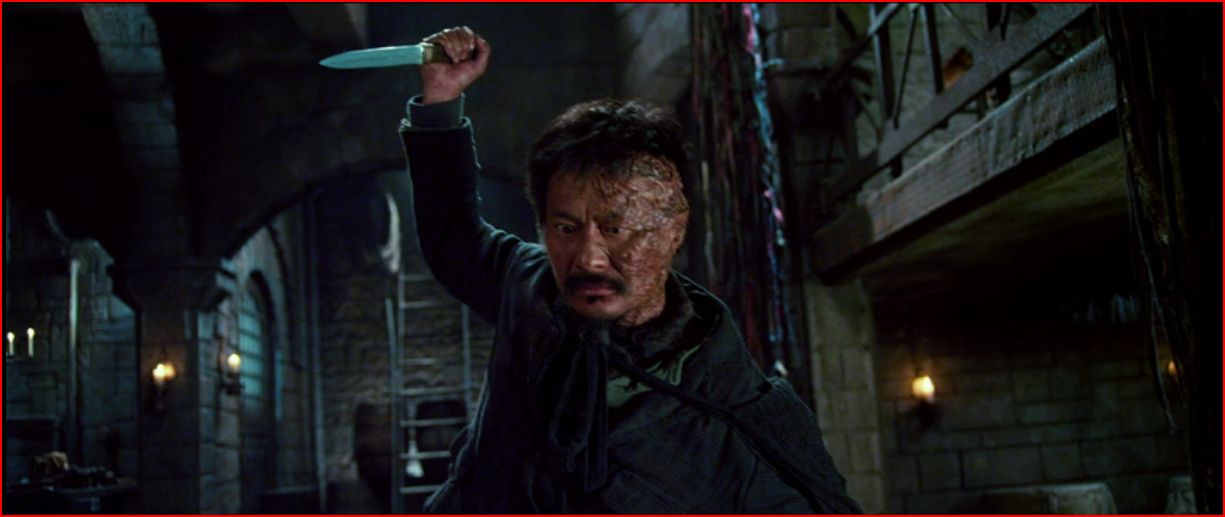
In the Chinese original, the title of Raymond Yip's picture is something like "Fascination of the Devil." At least that's what Google Translate gives me. So the film can be forgiven for opening with a multitude of spooks to beg the question, "Shouldn't that be Phantoms of the Theatre?" Eventually, however, something close to a traditional Phantom figure emerges, first masked, then revealed as disfigured. He's promoting the career of a movie actress, Meng Sifan (Ruby Lin) who happens to be making a picture in the theater he haunts, which will also host the film's premiere. The premiere will be a private one for a warlord (Simon Yam), whose son Gu Weibang (Tony Yang) directed the film. Father and son have issues, the most profound being that the warlord has swooped in to take Meng Sifan away from the director. Both are being manipulated, reluctantly, by the actress as part of the "Phantom's" revenge plot. Father and son, you see, were in the audience when the Phantom's acrobat troupe botched their big Shanghai debut, the lead female being distracted by the warlord's horndog attentions. That night, a fire gutted the backstage area, killing all but two of the acrobat family: the disfigured Phantom and, as we learn eventually, the young Meng Sifan, who was outside shoplifting at the crucial moment. Our Phantom blames the warlord and intends to see him burn for his old sins, as others who've entered the haunted theater have burned since the start of the picture.
Phantom is a film in love with the glamor of old movies, be they Chinese, French (the young director studied in Paris) or Hollywood. It's as much about how a filmmaker can cast a spell on himself as it is about the Phantom's quasi-supernatural revenge plot. The supernatural aspect of it, highlighted by special effects, apparently can be written off as figments of suggestible imaginations, since the director's platonic lady doctor friend (Huang Hung in a role reminiscent of Barbara Bel Geddes in Vertigo) figures out a natural cause for victims' deaths by internal combustion. Nevertheless, Phantom is haunted by the supernatural at the level of myth. The director falls in love as much with the character Meng Sifan plays on screen, a ghostly beauty in a tragic romance, as he does with what he thinks is the real woman. His tragic romance redeems what's largely a conventional melodrama with little to really scare audiences.
The film within the film poignantly parallels the heroine's character arc. In Gu Weibang's story, the ghost must eventually cut ties with the living by drinking a special brew. In Raymond Yip's film Meng Sifan must finally cut ties with her tragic past, but that extends to cutting ties with the director and stepping back out into the world to start a life of her own at last. There, rather than with the murder mystery, is the heart of the movie.
Past and present converge in a haunted Shanghai theater
The film within the film poignantly parallels the heroine's character arc. In Gu Weibang's story, the ghost must eventually cut ties with the living by drinking a special brew. In Raymond Yip's film Meng Sifan must finally cut ties with her tragic past, but that extends to cutting ties with the director and stepping back out into the world to start a life of her own at last. There, rather than with the murder mystery, is the heart of the movie.
Wednesday, January 25, 2017
UNDER THE SHADOW (2016)
If two films make a category, here's a new one: the Iranian diaspora horror film. At first, there was Ana Lily Amirpour's dystopian vampire film A Girl Walks Home Alone at Night, filmed in the U.S., and now there is Great Britain's official entry for the Academy Awards' Foreign Language film competition, written and directed by Babak Anvari. Unlike A Girl, Under the Shadow is actually set in Iran, specifically during the 1980s war with Saddam Hussein's Iraq, and addresses some of the Islamic Republic's repressive policies. Shideh (Narges Rashidi), is a medical student (her mother was a doctor, and so is her husband) with two strikes against her, and in Iran it's two strikes and you're out. Being a woman might be problematic in the first place, but her worst offense is that during the 1979 revolution she took part in some secular leftist demonstrations. That disqualifies her from resuming her medical studies, according to the government. Until she thinks up a new career within the new bounds, she's stuck being a housewife and mother to Dorsa (Avin Manshadi), who's fixated on her rag doll Kimiya. In angry resignation she consigns her medical books to the trash, with the meaningful exception of a textbook inscribed by her mother.
The war is intensifying. Saddam is firing missiles into Tehran and Shideh's husband is called to military service in a combat zone. Their neighbors are moving out of their apartment building and out of town after an Iraqi missile crashes through the roof. It doesn't explode but it gives an old man a fatal heart attack, Shideh's CPR efforts notwithstanding. Her husband urges her to evacuate, but she's reluctant to abandon the big city. Meanwhile, Dorsa is acting strangely. She tells her mom about talking to a new boy in the building who's supposed to be mute. She also talks to disembodied voices, while neighbors talk about djinn to Shideh's sophisticated dismay. She keeps trying to live like a liberated woman, sweating to her clandestine Jane Fonda exercise tape but tossing on the required modest coverings whenever someone rings the doorbell.
Family life deteriorates further after Kimiya the doll goes missing after the missile attack. A persistently feverish Dorsa insists that the doll must be in the closed-off upper floor, and she won't leave until Shideh finds it. Then Shideh's workout tape goes missing. Mother and daughter exchange recriminations after Shideh finds the casette in the garbage with the tape pulled out, and Kimiya eventually turns up mutilated in the locked desk drawer where Shideh keeps her medical textbook. It becomes increasingly apparent to Shideh that there's a third presence, at least, in the apartment that wishes them ill.
While the depopulated apartment building grows more menacing, the djinn increasingly appearing as a sort of animated chador that finally swells to the dimensions of a malevolent tent, Anvari makes clear that it's hardly less dangerous for Shideh outside. At one point she's so spooked that she runs out into the street with Dorsa, barefoot and without her public wrappings, until she's inevitably picked up by Tehran's roving morality police. "Are we in Switzerland now?" they ask her mockingly. Fortunately Shideh gets off with a strict reprimand ("We have values now," a cleric lectures her), but a larger point has been made. Shideh's building may have a specific djinn problem -- that becomes all too obvious during an inventive but overblown climax -- but the real challenge for our heroine is overcoming her stubborn hope of reclaiming her pre-revolutionary past on hostile ground. When she finally takes Dorsa out of the city it's only to move in with her husband's parents in the story, but metaphorically Under the Shadow's message is that the Islamic Republic itself has no place for her. To leave Tehran, and to leave behind relics of the past like the textbook and part of Kimiya, is symbolically to leave Iran, where horrors of different sorts persist. For those simply looking for chills, the film should entertain without seeming preachy, though some Americans might complain about a feminist message being forced down their throats. Anvari has a sure hand for the most part, and I liked how he was able to maintain a running gag about a garage door throughout his horror show and make it pay off at the climax. Another point in his film's favor is that, given how circumstances compel some filmmakers in Iran to stay indoors, it's easy to sustain the illusion of this British-made picture taking place in Iran. But while Shadow has obvious political relevance it also fits in to a global cycle of mother-child horror films (The Babadook, Goodnight Mommy, etc?) that may have something more to tell us about the wider world.
Monday, January 23, 2017
DVR Diary: PRIVATE PROPERTY (1960)
A hit in Europe but condemned at home for its frankness about sexual need, Leslie Stevens' film was widely thought lost until a restoration premiered at last year's TCM Film Festival. Private Property is frank without being explicit, of course, but the fact that no one could mistake what its characters are after no doubt made many people uncomfortable back then. Duke (Corey Allen, the chicken-run loser from Rebel Without a Cause) and Boots (Warren Oates, whose presence no doubt gave this film instant hipness upon its rediscovery) want to "make it" with a girl, Boots apparently for the first time. Though Oates was several years Allen's senior, Boots is the junior partner of the pair, unless Duke's "When I was your age ..." remark is meant as a joke. These guys are drifters and, apparently grifters who come in from off the beach to shake down a gas station for soda pop and cigarettes, hitch a ride and virtually carjack their way at both explicit (Oates) and implicit (Allen) knifepoint to where they want to go. The tone is set when Duke's threat/bluff proves more intimidating than the actual steel in Boots' hand. Duke's most dangerous weapon is his gift of gab. Casing a neighborhood to find an abandoned house, he starts a long-con seduction of the bored, sexually-frustrated housewife Ann (Kate "Mrs. Stevens" Manx), supposedly in order to deliver her to the waiting Boots. Posing as a door-to-door landscaper (a job he probably did hold at some point), Duke seems to respond to the prospect of genuine emotional and sexual conquest as Ann's need becomes apparent. Yet he also feels honor-bound to fulfill his promise to Boots, who proves a very reluctant rapist. Despite that, the thought of Ann submitting to Boots breaks Duke's heart and his mind. He takes his disappointment out on her, leaving a more realistic bruise on her face than you usually saw in movies at that time, and it's Boots who comes to her rescue, or tries to.
The film ends in Lifetime movie territory and the last line's promise of marital reconciliation is truly awful, but otherwise Private Property lives up to its fresh ahead-of-its-time reputation. Corey Allen gradually moved behind the camera to become a busy TV director but might have lasted long in front of the camera had this been more widely seen in the U.S. His future as a character actor as films grew both more frank and more explicit later in the Sixties probably would have been assured. He gives Duke a certain fragile charisma, the fragility of which may have made him only more attractive to Ann, compared to her aloof though well-meaning husband. Boots is early Warren Oates, from when he seemed typed as a sub-normal, and the actor doesn't get to shine as much as Allen does. His two big moments are the quasi-rape scene and the funnier bit when Boots, finally invited to Ann's house, has to play the role assigned him by Duke, an appliance store sales manager, while explaining his unprofessionally scruffy appearance. If anything, Manx, who broke up with Stevens and killed herself in 1964, is all too convincing in Ann's desperation, and I say that having not known the actress's fate until a few minutes ago. It's probably too soon to call Private Property a rediscovered classic, but it's now doubly fascinating as a historic document, both for what the film itself tells us of its time, and for what the time told us of itself by suppressing it.
Subscribe to:
Posts (Atom)