Wednesday, December 19, 2018

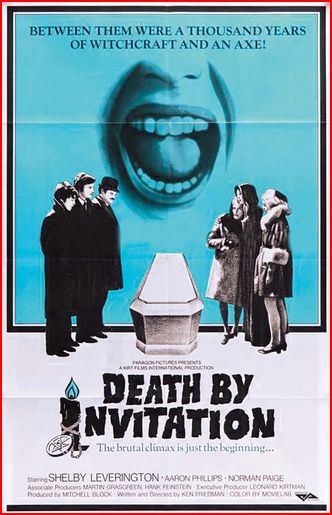
DVR Diary: DEATH BY INVITATION (1971)

On the evidence of Death By Invitation alone I would have dismissed writer-director Ken Friedman as a poor man's Andy Milligan, which is saying quite a bit as far as poverty is concerned. There's a strong resemblance when it comes to subject matter and overall aesthetic sense, but Friedman's oddity, recently featured on TCM Underground, was only the first stage of a career that continues to this day. He's mostly been a writer, most recently collaborating on a yet-to-be released documentary about the hip-hop performer T.I. His big-screen credits include White Line Fever, Heart Like a Wheel, Johnny Handsome, Cadillac Man and Bad Girls. The last-mentioned film, a 1994 western suggests some continuity of concern with Death By Invitation, as it involves violent female empowerment and is pretty dumb. As a director Friedman did only one other film, which probably was wise.

Young and ambitious, Friedman made a film about revenge across the centuries. It opens with unconvincing scenes of 17th century New Netherland, where a woman is tried and condemned for witchcraft to the accompaniment of a loud heartbeat. We cut abruptly to the present day, where a distant descendant of the lead accuser (Aaron Phillips) -- you can tell because they look alike -- presides bibulously over the Vroot family dinner. Arriving late is family friend Lise (Shelby Leverington), who bears a strong resemblance in turn to the accused witch of yore. She entices young Roger to meet her later at her apartment -- despite the father's warning that he shouldn't hang out with "any of those way-out people" -- where she tells a strange story that deserves to be quoted in full, since it's the highlight of the film. Imagine the following told in a spaced-out monotone, like the incantation it apparently is:

Roger, do you know of the Southern Tribes? Well, it was the common practice for one certain tribe that the women were the hunters, while the men were domesticated. When the village needed food, the women would go out and hunt for it. The men on the other hand were allowed to grease [pronounced "greeze"] the women's bodies before the hunt, but they were never allowed off their knees while massaging the oil into the women. When a band of women found a prey, they would rush at it together, all stabbing wildly with their knives, until the blood of the animal flowed upon their bodies, often mixing with their own blood. Then without knives they would rip away at the flesh of the animal with their hands and mouths. They would rub their bodies against the ravaged animal, against his head, against his genitals, and after they had completely satisfied themselves upon the animal and upon each other they would drag the remains back to the men. Now the men would grovel on the ground when the women returned, exposing themselves, hoping to be chosen, for if they were chosen, and if they were good, they were given food.
[Lights cigarette]
But it happened once that one certain man found that he could hunt in the woods and bring in more food than the women could, and that with his rather large body he could satisfy four or more husbands. And with this man as their leader the men began to ignore the women, disobey their commands. They found they no longer needed the women. Whereupon the women came together and met, and they ["greezed"] and oiled their own bodies and they prepared to hunt that man, naked.  We were -- they were naked. They tracked that man in the woods until they came upon him in the clearing. They fell upon him at once, ripping him open and eating his insides. The men were made to watch. They drank his blood and they chewed his bones until all of him was inside of them, but strangely they had raised themselves to passions far beyond their belief, and still writhing with pleasure and desire they fell upon the other men one by one, ripping them open and devouring them all.

Now that's a come-hither speech, and it works! Roger can't resist approaching this alluring and long-winded bacchant, and of course he gets what's coming to him, to the extent that Friedman's budget can visualize it. Practically speaking this means we get a shot of Roger from the neck down as several streams of blood begin to flow down his naked back. Lise's plan, you may not be surprised to learn, is to work her way through the Vroots, killing them indiscriminately, the women as well as the men. She takes out two daughters at once, though one is more or less accidental, the younger girl recoiling from the sight of her elder sister getting decapitated until she falls down a flight of stairs and brains herself. While synopses usually describe Lise as a descendant of the accused woman of the past, her slip of the tongue during her speech raises the possibility that she somehow is the fiend herself, though we have only the word of the accusers that that woman did anything wrong. In any event, while the local police are helpless to stop here -- they're comedy relief figures out of a 1940s B-movie -- Lise has not reckoned on another family friend, Jake (Norman Parker), whose virility overcomes her power. At the climax she tries repeatedly, in increasingly pathetic fashion, to repeat her Southern Tribes speech, as if she needs it to get sufficiently worked up, only to have Jake interrupt her repeatedly with his own come-ons, until old Peter Vroot charges in trying to finish what his ancestor started. Parker and Phillips share what might be, in spite of everything else, this film's strangest scene when Jake visits Peter at his office. Peter Vroot likes his Muzak, apparently, and has the stuff cranked up so loudly -- I recognized one familiar theme from a Tom and Jerry cartoon -- that he and Jake have to yell in order to hear each other in Peter's allegedly impressive sanctum sanctorum. You could believe that Friedman had the music playing on the set, and it may even be possible that he meant this to be funny. If so, it'd be one of those rare and serendipitous moments when a comedy scene is unintentionally funny. Some may say the whole film is that way, but that Southern Tribes bit is genuinely jaw-dropping and could well stop the snarkiest viewer in his or her tracks. To my shame, I found myself wishing that Friedman had had the means to put that story on film, though such a film probably wouldn't be something I could review here.

Saturday, December 15, 2018

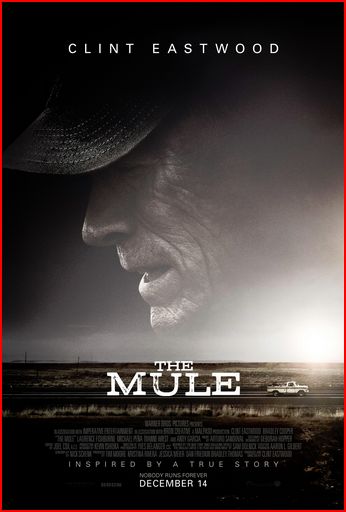
On the Big Screen: THE MULE (2018)

If any recent film has opened under an omen, it's this one. On Opening Day, December 14, it was reported that Sondra Locke had died. Going in, I had to wonder how Clint Eastwood felt at hearing that news. Coming out, I really had to wonder, for life, or its opposite, now seemed to imitate art. I now understand that Locke died last month, so on top of everything else you have to wonder whether her family waited for that day. Did they know what was in the film? To spoil things, a major turning point in the story comes when the Eastwood character learns that his former wife (Dianne Wiest) is terminally ill. At tremendous personal risk, he diverges from his assigned course to be with her, to apologize if not atone for being a lousy husband and father. He receives her forgiveness and is reassured of her love in her dying moments. The family subplot has probably the worst of The Mule's writing but it may have been what appealed most to Eastwood about the screenplay, apart from the core story's basis in fact. Clint Eastwood has been making "last films" for at least a quarter century now, beginning with Unforgiven. His most recent "last film" was Gran Torino -- written, like The Mule, by Nick Schenk -- but while the earlier film was a final statement of sorts on Eastwood's film persona, the new film aspires, seemingly, to say something about Clint Eastwood the man, particularly his poor record as a family man, implicitly including his treatment of Sondra Locke, through a fictionalized version of the criminal career of Leo Sharp, a World War II veteran, horticulturalist and excellent driver who, when down on his luck, hired out as a drug mule for a Mexican drug cartel.  Eastwood and Schenk change the name to Earl Stone but keep the vocation the same while elaborating imaginatively on the mule's motivation. Here, Earl wants to make money to make up for disappointing his family so often, but his apparent indifferent to how he makes the money, even after he verifies what must have been obvious from the start, suggests that he's changed less than he claims. The problem with Earl Stone, we're told, is that he prefers to live "in the moment" outside the sphere of home and family. Work, whether it's growing prize flowers or running drugs, is life to him more than home and family ever were. When he was home, he says, he wanted to get back out in the world, and one can't help suspecting that making movies means something similar to Clint Eastwood, which is why he's made two films this year at the age of 88. The Mule may be his confession, not necessarily that he has no life outside of movies, but that he didn't have as much of a life as he could have or, arguably, should have.

Yet The Mule is as much a vanity project as a confessional, though the two aren't necessarily contradictory. Split the difference and call it one of Eastwood's most narcissistic pictures. He's reached a point at last when he's undeniably frail, though apparently healthy; any fantasy of Eastwood overcoming younger antagonists is no longer plausible. Nevertheless, and regardless of whatever Leo Sharp felt during his misadventures, Eastwood's Earl Stone never shows fear, veers between stoic and smartass except when dealing with family, and gets to cavort, so to speak, shirtless with topless women as a guest of honor at a cartel party. Perhaps because he's so plainly frail now, Eastwood seems to feel a greater need to reaffirm his virility than we've seen in past films. The main thing he wants to reaffirm, or perhaps prove once and for all to skeptics, is that he can act. The Mule is Oscar bait, its primary goal, apart from getting the bad taste of The 15:17 to Paris out of people's mouths, is to give Eastwood one more chance at a vindicating Best Actor award. Unfortunately, while he's loosened up a lot and is often quite natural and funny, he still can't do much with Schenk's bluntly on-the-nose dialogue in the family scenes. Overall, his performance may contribute to uncertainty about the tone of the picture. People, I think, were prepared to see this as some sort of tragic commentary on socioeconomic modernity -- look what this war hero was reduced to! -- but it plays more like a mildly black comedy because Earl Stone doesn't take his situation very seriously and seemingly would rather take nothing too seriously. When he feels guilty, it's all about his family and not in the least about running drugs. Eastwood probably would rather not have his character seen as a victim of anything other than changing times, and in its own way the film is very much about personal responsibility in the conservative sense of the term. Within his thespian limits, he gives a subtle performance that easily could be seen as a shallow one.

Social commentary is inescapable, however. Earl Stone's flower business is ruined, so he thinks, by the internet, and his downward spiral is accelerated by the logic of the bottom line. This becomes most obvious on the cartel side of the story. Earl is initially an object of amusement if not contempt by the cartel gangbangers, but his easygoing zero-fucks-given attitude and some quick thinking in a pinch eventually earns the criminals' admiration, to the point when the big boss (Andy Garcia) invites him to his big decadent party. Soon enough, however, a new regime takes over, eliminating the old boss because he'd become too "lenient." What the new boss demands, above all, is efficiency and the strictest time management, with the slightest deviance punishable by death. It's just a slightly exaggerated metaphor for the modern job market, or will seem that way to some viewers. Earl's success as a mule is a commentary unto itself.  He's recruited not only for his perfect driving record, but because he, as an elderly white man, is one of the least likely people to be profiled as he drives around the country. The wisdom of his recruitment is demonstrated in scenes when plodding DEA agents (played with deceptive efficiency by Bradley Cooper and Michael Pena) reflexively profile after getting tipped off about a mule driving a black pickup. In one awkward scene, they pull over a hispanic-looking man who speaks no Spanish and frets loudly about the danger he's in. Later, staking out a motel where Earl is staying overnight, they see virtually everyone else there as their likely suspect. It all appears to prove a point against profiling; organized crime will respond to it by recruiting contrary to the profile. It's the same logic that makes the earlier cartel bosses indulgent toward Earl's eccentricities; his unpredictability will make him more difficult to track down. As Earl falls through the cracks in society, he can slip through some as well. In the end, though, The Mule is only superficially a crime film. It's more a character study than social commentary, though the latter often can reinforce the former. Good as it often is, it's not top-tier Eastwood but it'll be of lasting interest to auteurists for what it seems to try to say about the ultimate actor-turned-auteur of our time.

Wednesday, December 12, 2018

National Film Registry Class of 2018

A large bloc of "Movie To Be Announced" on the cable guide for TCM reminded me that the time had come for 25 more films of reputed historical value to be added to the Library of Congress's National Film Registry, and for some of them to play on the movie channel later today. As usual, we have an eclectic lot chosen according to criteria of generic and demographic diversity rather than by the sort of chronological priority that arguably should prevail when films are designated for preservation. I have no problem with any of this year's "diversity" choices (the headliner in that category is Brokeback Mountain), but as far as mainstream Hollywood is concerned this may be the most "meh" selection ever, ranging from a seemingly random Viola Dana picture from 1917 (The Girl Without a Soul -- not a horror film) to the stolid George Cukor musical My Fair Lady (which I suppose qualifies on the strength of its best picture Oscar) to the bland Broadcast News. The Registry has dutifully added another Keaton, another Welles, another Hitchcock and another Kubrick, but nothing seems historic about it. The two films that strike me as most deserving of the bunch are the documentary features Monterey Pop and Hearts and Minds, though I can't argue either with the 1908 actuality footage of an expedition to the Crow Nation or the supposed first-ever footage, from 1898, of a black couple kissing. More than ever, with the exceptions mentioned, the Registry announcement seems merely like a list of "great" movies, though the greatness of some (One-Eyed Jacks?) will remain subject to debate. Another look at the Registry website's list of "Some Films Not Yet Named to the Registry" reminds me that the annual selection could be far more exciting from a historical standpoint, though also probably far less compelling for the casual movie fan whose attention the curators crave. Of the 50 I selected from that list in 2015, only one -- Steamboat Bill Jr. -- has been added to the Registry. I realize my error, of course. I started from the beginning and made it to fifty films by 1943. That was very elitist of me, I guess.

Sunday, December 9, 2018

Too Much TV: THE CHILLING ADVENTURES OF SABRINA (2018 - ?)

Sabrina the Teenage Witch originally was supposed to be a character on The CW's  Riverdale series, or such was my understanding when that revisionist riff on Archie Comics was first announced. While Riverdale has gone in eccentric directions, as far as I can tell without watching it, but someone decided that incorporating the supernatual was a step too far. As a result, and probably to its benefit, The Chilling Adventures of Sabrina has ended up on Netflix  Sabrina is probably better off not seeming like an adjunct to a larger story playing out elsewhere; the title character (Kiernan Shipka) is rightly at the center of this show's universe. It's a variation on the pop witch mythos that dates back at least to the 1942 film I Married a Witch, dividing humanity into witches and "mortals." Sabrina Spellman herself is a half-breed, the daughter of a powerful warlock and a "mortal" woman, both dead under vaguely mysterious circumstances. As in the comics, she's raised by her (apparently) maiden aunts, the bossy, stuck-up Zelda (Miranda Otto) and the more warmhearted Hilda (Lucy Davis), along with a cousin, Ambrose (Chance Perdomo) who's under house arrest for once conspiring to blow up the Vatican. That seems like the sort of thing that might earn a warlock merit under the usual evil = good rules of such stories, but as the series builds up steam it becomes clear that the witch establishment, represented by high priest Faustus Blackwood (Richard Coyle) is compromised and compromising, ready to sell out witches since the 1690s witch craze, which hit the show's home town of Greendale with consequences that play out in the season-one finale. Sabrina attends the normal high school, where her best friends (Jaz Sinclair, Lachlan Wilson) are misfits in different ways and also more potentially magical than their "mortal" designation suggests. As she approaches her 16th birthday, Sabrina feels pressure to undergo the witches' initiation ceremony, signing her name in blood in the Dark Lord's book and enrolling in the local witch academy, which would take her from her pals and her boyfriend Harvey Kinkle (Ross Lynch). Being a typical TV teen, Sabrina balks and rebels, and thanks to a luckily discovered Christian baptism she gets to have things both ways, attending both schools.

Her problems are not solved. Working independently of Father Blackwood and the witch establishment to push Sabrina toward the dark side is a demoness who takes the form of Mrs. Wardwell (Michelle Gomez), a feminist high school teacher who becomes Sabrina's mentor. There's some deep ambiguity if not hypocrisy at work with this character. She does much to advance the show's feminist subtext, insinuating that the male-dominated with establishment fears female power, yet her ultimate goal seems to be to render Sabrina subservient to the very male Dark Lord. This becomes only slightly less murky when Wardwell reveals herself as the Lilith of Jewish/feminist myth, aspiring to equal standing to Satan, if not still more. Her special interest in Sabrina on the Dark Lord's behalf raises questions about Sabrina's own identity and destiny that remain to be answered and provide a hook for the second season that has already been filmed.

Sabrina is one of Greg Berlanti's productions but goes relatively light on the "lies are bad" hobbyhorse that powers many of his other shows. The writers, led by Roberto Aguirre-Sacasa, who writes a Sabrina comic book, are too busy world-building to indulge too much in teen genre-soap cliche. I think that makes the show's deeper dives into soapy sturm und drang all the more effective, more heartfelt because you're not seeing the characters going through the same contortions every single week. The writers are especially good on the family drama of the Spellman household, from the literal Cain-and-Abel dynamic of Zelda and Hilda (which borrows an idea from Alan Moore) to the sexually-frustrated Ambrose's (the show's token homosexual so far) embroilment in a slow-burning murder mystery. The best thing about the Spellman family is that their dynamics aren't set in stone; Zelda in particular proves to have more conscience and compassion than you would have guessed at first. As a whole, because the show has no monolithic vision of evil, all the characters seem more well-rounded than is usual in genre shows. Combined with Black Lightning on The CW -- I can't speak for Riverdale but Sabrina makes me more willing to give that show a chance -- this program shows that the Berlanti team is enjoying a strong second wind as its empire expands ... and I may have more evidence of that to report shortly....

Sunday, December 2, 2018

THE BALLAD OF BUSTER SCRUGGS (2018)

Through the title character, aka the San Saba Songbird, the West Texas Twit (or Tit) and, most troubling to himself, "The Misanthrope," Joel and Ethan Coen address some of their critics.

'Misanthrope?'  I don't hate my fellow man, even when he's tiresome and sulky and tries to cheat at poker. I figure that's just a human material, and him that finds it cause for anger and dismay is just a fool for expecting better.


Perhaps feeling less capable of telling a feature-length story lately, the Coens reportedly contemplated embarking on series television. It was announced that they were creating a western anthology series for Netflix, but instead, apparently quitting while they were ahead, they delivered a feature-length collection of six stories: five of their own and an adaptation of Jack London's "All Gold Canyon." There's a variety of tone to the anthology that belies any stereotype of the Coens' character or philosophy and makes it truly reminiscent of the Twilight Zone of western anthology TV, Zane Grey Theater. It opens with a trolling provocation featuring Buster Scruggs (Tim Blake Nelson), a seemingly invincible and suprisingly lethal singing cowboy who ultimately yields, in the most cartoonish fashion, to a harmonica-playing stranger presumably representing a later era of westerns. It's a combination of what some may enjoy most and what others despise in the Coens' work, but as the film moves from episode to episode it grows less predictable, veering from the fateful absurdity of "Near Algodones," in which James Franco's hapless bank robber escapes one hanging only to be doomed to another, to the utter nihilism of "Meal Ticket," in which Liam Neeson exploits a limbless savant who performs recitations and murders him when he fails to draw crowds anymore, before following London in a more hopeful direction.


The longest episode -- or so it seemed, though not in a bad way -- is both the most romantic and the most tragic. "The Gal Who Got Rattled" is a wagon-train story of the deliberate courtship of a suddenly penniless pioneer woman (Zoe Kazan -- a veteran of Meek's Cutoff, by the way) and a wagonmaster's lieutenant (Bill Heck), as much motivated by monetary concerns as by feelings of ardor. There are elements in the story -- a dog with a maddening bark, a bankroll left in a corpse's clothes -- that lead you to suspect an absurdly happy ending until the story takes a twist out of nowhere when the girl and the wagonmaster (Grainger Hines) are caught alone by an Indian attack. The Coens have set up an archetypal frontier scenario of the sort that might get them scolded for their portrayal of Native Americans, down to the wagonmaster giving the girl a gun so she can kill herself if the Indians get him, in order to spare herself the fate worse than death, which here gets described in some detail. In a brilliantly swervy climax, it looks like he's driven the war band back only to get tricked by a seemingly riderless horse. The Coens keep our eyes on this scene, as the Indian moves in to take a scalp, only to get killed by the possum-playing wagonmaster. Hooray! -- except that the girl was just as fooled as the Indian was, and the finish could be considered an indictment of the mortal terror of Indians the old tales induced. This is a great piece of filmmaking on its own, but it could only happen in an anthology format, since it's too short to be a feature and a standalone story won't go on series TV nowadays.

The film ends on an eerie note with a story that's part Stagecoach, part Samuel Beckett, with a typical Coen cast of eccentrics and grotesques sharing a ride with two men who may be bounty hunters or may be far more sinister than that. On paper it's little more than an opportunity for a lot of newcomers to the Coens' world to tuck into their meaty flights of rhetoric, especially Chelcie Ross as an interminible trapper. One thing you can depend on, no matter what the content or tone of the tale, is that these westerners won't sound just like the people next door today; it's of a piece with their True Grit in many ways, and maybe meant to show that they weren't just mimicking Charles Portis's prose. While they portray The Ballad of Buster Scruggs onscreen as an old hardcover book with color illustrations, it reminded me more of the western pulp magazines I've come to enjoy reading in its simultaneous variety and consistency. The finished product may or may not count as a salvage job, but it still plays to the Coens' strengths while minimizing their weaknesses in a way that makes it a vast improvement over the tedious Hail Ceasar! The brothers may well have found the right medium in Netflix for this point in their career. Had it been packaged as a series, that would only have made it more clear, as it was clear a century ago, that great filmmaking isn't restricted to feature-length storytelling.

Saturday, November 24, 2018

DVR Diary: KENTUCKY KERNELS (1934)

Bert Kalmar and Harry Ruby were among the most important creative talents in Pre-Code comedy. They were screenwriters and songwriters for many of the era's top comics, most notably for the Marx Bros. (Animal Crackers, Horse Feathers, Duck Soup) but also for Eddie Cantor, Joe E. Brown, Amos 'n Andy and, at the end of the Pre-Code era, Wheeler and Woolsey. Earlier, Wheeler and Woolsey's first starring vehicle, The Cuckoos, was adapted from a Kalmar and Ruby show. Hips, Hips, Hooray! and Kentucky Kernels were original screenplays by the pair, who contributed one song to the latter, one of George Stevens's first feature films as a director. There's no doubting that the writers, not the director, are the auteurs of this piece. The most Stevens-like moments come right at the start, as a jilted lover contemplates suicide, giving his possessions to passers-by one by one. Before this poor man carries out his plan, we cut to the stars, living in a waterfront shack in a parody of marriage, Wheeler complaining about the humiliation he suffers having to wash dishes every night while Woolsey, playing a magician between engagements, snarls at him. We stick around long enough to learn that they've cast fish nets all along the waterfront, catching junk rather than fish, and then we cut back to the despondent man jumping into the water. Apparently it's the first time our heroes have caught a living thing, but what good does it do them?

The boys get the idea into their heads that the man needs someone to care for and set out to adopt a child for him. At the orphanage, Margaret Dumont seems glad to be rid of Spanky (McFarland,natch), an infant psychopath with a compulsion to break glass. Soon to be the leader of Our Gang, Spanky is almost the antithesis of Shirley Temple; nearly as cute, yes, but a creature of pure mischief. Apparently Kalmar and Ruby thought the preceding the best way to get him on the screen with Wheeler and Woolsey, and at this point the despondent man disappears from the narrative, having reconciled and eloped with his girl. That's okay, though, since it means W&W will have to chaperone the tyke down south when it's revealed that he's the heir to a backwoods fortune. Unfortunately and inevitably, Spanky has inherited a household embroiled in one of the region's characteristic feuds. He's also inherited Willie Best (here billed only as "Sleep 'n Eat") as the family retainer, making this quite the household. Best is always a problematic presence, with his work alongside Bob Hope in "The Cat and the Canary" and "The Ghost Breakers" probably his most acceptable performances. Here, he's largely a poor man's Stepin Fetchit.

Inevitably and unfortunately, Wheeler -- the younger, more effeminate member of the pair -- falls for a girl from the enemy family (played by the late Mary Carlisle, who departed this earth last summer at age 104). This sparks a reconciliation of the families, helped along by the big song of the picture, presented in what had become the cartoonish RKO musical comedy style. Wheeler and Carlisle get the first verses, and then we cut to the patriarch and matriarch of the rival broods, allowing Noah Beery to show off the singing voice that got him cast in the infamous Golden Dawn of a few years before. Then we cut to a random collection of blacks for a more swinging rendition of the tune. Then Spanky sings it to a dog, and then Woolsey sings it to a mule. It's very much like the changes run on "Everyone Says I Love You" in Horse Feathers, only done all at once, and then, except for a little bit of recitative at the banquet table, the musical portion of the picture is over.

The feud resumes when Spanky pops a champagne cork and all the erstwhile feudists mistake that for gunfire. They recommence to shooting, all apparently missing each other at point blank range. All efforts at reconciliation fail, until our heroes, Spanky and Sleep 'n Eat are besieged at the ancestral manse. There's no way Kalmar and Ruby can top the siege sequence in Duck Soup, though there's an absurdly inventive bit of business involving a meat grinder, a blow torch, a string of light bulbs and some raspberries enabling the besieged heroes to fake a machine-gun attack on the besiegers. There are also painful bits when Spanky appears to invite gunfire by mounting hats on fragile objects on top of a crate inside of which Best cowers to no particularly comic effect. All ends peacefully, however, when the good guys produce a telegram showing that Spanky had been identified as heir to the estate by mistake, making it unnecessary to murder him or any of his household. It's the final bit of randomness in this most arbitrary of stories, but after all, it's the journey, not the reason, that matters.

This is Wheeler & Woolsey's first Code Enforcement picture and thus quite unsalacious if no less nutty than previous vehicles, presumably including the Kalmar-Ruby script for Hips, Hips, Hooray! Despite what I said about Stevens's contribution, there are a couple of nice gags with protracted payoffs that show the lessons he learned from Hal Roach. Early, Spanky sat on the accelerator of W&W's car, causing them to get in trouble with a traffic cop. Woolsey decides to impress the cop with his magic, appearing to tear the ticket to shreds, only to produce it intact before the flatfoot can get mad. The cop is impressed and asks how the trick is done, so Woolsey gives him instructions, and of course the gendarme irreversibly rips the ticket apart. He's a good sport, though and sends the boys on their way. Back home, they get the news about the man's elopement, along with a $1,000 check to cover taking care of Spanky for another month. Also impressed by the earlier magic, Spanky snatches the check and tears it to shreds. Down south, Spanky's new estate sports a prominent greenhouse, and the tot has to be steered constantly away from temptation until, at the very end of the film, as Woolsey, Wheeler and his girl are driving off, Woolsey and Spanky exchange glances in the front seat. Echoing the child's characteristic "Okey-doke!" Woolsey cathartically plows the car through the greenhouse. It's a characteristic closing gesture for a style of comedy itself on the way out at the end of 1934.

Saturday, November 17, 2018

LEGENDS OF THE POISONOUS SEDUCTRESS: FEMALE DEMON OHYAKU (1968)

Female Demon Ohyaku is like a film noir where the hero and the femme fatale are one and the same. The heroine is the moll of a thief whose gang is planning a big gold heist thanks to inside information from a government bureaucrat. The heist goes off as planned, and then the betrayal goes off as planned -- except for one thing. The bureaucrat, probably to no Japanese audience's surprise, plans to eliminate the thieves and claim all the gold for himself, presumably writing it off to the government as a loss. The gang is wiped out except for Ohyaku (Junko Miyazono) and her boyfriend Shin (Kunio Murai), who's stashed the loot in secret. Shin is put to the torture, his head placed beneath the blade of a guillotine, and when that doesn't work Ohyaku is tortured in front of him. To spare her he gives the gold away, and for his trouble his head's lopped off as Ohyaku watches. She's sent to an island prison where slave labor mines more gold.


To this point, everyone has underestimated the heroine. She survived a near-drowning in infancy when her mother jumped off a bridge, but bears a scar as a constant reminder of this primal injustice. She grows up to be a high-wire artist but has grown sick of all the wolf whistles by the time the story proper starts. Shin's scheme looks like the easy path to a new and better life, but after the great betrayal the only path left to her is the path of revenge.


On the island, Ohyaku becomes the plaything of a privileged convict and his wife, a tattoo artist (Yuriko Mishima) who grows obsessed with the heroine's smooth skin. She aches to tattoo and otherwise make Ohyaku her own. Ohyaku appears to give in, and rather likes the idea of a big nasty demon tattoo on her back, but for her the non-poisonous seductress is just one of many people she manipulates and leaves in the dust on the way back to the mainland. There, her ultimate revenge will be twofold. With some gangster friends she'll rob not merely a gold shipment, but the mint itself -- and then she'll kill the bureaucratic bastard who ruined her life the same way he had Shin killed.


Female Demon Ohyaku has an oldschool attitude toward revenge from which modern American pop culture has grown alienated. We've long understood that revenge can make a monster of you, the end justifying all means and all manner of mistreatment of not just the guilty but the innocent. Nowadays, we like to catch someone on the brink of taking revenge and tell them, "This is not you" or "You're better than this." I don't know if Japanese attitudes have changed in a similar way over the last 50 years, but in this picture, set sometime during the 19th century, when Ohyaku tells her friends what she's going to do to her past tormentors, their response basically is, "You go, girl!" Some modern viewers may expect her to stop short, to decide that the bad guy isn't worth what Ohyaku presumably is doing to her own soul or karma, but let me assure you that she does not stop short. There's something both awful and awesome about that that may be lost on those whose moral hedonism is so absolute that they can't even imagine anyone actually deserving to be killed. Movies like Ohyaku allow a vicarious release from the passivity such absolutism may encourage, without necessarily convincing anyone to turn killer. Ohyaku's revenge may seem self-indulgent to some viewers, but it also lends the film a kind of gravitas lacking in today's more common appeals to "hope," regardless of whether you think the heroine right or wrong. One can assume that identifying her as a "demon" makes Yoshihiro Ishikawa's film something other than an unambiguous endorsement of Ohyaku's revenge, but the fact that she is a heroine probably tells you as much about the world she lives in, or the world as Ishikawa saw it, as it tells you about Ohyaku herself.