Here's an extended clip of the circus scene and its aftermath. The synchronization and aspect ratio are better on the DVD, but you can see the whole movie in ten installments on You Tube.
A randomly comprehensive survey of extraordinary movie experiences from the art house to the grindhouse, featuring the good, the bad, the ugly, but not the boring or the banal.
Monday, February 9, 2009
THE ADVENTURES OF JUAN QUIN QUIN (1967)
Here's an extended clip of the circus scene and its aftermath. The synchronization and aspect ratio are better on the DVD, but you can see the whole movie in ten installments on You Tube.
Sunday, February 8, 2009
LOVE STORY 2050 (2008)
"Bollywood" tends to take an "everything including the kitchen sink" approach to its product. Indian movies seem to run longer, on average, than American films, and not just because of the musical numbers. The filmmakers seem to want to offer something for everyone, making movies for the sort of general audience that no longer exists in some places. The Baweja family's ambitious vanity project for scion Harman Baweja tries for all the bases, including action, comedy, romance, special effects and cute characters for kids. As a result, the 2050 part only kicks in about halfway through the picture, but that means there are still about 90 minutes to go.
Harman Baweja, son of the director and producer, stars as Karan Malhotra, son of a wealthy businessman based in Australia. Karan's mother is dead, and he has daddy issues. Due to parental indifference, Karan is a reckless risk-taker, pushing the envelope and wrecking Dad's MG in an effort to get the old man to take some interest and show some guidance. Karan is also willing to go recklessly for love. Off to Adelaide for an extreme sports tourney, he's besotted by the sight of Sana (the gorgeous Priyanka Chopra), a lady so lovely that butterflies alight in her open palm. When one such insect does the same for Karan, he knows that he and Sana are meant for each other. They finally meet cute when Sana mistakes her for her friend's boyfriend, a rival in a bike race, and roots for Karan to her pal's dismay. Director Harry Baweja goes all out with the bike race scene and a later bit in which Karan shows parkour-like skills trying to catch a bus bearing Sana through town. In time Karan wears down her resistance, challenges her to shoplift, and meets her family, who happen to be hosting his own Uncle Ya, aka scientist Dr. Yatinder Khanna, a NASA veteran who's been working on a time machine project. Karan and Sana play around inside the machine, she setting it randomly to travel to Mumbai circa 2050, but all it does is generate smoke and sparks.
Sana is then hit by a truck and killed while buying ice cream. The entire household is grief-stricken, but Uncle Ya stumbles across something she'd scrawled on one of his chalkboards after accidentally smudging it. Her drawing of an infinity symbol gives the professor an insight to perfect the time machine. He has the perfectly sensible idea of going back in time to prevent the fatal accident. But the controls are still locked at Sana's setting for 2050. This leads Karan to conclude that they'll have better luck finding Sana in the future, that she herself had unconsciously told them where and when to go. Dr. Khanna might be expected to knock Karan upside the head, but he's a believer in reincarnation. We've seen him discussing some ground rules earlier, including the idea that a person who dies without finishing their life's work will come back as her perfect double. The future it is! -- with two little kids as stowaways.
I half expected a nationalistic outburst portraying India dominant over the world, but the Bawejas have no political axes to grind as far as I can tell. In fact, they've been criticized for being Anglophile sellouts for seeming to suggest that Hindi by 2050 will be an obsolete provincial language. Even in the present, characters slip from Hindi to English and back again with almost unconscious ease. I suppose it'd be the same if they had movies in Renaissance Italy; characters would be equally glib in Latin and Tuscan or whatever the regional dialect was.
In any event, Mumbai in 2050 is somewhat reminiscent of the planet Coruscant, or maybe the world of The Fifth Element. I don't know if Muslim extremists are still a menace, but holographic adverts really get in your face -- or in one case threaten to run you over. Indians have apparently caught the bug for humanoid robots from Japan, since there are plenty to be found, including one Bicentennial Woman-like entity called "Quintessential Terrestrial" or QT for short. She calls Karan "Sec-C," short for Section C, the site of her own permanent memory bank. Inadvertently reactivated by our time-travelers, QT shows them how to get fake IDs and shows them around. We soon learn that the bottom has fallen out of the music industry, since instead of charging admission to arenas for concerts, the leading artists go about on giant floating platforms to entertain people in the middle of town. Greatest of the great is Ziesha (spelled so in her own graphics, but as Zeisha in the subtitles). At the sight of her Karan goes all Imhotep or Bram Stoker's Dracula on her; she is the reincarnation of his great love! Now he has to convince her of this.
QT (right) is Karan's friendly guide to future Mumbai in LOVE STORY 2050.
Ziesha is the stage name of a spoiled young woman named Zebelle. Her most intimate servant is a robotic teddy bear, a ruxpinite pink wretch named Boo whose inefficiency earns it frequent kicks in the tail from mistress. Miss Z is the host of a unique game show in which she asks fans questions about herself. They almost always answer incorrectly. What kind of fans are these? But Karan works his way into the audience and begins his mindgame. She's sort of attracted by his audacity. They meet cute again at a virtual Mortal Kombat game in which they wear white form-fitting motion-capture outfits (above, left) and merrily clobber one another. Karan lets her win; that's part of his plan. But someone else has a plan. The era's most powerful and most feared scientist, Dr. Hoshi, knows about the time machine. He was Dr. Khanna's lab assistant in the 2030s and has an inkling of what Uncle Ya had been up to. On his own, Hoshi has developed the power of teleportation and the ability to generate and fire bolts of energy. He has a scary costume and a mask. He does everything but breathe heavily. As Karan makes his moves on Ziesha -- never quite going to full Jimmy-Stewart-in-Vertigo lengths, but pretty questionable just the same, -- Hoshi makes his moves on Dr. Khanna and the time machine, setting up a climax in which love conquers time and death and Karan fights an android duplicate before the main event with Dr. Hoshi in a car chase high above the streets of Mumbai....
The reviews on IMDB from mostly if not entirely Indian viewers have been all across the board, from scathing to celebratory. This is understandable. Love Story 2050 is the sort of film which many people will immediately reject as stupid, because ... well, it is -- but may win over others with its all-out exuberance. The ideal audience would be one that was constantly curious to see what the Bawejas will do next. From the viewpoint of the wild world of cinema, our standards are as likely to differ from those of the run-of-the-mill Indian moviegoer as they do from his American counterpart. I'm a long way from having an objective standard of Bollywood aesthetics to compare this film against, but I can recommend Love Story 2050 to anyone who might enjoy a campy spectacle with singing, dancing, fighting, and special effects (including some contributions from Weta Digital) that never quite convince but fit the spirit of the film. Baweja seems to have the old barnstorming spirit that will put a camera and his actors on a speeding roller coaster (and no seat belt on his own son!) to get a cool scene. He really brings his Aussie locations to life, though his results with more futuristic sets are more mixed. At three hours (by the time the credits end) this film really is a little too long, but if you can spare the time (and you have a public library with a good foreign film section) you'll have a memorable experience of some kind.
What the heck. We may as well have a musical number. This is as representative as any.
On The Big Screen: THE WRESTLER (2008)
Darren Aronofsky's film of Robert D. Siegel's screenplay is clear-eyed when other hands might have made a tearjerker out of the story. It has a strong finishing kick, and it pulled away for me once it became clear that Rourke's character was not going to be redeemed. The Wrestler is consistent with Aronofsky's merciless vision as expressed in Pi and Requiem For A Dream. It is also a film of its time, attuned to a certain historic moment -- or at least it seems so now. That's because it isn't so much a satire or denunciation of professional wrestling as it is a pre-emptive strike against nostalgia for the 1980s.
Robin "Randy 'the Ram' Robinson" Radzinski is a creature of the 1980s, and still seems to live there. His personal soundtrack is all hair bands, and he wears his own hair long in a manner many current grapplers still prefer. He still has a primitive Nintendo system in his trailer so he can play an ancient video game in which he starred. He still sells VHS tapes of his glory days at fan fests. He actively dislikes the 1990s, as embodied by the music and attitude of Kurt Cobain. The 80s, by contrast, were all about having fun, and as Randy asks, "What's wrong with having fun?" Those were his years on top of the business, climaxed by his famous match with The Ayatollah, which will be restaged at the movie's climax. We are invited to see Randy (as he prefers to be called most of the time) as an embodiment of the 80s and a consequence of its excesses. Since I don't love the 80s, I may be biased toward this interpretation, but I stand by it.
What Randy the Ram really is is problematic, especially for himself. He doesn't care to be called "Robin" or "Mr. Radzinski," and is chagrined at having to wear a "Robin" nameplate while working the deli counter at a grocery store. On the other hand, he feels an even greater humiliation when someone recognizes him as "that wrestler from the 80s" on the job. It's okay to be Randy the Ram in the ring or the locker room or at a signing event, but not when your decline and decrepitude can't be denied amid the shelter of peers or fans. He can only be himself in the ring or among his peers. In this way, the Ram is reminiscent of all the ruined wrestlers in real life who came to believe their own hype, who had to believe that they were the heroes or heels they portrayed in the squared circle. Randy isn't as self-deluding as some real-life counterparts, and for much of the picture he seems clear-headed about his plight. He doesn't put on airs, he doesn't seem to be a jerk, and he's friendly toward just about everyone. That leaves you wondering why he fell from grace in the first place. As a onetime wrestling fan I could fill in the blanks myself, but other viewers might wonder whether Randy had only caught some bad break during the 90s. It's not until fairly late, once the real plot of the film has kicked in, that we understand Randy's problems.
Recovering from a heart attack and bypass surgery following an authentically brutal "extreme" wrestling match, Randy faces the medical necessity of retiring from wrestling. At this point, despite his tentative friendship with Cassidy the stripper, Randy realizes that he's alone in life, and feels a need to reconnect with his estranged daughter and repent for his neglectful ways. At the same time, he starts to signal that he wants more of a relationship with Cassidy. He fails at both ventures.
Cassidy is a parallel or mirror character to Randy. Her real name is Pam, and she prefers to be known that way outside the strip club. She has a kid, too, younger than Randy's, and she's still young enough herself to envision a future and a career beyond stripping. She warms toward Randy but governs herself according to a stripper version of the wrestlers' kayfabe code: no relationships with customers. It doesn't matter than she's considering quitting stripping, which would make Randy no longer a customer. The fact that he has been a customer seems like an insurmountable obstacle for a long while. Pam is on the brink of overcoming this scruple when Randy returns to his own business, triggered by his daughter's definitive rejection of him. That resulted when he gives into temptation in a way, we must deduce, that he has done all too often before. An offer of casual sex at a bar turns to drugs and more booze, and Randy misses a delicately planned dinner date with the nearly-reconciled daughter. Randy's humilation at the grocery store and a bridge-burning tantrum closely follow. Already rebuffed by Pam, Randy has nothing left, he believes, but the ring and the fans. He makes a comeback despite doctor's orders, telling Pam that "I only ever got hurt out there" -- in the outside, real world. Pam finally experiences a role reversal, becoming the spectator while someone she's started to care for becomes a mere performer, a "piece of meat" in his own earlier words. And instead of seeing Randy in his true glory, as he imagines it, she's horrified and flees the building. Noticing her absence, the Ram seems to sigh as he climbs up for what may prove a literal finishing move, as if her action confirmed the correctness of his course.
Randy the Ram and Cassidy, -- or would it be Robin and Pam, incognito, -- or maybe Mickey Rourke and Marisa Tomei on location? Identity is a problem in THE WRESTLER
(photo from http://www.exclusivelymarisa.com/ )
Saturday, February 7, 2009
Book Into Film: CUTTER AND BONE (1976) and CUTTER'S WAY (1981)

As a rule, it's not a good idea for me to read a novel before a movie is made from it. Movies usually can't help but suffer in comparison because they have to cut so much material out. Worse, screenwriters or producers often make arbitrary changes for no apparent good reason, or no reason that has to do with cinematic values. When that happens I can't help but wonder why -- and to try and understand the process better, I decided to read a novel that had been made into an acclaimed film, and then to watch the film.
Cutter and Bone is about Richard Bone, a drop-out from white-collar work and middle-class family life, and his pal Alex Cutter, a once-wealthy Vietnam vet who lost a leg, an arm, an eye and his sobriety in the war. Cutter lives with Maureen (Mo) and their child, "Old Brown Pants" in domestic squalor which Bone shares occasionally. One rainy night, Bone's car breaks down and he has to walk off a drunk through town to Cutter's place. On the way he sees a man get out of a car and dump some large object into a trash can. He later learns that the object was a murdered woman's body, but he can't help the cops with the investigation because he couldn't make out the man's face. Later, when he sees a picture of food service magnate J.J. Wolfe in the newspaper, he has an intuition that Wolfe was the man with the body. He almost instantly retreats from the claim, but once Cutter heard it, he assumes that Bone was right the first time. Cutter becomes obsessed with doing something to Wolfe, but its never clear (even to Cutter himself) whether he means to blackmail the millionaire or trap him into a confession that would get him arrested. The victim's sister, Valerie, joins Cutter and a reluctant Bone in the scheming. Bone can't bring himself to do his part in the blackmail plan, so Cutter takes the initiative. When Mo and the baby die in a house fire soon afterward, Cutter becomes convinced that Wolfe was sending him a message and grows increasingly unhinged as Bone tries to keep him tethered to reality.
At that point, book and film diverge dramatically, but Passer and screenwriter Jeffrey Alan Fiskin had already made substantial changes in the story by then. They increase the stakes for Bone (Jeff Bridges) by having him treated initially as a suspect in the girl's death, which he never really is in the book. Thornburg has Bone ratted out to the cops by a radical wannabe who'd heard his story while staying at Cutter's place and left in a huff over some petty dispute while Bone slept with his girlfriend. Those two characters are gone in the movie, which is excusable for concision's sake. A more distressing omission is the absence of Cutter (John Heard) and Mo's child. In the book, Mo is a poor housekeeper and an erratic though loving mother, as well as a heavy drinker and drug-user. She drinks in the movie, but the absence of the baby works to soften her character so that she remains more sympathetic and appears less like an irresponsible loser. Likewise, the movie never really states that Bone supports himself as a gigolo, and has him living on his own on a houseboat rather than as Cutter's guest. Again, he's less of a lowlife than he is in the book. This makes Cutter stand out more as an anomaly than he does in the novel, so that you might think he's the irritant primarily responsible for making Mo and Bone miserable (or for driving them into each other's arms). Valerie is also whitewashed. In the novel she's a part-time prostitute, but not in the movie. In both, though, she skedaddles after the fire.
Fiskin also does one of those arbitrary changes, changing J. J. Wolfe into J. J. Cord for no intelligible reason. He also changes J.J. from a poultry magnate based in the Ozarks into an oilman based right in Cutter and Bone's hometown. He then takes another character, George Swanson, who has no relation to Wolfe in the novel, and makes him an employee of Cord for the movie. George retains his function from the novel as a wealthy friend who helps Cutter out a lot, and I think the tie to Cord can be justified as a way of keeping George in the story. Later in the movie, Cutter will assert that Cord had killed George's father, or had him killed, in the past, and paid for George's education and made him a protege in order to atone but also to keep George under his thumb. It's teased a little that George might betray Cutter and Bone to his boss, but nothing really comes out of it.
George's tie to Cord also facilitates the movie's major change in the plot. In the novel, Cutter and Bone finally head to Wolfe's home ground in the Ozarks, with a new girl in tow -- Monk, "the Virgin of Isla Vista," whom Bone met after a suicidal swim after the fire ended in a hallucinatory orgy with "the Clap Twins" in which Monk didn't participate. The absence of all this material from the movie, including Monk, is understandable. In Wolfe's home town, Cutter disrupts a parade by blabbing about the great man's alleged crimes. It remains maddening unclear to Bone exactly what Cutter intends to do, and so it is to Cutter, whose mind deteriorates rapidly until he loses it completely at an amusement park and is left pretty much a vegetable in a local VA hospital. That leaves Bone to face minions of J.J. Wolfe and to become increasingly certain that his hunch is right after all. He can't be absolutely certain about that, however, until the final scene, in which he's driven down by Wolfe and a flunky and gets a good look at the shotgun that will kill him.
In the movie no trip to the Ozarks is necessary, since J.J. Cord is practically a neighbor. Taken to lunch at a country club by George, Cutter goes after Cord during a polo party, threatening to "crucify" him. Later, Cutter steals George's invitation to a Cord party and sneaks onto the Cord estate with Bone playing his limo driver. Despite Cutter's claim that the gun he's carrying isn't loaded, Bone fears the worst, but when Cutter gets loose from him, it's Bone who's captured and roughed up by Cord's bodyguards and finally taken in for an audience with the magnate. Cutter somehow eludes his pursuers long enough to get hold of a horse in Cord's stable and go riding to Bone's rescue. He makes it to Cord's house, but the horse throws him through a window, apparently killing him. Bone is now convinced that Cord killed the girl, and tells the dying or dead Cutter that fact. He then turns on Cord, saying, "It was you!" "What if it were," Cord scoffs, putting on dark glasses. Bone aims the gun still in Cutter's hand at Cord and fires. Blackout. Credits roll.
Bone (Jeff Bridges) points out a parade highlight to Cutter (John Heard) in Ivan Passer's CUTTER'S WAY .
To Thornburg's dismay, the producers deemed it necessary to change the ending of his story because they felt that death by rednecks was too reminiscent of the ending of Easy Rider. In a recent interview, Thornburg scoffed at that reasoning. "I thought to myself, so many people have been killed over the years by shotguns, for heaven's sake," he said, "You can't copyright an ending because there's a shotgun." Taken in the context of the film, however, the new ending has a more plausible if not necessarily better explanation. The film underplays to the point of ignoring the fact established early in the novel that both Bone and Cutter have been contemplating suicide. Both characters in the novel are sporadically paralyzed by indecisiveness or an inability to stick with a commitment, demonstrated by both men's failure (carried over in the film) to deliver the blackmail letter. Something of this survives in Bone, but it's become more like the more typical fear of commitment than the inability to trust his own instincts or impulses that fatally characterizes the original Bone. The movie Cutter is no more self-destructive than any movie alkie or Viet vet. His main trait seems to be a need to be or see a real hero. That's why he goads Bone into action, then takes heroic action himself at the end, as if redeeming himself with the ride to the rescue. There's less ambiguity about his motives in the movie than in the book. It's unclear up to a very late point in the novel whether Cutter means to kill or still just blackmail Wolfe, while the movie Cutter consistently wants to "get" Cord, first for being the sort of rich jerk who'd presumably never put his ass on the line, then because he's absolutely convinced that Cord had Mo killed. Cutter's more single-minded than in the novel, where it's rarely certain and often disturbingly uncertain whether he's sincere or putting someone on as a private joke. For Thornburg, Cutter and Bone are two disintegrating personalities. For Fiskin and Passer, neither really is; the protagonists are dysfunctional in less profound ways.
On its own terms, Cutter's Way is worthwhile for John Heard's furious performance as Cutter. He's not as ambivalently sardonic as the character in the novel, but it makes cinematic sense for him to be a more explosive personality. Heard really shines in extreme scenes that aren't in the book, like his outburst at the polo match. Best of all is a scene at an amusement pier, where Bone dawdles at a shooting gallery while Cutter waits for him to make a crucial phone call to Cord's office. His patience at an end, Cutter produces a loaded pistol and blasts Bone's target, telling the barker to "give the man his goddamn doll." When the second call proves fruitless, Cutter goes berserk, grabbing the stuffed animal and flailing at the pier railings with it before tossing it into the ocean and emptying his gun into the poor thing. Heard also nails a scene from the book in which he rams a neighbor's car and lambastes the neighbor with filthy insults, only to reappear after swallowing some mouthwash to play the humble, deferential wounded veteran when the police arrive. Jeff Bridges has little choice but to be a straight man for Heard, but does so with his expected charm. He also excels in tormented romantic scenes with Lisa Eichhorn as Mo, and his performance has resonance beyond the film itself, as I'll explain shortly.
While Fiskin may not have liked the novel's ending, he did like the element of the parade, which he transports to Santa Barbara for an early scene during which Bone has his great intuition about Cord and Cutter gets to make some nasty cracks about Indians and other parade participants. He also makes at least one change that enhances the suspense element of the story. In the book, we follow Bone into Wolfe's office and see him chicken out, intimidated by a flow chart that shows Wolfe's power over numerous major corporations. Thornburg wants us to know that he's lying to Cutter and Valerie about delivering the blackmail letter. In the movie, we see Bone go in, then see him get back in the car to announce his mission accomplished. It's not until Cutter goes nuts with the doll on the pier that Bone tells him the truth, which should come as a proper surprise to viewers who hadn't read the book. I don't really approve of the movie's ending, but overall I think that Fiskin and Passer constructed a story that succeeds in its own right, but not as profoundly as the book.
Through most of the movie I was trying to think of what Jack Nitzsche's score reminded me of. The answer: Nitzsche's score for One Flew Over the Cuckoo's Nest, which uses similar instruments in a way that now strikes me as the generic soundtrack for dying hippy dreams, or dying 70s dreams -- whichever you prefer.

Cutter and Bone team up (somewhat passively on one side) to dispense some form
of justice in CUTTER'S WAY.
Screen capture from Radiator Heaven.
Finally, here's more of an echo than an epilogue. A quick Google search confirms that I'm far from the first person to think of this, but what does it sound like when you have Jeff Bridges as the relatively laid-back sidekick of an often-angry and singleminded Vietnam veteran? So are there hints of The Big Lebowski in the novel? Not as many, I think. Bridge's Richard Bone is a more placid character than Thornburg's, who is clearly on more of a downward trajectory than the movie Bone. In book and film alike Alex Cutter is a long way from Walter Sobchak, but the business with the car foreshadows Walter's destruction of a car in the Coen Bros. film, and I could see Cutter believing that Lebowski was faking his disability ("This man walks!"). The one element in the book that might be a foreshadowing or a proof that the Coens read it is the fact that Mrs. Little, a woman for whom Bone goes to work as a "handyman" in the novel, and who doesn't appear in the film, is a sculptor -- an artist, as Maude Lebowski is in the later movie.
In closing, I recommend Cutter's Way as a good sample of very late 70s cinema, but I recommend Cutter and Bone even more strongly as a great 70s novel.
Friday, February 6, 2009
James Whitmore (1921-2009)
Thursday, February 5, 2009
The Premio Dardos Seal of Approval (FINALIZED)
Imagine my surprise when, after doing this thing for little more than three months, I was nominated by The Vicar of VHS, proprietor of the Mad Mad Mad Mad Movies blog, for the Premio Dardos award. What did I do to deserve this? Perhaps the following may explain:IGLOO OF THE UNCANNY. The Igloo Keeper is a dedicated reviewer of horror cinema from the golden age to the present day, and is having increasingly fun developing his frosty persona with an appropriately non-linear diary. He has interesting things to say about everything from Universal and Hammer to last year's horrors, or thereabouts.
MIDNIGHT CONFESSIONS. Someone should put the Rev. Fred Phantom on television. He goes the extra mile to create "live" reviews that combine his spoken commentary with witty collections of clips, covering everything from Italian to Blax-ploitation. This is a guy that can turn a review of Luigi Cozzi's Contamination into a satire of Starbucks. He reminds me of the horror hosts of yore in a way -- a good way. Drop by and tell him this freak says hello.
POPCORN AND STICKY FLOORS. Jiangtou, Jesse and Michael are great purveyors of primary source materials from the wild world of cinema, from Polish movie posters to prime exploitation trailers. Theirs is a constantly stimulating audiovisual blast from the exploitative past. See if you agree with them that Bruka, Queen of Evil has the greatest trailer of all time. It has plenty of competition on their blog.
WOPSPLOITATION. Don't let the title deceive you. Beedubelhue covers quite a lot of territory in the wild world of cinema, with an emphasis on exploitation that ranges from kung-fu movies to Jodorowsky's Santa Sangre. To an extent, he reminds me of me, so if you agree with me that there's often a lot of value in exploitation cinema, Wopsploitation is a valuable reference to what's out there.
Finally, after considerable consideration, I'm giving the last one to HOUSE OF SELF-INDULGENCE, where Yum-Yum spotlights the glamorous schlock of the 70s and 80s, with special attention more recently to the glories of Crown International Pictures. It's an attractive blog to look at with a pleasing balance of text and screen captures, and always amusing to read.
I Want You to enjoy all these great movie blogs!
Wednesday, February 4, 2009
MIDNIGHT MOVIE MASSACRE: Is This the Worst Movie Ever Made?
I have to put it in the form of a question, since I didn't finish the movie. I held out for 45 minutes, but I dared not try for more. I felt at risk of spiritual death. I honestly felt my brain turn to stone while watching this film. It may be one of those cursed movies that others make movies about. Think of it as a kind of conceptual cross between Lamberto Bava's Demons and Uncle Josh Goes to the Moving Picture Show. It combines the sensibility of '80s exploitation and the narrative techniques of 1912 much as John Belushi combined the contents of his cheeks while making a zit.
First off, I was conned. My friend "Wendigo" had just picked up a set of "Mars" themed sci-fi films. The others were Flight to Mars, a quaint Cameron Mitchell starrer from 1951, and the original Invaders From Mars. The odd one out was a title called Attack From Mars. I found no reference to it in either Psychotronic guidebook, and I didn't think to go online and do an IMDB search before taking the plunge. The special feature on the disc was an "Alternate Title Sequence." Only when we started the actual movie did we realize that using the title Attack From Mars was what made the alternate an alternate. Once I saw the real title I hit the books again, but in retrospect I must conclude that Michael Weldon has a stronger stomach for this sort of thing than I do.
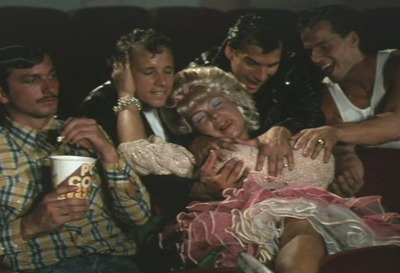
After a pre-credit intro hyping an imminent menace from Mars, we come to a movie theater taking tickets for a midnight show. The year is 1956. The feature attracts an eclectic audience. Here are some horny nerds; aren't they funny looking? Here comes a married couple, a fat wife and a milquetoast husband; aren't they funny looking? They buy out practically the entire snack bar. The fat lady eats a lot. Isn't that funny? One of the nerds hallucinates the main character of a coming attraction, but his cohort doesn't see it. Isn't that funny?
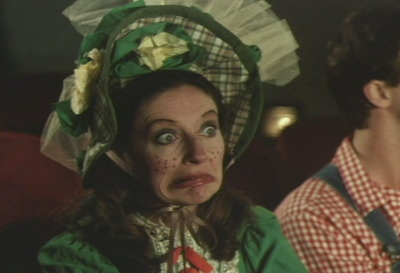
More people find seats inside the theater. Here come a couple of rubes. Are they hillbillies, religious fanatics, or theater people? They have outlandish costumes, perhaps stolen from the road company of Li'l Abner. Perhaps they're cast members themselves, since they have freckles painted on their faces. They gape goggle-eyed at the screen before the show begins. Isn't that funny? Then there's a drunk. He staggers and takes a pull from his flask. Later he stumbles and spills his snacks. Funny? How about the three fonzies who act like apes in the back row and respond to a projected admonition against vandalism by tearing apart a seat? Or how about the girl who looks like she stuck whole rolls of toilet paper in her bra, and her clueless boyfriend. Or the girl who sneezes. Isn't it funny to sneeze? She sneezes a lot. Isn't that funny?
A female denizen of Earth circa 1956, as imagined by the makers of
MIDNIGHT MOVIE MASSACRE
(photos from www.badmovies.org)
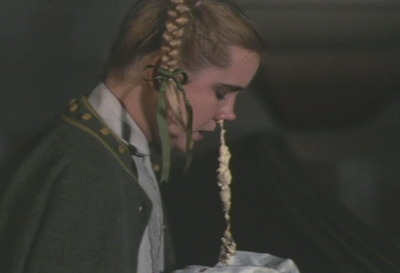
Amazing special effects characterize MIDNIGHT MOVIE MASSACRE, from synthetic snot (above) to flesh pumping (below).
You might think it was enough of a challenge to juggle this many plot threads, especially since the director's juggling technique leaves quite the mess on the floor. But to make things more interesting, a flying saucer deposits a deadly mist around the theater, and murders begin. These killings are illustrated in the classic manner: red sprays from offscreen sources stain walls, furniture and appliances. Oh, they're cheating just like the old movies would. I get it! Yes, but then I got it -- the deal breaker scene. The director starts intercutting a fidgety kid into his usual sequence of scenes. At first I was wondering whether the mere existence of a child was supposed to be funny, but the brat eventually slides out of his seat and into the lobby.
He enters the manager's office and finds a charnel house. The manager has been dismembered, and body parts and pools of blood lay all over. Blood drips down a white clock radio. There's a pile of green alien gunk (I assumed the worst) on the manager's desk. In a tortuously attenuated sequence, the child contemplates the scene before him. He sticks his finger in the pool of blood. He ponders whether to dip his lollipop in the alien gunk. We cut back repeatedly to what may have been the exact same shot of blood running down the clock radio. We see the body parts, the kid, the gunk, the clock, the lollipop, the kid, the clock...until his parents finally find him and take him out of the theater, complaining that Space Patrol was a lousy movie. That was my cue to quit.
It wouldn't surprise me if someone stepped forward to defend Midnight Movie Massacre as an homage or deadpan parody of the kind of film it seems to be. People being what they are, someone is bound to find the movie's systematic failure to achieve humor funny unto itself. Somebody probably "gets" this movie. If so, that person should be quarantined. This film supports my theory that the worst movie ever made, whatever it may really be, must be a failed comedy, since other bad films can be redeemed by our laughing at them, while the worst must be one that we cannot laugh at. Human nature is resilient, however, and people are capable of laughing at anything. I've lasted through some truly bad comedies like Dracula the Dirty Old Man or Robin Hood: Men In Tights, but none of them struck me the same way as this one did, which was slightly like having a TV set dropped on my head. But some people might still find that to be a good thing. Is there a movie from which no one can salvage anything? Is Midnight Movie Massacre that film? The question can only be settled by the great democracy of time -- and, to be fair, by those brave souls who've seen the entire picture.
But let us punish the guilty. Larry Jacobs and Mark Strock directed it. Six people wrote it, including '50s genre poacher Wade Williams. IMDB doesn't match actors with roles, but all their names are on the record. They all did an admirable job in the 1980s of making a movie (the theater part, that is) that looked at least twenty years behind the times -- and I go back only that far because the film's in color.