Thursday, March 17, 2011
Michael Gough (1916 - 2011)
Sad news today for genre film fans. The actor once known for his scenery-chewing villainy in numerous British horror and sci-films (Konga, Horrors of the Black Museum, etc.), whose image mellowed into that of Batman's wise old butler in four films, has passed away at a great and venerable age. Gough was present close to the creation of Hammer Horror as a supporting player in Terrence Fisher's (Horror of) Dracula and was a fixture in the English genre for more than twenty years thereafter. He remained creatively associated with Tim Burton until just last year, when he contributed a voice to Alice in Wonderland, and he made it before the end into the latest edition of David Thomson's Biographical Dictionary of Film. Gough was an instantly memorable figure who'll be just as immediately missed by his many fans around the world.

Wednesday, March 16, 2011
PANIC BEATS (Latidos de Panico, 1983)
 Growing up in Franco's Spain, Jacinto Molina was steeped in American horror culture. His enthusiasm for Universal Pictures is most obvious in the Waldemar Daninsky werewolf films he wrote (and later directed) for his Paul Naschy alter ego. Latidos de Panico shows a broader American (or Anglo-American) influence, since the core story echoes Patrick Hamilton's play Gaslight, which was made first into a British movie, then into the more famous George Cukor film for M-G-M, which earned Ingrid Bergman her first Oscar. Was the American influence broader still? Could Molina have read translated EC Comics? I have my doubts, but after seeing Panic Beats you'd see why I ask.
Influences aside, Molina's film is a sequel to one of Naschy's most popular movies, Carlos Aured's Horror Rises From the Tomb, for which Molina created the character of Alaric de Marnac, one of his variations on the Gilles de Rais theme. Molina's script and Aured's film borrowed from Mario Bava's Black Sunday the idea of an executed villain's curse coming to fruition centuries later. It also enabled Naschy to play two roles: Alaric and a doomed 20th century descendant. Latidos is a sequel to this film the way any Daninsky film is a sequel to its predecessor. That is, Panic Beats is more a reprise than a continuation of the de Marnac character, an opportunity for Naschy to do again something that had proven cool before, with variations.


As an actor-director, Molina has to keep the suds and dirty water carefully placed to hide the "full Naschy" from sensitive audiences, if not from actress Pat Ondiviela.
Whether the femme fatale counts as the required unfaithful woman or not, who should show up to pay her a call but Amalric de Marnac in full armor, an embodiment of Paul's revenge from the freshest of graves? Underneath his helmet is a rotting skull, which re-coheres into the familiar fearsome and bearded visage as Amalric's armor steams with rage. He is a silent, remorseless avenger, more like one of EC's gruesome avatars than a self-interested villain. He avenges his descendant with uncompromising finality, and unlike an EC comic, there's no gallows humor to lighten the mood.

Monday, March 14, 2011
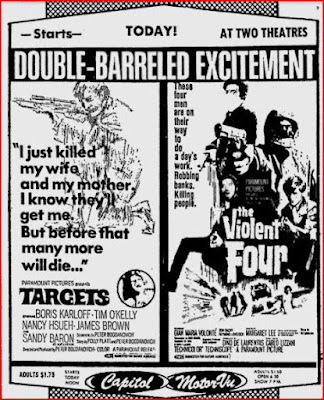
BANDITS IN MILAN (The Violent Four, 1968)
 A young man walks past a bank. Through the window, he sees what looks like a robbery in progress. The first thing he asks the man standing in front is, "Is it a movie?" "Yeah," the other guy answers, "those guns are empty." We know better; the robbery is real and this guy is a lookout for the robbers. The kid asks him, "Can I stand here and watch?" The lookout shoos him away, and the kid sulks, "Oh, I had someplace to go, anyway."
Like I said, we knew better -- or did we? Our confusion isn't necessarily a credit to the tricky structure of Carlo Lizzani's docudrama, which comes on early more like a mockumentary, or a mock mondo, based on an actual September 1967 bank robbery and police chase that left several Milanese citizens wounded and two dead.

September 26, 1967.
The long, disorienting digression takes us into mondo or pop-art territory. The subject is mob infiltration and intimidation of nightclubs, and we're shown a protection racket horning in on a club owner who already pays off another gang. He's warned to play ball with the new people, and when he hesitates, Lizzani cuts to clippings from Batman comics, including their infamous onomatopoeia, before cutting back to show the owner's office wrecked. From there we segue to the story of an aspiring model exploited and eventually set on fire by the mob.
While all this is going on, we learn, Piero Cavallero (Gian Maria Volonte), an ex-leftist who's turned from Communism to crime after his expulsion from the party, is assembling a crack robbery gang. Thinking himself a kind of guerrilla general, Piero's strategy is to stretch police resources thin by hitting a series of banks in a single day in rapid succession. He envisions the Banco di Napoli robbery as his last big score in Milan, but it's one bank too many. Bystanders identify the license plate of the getaway car and the chase is on.

Gian Maria Volonte vs. Tomas Milian on the streets of Milan.

History forces Lizzani into anticlimax. While future Italian cop films would have scripted an appropriately violent end to Piero's gang, Bandits sticks to the facts. All of the robbers are taken alive, Piero and his last accomplice readily surrendering when cornered in a small town barn. The film ends with Piero lording it over the media as he's booked, boasting of his generalship and cynically downplaying his killings compared to Vietnam, while the accomplice sullenly denounces Piero to anyone who'll listen. That's it. No moral, no catharsis, no closure. Just the facts -- if you can believe what you see on film.
Sunday, March 13, 2011
Wendigo Meets LET ME IN (2010)
 In what might serve as an omen for the makers of the American remake of The Girl With the Dragon Tattoo, Matt Reeves' Americanization of Sweden's other big cinematic export, Let the Right One In, bombed utterly on its release last fall. It must have struck the producers as a cruel surprise, given how the Swedish film had become a cult hit as a film and DVD in America. My friend Wendigo became one of Let the Right One In's admirers once he caught up with it on DVD. He wasn't surprised when the remake failed, and he remains unsurprised now that he's seen Let Me In and found it a respectful remake and a good film.
The Swedish film was only ever an art-house or cult success, he notes, so any effort to retool it for mainstream multiplex moviegoers was doomed. At this time in genre history, the John Lindqvist story has nothing that mainstream American vampire films want. Above all, it doesn't have sex. When he heard that an American version was being made, Wendigo was afraid that "Oscar" and "Eli" would be turned into teenagers and their relationship romanticized in an effort to lure in the Twilight audience. But if anything, Reeves doomed his project by remaining faithful to the original and keeping the main characters as children, or in the image of children.


Ronald Reagan (televised, lower right) should get credit for a cameo role in Let Me In.
Let Me In, of couse, is not something new. It's a remake, sometimes shot-for-shot, of a story familiar enough for us not to synopsize it here, moving the location from Sweden to New Mexico but keeping the period the 1980s. If not for the original, Reeves' movie would have become one of Wendigo's favorites. The ranking isn't automatic -- Wendigo likes The Ring better than Ring, for instance. But in this case the Swedish film feels more spontaneous, and the American version a little too overproduced.

"I'm not a girl," the vampire says, and sometimes Chloe Grace Moretz makes you believe it.
 Wendigo admits that the comparison is unfair on at least one level, since his unfamiliarity with the Swedish actors allows him to identify them more completely with their roles, while he couldn't help identifying Chloe Grace Moretz's "Abby" with her Hit Girl from Kick-Ass. But the American actors eventually won him over, and he feels that Moretz and Reeves were more successful than their Swedish counterparts (right) in stressing the femme vampire's disquieting androgyny, and complementing it with a certain androgyny in Kodi Smit-McPhee's "Owen." Moretz looks bigger, more robust than her counterpart, and wears pants and hoodies that sometimes conceal her femininity -- as is appropriate given the original character's backstory, while Smit-McPhee's abject wimpiness gets him called a girl by his bullying tormentors.
Who are these masked men?


Reeves does some interesting original things, from the odd way he never puts Owen's mother in focus, which emphasizes the mutual alienation of son and mother, to his reimagining of Jenkins's attacks. In America you can't just hang around someplace waiting for someone to walk past, so Jenkins carjacks folks, breaking in and hiding in their vehicles to jump them at railroad crossings. These sequences are nicely done, especially an admittedly Hitchcockian scene when unforeseen complications lead Jenkins from desperation to disaster. As Reeves notes elsewhere on the DVD, his intention is to get you rooting for Jenkins to escape his predicament, no matter how evil his purpose and how foredoomed he is to anyone familiar to the story. With us, he succeeded.

Abby is never so much an American vampire as at moments like this.
If Let Me In falls short of its original, that can be blamed on overproduction. There's a little too much CGI climbing and leaping, and Moretz gets to wear a CG "grr-face" that her Swedish counterpart never needed. Wendigo has nothing against "grr-faces," but he doesn't understand why nearly every American vampire film needs them. Why aren't fangs enough? Maybe they aren't cool or badass enough, and maybe effects teams do it simply because they can. The reductio ad absurdam of that mentality was Stephen Sommers' Van Helsing. Since then, excessive FX often makes it more difficult for Wendigo to take vampires seriously, a problem he never had with more minimalist vampires of the past and present.
The American film doesn't live up to the original's wintry cinematography, despite much imported snow, and Reeves reveals some limitations as a director following the stunt of Cloverfield. He seems to lose track of Owen's creepiness once he starts "going steady" with Abby, and other interesting angles end up underdeveloped. Reeves seems to have a reason for using clips of Ronald Reagan beyond establishing the period, but search us for what it was -- probably something to do with "evil," I suppose. He also lays the pop soundtrack on more thick than the Swedes did, in what struck us as an obvious attempt to sell an album. These complaints don't add up to a negative review. Wendigo stresses again that Let Me In is one of the better American vampire movies he's seen in a while.
Thursday, March 10, 2011
A WOMAN, A GUN AND A NOODLE SHOP (2009)
 Zhang Yimou didn't hide the fact that this film, also known as A Simple Noodle Story, is a remake of the Coen Brothers' debut movie Blood Simple, which I guess makes the period Chinese setting the most unlikely setting for a film noir since Anthony Mann set The Black Book in Revolutionary Paris. With Zhang at the helm, it may as well have been David Lean's version of Blood Simple. Older fans and history buffs will get my point. Lean made some great films, with some saying his black and white British films from the Forties are even better than Bridge on the River Kwai or Lawrence of Arabia. But after a certain point Lean seemed unable to tell a story simply, and his comeuppance came with Ryan's Daughter, a film that seemed appallingly overproduced by the standards of 1970. After the global success of Hero, House of Flying Daggers and Curse of the Golden Flower, Zhang seems to have reached that point. Noodle is a visual overdose that swamps mood with spectacle. When characters chase each other through the desolate hills, the hills are so gorgeously desolate that they dwarf the actors in every way. Zhang may have a narrative point to make about the characters' pettiness, but that point also gets dwarfed by the hyperaesthetic location cinematography.


An unfaithful wife...

A vengeful husband...

A man who kills for money....
Past the halfway point, however, as Noodle grows more recognizably imitative of Blood Simple, Zhang's commitment to reproducing the original's suspense brings the film under greater control. Things slow down as Zhang ratchets up the tension, putting his soldier over as a convincing menace to set up the final showdown with the wife. Apart from the aesthetic excess of slow-mo shots of arrows flying through the house, the climax works nearly as well as it did the first time around. The Coens wrote a strong scene, and I was tempted to say that it works in spite of Zhang, but I realize how easily it could have been botched. Zhang deserves credit for reclaiming suspense and some entertainment from what looked like a lost cause.
Anyway, it's nice to see the influence running the other way for once. We're so used to seeing Hollywood poaching foreign cinema for story ideas that it's almost reassuring in a backhanded way to see foreigners borrowing from American movies. Of course, Zhang didn't make Noodle to preempt Blood Simple from Chinese screens, so it's not quite the same thing that Hollywood usually does. Since the Coens themselves aren't above remakes, and even did a good one last year, seeing one of their own films remade is kind of like the circle of life in motion, to be sappy about it.
Straight from Sony Pictures Classics, here's the American trailer, for which the film's unoriginality is its main selling point.
Wednesday, March 9, 2011
WINTER'S BONE (2010)




Sunday, March 6, 2011
WESTBOUND (1959)
 While making the films with Budd Boetticher for Columbia Pictures that have made his latter-day reputation as a western star, Randolph Scott also made pictures for Warner Bros. For his last Warners picture, the studio hired Boetticher to direct. Neither the producer nor the writers had worked with Scott before, and it's unclear whether the actor had anything like the creative control he enjoyed over his Columbia efforts. The end product still seems like a Randolph Scott movie, if somewhat less like a Boetticher film. The Civil War story lacks the spare clarity of the team's Columbia pictures, but remains grounded in certain story situations typical of later Scott films. Scott and Boetticher may also be responsible for a graver mood that prevails here than in other comparable patriotic Fifties westerns.
Scott plays John Hayes, a Union cavalry officer assigned to securing the Overland Stage route through increasingly hostile territory and assuring that Union troops in the West get paid. The deteriorating situation is made clear to him at a station where the manager insults a maimed veteran (Michael Dante) by putting salt in the young man's slice of pie. Hayes is a man who takes crap from no one and will not let anyone give crap to a brave man who gave up an arm for his country. He forces the station master to eat the pie. The situation sounds absurd but it establishes Hayes's understated power of intimidation.


Good guys (Karen Steele and Michael Dante, above) and bad guys
(Michael Pate and Andrew Duggan, below) in Westbound.

Mace emerges as the real villain of the piece, while Putnam proves the sort of ambivalent antagonist you'd see in the Columbia pictures. With Hayes having reappeared, Putnam clearly feels insecure in his marriage and succumbs to alcoholism. But strangely, precisely because Hayes is his enemy, Putnam refuses to turn a wartime conflict into a personal matter. While Mace advises that the easiest way to resolve the situation is to assassinate Hayes, Putnam refuses to consider that option. He thinks he can drive Hayes from the field by pressuring stage drivers or stealing the Overland's horses. It's as if Putnam wants to prove to everyone that he doesn't fear Hayes as a returned romantic rival, but his choice of strategy enables Mace to commit a series of escalating atrocities for which Putnam is, for all intents and purposes, to blame.


See enough Randolph Scott films and the pattern of a "Randolph Scott film" becomes more recognizable. The man and his associates knew, by the 1950s, the sort of stories and situations that worked best for him. Whether Scott and Boetticher gave it a personal touch, or the Warner people tailor-made a story to suit Scott's strengths, Westbound is plainly a Scott vehicle. While the story in simplest terms is something Gary Cooper or any other Hollywood westerner could have performed, I suspect it would have been inferior with any other actor starring. Whether it would have been inferior with some one else directing is another story. While Scott was clearly comfortable with Boetticher by this point, I imagine that the other top Western directors of the decade -- Anthony Mann, Delmer Daves, etc. -- could have done just as well with the actor and the material. I don't have any problem with Boetticher's work here -- the image seems little compromised by the fullscreen "Starz Play" stream available on Netflix, except for the sequence when Mace's horsemen pursue a stagecoach across a too-sweeping expanse of road -- but the film overall plays less to the director's strengths, which I identify with a certain stoic minimalism, than it does to the star's. Boetticher probably should get credit for keeping the film personal as a Scott movie and getting the usual strong performance from the actor. I haven't seen enough of Scott in other hands yet to determine how much of his definitive screen persona is Boetticher's (or Burt Kennedy's) creation, but for now I'm inclined to give the director the benefit of the doubt. As a team, Boetticher and Scott were seven-for-seven. None of their collaborations fail to impress. Individual works by other directors and other stars may have been better films, but Boetticher and Scott were the most successful team in terms of quantity and quality during the greatest decade of Hollywood westerns.
Subscribe to:
Posts (Atom)