Friday, July 13, 2012

Now Playing: JULY 13, 1962

Not as many horror marathons or spook shows as I expected for a Friday the 13th -- at least not in the places whose papers I can read in the Google News Archive. I suppose the target audience has other things to do on a summer night....But here are two in Eugene OR alone.


Here's an eclectic lineup in Daytona Beach


I imagine that the early show they promise will calm the nerves may be just the picture to make horror fans' skin crawl.

And here's an exhibitor in Lawrence KS who thinks he can promote William Castle pictures better than Castle can.


Castle himself would probably appreciate the mystery about that shock bonus. There are probably people alive who remember what it was, but we'll probably never know....But let's see how Castle does it. This pitch for Macabre appears on EddieVHRocks5150's YouTube channel.


This trailer for House on Haunted Hill comes from latenitevideo's channel. 

Thursday, July 12, 2012

MR. FREEDOM (1969)

By the time The Avengers opened globally in the spring of 2012, most of the world's moviegoers had seemed to embrace the concept of American superheroes. Not quite half a century ago, however, the superhero seemed to many outside America as an embodiment of a supposed national proclivity to solve problems with infantile violence. Such was the opinion, apparently, of an American, the innovative fashion photographer William Klein, who made this send-up of superheroes and American adventurism in 1968, a year of political upheaval and mayhem in both the U.S. and France, Klein's adopted country. He wrote and directed the film while cinematographer Pierre Lhomme (whose next project was Jean-Pierre Melville's Army of Shadows) shot it. They deserve to share credit for a spectacular if superficial visual achievement.


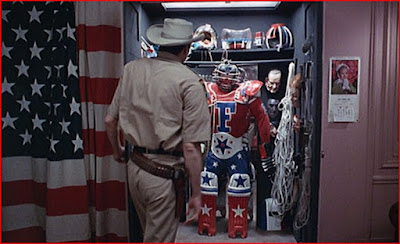
Mr. Freedom opens with news footage of urban rioting in an American city. A tall man in a state trooper's uniform opens a secret closet to reveal the uniform (basically a football jersey and pads and a baseball catcher's mask) and weapons of Mr. Freedom (John Abbey), who tracks down some ghetto looters and massacres them and their family. After this representative episode, the same mystery man reports to his boss, Dr. Freedom -- evocatively and provocatively played by Donald Pleasance, who was probably best known at the time this film came out as the superterrorist Blofeld from You Only Live Twice. The good doctor instructs Mr. Freedom to go to France, where Capitaine Formidable, a hero friendly to America, has gotten into trouble. In Texan mufti that suggests a more menacing version of Joe Bob Briggs, Mr. Freedom arrives in Paris, brushing aside tourists at the Eiffel Tower. In a hotel elevator, he confronts a karate-chopping femme fatale who reveals herself as Marie Madeleine (Delphine Seyrig), Capitaine Formidable's sidekick. After establishing her credentials by singing the Mr. Freedom song, she conducts our hero to a secret lair where his French acolytes hold a pep rally for him.


They are the enemies of the FAF, a leftist terror cell suspected of taking out Capitaine Formidable. Seeking to rescue or avenge the Capitaine, Mr. Freedom charges into an uncertain situation. The FAF receives funds from Moujik Man (Philippe Noiret), a bloated Soviet agent mainly interested in reaching some compromise with the American hero, but are tempted by the uncompromising rhetoric of Red China Man, a giant dragon that lurks within the Paris Metro. Meanwhile, Super French Man, a sort of giant balloon creature representing General de Gaulle, remains aloof, offering no help to Mr. Freedom, who lays waste to the Frenchman's minions with his X-Ray spectacles.


Everything builds to an escalation of the Cold War to the psychological terror stage as Mr. Freedom's forces take the fight to the FAF while the hero himself is temporary felled by a crisis of confidence. Marie Madeleine's child calls him a bad, scary man, causing him to question all his assumptions about the world. At his trough, he breaks out in stigmata, -- perhaps related to a cameo appearance by Jesus Christ and the Holy Virgin --  but Marie Madeleine restores his confidence by feeding him an enormous bowl of Corn Flakes. Mr. Freedom renews the struggle, but unexpected reversals and betrayals force him to go for The Big One -- to destroy France in order to save it....


If Mr. Freedom is an anti-American film, it should be noted that Klein has little good to say about any other political entity, based on his cartoonish presentation of the Russians and Red Chinese. Klein seems to retain some faith in revolution, however, or in revolutionary youth. The most positive, cheerleading moment in the picture comes when he shows Mr. Freedom's ultimate act of destruction, set up in a scene arguably inspired by White Heat, actually to have been fairly limited in scope. He swishes over to a demonstration several blocks away, which he presents in an approving way, as if to say that America can't suppress the people's rebellious spirit. From Mr. Freedom's addled perspective, these people oppose freedom, and Klein seems to agree. That is, they oppose a particularly crassly materialistic and selfishly self-righteous form of freedom that Klein identifies as uniquely American. Part of this freedom is tasteless consumerism, represented by an American Embassy that's a typical diplomatic structure on the outside, but a grocery store on the inside -- albeit one apparently stocked entirely with French consumer goods, since I didn't recognize any of the brand names -- where blonde cheerleaders attend our hero as he tours the aisles. It is also, inevitably, bigoted. We earlier saw Mr. Freedom shoot down a family of black people; he later uses the "N-word" freely and muses that life was simpler in America before the slaves and other foreigners came. If Klein intends Mr. Freedom to represent American attitudes, many American viewers will understandably see it as slanderously unfair. But Klein comes from an era when many people felt that American self-righteousness (e.g. "Better Dead Than Red") made nuclear war possible if not likely. Many people around the world probably wondered why Americans hated them, much as Americans wonder now why Islamists hate them. Fear and hatred toward a kind of exaggerated or imagined Americanism was an understandable if not absolutely justified attitude of the time that Mr. Freedom preserves like a piece of Pop Art in a museum.


As a movie, Mr. Freedom is a pictorial wonder, but not necessarily a cinematic one. Klein and Lhomme bombard us with dynamic, colorful comic-book style imagery, even if the comic-book style is more Mad than Batman. To call the film Pop Art is no great exaggeration -- call it Agit-Pop if you prefer. I suspect it had some visual influence on Alan Moore's Watchmen comics, to close the circle. Shots of our hero standing in front of banks of TV screens anticipate Dave Gibbons's artwork, while Mr. Freedom himself may well have influenced Moore's concept of The Comedian. But the movie's comic-book visuals are also its weakness. Klein can create brilliant compositions with characters in iconic poses, but he isn't very good at directing action. Despite his and Lhomme's visual brilliance, too much of Mr. Freedom looks like a concert film -- a recording of a live performance that hasn't been fully conceived in cinematic terms. Mr. Freedom gets many monologues -- all well-delivered by John Abbey -- which, while not too far removed from Batman's inane pontifications on TV, are too theatrical in their duration and their word-jazzy intonations. Klein may or may not have been inspired by the Batman TV show, but his fights (most involving firearms and characters in bizarre costumes) lack the "Pow! Zap! Biff!" dynamism of Batman or any real sense of slapstick humor. One reason many Americans may not be able to laugh off Mr. Freedom's anti-American attitudes is because the movie isn't really very funny. Part of that might be Klein's mean-spiritedness, but much of it is his failure as a comedy director. But if you come not to laugh but simply to look, you'll probably have a more rewarding experience. Mr. Freedom is a unique visual document of its time.

Wednesday, July 11, 2012

Now Playing: JULY 11, 1962

The opening of Advise and Consent in St. Joseph MO raises a loaded question:


Fortunately, Americans live in a free land where we dare ask such questions of our leaders. In democracy, everyone is accountable to everyone else, a principle celebrated on the occasion of a Pittsburgh opening for a foreign film.


It is a free country, but if you want to win this contest and be blurbed in a major metropolitan newspaper it might be wise not to say, "French films are pretentious" or "Truffaut is so primitive compared to Godard!"

Perhaps we should start with a film easier to criticize. Toledo gives us two to choose from.


Meanwhile, back in Pittsburgh, another exhibitor wins the Truth in Advertising award -- as long as you read the fine print.


Also look for this picture under the titles The Black Rebels (from Something Weird Video) and Lola's Mistake. The ad text is a little blurred, but it credits the author A. B. Guthrie Jr. as a co-writer of the screenplay. Guthrie, a Western specialist, gets no such credit from IMDB, but other sources confirm that he acted as a script consultant and promoted the film during its original 1960 release. This was a rare moment when you could imagine staking a film on Rita Moreno's name in the wake of West Side Story, but within a couple of years she was doing TV guest shots.

Finally for today, here's some fresh copy for Disney's Bon Voyage, which is playing its third week in some markets but just opening in Daytona Beach. I'd better let the art speak for itself.

Monday, July 9, 2012

CASANOVA '70 (1965)

The 1960s were the decade of the '70s. Not counting a slightly disreputable American precursor in the form of 1958's Frankenstein 1970, the Sixties used the '70 suffix several times as an indicator of super-modernity for purported modernizations of classic tales and archetypes. The anthology film Boccaccio '70, for instance, offered itself as an update of the Decameron, while Manon 70 gave the modern treatment to the novel Manon Lascaut. The notion of ultramodernity wasn't exactly obscured if people believed that the magic number also denoted a widescreen presentation. Mario Monicelli, acknowledged as an expert in comedy all'Italiana, also deserves recognition as the master of comedy '70. His contribution to Boccaccio '70, a slice-of-life romantic comedy on a colossal scale, was edited out of the film's American release, and not restored until a 21st century DVD release, because it took the picture over the three-hour mark and Monicelli, despite Big Deal on Madonna Street, was the least well-known of the anthology's directors (the others being De Sica, Fellini and Visconti). His consolation prize was getting an entire '70 picture to himself, along with the services of Marcello Mastroianni, who may have seemed like the only cinematic asset missing from the Italian super-anthology.


The premise, of course, was to imagine a serial seducer on the semi-legendary model of Giacamo Casanova in the Swinging Sixties, or just afterward. But since this is a Monicelli picture, his Casanova has to be dysfunctional in some way that was perhaps characteristically Italian. Monicelli and his co-writers, the dream team including the late Tonino Guerra and Suso Cecchi d'Amico, along with the director's Organizer collaborators, Age and Scarpelli, came up with an appropriately mock-psychological explanation for their Casanova's compulsion. Mastroianni plays NATO Officer Rossi-Colombotti, who discovers to his dismay that seduction is too easy for him, so easy that he can't rise to the occasion, if you please, unless he increases the risk factor. Or so a dubious analyst (comedy director Marco Ferreri) with an Oriental gimmick and a latent streak of misogyny tells our hero. This sets up an episodic saga that could well have become a multi-director anthology under different circumstances, as Rossi-Colombotti struggles to find new ways to make love dangerously. He enters a lion cage on a dare from the sexy female lion tamer and gives her a kiss in front of his would-be fiancee. On a mission in Sicily, he makes it with a girl while her violent family waits outside, our hero having pretended to be a doctor in order to inspect her virginity, a matter of honor to her kin. In the last and longest episode, he renews an acquaintance with an oppressed countess whose husband pretends to be deaf and schemes like a villain from melodrama to use his collapsing property to kill our hero. And when things go the other way, Rossi-Colombotti ends up on trial for murder.


What's the difference between this scenario and so many Hollywood sex comedies of the same era? The simple answer is talent. Monicelli last appeared on this blog as the director of The Organizer, a gritty, downbeat period piece about a failed factory strike. There the comedy was subtle and somewhat dark, more a matter of empathy with human frailty than anything else. Casanova '70 is a big, broad comedy with sight gags and sometimes farcical action, and Monicelli handles that kind of comedy just as deftly as the more dramedic or tragicomic material of The Organizer. Mastroianni is his star in both pictures, and like the director the star toned down his stardom for the earlier film. As Monicelli's messed-up modern Casanova he goes all out, and the results remind us that Marcello Mastroianni should be ranked among the greatest comic actors in movies.


He has the rare combination of a clown's temperament and matinee-idol looks that made Cary Grant and currently makes George Clooney occasionally brilliant comedians, but in Mastroianni's case, from what I know of him, comedy was his primary mode. Stuff like Casanova '70 is his specialty. He's naturally convincing as a lover. He can do the physical comedy. He's not afraid to look or sound silly, as when he has to enunciate every syllable while addressing the allegedly deaf Count and comes across like he's addressing a primitive imbecile, or like one himself. But his special comedic gift may be the way he can make himself the center of a scene while doing nothing but watching other people. He would have fit in at Hal Roach's studio with such great reaction artists as Oliver Hardy. When a bridge collapses behind him as he's conveyed over water to the Count's castle, the payoff is his reaction -- not that he mugs or pulls a face. His reactions are more the perplexity of a man whose sense of decorum, dignity, complacency or superiority is under constant assault, yet doesn't want to give any of that away. His best such moment comes at the Sicilian restaurant as he waits with Hitchcockian patience for service as noises inside portend that all hell is about to break loose. Monicelli defuses the tension with a gag, as a pantsless toddler wanders onto the patio and crawls under Mastroianni's table. Mistaking the brat's babbling for the mewling of a cat, he dips some bread into tomato sauce and clucks at the creature under the table, inviting it to eat. At that moment a mob comes pouring out of the kitchen, seemingly determined to lynch a man attempting to escape them but finally carrying him, as he kicks and screams, back inside. Mastroianni simply watches. He even turns his back to the camera to follow the action, but his presence holds the entire scene and Monicelli's pictorial composition together. The comedy is only superficially grounded in the Sicilians' barbarism -- they're the equivalent of hillbillies in an American comedy -- but in Mastroianni's implicit questioning: "What am I doing in such a place? How did I get here? What is going on?" His character can be a priapic buffoon for us to mock elsewhere in the picture, but when it counts Mastroianni becomes a dismayed everyman and our point-of-view character, a would-be ringmaster who's lost control of the human circus.
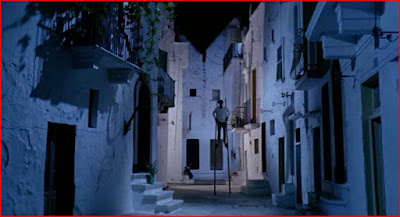

The star is ably supported by a harem of temptresses led by Marisa Mell as the Countess, while the director is still more ably supported by vivid cinematography by Aldo Tonti -- the picture's a knockout in HD -- and expansive production design by Mario Garbuglia, who was coming off both The Organizer and Visconti's The Leopard. Casanova '70 is an exemplary film from the period of Italy's epic bid for global cinematic domination on both the arthouse and the grindhouse level, and it has an appropriate pictorial ambition, if not an outright swagger. A Casanova film from the actual 1970s would probably look and feel very different -- the closest thing I know of is Fellini's film with Donald Sutherland as the historical character -- but Monicelli's film wasn't meant as a prophecy. Think of it as Casanova 1965 and you have an attractive, amusing document of a moment in cinematic history and a highlight from the collaboration of a brilliant comic actor and a brilliant comedy director.

Here's the trailer from Fandorific's YouTube channel:

Sunday, July 8, 2012

Ernest Borgnine (1917-2012)

Until today (and since the death of Marlon Brando) the earliest-surviving winner of the Best Actor Oscar, and active in Hollywood until very recently, having appeared as the most superannuated of the stars of 2010's Red, one of American cinema's great heavies and one of its seemingly indestructible men has passed away. Borgnine was one of the few nonagenarians whose demise can be described as shocking news. He carved a niche for himself in mean roles in such films as From Here to Eternity (in which Montgomery Clift knifed him to death) and Bad Day at Black Rock (in which Spencer Tracy karate chopped him into submission with one hand literally tied behind his back), but proved with Marty that he could play a flawed but benign everyman. At his early peak in the 1950s, he could even be a romantic lead, as he was, perhaps to Alan Ladd's surprise, in Delmer Daves's The Badlanders. Borgnine's stardom ebbed enough to make TV attractive in the 1960s, and after he was done with McHale's Navy he was ready for another run of movies, including his most likely greatest performance as William Holden's sidekick and conscience in The Wild Bunch. Borgnine aimed higher but suffered crushing disappointment when Paramount wouldn't cast him in the role he most coveted, Vito Corleone in The Godfather. He could still play brutes (as in Hannie Caulder and Emperor of the North) as well as violent men of honor (as in A Bullet for Sandoval), but who knows how his last forty years would have differed had he got the Godfather part. He was good enough to allow us to imagine him in Brando's place. He enlivened every picture I can recall that he appeared in. This is a sad day.


Follow this link to see past Mondo 70 reviews of Borgnine pictures.

Saturday, July 7, 2012

The Caramel War: Yasuzo Masumura's GIANTS AND TOYS (1958)

"E verybody wants their fifteen minutes of fame," a businessman says, in English translation, when explaining how Japan's TV networks and other media outlets strive to fill time and space in order to keep in business -- they create celebrities constantly from a perpetually willing populace.  The year is 1958. Andy Warhol will not make his famous prophecy about everyone getting their fifteen minutes for another decade. I assume that the translator who composed the subtitles for the Fantoma DVD of Giants and Toys used a now-familiar American idiom to replace an unfamiliar Japanese idiom, without realizing that putting the phrase in anyone's mouth in 1958 was anachronistic. But if it's a literal translation of the actor's remarks, then screenwriters Ken Kaiko and Yoshio Sirasaka were also prophets. That would seem right somehow. It would be in keeping with the way Yasuzo Masumura's satire echoes contemporary American concerns with mass media, celebrity, and the omnipresence of advertising. It may seem strange that Japanese writers and filmmakers, only thirteen years removed from being bombed nearly to the Stone Age, are as advanced in their anxiety about mass culture as the American vanguard, but as one character says, "America is Japan." It's less a matter of America remaking Japan in its own image than of Japan making another of its characteristic adaptive leaps and becoming, on this film's evidence, even more of a media and ad-saturated society than its American model. Accordingly, Masumura's satire is more intense, emotionally and pictorially, than such American counterparts as The Man in the Grey Flannel Suit, Will Success Spoil Rock Hunter?, Sweet Smell of Success, and so on. Giants and Toys may be the ultimate global statement on the subject.


In the neon world of Giants and Toys, Nishi (approximately fifth from right, below)
starts out as just a face in the crowd.


One immediate difference between Japanese and American cases is the absence, in Masumura's film at least, of an equivalent of "Madison Avenue," the world of advertising agencies eventually called by name in a minor 1962 Hollywood picture. The competing caramel companies of Giants and Toys appear to do all their marketing in-house. World, Giant and Apollo are battling for dominance of the candy market, each seeking a new tie-in gimmick to pull it ahead of the rest. Apollo seems to take the subtle approach, while Giant relies on a spokesman in a strongman costume to sell its stuff. Our main focus is on World's struggle to distinguish itself. The company has problems. The lights have gone out on two letters of its English language neon sign, so that the company's name reads OLD. How to change their image. Key to the effort are hard-charging Goda, who suffers from the Movie Disease (occasional coughing fits, blood on the handkerchief) and his young, idealistic assistant Nishi. Among their strategies are a space-age gimmick with futuristic giveaways to tie in to an upcoming Space Expo, and the discovery of a new corporate spokesperson, a perky girl with bad teeth, supposedly from enjoying too many World Caramels. Everything converges as the girl plucked from the slums, whom Nishi thinks "looks like a monkey," dons a spacesuit and films elaborately choreographed commercials with earwig soundtracks, delivering World Caramels to the benighted people of distant worlds.


A star is born, but will success spoil Kyoko Shima?


The girl, Kyoko Shima, becomes Japan's Next Big Thing from her initial appearances in magazine layouts to a delerious live tour, quickly growing bigger than World. All the while, Nishi strives to get intelligence on the rival companies from his buddy and his girlfriend, who happen to be his counterparts at Giant and Apollo respectively. The moment I described Nishi as idealistic you should have guessed that he would prove a loser, dominated by Goda, played by his pals, increasingly intimidated by Kyoko. Idealistic loser that he is, he rebels in spirit against the shallow cutthroat competition that intensifies after a factory fire knocks Apollo out of the running. Everything seems to depend on his getting Kyoko to appear in her space costume at the Expo, but his Galataea, now aided by Nishi's pal from Giant, checkmates him and goes on to pursue her destiny, leaving our hero to a fate more closely resembling Requiem For a Heavyweight than any of the American ad-age satires mentioned earlier. It's also an extra satiric payoff for the entire space-age gimmick, as Nishi's shamefaced donning of the spacesuit symbolizes his alien-ation from the crass culture he's helped to cultivate.


Requiem for a lightweight.

Giants and Toys is a more definitive visual document of the 1950s than most of its Hollywood counterparts. It looks right, at least to someone who didn't actually live then. That is, the cinematography of Hiroshi Murai and the art direction of Tomoo Shimogawara looks torn from the pages of Life magazine, lurid and lush. The actual products of the ad culture look authentic, especially the zany spacewoman commercial we see mostly on a TV screen and briefly as it's apparently being shot live at that moment. The film's satire seems more pointed, or more focused, than the American pictures, more on-target in portraying the caramel competition as an amoral equivalent of war. The analogy is illustrated most dramatically as planes leaflet-bomb Tokyo with promos for one of the candy companies, and dramatized most starkly when a possibly-dying Goda accuses Nishi of being a traitor for refusing to go the extra miles for his corporation. Interestingly, Goda scoffs at actual invocations of bushido, as when an older, even more moribund executive suggests that it'd be dishonorable to snatch Apollo's market share while the rival company is helpless following that fire. It's Goda, not that older man, who seems to embody the warlike spirit that set Japan on a course of conquest and tyranny a generation earlier and now expresses itself in obsessive battles for sales. That sublimated bloodthirst finds its ultimate new expression in Kyoko's utterly mad musical performance, as racist a fantasy of primitive barbarism as anything the U.S. might have come up with. As dancing savages chuck their spears, Kyoko sings lyrics about stabbing people until they bleed out, chopping them up and selling them to the native women. The goofball girl-next-door achieves apotheosis a goddess of death, capping a giant performance by Hitomi Nozoe that stands somewhere between Judy Garland in the 1954 A Star is Born and Jayne Mansfield in Rock Hunter. Hiroshi Kawaguchi as Nishi and Hideo Takamatsu (who would later turn up U.S. TV on Shogun) as Goda are also outstanding, with personalities to match Masumura's wild widescreen imagery.


Not everything the director tries works; I'm not sure of the point of running three separate montages over images of Goda attempting to use his cigarette lighter, for instance. But for someone swinging for the seats in nearly every frame (including scenes set at an actual baseball stadium) Masumura has a very good batting average in this picture. He knocks the picture as a whole out of the park, creating as defining a film for the era and its self-satirizing anxiety as I can imagine. It has to go down as one of the best films of the 1950s and one of the very greatest about the 1950s.

Friday, July 6, 2012

Devil's Handburgers: Now Playing, JULY 6, 1962

It may be new to Albany NY, but we've seen this double-bill before.


A few things are different, though. I don't recall the "Devils Handburgers" and related condiments (upper right) being offered in the last place that played these pictures. Talk about your incentives -- you can bring blood home with you! But let's not ignore the real difference: this is a triple bill of "3 Smash Hits." What's the third picture? What'd be the ideal follow-up to two Crown International schlockfests?

This would be.


Yes, it's Ingmar Bergman's classic, The Virgin Spring. The disclaimer reads: "Certain essential scenes in this film should be seen only by adults. They are not suitable for younger, more impressionable minds. We strongly recommend this film for adults only." More proof, I guess, of the fuzzy boundaries separating "art," "adult" and "exploitation" pictures at this time.

If this disturbs you, try repeating: "Det är bara en film, det är bara en film ..."