Monday, July 8, 2013

Now Playing: JULY 8, 1933.

This is getting monotonous!


By now the Gold Diggers phenomenon is news of a sort.


The Warner clearly hit the mother lode. Repeat business at the trough of the Great Depression is quite a feat. To remind you, only one other major-studio 1933 release has stayed in first run in Milwaukee for even a second week -- and that was 42nd Street. Gold Diggers has blown 42nd Street out of the water. What's the reason? Maybe there's this reality at the core of the story: "We're In the Money" as long as the show runs.

Meanwhile, at least one of this week's other contestants seems to be copying the champ's advertising.

 
Imitation in this case may be a sincere form of flattering the potential audience.

Saturday, July 6, 2013

HELL'S HINGES (1916)

Western movies have been with us since 1903's The Great Train Robbery, if not before. Edwin S. Porter's short subject is probably still perceived as "the first film to tell a story," however untrue the claim is. But if westerns go all the way back to the beginnings of narrative cinema, Hell's Hinges is arguably the first western that really shows us what the genre was capable of, the first to indulge in apocalyptic violence and vengeance in a truly picturesque, cinematic fashion. Made a year after D. W. Griffith wrote history with lightning, Hell's Hinges is the Birth of a Nation of westerns. The violence is white-on-white but it portrays no less of a kulturkampf than Griffith's racist epic -- and the absence of a race element may make the culture element more stark and alarming. In 1916 the U.S. was near the high tide of the campaign for Prohibition. That campaign converges with the Ku Klux Klan revival allegedly sparked by Griffith's film as part of a nativist defense of a traditional Protestant culture deemed authentically American. Hell's Hinges portrays a war on Christianity on the 19th century frontier, in which, presumably, sympathetic audiences recognized a shadow of the war on their traditional values waged in their own days by the defenders of the saloon, the sabbath breakers, the suffragists, etc. And in William S. Hart that audience saw the wrath of God.


Why does the frontier need taming? I'm not asking about the line separating settler from Indian; the problem in so many westerns is that the settlers themselves need taming. Aren't those settlers of authentic American stock? Aren't they Christians when they set out? Presumably so, but something happens on the frontier that helps define the western. Coming to tame the frontier, the settlers end up needing to be tamed. That's the situation in the town called Hell's Hinges when the film gets there, and the situation repeats itself in miniature.


Rev. Robert Henley (Jack Standing) is sent from New York to restore religion to the frontier town. In a prologue, the film has already told us that Henley is a flawed preacher, more interested in preaching as a performance for admiring ladies than in winning souls. We're also told that his sister Faith (Clara Williams) who comes to Hell's Hinges with him is a better Christian than he is. Woman is the vanguard of civilization in many westerns, whether as the archetypal schoolmarm or as an evangelist like Faith. Where Robert performs Christianity, Faith lives it. It's something you can see in every part of her demeanor, if you have the sensitivity or sensibility to recognize it. Miraculously, someone in town does recognize it. Blaze Tracy (Hart) is just one of the guys in Hell's Hinges until Faith shows up. Something about him responds to something about her. Pop fiction of the time described it as some sort of race instinct to worship and defend female purity. In simpler terms, Blaze is smitten, so he's going to defend the Henleys against the hostility of most of the town, allying himself with the "petticoat brigade," which despite the feminizing label includes a handful of righteous bearded patriarchs, all of them longing for old time preaching, but not getting it from the Rev.


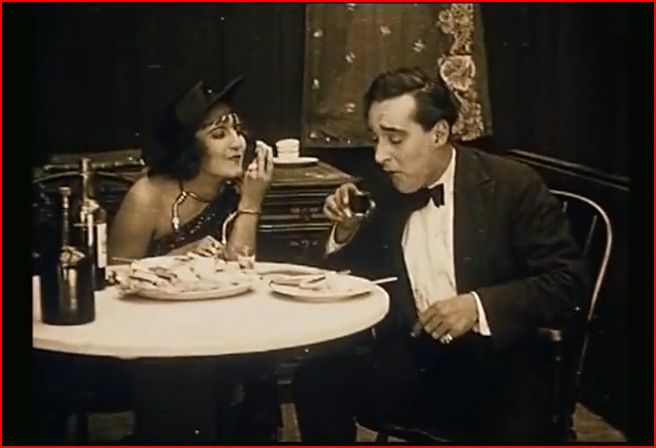
Instead, Hell's Hinges corrupts the preacher. Fearful of the potential influence of religion on business, the town saloon keeper Silk Miller (Alfred Hollingsworth) has Dolly, one of his dance hall girls (Louise Glaum) seduce Robert Henley. It doesn't take much: one drink and the Rev. is in Reefer Madness land, practically. Dolly detains him all Saturday night so he misses his Sunday sermon, the congregation finding the two passed out together. An instant alky, Robert is later goaded into joining a mob in burning his own church. A gun battle breaks out between the mob and the congregation, and Robert is killed in the crossfire.


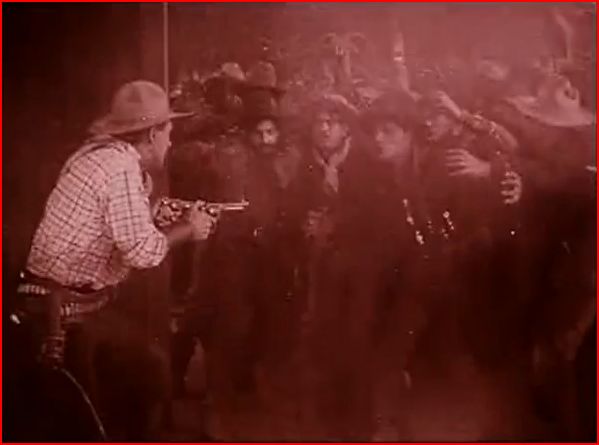
This happens while Blaze is riding out to fetch a doctor for Robert. Now that his time has been wasted, Blaze is plenty mad. I'm probably understating this. Never mind that the greater offense in his eyes was probably making Faith cry. Whatever the provocation, his anger is unfathomable, yet he is poker-faced in his determination as he marches toward the camera and into town. The violence against the church in this picture has already been somewhat startling -- did things really get this bad in the Old West? -- but what follows is stunning. Not if we measure by body count, since I think Blaze kills no more than three people. But as a matter of scale Hell's Hinges sets the standard for disproportionate response to offense. To avenge Robert Henley and his church, Blaze -- his very name is foreshadowing -- burns the town to the ground.


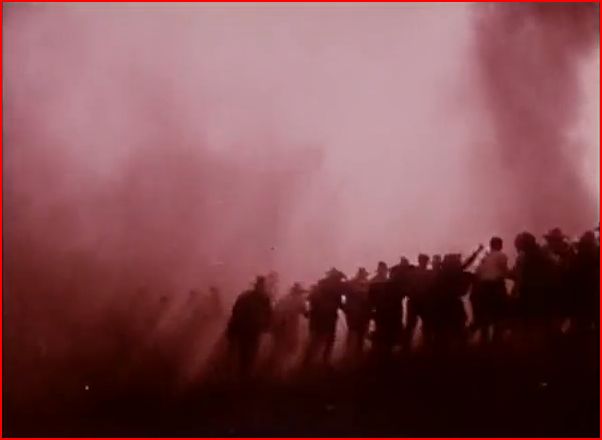
Charles Swickard is the credited director of this Thomas H. Ince production, but one Clifford Smith and Hart himself shared in the direction. The big question is who directed the last reel, because that director is a master. Working with cinematographer Joseph August, who would do exemplary work into the 1940s, the director stages a minor Armageddon, at once dangerously authentic -- Hart is literally playing with fire -- and precociously expressionist as fire and smoke turn the town into an abstraction of disaster and panic. From the startling (for 1916) overhead shot as Blaze cows a crowd and shoots out a lamp to the serendipitous lens flare as he walks past an explosion without flinching -- setting another precedent -- the film's climax is virtuoso filmmaking that still impresses after almost a century.


Blaze Tracy is Hart's definitive "good bad man" and the ancestor of Clint Eastwood's William Munny among others who practically become bad good men. Blaze's wrath is terrible to behold, the more so as he becomes less a laughing mocker like his erstwhile peers and more a grim-faced avenger. In his fiery apotheosis Hart achieves a paradoxical charismatic expressionlessness. We see him snarl a little as he confronts the saloon crowd, but he remains glacially unmoved by the destruction he perpetrates and the horror surrounding him, not even afraid for himself as he takes his time striding through the holocaust. Across the years, you'll recognize him as a type you still see in movies today. Much about Hell's Hinges may seem obsolete or quaint, but Hart could be a star now with this performance, because he helped define a certain kind of stardom, just as this film defined a certain kind of western.

*   *  *

Do you have an hour or so to kill? Then have a look at Hell's Hinges in full. MantisCinema uploaded this 63 minute version to YouTube.


Thursday, July 4, 2013

On the Big Screen: COPPERHEAD (2013)

The facial hair is more plausible than ever in Ron Maxwell's latest cinematic portrait of the Civil War era, and this time, focusing on the New York home front, the director of Gettysburg and Gods and Generals looks past the literary efforts of the Shaara family and back to the 19th century, when Harold Frederic wrote the source story -- which is no relation to the 1920 Lionel Barrymore silent movie of almost the same name. Frederic's story was adapted by Bill Kauffman, a writer I know as a contributor to The American Conservative magazine. Less orthodox than the title suggests, TAC is anti-interventionist in foreign policy -- they don't care for the "isolationist" label -- and opposed the invasion of Iraq. Kauffman envisioned Copperhead as primarily an anti-war movie, but he wanted to challenge audiences by making the case in the context of a "good war." The challenge puts audiences in a complicated position, because we understand that the character expressing unpopular opinions is supposed to be our protagonist. He's Abner Beech (Billy Campbell), a resident of "The Corners," a small community in northern New York. A staunch Democrat, he despises Abraham Lincoln and sees the war against secession as the first of many violations of the Constitution. Unfortunately for him, public opinion in The Corners has turned against him in the past decade. Once as staunchly Democratic as Abner himself, it turned Republican in the 1860 election, and after secession and the bombardment of Fort Sumter, most people rapidly caught up with the once-despised radicalism of the town's loudest abolitionist, Jee Hagadorn (Angus Macfadyen). It seems simple to them: the Confederates quit the Union and attacked the American flag, and that makes traitors of them and anyone who questions the need to suppress them. Abner and his family grow increasingly isolated, with only the Irishman (and thus reliable Democrat) Hurley (Hugh Thompson) at his side when they go to vote, without benefit of secret ballot, in the 1862 gubernatorial election. The Democratic candidate wins on a peace platform, further embittering The Corners against Beech.

Since our story comes from 19th century literature, there is a romantic complication. Abner's son Jeff (for Thomas Jefferson) loves Hagadorn's daughter Esther (Lucy Boynton), though she's inherited enough of her father's fanaticism that she can't stand the name Jeff, identifying it with Jefferson Davis. She convinces her beau to change his name to Tom, and he himself, in rebellion against his father's hostility to the Hagadorns, enlists for the war. He fights at Antietam and is reported missing. While Esther worries and Jee's own rebellious son (Augustus Prew) travels south as a civilian to find Tom, the fathers reveal themselves as equally insensitive extremists, Jee indifferent to Tom's fate in his ecstasy over the Emancipation Proclamation, Abner dismissing him as having brought his doom upon himself. Each man is so consumed by ideology that an individual life no longer matters to either of them.

A further complication: after Abner celebrates the Democratic victory with a bonfire on his farm, like a flaming thumb in the eye to the local majority, Esther learns that Republican extremists, including her father, plan to tar and feather him. She goes to the Beech farm to warn the family, and is trapped their when the mob arrives. When the mob accidentally sets the farmhouse on fire, the Beeches get out, but Esther doesn't. Just about this time, her brother arrives with a one-armed Jeff in tow. Having seen horrors down South, he sees more at home....

Admittedly, Kauffman and Maxwell wanted to complicate anti-war sentiment, and in doing so they play with fire. Copperhead begs the question whether one can only be anti-war without taking a side on the issues of the war in question. Can you oppose the Civil War, for instance, without implicitly endorsing secession and or slavery? For Abner Beech it's a split decision: he grudgingly admits that slavery is wrong, but considers it none of his business, while letting the Confederacy go is preferable, as far as he's concerned, to the ongoing bloodbath for which he blames Lincoln. Challenged by the town blacksmith (Peter Fonda), Abner claims to value the Union, but values local things more. It would have been interesting had some character asked him whether he valued anything more than the Constitution, given his obsession with Lincoln's actual or supposed violations of the sacred document. Reportedly, the filmmakers are more evenhanded toward Frederic's characters than the original author was, though that makes me wonder what sort of outrageous grotesque the original Jee Hagadorn was compared to Macfadyen's ranting, singing, cane-pounding fanaticism. While modern viewers can recognize Campbell's Abner as the sort of crank they see and hear today, you wonder whether people like Jee ever actually walked or limped on earth. While Abner remains the more sympathetic character, the film calls the character out when he grows too stubborn, self-righteous or simply hateful. He can't be called the hero of the film -- the story may have no real hero. But the film's very existence seems intended to carry on Abner's questioning of the Civil War. It offers no judgment of its own on the war, contenting itself with a lesson in tolerance and loving thy neighbor -- carefully including an extra attack on slavery -- to The Corners.  Abner's question -- whether this war or any war is worth it -- is left hanging. That ambiguity is a hard sell at a time when Django Unchained exploits the easy assumption that slaveholders deserve death. Almost inevitably, coverage of the film appears restricted to conservative media, which might create expectations of a more reactionary message than the film actually delivers.

Copperhead is at its best when Kauffman and Maxwell take time to portray village life in detail, from trips to the general store to the operations of the sawmill. It's most successful at the level of art direction, while the story's slow start actually works to adjust us to the pace of 19th century life. As a neophyte screenwriter, Kauffman exposes his limitations when characters debate each other; he can't vest those scenes with the life of authentic conversation, though he might excuse their clunkiness as illustrating Abner and Jee's increasing detachment from everyday concerns and real relationships. As with the writing, so with the acting. The younger performers who don't have to embody extreme political views generally fare better than the two stars. As for the direction, Maxwell doesn't have to worry about underbudgeted battles this time, and that's a good thing, as he's better at atmosphere than action. Regrettably, the dramatic climax of the picture, the fire scene, is its worst directed moment. The film's biggest failing, however, is the likelihood that people will leave it still wondering what Maxwell and Kauffman were trying to tell them. They might say they meant only to raise questions, but while they certainly succeeded at that, I'm not sure whether all the questions audiences ask will be those the authors intended.

Happy Independence Day, 1933!


Tuesday, July 2, 2013

Pre-Code Parade: SADIE MCKEE (1934)

Vina Delmar is forgotten today except by classic movie buffs who may recognize her as the screenwriter for The Awful Truth and Make Way for Tomorrow. In 1933 she was popular enough as an author that M-G-M bought the movie rights to her Liberty magazine story "Pretty Sadie McKee" before it was published, with a Joan Crawford vehicle in mind. John Meehan adapted it and Clarence Brown directed. It's a rags-to-riches-to-respectability chronicle following Sadie through three intertwined relationships. Her parents are servants to the Alderson family and she grew up as the playmate to Michael, the Alderson scion. Grown up, she's gotten work outside the household but comes in to play maid for larger dinner parties. At one such she re-encounters Michael (future Mr. Crawford Franchot Tone), now a lawyer, and shares friendly memories of childhood pranks. But when Michael talks of making an example of Tommy Wallace (Gene Raymond), a boyfriend of Sadie's who's gotten into trouble, she can't hold back from denouncing Michael and his entire social set in front of the dinner party. She and Tommy elope to the big city, where the feckless boy seduces her with a song ("All I Do is Dream of You") on the ukelele in advance of their wedding.

The next day, Tommy dumps her. While she's waiting at the court house to get a marriage license, Tommy is seduced in turn by Dolly Merrick (Esther Ralston) who makes him part of her act -- a musical stooge, he interrupts her song while "practicing" in the audience until she yields the spotlight to him. Left to her own devices, with only Opal (Jean Dixon) for a friend, Sadie finds work as a niteclub dancer. One night she catches the eye of Jack Brennan (Edward Arnold), an overgrown child of an alcoholic millionaire. He wants to marry her on the spot, but his dinner companion objects. It's Michael Alderson, his legal counsel, and Sadie marries Brennan mainly to spite him. The spite is mutual as Michael suspects Sadie of gold-digging. She isn't especially welcome with the Brennan servants, either. They prove a bunch of enablers, led by butler Finnegan (Leo G. Carroll) who keep their master sozzled the way he likes. Sadie's happy to go along with that for a while, especially when the prospect arises of seeing Tommy on the side, but when she learns that Brennan could drink himself to death before long, she takes it upon herself to dry him out, defying Michael and the servants, who all think the worst of her, and ultimately Brennan himself, whose drunken antics grow steadily less comical as his self-destructive streak becomes more apparent. Arnold nearly steals the film with his wild-man performance, riding a wild arc from comedy to outright menace as Brennan finally slugs Sadie in the face after she empties his liquor cabinet. At its trough, Sadie McKee is a dark reflection of the era's gold-digger comedies as her sugar daddy proves far less manageable than the typical befuddled buffoon that Guy Kibbee might have played.

The film goes soft in the final act as Meehan (or Delmar) clears all obstacles to a happy ending. Brennan climaxes his ultimate tantrum by tumbling down a flight of marble stairs and breaking his leg. Laid up, Brennan finally dries out and, realizing what he owes Sadie, he agrees to divorce her after she learns that Tommy and Sadie have broken up. Tommy's health is failing now, causing the fickle Sadie to dump him. Michael tracks him down and discovers that he has the Movie Disease (cough, cough). He sets the man he once wronged up in a sanitorium, but it's too late for anything but a deathbed scene in which Tommy commends Michael to Sadie. With his two rivals nobly renouncing their claims, Michael gets the girl at last despite being a self-righteous jerk for most of the picture. The film's main flaw is its failure to convince you that Michael deserves Sadie; he simply prevails by a process of elimination, without displaying Tommy's languid, musical sensuality or Brennan's briefly attractive playfulness. Before the wrap-up, however, Brown puts a pretty good picture together. It's an unusually musical picture for a non-musical, and the music -- Tommy on the ukelele, a small jazz ensemble at Sadie's niteclub compelled by Brennan to play all night -- gives the movie a distinctive, almost leisurely atmosphere that makes Brennan's turn to brutality all the more alarming.  Sadie McKee is about three-quarters of a fine movie, and if the end keeps it from being great its overall record is still pretty good. 

Sunday, June 30, 2013

SOLDIER BLUE (1970)

When HBO came to our neighborhood my parents, who had sprung for cable, chose not to pick up the new movie channel. I had friends whose families did get HBO, and I would watch movies with them whenever I got the chance. I was about ten years old when I first saw Ralph Nelson's Soldier Blue. We were just kids, so we were really just interested in the famous massacre scene at the end of the picture. You didn't see that level of violence and gore on TV back then, and it was a kind of revelation, if not a rite of passage, to see it in someone's living room. What happened to the Indians was awful in both senses of the word -- deplorable yet kind of awesome. Watching it again this past week, I realized that I remembered little about specific acts of violence. Soldier Blue's violence had become something abstract in my memory. The film had become less about a crime perpetrated against Native Americans and more a film about violence, one in which violence became an end unto itself. In retrospect, that's the problem with it.


Before adapting Theodore V. Olsen's novel Arrows in the Sun, writer John Gay had scripted the comedy western The Hallelujah Trail, while director Ralph Nelson had helmed the western drama Duel at Diablo. Nelson, at least, had established his credentials as a wrangler of sweeping outdoor action. Neither he nor Gay seemed from prior work like the sorts to make a revisionist western, yet Soldier Blue is nothing if not that. It is revisionist in content if not in form, retaining the classic sweep and widescreen framing of earlier westerns while subverting earlier archetypes and blatantly inviting comparisons with the massacres of the Vietnam War. Nelson and cinematographer Robert B. Hauser give the film an epic look and clearly had plenty of money to spend, but may have risked charges of anti-Americanism by portraying the U.S. Cavalry as blatant murderers of peaceful natives.


The story starts from the opposite end conceptually, with Pvt. Honus Gent (Peter Strauss) barely surviving the massacre of his cavalry unit by Cheyenne warriors. His unit was escorting a rescued captive, Cresta Lee (Candice Bergen) to her fiancee, also a cavalryman. During the bloody battle -- it opens with Honus's buddy catching a bullet in the face -- Cresta manages to rescue herself. The first genre reversal of the picture is Cresta's role as the experienced wilderness survivor in place of the typical older, stronger male. She'd been taken by the Cheyenne two years earlier and was with them long enough to learn more woodcraft than the rookie Honus has. Her personality is defined by her city background. New York is where she got her filthy mouth and her feisty no-nonsense attitude, qualities that seem anachronistic in the setting but are meant to make her the audience-identification figure in 1970. Despite her technical captivity, Cresta embodies an alternative synthesis of urban modernity and native wisdom, refusing the alternative frontier attitude of conflict and conquest. She never truly goes native -- she tells Honus that she's not a Cheyenne and never will be -- but she identifies with them more than with the soldiers she's stuck with in more than one sense.


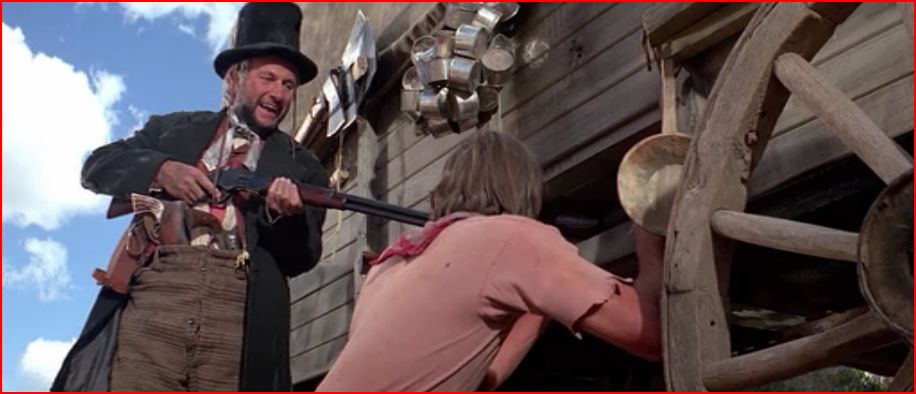
With Cresta as his guide, Honus has a consciousness-raising journey back to the army. Initially inclined to think of Cresta as a traitor and a tramp, he gradually gives in to what we're meant to see, looking past Candice Bergen's abrasively one-note performance, as the young woman's natural charm. They see the worst of red and white, Honus being forced to fight a brave to the death for a lost sock, then teaming with Cresta to thwart a peddler (Donald Pleasance) selling rifles to the Indians. Having stopped him, our heroes think they've prevented a war, but gloryhound Col. Iverson (veteran western character actor John Anderson) has different ideas. Seeing his army massing for an attack, Cresta runs to the Cheyenne to warn them to flee, but while a handful foolishly want to fight back, her onetime husband Chief Spotted Wolf (Jorge Riviero) more foolishly thinks that his gifts from the U.S. government -- a flag, a medal -- will convince Iverson of his peaceful intentions.
 

The infamous massacre, based on the Sand Creek slaughter of 1864, ensues. Nelson clearly feels licensed by the success of The Wild Bunch to escalate the violence to levels he would not have dared imagine at the time of Duel at Diablo, just four years earlier. It's a make-or-break moment for the film, if audiences haven't already been turned off by the braying Bergen or the whiny Strauss, who looks and sounds sort of like a Rankin-Bass puppet. Seeing it with somewhat more mature eyes, I think I understand that what I got a kick from long ago hurts the scene and the movie. The main problem with the massacre scene is that Nelson punctuates it with special effects that reduce the moral horror he hoped to evoke into simple spectacle. An Indian boy gets a bullet through his face the way the cavalry guy did at the start of the picture. Blood flies everywhere. In the most blatant example, Nelson zooms in on an isolated woman screaming as a soldier charges with his sabre. In the next shot, the soldier decapitates a dummy. This is not something you do if you want to focus the audience's moral attention on the terror inflicted on the Cheyenne.


The decapitation is an effect, an end unto itself as in horror movies -- but recall that horror movies may horrify but generally don't provoke the sort of moral outrage Nelson and Guy were aiming for. If they do, the outrage is directed at the film itself, just as it was directed against Soldier Blue, more often than it's directed at the fictional characters perpetrating the atrocity. In the very same year, Arthur Penn directed a massacre of Indians in Little Big Man that, in my memory at least, was less concerned with extreme effects yet more effective in its similar revisionist purpose despite leavening it with the humor of Chief Dan George imagining himself invisible. Nelson was trying to do too much, merging the revisionist politics of the era (though sympathy for the Indians goes back to silent movie days) with the revisionist violence of Peckinpah and the spaghetti westerns. Worse, perhaps, he may have used revisionist elements without really having any revisionist sensibility of his own, turning Soldier Blue into a kind of exploitation piece. Above all, Soldier Blue is a revisionist western with Hollywood production values. I'm sure it was meant that way, to be more jarring at its climax, but the effect is somewhat too jarring for the good of the film and its message. This is one of those revisionist westerns that hasn't aged well and will probably endure best as a period piece, an artifact of 1970 rather than a portrait of the Old West.

Saturday, June 29, 2013

The Curtain Falls: JUNE 29, 1933

Sometimes the shape of a story is decided not by how it ends, but when.


Did Arbuckle die of happiness? A follow-up story in the June 30 paper reports that on the 28th Warner Bros. had signed the comedian, who had just wrapped a series of two-reelers, to a feature-film contract. He felt over-excited and went to bed early. He had turned his story around, he thought. But we still think of Arbuckle as someone destroyed by unfair persecution, because we'll never know how far he might have rebounded. He might have become a stalwart of the Warners stock company -- or the backlash of 1934 may have resulted in a new banishment. At the moment of his death his star was rising, while that of his friend and protégé Buster Keaton was plummeting. Keaton lived long enough to regain the recognition he deserved, and his life is seen as a triumph over adversity. Arbuckle remains one of Hollywood's tragic figures, but sometimes tragedy is just a matter of timing.

Meanwhile, the show must go on!