The Marvel shows on Netflix are meant to bring superheroes to the small screen without the "cheesiness" of the DC shows on The CW. They appeal to the readership of "gritty" comics with a pretense of urban realism and a disdain for the humane idealism of traditional superhero comics. The ideal is an illusion of real life at street level, combined with the usual fantasies of superhuman strength or other impossible abilities. If that's the mandate, then Luke Cage fulfills it better than any Marvel show to date. At it's best, it's good because it's a good crime show more than it is a superhero show. It pits Luke (Mike Colter, perfectly haunted yet stoic), to whom Netflix viewers were introduced during the Jessica Jones show, against a Harlem crime family with tentacles in the worlds of politics and entertainment. The Paradise nightclub is the headquarters of Cornell Stokes, aka "Cottonmouth" (Academy Award nominee Mahershala Ali in the first strike of his one-two breakout punch in 2016). He's the local kingpin,while his cousin Mariah (Alfre Woodard) is a city councilwoman. The subtext of almost-sibling rivalry between these two, Cornell proving to have been a reluctant heir to gangsterdom, Mariah proving a ruthless replacement, almost overshadows Luke's interventions, which escalate after beloved barber Pop, for whom Luke works as sweeper, is mowed down as collateral damage. Corruption at every level of government permits Cottonmouth to flourish, while Luke's own criminal past -- born Carl Lucas, he was framed, convicted and subject to experiments giving him almost-invulnerable skin before escaping prison -- puts him in danger as the hoodie-wearing vigilante becomes a public hero. He gains allies in righteous cop Misty Knight (Simone Messick, who must have wondered why some viewers hoped to see her character lose an arm) and Netflix mascot Claire Temple, the "night nurse" (Rosario Dawson), but gains more powerful enemies as Cottonmouth seeks the means to take down a superhero.
Regains is probably the right word, since the man with the special bullets that can hurt Cage is Willis Stryker, aka Diamondback (Erik LaRay Harvey), Carl Lucas's ever-resentful half-brother and the man who framed him. In the second half of the series Diamondback -- did you know that Marvel Comics has a "Serpent Society" filled with snake-themed villains? -- becomes the big bad, and the show suffers a little for that. While Cottonmouth evolved into a tragic figure, Diamondback is all about simplistic family issues, and is finally offered up as a sort of square-up for viewers who wanted to see Luke fight a costumed supervillain. Fortunately, Woodard's Mariah and her henchman Shades (Theo Rossi), inherited from Cottonmouth, remain cold constants, maddeningly adept at working the system and exploiting every mistake by the good guys. Part of the whole "gritty" thing is a profound skepticism (that often escalates into "grimdark" horror) toward heroes' ability to overcome pervasive corruption. In keeping with that, Luke Cage has no happy ending, though viewers' dismay or frustration with the outcome will be eased by the knowledge that Luke is schedule to return in Fall 2017 as one of The Defenders. The show's biggest success is its creation (credit is due here to mastermind Cheo Hodari Coker) of a milieu in which the outcome seems all too correct. It's dark but happily not humorless; the show can find time to make fun of Luke's original comic-book costume, for instance, which makes Colter look like a "damn fool." But like all the Netflix shows, the humor is toned down considerably from the quipping imperative of Marvel's movies.
I'm not going to get into a flame war over whether Marvel/Netflix or DC/CW is superior; they are different enough in intentions to make them almost like apples and oranges. But while quality control in the Berlantiverse remains erratic, the Defenders project has maintained a consistent level of quality. It's a point in their favor when you can still say that Daredevil season one, their very first production, is their weakest product. While Daredevil inevitably veers into outright fantasy (most of which derives from Frank Miller's vision, despite his grim/gritty reputation) and Jessica Jones is almost Dostoevskian in its preoccupation with personal wretchedness, Cage sets the standard for quasi-realistic superhero television that others will have to meet -- if they care to, that is.
A randomly comprehensive survey of extraordinary movie experiences from the art house to the grindhouse, featuring the good, the bad, the ugly, but not the boring or the banal.
Tuesday, January 31, 2017
Saturday, January 28, 2017
PHANTOM OF THE THEATRE (2016)
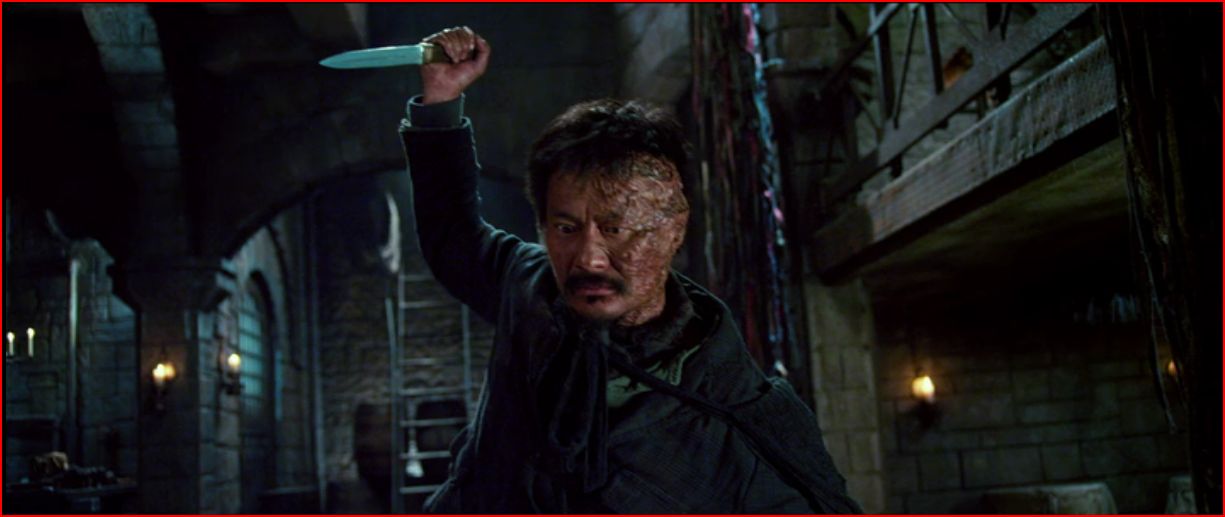
In the Chinese original, the title of Raymond Yip's picture is something like "Fascination of the Devil." At least that's what Google Translate gives me. So the film can be forgiven for opening with a multitude of spooks to beg the question, "Shouldn't that be Phantoms of the Theatre?" Eventually, however, something close to a traditional Phantom figure emerges, first masked, then revealed as disfigured. He's promoting the career of a movie actress, Meng Sifan (Ruby Lin) who happens to be making a picture in the theater he haunts, which will also host the film's premiere. The premiere will be a private one for a warlord (Simon Yam), whose son Gu Weibang (Tony Yang) directed the film. Father and son have issues, the most profound being that the warlord has swooped in to take Meng Sifan away from the director. Both are being manipulated, reluctantly, by the actress as part of the "Phantom's" revenge plot. Father and son, you see, were in the audience when the Phantom's acrobat troupe botched their big Shanghai debut, the lead female being distracted by the warlord's horndog attentions. That night, a fire gutted the backstage area, killing all but two of the acrobat family: the disfigured Phantom and, as we learn eventually, the young Meng Sifan, who was outside shoplifting at the crucial moment. Our Phantom blames the warlord and intends to see him burn for his old sins, as others who've entered the haunted theater have burned since the start of the picture.
Phantom is a film in love with the glamor of old movies, be they Chinese, French (the young director studied in Paris) or Hollywood. It's as much about how a filmmaker can cast a spell on himself as it is about the Phantom's quasi-supernatural revenge plot. The supernatural aspect of it, highlighted by special effects, apparently can be written off as figments of suggestible imaginations, since the director's platonic lady doctor friend (Huang Hung in a role reminiscent of Barbara Bel Geddes in Vertigo) figures out a natural cause for victims' deaths by internal combustion. Nevertheless, Phantom is haunted by the supernatural at the level of myth. The director falls in love as much with the character Meng Sifan plays on screen, a ghostly beauty in a tragic romance, as he does with what he thinks is the real woman. His tragic romance redeems what's largely a conventional melodrama with little to really scare audiences.
The film within the film poignantly parallels the heroine's character arc. In Gu Weibang's story, the ghost must eventually cut ties with the living by drinking a special brew. In Raymond Yip's film Meng Sifan must finally cut ties with her tragic past, but that extends to cutting ties with the director and stepping back out into the world to start a life of her own at last. There, rather than with the murder mystery, is the heart of the movie.
Past and present converge in a haunted Shanghai theater
The film within the film poignantly parallels the heroine's character arc. In Gu Weibang's story, the ghost must eventually cut ties with the living by drinking a special brew. In Raymond Yip's film Meng Sifan must finally cut ties with her tragic past, but that extends to cutting ties with the director and stepping back out into the world to start a life of her own at last. There, rather than with the murder mystery, is the heart of the movie.
Wednesday, January 25, 2017
UNDER THE SHADOW (2016)
If two films make a category, here's a new one: the Iranian diaspora horror film. At first, there was Ana Lily Amirpour's dystopian vampire film A Girl Walks Home Alone at Night, filmed in the U.S., and now there is Great Britain's official entry for the Academy Awards' Foreign Language film competition, written and directed by Babak Anvari. Unlike A Girl, Under the Shadow is actually set in Iran, specifically during the 1980s war with Saddam Hussein's Iraq, and addresses some of the Islamic Republic's repressive policies. Shideh (Narges Rashidi), is a medical student (her mother was a doctor, and so is her husband) with two strikes against her, and in Iran it's two strikes and you're out. Being a woman might be problematic in the first place, but her worst offense is that during the 1979 revolution she took part in some secular leftist demonstrations. That disqualifies her from resuming her medical studies, according to the government. Until she thinks up a new career within the new bounds, she's stuck being a housewife and mother to Dorsa (Avin Manshadi), who's fixated on her rag doll Kimiya. In angry resignation she consigns her medical books to the trash, with the meaningful exception of a textbook inscribed by her mother.
The war is intensifying. Saddam is firing missiles into Tehran and Shideh's husband is called to military service in a combat zone. Their neighbors are moving out of their apartment building and out of town after an Iraqi missile crashes through the roof. It doesn't explode but it gives an old man a fatal heart attack, Shideh's CPR efforts notwithstanding. Her husband urges her to evacuate, but she's reluctant to abandon the big city. Meanwhile, Dorsa is acting strangely. She tells her mom about talking to a new boy in the building who's supposed to be mute. She also talks to disembodied voices, while neighbors talk about djinn to Shideh's sophisticated dismay. She keeps trying to live like a liberated woman, sweating to her clandestine Jane Fonda exercise tape but tossing on the required modest coverings whenever someone rings the doorbell.
Family life deteriorates further after Kimiya the doll goes missing after the missile attack. A persistently feverish Dorsa insists that the doll must be in the closed-off upper floor, and she won't leave until Shideh finds it. Then Shideh's workout tape goes missing. Mother and daughter exchange recriminations after Shideh finds the casette in the garbage with the tape pulled out, and Kimiya eventually turns up mutilated in the locked desk drawer where Shideh keeps her medical textbook. It becomes increasingly apparent to Shideh that there's a third presence, at least, in the apartment that wishes them ill.
While the depopulated apartment building grows more menacing, the djinn increasingly appearing as a sort of animated chador that finally swells to the dimensions of a malevolent tent, Anvari makes clear that it's hardly less dangerous for Shideh outside. At one point she's so spooked that she runs out into the street with Dorsa, barefoot and without her public wrappings, until she's inevitably picked up by Tehran's roving morality police. "Are we in Switzerland now?" they ask her mockingly. Fortunately Shideh gets off with a strict reprimand ("We have values now," a cleric lectures her), but a larger point has been made. Shideh's building may have a specific djinn problem -- that becomes all too obvious during an inventive but overblown climax -- but the real challenge for our heroine is overcoming her stubborn hope of reclaiming her pre-revolutionary past on hostile ground. When she finally takes Dorsa out of the city it's only to move in with her husband's parents in the story, but metaphorically Under the Shadow's message is that the Islamic Republic itself has no place for her. To leave Tehran, and to leave behind relics of the past like the textbook and part of Kimiya, is symbolically to leave Iran, where horrors of different sorts persist. For those simply looking for chills, the film should entertain without seeming preachy, though some Americans might complain about a feminist message being forced down their throats. Anvari has a sure hand for the most part, and I liked how he was able to maintain a running gag about a garage door throughout his horror show and make it pay off at the climax. Another point in his film's favor is that, given how circumstances compel some filmmakers in Iran to stay indoors, it's easy to sustain the illusion of this British-made picture taking place in Iran. But while Shadow has obvious political relevance it also fits in to a global cycle of mother-child horror films (The Babadook, Goodnight Mommy, etc?) that may have something more to tell us about the wider world.
The war is intensifying. Saddam is firing missiles into Tehran and Shideh's husband is called to military service in a combat zone. Their neighbors are moving out of their apartment building and out of town after an Iraqi missile crashes through the roof. It doesn't explode but it gives an old man a fatal heart attack, Shideh's CPR efforts notwithstanding. Her husband urges her to evacuate, but she's reluctant to abandon the big city. Meanwhile, Dorsa is acting strangely. She tells her mom about talking to a new boy in the building who's supposed to be mute. She also talks to disembodied voices, while neighbors talk about djinn to Shideh's sophisticated dismay. She keeps trying to live like a liberated woman, sweating to her clandestine Jane Fonda exercise tape but tossing on the required modest coverings whenever someone rings the doorbell.
Family life deteriorates further after Kimiya the doll goes missing after the missile attack. A persistently feverish Dorsa insists that the doll must be in the closed-off upper floor, and she won't leave until Shideh finds it. Then Shideh's workout tape goes missing. Mother and daughter exchange recriminations after Shideh finds the casette in the garbage with the tape pulled out, and Kimiya eventually turns up mutilated in the locked desk drawer where Shideh keeps her medical textbook. It becomes increasingly apparent to Shideh that there's a third presence, at least, in the apartment that wishes them ill.
While the depopulated apartment building grows more menacing, the djinn increasingly appearing as a sort of animated chador that finally swells to the dimensions of a malevolent tent, Anvari makes clear that it's hardly less dangerous for Shideh outside. At one point she's so spooked that she runs out into the street with Dorsa, barefoot and without her public wrappings, until she's inevitably picked up by Tehran's roving morality police. "Are we in Switzerland now?" they ask her mockingly. Fortunately Shideh gets off with a strict reprimand ("We have values now," a cleric lectures her), but a larger point has been made. Shideh's building may have a specific djinn problem -- that becomes all too obvious during an inventive but overblown climax -- but the real challenge for our heroine is overcoming her stubborn hope of reclaiming her pre-revolutionary past on hostile ground. When she finally takes Dorsa out of the city it's only to move in with her husband's parents in the story, but metaphorically Under the Shadow's message is that the Islamic Republic itself has no place for her. To leave Tehran, and to leave behind relics of the past like the textbook and part of Kimiya, is symbolically to leave Iran, where horrors of different sorts persist. For those simply looking for chills, the film should entertain without seeming preachy, though some Americans might complain about a feminist message being forced down their throats. Anvari has a sure hand for the most part, and I liked how he was able to maintain a running gag about a garage door throughout his horror show and make it pay off at the climax. Another point in his film's favor is that, given how circumstances compel some filmmakers in Iran to stay indoors, it's easy to sustain the illusion of this British-made picture taking place in Iran. But while Shadow has obvious political relevance it also fits in to a global cycle of mother-child horror films (The Babadook, Goodnight Mommy, etc?) that may have something more to tell us about the wider world.
Monday, January 23, 2017
DVR Diary: PRIVATE PROPERTY (1960)
A hit in Europe but condemned at home for its frankness about sexual need, Leslie Stevens' film was widely thought lost until a restoration premiered at last year's TCM Film Festival. Private Property is frank without being explicit, of course, but the fact that no one could mistake what its characters are after no doubt made many people uncomfortable back then. Duke (Corey Allen, the chicken-run loser from Rebel Without a Cause) and Boots (Warren Oates, whose presence no doubt gave this film instant hipness upon its rediscovery) want to "make it" with a girl, Boots apparently for the first time. Though Oates was several years Allen's senior, Boots is the junior partner of the pair, unless Duke's "When I was your age ..." remark is meant as a joke. These guys are drifters and, apparently grifters who come in from off the beach to shake down a gas station for soda pop and cigarettes, hitch a ride and virtually carjack their way at both explicit (Oates) and implicit (Allen) knifepoint to where they want to go. The tone is set when Duke's threat/bluff proves more intimidating than the actual steel in Boots' hand. Duke's most dangerous weapon is his gift of gab. Casing a neighborhood to find an abandoned house, he starts a long-con seduction of the bored, sexually-frustrated housewife Ann (Kate "Mrs. Stevens" Manx), supposedly in order to deliver her to the waiting Boots. Posing as a door-to-door landscaper (a job he probably did hold at some point), Duke seems to respond to the prospect of genuine emotional and sexual conquest as Ann's need becomes apparent. Yet he also feels honor-bound to fulfill his promise to Boots, who proves a very reluctant rapist. Despite that, the thought of Ann submitting to Boots breaks Duke's heart and his mind. He takes his disappointment out on her, leaving a more realistic bruise on her face than you usually saw in movies at that time, and it's Boots who comes to her rescue, or tries to.
The film ends in Lifetime movie territory and the last line's promise of marital reconciliation is truly awful, but otherwise Private Property lives up to its fresh ahead-of-its-time reputation. Corey Allen gradually moved behind the camera to become a busy TV director but might have lasted long in front of the camera had this been more widely seen in the U.S. His future as a character actor as films grew both more frank and more explicit later in the Sixties probably would have been assured. He gives Duke a certain fragile charisma, the fragility of which may have made him only more attractive to Ann, compared to her aloof though well-meaning husband. Boots is early Warren Oates, from when he seemed typed as a sub-normal, and the actor doesn't get to shine as much as Allen does. His two big moments are the quasi-rape scene and the funnier bit when Boots, finally invited to Ann's house, has to play the role assigned him by Duke, an appliance store sales manager, while explaining his unprofessionally scruffy appearance. If anything, Manx, who broke up with Stevens and killed herself in 1964, is all too convincing in Ann's desperation, and I say that having not known the actress's fate until a few minutes ago. It's probably too soon to call Private Property a rediscovered classic, but it's now doubly fascinating as a historic document, both for what the film itself tells us of its time, and for what the time told us of itself by suppressing it.
Thursday, January 19, 2017
AFERIM! (2015)
Constandin is a boor and a bigot, but so's everyone else in this benighted land. In one grimly hilarious scene he encounters a rural clergyman who launches into a long list of ethnic stereotypes stretching from England ("They think a lot") to the Middle East. Human life has little value and "crows" have less. But on the return trip, especially when Constandin gets to relax (and get laid) at a tavern, he starts to warm to Carfin a little. He's still a ruthless, mostly heartless person, as we see when he sells a "crow" boy in a festive market town -- complete with a proto-Ferris wheel -- but he's not entirely heartless, nor is he incapable of treating a "crow" somewhat like a human being. The long tavern sequence is a breather for the audience, too, and it's a relief to see these people enjoying life a little. Even if it seems cruel to have Carfin try to get a coin off the top of a lit candle with his teeth, the spirit of play in the scene encompasses everyone in momentarily humane camaraderie.
Finally Constandin delivers Carfin to the boyar Iordache (Alexandru Dabija). By now, we know that Carfin bolted because his affair with Iordache's wife had been found out. The boyar, a virtual Dracula in his moustache and archaic costume, is determined to personally, publicly castrate Iordache to teach his wife and everyone else a lesson, but Constandin, of all people, pleads for mercy. He only gets threatened for his trouble, while Iordache's poor wife gets Carfin's brutally severed balls rubbed in her face. Jude happily skips graphic detail in this scene, but Carfin's screams tell the story as eloquently as any image might. The moral seems to be that cruelty flows from the top in this feudal culture, and the man on top is tops in cruelty.
Aferim! is a modest masterpiece of juxtaposition, using some of the most lavish monochrome cinematography I've ever seen to illustrate the sordid poverty of old Romania. Some scenes have an almost painterly quality, and others made me think of the Russian Ilya Repin's paintings of rough peasantry come to life, only greyscaled. You could imagine the film as a photograph of the age it portrays, while color might only undermine its illusion of authenticity, which extends to the art direction and the performances. The whole project is a satiric rebuke to nostalgia for some endangered authentic national culture, shown here to have been utterly squalid not so long ago. It's to the Romanians' credit that they haven't taken the film as an insult, but have honored it instead.
Monday, January 16, 2017
DVR Diary: NO BLADE OF GRASS (1970)
Actors turned directors fall roughly into two types. Some are committed to directing as a craft, e.g. Ida Lupino, Clint Eastwood, Robert Redford, etc. For others, craftsmanship takes second place to personal expression. Their films aren't as slick as the other group's but are unmistakably personal. That lineage goes back to Charlie Chaplin, and Mel Gibson is probably the exemplary figure in that category today. Cornel Wilde belongs to that lineage, and in his attention to violence and suffering Wilde, who directed eight films over twenty years, looks like a direct precursor to Gibson. No Blade of Grass in some ways looks like a precursor or prequel to Mad Max, the George Miller film that made Gibson a star. Wilde's clumsy flashforwards, his self-indulgent solarization, and his heavyhanded pictorial editorializing sometimes make Grass look like the missing link between Mad Max and Jean-Luc Godard's Weekend in its apocalyptic pretentiousness. David Thomson says of Wilde's films that they sometimes make you believe they're the first movies ever made, and Grass, adapted by Wilde under a pseudonym in collaboration with Sean Forestal from a John Christopher novel, approaches its subject as if no one had considered such stuff before. In fact, Wilde was not the first actor to visualize the collapse of civilization; Ray Milland beat him to the punch with Panic in Year Zero! several years earlier. Maybe actors have some special appreciation of how fragile the veneer of civility actually is, but that's a topic for another time.
In Grass the environment is buckling under human pressures, from population growth to pollution -- Wilde can't show enough pollution -- and some people are starving while others enjoy plenty. In case this isn't crystal clear to you, Wilde cuts back and forth from TV footage of starving Africans to Brits stuffing their faces at a well-stocked buffet. Soon no one will enjoy plenty, as a grass-killing plague spreads around the world. John Custance (Nigel Davenport, starring in Wilde's on-screen absence) and his brother David (Patrick Holt) get the straight dope from their government friend Roger (John Hamill). David heads north to start a potato crop that will ensure a food supply for his extended family, and invites John to bring his family to safety. By the time John's family (his wife is played by Jean Wallace, the current Mrs. Wilde) gets going things are already falling apart. Their trek grows progressively more dangerous as civilization deteriorates rapidly into violent predatory factions, and the Custance party has to leave their scruples behind to survive.
The Custances pick up allies along the way, though some are of dubious value. Pirrie (Anthony May) proves the most dangerous, killing his own woman in a fit of jealousy and eventually claiming John's daughter for himself while demanding equal partnership in their journey. The tense relationship of Pirrie and Custance holds your interest until the small band starts growing, most people recognizing strength in numbers, though our protagonists have to kill the leader of a larger band to get them to go their way. Ironically, as everything else falls apart this motley group (including a token "Paki") pulls closer together, effectively defending themselves against a gang of horned-helmeted, tactically challenged bikers in the picture's action highlight. The more bitter irony emerges when John's party reaches David's farm, only to learn that David, understandably not anticipating such a large group, refuses to allow anyone in but John, his immediate family, and Roger. In what might be seen as a last stand for civilization over tribal kinship, and at the same time as an ultimate breakdown of human order, John decides to lead his band in a hostile takeover of David's compound, putting the group before family.
The first half hour or so of Grass is pretty bad, but once Wilde gets outdoors he's on familiar turf. His recognized masterpiece is The Naked Prey, a film that consisted of himself being chased by African tribesman, and Grass proves again that he has an eye for landscape and people moving through it with dramatic urgency. As John Custance's band grows the film builds real momentum, despite everything Wilde does to sabotage himself with pointless flashforwards previewing events to come a few minutes later.There's a real sense of tragedy in the final confrontation between the brothers that survives Wilde's portentous narration and the dreadful folk song that opens and closes the film. There's no getting around the fact that No Blade of Grass is a profoundly awkward move -- never more awkward than in a montage crosscutting between a young mother's doomed labor and John's flashback to his wife's first childbirth, highlighted by out-of-nowhere graphic birth-of-a-baby footage of the sort that used to be shown to adults only with a lecture and booklets for sale. But if you tried to smooth all the rough patches in Wilde's work you'd probably lose most of the knobby authenticity and rugged power they have. You have to take the bad to get the good, and fortunately there is some good in Wilde to justify the effort.
In Grass the environment is buckling under human pressures, from population growth to pollution -- Wilde can't show enough pollution -- and some people are starving while others enjoy plenty. In case this isn't crystal clear to you, Wilde cuts back and forth from TV footage of starving Africans to Brits stuffing their faces at a well-stocked buffet. Soon no one will enjoy plenty, as a grass-killing plague spreads around the world. John Custance (Nigel Davenport, starring in Wilde's on-screen absence) and his brother David (Patrick Holt) get the straight dope from their government friend Roger (John Hamill). David heads north to start a potato crop that will ensure a food supply for his extended family, and invites John to bring his family to safety. By the time John's family (his wife is played by Jean Wallace, the current Mrs. Wilde) gets going things are already falling apart. Their trek grows progressively more dangerous as civilization deteriorates rapidly into violent predatory factions, and the Custance party has to leave their scruples behind to survive.
The Custances pick up allies along the way, though some are of dubious value. Pirrie (Anthony May) proves the most dangerous, killing his own woman in a fit of jealousy and eventually claiming John's daughter for himself while demanding equal partnership in their journey. The tense relationship of Pirrie and Custance holds your interest until the small band starts growing, most people recognizing strength in numbers, though our protagonists have to kill the leader of a larger band to get them to go their way. Ironically, as everything else falls apart this motley group (including a token "Paki") pulls closer together, effectively defending themselves against a gang of horned-helmeted, tactically challenged bikers in the picture's action highlight. The more bitter irony emerges when John's party reaches David's farm, only to learn that David, understandably not anticipating such a large group, refuses to allow anyone in but John, his immediate family, and Roger. In what might be seen as a last stand for civilization over tribal kinship, and at the same time as an ultimate breakdown of human order, John decides to lead his band in a hostile takeover of David's compound, putting the group before family.
The first half hour or so of Grass is pretty bad, but once Wilde gets outdoors he's on familiar turf. His recognized masterpiece is The Naked Prey, a film that consisted of himself being chased by African tribesman, and Grass proves again that he has an eye for landscape and people moving through it with dramatic urgency. As John Custance's band grows the film builds real momentum, despite everything Wilde does to sabotage himself with pointless flashforwards previewing events to come a few minutes later.There's a real sense of tragedy in the final confrontation between the brothers that survives Wilde's portentous narration and the dreadful folk song that opens and closes the film. There's no getting around the fact that No Blade of Grass is a profoundly awkward move -- never more awkward than in a montage crosscutting between a young mother's doomed labor and John's flashback to his wife's first childbirth, highlighted by out-of-nowhere graphic birth-of-a-baby footage of the sort that used to be shown to adults only with a lecture and booklets for sale. But if you tried to smooth all the rough patches in Wilde's work you'd probably lose most of the knobby authenticity and rugged power they have. You have to take the bad to get the good, and fortunately there is some good in Wilde to justify the effort.
Saturday, January 14, 2017
On the Big Screen: SILENCE (2016)
Martin Scorsese has made films about Jesus Christ and the Dalai Lama. Silence, adapted from a novel by the Japanese Catholic Shusaku Endo, sometimes seems like an attempt to reconcile or synthesize Christianity and Buddhism in the historical context of the persecution of Christians by Buddhists in Tokugawa Japan. Two young Jesuit priests, Rodrigues (Andrew Garfield) and Garupe (Adam Driver) sneak into Japan to investigate reports that one of the last remaining priests, Fr. Ferrera (Liam Neeson) has apostasized, renouncing the faith. They minister to underground congregations who revere "Deus" and cherish any material artifact of faith, from crude tiny crucifixes to rosary beads. These people face terrible torture and certain death if their faith is discovered and they refuse to recant by trampling icons. The priests are in constant danger from betrayal, especially from the man who ferried them to Japan, Kichijiro (Yosuke Kobozuka), an abject character whose family was slaughtered despite his apostasy. Kichijiro in many ways is the worst sort of Christian, one who wallows in his weakness just so he can confess it, yet we will see that his faith is in some sense the strongest of all. Ultimately it is Rodrigues whose faith faces the sternest test after Kichijiro betrays him into the hands of Inoue (Issey Ogata), ironically designated an "Inquisitor." Inoue sees Christianity as the foot in the door for unwanted European influence in his country, and claims that it may be "true" elsewhere but not in Japan. He respects the power of symbolism, telling Christians that they don't have to sincerely recant so long as they go through the motions he hopes will demoralize others by undermining respect for the clergy and their sacred symbols. One can also see an ideological threat to the shogunate, at least as seen by a Japanese believer and a Catholic filmmaker, in the Christian insistence on the value of every human life, while Japan's feudal culture -- as shown in many a Japanese film -- holds much life worthless. You can understand the preference for a Buddhism that aspires to the nullification of self and implicitly acquiesces in feudal tyranny, as well as the significance of the apparent conversion of Fr. Ferrera to Buddhism. He claims to be convinced that real Christianity can get nowhere in the "swamp" of Japan, and tries to convince Rodrigues that keeping the faith is worse than futile. He employs moral blackmail, holding Rodrigues responsible for the torture that the audience more likely will blame on Japan's vicious rulers. But if unassailable power holds innocent lives hostage against the priest's apostasy, Ferrera claims they'll be sacrificed to Rodrigues's pride. Through his ordeal, Rodriguez aches for divine guidance, but the film's title tells you what he gets until the climax.
Apart from a couple of pretentious shots early on, this is a relatively austere film for Scorsese, and that may explain why some reviewers find its length oppressive. It's also unavoidably an intellectual if not theological film, for all the gruesome poignancy of the tortures inflicted on Japanese Christians, and for that reason Silence has probably lost some reviewers' attention. One particularly philistine pan asks why everyone makes a big deal about trampling icons, but this issue really is -- pun intended, I guess -- the crux of the film. Ultimately Scorsese and co-writer Jay Cocks, if not Endo before them, are critiquing a materialist element of Christianity that arguably can be done without. Investing these symbols with such crucial significance leaves the faith vulnerable to the sort of hostile iconoclasm Inoue practices. Rodrigues's initial dismay at the Japanese Christians' devotion to symbols proves the right instinct, and while we see that Christians ultimately can't do entirely without such symbols, it looks like the key to the survival of Christian people is their readiness to sacrifice symbols, on the understanding that the symbols aren't the faith itself. The less Christianity takes the form of idolatry, the less vulnerable it is to Inoue's sort of propaganda. It's an oddly Protestant note to sound as an important theme of a Catholic story, but there it is.
If Silence convinces people of anything, it's that Andrew Garfield still has a future in movies after the Amazing Spider-Man debacle, though Hacksaw Ridge may already have convinced some people. The film ends up on his shoulders and he bears it well. I was even more impressed by the Japanese performing in English. Kobozuka goes all out as Kichijiro, giving the story's Judas a pathetic grandiosity that might remind you of Akira Kurosawa in his more Dostoevskian moods. Issey Ogata gives an eccentrically gnomic performance as the Japanese inquisitor (credit is also due to Tadanobu Asano, more fluent than ever, as his slick interpreter) both verbally and physically creepy. There's a moment where Rodrigues seems to have the upper hand in a debate when Inoue seems to deflate in stages before our eyes; the only missing effect is the steam coming out of his ears. He makes a great villain, though Neeson, in a smaller role than his billing suggests, is arguably more effective the sort of devil's advocate the story really needs. It looks like the film will prove a flop at the box-office, and that makes me wonder why Paramount didn't promote Silence more to the apparently growing audience for religious pictures. It certainly would strike a chord with those Christians who for whatever reason feel persecuted today, but perhaps the film is too specifically Catholic for the faith-based audience here, and maybe some still hold the allegedly sacrilegious Last Temptation of Christ against Scorsese. That'd be unfortunate, since Silence is really a more effective Christian film than that earlier effort. It's still far from Scorsese's best, but it's one of the better pictures of 2016.
Apart from a couple of pretentious shots early on, this is a relatively austere film for Scorsese, and that may explain why some reviewers find its length oppressive. It's also unavoidably an intellectual if not theological film, for all the gruesome poignancy of the tortures inflicted on Japanese Christians, and for that reason Silence has probably lost some reviewers' attention. One particularly philistine pan asks why everyone makes a big deal about trampling icons, but this issue really is -- pun intended, I guess -- the crux of the film. Ultimately Scorsese and co-writer Jay Cocks, if not Endo before them, are critiquing a materialist element of Christianity that arguably can be done without. Investing these symbols with such crucial significance leaves the faith vulnerable to the sort of hostile iconoclasm Inoue practices. Rodrigues's initial dismay at the Japanese Christians' devotion to symbols proves the right instinct, and while we see that Christians ultimately can't do entirely without such symbols, it looks like the key to the survival of Christian people is their readiness to sacrifice symbols, on the understanding that the symbols aren't the faith itself. The less Christianity takes the form of idolatry, the less vulnerable it is to Inoue's sort of propaganda. It's an oddly Protestant note to sound as an important theme of a Catholic story, but there it is.
If Silence convinces people of anything, it's that Andrew Garfield still has a future in movies after the Amazing Spider-Man debacle, though Hacksaw Ridge may already have convinced some people. The film ends up on his shoulders and he bears it well. I was even more impressed by the Japanese performing in English. Kobozuka goes all out as Kichijiro, giving the story's Judas a pathetic grandiosity that might remind you of Akira Kurosawa in his more Dostoevskian moods. Issey Ogata gives an eccentrically gnomic performance as the Japanese inquisitor (credit is also due to Tadanobu Asano, more fluent than ever, as his slick interpreter) both verbally and physically creepy. There's a moment where Rodrigues seems to have the upper hand in a debate when Inoue seems to deflate in stages before our eyes; the only missing effect is the steam coming out of his ears. He makes a great villain, though Neeson, in a smaller role than his billing suggests, is arguably more effective the sort of devil's advocate the story really needs. It looks like the film will prove a flop at the box-office, and that makes me wonder why Paramount didn't promote Silence more to the apparently growing audience for religious pictures. It certainly would strike a chord with those Christians who for whatever reason feel persecuted today, but perhaps the film is too specifically Catholic for the faith-based audience here, and maybe some still hold the allegedly sacrilegious Last Temptation of Christ against Scorsese. That'd be unfortunate, since Silence is really a more effective Christian film than that earlier effort. It's still far from Scorsese's best, but it's one of the better pictures of 2016.
Subscribe to:
Posts (Atom)