Predating the badass Elizabethan poets and playwrights by more than a century, Francois Villon may be the true OG, the first to combine thug life and art. In the 1930s he was a sort of pulp hero, the protagonist of a series of short stories in Liberty, one of the popular general-interest weekly magazines of the era, by John Erskine. As rendered by screenwriter Preston Sturges, adapting a hoary old play that had already been filmed in 1920, and directed by Frank Lloyd of Cavalcade infamy (and more recent acclaim for Mutiny on the Bounty), Villon (Ronald Colman) is a cross between Robin Hood and Moses. In his primary role as poet-thief, Villon looks like a scruffier Robin down to the feathered cap, and in general 15th century France seems to have been everyone's model for what Robin and his men of the turn of the 13th century looked like. It's a cool look that made an alternate silent version of the Villon legend, Alan Crosland's The Beloved Rogue, sometimes look like a Maxfield Parrish painting come to life. It suits Colman, who had played another noble thief, the "amateur cracksman" Raffles, a few years earlier. He proves equally suited to higher fashion when the main story kicks in. Villon, after robbing a government food storehouse, has made the mistake of badmouthing King Louis XI and boasting of what he would do if he were king -- he has a whole poem, mainly romantic, on the subject -- in the incognito presence of the monarch himself (Basil Rathbone). Impressed by Villon's bravado, and grateful that he's killed a high-ranking traitor during a tavern brawl, the curmudgeonly king challenges the poet to live up to his boast by making him the Constable of France, complete with fake title, a bath and a shave that renders Villon unrecognizable, at first, to the lady Katherine (Frances Dee), who had snubbed the impertinent writer in church shortly before. Villon's main task is to maintain morale in Paris and defend the city from the besieging Burgundians, but the poet's SJW approach to these problems -- lenience for his fellow thieves and further looting of the government storehouses -- annoys the establishment and puts the new Constable, thanks to some retroactive sentencing, in mortal peril.
This is unmistakably a Colman star vehicle, but that doesn't stop Basil Rathbone from stealing it with one of the most eccentric performances of his career. By 1938, a year before he started playing Sherlock Holmes, I assume people knew what to expect from Rathbone: vicious villainy backed, if the period permitted it, with masterly swordplay. I assume that people seeing Rathbone's name expected a "Basil Rathbone" performance, and that they, as I, were blindsided by what he actually gave them. Pop culture in those days apparently had a pretty specific idea of what Louis XI, the "spider king," was like, perhaps because character actors had been barnstorming through the part in stage versions of If I Were King since 1901. You get a somewhat more benign version of the character from Henry Davenport in William Dieterle's The Hunchback of Notre Dame a year later: intelligent but lacking in imagination, almost unpretentious in his frankness, smarter than he looks but probably not as smart as he thinks he is. As scripted by Sturges, soon to make his mark as a director of high wit, Rathbone's king often gets the better of Villon -- or so I think modern audiences will think -- with various sardonic zingers. But Rathbone plays the man as if Ebeneezer Scrooge had usurped the throne of France and was having the time of his life doddering about arrogantly with the power of life and death and hee-heeing through the picture as if history were his private, royal joke. It's the funniest stuff from Rathbone I've ever seen, and now that I think of it I don't know why it surprised me. If he routinely went over the top dramatically (see Son of Frankenstein) why shouldn't he go over the top comically as well?
Given the year and the proximity to World War II, I can't help wondering whether Sturges had a message for Depression America by showing Villon strengthening France to face an enemy onslaught through the redistribution of wealth, or at least of food. Whether he did or not, If I Were King gains a certain timelessness by portraying Villon as a kind of comic Moses, an impostor elevated to great power who raids the granaries and is denied the promised land at the end. Grateful that Villon has led the people to turn back the Burgundians, but still resentful of the poet's thefts and impertinence, Louis spares Villon's life but banishes him from Paris, allowing him the run of the rest of France but denying him the city that was his life. In history, this banishment (for mere theft, the king having nothing to do with it) was Villon's cue to vanish from history. In the movie, it sets up a happy ending as Katherine follows him luxuriously into exile. Villon had a girlfriend among the rabble (Ellen Drew) who was portrayed so sympathetically that I thought the poet might ditch Katherine for her, until the brave guttersnipe died fighting the invaders. So much for social justice. It's still a fun, light historical entertainment made especially entertaining by Rathbone's one-of-a-kind performance and Colman's effortless panache.
A randomly comprehensive survey of extraordinary movie experiences from the art house to the grindhouse, featuring the good, the bad, the ugly, but not the boring or the banal.
Monday, July 31, 2017
Saturday, July 29, 2017
On the Big Screen: ATOMIC BLONDE (2017)
This is a movie that stages a fight behind a movie screen projecting Stalker, perhaps so the filmmakers can boast that they got people who came to see Charlize Theron beat up people to learn about Andrei Tarkovsky on Google. It's a film that casts Barbara Sukowa in a bit part as if it were a homage to New German Cinema. It is, as I mentioned in passing, a film in which Charlize Theron beats people up, but that doesn't mean it can't be pretentious in its own fashion.
As a movie star, Theron was born in violence. In 2 Days in the Valley she was not just the hot new hottie but the one who got attention for bare-knuckle brawling with Terri Hatcher. She's always been something of an Amazon, and that probably made it easier for her to earn acclaim and awards playing a Ms. Hyde version of the type, an uglyfied man-hating murderer in Monster. It has long seemed like her destiny to be an action star, especially as she advances into her forties past leading-lady territory. She made a move in that direction right after Monster, but Aeon Flux set back her cause for a while. More recently she's become an A-level genre fixture, finally established as an action goddess by Mad Max: Fury Road. I don't know what the hell she was doing in the last Fast and Furious movie, but for her latest star vehicle she's teamed with some of the people who miraculously transformed Keanu Reeves into a midlife badass in the John Wick films. The promise of Atomic Blonde is that Charlize Theron will not only beat people up, but will do so with style and devastating force and little winks to the movie nerds in the audience.
Stuntman turned director David Leitch has filmed a screenplay adapted from one of those obscure graphic novels that Hollywood pays people to read -- don't envy them until you read a few hundred -- by screenwriter Kurt Johnstad, who most recently wrote the second 300 movie -- the really bad one. I don't know whether he or the original writer deserves the "credit" for Atomic Blonde's utterly generic spy story, which depends on that old standby, the List. In 1989, as the Berlin Wall crumbles, the intelligence agencies of several nations are fighting over one of those lists, the existence of which automatically endangers vast numbers of operatives and assets. MI6's contender in this deadly sweepstakes is Lorraine Broughton (Theron), whose sole useful attribute, from what we see, is her versatility in hand-to-hand combat. She replaces a British agent who was killed, presumably by a traitor known as Satchel. She is to be assisted by David Percival (James McAvoy) an agent working on the other side of the Wall as a black marketeer. Percival has a back-up for the list: the German agent who created the list and has memorized all of it. If all else fails, this man is to be smuggled out of East Berlin. Broughton and Percival have a prickly relationship that happily doesn't consummate in romance, as might have been taken for granted a few years ago. Instead, our heroine has her very own Bond Girl in the form of a French agent (Sofia "The Mummy" Boutella). None of this can be told straightforwardly, of course, because this is the 21st century. Instead, the details are related after the fact during a framing-device debriefing that preempts any suspense about Broughton in Berlin. MI6 has been taken over by Hydra, it seems, since Broughton must answer for her actions to Arnim Zola and his U.S. counterpart (John Goodman). Any narrative (or erotic) momentum the film works up is broken up by its constant return to the inert framing device -- but let's face it. The narrative isn't really meant to have momentum of its own; it only has to transport us from one action setpiece to another, and while the story of the film is pretty tedious, and eventually predictable, those setpieces mostly live up to the advance hype. I'm not going to bother describing them, apart from citing one that plays out during a lengthy Rope-style "single take" as the piece de resistance. It will do to recommend Atomic Blonde as an action film that puts Theron over as an opportunistic, resilient brawler in a relatively realistic style. If Wonder Woman is too fantastic for your tastes, Atomic Blonde should end up your female action movie of the year, though it may try your patience at times when it tries to tell a story instead of doing what it's really good at.
As a movie star, Theron was born in violence. In 2 Days in the Valley she was not just the hot new hottie but the one who got attention for bare-knuckle brawling with Terri Hatcher. She's always been something of an Amazon, and that probably made it easier for her to earn acclaim and awards playing a Ms. Hyde version of the type, an uglyfied man-hating murderer in Monster. It has long seemed like her destiny to be an action star, especially as she advances into her forties past leading-lady territory. She made a move in that direction right after Monster, but Aeon Flux set back her cause for a while. More recently she's become an A-level genre fixture, finally established as an action goddess by Mad Max: Fury Road. I don't know what the hell she was doing in the last Fast and Furious movie, but for her latest star vehicle she's teamed with some of the people who miraculously transformed Keanu Reeves into a midlife badass in the John Wick films. The promise of Atomic Blonde is that Charlize Theron will not only beat people up, but will do so with style and devastating force and little winks to the movie nerds in the audience.
Stuntman turned director David Leitch has filmed a screenplay adapted from one of those obscure graphic novels that Hollywood pays people to read -- don't envy them until you read a few hundred -- by screenwriter Kurt Johnstad, who most recently wrote the second 300 movie -- the really bad one. I don't know whether he or the original writer deserves the "credit" for Atomic Blonde's utterly generic spy story, which depends on that old standby, the List. In 1989, as the Berlin Wall crumbles, the intelligence agencies of several nations are fighting over one of those lists, the existence of which automatically endangers vast numbers of operatives and assets. MI6's contender in this deadly sweepstakes is Lorraine Broughton (Theron), whose sole useful attribute, from what we see, is her versatility in hand-to-hand combat. She replaces a British agent who was killed, presumably by a traitor known as Satchel. She is to be assisted by David Percival (James McAvoy) an agent working on the other side of the Wall as a black marketeer. Percival has a back-up for the list: the German agent who created the list and has memorized all of it. If all else fails, this man is to be smuggled out of East Berlin. Broughton and Percival have a prickly relationship that happily doesn't consummate in romance, as might have been taken for granted a few years ago. Instead, our heroine has her very own Bond Girl in the form of a French agent (Sofia "The Mummy" Boutella). None of this can be told straightforwardly, of course, because this is the 21st century. Instead, the details are related after the fact during a framing-device debriefing that preempts any suspense about Broughton in Berlin. MI6 has been taken over by Hydra, it seems, since Broughton must answer for her actions to Arnim Zola and his U.S. counterpart (John Goodman). Any narrative (or erotic) momentum the film works up is broken up by its constant return to the inert framing device -- but let's face it. The narrative isn't really meant to have momentum of its own; it only has to transport us from one action setpiece to another, and while the story of the film is pretty tedious, and eventually predictable, those setpieces mostly live up to the advance hype. I'm not going to bother describing them, apart from citing one that plays out during a lengthy Rope-style "single take" as the piece de resistance. It will do to recommend Atomic Blonde as an action film that puts Theron over as an opportunistic, resilient brawler in a relatively realistic style. If Wonder Woman is too fantastic for your tastes, Atomic Blonde should end up your female action movie of the year, though it may try your patience at times when it tries to tell a story instead of doing what it's really good at.
Tuesday, July 25, 2017
DVR Diary: THE BIG PARADE (1925)
Ever since Wonder Woman stormed through No Man's Land earlier this year I've wanted to take a fresh look at World War I movies, including those I'd seen before. It had been a while since I looked at King Vidor's 1925 blockbuster, the first major film about the war made after the armistice, with no need for propaganda. It made a superstar of leading man John Gilbert, real stars of romantic lead Renee Adoree and comic relief Karl Dane, and a bankable name of Vidor himself. I didn't remember it being as hard a slog back then. More than half the film is over before we get a battle, and most of that first half is seemingly interminable service comedy stuff with Gilbert, Dane and Tom O'Brien in France. That probably reflects the sensibility of Lawrence Stallings, whose novel Plumes formed the basis of the screenplay. Roughly speaking, Hollywood gave us two kinds of World War I movie between the world wars, not counting the German-point-of-view picture All Quiet on the Western Front. John Monk Saunders, the writer of Wings and many subsequent war pictures, brought a sort of "Lost Generation" post-traumatic sensibility to his work that makes his pictures more accessible today. To be cynical about it, his 1940 suicide probably gives Saunders additional street cred in our time, though if you want to play that game take note that by little more than a decade after Big Parade was completed Gilbert, Adoree and Dane were all dead. Stallings brings a different sensibility to war literature. His major contributions were Plumes and the play he wrote with Maxwell Anderson, What Price Glory, adapted into another blockbuster movie that inspired a spinoff comedy series about its bromantic heroes, Flagg and Quirt. Judging from Big Parade (assuming it to be a faithful adaptation of Plumes) and What Price Glory, it looks like Stallings saw the war as an occasion for the loosening of inhibitions as well as a perhaps pointless slaughter. Hence the girl-chasing in Big Parade as well as the notoriously salty "dialogue," available only to lip-readers, of the What Price Glory film. Saunders covers some of that territory as well, especially in Wings, but his stories always remain more grim than Stallings'. That's not to say that Big Parade doesn't get grim. In fact, it probably came across to its original audiences as very grim, since after building up Gilbert's buddies through that long first half of the picture Vidor promptly destroys them in his one big battle scene.
To back up a bit, Gilbert plays Jim Apperson, wastrel son of a successful businessman who enlists at the spur of the moment when the U.S. declares war on Germany without really thinking about it much. His dad thinks he's become a man at last -- an older brother stays home to help run the business -- but Jim doesn't want to make a big deal of it because he realizes, on his first second thought, that his mother will be horrified. Nevertheless, he leaves home and girlfriend behind to ensure basic training and the many indignities of military life (especially stable cleaning) alongside construction worker Slim (Dane) and bartender Bull (O'Brien). In France, they all have the hots for Melisande (Adoree), but Jim's an easy winner in that contest over his grotesque pals. Finally their unit is called to the front (the intertitles get hysterical about it: "Front! FRONT!" etc.) and Melisande can't stand to see Jim go. In a melodramatic high spot, she clings to the rear fender of the truck taking the men away until she can't hang on anymore, and then lies there abjectly after everyone else has left.
There isn't really any trench warfare in Big Parade unless you count the dark night Jim and his buddies spend in a shell crater. Instead, the Americans advance on the enemy through a forest in a scene famously choreographed by Vidor to establish a rhythm of footsteps, gunshots and falling bodies. In its deliberateness this scene is far from the machine-gun pacing of Lewis Milestone's All Quiet battles or the relentless tracking shots of Stanley Kubrick's Paths of Glory, but it's a great way to build up tension as the Americans approach their baptism of fire. At a more intimate level, the night scene with the three soldiers in the crater must have been terrifying to the original audience as the men lose each other in darkness and light can mean death. The intertitles go over the top again in their own way -- blame them on movie writer Harry Behn rather than Stallings -- as Jim loses his buddies. "GOD DAMN THEIR SOULS!" he thunders at the Germans as he realizes that they've killed Slim. He gets a bit more explicit than that later, and while I recall seeing a version in which "bastards" is spelled out on screen, the version I saw on TCM (presumably more authentic) bleeps it down to "B---!" In any event, Jim barely survives, taken away in a singular burst of color by a Red Cross truck and sent home minus a leg. He learns that his girl has Dear Johned him with his brother and promptly heads back to France -- whether to stay with Melisande or bring her home to America is unclear. My gut feeling is that he stays, and I suppose there's a message there about the war experience for many Americans. You probably need a sense of Big Parade's place in film history to fully appreciate it now, or at least forgive the patches that have grown dull over time, but it's still essential viewing if you're interested in how Hollywood presented the war supposed to end all war.
To back up a bit, Gilbert plays Jim Apperson, wastrel son of a successful businessman who enlists at the spur of the moment when the U.S. declares war on Germany without really thinking about it much. His dad thinks he's become a man at last -- an older brother stays home to help run the business -- but Jim doesn't want to make a big deal of it because he realizes, on his first second thought, that his mother will be horrified. Nevertheless, he leaves home and girlfriend behind to ensure basic training and the many indignities of military life (especially stable cleaning) alongside construction worker Slim (Dane) and bartender Bull (O'Brien). In France, they all have the hots for Melisande (Adoree), but Jim's an easy winner in that contest over his grotesque pals. Finally their unit is called to the front (the intertitles get hysterical about it: "Front! FRONT!" etc.) and Melisande can't stand to see Jim go. In a melodramatic high spot, she clings to the rear fender of the truck taking the men away until she can't hang on anymore, and then lies there abjectly after everyone else has left.
There isn't really any trench warfare in Big Parade unless you count the dark night Jim and his buddies spend in a shell crater. Instead, the Americans advance on the enemy through a forest in a scene famously choreographed by Vidor to establish a rhythm of footsteps, gunshots and falling bodies. In its deliberateness this scene is far from the machine-gun pacing of Lewis Milestone's All Quiet battles or the relentless tracking shots of Stanley Kubrick's Paths of Glory, but it's a great way to build up tension as the Americans approach their baptism of fire. At a more intimate level, the night scene with the three soldiers in the crater must have been terrifying to the original audience as the men lose each other in darkness and light can mean death. The intertitles go over the top again in their own way -- blame them on movie writer Harry Behn rather than Stallings -- as Jim loses his buddies. "GOD DAMN THEIR SOULS!" he thunders at the Germans as he realizes that they've killed Slim. He gets a bit more explicit than that later, and while I recall seeing a version in which "bastards" is spelled out on screen, the version I saw on TCM (presumably more authentic) bleeps it down to "B---!" In any event, Jim barely survives, taken away in a singular burst of color by a Red Cross truck and sent home minus a leg. He learns that his girl has Dear Johned him with his brother and promptly heads back to France -- whether to stay with Melisande or bring her home to America is unclear. My gut feeling is that he stays, and I suppose there's a message there about the war experience for many Americans. You probably need a sense of Big Parade's place in film history to fully appreciate it now, or at least forgive the patches that have grown dull over time, but it's still essential viewing if you're interested in how Hollywood presented the war supposed to end all war.
Saturday, July 22, 2017
On the Big Screen: DUNKIRK (2017)
How ironic that reviewers have rushed to call Dunkirk Christopher Nolan's best film, as if in implicit rebuke to all his genre pictures, when all he did was make a war film just as he would make a genre picture. As for reviews declaring Dunkirk one of the greatest war pictures, don't make me laugh. It's neither that nor Nolan's best film -- for me, that is either The Dark Knight or The Prestige -- but it is a decent war film and admirable in its compactness at under two hours. More than anything else, Dunkirk is a battle movie done as a thriller, designed to keep the audience in constant suspense regardless of their knowledge of history. Most people going to the movie know (I hope!) that the good guys win this one, that the British manage to evacuate their army with help from a cross-channel civilian flotilla. But that doesn't tell you whether Nolan's fictional characters will make it through or not. Unlike most battle films, Dunkirk is a micro-epic, focusing on whether a few particular characters whose individual fates are uncertain will survive or succeed. We don't really get the macro perspective except for Kenneth Branagh's scenes as an anxious naval commander, and unlike the classic World War II battle film template, we don't get the enemy perspective at all. On one level that hurts Dunkirk because it can't answer the question of why the Germans didn't make a serious effort to wipe out the British army, though any film of this story can't help but beg that question. On the other hand, it's a matter of artistic license not to care what the Germans were thinking.
The whole point of Nolan's Dunkirk is to immerse 21st century movie audiences in the terrifying immediacy of 20th century war, and it succeeds at that as much as any film can that simultaneously distracts the audience with Nolanesque gimmickry. To Nolan's credit, he's upfront about the gimmickry as he introduces his three storylines. The gimmick is that the three stories, while intercut with each other constantly, aren't actually concurrent until near the end of the picture. The opening story, dealing with some stray soldiers straggling to the beach and struggling to worm their way onto any available escape ship, takes place over the course of a week. A second narrative featuring Mark Rylance as a civilian boat captain taking part in the rescue mission over the objections of Nolan stalwart Cillian Murphy (who has a seemingly incomplete story arc of his own linking the beach and boat stories) takes place over the course of one day. The third thread, focusing on Tom Hardy's Spitfire pilot (the actor again spends much of a film behind a mask) battling German planes, plays out over the course of a single hour. There's no real reason to do this apart from "Christopher Nolan," but as long as audiences understand what the onscreen notes explain it doesn't really hurt the picture, either. None of the storylines spoil each other, allowing the audience to concentrate on each individual deathtrap or combat episode. Structurally, Dunkirk is not unlike those feature-length condensations of golden-age serials that include all the cliffhangers but leave little room for much else. Think of it as a Republic picture made with absolute mastery and a grown-up screenplay on an unlimited budget, with the added Nolan virtue of minimal fakery of the sea and air action. There's no disputing that Nolan is very good at suspense, and credit is definitely due the skill with which he (as sole writer) finally converges the three storylines, as Hardy battles to keep a German plane from slaughtering helpless soldiers, including our beach heroes, swimming from a sinking minesweeper to Rylance's boat. The hyperbole of early reviewers might provoke a backlash that the film doesn't deserve, but that hyperbole does compel me to say that Dunkirk, for all its virtues, is the most overrated film of 2017 so far.
Wednesday, July 19, 2017
1898 (...Los ultimos de Filipinas, 2016)
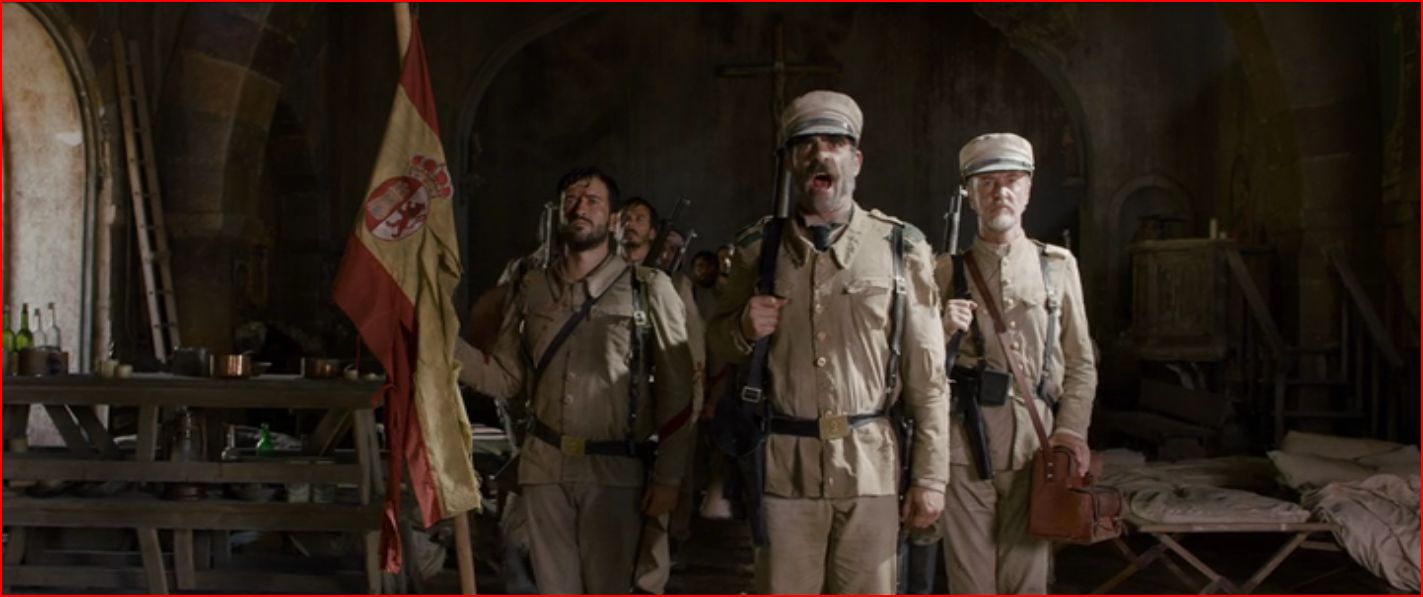
There's something about the Philippines, I guess, that makes foreign soldiers very reluctant to leave. The U.S. definitely overstayed its welcome there, but at least we didn't leave last-ditch fanatics behind when we decided to leave. When I was growing up, however, the world was fascinated by stories of Japanese soldiers holed up in the islands for up to thirty years after the end of World War II. There was precedent for this, on a more modest scale, after the 1898 war in which the U.S. "liberated" the Philippines from Spain. Despite that crushing defeat, a Spanish garrison held out at Baler, in eastern Luzon, for nearly a year, surrendering only in June 1899. The siege of Baler was the subject of a heroic war film in 1945, during the Franco dictatorship. Salvador Calvo's remake is far less celebratory.
The garrison is made up mostly of recent arrivals from Spain, few of whom have any real training. Our point-of-view character among these recruits is an aspiring artist who befriends the resident priest. While the soldiers can hold out for months with the ammo available, the important thing for the priest and his new protege is a plentiful supply of opium. One important thing the unit lacks is nutritious produce. Berberi breaks out, killing the original commander. The men continue to hold out, though at least one deserts.
Meanwhile, as the besieging Filipinos well know, Spain is negotiating a sale of the islands to the victorious U.S. to bring the war to a definitive close. Anticipating their next war with the Americans, the natives would like to end the siege with minimal fuss and hope to convince the Spaniards with up-to-date newspapers. The new commander dismisses all reports as fake news, contrived to trick them into surrendering. Eventually, our artist hero is sent out on a mission to get authentic news from Manila, the capital. He's promptly captured by a courteous Filipino commander who sends him on his way in the hope that the truth will set everyone free. The commander still won't believe and condemns the artist as a drug-addled traitor. Our hero will survive the siege, but his artistic ambitions end up one last casualty of a hopeless war.
The siege of Baler was something new to me, and that lent novelty to 1898. The siege was no Alamo and its conclusion -- the commander finally reads a piece of news he can't dismiss as fake -- is inescapably anticlimactic. The maiming of our artist hero serves as a symbolic catastrophe on top of the already pointless deaths during the siege. The film's real strength is its ensemble cast, led by Luis Tosar, Javier Gutierrez and Alvaro Cervantes as the artist. There's nothing really innovative here as far as battle films go, but for audiences outside the Spanish-speaking world 1898 provides a fresh look at the absurdity of imperialism and the folly of war.
Meanwhile, as the besieging Filipinos well know, Spain is negotiating a sale of the islands to the victorious U.S. to bring the war to a definitive close. Anticipating their next war with the Americans, the natives would like to end the siege with minimal fuss and hope to convince the Spaniards with up-to-date newspapers. The new commander dismisses all reports as fake news, contrived to trick them into surrendering. Eventually, our artist hero is sent out on a mission to get authentic news from Manila, the capital. He's promptly captured by a courteous Filipino commander who sends him on his way in the hope that the truth will set everyone free. The commander still won't believe and condemns the artist as a drug-addled traitor. Our hero will survive the siege, but his artistic ambitions end up one last casualty of a hopeless war.
The siege of Baler was something new to me, and that lent novelty to 1898. The siege was no Alamo and its conclusion -- the commander finally reads a piece of news he can't dismiss as fake -- is inescapably anticlimactic. The maiming of our artist hero serves as a symbolic catastrophe on top of the already pointless deaths during the siege. The film's real strength is its ensemble cast, led by Luis Tosar, Javier Gutierrez and Alvaro Cervantes as the artist. There's nothing really innovative here as far as battle films go, but for audiences outside the Spanish-speaking world 1898 provides a fresh look at the absurdity of imperialism and the folly of war.
Sunday, July 16, 2017
George A. Romero (1940-2017)
Romero died bitter. Once you get past today's obituaries, a Google News search will point you to interviews published earlier this month, as he struggled to raise funds for another Dead film that he had co-written and planned to produce. He railed against today's zombie movies and shows, convinced that such things as World War Z and especially The Walking Dead, products he apparently saw as bastardized versions of his vision, had made it impossible for him to get financing for his modestly-budgeted ideas. Romero apparently took it as an insult that he had been invited to direct episodes of Walking Dead, and he showed what strikes me as a reactionary blindness toward that show's significance, based on what fans of the show tell me, when he complained that it had reduced the "zombie apocalypse" to a mere backdrop for what he called soap opera, while the Dead films always were elevated, or so the auteur implied, by his inclusion of satiric subtexts. I don't watch The Walking Dead, but the impression I get from those who've watched and commented on it is that such a show can't help but comment implicitly on the world of here and now. In short, in his frustration Romero was unfair to those who followed in his footsteps or, as he may have seen it, stood on his shoulders to reach glories denied him. But George A. Romero was a filmmaker entitled to some indulgence of his unfair moods. The shows he despised at the end of his life were only further proof that Romero himself had made, in Night of the Living Dead, one of the handful of most culturally influential movies ever made. It introduced the world to what is still often called a "Romero zombie," to distinguish it from both the voodoo-driven thralls of past movies and the more articulate (sometimes muscularly, sometimes verbally) brain-eaters seen later. It was a milestone in horror cinema despite its tiny budget and its unlikely appearance as a black and white gore film in 1968. It was also indisputably a work of genius that earned his follow-up zombie films Dawn and Day the status of unique events, and not just because their standard-setting gore defied the ratings system and normal exhibition policies. A second trilogy of 21st century films was less successful, but Land of the Dead was still a great entertainment that advanced Romero's mythos in major, tantalizing ways, and Survival of the Dead proved him still a fine storyteller in the pulp tradition at the effective end of his career. It's important now to remind people of the great films Romero made outside the zombie genre. My favorites include his vampire film Martin and especially his neo-Arthurian biker movie Knightriders, while Creepshow, his and Stephen King's homage to EC Comics, still has many fans. In the end, Romero had a right to be bitter, if only because he never cashed in on the incredible popularity of his zombie innovation the way he should have, but lived to see many others feeding on the harvest he'd planted. But if history can be a solace, Romero should rest in peace -- unless, like John Leguizamo in Land, he wants to see "how the other half lives."...
Saturday, July 15, 2017
On the Big Screen: WAR FOR THE PLANET OF THE APES (2017)
Matt Reeves' Planet of the Apes trilogy has gradually moved away from the concept's dystopian foundation, as established by original novelist Pierre Boulle and original screenwriter Rod Serling, making the saga of Caesar the chimp revolutionary a crowd-pleasing fantasy series. His movies remain superficially dystopian, portraying the further decline of the human race, but by now they don't feel dystopian in any meaningful way because no one's rooting for the humans. From the beginning, the Apes myth has been the sort of dystopia in which the victims had it coming; Charlton Heston's final rant in the 1968 movie sets the tone. Keep at it and the victims are bound to lose viewers' sympathy, especially when the filmmakers don't treat them as victims, but villains. The best proof of Reeves' success is that people don't ask themselves whether, as human beings, they should be happy with the results of his films. A lot of people will credit this to Andy Serkis's by-now overrated (But still good! Don't kill me!) motion-capture performances as Caesar and the sympathy he earns for the apes, but it really comes down to the writing -- and maybe also to a more misanthropic spirit in our time. You might expect a divided audience, some identifying more strongly with the apes while identifying the humans with certain more obnoxious or oppressive members of the species, while some still regard even the purely fictional prospect of human extinction with horror. But I doubt whether anyone watching War is not on Caesar's side, no matter what that means for those who aren't.
We open with the war promised at the end of the last picture underway. Diminished as they are by the simian flu, humans in northern California still outnumber and outgun Caesar's band of artificially-evolved apes, but still can't overcome the ape defenses in the dense forest. Nevertheless, each skirmish brings unacceptable losses, and Caesar hopes to break out of the forest and head south, where there are, presumably, fewer humans. Col. McCullough (Woody Harrelson), the leader of the local army, isn't going to let the apes go so easily. Doubly resentful now that he's discovered that simian flu is a gift that keeps on giving, McCullough (referred to by everyone else as simply "The Colonel") intends to exterminate the apes through slave labor. He's put captive apes to work building a wall -- don't freak out, anybody; the screenplay was written before anyone took Trump seriously, and in any event the wall is meant to keep out fellow humans, fellow soldiers even. A main force further north hasn't taken well with the Colonel's method of controlling the spread of secondary simian flu, which is to shoot anyone who contracts it, including his own son. Despite his extinction agenda, McCullough has simian collaborators: followers of the late Koba (Toby Kebbell takes a few encores to haunt Caesar's dreams) who paradoxically make common cause with humans out of fear and resentment of Caesar. In his greatest blunder as a leader, Caesar sends the majority of the apes south while he seeks personal revenge for casualties inflicted in one of the Colonel's raids on the forest. He's accompanied by his stalwarts: Luca the gorilla (Michael Adamthwaite), Maurice the orangutan (Karin Konoval) and Rocket the chimp (Terry Notary) -- and by a little human girl (Amiah Miller) that Caesar's crew inadvertently orphaned, and for whom the kindly Maurice in particular feels responsible. We learn eventually that her muteness is a result of the secondary virus, but more on that later. While this motley band, joined eventually by the first evolved ape they've ever seen who isn't part of their original group, heads toward a border station where they expect to find the Colonel, that clever man swept down upon the refugee apes with such swiftness and efficiency that they all arrive there and are put to work before Caesar reaches the place.
I prefer to keep spoilers at a minimum for non-superhero movies so I won't say much about the rest of the film, except to describe it as a cross between Apocalypse Now and The Ten Commandments, the latter proving the dominant strain even though Reeves openly invites comparison with the former with a bald, crazy colonel and some "Apepocalypse Now" graffiti. There's clever symbolic labeling throughout the film; the Colonel's soldiers call the apes "Kongs" but dub their gorilla collaborators "Donkeys"; one soldier's battle slogan, written on his helmet, is "Bedtime for Bonzo." There's more overt humor here than in the previous films, perhaps because Reeves recognizes by now how popular these films are. We even get a comedy-relief ape in the aforementioned but just-now identified "Bad Ape" (Steve Zahn), whose nebulous origin story opens the door to further exploration or the increasingly apish planet. He got smart like his fellow zoo apes but he honestly isn't very bright. His main trait is old-school comic cowardice of the sort that gets set aside when your buddies apply enough pressure. The little girl, who is given the easter-egg name "Nova" after one of Bad Ape's car-ornament trinkets, often proves more useful than this simian who never learned sign-language and thus can't communicate understand the other apes when Caesar's not around to translate. About the girl and her sickness: anyone who knows the history of Planet of the Apes can see that her plight evokes the mute humans Charlton Heston encounters. But what has happened to her exactly? For Col. McCullough the secondary flu is a fate worse than death because it robs people of speech. He also claims that victims are reduced to a "primitive" state, but we have only his hysterical word for that, compared to the evidence of Nova, who picks up the apes' sign language readily enough and displays numerous positive character traits that belie the Colonel's pejorative sense of "primitive." One could almost believe that the secondary flu has purified the girl, whose future is one of the more tantalizing threads that could be picked up in a post-Reeves sequel. For now, at least, it looks like Reeves and co-writer Mark Bombeck may have meant to make a point about our identification of sentience with speech or our reluctance to ascribe sentience to those without speech, but if so they fudge it a little by having Caesar talk more often than he probably needs to or should in story terms, for the obvious reason of reinforcing audience identification with the hero chimp.
As I said, the Ten Commandments gene ultimately overwhelms the film, inflicting a gratuitous disaster climax on top of the genuine climax of Caesar's escape from the Colonel's base in the middle of an air attack by the enemy army. It keeps up after that extra-climax with a sadly flat denouement at the edge of the promised land, with Maurice as Caesar's Aaron and Rocket as his Joshua, while Reeves can think of nothing better for Nova and Bad Ape to do than romp around in circles in something like a parody of play. But I won't hold the end of the picture against its actual story or Reeves' overall direction. War relies on emotional intensity rather than frantic action, often lingering on the wondrously expressive faces of Caeasr -- surely you can't credit Serkis alone for all of this -- and the other lead apes, and emphasizing Harrelson's profoundly menacing presence as the Colonel without requiring him to emote villainously. Reeves is at his best simply framing Harrelson watching the imprisoned Caesar from his balcony, or receiving the adulation of his troops while preoccupied with shaving his head. Harrelson does a tremendous job under Reeves' direction to compete with the lead apes, who probably are the best CGI creations on film to date, not counting Pixar movies. Reeves can shoot close-ups of their faces with Leonean intensity with full justification; you really do feel like you can see the inner workings of Caesar, Maurice or Rocket's mind when they're not talking or signing. War may not really stick the landing, but it should still go down as one of the best third films in a series. While there can and perhaps should be more films in this Apes series, Reeves' trilogy should stand for some time as one of the most impressive achievements in modern genre film.
We open with the war promised at the end of the last picture underway. Diminished as they are by the simian flu, humans in northern California still outnumber and outgun Caesar's band of artificially-evolved apes, but still can't overcome the ape defenses in the dense forest. Nevertheless, each skirmish brings unacceptable losses, and Caesar hopes to break out of the forest and head south, where there are, presumably, fewer humans. Col. McCullough (Woody Harrelson), the leader of the local army, isn't going to let the apes go so easily. Doubly resentful now that he's discovered that simian flu is a gift that keeps on giving, McCullough (referred to by everyone else as simply "The Colonel") intends to exterminate the apes through slave labor. He's put captive apes to work building a wall -- don't freak out, anybody; the screenplay was written before anyone took Trump seriously, and in any event the wall is meant to keep out fellow humans, fellow soldiers even. A main force further north hasn't taken well with the Colonel's method of controlling the spread of secondary simian flu, which is to shoot anyone who contracts it, including his own son. Despite his extinction agenda, McCullough has simian collaborators: followers of the late Koba (Toby Kebbell takes a few encores to haunt Caesar's dreams) who paradoxically make common cause with humans out of fear and resentment of Caesar. In his greatest blunder as a leader, Caesar sends the majority of the apes south while he seeks personal revenge for casualties inflicted in one of the Colonel's raids on the forest. He's accompanied by his stalwarts: Luca the gorilla (Michael Adamthwaite), Maurice the orangutan (Karin Konoval) and Rocket the chimp (Terry Notary) -- and by a little human girl (Amiah Miller) that Caesar's crew inadvertently orphaned, and for whom the kindly Maurice in particular feels responsible. We learn eventually that her muteness is a result of the secondary virus, but more on that later. While this motley band, joined eventually by the first evolved ape they've ever seen who isn't part of their original group, heads toward a border station where they expect to find the Colonel, that clever man swept down upon the refugee apes with such swiftness and efficiency that they all arrive there and are put to work before Caesar reaches the place.
I prefer to keep spoilers at a minimum for non-superhero movies so I won't say much about the rest of the film, except to describe it as a cross between Apocalypse Now and The Ten Commandments, the latter proving the dominant strain even though Reeves openly invites comparison with the former with a bald, crazy colonel and some "Apepocalypse Now" graffiti. There's clever symbolic labeling throughout the film; the Colonel's soldiers call the apes "Kongs" but dub their gorilla collaborators "Donkeys"; one soldier's battle slogan, written on his helmet, is "Bedtime for Bonzo." There's more overt humor here than in the previous films, perhaps because Reeves recognizes by now how popular these films are. We even get a comedy-relief ape in the aforementioned but just-now identified "Bad Ape" (Steve Zahn), whose nebulous origin story opens the door to further exploration or the increasingly apish planet. He got smart like his fellow zoo apes but he honestly isn't very bright. His main trait is old-school comic cowardice of the sort that gets set aside when your buddies apply enough pressure. The little girl, who is given the easter-egg name "Nova" after one of Bad Ape's car-ornament trinkets, often proves more useful than this simian who never learned sign-language and thus can't communicate understand the other apes when Caesar's not around to translate. About the girl and her sickness: anyone who knows the history of Planet of the Apes can see that her plight evokes the mute humans Charlton Heston encounters. But what has happened to her exactly? For Col. McCullough the secondary flu is a fate worse than death because it robs people of speech. He also claims that victims are reduced to a "primitive" state, but we have only his hysterical word for that, compared to the evidence of Nova, who picks up the apes' sign language readily enough and displays numerous positive character traits that belie the Colonel's pejorative sense of "primitive." One could almost believe that the secondary flu has purified the girl, whose future is one of the more tantalizing threads that could be picked up in a post-Reeves sequel. For now, at least, it looks like Reeves and co-writer Mark Bombeck may have meant to make a point about our identification of sentience with speech or our reluctance to ascribe sentience to those without speech, but if so they fudge it a little by having Caesar talk more often than he probably needs to or should in story terms, for the obvious reason of reinforcing audience identification with the hero chimp.
As I said, the Ten Commandments gene ultimately overwhelms the film, inflicting a gratuitous disaster climax on top of the genuine climax of Caesar's escape from the Colonel's base in the middle of an air attack by the enemy army. It keeps up after that extra-climax with a sadly flat denouement at the edge of the promised land, with Maurice as Caesar's Aaron and Rocket as his Joshua, while Reeves can think of nothing better for Nova and Bad Ape to do than romp around in circles in something like a parody of play. But I won't hold the end of the picture against its actual story or Reeves' overall direction. War relies on emotional intensity rather than frantic action, often lingering on the wondrously expressive faces of Caeasr -- surely you can't credit Serkis alone for all of this -- and the other lead apes, and emphasizing Harrelson's profoundly menacing presence as the Colonel without requiring him to emote villainously. Reeves is at his best simply framing Harrelson watching the imprisoned Caesar from his balcony, or receiving the adulation of his troops while preoccupied with shaving his head. Harrelson does a tremendous job under Reeves' direction to compete with the lead apes, who probably are the best CGI creations on film to date, not counting Pixar movies. Reeves can shoot close-ups of their faces with Leonean intensity with full justification; you really do feel like you can see the inner workings of Caesar, Maurice or Rocket's mind when they're not talking or signing. War may not really stick the landing, but it should still go down as one of the best third films in a series. While there can and perhaps should be more films in this Apes series, Reeves' trilogy should stand for some time as one of the most impressive achievements in modern genre film.
Subscribe to:
Posts (Atom)