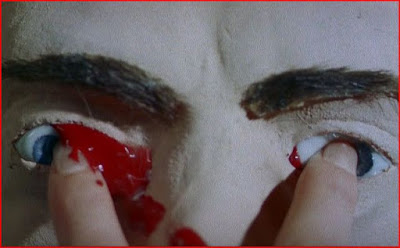
A randomly comprehensive survey of extraordinary movie experiences from the art house to the grindhouse, featuring the good, the bad, the ugly, but not the boring or the banal.
A horse-drawn wagon rolls hurriedly through a wilderness as a man settles down to a dubious picnic lunch: a chalky looking loaf of bread and two hard-boiled eggs. The man will eat the eggs, but saves the bread for another time. It's our old friend Sartana, dapper as ever but now looking more like George Hilton than Gianni Garko. He's gone back to the grubby three-day growth look of his earlier outings instead of the blond moustache Garko adopted later. Appearances aside, Sartana didn't come out here just to have a snack. He wants to kill a man; the driver of the wagon has a price on his head. But someone beats him to it. A gang of bandits pop out of trapdoors in the earth and blow away the driver and his escort. They gather up the riderless horses, but what of the wagon's contents? They don't seem to care. In fact, they throw a stick of dynamite at it and ride away.
Sartana's curiosity is piqued. Why didn't they loot the wagon? He wants to take a look for himself, but that means preventing the explosion. That should be a simple matter, for a gunhawk like him, of shooting away the fuse before the fire reaches the dynamite. But Sartana doesn't do things the easy way. Instead, he tosses his water canteen far into the air and shoots a hole through it. The water puts out the fiery fuse. It takes our hero a full credit crawl before he reaches the wagon. I don't know what he expected, but he finds sacks of sand in a safe.
If it all seems familiar to Sartana, he doesn't let it show, but it reminded me of one of his earlier films in which the villains faked stage robberies as part of an insurance fraud scheme. The rest of this film, directed by "official" Sartana hand Giuliano "Anthony Ascott" Carnimeo, traces the hero's effort to track down the gold that everyone else believes has been stolen. His detective work pits him against the bandit gang and an evil banker, along with various satellite villains. The main thing is that there be plenty of people for him to shoot.
Sartana is like The Shadow of the spaghetti west. His gimmick is that he sees all and knows all. The gag is that he's always at least one step ahead of the opposition. His gunplay tends toward the cartoonish, the gunfights ending up like sight gags. There's an almost classical slapstick quality to his showdowns this time out, since he almost always cheats. He always seems to have a gun hidden somewhere, whether in his boot, in a deceptively empty holster, or in that nasty loaf of bread. The bread becomes the main running gag of the film, provoking the funniest line in the English dub when a bandit, on to his tricks, orders Sartana: "On your feet, and keep your hands away from that loaf of bread!" When Sartana makes a big reveal of three loaves of bread on a table during his final showdown with the bandit leader, you can't doubt that Carnimeo and writer Tito Carpi have tongues in cheeks more than ever this time out. There's no realism to the gunfights, since Sartana's enemies uniformly violate the Tuco Rule and talk, talk, talk (one even tells his men to count to three!) when they should shoot, shoot, shoot. The gags wouldn't work otherwise. It still works, somehow; I was amused by the brazenness of it all.
This is why they called it Boot Hill.
When Sartana plays with his food, he plays for keeps.
The filmmakers throw a couple of wild cards into a mix: a ruthless saloon girl played by Erika Blanc, and a rival gunfighter named Sabbath. This man (some online reviewers point out that, in some countries, he'd be called Sabata) is in some ways Sartana's antithesis. He wears white while Sartana wears black, for instance. He's also an effete, poetry-reading, parasol-carrying Englishman -- or at least he sounds that way in the dub. He reveres his mother's memory and insists on etiquette toward ladies; he kneecaps a thug who was threatening to rough up the saloon girl in order to make him "curtsy" properly. In this showcase role, the American actor Charles Southwood nearly steals the picture from a charismatic George Hilton. I got the impression that this film may have been a tryout for a separate Sabbath series that never happened, though Carnimeo and Carpi later pitted Hilton and Southwood against each other again in a film in the Alleluja series.
Erika Blanc (top) and Charles Southwood (below) complicate things for Sartana and keep us guessing which side each will end up on.
This last "official" Sartana film -- the last with either Carnimeo or Garko involved -- is a refreshing comedown from the ridiculous excess of Garko's last outing, in which Sartana turned a church organ into a machine gun. Perhaps with Garko out of the way Carnimeo could poke fun at the character and his conventions instead of simply escalating the outlandishness quotient. Hilton makes a good replacement, he's supported by a good cast, and he's backed by a nice score by Francesco (The Inglorious Bastards, Lone Wolf McQuade) de Masi. It's still the sort of gimmicky film that hardcore spaghetti fans aren't necessarily supposed to like, but I'll recommend it for being well-paced, action-packed, and pretty amusing in its silly way.
While the version included in VideoAsia's Spaghetti Western Bible Vol. 2 collection is full-frame, here's a widescreen Italian language trailer, uploaded to YouTube by MrSpaghettiWestern.
Erle C. Kenton's comedy hit screens early in 1934, the year that mostly Catholic moral reformers finally succeeded in pressuring Hollywood into cracking down on the more salacious or sensational elements that made "pre-code" cinema what it was. The stricter code enforcement most likely made Search for Beauty unreleasable for many years afterward. To be honest, that was no great loss. While today's movie buffs revere pre-code for its sophisticated frankness and stylish transgressions, Kenton's film points to another, maybe more likely evolutionary path Hollywood may have taken had there been no crackdown. Beauty is a crude, bawdy and stupid show self-consciously dedicated to pushing the envelope in some ways without really delivering the goods in other respects. It points more toward sitcoms and bad British softcore comedies than the liberated expressiveness of the Seventies and beyond.
As a New York Times review explains, Search is the payoff of a publicity stunt Paramount Pictures perpetrated in 1933. The studio sought out the most perfect physical specimens, male and female (whites only, of course) in the English-speaking world in order to recruit them for pictures. They ended up getting no mention individually in the opening credits, being listed only as the 30 contest winners, but they are prominently placed throughout the picture. They provide the bulk of the beefcake and cheesecake in the picture, with more beef than cheese on display because the boys can go topless -- and bottomless in one locker-room scene. The women are more modest, though one can tell that they aren't wearing bras beneath their one-piece uniforms.
Buster Crabbe near the finish of his Search For Beauty. Below, Crabbe as seen in the Oppressive Female Gaze (of actress Gertrude Michael) at the film's facsimile of the 1932 Olympic Games.
The young leads are established actors, Larry "Buster" Crabbe and teenaged Ida Lupino as Olympic gold medalists (Crabbe was one in real life) who are hired as celebrity editors of a health-and-fitness magazine whose new publishers -- including ex-con Robert Armstrong in dumbed-down Carl Denham mode -- see the venture as a vehicle for sexy pictures of scantily clad specimens. Crabbe and Lupino are true believers and resent the publishers turning their project into trash. Armstrong uses Crabbe's idea for a global fitness contest as an excuse to send the lad out of the country so he and his partners (including the always-amusing, though less amusing than usual, James Gleason) can run the show unhindered, voting down Lupino consistently in editorial conferences.
James Gleason and Robert Armstrong rub their hands greedily while well-intentioned editrix Ida Lupino fumes. She ought to; even Crabbe treats his supposedly equal partner like a secretary, telling her to "take a letter" in one scene.
Crabbe returns with an idea to convert a health-farm owned by the former publisher into a modern fitness hotel, and has put the contest winners under personal contract to himself rather than the magazine, outwitting Armstrong when the huckster proposes a split meant to leave him in control of the bodies beautiful. The rest of the film involves Armstrong's scheme to regain control of the hotel on its opening weekend, the highlight of which is a big floor show featuring all the contest winners.
The floor show is the film's make-or-break moment that could redeem the inane comedy of the huckster publishers and the so-far tepid exploitation of its physical specimens. It proves an uninspired, turgid sequence. For a choreographer or art director it really needed the unholy love child of Busby Berkeley and Leni Riefenstahl -- but Mitchell Leisen might have worked in a pinch. Paramount had no such luck, and by the Berkeley standard this sequence would have a hard struggle to be second-rate. In a way, it's topped by a climax that comes across as a parody of the quasi-fascist films of the period that show dynamic people taking decisive, often extra-legal action against social problems. In Search, this uprising takes the form of the contest winners forcefully rousting the inaugural weekend guests -- uniformly old or fat -- out of their beds at a beastly hour of the morning for compulsory calisthenics conducted by Crabbe and Lupino. To add insult to insult, the "guests" are instructed to "whistle gaily" on their forced march, and when bare-chested men compel male weaklings to do so, you know and the filmmakers know what whistling gaily can mean.
In the spirit of pre-code exploitation, here's Toby Wing as Lupino's impressionable younger cousin.
The end is typical of the film, as Gleason takes the final bow.
There are a few good Depression zingers in the screenplay. Armstrong, on his release from prison, complains that some of the money stashed away on his arrival is missing; he tells the guards that jail is nearly as bad a place to keep your money as a bank. But for the most part the picture lacks that social relevance that gives many pre-codes an extra edge. Search for Beauty is basically a brain-dead comedy without comedians (Gleason is reduced to malapropisms while Armstrong only blusters) and a half-hearted attempt at exploitation. But it probably earns its place as the last film in Universal's Pre-Code collection by showing exactly how far films could go by the end of that remarkable era.
By the way, here's the full "Symphony of Health," uploaded to YouTube by MataMachree -- the poster no man can resist!
Jacques Audiard is a French writer-director who's brought American influences into his country's crime film genre. His previous picture, The Beat That My Heart Skipped, was a do-over of James Toback's Fingers. I haven't seen Fingers, but I liked Audiard's film for the most part, so I was willing to give him another shot, especially when Un Prophete was nominated for the Best Foreign Film Oscar. This time the influence is more Scorsesean, but since Martin Scorsese has never made a prison film, Audiard gets points for originality. I also see the influence on the soundtrack; Alexandre Desplat must share time with a variety of pop tunes, often sung or rapped in English (have the French no version of Mackie Messer?). For all I know, this sonic atmosphere reflects the reality of the French underworld, but it also makes the film seem slightly less French somehow, though this isn't a criticism of the film. In fact, the foreign music on the soundtrack is in keeping with the globalization of crime portrayed in the picture as the traditional French criminal element gradually yields to more exotic growths.
The "prophet" of the title is Malik El Djebena (Tahar Rahim), a friendless small-timer on his first stretch in prison. He's the ultimate new fish or greenhorn; he can't keep the guards from confiscating his one 50-franc note or two goons from mugging him for his sneakers on his first outing in the yard. In his complete isolation he needs to become protected (literally a protege). He won't pay the price another prisoner, Reyeb, demands -- oral sex. But he soon finds himself with no choice but to pay the price the Corsican mob demands -- accept Reyeb's proposition, but kill him. The Corsicans run the show in stir; they're like Paulie's gang in Goodfellas' prison interlude. After messily doing his duty (he must carry a razor in his mouth), Malik becomes the unlikely protege of Cesar Luciani (Niels Arestup), the old top dog of the Corsicans, gradually earning privileges while availing himself of the prison education system. As a loner, Malik finds himself able to move among different ethnic factions, befriending a Gypsy drug dealer who tells him of a stash of opium that Malik acquires during a furlough arranged by Cesar for the Corsican's own purposes. With help from his former prison tutor, now on the outside, Malik sets up his own drug racket, smuggling stuff into the prison and enhancing his own position, but risking his standing with Cesar, who needs him to keep clean in order to keep getting furloughs. But a shift in political winds reduces the Corsican cohort in this particular prison, threatening Cesar's power despite his continued influence over the hacks (guards). Outside, Corsicans, Italians, Arabs, Egyptians and others vie for power, creating more opportunities for Malik to build alliances and play groups off each other, even as things get more dangerous for him.
What makes Malik a "prophet?" The one time anyone calls him that in the film is when he saves himself from angry gangsters by warning them that deer are about to run into the path of their car. He had, in fact, dreamt about deer on the road earlier in the picture. That's one of the fantastic elements Audiard introduces, as if in acknowledgement of the implausibility of Malik's rise to power. The main recurring fantasy feature is the ghost of Reyeb, who chats with Malik occasionally to no real purpose, except perhaps to establish the protagonist's "miraculous" credentials. But Malik is mainly a prophet in a more mundane sense, on the historical model of a man of obscure origins who rallies disparate people together to become a power in the world. He's no preacher or lawgiver, and he's not particularly charismatic, but he has the power to inspire trust, especially as he learns to be up front about his agenda. When a clique of Muslim cons accuse him of trying to use them, he disarms them, metaphorically speaking, by asking, "Why not?" He takes advantage of the deer incident to confirm his captors' suspicion that he'd killed their friend Reyeb, and they spare him. Even Cesar, who's determined to keep him in a servile role most of the time, ultimately enlists him in a final hare-brained scheme to reassert his power on the outside because he trusts Malik more than others. When Audiard calls Malik a prophet, he doesn't mean the sort of dude who isn't honored in his own country -- not one of those Hebrews who gets killed for denouncing their rulers -- but a prophet on the specific model of Muhammad: a gifted man who overcomes his persecutors and may end up ruling them all, after his hijra in prison.
I don't know if the mystical elements really help the story, but they don't really hurt it, either. Un Prophete is a complex, intense and occasionally brutal crime thriller that kept me engaged for its entire 155 minutes. Audiard does a great job of getting you enraged at the injustice of a prison system that allows cliques to run amok and torment hapless individuals like Malik, whose comeback gets you rooting for him to beat the system and the system within the system. There are moments of major suspense when Malik's outside errands for Cesar put him in peril, or when he has to improvise when a climactic hit doesn't go according to plan. Rahim and Arestup are great in a rivalry that plays out under the surface of their scenes together, when Malik must maintain his servility and Cesar must pretend that he still runs things. And while the American influence is undeniable, Audiard never neglects his native social and demographic context. With Un Prophete he's helped keep the great French crime film tradition alive and well.
Here's an action-packed British trailer uploaded to YouTube by TheMovieJam:
Narciso Ibanez Serrador answers his title question right off the bat. He plays newsreel footage of twentieth-century horrors over the opening credits as a ticker tabulates the juvenile casualties of World War II, the partition of India and Pakistan, the Korean and Vietnam wars and the Biafran uprising in Nigeria. In an interview on the Dark Sky DVD, Serrador (who has worked mostly on TV as the creator and head writer of a long-running Spanish anthology series) thinks he may have made a mistake in putting this data up front. He now thinks it may have worked better as a coda at the end, but I think he shouldn't second-guess himself.
That litany of childhood death sets us up to respond to the developing nightmare on the island of Almonzara in a certain way that enhances the horror of it. Without the historical set-up, we might spend most of our time wondering how, not to mention why, the children of the island are systematically massacring the adults. Given a world-historical context, our speculation roams more widely than it might otherwise. We can begin to imagine the children's murderous "playing" as some sort of divine retribution.
Serrador tells us that he dispensed with an idea developed in the source novel by Juan Jose Plans, which was actually written concurrently with the screenplay. Plans wanted to explain the rampage with some sort of toxic event hitting the island, but Serrador keeps things more mysterious by not explaining it. All we know is that the killing impulse is transmitted telepathically from child to child, and in one case from child to fetus. Explain that how you like. It clearly put the American distributors in mind of Village and Children of the Damned, since they retitled Serrador's movie Island of the Damned for its stateside release. The general vibe of the film is like a cross between the Damned movies and Night of the Living Dead, though the island kids are more happy and playful than either analogy might imply.
The menacingly quiet scene above throws the benign scene below, from earlier in the film, into a more menacing light.
Of course, another way to answer the title question is to say, "We'll see." It's an open challenge to see whether the killer kids will drive our English tourist protagonists to the breaking point. The adults of Almonzara couldn't cross the line. One of the last survivors actually asks the question of the English couple to explain why he couldn't stop the tykes from killing his wife. Tom, we'll learn, is made of sterner stuff. Of course, none of the kids he might shoot are his, though he does have one of his own to worry about. After what he and we have seen, however, we're ready to root him on. Does that make us moral equivalents of all the soldiers for whom the children of the twentieth century were collateral damage? Serrador may have wanted us to feel that way, but the business with the telepathy undermines the effect. Once we see that going on, we're probably inclined to see the kids as no longer fully human. Are they? Or do they represent a sudden single-generation evolutionary leap that has to kill the past to secure its landing? However you interpret it, you're going to identify with the lone man who has to blast his way through them or beat them down with poles to escape the island.
Quien Puede Matar a un Nino? is a sinister, unsettling film. Its air of simmering apocalypse is enhanced by its quasi-future setting in which Thailand has fallen to a fictional Communist uprising. Its moments of violence shock by suggestion rather than with gore, and the most gruesome moments come when Tom starts fighting back against the kids. When the kids attack, most notably when they treat an old man as a human pinata, we never see when the sickle strikes home, but we're horrified enough by the pure perverse playfulness of the psycho brats. Depending on your attitude, the final battle between Tom and a mob of kids may be more than you can stand if you can't stand violence against children. I was sicko enough to want to cheer when he finally opened fire on them, and I suppose many other viewers felt the same release of tension when Tom took the offensive. Whether you regret that feeling afterward is up to you.
"Who can kill a child?" I'm sure some brave grindhouse types must have said, "Give me a gun, I'll show you who can kill a @$%#!! child!" back in the day.
Here's Dark Sky's own nicely done trailer for the movie (with a German title), uploaded to YouTube by dreamindemon
After he saw and enjoyed Fascination a few months ago my friend Wendigo was willing to try more films by the French vampirist Jean Rollin. One of those most frequently recommended to us was La Morte Vivante, which appears to have been shot at the same estate as the earlier film. We've noticed a little uncertainty about whether The Living Dead Girl counts as a vampire movie, however. Some say it's more of a zombie film, and Salvation Films included it (along with Rollin's somewhat less ambiguous Night of the Hunted) in a Zombie Collection box set. Since I happen to own a copy of this collection, we decided to let Wendigo make the call.
Catherine Valmont is dead and minding her own business as the story begins, but her repose is disturbed by shady types using her family crypt as a dump for toxic waste. They've been dumping barrels for a while, but on this auspicious day the dumpster decide to get into the grave robbing business. No sooner has one of them cracked open Catherine's coffin and declared the but-recently deceased young woman beautiful than an earth tremor strikes, causing some barrels to burst open and disturbing some bats. The ghouls' driver up on the surface doesn't notice, however. One barrel leaks some liquid glop that burns one man's face, while fumes from another have the magical effect of reviving poor Catherine. Did these fumes transmit the angry spirit of Moe Howard? We never learn the truth, but somehow her first impulse is to poke her visitor's eyes out with her Press-On Nails of Death.
Those nails are sharper than they look. They can gouge a guy's throat out with her hardly trying. Indeed, Catherine seems more confused than anything else, merely poking people and moving on in an admittedly zombielike manner. Instinct takes her back to her home, which is being shown by realtors to potential American buyers. There's a lot of English dialogue in this picture, which made us wonder whether Rollin was hoping for U.S. theatrical distribution. To our knowledge, he never got it. But we're stuck with an obnoxious American character and his French actress-photographer wife as nosy near-heroes for most of the film. She sees the strange white-clad barefoot girl wandering through a meadow and takes pictures. Townspeople recognize them as shots of the lately late Catherine, inspiring our mundane heroine to further snooping while hubby can barely be bothered.
Memories of childhood link Catherine and Helene
Back at home, Catherine begins to remember things. Photographs and a music box remind her of her dearest childhood friend, Helene, with whom she once made a blood pact to die as nearly together as possible. Helene is still in town, and when she calls the Valmont estate and hears only the music box, she begins to get spooked enough to go there to investigate. She finds the naked exsanguinated corpses of the realtor and her boyfriend, who'd been trespassing after hours. Then she finds a naked bloodstained Catherine reacquainting herself with the piano.
What would you do? Helene's response is complicated by the fact that she missed Catherine's funeral and has never seen her dead. This allows her to convince herself that Catherine was never dead, that her reported death was some sort of hoax, and that something's wrong with her friend that she can help her with. That something seems to involve a frequent need to consume blood in order to fend off agonizing neck pain. How about pigeon blood? Catherine politely declines as we note increasing sentience after every kill and feeding. Human blood it is, then, initially small portions of Helene's own, then that of victims lured to the house by the hitchhiker con from Vampyres.
By this point Wendigo had concluded that Catherine is a vampire. There are scenes when she bites quite messily into victims' flesh, but it looked to him like she was spitting out the meat and biting mainly to get at arteries, with Rollin rewarding her with lovely sprays of the red stuff. Wendigo hesitates about defining La Morte Vivante as a "vampire movie," however, because it's not so much about Catherine's vampirism as it is about Helene's obsessive, oppressive dedication to her living-dead friend. Helene and Catherine travel opposite character arcs. Unusually for a vampire, Catherine becomes not only more sentient but also more conscientious, more remorseful, more moral the more she feeds. She starts out as a mindlessly zombielike killing machine, but as she regains her memories and power of speech, she becomes an increasingly reluctant vampire. She evolves from a traditional, almost animalistic vampire into a more modern "noble" vampire, ultimately performing a heroic act of will in rescuing a victim left for her by Helene. At the same time, Helene becomes much more and much worse than a "Renfield" type. She quickly abandons all scruples to become a ruthless enabler, a kidnapper and accessory to murder. Helene is monomaniacally obsessive; keeping Catherine "alive" is all that matters, even if Catherine wants to die. "I'm evil," Catherine protests, though her later actions arguably belie the claim, while Helene ends up a remorseless torturer.
The horror watches in horror as her friend besmirches their childhood idealism.
Rollin has in fact ingeniously reversed the traditional vampire-romance formula and given us a film in which Renfield, rather than the vampire, is the master. The appeal of the romantic vampire is the promise of eternal love, for the sake of which the victim subjects herself to the vampire's power. Here, the mortal's desire for eternal union effectively enslaves the vampire. It's the abomination who sees what's wrong with this picture, which the enabler refuses to acknowledge.
Wendigo suggests that Helene may be overcompensating for her apparent failure to be there during Catherine's fatal illness, or to attend her funeral. He speculates that they had actually drifted apart some time before, and that Helene began feeling remorse after the fact. How close were they? We know enough of Rollin's career to find it significant that this film never has a lesbian love scene between Helene and Catherine, either in flashback or in the present. Wendigo thinks it possible that they were lovers in the past, but he doesn't think it decisive one way or the other. Most likely, this being a Rollin film, if he wanted us to think they were lovers he would have showed a love scene. On the other hand, it may have been a deliberate withholding of what we expect from him to build up anticipation for the profoundly different sort of consummation that comes at the end of the film.
Like Fascination, this is a great looking film with an ideal found set, though Rolln finds enough new angles to make you almost forget that we've been here before. As the leads, Francoise Blanchard (Catherine) and Marina Pierro (Helene) are easy on the eye and easy to accept in their roles. They have to act more with their emotions than with their bodies and do a good job. The other actors are mostly good, though those playing the American couple are a little over the top.
Anti-American violence in La Morte Vivante: an unconvincing stand-in takes fire for Carina Barone, while Mike Marshall discovers the treachery of those freedom-hating frogs.
Rollin's script arguably leaves too many questions unanswered, and his direction is marred by occasional continuity gaffes. Bloodstains on Catherine's burial dress appear and disappear or move about from shot to shot. Catherine clamps her nails on a victim's tongue, squeezing out a rush of blood, but in a later shot the victim's face is clean and her mouth uninjured. At another point Catherine's nails seem suddenly trimmer than they should be. The photographer says she saw Catherine's bare feet when it would have been impossible to tell as she walked through tall grass. These are quibbles, but there are enough of them to make this at least a sloppier film than Fascination. It's also not as visually inspired as the earlier classic, with fewer iconic moments like Brigitte Lahaie marching into battle with her scythe. There are still some powerful moments, however.
It's not exactly damning a film to say it's not as good as Fascination, of course. In fact, Wendigo found this a very good film with an impressively different approach to the vampire concept. Jean Rollin is now 2 for 2 in his book, and there are many more vampire films, and others, yet to be seen.
The trailer was uploaded to YouTube by impossiblefunky:
The BBC reports the emergence of a new bad movie cult around a $10,000 opus called Birdemic: Shock and Terror. This cult is news to me. I follow a lot of blogs, but I can't recall reading anything about such a film before tonight. It just hit New York City last month, earning this write-up from the Times. No "bad movie" has gotten this much attention since The Room, as far as I can recall.
Severin Films has picked the film up for distribution and has uploaded an official trailer to YouTube.
I smell a rat. This has too much of an on-purpose quality to it, and not enough of the naive inspiration that makes the truly great bad films things to treasure. Perhaps I'm just refusing to believe that someone would put those bird attack scenes on screen and expect people to be thrilled or scared by them.
Birdemic is the third feature written and directed by James Nguyen, a professed Hitchcock fan, and it currently boasts a 2.1/10 rating from 127 reviewers at the Internet Movie Database. A film needs 1500 votes to make IMDB's all-time worst 100, but if it maintains its current batting average over time, it would be tied with such worthies as Lawnmower Man 2 and Son of the Mask in history's rankings, somewhere in the sixties.
By the way, now that I've examined the list for the first time in a while, I notice a bull market in Coleman Francis. Night Train to Mundo Fine (aka Red Zone Cuba) and The Skydivers are part of a logjam at the exalted nadir of the list, sharing a 1.4 average with five other films. For the record, the film named by Michael Adams as the worst of the worst, The Maize, is only 31st on the list, though his third-worst film, Ben and Arthur, is worse in the IMDB reviewers' eyes, ranking 9th. My own candidate for worst film, Midnight Movie Massacre, only has 91 votes and a 2.7 score -- out of the running for the Worst 100 even if it had the minimum number of votes.
If you're looking for the truly worst movies of our time, you probably have to look outside the predictable genres. It's too easy now for someone to put together a put-on with bad effects and joking actors that would, in some sense, be worse than bad. I still haven't seen The Room, but it seems sincere in its apparent incompetence and it isn't just a cheap, contemptuous genre film -- which is what Birdemic looks like at first glance. People who've seen it can correct me if they think the whole film has a more authentic badness than the trailer and clips suggest. But right now it looks like a triumph of exploitation in its postmodern form, with badness as a form of ballyhoo, a promise that the product can't deliver. There's a kind of madness in the most memorable bad films, but Birdemic merely looks stupid.
* * *
Gary Giddins has something interesting to say about bad movies in his new collection, Warning Shadows:
If DVDs testify to the endurance of cinema as art, they also underscore the differences between movie art and literature and music. Bad books become unreadable and bad music unlistenable. But many if not most bad movies, even some that were unwatchable in their initial release and for decades later, in the fullness of time become curios that allow us mild pleasures of performance, photography, dialogue, costume, set design, and documentary evidence of another age -- not because the movies show us the way the world really was but because it lays bare the way it imagined itself to be.
That part of a paragraph could be a credo for this blog. Whether the anointed bad movies of the present will have the same effect in the future may be inherently impossible to say, but sometimes I have my doubts.
Lucio Fulci will go down in history as a horror director, remembered most either for Zombie, the definitive Italian zombie film (i.e. the one with the shark) or for The Beyond, which Quentin Tarantino promoted in a 1990s revival. But like most of his peers in Italy, Fulci worked in whatever genre was popular. In the mid to late 1960s that meant westerns. Le Colt cantarono la morte e fu ... Tempo di Massacro (later imported to the U.S. by AIP and dubbed The Brute and the Beast -- whatever they thought that meant) was his first shot at the genre.
Franco Nero (above) and George Hilton (below) in Massacre Time.
The surprising thing about the film is the way that Franco Nero, fresh from his international triumph in Sergio Corbucci's Django, is almost completely upstaged by George Hilton in an "ugly" role. Nero is Tom Corbett, a miner summoned back to his home town, which he finds under the brand of the Scott clan. The Scott monogram -- a dollar-sign like S and T design, marks nearly every building in Laramie Town. We know they're a bad brood because a prologue showed the Scott scion Jonah (Nino Castelnuevo) hunting humans with dogs who maul a man to death. One disappointment about the movie is that this prologue made me anticipate another hunting scene with Nero and/or Hilton as the prey, but that never happens. Instead, the Scotts seem determined to make life miserable, or short, for almost everyone Tom encounters, though they keep their hands off Tom himself.
Tom reunites with his brother Jeff (Hilton), a master of drunken gunfighting. Jeff is a one-man barroom brawl, battling a bevy of Scott minions with an alcoholic desperation (he's fighting to reach a bottle of tequila at the bar) and the tenacity of a punch clown. Knock him down and he's back up at once to sock you. Numbers tell at last, however, until Tom intervenes. A half hour has passed before Nero perpetrates any violence, and he continues to take a back seat to Hilton as the film progresses. While Tom eventually proves his prowess with firearms, Jeff is clearly the superior gunman. An hour goes by before Nero shoots anybody. By then he's been worsted in a whip fight with Jonah, with a face full of scars for his trouble, and he's also learned why he was summoned to town. Tom is the Scott patriarch's secret son, and the old man wants him to take over the ranch instead of the unstable Jonah. Nothing of the sort is going to happen, of course, until Tom and Jeff deal with the white-clad whipmaster, who also plays a mean organ....
Jonah gives Tom what-for, which is all the churl deserves for violating the dress code!
Like any proper spaghetti western, Massacre Time is good and violent, though you shouldn't expect violence or bloodshed on the level of Fulci's zombie films. The action is well staged and gives Fulci opportunities to show some style. In once scene Nero and Hiton hole up in a ruined house awaiting a parley with Scott. Fulci films them setting up shop through a broken wall and an empty window frame. Later, he employs a frame within a frame as Nero fires his gun in one shot, and in the next we look through a window next to Hilton and see a rider fall from his horse. In the same sequence Hilton gets a nice bit of business that demonstrates the "show, don't tell" principle. Nero suspects him of having shot someone he shouldn't have and knocks him around a bit. It won't do for Hilton to just say, "I didn't do it!" Instead, he proves his case by opening his weapon and letting the bullets drop, one by one, until we see six on the ground and know he's innocent -- this time.
Written by Fernando di Leo, later to become a master crime film director, Massacre Time is a spaghetti that, despite the setting, isn't really about America. The Scotts, Jonah especially, seem less like an American cattle dynasty and more like the depraved aristocrats of European gothic fiction. Class-conscious Italian audiences probably responded the way Fulci and di Leo intended, recognizing their own oppressors in the villainous clan. But the rich-are-shit message is undercut a little by the fairy-tale aspect of the story that makes Tom the true heir to the Scott empire. Also, any sense that this is a left-wing movie is hurt, by modern standards, by the inclusion of a Chinese undertaker and barroom pianist who uses "Confucius Say" aphorisms, but this character (played by Tchang Yu) is individualized enough (he disagrees with Confucius a lot) to be fairly inoffensive. Overall, Massacre Time might have a mixed message if it really had a message. It doesn't. It's no genre classic, but it's a reasonably entertaining action film.
Here's a dialogue-free Italian trailer, uploaded to YouTube by LindbergSWDB:
And here's a US TV spot for The Brute and the Beast, uploaded by mtraty
 A horse-drawn wagon rolls hurriedly through a wilderness as a man settles down to a dubious picnic lunch: a chalky looking loaf of bread and two hard-boiled eggs. The man will eat the eggs, but saves the bread for another time. It's our old friend Sartana, dapper as ever but now looking more like George Hilton than Gianni Garko. He's gone back to the grubby three-day growth look of his earlier outings instead of the blond moustache Garko adopted later. Appearances aside, Sartana didn't come out here just to have a snack. He wants to kill a man; the driver of the wagon has a price on his head. But someone beats him to it. A gang of bandits pop out of trapdoors in the earth and blow away the driver and his escort. They gather up the riderless horses, but what of the wagon's contents? They don't seem to care. In fact, they throw a stick of dynamite at it and ride away.