Saturday, November 13, 2010

92 IN THE SHADE (1975)

To set the stage for novelist-screenwriter Thomas McGuane's directorial debut, Wikipedia relates that McGuane's first wife left him to marry his star, Peter Fonda, while McGuane himself married Fonda's romantic interest, Margot Kidder, and had an affair with another actress in the film, Elizabeth Ashley. To this volatile mix add Seventies stalwarts Warren Oates and Harry Dean Stanton. The film doesn't live up to the set-up.

McGuane, who had written the screenplay for Arthur Penn's The Missouri Breaks, here adapted one of his own novels. 92 in the Shade chronicles the feud between fishing guides Tom Skelton (Fonda) and Nicholas Dance (Oates). Dance is sometimes suicidal and reputedly homicidal. When he goes to jail for attacking a man, Skelton exploits the vacuum to get a job from wharf boss Carter (Stanton) guiding a vacuous old couple. Dance's stay in stir is short, however, and while Skelton is following a line into marshy waters to fetch a trophy for his client, Dance and Carter reclaim the clients and leave Skelton in the water. To them it's all a big joke, but Skelton tops them by burning Dance's boat.


"If it costs a cent to rent a tuxedo for an elephant, I couldn't rent a t-shirt for a flea." Warren Oates in Thomas McGuane's 92 in the Shade.

Dance doesn't exactly go berserk, but he does warn Skelton not to guide anymore in his territory, on pain of death. Undeterred, Skelton gets money from his cranky attorney of a grandfather (Burgess Meredith) to get a boat of his own built. Despite Dance's matter-of-fact reminders of his ban, Skelton intends to make the awkward, eccentric Ollie Slatt (Joe Spinell) his first client, forcing Dance to back up his threat if he can....

As a beginner, Joe Spinell must learn that fishing is something you do to the fish, not with it.
To spoil things, it seems that McGuane bowdlerized his own source material. In the novel, Wikipedia says, Dance follows through and kills Skelton. In the film, the men struggle on board Skelton's boat while Slatt jumps ship, but Skelton disarms Dance and chucks his gun into the water. The rivals then settle down to finish the film with Peckinpavian laughter. Between novel and film came a life-threatening, life-changing car crash. It may have altered not only McGuane's attitude toward his art (he began screenwriting after recovering) but his attitude toward the story -- though a reported alternative ending may betray some indecision. The anticlimax, following an ineptly filmed scuffle, fits the laid-back if not passed-out spirit of the picture. The film is all novelistic observation of eccentric personalities and their relationships, with little sense of dramatic urgency despite the inherent credibility (or as he says here, "credence") of Warren Oates's threats. He can make laid-back threats and have them taken seriously, except if the director himself ultimately refuses to do so. That may be a deliberate authorial strategy, but it leaves the film begging the question, "So what?"

The answer should be that we've enjoyed a rich slice of regional life and shared the experiences of colorful characters, but McGuane stretches himself too thin accommodating too many eccentric personalities, all of whom probably have a proper place in the novel. In the film, however, there doesn't seem to be a point to Mrs. Carter's (Ashley) obsession with her cheerleading past, her determination to impress people with her enduring baton-twirling skills, or Carter's opposition to her doing so. Likewise, the grandfather-grandson dynamic of pride and dependence between Meredith and Fonda leaves room for Skelton's actual father who, being played by William Hickey, is just another weirdo. McGuane may have thematic reasons for including these oddballs and their obsessions, but whenever these characters reappear the movie loses a lot of what little focus it had.

As a novelist, director McGuane is predictably fond of long-take dialogue scenes. Here's one with typically eccentric details between Margot Kidder and Peter Fonda.
If McGuane gets anything right as a first-and-only-time director, it's atmosphere. 92 in the Shade has a grungy, lived-in quality and a good feel for the principals' working environment. The best scene in the movie may be Skelton's long day with that boorish, bickering old couple, culminating in his long tracking of the line through the marsh and climaxing in the disappearance of his clients. It's the sort of extended anecdote that might have been extended further into a coherent feature in its own right. As a whole, however, McGuane falters somewhere between extended anecdote and novelistic closure. Despite an incredible cast, the performances aren't enough to justify a story that ultimately lacks a point. Lacking a point isn't necessarily a problem, except that McGuane apparently meant to make one.

Thursday, November 11, 2010

MANNAJA (A Man Called Blade, 1977)

Just when the spaghetti western had seemed to die laughing, thanks to the popularity of Terrence Hill's comedies, there was a final surge of serious, violent Italian westerns in the mid-1970s, including Enzo G. Castellari's Keoma, Lucio Fulci's Four of the Apocalypse, Michele Lupo's California and Sergio Martino's sole contribution to the genre, starring poliziotteschi icon Maurizio Merli. Martino has made films in nearly every Italian exploitation genre imaginable -- mondo (Naked and Violent), giallo (All the Colors of the Dark, etc.), poliziotteschi (The Violent Professionals), cannibals (Mountain of the Cannibal God), post-apocalypse (2019:After the Fall of New York), etc. It's not surprising, then, to see some influence from other genres in Martino's western.

The horror influence is most obvious and immediate. A pre-credits sequence introduces us to a mountain-man type stumbling through a misty, muddy stretch of woods, with something clearly in pursuit. In some shots, we get the pursuer's point of view through the trees. Finally, the fugitive is cornered and backs up against a tree to fight. Now we see a man on horseback, his face concealed by fog and shadow, raise a tomahawk and throw it. The weapon strikes home, depriving the target of his right hand.

This butcher is Blade (Merli), a bounty hunter who brings his quarry, Bert Craven, into the nearest town to get his money. Impatient and apparently unwelcome in the company town, Blade stakes Craven in a double-for-nothing card game, after figuring out how his opponent uses a mirror to cheat. Blade isn't greedy; once he's won the equivalent of Craven's bounty, he sets the dismembered fugitive free, and is promised repayment by Craven.

Blade has a larger issue with the man who runs the company town, Mr. McGowan (Philippe Leroy). McGowan's land, stripped down by lumbering and mining, used to belong to Blade's father. McGowan seized it somehow, and in the course of a struggle Blade's father was killed accidentally by a falling tree. It may as well be murder as far as Blade is concerned, but McGowan, now a cripple, is an unappealing target for vengeance. Not to worry, though, since Blade makes enemies easily enough. His most ready-made enemy is Voller (John Steiner), McGowan's right-hand man, the secret lover of McGowan's daughter, and the secret leader of the bandits who've been robbing McGowan's shipments.

Blade's grudge with McGowan becomes small potatoes as Voller makes his play for power. Eventually McGowan has to depend on Blade to negotiate for him when the bandits kidnap his daughter, neither he nor Blade yet knowing that she and Voller are on the bandits' side. Their extortionate terms force McGowan to work his men all the harder, until a labor uprising breaks out. Voller takes advantage of the confusion to shoot McGowan in the back, but his is a pyrrhic victory after the workers destroy much of the physical plant, leaving him to reign over ruins.

Voller has left Blade buried up to his neck in the desert, his eyes pinned open to be blinded by the sun, a knife blade pricking his neck. This is on top of killing a prostitute Blade had befriended, one of a troupe that eventually gets massacred back in McGowan's puritanical town, in front of our hero's eyes. Now Blade has something fresh to avenge, but he's hardly in a position to do anything about it.

Fortunately, who should show up but Bert Craven, now sporting a fancy hook where his hand had been, to repay his debt by digging Blade out of the deathtrap. Craven's intentions aren't entirely honorable, however. When he learns that Blade is effectively blind, he figures he can profit by ratting him out to Voller. He leaves Blade to grope about in a deep cave, feeling his way through assembling some crude tomahawks, while Craven rides into town. In a struggle against time, our hero forces himself into the light to acclimate his eyes once more before Bert and Voller's goons come for him....

Martino's horror style comes through again in both the desert sequence and during Blade's ordeal in the cave, the latter being perhaps the most stylish sequence in the film after the prologue. Voller, the villain, sometimes seems like a figure out of a horror film, especially when he has his dogs with him, than a conventional western villain. I can't speak for the Italian-language original, but the Germanic drawl the English dubbing actor gives the character enhances his alien creepiness.

Mannaja isn't just an expression of unconscious style, of course. Martino makes some conscious choices of art direction, emphasizing mud and fog as much as possible. This is a grimy, slimy film -- not unprecedented for spaghetti westerns, but almost tactile in Martino's presentation. There's a primordial quality underscored by the eccentric theme song composed by the De Angelis brothers, its opening verse intoned in a deep, slow drone, here transcribed to the best of my ability.

You're ... alone,
A solitary man,
And when the sun goes down,
Your memory's back around
With you,
And your heart
Is breaking down....

Like...a wolf
At night you look, for whom?
To hold your soul apart
And make you run away
'Til now,
And your mind
Won't forget....


Spaghetti westerns have a kind of default ethos that often asserts itself regardless of the particular talent involved in any given picture. Maurizio Merli, for instance, may have been a right-wing icon in Italy for playing power-hungry tough cops in the Seventies, but Mannaja, like many spaghettis, is very much a left-wing film, its original villain a rapacious capitalist outdone only by a bigger, more brutal bandit who proves only more eager to crush the working class, even as the workers manage to deny him the spoils of his victory. There's an apocalyptic quality to the film that may anticipate Martino's Mad Max-inspired Eighties action movies as the troglyditic Blade emerges from the fog to face Voller in the wreckage of his kingdom. There's an overall strangeness to this late spaghetti, awkward plot and all, that helps justify the Italians' return to a genre they had nearly mocked into oblivion.

This version of the "Man Called Blade" trailer was uploaded to YouTube by ShobaryWesterns.

Tuesday, November 9, 2010

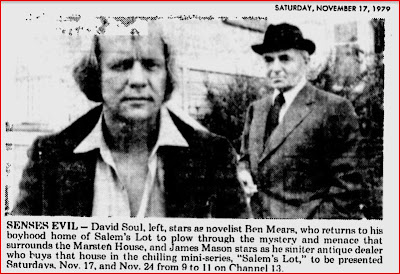
Wendigo Meets SALEM'S LOT (1979)


Here's what vampires shouldn't be: pallid detectives who drink Bloody Marys and only work at night; lovelorn southern gentlemen; anorexic teenage girls; boy-toys with dewy eyes. What should they be? Killers, honey. Stone killers who never get enough of that Type A. Bad boys and girls. Hunters. In other words, Midnight America. Red, white and blue, accent on the red.


King had his chance at the vampire genre more than thirty years ago in Salem's Lot, his second-published novel and his first to be turned into a TV miniseries. I think it was also the first to be remade as another miniseries, but that's another story. My friend Wendigo and I took a look last weekend at Tobe Hooper's three-hour film, which was broadcast in two parts on consecutive Saturdays in November 1979, then condensed into a 112 minute theatrical release.


Kurt Barlow isn't exactly an American vampire, hailing from Europe as he does, but apart from that King's master vampire and the vampires he creates are straight killers, hunters who do whatever they have to to survive. In the novel, Wendigo tells me, Barlow is even less the newly-minted King type, more of a smooth talker and a seducer than the Nosferatu-inspired beast played by Reggie Nadler. But Barlow is never a "romantic" vampire, never the object of women's fantasies. He makes vampires but he doesn't get into the whole master-vampire thing. He lets some of his creations crash in his pad, but he seems quite indifferent to whether they fail or flourish. His only meaningful relationship is with Straker, his advance man, procurer, etc. They've traveled the world bleeding small towns dry, and the erstwhile Jerusalem's Lot is their next target. Are they drawn there by the Marsten House, a building thought by some (including our hero, Ben Mears) to be innately evil, or is there something about the people and their conflicts that Straker thinks Barlow can exploit? According to Wendigo, neither book nor movie ventures a solid answer.


Barlow (Reggie Nadler) brandishes some sharp claws while menacing Lance Kerwin, while Straker (James Mason) brandishes some broken furniture at his enemies.

Based on King's descriptions in the novel, Wendigo says that James Mason might well have played Barlow in a more faithful adaptation. But instead of portraying the vampire as a suave degenerate, the miniseries presents him as an inarticulate beast man, the producer feeling, no doubt under the influence of The Night Stalker, that a silent vampire was more scary. Wendigo thinks this approach undercuts both Barlow and Straker. In the novel, he says, the minion is almost a scarier character than the vampire, a "Renfield with attitude" who gives off a molester vibe in every scene. Mason is fine in the revamped role, but something's lost in the adaptation, not just his creepiness but the servility that helps put Barlow over as the real menace. In the miniseries Straker comes off almost like Barlow's keeper, and Barlow comes off as little more than Straker's trained animal. Wendigo says that Rutger Hauer and Donald Sutherland get vampire and minion more nearly right in the remake, though that project has plenty of problems of its own.


The Marsten House

There are many more inevitable differences. The hero's love interest is a much younger woman in the novel, for instance, and her father and a separate doctor character have been merged in the miniseries. Mears himself (David Soul in the miniseries) isn't a newcomer to town in the novel, but had been away long enough that many residents take him for a stranger. The novel has a strong New England flavor that the miniseries mostly misses, and King has more time to build a more detailed, complex map of characters than Hooper has. King makes clear what Hooper can only hint at, that the town's moral rot makes it a perfect target for the vampire as much as the insularity that makes so many people reluctant to trust Mears's warnings about vampires. Salem's Lot is so caught up in itself and cut off from the rest of the world, Wendigo says, that you might believe that no one would miss it if it were wiped out. It's a more degenerate version of the small, endangered community of Whitby in Dracula, the novel King was inspired to adapt to an American context, and you get a stronger sense in the book that the population is getting wiped out rather than simply running away.


The town, seen from one of its more popular landmarks.

However much Hooper's miniseries deviates from King, Wendigo still likes it quite a bit. There are several things the director does very well. While turning Barlow into Count Orlok may be going too far, the look of the other vampires is appropriately rotten, discolored, dehumanized. Their power to bedazzle people has nothing to do with any innate glamour. It doesn't sound quite as cool as King's current description of the ideal vampire, but killers and hunters they certainly are.

Like I do, Wendigo well remembers the scenes of the child vampires floating up to the windows of their friends and scratching the panes. It's the same act an adult vampire will pull on an adult victim, but here you can't read any sex appeal into it. While those window scenes are the most memorable, there are also impressively creepy bits as a man is compelled to leap into an open grave, the better for a freshly buried boy to feed on him, and when he later appears to menace a victim while rocking in a chair.


Salem's Lot has some of the most ludicrous cross scenes, as vampires are repelled by the cross off a model tombstone and, most infamously, by two tongue depressors held together by surgical tape. But Wendigo thinks that these scenes effectively convey the ad hoc desperation of the newly-minted vampire hunters. I find the scenes interesting in the context of a priest's failure to repel Barlow with as official a crucifix as you can ask for. It shows that there are different kinds of faith, and that the faith in the existence of monsters and evil is more potent than simple faith in God. At the same time, the story seems to suggest that the existence of evils like Barlow is the most convincing argument for the existence of God for skeptics like Mears, who affirms the old saw that there are no atheists in foxholes.


Wendigo likes the acting with the arguable exception of an insufficiently energetic Bonnie Bedelia as the love interest. Some people may not think much of David Soul as an actor, but we find him nondescript enough that we accept him as Mears, not Hutch, for what that's worth. If anything hurts the project, it's the heavyhanded music that telegraphs menace for the most obtuse viewers. Ominous music swells whenever Mason takes a walk or a drive, as if to remind audiences during the slow first hour that something's supposed to be scary. That kind of telegraphing undercuts Hooper's distinct power to shock with sudden action. While the film gets better and scarier as it goes along, I actually found the most jump-inducing scene to be one without a vampire, when Mears is abruptly attacked by an ex-boyfriend of the Bedelia character. The last half-hour or so, I thought, was fine by any standard.

Normally when a Stephen King story gets its second adaptation it's meant to be closer to the source than the first try. Salem's Lot is an exception; Wendigo says that the remake is far less faithful to the novel than the Hooper miniseries, and just plain inferior as a story and a film despite a bigger budget. The Hooper, however, is a vampire film of a certain moment in time, just before the romantic vampire made its big move into the mass imagination. It's an advance technically on Dan Curtis's vampire tales and a departure from Curtis's tragic antihero characters, who probably had a greater influence in the long run. By now, and maybe by the time the remake was made, King's conception of the vampire as basically a bogeyman has become obsolete, his protests notwithstanding. It's hard to respect his complaint, since a vampire as a thing of fiction can be anything that suits our fancy, but there should still and always be room for the old-school unromantic vampire that many people now know only from Salem's Lot.

Here's the theatrical trailer as uploaded to YouTube by the no-doubt appropriately named TobeHooperFan.

Monday, November 8, 2010

FAREWELL TO THE SUMMER LIGHT (1968)

Among those who know the work of director Yoshishige (Kiju) Yoshida, Farewell to the Summer Light is a divisive film. Some viewers rank it among his greatest films, while some consider it one of his worst. I can see how it might annoy people. Filmed in Europe, it's not about Europe. Conspicuously dated "1968" at the end, it has nothing to say about the upheavals of that year.

Mariko Okada and Tadashi Yokouchi: Are they game pieces on a map of fate, or is Europe (and Rome specifically, below) their personal game board?

The continent forms a pretty backdrop for an on-off affair between Makoto, a visiting Japanese scholar (Tadashi Yokouchi) and Naoko, an expatriate Japanese purchaser for an import-export firm (Mariko Okada, aka Mrs. Yoshida). Naoko is in Europe but not of it, married not to a European but to another expatriate, an American who, in one of the film's few humorous touches, harangues Makoto on existentialism and the culture of the copy. Naoko says it's an honor for her husband to address Makoto thus.

Okada and Helene Soubielle: A Japanese playing the part of a fake European and a European serving Yoshida as a fake American.

The scene adds another level of alienation for American viewers: the American, Robert, and his sister are played by French actors. Paul Beauvais had previously acted in Jean-Luc Godard's Petit Soldat while Farewell was Helene Soubielle's second film role in a short career. Yoshida dubs them into stilted English (Okada and Yokouchi presumably speak their own English lines, phonetically or otherwise), but his Japanese audience is going to read the subtitles on the right side of the screen, while an American viewer gets hit with a simultaneous alternate rendering of the English dialogue via the subtitles on the bottom of the screen translating the Japanese dialogue. In any event, the "Americans" are cyphers. I was expecting the sister to attempt an affair with Makoto, but it never happens. The visiting scholar is wrapped up in several levels of preoccupation, and that's the actual subject of the film.


Makoto is interested in finding the cathedral that inspired the first Christian church built in Nagasaki by Portuguese missionaries. On a deeper level, he's in Europe looking for some revelation about Japan, or about himself. Naoko is a Nagasaki native herself, but lost her mother and brother in the 1945 atom bombing. She's lived in self-imposed exile from Japan for years, unable to accept the scarred, altered country as her home. As lovers and traveling companions, Naoko and Makoto look to each other as representations of Japan, of Nagasaki, or simply "home." Makoto criticizes Naoko's apparent rootlessness and urges her to return to Japan. Finally, he identifies her with the cathedral of his quest. However, she points him toward the actual, historical cathedral, but claims that it is "hers" in some profound way because it reminds her of Nagasaki before the bomb. Europe, it seems, is where people go to create personal landscapes of meaning -- which is arguably what Yoshida did for this film.

Working in color for the first time in five years, since Escape From Japan, Yoshida swings for the seats with almost every shot of Farewell. Landscape and architecture provide ample temptation for self-consciously artful compositions all over the continent. Here Yoshida bids to be recognized as the most "European" Japanese director the way Akira Kurosawa is often deemed the most "American." He indulges in Antonioni-style displays of signage and finds a similar paradoxical beauty in rampant commercialism. He indulges further in Godard-style fantasy, following a mondo-esque visit to a bullfight with a vision of Naoko killing herself with a toreador's sword in the middle of the ring, with Makoto the only spectator.

Ai no corrida?

In the battle of style against subject, style would seem to have won in a Napoleonic rout -- except that there is substance here. Naoko and Makoto's neglect of the reality of Europe and their failed attempt to construct a shared realm of meaning there or anywhere is a tale worth telling, and it could just as well be told with American or African or Chinese actors -- or Europeans. Alienation is Yoshida's subject, and his conclusion is the opposite of Donne's and Hemingway's. In Farewell, every man and woman is an island; Naoko expressly identifies herself with a coastal castle that is separated from shore by the night tide. It isn't exactly an inspiring or uplifting thesis, but on the other hand you have some of the most dazzling camera compositions of the Sixties, and they do express something profound, whether we like it or not.

Saturday, November 6, 2010

COLT 38 SPECIAL SQUAD (Quelli della calibro 38, 1976)

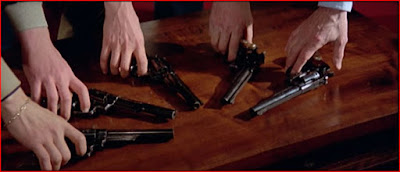
Cops in Italian poliziotteschi films from the 1970s are always griping about the need to escalate police powers in order to counter the escalating arsenal of organized crime. Massimo Dallamano's film -- the last for the cinematographer turned director -- escalates the urgency of the argument to an apocalyptic pitch by granting the cops extra powers early, yet having them instantly outclassed by criminals who are terrorists in all but name. Quelli della calibro 38 leaves you wondering whether something -- censorship or plain fear -- kept Dallamano from identifying his villains as political terrorists. Nevertheless, this film raises the stakes to life or death not only for the cops, but for all the people of Turin.

Though thousands of people are imperiled, the conflict boils down to a feud between Inspector Vanni (Eurocrime stalwart Marcel Bozuffi) and "The Marsigliese" (Ivan Rassimov), a symbolically foreign crime boss. Vanni kills Marsigliese's brother during a raid; Marsigliese escapes and takes revenge by murdering Vanni's wife in front of her son.

Marsigliese got away in the first place because Vanni's firearm failed. That inspires the creation of the Special Squad, armed with the title weapon, equipped with motorcycles and given "just a little extra freedom of action." Just how little is shown when Vanni's superiors learn that his men are using fragmentation "dum-dum" bullets on criminals.

Inspector Vanni didn't take this man's fingers, but if justice demanded it, who knows?...

While Vanni faces a reprimand, Marsigliese acquires a massive stash of explosives and embarks on a terror campaign of bombings, starting with an unlucky informant before moving on to cars and public places. The object of holding the city hostage is to get millions in diamonds and a clean getaway. He has the jump on the cops by tapping into their scanner frequencies, and his mobile remote-control detonator system for the bombs seems to make Marsigliese untouchable.


There may be a weak link in his plan, however: Sandra (Carole Andre), a nightclub owner and girlfriend of Marsigliese's lieutenant Guido whom the boss uses to deliver unwittingly a bomb that kills several people. She's also an acquaintance of Nico (Riccardo Salvino), the Special Squad member with the nearest thing to a personality. With Marsigliese determined to destroy weak links as quickly as possible, Vanni has to piece the evidence together to track the bombers down before more innocent people die....

Colt 38 Special Squad has the momentum of a horror film as Marsigliese's bombings take an increasing toll and the police fail repeatedly to stop him. Dallamano sometimes portrays the film's violence in cartoonishly grotesque fashion, as when the informant blows up and when a crook gets his fingers chopped off by a slamming car door. But the bombing scenes are shot with the gruesome grandeur of the tracking shot of the train-robbery massacre in Dallamano's spaghetti western Bandidos. They give Colt 38 an exploitation epic quality above and beyond the normal scale of police-film violence.

The film is a triumph of style over substance by default, since it's not exactly character driven. Beyond the two principal antagonists, we learn that just about everyone else in the film is expendable as potential relationship storylines disintegrate before our eyes. This only adds to the horrific quality of this effort from a director perhaps best known for his giallo films. As for style, Colt 38 has that in spades, from Gabor Pogany's cinematography for rare night-time car chases and vivid nightclub scenes to one of Stelvio Cipriani's best scores -- including a song by Grace Jones, of all people.

Dramatic night-time stunt work and large-scale widescreen cinematography are highlights of Colt 38 Special Squad.

Thriller may be the best label for the film, and on that level Colt 38 largely succeeds as a thunderous, terrible climax to the poliziotteschi genre -- terrible in the sense of inspiring, if not actual terror, a kind of awe.

Here's the trailer from noshamefilms:

Thursday, November 4, 2010

CREATURE WITH THE BLUE HAND (Die Blaue Hand, 1967)

While no equal to its erstwhile Axis partner Italy in the generation of cinematic genres and subgenres, Germany has cultivated its own national styles and genres, from the globally-influential expressionism of its silent films to the question-begging "New German Cinema" of the Seventies and Eighties. The Germans' most distinctive contribution to the global grindhouse of pop cinema may be the krimi, a genre of crime film as much inspired by a foreign writer (England's Edgar Wallace, a co-author of King Kong) as by national traditions (Dr. Mabuse, etc.) Krimis usually deal with some sort of supercriminal or gang pitted against the intrepid investigators of Scotland Yard -- an Italian tendency to set numerous gialli and other horror films in England may reflect a krimi influence. The German films have several distinctive features, the most prominent arguably being the use of loud, jazzy or loungy soundtracks that give them a dated quaintness today -- and the frequent participation of rising star Klaus Kinski.

Die Blaue Hand, directed in lurid color by krimi specialist Alfred Vohrer, is a Kinski showcase. He's being sentenced for murder as the film opens -- or rather, Dave Emerson is until the respected, monocled Dr. Mangrove (Carl Lange) informs the court that Dave is insane and requires hospitalization. The court so rules, provoking Dave to prove both his innocence and his sanity by leaping out of his box and screaming at the judge. How can you say no to that? All the while, another Kinski watches -- this is Dave's twin brother Richard. Unfortunately, Vohrer's effects budget limits our chances to experience the certain madness of two Kinskis on screen simultaneously.

Subdued, Dave is in a police van awaiting transport to Mangrove's asylum when someone tosses a key inside. Dave has no idea who did this, but he isn't questioning his good fortune either. That night, he breaks out of the asylum and heads for the Emerson mansion, where he gets past an exiting Richard and holes up in his brother's bedroom. Is it a coincidence that, at the same time, a hooded figure sporting an armored, spiked (and yes, blue) gauntlet starts punching people to death at the mansion? It is an old family heirloom, after all.

"You see? It's blue!"

A typical heroic inspector (top-billed Harald Leipnitz) is soon on the case, visiting the Mangrove asylum and inspecting the remaining inmates. This means a literal peepshow view of an insane stripper who apparently suffers from what we might call interpretive insanity. That is, she interprets her insanity by stripping. Nothing else is quite that interesting, though there's also one of those big, bald, stupid looking fellows who are often up to no good in krimis, sitting quietly for the moment in his cell.

Dr. Mangrove's controversial strip therapy concept was denounced in
his time, but he could probably make millions with it today.

The investigation moves on to the Emerson place, where the inspector quickly figures out that the man passing himself off as Richard is actually Dave the fugitive, who has cleaned and dressed himself and exploited the fact that no one in his family -- a mother, two younger brothers and a sister -- can tell the twins apart. The inspector also realizes that Dave is innocent of one thing at least, since die blaue Hand attacks the Emerson girl while Dave is standing in front of him. Now the inspector is willing to entertain Dave's story of a larger frame-up, especially if Dave can help him stop the gent with the gauntlet from wiping out the other Emersons. Richard is already presumed missing, and in short order the two remaining brothers are dispatched, while the brave and comely Myrna (Diana Koerner) undertakes an investigation of her own.

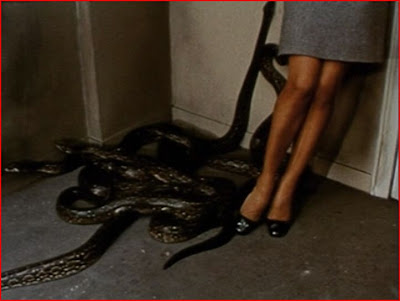
The good guys eventually discover a conspiracy to wipe out the Emerson children and frame Dave for it. Dr. Mangrove is a willing collaborator; his asylum is no more than a dumping ground for people who want to be rid of inconvenient relatives. He'll declare anyone insane for a price, and he'll keep people in line with drugs and torture if necessary. He has his own orwellian Room 101 full of rats and snakes to scare victims like Myrna into compliance if she can't be rescued in time. The mystery, if that's the right word for it, is who's paying Mangrove and having the kids killed. The deeper mystery is why someone needs to parade about in a cloak and use a mailed fist to kill them, but let's indulge the krimi genre in its eccentricities.

You can't get much more evil than Karl Lange's Dr. Mangrove -- but what if you add snakes???

After that characteristic opening scene, Kinski may actually be the biggest disappointment of the film. Since Dave is soon established as one of the heroes, and Richard is absent for most of the picture, the great man doesn't really have many opportunities to do his crazy thing. The idea of twin Kinskis should have resulted in something amazing in its own right, but Creature with the Blue Hand probably never meant to be that film.

Fortunately, Die blaue Hand is a pretty wild movie on its own terms. It crams a lot of bizarre digressions into a mere 74 minutes, not counting some stuff reportedly inserted after the fact by an American distributor. You get a room full of hanging mannequins, a butler who reveals himself as the disgruntled ex-husband of the Emerson materfamilias, and a second inspection of the insane stripper, on top of everything I've already mentioned. If Kinski recedes during the story, Karl Lange emerges as an awesome looking villain in the Germanic Caligari tradition of evil asylum keepers, while Diana Koerner makes Myra an appealing heroine. Visually, even in something well short of restored form, Hand looks great in moody, Bava-influenced color, and the admitted datedness of the music is a point in the film's favor as far as I'm concerned. However faithful he may or may not be to Edgar Wallace, Vohrer came up with a vivid modernized mix of the Mabusian crime tradition and the American "old dark house" style. A film like this was probably campy when it first appeared, but if you can tolerate its absurdities you'll probably be as entertained by this brisk adventure as I was.

Tuesday, November 2, 2010

THE KILLER IS LOOSE (1956)

Leon Poole looks like your typical hapless film-noir antihero. A war veteran, he was apparently sort of a foul-up as a soldier, known as "Foggy" to his sergeant, who happens to show up at the bank where Leon works as a teller to embarrass him with wartime tales. What worse can happen? How about a bank robbery? Possibly goaded by Sarge's ribbing, Leon decides to play hero and tries to stop the robbers from leaving the bank. He gets knocked on the head for his trouble, but he wins the old sarge's respect.

One problem: Leon's play at heroism is exactly that: a put-on. As a wiretap reveals, he was the inside man on the job. On that evidence, Det. Sam Wagner (Joseph Cotten) leads his team to the Poole apartment. Tipped off by his accomplice to the tap, Poole is armed and ready, firing through the door to wing Wagner's partner Gillespie (Michael Pate). Sam and uniformed flatfoot Denny (Alan Hale Jr.) burst through the door, Sam hitting the floor and firing at a shape in the dark. The shape was Poole's unarmed wife. Leon himself is stunned, strangely submissive yet calmly indignant as he lays Mrs. Poole out on their bed before his arrest. He maintains the same attitude through his trial, and upon his conviction promises Wagner that he'll settle accounts with him someday.

To this point, Poole (Wendell Corey) hasn't killed jack, except maybe in the war. That changes after he's rewarded for good behavior with a transfer to an honor farm. Riding with a single guard en route to unload a truck, he kills his keeper with a hoe blade and drives off on a road of vengeance that will lead to the Wagner house, where he intends to settle accounts with literal equity by murdering Sam's wife, Lila (Rhonda Fleming)....

Directing Westerns for Randolph Scott, Budd Boetticher frequently spotlighted inadequate husbands whose wives became potential romantic interests by default for Scott. In this black-and-white thriller, his last film before his alliance with Scott, Boetticher makes the loser archetype, who often ends up a victim, the villain of the piece. Given how his wife died, we ought to feel at least a little sympathy for Poole, and under Scott's tutelage Boetticher might have made us do so. Here, however, he's stuck with a three-handed screenplay and a performance by Corey that reduces Poole to a benumbed zombie. Revenge is a matter of passion, no matter what the Klingons say about the ideal serving, but Corey is hopelessly dispassionate. Some may find him chilling, and that was my own initial impression of him, but he gets too much to do and say after his escape -- including a belabored visit to his old sarge's house -- to retain any mystique for long. Boetticher made a classic of thwarted revenge later, directing Scott as the avenger in Decision at Sundown, but once he's loose Corey's killer is little more than a bogeyman, though he does go off on an interesting tangent to stalk Mrs. Wagner in a woman's raincoat and rolled-up pants legs toward the end.

Cotten is solid as the businesslike hero, and there's a feeling of authenticity to the understated procedural dialogue of the cops, but The Killer is Loose is further sabotaged by a by-the-numbers soap-opera subplot driven by the pregnant Lila Wagner's insistence that Sam quit taking risks. She's ready to leave him over his supposedly foolhardy bravery until it finally sinks in that Sam is offering himself as a target to divert Poole from her. That inspires her to some stand-by-her-man foolhardiness of her own as she treks back to the danger zone with the cross-dressing Poole in pursuit. Fleming does her best with the material, and shares a great little scene with Cotten as she whips up an early breakfast while he freshens up after hearing of Poole's escape, but this storyline wouldn't pass muster with Scott, I suspect, and it doesn't pass muster here.

The Killer is Loose looks sharp despite its shortcomings. Boetticher already knows how to set a stage simply for suspenseful action and exploits urban locations as adeptly as western landscapes. Lucien Ballard's cinematography is outstanding throughout. The opening robbery is sharply done, and the raid on Poole's apartment starts strong, only to grind to a halt as the cops let Poole rattle on about the injustice done him. Boetticher overreaches in a scene when the Sarge dares Poole, who's holding his wife hostage, to fight him like a man, but the climax, with the cops struggling to I.D. Lila or Poole and debating whether to open fire on the stalker with the target so close, gives the film a needed closing jolt of intensity. It's minor Boetticher compared to his westerns, but it's still a solid, if flawed B-movie thriller in late noir style.