A randomly comprehensive survey of extraordinary movie experiences from the art house to the grindhouse, featuring the good, the bad, the ugly, but not the boring or the banal.
Isabel Coixet's erotic thriller never manages to top the outrageousness of its opening scene. It's a business banquet thrown by a Japanese firm for visiting American businessmen to help seal a deal. The men eat sushi -- warm sushi, we're told -- off the bodies of naked women. Wikipedia tells me that the scene created controversy in Japan because audiences there thought that Coixet was perpetuating stereotypes of national decadence. In the film I saw, however, on an IFC DVD, the corporate executive complains about having to go through such a demeaning event because the Americans expect it from them. That is, the scene is a comment on American stereotypes of Japan and the Japanese willingness to cater to them. Was that line added after the premiere or did the critics miss it?
The social comment could easily get lost in what follows, as the executive, Nagara, receives whispered news and promptly transforms the scene into a White Heat homage, slapping the sushi off the poor frightened women's bodies as he launches into a tantrum of grief. His daughter Midori has killed herself. She's left a suicide note written in blood on her bathroom mirror: "Why didn't you love me as I loved you?"
Understandably, Nagara blames his daughter's death on her boyfriend David (Sergi Lopez), a Spanish wine dealer. He wants David's blood and orders his chief flunky to make arrangements. How exactly the arrangements are made is unclear, but we're shortly introduced to Ryu (Rinko Kikuchi), a seafood butcher by trade with an odd habit of visiting cemeteries and compulsively cleaning certain graves. We see her through the eyes of our narrator, a sound-recording technician who admires the way Ryu slurps ramen noodles. Objectively, we infer that the graves belong to people whom Ryu, who moonlights as an assassin, has killed. David is her next target.
Ryu is lonely, David is grieving and Nagara is impatient. Guess what happens?
Ryu:I didn't know there were sensual wines. David:Why not? Everything can be sensual.
Coixet tries to keep it interesting by showing how the lovers struggle with competing alienations, how their love may be less a matter of connecting with each other than a matter of each working out purely personal issues. This is especially true of David, who struggles admirably to fit into Japanese society by learning the language. As it turns out, most of the Japanese he encounters, from his employees to Ryu, are more comfortable speaking with him in English. The fact that the lovers address each other in a third language makes the alienation theme more obvious; this is a Spanish film in which the Spanish language goes almost entirely unspoken. There's a further point to be made about the ultimate inability to comprehend fully another person's issues; that point is made the most as we learn more (though never much) about Midori. It's driven home hardest in a speech by David's employee -- delivered in the most fluent English in the picture -- in which he explains that the girl was unworthy of either Nagara or David's grief. The "you" in her suicide note could have been either of them, or both, but we're assured through this convenient intervention that neither man is really to blame for her death. It seems that people's narcissism inevitably hurts those close to them; the more Ryu realizes that David is on some level using her to work out his grief issues, the more she suffers, and the more likely she may be to take back her decision to renounce the contract on David, if the employers don't act first....
But while Coixet has something interesting to say about the trouble with love, her film ends up being little more than eye candy, all too easily indulging in exotic eccentricity for its own sake. It's handsomely shot, but in a generic way, with the predictable godlike views of Tokyo at night. It burdens itself with pointless quirkiness, showing us not once but twice a person dressed as a shrubbery in a subway station and a group of young people who meet periodically to commemorate different emotions on orders from a meagphone-wielding master. First it's Kiss Day, and later it's Anger Day, and both times Ryu wanders through the absurd scene to illustrate her loneliness and alienation. The point was made the first time. Even the eroticism and the display of two would-be international stars in the nude must compete for your eye with the gimmick of a hotel room in the shape of a Paris Metro car, complete with standing-room accessories. Coixet is too self-conscious about creating pretty pictures or odd images. That and a very predictable tragic finish make Mapa de los sonidos an essentially superficial film. Whether you like it or not will depend on how you like the imagery, but this is a case where style may have undermined the substance of a potentially better movie.
The British-American director Peter Yates, who died yesterday at the age of 81, will probably be best remembered for the seminal cop and car-chase film Bullitt , one of Steve McQueen's definitive roles, or for his bicycle drama Breaking Away from about a decade later. Rather than write more about his career here, I'll just direct you to my favorite among his movies, the gritty proto-Tarantinian crime drama The Friends of Eddie Coyle (1972), a remarkably faithful adaptation of the George V. Higgins novel that has enjoyed a revival of esteem thanks to a recent Criterion DVD release. It's one of the best American crime films from a great decade for the genre, and it may lead to a greater appreciation of Yates's work if more people discover it now.
Phil Karlson takes a huge chance in the opening reel of his based-on-fact crime drama by forefronting the fact. The Phenix City Story opens with its own newsreel; Clete Roberts (whom TV fans will remember playing himself interviewing members of the 4077th on M*A*S*H*) goes to the title town, where the story itself has been filmed on location, to interview some of the real people to be portrayed by actors later, including the widow of Albert Patterson, the candidate for Alabama attorney general who was assassinated on orders from the Phenix City vice syndicate. Conspicuously absent from this round of awkwardly authentic interviews is John Patterson, son of the martyred politician who by the time of filming had become attorney general in his own right. The dignity of his office may have kept the younger man from appearing in the show, but he may also have objected to some sensationalizing of his role in routing the racketeers. In any event, these first minutes are very dry, and have been cut out of some copies of the film. They may have seemed necessary because the story was so well-known nationally, having been covered in the leading magazines and by Pulitzer-winning reporters. The newsreel is Karlson's bona fides, an implicit endorsement by many of the participants in the story that the narrative that follows is essentially true.
After the opening credits come more buildup, now from a narrator who sets the scene. Phenix City is a border town linked to Georgia and Fort Benning by a bridge that brings servicemen to town and, in most cases, to the notorious red-light district along 14th Street, where vice is one of Alabama's biggest industries. After all the hype, one almost expects Phenix City to stand revealed as a bacchanal worthy of DeMille, or at least more Vegas-like than it proves. The reality, according to the movie, was cheaper, grittier, more tawdry overall: a mediocre chanteuse singing the "Phenix City Blues" with a jazz-band backup for a bunch of servicemen while the dice and card tables at the Poppy Club keep busy. This is the crime capital of the nation, "Sin City USA?" This certainly is the place: the film is shot largely if not entirely on location. And despite any initial disappointment at the scale or intensity of vice in Phenix City, the corruption and viciousness gradually grows on you.
The racketeers of 14th Street control law enforcement locally and have pull throughout the state. That means they can and do get away with murder thanks to cooperative or merely cowardly jurors. Old Albert Patterson (John McIntyre) knows the score and is just as reluctant from a pragmatic standpoint to work with the town's would-be reformers as he is from a moral standpoint to collaborate with the big boss, Rhett Tanner (Edward Andrews). His son John, just home from Europe and not necessarily eager to join his father's firm, proves less tolerant of conditions. Having dealt harshly with Nazis, John has little tolerance for Tanner's goons beating up respectable citizens or disgruntled gamblers. He wades in with his fists and finds allies in a Poppy Club patron whose girlfriend is a dealer there and a black janitor who saves John from an attack from behind by way of submitting his resignation. Whether John Patterson's crimefighting career started so dramatically or not, the film version gives Karlson a chance to film one of his patented brutal brawls with frame-shaking impacts and bodies practically falling into the first row of theater seats.
Antagonists: Rhett Tanner (Edward Andrews) makes an offer not to be refused; below, John Patterson (Richard Kiley) studies a fallen foe after a barroom brawl.
14th Street strikes back ruthlessly, first by kidnapping and killing the janitor, Zeke Ward's, daughter as punishment for him and a warning to John Patterson and his small children. Another Patterson ally gets his skull bashed in, but a jury decides that the victim somehow dashed his own brains out falling into a sawdust-covered, rock-free ditch.
The sight of a dead child is a particularly gruesome moment from Phenix City.
The jurors' disregard for the elder Patterson's proofs is the final straw for the old man. He's now convinced that the only way to break 14th Street is to take the reins of law enforcement at the state capital as attorney general. Some viewers may be confused by what follows, since his nomination seems to be equated with his election. Patterson is in fact running in the Democratic primary, which in the days of the "solid" segregationist South and a powerless Republican party was virtually the general election. Though Tanner's goons control the voting in Phenix City itself, beating the tar out of any opposition voters, they can't rig the whole state. Albert Patterson wins the primary and is deemed the "attorney general nominate," a counterpart to "attorney general elect" in other states. His victory gives 14th Street two options. They could throw all their resources behind a Republican candidate who presumably exists, or they can simply kill Patterson.
The Phenix City Story is a successful thriller because Karlson pulls off the great trick of first telling you exactly what will happen and then making the actual happening on film a matter of great suspense. Instead of resignation toward Albert Patterson's doom, the audience has been goaded and galvanized by Karlson's storytelling to root for the good guys to win. You want the old man not to be killed. At the same time, Karlson has told you that the story will end happily, that Phenix City has been cleaned up and 14th Street routed, yet the omnipotent violence of the Tanner gang and the pure inevitability of Albert's destruction leave you wondering how they could possibly lose. As it is, the end came less dramatically than portrayed here. We know that the governor declared martial law after Patterson's assassination, but in the film the arrival of the National Guard to shut down 14th Street looks like mere mopping up after John Patterson and Zeke Ward take justice, if not the law, into their own hands.
Apart from the scandalous history it recounts, Phenix City has a point to make about the rule of law. We're only twenty years but really a world away from the vigilante films of the Seventies set in similar locations, including some films also based on more or less real events. While those later films glorify the act of a citizen becoming judge and executioner, Karlson and writers Crane Wilbur and Daniel Mainwaring take every opportunity to repudiate vigilantism. We're told that vigilante tactics have been tried against 14th Street before, in vain; one can imagine Tanner's goons beating the krap out of the Klan back in the Twenties, if they didn't just co-opt the local klavern. Even on the night of his father's murder, John Patterson has the clarity of mind to talk a lynch mob out of sacking 14th Street, though he'll get to take some non-lethal vengeance on Tanner himself later that night. Zeke Ward has every reason to kill the man who murdered his daughter, but when his wife restrains him and reminds him of the commandment against killing he comes to his senses in time to talk Patteron out of killing Tanner. If you're accustomed to the vigilante style of the Seventies and after it can't help seeming to disappoint, even if you admit to yourself that the film is constrained by history. But the presumably fictional violence Karlson throws in at the end to please the crowd confuses the ultimate message. Did 14th Street fall because someone in authority finally stood up for law and justice, or because someone finally beat the shit out of the head gangster?
In retrospect, a reviewer might raise questions about the racial politics of the film. John Patterson looks like a racial progressive by association with Zeke Ward, but the real man as attorney general and later as governor proved a staunch supporter of segregation and an enemy of the civil rights movement, though the still-living Patterson caught up with the times enough to endorse Barack Obama for President in 2008. Karlson's film left me wondering how race factored into the real Phenix City story. In the film, Zeke Ward and his family are tokens, and we don't know whether other blacks partook in or benefited from vice, or whether any relation between blacks and organized vice influenced white citizens' view of 14th Street. These questions shouldn't color your final judgment of Phenix City as a film, but they're food for thought just the same.
On its own terms, The Phenix City Story works as a hard-hitting, convincingly brutal expose of the American underbelly. Its inclusion in the latest Warner Home Video Film Noir Classics collection (Vol. 5) is justified by the subject matter, if not by the entire checklist of noir archetypes, and by a successful exercise in night-shot noir by Harry Neumann on location in the actual town. On the acting side honors are shared by Richard Kiley's intense heroics and an unexpected, turn against type by perennial fuddy-duddy Edward Andrews as the casually vicious villain. Karlson's film is strong rabble-rousing stuff that'll get you mad, just as the writers and director intended. The compromises it makes at the end leave it a little short of classic stature, but it's certainly worth a look for any fan of American film from the Fifties.
Jean-Pierre Jeunet declares his influences early in his latest film. He shows his hero watching The Big Sleep and lip-syncing Bogart's dubbed-French dialogue. The opening credits are in black and white, and in English, and the music of Max Steiner plays over them, as it will through much of the film. All the zaniness to come, then, is a riff on classic Warner Bros. melodrama -- or is it more of an homage to the cartoons of Tex Avery, one of which is excerpted in the scene when the hero finds himself fired from his video-store job? MicMacs is definitely more plausible as a cartoon homage, but all these overt acknowledgments of Hollywood influences strike me as misdirection after the fact. For one thing, the overall flavor of the thing remains very French. For another, if it reminded me of Hollywood at all, it was reminiscent less of any Warners or Steiner-scored story than of a Frank Capra film. If you're a cosmopolitan film buff with a long view of history, think of MicMacs as a mix of Les Vampiresand You Can't Take It With Youand you've just about nailed it.
There's a little Mel Brooks in the mix as well. Our hero hears the Steineresque score swell up on the soundtrack, but the camera reveals a symphony orchestra behind him -- or is it just a brain-damaged hallucination?
The Capraesque revenge tale deals with Bazil (Dany Boon), who as a child is orphaned when his father is killed by a land mine in the Western Sahara and his grief-stricken mother is taken to the nervous hospital. As a grown man, Bazil is the archetypal video-store clerk until he's shot in the head through a freak accident. The bullet can't be removed without rendering Bazil a vegetable; left there, it could kill him at any moment. Released from the hospital, he learns, as you learned a moment ago, that he'd been laid off. He becomes an almost Chaplinesque figure, pantomiming for coins, until he falls in with an eccentric extended "family" of junkyard scavengers, inventors, contortionists, etc. They join him in his madcap quest for revenge on the arms dealers whose mines and bullets have marred his life. A human cannonball, an African conspiracy, Benito Mussolini's eye and Marilyn Monroe's tooth all figure in, and Bazil must often literally think fast to keep himself from dropping dead on short notice.
Whimsy: above, a weightlifting robot; below, Jeunet mascot Dominique Pinon as the record-seeking human cannonball.
With a filmography ranging from Delicatessen to Amelie, Jeunet should have any viewer on whimsy alert. I've been able to tolerate and even enjoy his past work (excepting Amelie, which I haven't seen), but MicMacs is the first Jeunet film I've actually disliked. Its heart is in the right place and it picks the right targets, but the fatal flaw of self-amusement poisons the atmosphere throughout. The film is too cute, too quaint, too self-consciously adorable for its own good. Maybe French viewers and Europeans in general have a greater tolerance for such labored whimsy, but I found it insufferable from an early point. In the film's defense, I think Jeunet is quite consciously employing groaner humor, such as the historically inevitable joke on the phonetic intersection of French poetry and American one-man army films. An arms dealer boasts to his son that he compared himself to Rimbaud in a speech. "Do you know who Rimbaud is?" he asks the boy. "You need to work out more," the child answers.
Overall, however, the best I can say is that it didn't get that much more insufferable as it went on. The complicated maneuvers of the plot may keep people interested, and the film grows slightly more tolerable as it gets more active. In sum, MicMacs seems like a step backward for Jeunet following his least generic film, A Very Long Engagement. But to be fair, for a contemporary fantasy film you could probably do worse. I tremble to think what an American MicMacs would look like.
A childhood memory: It was a Sunday morning, I think, sometime in the autumn. We had the channel on for the football game, and water was already boiling for an early dinner and steaming the windows. I remember almost nothing distinctly about this movie except a strange sense of awe at the thought of scientists trekking to the Arctic to thaw out a man frozen for centuries. The stark stillness of it stuck in my mind, the lack of a soundtrack somehow making it seem, if not more real, then more true. The film didn't scare me, really, but the idea of it left me with a vague dread that lingered long after I forgot all the details of what happened after they brought the block of ice and the man in it back to civilization.
Since then, of course, I've read all about Phil Rosen's film, Bela Lugosi's last Monogram release for Sam Katzman's Banner Productions unit. I knew better than to expect any confirmation of my ancient memories when I clicked Play on the Netflix stream, but I hoped for some moment of recognition, to see something I could remember seeing nearly forty years ago. Needless to say, the shots of parka-clad Lugosi and John Carradine, with two extras picking away at studio ice, in front of a now-unconvincing backdrop on an ill-dressed set, couldn't be as evocative as the ideas they symbolized were when I was small. The nearest I came to a frisson of recognition, I think, when I saw a closeup of the block of ice in Lugosi's lab, as he's about to take a blowtorch to it. Something stirred then, barely. I could still appreciate how the simplicity of it all would be more suggestive to a child than a more colorful, more musical, more elaborate presentation. There was an emptiness you could fill with your own imagination, if you chose.
Or you could just laugh. To the extent that I saw Return of the Ape Man with fresh eyes, it was pretty damn hilarious. Despite the title, it isn't a sequel to The Ape Man, in which Lugosi had accidentally regressed himself into a missing-link state and could cure himself only with that Poverty Row cure-all, spinal fluid. But the title is literally true if you accept the "Pithecanthropus" specimen ripped from a glacier as an "ape man" who "returns" to life under the dedicated ministrations of Professor Dexter (Lugosi), for whom an anthropological expedition to the wintry, presumed habitat of early man is but a continuation of the experiments undertaken with his colleague, Professor Gillmore (Carradine), in freezing and reviving live human subjects. The film opens with the scientists thawing out a hobo they'd lured off the street and paying him five bucks for his trouble. So far, so good. Dexter believes that persons frozen as the hobo was could be preserved for years or centuries and still be revived as good as new. Gillmore points out that it'd be impossible for them to live long enough to test the theory, but Dexter argues that thawing an early human out of his icy tomb would prove his point without taxing his longevity.
So off to the Arctic they go, the trip illustrated with stock footage and inexplicably festive library music. Gillmore soon grows homesick, protesting to Dexter that he's married, after all. "I'm married, too," Dexter answers, "A true scientist is married to his profession." Gillmore grudgingly perseveres and is rewarded by the discovery of an icebound body moments later.
"I'm back!" The returning Ape Man acclimatizes himself to his new surroundings, including Bela Lugosi (left) and John Carradine (right).
Transported and thawed, the caveman (Frank Moran) is confused and violent. Dexter can only control him with the blowtorch he used to thaw out the primitive. "He knows his master!" Dexter proclaims, on the presumption that his subject never understood fire in his first life. Getting more information is difficult, since the ape man appears incapable of language. Dexter's solution is a partial brain transplant, grafting just enough grey matter to make the subject articulate if not reasonable while avoiding the confusion over identity that complicates so many brain-transplant pictures of the time. Still, Gillmore is troubled by the idea, since the modern brain matter must come from a live subject, and that would mean murder. "Murder is an ugly word," Dexter counters, "As a scientist, I don't recognize it."
Lugosi's Dexter is a classic absent-minded professor. He now wants to harvest brain matter from a live, modern human despite his colleague's qualms. You or I, being practical people, might go about this well out of range of the colleague's scrutiny, choosing a complete stranger, or maybe the hobo again, and maybe taking the extra precaution of disguising yourself in a gorilla skin to throw off suspicion. The guileless Prof. Dexter, however, goes to Prof. Gillmore's party and instantly targets the beau of Gillmore's niece. Dissembling is alien to Dexter's scientific nature. He states what's on his mind quite openly, observing: "You know, some people's brains would never be missed." Gillmore himself figures out quite quickly what's up, thwarting Dexter in the nick of time and breaking off social relations with him.
A scene from an unrealized Monogram James Bond picture? Not quite.
(I must throw in a speculative historical note. Dexter's designated victim happens to be named Steve Rogers. That fact compelled me to wonder whether Stan Lee or Jack Kirby had seen this film and recognized the name as the civilian identity of Captain America, Kirby's creation for whom Lee was writing at Timely Comics when the movie came out. Did such a mental association of the film with Cap inspire either man to bring the star-spangled hero back to comics in the 1960s by having him thawed out of a block of ice? Or is this just one strange coincidence? You decide.)
Unable to improve his charge's mind, Dexter must be constantly careful lest he break free of his cage and run amok in public. During one such misadventure, the caveman kills a cop before Dexter rounds him up with his trusty blowtorch. Now he can think of only one way to redeem the situation: he must lure Gillmore back to the lab with a promise to destroy the primitive, then take the professor's eminently useful brain. Lured, Gillmore steps into Dexter's trap, a carpet wired so Dexter can hit his former friend with a paralyzing current. The paralysis allows Dexter to explain what will happen while allowing Gillmore to chide Dexter some more and nobly resign himself to his fate.
"I have advanced his mind 20,000 years in a few hours," Dexter boasts after the surgically enhanced apeman responds with a nod when asked if he feels all right. He grows more verbal gradually, but it looks as if Dexter has used too much of Gillmore's brain. The poor creature thinks he's Gillmore, and he has the dead man's aptitude on the piano, playing the Moonlight Sonata when he breaks into the Gillmore home one night. As with some brain-transplant subjects, the ape man is torn by conflicting impulses: Gillmore's affection for his family and his own primal compulsion to kill everything that moves. Snap goes Mrs. Gillmore's spine and the conflicted creature is on the run again. Finally, now that the cops are closing in on him, Dexter realizes that the experiment has to be brought to a close. But before he can light up a rolled-up newspaper, the caveman breaks his back and bolts out again, soaking up bullets with ease as he goes. Our ancestors were bulletproof, you see, the best proof of that probably being that they didn't have bullets in those days. But if bullets can't hurt Pithecanthropus, Dexter knows what can. The cops' only hope is fire....
It's not the same woman in both shots, in case you were wondering.
Obviously, Lugosi fans will enjoy some of the great man's mighty utterances here, and the sight of him caveman-wrangling with his blowtorch is an inspiring one. But because the apeman carries the burden of terror for most of the picture, Bela inevitably takes a back seat after a while, making this something less than a definitive vehicle for him. As for Carradine, I don't know whether it was more humiliating for him to play an idiot servant in something like Voodoo Man or a complete straight-man character in this film. His career was clearly in crisis, already, and that seems sadder than Lugosi's situation, since the Hungarian was arguably still at a career peak of popularity here. In any event, Carradine contributes nothing in a thankless role. As the Ape Man, Frank Moran is a fairly unformidable subhuman, but it's still a fairly amusing spectacle to watch him run around. Return of the Ape Man is almost irredeemably dumb, but I still say that its absences and lapses, its very impoverishment, might still allow it to make a moody impression, entirely unrelated to its narrative or performative virtues, on people of an impressionable age or temperament. You never know what a child will make of something.
On December 31 I closed my moviegoing year with the film that may be the most divisive among reviewers and bloggers released during 2010. Black Swan is Darren Aronofsky's follow-up to The Wrestler, my favorite film of 2008 and reinforces the director's fascination with self-destructive personalities. In his new film Aronofsky brings his preoccupations into the world of ballet, practically daring film buffs to draw comparisons with Powell & Pressburger's Red Shoes. It's probably a mistake to assume that the director was attempting a modern-day Red Shoes and to judge him by that standard. It became clear to me pretty quickly that Aronofsky is not in the least interested in the romance of artistic life and performance that drives the British film. He makes little effort to make ballet beautiful or attractive, instead making everything orbit in subjective confusion around Natalie Portman. Only at the end, when a performance of Swan Lake traces the Portman character's mental breakdown, does he show any ambition to emulate or top the Archers. More often, I was reminded, perhaps appropriately, of American archetypes. Rather than his Red Shoes, Black Swan is arguably Aronofsky's All About Eve, or his 42nd Street ("You're going out there a newcomer, but you've got to come back a mental case!") or, as many, myself included, may be tempted to say, his Showgirls. I offer that last as a value-free statement; let each interpret it by his or her own lights. For some, it may be a recommendation, and if anyone feels that way I see no reason to disabuse them. But it has to be said that Black Swan is a camp classic or else no kind of classic. It's a work of authentic, naive camp; Aronofsky films the script by Mark Heyman, Andres Heinz and John McLaughlin as if unaware -- not indifferent but unaware -- that every character in it is an idiot. The entire story is founded on the notion, propounded by a choreographer (Vincent Cassel) whose intellectual or aesthetic credentials are never questioned, that a ballerina must tap into some sort of dark side in order to dance the role of the Black Swan in the Tchaikovsky ballet. This advice is given to a dancer (Portman) so repressed and infantilized by her mother (Barbara Hershey) that her success to date in the dance world is a mystery. There's a story in the mother-daughter relationship, mom having given up her own career to raise the girl and now feeling both vicarious triumph and jealousy over being surpassed, but the situation seems inadequate to explain the daughter's paranoia, hallucinations and scratching fits. The cut-throat competitive world of ballet contextualizes things a bit more, but Nina Sayers' aria of insanity seems more a matter of innate mental defect than a product of family or career pressure. The character is conceived entirely in reactionary terms and gives no evidence of an inner life. We never get any sense of Nina's own artistic aspirations or sensibilities, or whether she dances for her own pleasure or her mother's. Because Nina is a void, there's no pathos to her accelerating breakdown, nor much rooting interest in the possibility of her escaping it. And for this almost perfectly thankless role Natalie Portman is considered a favorite for the Academy Award. She certainly gives it her all, but Nina is such an overdetermined character that it's difficult to see what Portman could really contribute to the role apart from conviction and dance skills. Hers isn't a true camp-classic performance because it never transcends the material, but is captive to it. It proves, however, if the last three Star Wars films hadn't already, that Portman is a trouper. She balks at no hoop before jumping through it. Ask her to feign masturbation and she'll do it. Require her to make out with Mila Kunis and it's done; it may not even have been burdensome for her. Portman is fully dedicated to your entertainment, and that should count for something. But I've got to think that there have been better female performances in 2010, even if I haven't seen them yet. It's not Portman but Aronofsky who cements the film's camp standing, first with his unironic direction of the soap-opera setup, and then with a final half-hour payoff of visionary delirium that'll redeem the picture for a lot of viewers. It didn't quite redeem it for me -- or hasn't yet in retrospect -- because the buildup to it was so oppressively oppressed, but the film as a whole has clearly struck a chord with many people, if only because so many people see themselves, or imagine the people around them, on the brink of self or mass-destruction. If not the Red Shoes of our time, Black Swan is certainly a fable for it. What that says for our time is another story.
Hammer followed the success of Roy Ward Baker's The Vampire Lovers with Jimmy Sangster's Lust For a Vampire, a film my friend Wendigo has seen but once. Once was enough: the lead actress, though quite a looker, was no Ingrid Pitt when it came to talent or personality. Nothing about Lust impressed him, and to have the vampire woman lusting for a man violated the Carmilla concept. Whatever its original audience thought, Hammer persevered and put John Hough to work directing a third "Karnstein" film. This time, though, the British studio brought some extra exploitation inspiration to the project, merging their signature vampire product with the then-hot topic of witch-hunting. The result is a conceptually dynamic film that I prefer to Vampire Lovers, while Wendigo himself has some justified reservations.
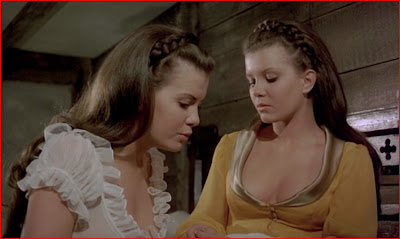
The Collinson twins differentiate themselves gradually over the course of the film.
For most of the picture, the titular twins (played by pioneer twin Playmates Mary and Madelaine Collinson) take a back seat to a war of wills waged by witch-hunter Gustave Weil (Peter Cushing), the head of a torchbearing Brotherhood, and the decadent Count Karnstein (Damien Thomas). The Count routinely has his way with local women, doing who knows what in his castle, but the bourgeois Brotherhood can't touch him because, as an aristocrat, Karnstein enjoys the protection of the Holy Roman Emperor. The war of wills is a class war fueled by Weil's resentment of Karnstein's privileges -- and his sexual prowess, we can assume -- and Karnstein's libertine contempt for Weil's intolerant moralizing. In their first encounter, Karnstein looks more like a hero, since we've already grown suspicious that the Brotherhood is burning innocent women. We're inclined to think that Karnstein has Weil well pegged as the real villain of the piece. However, amid the witch-burning there's this nagging business of a vampire. Someone's in the woods biting necks. Who could that be?
Both Gustave Veil (Peter Cushing, above) and Count Karnstein (Damien Thomas, seated below) have sins to answer for, but is that poor schmuck with the bite on his neck (bottom) one of them?
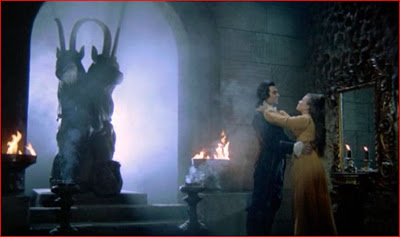
Count Karnstein, perhaps? The answer seems to be no, at least at first. We see the Count become a vampire by performing a blood sacrifice to summon the spirit of his ancestress Mircalla/Carmilla for a round of necro-incest prior to the necessary bite, but that begs the question of who was biting folks before. Wendigo thinks it a major weakness of the picture that this question is never really answered. We may be meant to assume that Karnsteins are running around all over the place, but since we see no other vampires before the Count summons Mircalla, we can't draw any conclusions about the early vampire attacks with any certainty.
The Ghost of Vampires Past approaches Count Karnstein. Below, director John Hough makes the most of mirrors and mirror-related effects, including the Count's loss of his reflection as he becomes a vampire.
In any event, the battle between bourgeois morality and aristocratic depravity is played out in miniature between the newly-arrived Gellhorn twins. Maria (Mary) is the good girl, while Frieda (Madeline) is the wild child. Only Anton (David Warbeck), the choral instructor of the local Hammer Academy for Highly-Developed Young Ladies, senses the moral difference between the twins, and can thus tell them apart reliably when no one else can. Frieda resents the discipline imposed by Uncle Gustave and is attracted by the Count's decadent reputation. Maria isn't exactly happy with her uncle, but doesn't feel the same temptation to transgress out of spite that Frieda feels. Maria's too good for her own good. When Frieda runs off to spend a night with Karnstein and is turned into a vampire, Maria covers for her, convincing Gustave that she's Frieda and that Maria had run off for the night. For her trouble, Gustave beats "Frieda" with a belt and is sure to beat Maria in the morning to punish her. The real Frieda doesn't care.
Anton has been studying vampire lore, and tries to explain to Gustave that the local problem is vampires rather than witches, and that burning suspects will do no good. You get a sense that, on some level, Anton is simply trying to discourage Gustave from burning women. But when his sister turns up dead by neckbite (and not necessarily by Karnstein or Frieda) he makes vampire fighting a serious vocation. Gustave gets wise when he catches Frieda in the act, but convinces the Brotherhood to behave themselves and hold the vampiress in prison for a time. That gives Karnstein time to kidnap Maria and do the switcheroo, so that Maria is brought to the brink of burning before Anton convinces Gustave to give her the crucifix test again. A now quite repentant Gustave rallies the Brotherhood to join Anton in an assault on Karnstein castle to destroy the aristocrat and his evil acolytes once and for all. Normally Peter Cushing vs. vampires has a foregone conclusion, but this time around he may have too much to answer for....
Twins may not have as much nudity as one might hope for, but the final reel has plenty of gore to keep up Hammer's street cred.
Wendigo acknowledges that Twins has a lot going for it. It has a strong male cast, Cushing, Damien Thomas and Peter Warbeck all giving good performances grounded in the film's social and cultural context. The film is admirably ambiguous in making Cushing a virtual villain motivated by obvious jealousies and resentments who only gradually evolves into an antihero. Count Karnstein also evolves, or devolves, from a mere libertine skeptic who initially scoffs at a purported sacrifice to Satan into someone who embraces absolute evil as almost an aristocratic imperative. He looks like he'll be the antihero at first in that early confrontation with Gustave, but his aristocratic prejudices seem to doom him to wickedness. Amid the confusion, Anton emerges as the least ambiguous hero -- though I initially suspected him of being the original vampire. Wendigo also likes the way the conflict between the twins echoes that of Weil and Karnstein, with the sisters taking opposite extremes of fatal selfishness and almost-fatal selflessness. After stumbling with the first sequel, scripter Tudor Gates, who worked on all three Karnsteins, was really back on his game this time. Technically, Twins is a knockout, richly envisioned by Hough and usually realized evocatively by cinematographer Dick Bush and art director Roy Stannard. Interiors and exteriors are often quite striking, and Twins overall looks richer and more striking (whatever the difference in budget) than Vampire Lovers.
Wendigo wants to stress again how irritated he was by the film's failure to identify the original vampire. For him it's a major, almost crippling flaw of the story. If anything, the whole vampire angle is a weakness of this ostensible vampire movie. That's because he feels that both Frieda and Count Karnstein became less interesting once they became conventional vampire villains. He also feels that Hough bungles one major scene, the bedroom tussle between Anton and Frieda disguised as Maria. Shot with a handheld camera and a fisheye lens, it was probably meant to express immediacy, but in Wendigo's opinion it only looked amateurish and made Madelaine Collinson -- in her one nude scene -- look silly. Meanwhile, the business with Joachim, Karnstein's mute black servant, having to pantomime that the Brotherhood is advancing on the castle, looks goofy to say the least if not a little racist. Joachim gets his own back later with an impressive cleaver-to-the-head attack on a Brother. Finally, Harry Robinson's music is probably inappropriate in its own right, sounding more like a swashbuckler soundtrack, but his main theme now sounds alarming like the opening music for the Justice League cartoon series of a few years back. That's not Robinson's fault, but anyone who "recognizes" the music may have a hard time taking the film as seriously as it deserves.
While I've stated my preference for Twins over Lovers, Wendigo is reluctant to name a favorite of the two. The original film retains the overwhelming asset of Ingrid Pitt, while the stunt-cast Collinsons don't impress him as actors. Also, like Lust, Twins is almost lesbian-free, which is simply wrong, in Wendigo's opinion, for material derived from Carmilla. It also has less nudity in general, a fact that surprised and disappointed Wendigo somewhat. While this makes it look like he leans toward Lovers, he feels that the comparison is like apples vs. oranges. I'll accept that because Twins really took the Karnstein concept in a new direction and practically into a new genre. What keeps them together in a trilogy, beside the Karnstein name, is a concern with vampirism as an analog for sexual deviance, whether Lovers' obvious lesbianism or Twins' implicit libertinage. In the end, Wendigo likes both films for different reasons, flaws and all. Throw out the middle film and you have an admirable diptych of late Hammer nearly at its best.
Here's a British trailer uploaded to YouTube by flotzcore.
 Isabel Coixet's erotic thriller never manages to top the outrageousness of its opening scene. It's a business banquet thrown by a Japanese firm for visiting American businessmen to help seal a deal. The men eat sushi -- warm sushi, we're told -- off the bodies of naked women. Wikipedia tells me that the scene created controversy in Japan because audiences there thought that Coixet was perpetuating stereotypes of national decadence. In the film I saw, however, on an IFC DVD, the corporate executive complains about having to go through such a demeaning event because the Americans expect it from them. That is, the scene is a comment on American stereotypes of Japan and the Japanese willingness to cater to them. Was that line added after the premiere or did the critics miss it?