Monday, November 2, 2015

JAUJA (2014)

International man of cinema Viggo Mortensen returns in a role that allows him to try Spanish again, after his mixed reviews for Captain Alatriste, as well as his ancestral Danish. Argentinian director Lisandro Alonso and co-writer Fabian Casas have crafted a tale that resembles The Searchers on the scale and in the tone of Meek's Cutoff, with a folkloric if not fairy-tale quality that should have tipped me off that something more or less than meets the eye was going on. There's a studied primitivism to this period piece; leave out the fine color cinematography of Timo Salminen and it could have been made almost the same way one hundred years ago. Alonso works in long takes, in scenes that aren't built around dialogue, requiring Mortensen in particular to do a lot of non-verbal business to help define his character. The director likes to show characters taking their time coming toward us, then taking their time moving away from us. He emphasizes the spatial relationships between his characters. In an early shot, a soldier is bathing and masturbating in a small natural pool. While he works himself over, a figure appears in the distance from screen right. A cut reveals this newcomer as Mortensen, whom we watch puttering about as the soldier, now in the distance, dries up, dresses, and approaches him. There's something inherently old-fashioned about the pacing that enhances the period feel of the scene. Alonso has an effective style that looks superficially like an absence of style.


Mortensen plays Gunnar Dinesen -- is there a homage to Karen "Isak Dinesen" Blixen of Out of Africa fame there? -- an engineer and advisor to the Argentian army, apparently concerned above all with keeping his daughter (Viilbjørk Malling Agger) away from that wanker and other soldiers. His efforts avail him not, as Ingeborg elopes with a younger, better looking soldier. We're in Searchers territory once Dinesen heads out alone in pursuit of the couple, with all three in danger from renegades. Gradually it seems to become a different kind of quest, or else a different kind of story altogether.


Alonso's neo-primitivist storytelling leads you to believe that Jauja is some sort of naturalist narrative, but all along there's something almost too quaint about it. It could be the curved corners of the old-timey 1:33 aspect-ratio frame, which made me think of 19th century photographs. Maybe there's something too obviously archetypal about it, apart from the most obvious Searchers references. And maybe a spoiler warning is in order, since at a certain point, when Dinesen encounters an old woman in a cave, Alonso's tale becomes something more like a dream, or a blood memory half-recovered in a dream. The film ends far in time and place from Patagonia, but the message seems to be that dreams, myths or archetypes can transcend distance, or else that the distance between present and past, or history and dream. is even less. You can complain that this takes you right out of the picture, if you wanted to know what happened when Dinesen caught up with his daughter. But maybe a point is being made about your offended sense of linear time when a film finds reason to remind you that it's only a film, and all of it only fiction. You may try to reclaim some sort of linearity by figuring out who the girl in modern dress is, and the director himself leaves clues that point to the relevance of the Dinesen story to the present-day epilogue. But there's no denying that Jauja is the sort of film that will leave people asking "Is that it?" in way that questions whether there was ever an it to it. I suspect that there is an it to it after all, but I'm not sure yet whether there's enough of it to justify the tease that Jauja perpetrates. There's still the beautiful cinematography, the admirably laconic direction, and a fine, fully committed physical performance from co-producer Mortensen, and the twist, if you want to call it that, doesn't take any of that away. Watch the film for those, and judge the rest for yourselves.

Friday, October 30, 2015

On the very small screen: BEASTS OF NO NATION (2015)

Cary Joji Fukunaga's movie has been touted as Netflix's first feature film, but the rental and streaming superpower only bought into the project after it had been shot, paying $12,000,000 for distribution rights concurrent with its streaming debut for subscribers. Since few theaters wanted to do Netflix any favors by actually exhibiting the film, I ended up watching it on my trusty e-reader's 7" screen. The picture quality is good, but some urban and jungle scenes probably need a bigger screen to fully breathe. Since it has an intimate focus, the travails of one boy, despite a potentially epic setting, Beasts of No Nation is a fairly device-friendly picture, but that same narrow focus probably limits whatever impact Fukunaga, who adapted Uzodinma Iweala's novel as well as directing, may have intended for it.


The overall feeling is like Apocalypse Now as a boy's adventure film, or if you prefer, a boy's adventure story in the manner of Apocalypse Now. The boy is Agu, (Abraham Attah), a pre-teen citizen of an unnamed African country. Agu is a bit of a rascal; he and his friends are first seen trying to sell an "Imagination TV," i.e., a hollow console behind which they perform in various genres as one boy changes the theoretical channels. It's a state-of-the-art device; call up the 3-D channel and one boy will dive through the empty picture window, right at you! The punch line comes unexpectedly some time later, when we learn whose TV has been dismembered for this purpose. This early comedy is meant to make the radical change in tone more abrupt and stark.


The enemy is coming. They have a name, but the fact is, there are lots of enemies, lots of militias with a bewildering variety of initials. Is it the People's Front of Judea or the Judean People's Front? None of them are taking prisoners, however, and when one particular militia comes to town Agu's childhood, poor but in some ways idyllic, comes to a violent end. The family is broken up, mother ferried out of town with the youngest child, but while Agu was meant to go along he ends up with his father and brother, both of whom are mowed down by the occupying militia. In the confusion Agu escapes into the jungle, where his chances look bleak.


Agu is recruited into another militia, led by the charismatic Commandant (Idris Elba). He has a way with child soldiers and a way with soldiers in general; we see him lead his men to take a well-guarded bridge with little more than his force of personality. Afterward, he orders Agu to kill his first man, telling him that the sobbing wretch at his feet is one of those who massacred his family. It's unclear whether Agu believes this or whether he just wants to make his pathetic victim shut up. His new pal Strika, hardly older than he, joins in the slaughter as the Commandant watches approvingly.


To Agu the Commandant may look like a conqueror in his own right, but he answers to higher powers, to his own chagrin. After suffering repeated humiliations when summoned by his supreme commander, the Commandant decides to strike out on his own, taking his militia with him, but this proves a foolhardy. In time his spell over Agu and the others is broken, but where can they go from there?...


Abraham Attah makes an impressive debut as Agu, while Idris Elba is impressive as ever as the Commandant. They could be a modern Jim Hawkins and Long John Silver, if the old pirate had fed his boy drugs and demanded sex from him. Some see the Commandant as a new Kurtz, somewhere close to the original heart of darkness of Joseph Conrad's story, but a Kurtz less easily eliminated. Beasts of No Nation may well leave audiences wondering whether "Exterminate all the brutes" isn't the right idea, though that probably isn't the response Fukunaga was hoping for. It really depends on whether he intended the film as a consciousness-raising expose of the wars still ravaging Africa, or as an atrocity exhibition. The apparently deliberate vagueness about its setting subverts any educational purpose Fukunaga may have had. Someone watching this film should want to know why these things are happening, and there really can't be even a hope for a solution unless we have such an understanding. Why are all these groups fighting each other? The only hints we get are the sight of the international businessmen waiting on the Commandant's boss and the sinister, authentic slogan occasionally seen and heard: "It's Our Turn to Eat." Politics in Africa seems to be a zero-sum game of tribes and factions for whom war is a natural extension. But it doesn't take much research to learn that there's more in play than that, and any film set in modern Africa, whatever its source, owes it to its audience to show that something more is going on than generic African savagery. I'm sure Fukunaga didn't mean it this way, but I wouldn't be surprised to see Beasts condemned as a racist film, and the writer-director has himself to blame for not the providing the political context that would refute any essentialist inferences audiences might draw. Fidelity to art may limit Fukunaga's options, since the novel requires us to see everything from a small boy's limited perspective. But the director doesn't help his case with a rather generic approach to war and its horrors. The experience of a child soldier is novelty enough to justify the film, but when the child soldier re-enacts a scene from All Quiet on the Western Front late in the picture some of the necessary novelty is diluted by movie memories. Nor is the ending as inspiring or inflammatory as it could be; instead, the film glides to a gradual stop with a promise that Agu can learn to be a boy again and play like other boys in the surf. Everything's okay, then, if he's going to be all right. There's something inexcusably Hollywood about that, as if the survival of the individual excuses the general horror. By now, though, I think I'm guilty of special pleading against the film. I should make it clear that Beasts of No Nation is a fine, often alarming, sometimes horrific film that should have some impact on viewers, and I recommend that people see it.  It ought to make people want to know why such things as they see on screen have happened in Africa, but it will give them very few answers, and by the time it's over audiences' aroused curiosity may have dimmed or died -- and if so, that's a failure.

Sunday, October 25, 2015

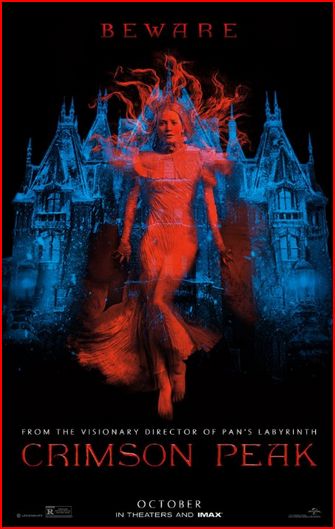
On the Big Screen: CRIMSON PEAK (2015)

 
Probably no film until At the Mountains of Madness finally happens will be first-rate Guillermo del Toro, but Crimson Peak was a mildly pleasant surprise after a week's worth of bad word of mouth. Too obviously derivative to rank with his Spanish tales, his latest film is at least a sincere pastiche of gothic film and fiction. The action appears to fall just outside the 19th century, but Peak is the director's homage to the look of that epoch, particularly as other directors have seen it. Reviewers have detected the influence of Mario Bava, and there is a Bava Ball bouncing through parts of the picture, but you underestimate del Toro if you limit his influences along generic lines. There's more Visconti (think The Leopard) than Bava in the early ballroom scenes, and Crimson Peak can be seen as an evil twin of Scorsese's likewise-inspired Age of Innocence. You underestimate del Toro if you underrate his literary influences. Peak is his self-conscious Gothic picture, and it's a surprisingly American Gothic, the first half being set in Buffalo. The heroine (Mia Wasikowska) is more someone out of Louisa May Alcott with her irrepressible blood-and-thunder literary instincts than someone from the Brontes. Thinking of her as an Alcott type, I was taken by surprise when an automobile announced that the time was more like Edith Wharton's. Del Toro and cowriter Matthew Robbins strike the right note in romanticizing her literary aspirations. Edith Cushing's courtship of Thomas Sharpe (Tom Hiddleston) coincides with his reading of her latest manuscript. Pressured by her father into renouncing her and breaking her heart, Sharpe knows how to strike; he tells Edith she's a bad writer. There's something charming about this that's more charming for taking place in a horror movie.

Rest assured, reader, that Edith is free to join her love across the ocean at Crimson Peak when her dad's head is bashed in by a mysterious assailant in his club washroom. Sharpe and his hostile sister (Jessica Chastain) live in a preposterous mansion, majestic in its isolation like The Shining's Overlook Hotel or the Benedict house in Giant, that seems not only to breathe but bleed; red clay seethes beneath the soil and the Sharpes hope to recover their family fortune harvesting it with modern machinery. Sister Lucille took a dislike to Edith back in America; at home she's the sort of complication you expect a Gothic mansion to have, and there's no more I can say about her that won't spoil the story.

Not satisfied with his pastiche and homages, del Toro strives to put his signature on the piece by making the various ghosts our heroine encounters the sort of creatures you see in a del Toro picture. Call them guillermites, if you will, and while I had to laugh at one particularly idiotic review that complained that ghosts shouldn't look like that, I must admit that the director's characteristic creations did seem a bit like alien superimpositions on an imagined 19th century. That's just a quibble, however, while the abundance of glaring clues to the truth of household arrangements past and present at Crimson Peak is a more serious weakness of the film. There's more Shining influence to be found in this film's climactic chase and combat in the snow, and in the long trek of a supporting character in order to get stabbed, while the involvement of two women in the combat arguably hearkens all the way back to The Archers' Black Narcissus, which was something of a stylistic influence on the Kubrick film. Crimson Peak is indeed rich in allusions for film buffs, but the general audience is more likely to be won over by the committed acting of the three leads, so long as they have more patience for the screenplay's novelistic pace than some reviewers have shown. I've seen several writers complain that the film is all buildup and little payoff, but I suspect that's short attention spans talking. Despite its up-to-date special effects Crimson Peak is an old-fashioned film in many ways, most of them good ways. Whatever its flaws, it's a welcome alternative to the latest found footage and other cliches that pass for horror these days, and its old-fashionedness may prove more of a virtue for Halloweens to come.

Saturday, October 24, 2015

Maureen O'Hara (1920-2015)

It's tempting to say that O'Hara was ahead of her rightful time. Watch her cut loose in At Sword's Point or Against All Flags and it's easy to imagine her today as a Katniss Everdeen or a Black Widow or simply kicking ass on a regular basis. The world could be hers -- our actual Katniss's warnings about enduring inequality notwithstanding -- in a way it could not have been, we presume, in O'Hara's heyday. Clearly she was an exceptional figure in her own time, as those films I mentioned earlier, among others, testify. Other actresses played pirate queens occasionally but O'Hara was clearly the Queen of Technicolor Action, to differentiate her from just plain Queen of Technicolor Lucille Ball, with no real rivals for her throne. She established herself as a swashbuckler before she was firmly established as John Wayne's mythic consort, and that role (sustained through five pictures) complemented her action-heroine status on the implicit assumption that only a mighty woman could stand up to, if not master, the Duke. That might and will were recognized in her last theatrical film, Only the Lonely, which closes with septuagenarians O'Hara and Anthony Quinn  thwarting an airplane hijacking. There may be an Irish stereotype at the bottom of all this, but the result was a primitive form of female empowerment. Of course, she was never primarily an action hero for fans of her time, and while her fencing prowess may be noted in the retrospectives to come you'll more likely see her wedding train lifted by the breeze from How Green Was My Valley, or watch her debate Santa Claus with little Natalie Wood in Miracle on 34th Street, and you'll certainly see a hell of a lot of John Wayne. It may have rankled her a little late in life to have to answer questions about Wayne, but Wayne's enduring relevance, along with the Christmas movie, ensures her relevance today and earns her a degree of recognition on her passing that dwarfs the parting honors this year for the likes of Lizabeth Scott or Joan Leslie. If anything, O'Hara may loom larger now than she actually was in her heyday, but there's still that nagging thought that she could have been bigger now, when presumably she could carry blockbuster tentpole movies on her own. That's presentism, of course, and as Maureen O'Hara was a creature of classic Hollywood, who can say that action-hero stardom was what she'd want? To her, today's tentpole pictures must have looked like bloated B movies, and she probably had more ambition as an actress than that. She wouldn't have wanted a career that was all At Sword's Point, I'm sure. It's fun to imagine her getting the best of both worlds, using the action pictures to bankroll what she might consider more serious acting. In the end it's all idle speculation, but I think that imagining the career O'Hara could have today testifies to the success of the career she had. You look at her then and you wish she were still around now, still in her prime, playing a lover, a fighter, or both, or anything she pleased.

Tuesday, October 20, 2015

THE BRAINIAC (El baron del terror, 1962)

Something was in the air in the early 1960s: an imperceptible whiff of burning sinners. The fire is lit by Mario Bava in Italy with La Maschera Del Demonio, better known as Black Sunday, but almost simultaneously in Great Britain we have a witch burning with vengeance in John Llewellyn Moxey's City of the Dead, aka Horror Hotel. Of course the atomic age didn't innovate the idea of a witch or diabolist's vengeance across the centuries, but maybe there was something about the mid-Twentieth century, with memories of so many persecutions still fresh, that kept the fire burning. It reached Mexico in 1962, when director Chano Urueta and his writers switched up the formula a little by making the inquisitor's victim a male and tapping shallowly into veins of science fiction to give his monster movie a little space-age flavor. However derivative it remains, El Baron del Terror is arguably some kind of cinematic landmark. While not the first film to feature a brain-eating monster (that's probably 1958's The Brain Eaters), Urueta's picture is, as far as I know, the first move with a more-or-less humanoid brain eater, a detail the confusing American title (the -iac suffix might have evoked computers or robots to many ears and Superman's green-skinned android nemesis of the same name had been around since 1958) emphasizes by mashing "brain" and "maniac" together. Presumably Urueta wanted to distinguish his picture by giving us a new kind of monster, in which case: mission accomplished!


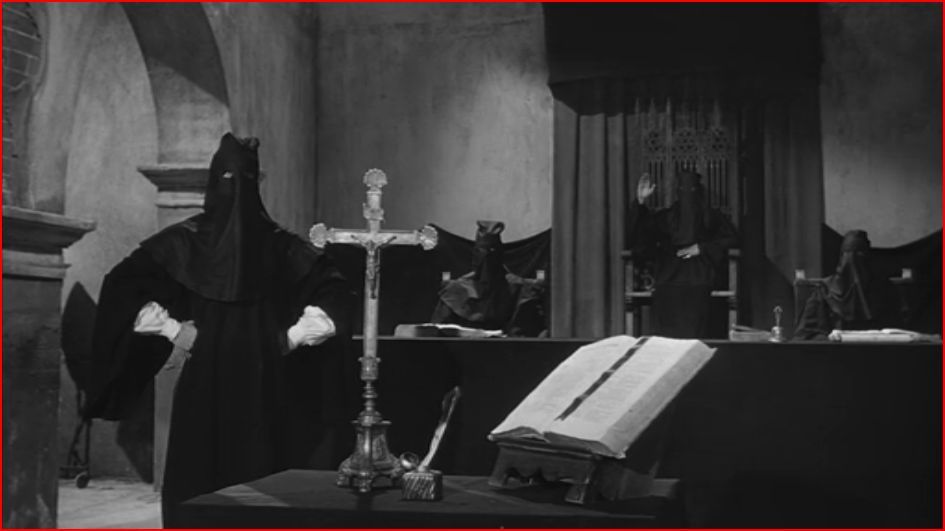
While I hinted above that some lingering guilt about persecutions may underlie this little cycle of vengeance pictures, the overriding truth on screen is that these films' primal victims had it coming. Vitellius d'Estara (Abel Salzar) is definitely some kind of sorcerer. More amused by than fearful of the Inquisition, despite his ultimate submission to burning, the baron shows off his powers by making his shackles disappear as his trial closes. Despite the appeal of one apparent friend, who suffers 300 lashes for his trouble, d'Estara is condemned for the usual litany of offenses against God and man. Focusing on a passing comet as the fire rises, the baron vows to take revenge on the families of his tormentors, whose faces he can see through their black hoods, the next time the comet passes over the Earth.


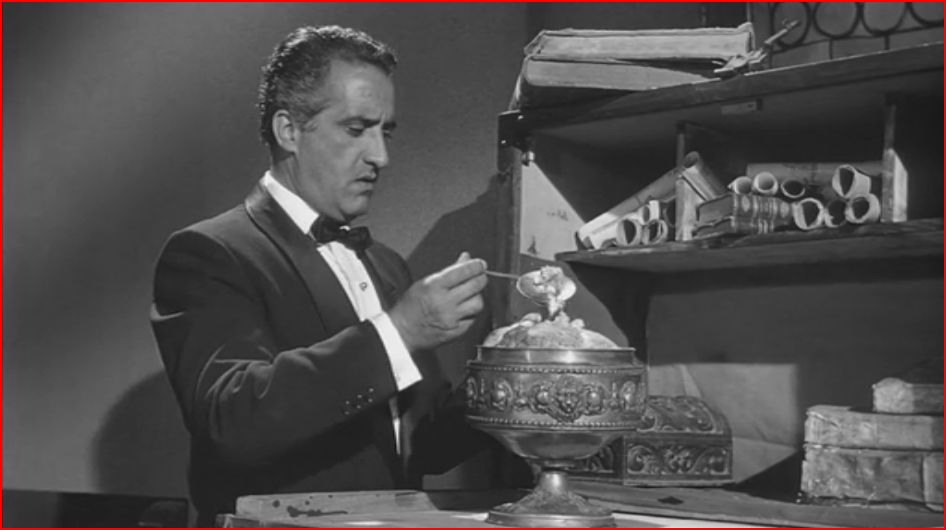
Three hundred years later, widespread inbreeding makes it easy for the returned d'Estara to identify his targets, if their names hadn't given things away, except when the latest descendants are female. The male descendants are identical apart from the lack of most facial hair. This inbreeding appears to have diminished fertility among the descendants of 17th century inquisitors, since it seems that there's only one descendant of each family (after 300 years!) for the baron to kill. In 1961, two young astronomers in love help their mentor locate a comet passing over their observatory. The girl's a descendant of an inquisitor; the boy descends from d'Estara's only defender. If not star-crossed, they are comet-crossed lovers. A fragment of said comet makes a remarkably soft landing in a park and proves to be a space vehicle with a single passenger. For lack of a better word to describe him, this is the Brainiac. His skull seems to breath as he brandishes his mandibles at a hapless drunk. Despite appearances, his forked tongue has remarkable penetrating power; let him at the base of your skull and he'll suck your brains out. Freshly nourished, he takes on the form of our old friend Vittelius d'Estara, who quickly establishes himself as an old-country aristocrat, complete with faithful lackey, newly settled in the country. Whether his Brainiac form facilitates space travel or is a jape of his master the devil is unclear, but it seems like Vitellius is his default form, though he must eat brains regularly to maintain his humanity. Since his mission of vengeance isn't enough to sustain him, he keeps a goblet of brains, unrefrigerated, in a secret chest, taking a spoonful when necessary in order to keep up appearances at parties.


So much for the interesting part of the film. From this point, which is pretty early, things get monotonous. The baron picks a victim, seduces her if it's a female, intimidates him if it's a male. In human form his eyes flicker with a hypnotic effect that loses some of its force when d'Estara becomes the Brainiac in order to feast. Chase, kill, repeat, until we're down to our two young astronomers. The film might have played up the baron's more ambivalent feelings toward his old friend's descendant, but he doesn't raise the subject until almost the end of the picture. Nor is the young man much of a hero. He's merely a spectator when two cops who've been our comedy relief most of the way show up to save the day, on who knows what hunch, with flamethrowers. We learn here that when you burn a Brainiac there's a human being under all that yuck, but he won't keep in the open air for long.


The baron in his Brainiac form is certainly memorable, if almost laughable in his stylish suits. For all his limitations there's some honest po-faced lunacy about his very existence, and clearly an honest desire to make something original about this latest iteration of an increasingly familiar archetype. El Baron del Terror is no more than an idiot cousin to Bava's classic but there's still something eerie about its mishmash of inquisitions and observatories and its conviction about the persistence of evil in many forms,  not just the heritage of the past but the potential of the vastness of space as the domain of the Devil. 

Saturday, October 17, 2015

On the Big Screen: BRIDGE OF SPIES (2015)

Steven Spielberg now directs movies for old people. It was an overwhelmingly gray-haired crowd at the neighborhood art house where I saw his newest film -- and I'm not exactly young myself. You could believe that these people have grown old with Spielberg, and you could more easily believe that only they could have much interest in Bridge of Spies. It was a good-sized crowd of old people, but I don't know what the screenings look like at the malls where the kids go. Spielberg isn't the brand name he used to be. That's partly because Spielberg has strayed more often recently from special effects and pre-sold genre material. Bridge is another of his adult pictures, another attempt to reach beyond his supposed limitations. As if acknowledging a need for help in this venture, he reached out to the Coen brothers, of all people, to re-write Matt Charman's original script. They make an unlikely team: the arch manipulator of emotions and the brothers often accused of cold, contemptuously satiric superiority to their subjects. Then again, Spielberg took it upon himself to make a Stanley Kubrick movie once, so maybe he recognizes an affinity inside himself with the "cold" auteurs that others miss. I'm guessing that he called the Coens in to give the dialogue some period authenticity as well as a certain snap that the brothers alone, arguably, can supply. They were certainly a gift to Tom Hanks, and perhaps they owed something to him after putting him through The Ladykillers. Hanks has a field day here in a role that's half lawyer, half salesman, and his crafty glibness as James Donovan plays well off the laconic stoicism of Mark (Thomas Cromwell) Rylance as Rudolf Abel, the Soviet spy Donovan is recruited to defend in a U.S. court. Acting isn't the problem with Bridge of Spies; if it had been the two-hander it appeared to be initially everyone probably would have been better off. But whatever the Coens did to polish the script, they were apparently of no help with a story structured to subvert its intended moral.

The moral seems to be that every person counts. Donovan is reluctant to take on Abel's defense for any number of reasons, but once he accepts the task he goes beyond the call of duty -- by which I mean he gives Abel more of a defense than the government actually intended. A demonstration was intended to show that in the U.S. everyone gets a fair trial, but all that's really expected of Donovan is a "capable defense" that won't change the obvious outcome. The outcome should be obvious because there's no doubt that Abel was a spy, but Donovan takes his work seriously and looks for irregularities that might get Abel off, only to find that the courts aren't interested. Even after Donovan persuades the judge to spare Abel's life with the pragmatic, prophetic argument that he could be traded down the line for some captive American spy, he carries the appeals process all the way to the Supreme Court, losing his ultimate appeal by a 4-5 vote. For this, the film tells us, Donovan was vilified and threatened by a hysterical public. Spielberg almost certainly overdoes this, to the point of having someone fire shots through Donovan's window, frightening his children, when in fact Donovan was so far from vilified that in 1961 he became vice president of the New York Board of Education. Presumably Spielberg exaggerates Donovan's ordeal in order to make him an exceptional figure, a heroic exception to the era's Cold War hysteria but also an exception that in inverse fashion vindicates his country. As long as the exceptional man lives up to the principles that presumably justify the Cold War, even when the majority seems to fail, he still affirms Hollywood's version of American exceptionalism. Through Donovan Spielberg (and the Coens) can affirm American exceptionalism while maintaining an ambivalent attitude toward the Cold War. On the one hand, to get ahead of myself, Donovan witnesses the Soviet Bloc at its worst when people trying to jump the Berlin Wall are mowed down mercilessly. On the other, Bridge of Spies is determined not to make Rudolf Abel a villain. We're clearly meant to accept Donovan's apolitical assessment of Abel as a "good soldier" -- one who never says an ideological word in the entire picture -- over the bloodthirsty indignation of his fellow Americans. We're also meant to see Abel as a political if not moral equivalent of Francis Gary Powers, the downed U-2 spy pilot for whom he's eventually traded through Donovan's negotiations -- and Spielberg's attempts to illustrate that equivalence just about sink his movie.

Spielberg's attempt to make Powers (Austin Stowell) a character in the story is a classic case of too much and not enough. Abel may not have much of an internal life apart from his hobby of painting, but Rylance's mannered stoicism bring the character to life, while Powers is never more than a cipher. But once Donovan raises the possibility of trading Abel for a future captive American Spielberg introduces the cipher and keeps going back to him, developing the character not at all and killing much of the dramatic momentum the Hanks-Rylance team had built up. At his worst, he crosscuts between a Powers takeoff and Donovan arguing before the Supreme Court for no sensible reason. The inevitable destruction of Powers's plane and his narrow escape by parachute is spectacularly pointless; the plot would be served as well if the pilot's capture and trial were reported to our protagonist as a fait accompli. An interesting point is raised when Donovan observes that he, Abel and Powers are three of a kind, the most hated men in America -- Powers joining the club because he'd gone against orders and allowed himself to be captured and used in a presumed show trial -- but neither script nor Stowell do anything to make that observation meaningful.

Worse still, Spielberg compounds his error once Donovan goes to Berlin, ostensibly unofficial but at the government's behest, to negotiate the Abel-Powers exchange. In Berlin Spielberg introduces another major character, the American student Frederic Pryor (Will Rogers), who gets arrested in East Berlin for trying to smuggle his German girlfriend to the West before the Wall is finished. Learning of Pryor's plight, Donovan is determined to get him released along with Powers in return for Abel, without considering that the East Germans who hold Pryor have different priorities from their putative Soviet masters, who hold Powers. If anything by virtue of having a girlfriend in East Berlin Pryor is instantly a more interesting character than Powers, but he still isn't interesting enough to justify looking in on him, much less Powers, when we want to stick with Donovan. The movie tells us that these two matter, but fails to show it. Neither Powers nor Pryor is part of the real story, which is Donovan's often desperate, always cunning dealings with the Communists, but Spielberg thinks differently. They're his proof that every person counts, but at the same time they're exceptions in a way we've seen before in Spielberg's serious pictures. Because for Spielberg the exception is the essence, he can affirm human goodness in a Holocaust picture because one guy saved some Jews, and he can make Saving Private Ryan  a victory because a bunch of guys die to send Matt Damon home. I don't bring this up to denounce two of Spielberg's best pictures, but I'm pointing out why some people do denounce them and may also denounce Bridge of Spies. If I've correctly diagnosed a Spielberg Fallacy in all these films, I find it most glaring in Bridge because his superfluous preoccupation with Powers and Pryor, or else his (or the Coens') complacent failure to earn concern for them, mars the dramatic balance of this picture more severely.

That's a shame because Bridge sure is a lovely film to look at. It's another pictorial triumph for Spielberg and cinematographer Janusz Kaminski. Just about every frame here is a thing of beauty, for which production designer Adam Stockhausen deserves a fair share of credit. The film isn't quite so easy on the ear; while John Williams arguably hasn't contributed much to Spielberg's movies in quite a while, his absence for the sake of Star Wars is felt if only because Thomas Newman's score is banal rather than merely predictable. Overall, I'm tempted to credit the Coens with whatever dramatic energy or occasional wit the picture has, though they should also take the blame for including or failing to remove some corny bits. Was giving Abel "Would it help?" as a catchphrase whenever Donovan asks whether he worries about things their idea? What about that supposedly soul-stirring story Abel tells about a man getting beat up by partisans but earning their respect, that you know as soon as you hear it will payoff later in the picture, as it does when Abel comes to Donovan's aid in a standoff? I suppose the brothers couldn't rewrite every word, but surely they could have done more with this script, or else the dramatic structure determined by Spielberg was irreparably flawed. For all that, I can't help imagining that had they directed it Bridge of Spies might have been a less compassionate but better picture.

Tuesday, October 13, 2015

DVR Diary: WHY BE GOOD? (1929)

Colleen Moore was one of the biggest stars of 1920s Hollywood and the person who pretty much defined the look of the archetypal flapper -- you can take F. Scott Fitzgerald's word for it -- but show people with a non-specialized knowledge of film history a picture of her and they'll probably mistake her for Louise Brooks. Apart from their shared hairstyle, there was no comparing the two in 1929, but Brooks's films for G. W. Pabst have endured in the cinematic canon in a way nothing of Moore's has, and even Brooks's memoir gets more literary respect than Moore's. Life enhances art retrospectively to an extent, and Brooks led a more dramatic life than Moore, whose career didn't really survive the coming of sound but who died rich from wise investments. It's most likely also true that Pabst's Pandora's Box is better than anything Moore made. But does Moore deserve to be as completely eclipsed as she has been?

Last year Moore was given a chance to stick her foot in history's door when a restoration of William A. Seiter's Why Be Good? did the film-society circuit. The title was certainly inviting, suggesting that Moore marched mutely to the beat of the Pre-Code Parade -- mutely because Moore, in a rare move, had retreated to silents (albeit with Vitaphone music tracks) after making her talking, singing debut the year before. I haven't seen her first musicals -- in fact, they're lost films -- so I can't say whether she had good reason to retreat. But I can see how sound may have weighed her down; on the silent screen she has the perky exuberance of the era's clowns. I can also see that Moore was getting a little old, at 30, for her typecast flapper role; Flaming Youth had made her a superstar six years earlier. She tries to make up for that with manic energy. Moore helped popularize the Charleston and Why Be Good? makes much of her dancing, but to the modern eye it looks like she's having a manic conniption fit. She could be trying too hard at this point, but once she's off the dance floor she's much more palatable.

Moore also lives up to our expectations for flappers by asserting her character's rights against both her father and her boyfriend Winthrop (Neil Hamilton). When Dad questions the aptly-named Pert Kelly's nightlife, she reminds him that the year is 1929, not 1899, and that she's earning nearly as much for the household as a department-store salesgirl as Dad does, so she's entitled to make some decisions for herself. She has a more substantial complaint against the boyfriend. He's the new personnel director at her store, and the owner's son, whom she happened to meet cute at a jazzed-up boiler room turned speakeasy before their professional relations are established. He has to reprimand her the following morning for coming in late -- his waiting room is full of leggy employees who plan on coming in late more often if it means a trip to the handsome man's office -- but Pert has him to rights when she blames him for bringing her home late. On the other hand, he made it in on time, didn't he? Anyway, when Winthrop's dad notices his interest in Pert he decides she should be fired, even though her supervisor says she's one of their best salesgirls. Naturally Pert blames Winthrop, but he promises to get her job back and plies her with gifts. The mating dance begins in earnest, each careful to check the other's intentions. The climax comes when Pert confronts him over male double standards after a succession of mixed signals. Her message remains all too relevant today: men expect women to come on strong, loosen up, etc., but the next thing you know they condemn you for doing just what you think they want. Fortunately, her tirade convinces Winthrop that she's a good girl after all and a happy ending is assured.

In short, Why Be Good? is a romantic comedy and the genre doesn't age well. In fact, it dates quickly. Compared to the mechanical brilliance of slapstick comedy, romantic comedy seems trifling, and you have to pay attention to the intertitles. As a star vehicle, however, it's good testimony to Colleen Moore's star power. She's pretty and charismatic and has a physical grace peculiar to the silent era when she isn't going berserk on the dance floor. Moore will never be the icon for the modern age that Louise Brooks became, but Why Be Good? should resonate in our time as a snapshot of a young woman struggling with the odds stacked against her to live on her own terms. Not many films survive to testify to Moore's stardom -- only one reel of Flaming Youth is known to exist -- but this one at least gives us a clue to what all the fuss was about. It's a reminder that Colleen Moore was an icon of her time, at least, and a part of Hollywood history who deserves to be remembered.