Tuesday, February 16, 2010

Larry Talbot vs. Dracula: Part 1

The way he walked was thorny, though no fault of his own.... This past weekend, moviegoers saw Lawrence Talbot begin a new journey along a fairly familiar path. My friend Wendigo is invalid enough that he can't watch a film he craves to see until it hits DVD, so this weekend he and I entertained ourselves by examining the end of Talbot's original journey -- the two ends, actually: the formal end of his storyline and a satirical epilogue.

So we start at the end: Erle C. Kenton's House of Dracula (1945), a film that some take as proof that the Universal Monster genre had gone creatively bankrupt. Its cavalier attitude toward series continuity, its late attempt to almost undo Universal's place in history as the pioneers of true supernatural content in horror films by reducing curses to medical ailments, and its upstaging of all the classic monsters by a mad scientist, make it look like the end of the series (for it's very consciously the end) had come just in time, if not a little too late. But Wendigo, I suspect, isn't the only person who considers it at the very least an improvement on 1944's House of Frankenstein, and speaking for myself, I think that mad doctor deserves some credit as Universal's last great creation of its classic, pre-Creature From the Black Lagoon era.

Continuity is out the window once Baron Latos, the man who claims to be (and as far as Universal is concerned, is) Count Dracula bats his way through an open window to ogle Miliza, a live-in nurse and research assistant in the employ of the eminent Dr. Edelmann (Onslow Stevens). After satisfying his voyeuristic urges, though not his vampiric ones, Latos (John Carradine) strolls into Edelmann's quarters shortly before dawn. Excusing the hour and the intrusion, Latos banters his way into a confession of his Count-dom and declares his readiness to be rid of the curse that compels him to drink blood. We last saw Latos as a pile of bones bleaching in the open air once he fell off the wagon in House of Frankenstein. So what's the rule, now? Did someone just have to drag the skeleton indoors to bring him back? Admittedly, we could ask what Dracula's staked skeleton was doing somewhere in Pre-Occupied Europe at the start of HofF when we saw alleged Dracula Count Alucard skeletonized somewhere in Louisiana at the end of Son of Dracula? Universal was no longer asking questions, probably presuming that audiences no longer regarded its monsters as anything but cartoon characters who could turn up at any time or place as a script demanded, but that doesn't mean we can't ask.


Carradine's glare at Martha O'Driscoll may have something to do with her being billed ahead of him in a film called House of Dracula!


Wendigo likes to speculate that Latos and Alucard are imposters, either vampires actually turned by the original Dracula (you know who) or interlopers exploiting the real one's absence to advance themselves in the realm of the supernatural. He offers this as a take-it-or-leave-it proposition, since he concedes that Universal had no interest in vampire continuity as of Son of Dracula. As Latos, Carradine has more to do in HofD than in his perfunctory previous outing, and he gives a better performance: more refined, colder, less southern gentleman-like. As the title says, he's the center of the film, though once again he drops out of the picture well before the end.

When he first saw HofD, Wendigo believed that Latos sincerely desired a cure but succumbed to his unnatural lust for Miliza. It's clear to him now that Latos had an urge for the nurse from a previous encounter, meant to vamp her and made himself Edelman's patient in order to get close to her -- but why doesn't he just bite her when he can freely fly through her window??? Wendigo suggests that Latos was toying with Edelmann and his staff, but he admits it's not a very convincing explanation. You could also argue that he initially sought a cure to win her as a human, since he submits to Edelmann's initial treatments. But he quits the treatments and sets about mesmerizing the nurse and making his usual spiel about the strange twilight world where the people are dead, yet alive, that peculiar emotionless realm where there are, on Latos's word, no material needs, yet he needs to drink the blood of the living. I wonder sometimes whether the mythical realm of Visaria where the House films take place isn't itself the strange twilight world where World War II isn't happening and Larry Talbot seems to be falling backwards through time from his 1941 starting point.

Could Latos have been cured? The film hints that Dr. Edelmann is on to something, and there'd be no reason for Latos to stop the treatments if they weren't going to work. Edelmann's success with Larry makes one wonder whether he could have worked similar wonders with a more compliant Latos, but his failure to complete the treatment leaves open whether the curse of vampirism is something beyond science. Of course, we had been led to believe that Larry's curse was beyond the ken of science, and look what happens to him.

What a coincidence. One day after Latos shows up at Edelmann's office, Larry Talbot turns up begging for help, only to run off impatiently when the doctor doesn't come running. We last saw Talbot dead at the end of House of Frankenstein with a silver bullet through the heart, shot there by a gypsy girl fulfilling the rule that one who truly loves a wolfman and is willing to die for him can kill him. Only he isn't killed. There's a lot of stuff that can kill a wolf man, we've learned over time, but nothing does it permanently. Larry gets himself arrested and locked in the local jail by the ever-authoritative Lionel Atwill, and the result leaves us asking why Talbot never thought of this before. Before the eyes of a hastily-summoned Edelmann, Larry transforms into the Wolf Man, tugs at the iron bars a few times, sinks to the floor in despair and rolls into a catatonic fetal position for the rest of the night. How the mighty are fallen! Admittedly, Wendigo realizes in retrospect that, in order to have a happy ending in 1945 under the Production Code, Talbot could have no blood on his hands. But this spectacle in jail, followed by his failure to kill Dr. Edelmann in a cliffside cave (the old man holds out until sunrise) make it a kind of relief that we never see the Wolf Man again.

Guess who they find in that cave? It's the Frankenstein Monster, who oozed his way here through the quicksand he sank in at the end of House of Frankenstein. Are we supposed to believe that? Yes! For there beside him are the bones of Dr. Niemann, the only explicit reference to the previous movie, and a mint-condition manuscript of Dr. Frankenstein's Secrets of Life and Death. So there is continuity of a sort, and we're all justified in asking every question you want about how Latos and Talbot got out of their predicaments. I suppose they could have handled the Monster the same way as the other monsters. I can see him banging on Edelman's door and announcing himself: "Me...sick...fix?...friend?"

Edelmann and Talbot drag the thing to the former's lab, where Larry warns the good doctor against experimenting with the Monster. His argument from experience, on top of a stern moral argument from Nina, his other nurse, convince Edelmann to leave it alone. Nina longs for Edelmann to cure her hunchback and pines for him as a person, though I wonder at her reasoning. As things stand she's the world's prettiest hunchback. Afterwards, she'd only be another pretty nurse. As it is, she has a prettier face than Miliza, but those insensitive boors Talbot and Latos can't look past the hump, apparently. They only have eyes for Miliza, and one wonders whether there's a missing scene in which Latos's jealousy over Talbot making a move on the blonde nurse provokes him into rejecting his treatments and asserting his dominance. You have to wonder. You have to wonder why poor Nina has to die in such a brutal way later on when she's a more sympathetic character than Miliza. Wendigo's sad conclusion is that Miliza was simply too blonde to die.

The lovely Jane Adams as Nurse Nina, with that distracting hump away from the camera

Anyway, Latos pulls a fast one on Edelmann, rejecting an emergency transfusion and instead infusing the poor doctor with his own accursed blood. He heads for Miliza's room to take her once and for all, but Edelmann recovers quickly, follows Latos into the room, and pulls a cross on him. As Larry enters through another door, Latos cowers and runs for his coffin. This is the only encounter of Chaney and Carradine in the entire film, but Wendigo points out that this could be sufficient to establish Talbot's lasting enmity toward Dracula, since the vampiric bastard was going after his woman! We learn quickly that Latos has planned things poorly. All this time he's existed at Edelmann's suffrance, since the doc could expose Latos's encoffined corpse to the sunlight through a basement window anytime he pleased. After this episode, Edelmann damn well pleases.

Larry never actually sees Baron Latos face to face, so the fact that Count Dracula looks quite different in their next encounter wouldn't have fazed him at all.


Exit Latos, but he's done his evil work. His blood flows through Edelmann's veins, but instead of developing a thirst for blood, the accursed doctor develops a lust to kill. It's ironically Wolf Man-like, but Wendigo says it's Universal's way of finally doing a Jekyll-Hide character. Edelmann doesn't seem to have become a vampire, but he transforms when night falls into a depraved killer. Up to this point, Onslow Stevens has been a benign presence and a straight man for the monsters. Now he takes over the movie and becomes a total badass. With minimal makeup, some mussed-up hair, and lots of his own body language, the transformed Edelmann is a really menacing presence, all the more so for not ranting and raving but playing his malice very cool.


Dr. Edelmann goes through one of those dream-induced transformations, unleashing Onslow Stevens as a grim but gleeful freak who takes over House of Dracula.


Fortunately, while he's still himself Edelmann performs his miracle operation on Talbot, applying some plant extract on Larry's unshaven skull to make it expand, relieving the pressure which we now learn triggered the poor man's lycanthropy. This is a mixed blessing, since that pressure also made Larry immortal, but maybe that was just the power of positive thinking. Whatever was going on in his head, Wendigo says we should bottle it and sell it. If all you have to do is lock yourself in a cell for three nights out of the month, that's not really a high price to pay. It was for Larry, though. He makes clear here that it's unendurable for him to undergo the transformation even if confinement renders him harmless. It's one more grace note in a memorable, archetype-creating multi-film performance by Lon Chaney Jr. Some find his suffering insufferable, but we feel that it expresses a kind of righteous recognition that his condition isn't just bad for him, but profoundly wrong. Wendigo especially appreciates the consistent portrayal of Larry as someone crying for help, or crying out warnings, to whom no one wants to listen. He gets past that early here, since everyone sees him change in jail, but he still has to deal with Atwill's accusation that he committed Edelmann's murders. For once he has to plead innocence, but he gets the same old skepticism.

Look into the light, Larry!

Does Larry's cure betray the concept of the Wolf Man as a tragically accursed creature? Wendigo doesn't think so, simply because Talbot has always been a good guy at heart, despite his unconscious rampages under the full moon. The fact that Universal gave Larry a happy ending is probably the best proof we have of Talbot's popularity with moviegoers. You have to presume that people wanted to see the guy get a break. So why is he a Wolf Man again three years later? Arguably because people wanted him back.

Wendigo can't deny that House of Dracula has plot holes one could fly a jet through and has a questionably rushed finale. After Edelmann's final showdown with Talbot, the Monster lurches through a scene, swatting victims aside almost by accident, before exploding equipment causes a flashback to the finish of Ghost of Frankenstein. This film is in many ways a slapdash product, with an unoriginal score but its saving grace is the studio's desire to get the series over with, to give it an actual end.

This copy of the Realart trailer was uploaded to YouTube by StevieRotten.


Sunday, February 14, 2010

Pre-Code Parade: TORCH SINGER (1933)

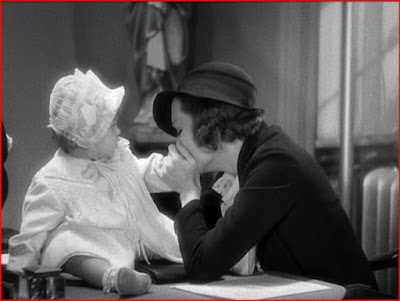
Alexander Hall's entry in Universal's Pre-Code Hollywood Collection is a slick Paramount weepie about a woman who lives a triple life. We first meet Claudette Colbert as Sally Trent, a struggling singer about to become a single mother in a charity ward. The father, Mike (who will be revealed later as Universal horror juvenile David Manners), has gone to China, and his mother mistrusts Sally's claim of his paternity. Sally shares an apartment with fellow single-mom Dora (the charmingly accented and awfully short-lived Lyda Roberti) but is soon on her own and incapable of supporting her daughter and namesake Sally in Depression conditions. She despairingly turns the girl over for adoption, but from that bottom point her career heads upward.


As Mimi Benton she becomes a nightclub sensation with a scandalous reputation. Little do those who scold her know that Mimi is also "Aunt Jenny," an overnight radio sensation with her daily bedtime-story program sponsored by Oatina. She scored that gig by being in the right place at the right time, thanks to her relationship with the sponsor and a smart agent (Ricardo Cortez, the original Sam Spade of cinema), taking over live and improvising when the original Aunt Jenny comes down with mike fright.

All Sally/Mimi/Aunt Jenny needs is a movie deal to become Queen of All Media for 1933. Ricardo Cortez looks on concernedly below right.

The heroine's protracted identity makes it difficult for Mike to track her down once he returns from China and learns how his mother mistreated her. Meanwhile, even though it was a condition of giving up Sally Jr. for adoption that she should never see her again, our heroine gradually realizes that her radio celebrity as a kid-show host makes it possible to track down her daughter. She conceives an elaborate birthday-club scheme in the hope that little Sally is one of her fans, but the futility of her quest makes a mockery of her success, driving her to drink and desperate illness before the trail ends with the promise of a family united at last after the compassionate agent chivalrously steps aside.

Aunt Jenny rises from her sickbed (after a bender) to make one last shout-out to Sally.

Whether Cortez's agent should have stepped aside in favor of Manners's man of wealth is open to question, and the studio itself may have questioned the outcome until the last moment. There's a very obvious edit in Cortez's final scene (I don't know if it was made after the Code crackdown or before the original release) that either eliminated some crucial dialogue or imposed the final words we actually hear. In any event, Manners holds the trump card in this mild rivalry, so his triumph was most likely foreordained. Still, it's always hard to see women picking Manners over anyone, vampires and other monsters included. It's also a little annoying to see how he apparently accomplished effortlessly what Colbert could not despite marshaling massive resources. It turns him into a deus ex machina that the film shouldn't need, mainly for the purpose of preserving the traditional family unit despite his starting out as a deadbeat dad.

Male leads aside, Torch Singer is a showcase for Claudette Colbert on the brink of superstardom, the year before Cleopatra and It Happened One Night. Here she shows what most people already knew, that she can dress up really nice, as well as something not as often heard -- her singing voice. From what I can tell it's her own, and while the songs don't set the world on fire she sells them well enough. Her main task is to run the emotional gamut and she shows great form doing so without ever succumbing to cliche. Success goes to her head but she also retains compassion for others, while her quest to recover her daughter keeps us on her side.

For modern audiences, one scene in particular cinches our loyalty to Colbert. In her apartment, she listens to her maid Carrie (the appealingly un-mammylike Mildred Washington, even more awfully short-lived than Lyda Roberti) read Aunt Jenny's fan mail. Carrie reads a letter from a little girl named Sally, sparking sudden hope in our heroine, who heads directly to the return address with high hopes and a big box of chocolates. She finds an amazed Sally -- a poor little black girl who's overwhelmed by the sudden appearance of her radio idol. She gets to keep that box of chocolates, and she gets her own special story from Aunt Jenny. Whatever you think of the rest of the film, this scene would probably get a thumbs-up from anyone who sees it.


In lieu of a trailer, here's an audio upload to YouTube by edmundusrex of Colbert singing Mimi Benton's signature tune, "Give Me Liberty or Give Me Love."

Saturday, February 13, 2010

INFERNAL STREET (1973): How do you Just Say No in Chinese?

Ti Hong is an aspiring doctor who works in Dr. Chu's "surgery," as the English dubbing of Shen Jiang's film calls his clinic. Our hero's mind seems more set on kung fu, as we might hope, this being a kung fu film, though his main motivation seems to be the opportunity to practice with Chu's attractive daughter. We find them desecrating a graveyard with punches and kicks as the story begins. Dr. Chu's staff has been treating a growing number of opium and morphine addicts recently. As one doctor notes, "It just started in the last six months since the Japanese opened that club." Coincidence? Who are we kidding? This is a Chinese kung fu movie; all calamities are obviously the Japs' fault. Sure enough, at that club we find the Japs plotting their next marketing strategy. "I think we ought to import less opium, get more morphine," one suggests to their boss, the Chairman -- a well-dressed man whose face we don't see, who communicates with his minions mostly with growls and grunts.

Business is good, but could be better if only Dr. Chu, who is waging an anti-drug campaign, could be discredited. The Chairman and his Chinese collaborators come up with a brilliant stratagem to do just that. They send one of their men to the surgery for emergency treatment.
Doctor: You a drug addict?
Minion: What's the matter? Mean you can't tell?
[Doctor takes Minion's pulse]
M: What's wrong?
D: Nothing!
M: Nothing? What do you mean? I'm an opium smoker. I've been smoking opium for the past fifteen years!
D: You don't look like an addict.
M: Well, I'm sorry about that, too! What am I supposed to look like? What sort of surgery is this? Oh, come on! Prescribe something for me! Something to make me feel better!
D: Yeah, yeah. We'll do that, yeah. Hey Lu, the usual dose.

After detecting nothing wrong with the man, the doctor gives him "the usual dose" of something on the man's word that, despite all the evidence one's pulse can provide, he's a desperate drug addict. He sure does act like one afterward, raving in ersatz agony and telling anyone who happens to walk in that "I've gone mad!"


The doctors don't believe it, but the minion's pals defend his honor and the integrity of his illness, accusing Dr. Chu, who had nothing to do with the transaction, of malpractice. After some pushing and shoving, followed by some punching and kicking from Ti Hong, Chu agrees to pay the gangsters some hush money. But Ti Hong isn't having it. He invades the Jap-operated gambling den and wins the money back with extreme prejudice. That makes him a target for the Chairman's goon squad, but Ti Hong welcomes the attention. Confronted in the countryside by superior numbers, he asks a Hitler-moustached minion, "Are you a Chinese or a Japanese?" Why does he ask? "The Chinese, there's always hope for them. I'll treat them lightly. But the Japs, those pigs shouldn't live." This is actually just bluster. The victorious Ti Hong spares the Japanese, contenting himself with cutting their ears off.

We could have warned these Japanese gangsters that Hitler style was useless against Chinese boxing, but since it would have fallen on deaf ears anyway the consequences of their folly are no great loss.


Dr. Chu has a conflicted view of kung fu. He feels that his daughter and Ti Hong are wasting their time, but he once ran his own kung fu school. Back then he was just as opposed to drugs, but certain Japanese gangsters questioned his views about the deleterious effects of opium. They challenged him to a fight against a champion of theirs who not only sold but used the stuff. The only unusual effect of his addiction was to give him something like iron fingers and the power to embed them in wooden surfaces. He used this talent to tear Chu's shirt and bruise his back. This defeat compelled Chu to give up martial arts (and anti-drug campaigning, for a time), steering him toward his medical career. We've given you the key puzzle pieces now. There's a master criminal whose face we don't see, and the hero's master was humiliated by someone we do see in a flashback. Can you guess the Chairman's identity?...

Meanwhile, the Chairman's strategy shifts from discrediting Chu to discrediting Ti Hong. The bad guys approach this challenge with the same brilliance they showed earlier. They send the wife of a comedy-relief morphine addict into dangerous proximity to our hero so she can cry rape at an inconvenient moment. The addict denounces him and the wife insists that she couldn't resist him because he's so strong. Enraged, Ti Hong shoves her to the sidewalk, stunning her. The bad guys slip her a serious mickey and declare her dead. This gets Ti Hong carted off to prison, where he can still beat most of the guards and their Japanese pals with both hand shackled above his head. But it's convenient for him to be there once the bad guys arrest Chu and his daughter, bringing everyone together for the big reveal of the Chairman's identity and the big showdown between him and Ti Hong.


I can't fairly judge the quality of star Yiu Tien Lung's fight choreography because Mill Creek Entertainment's copy of Infernal Street is a clearly-cropped fullscreen version. The fighting is passable and our hero brawls with expressive enthusiasm, but the story (at least in English) is childishly ludicrous. The writer wants to drive home the anti-drug message, most forcibly in Ti Hong's flashback to his father's death from addiction, and his mother's immediate suicide, presumably from smashing the back of her head against a wall. But the dialogue (again, at least the dubbing) undermines any seriousness of purpose, as when an addict is asked why he doesn't kick the habit and answers, "Come on, I couldn't do it and it doesn't cost that much!" in a Jerry Lewis-like voice.

The toll of drugs: Above, Ti Hong's mom is collateral damage. Below, "Would you like some morphine?" "WOULD I?!?"

It renders the drama ridiculous but definitely enhances the film's entertainment value for certain audiences. I'm sure the typical anti-Jap material has the same effect, giving some viewers a certain thrill of transgression at seeing such naked hatred expressed by one people for another. Here it's done in such a bloody slapstick manner that it really is kind of funny, whether it was meant that way or not, and I suppose the Chinese in the Seventies still had fresh enough memories of Japanese atrocities to explain their attitude. In the form in which we have the film I can safely recommend it only to bad movie buffs who'd find the idea of a Chinese Reefer Madness with kung fu and xenophobia thrown in potentially appealing.

Flashlegsrare has uploaded a video trailer (widescreen and subtitled) for Infernal Street to YouTube.

Friday, February 12, 2010

In Brief: PARANORMAL ACTIVITY (2007-9)

The title itself is a kind of euphemism, compared to how earlier generations might have titled such a story. Consider The Haunting of Katie, Terror on Video, Demonic Possession or other possibilities. The paradox of "paranormal" is that it seems intended to normalize the phenomena portrayed in Oran Peli's venture into the "found footage" genre. In that sense, "Paranormal Activity" is an ironic and thematically appropriate title, just as "found footage" is the appropriate approach to the story Peli tells. The footage is the male protagonist Micah's attempt to quantify and thus manage the increasingly severe noises and movements in the home he shares with his girlfriend Katie. Micah (pronounced "Meeka") is a DIY ghost hunter. He's got the video equipment and the gear to record and isolate peculiar sounds. Dumb as he is in horror-movie terms, he represents modern-day empirical rationalism. He's a man of the age of the "Ghost Hunters" TV show and all its rivals, imitators and rip-offs, but his half-assed pursuit of knowledge is a flight from knowledge at the same time. He can't deny that strange stuff is happening in his house, but he stubbornly refuses to recognize it for what it is. He can acknowledge weird shit and finally want to flee from it, but he seems incapable of acknowledging evil or prior knowledge of evil. He reluctantly welcomes a psychic but refuses to consult a demonologist and ignores Katie's warnings not to mess with ... whatever it is ... by trying to film it or contact it with a borrowed Ouija board. Is Peli trying to say something about all the real-life ghost hunters? I doubt it, unless he believes in demons himself. It's more likely that a natural story idea occurred to him and he had the minimal means to put it on film, and the rest is pop-culture history.

Paranormal Activity worked for me on an intellectual level instead of a visceral one. Despite the gimmick, it's really a classic horror story of a certain kind in which a fool gets his comeuppance. On that level it was reasonably well thought out. As for the extraordinary claims about how frightening it is, maybe you had to be in the right place at the right time. To get the scare effect you probably have to be in a crowded theater where the screaming crowd serves as a horror multiplier. Peli's technique makes it impossible for him to set up his scare moments with traditional movie gimmickry. The camera just stares out at a couple in bed and there's no music to create a mood. Some people may feel that these self-imposed limitations make the spook scenes more horrific because they may look more real, but some of the biggest scare moments come across as little more than dead air in the privacy of home, It's as if you need other people screaming as the punctuation that proves that something really scary happens.

The gimmick is also abused to pad the film in spots. Several times we have overnight scenes in which something paranormal happens while our couple is sleeping, seen only by the video camera. Then on the next morning we'll see Micah and Katie watch the same footage and react to it. It may be that Peli wants to establish the objective reality of events, while the morning-after scenes are meant mainly to illustrate Katie's growing panic or Micah's obtuseness. But all of that could have been established in the morning-after scenes, since the video images are objective reality whether we see them "live" or on Micah's laptop. The main object seems to have been to get the film safely to releasable feature length.

Now that I've criticized some of the gimmickry let me reiterate that I think the film succeeds thanks to the writing and the acting, the stars being persuasive in a way that artless newcomers often can be. People who judge the film by whether it deserved to be a blockbuster, or those who felt manipulated by the marketing campaign, shouldn't lose sight of the genuine quality in the film's concept. At the same time, it's fair to say that the hype was excessive in portraying Paranormal Activity as more than it is. What it is is a mild satire of modern culture, and the fact that it needed such hype to get our attention probably tells us something more about our culture.

Wednesday, February 10, 2010

LUXURY CAR (2006)

My plan was to go into bad-movie mode for a little bit, posting reviews of a couple of entertaining stinkers I'd seen over the weekend while reading the Adams book (see below), but all it takes is a trip to the Albany Public Library to send me on a detour. As I've said often enough, the place has a great and growing foreign-film collection, and last night they had a new arrival I hadn't heard of before. The story sounded interesting enough to justify a rental. It costs nothing and the film's hardly more than 80 minutes long. It won the Un Certain Regard award for writer-director Wang Chao at the 2006 Cannes Film Festival and was released on DVD as part of First Run Features' Global Lens Collection, which has turned up decent stuff before.


It's a pretty straightforward story of crime, changing times and family ties. Schoolteacher Qi Ming is heading to the city of Wuhan, where he went to college, for the first time in 40 years. He was rusticated during the Cultural Revolution, but fell in love, started a family, and stayed on after his rehabilitation. He returns at last to find a son who's gone missing, and he discovers that another Cultural Revolution has taken place. He seeks help from his daughter Yanhong and from a friendly policeman on the brink of retirement. It sinks in that his daughter's circumstances are pretty squalid. Her roommate is a whore who brings johns to their apartment, and Yanhong herself isn't much better. She's a hostess at He Ge's karaoke club, and the job involves a lot more than singing badly. She's also carrying He Ge's baby; she knows it's his because he's "the only one who never wears a condom." While Qi Ming and the cop pursue every possible lead, it becomes apparent that He Ge knows more about the missing man than he's letting on. Meanwhile, Yanhong is in danger of becoming collateral damage in a gang war between He Ge's crew and the powerful Director Tang who fancies her and resents He Ge hogging her for himself.


Yuan Tian as Yanhong, who travels in the opposite direction of her father, from city to country, but actually retraces his footsteps of forty years before.

Wang Chao films this story in a manner that creates more tension between father and daughter than between anyone and the local gangsters. It's not just a matter of him discovering her unsavory work and a scandalous pregnancy. It's also a matter of her lingering jealousy over the fact that her dying mother always liked brother better, and that dad came back to Wuhan to find him, not visit her. The real conflict of the movie is generational, not a gang war, between old and new culture as much as between dad and daughter. It's about an exile returning to the place he supposedly always belonged, and finding himself a kind of exile again, and a daughter returning to the old country to find little more than nostalgia and death. It's more an attempt at social realism than a crime film, though I think He Huang as Da Ge (see photo below) could have handled a more central role in a genre story.


Luxury Car (a Sino-French co-production) is an unflattering look at Chinese society, though it has nothing to say about politics, and it seems to have been made more for the global film-festival audience than for Chinese viewers. It played in Hong Kong, but maybe not in the mainland from what I could tell from IMDB. Despite what I wrote above, it may still have too much of a genre quality to be a convincing portrait of modern China, but as a low-key crime film with a strongly-acted family angle it's a healthy alternative to the country's glut of CGI historical fantasies and builds your appetite for more of contemporary Chinese cinema.


Here's an English-subtitled trailer, uploaded to YouTube by globalfilminitiative:

Tuesday, February 9, 2010

Return of the Worst Movies Ever Made

In the year 2007 Australian screenwriter, film reviewer and occasional actor Michael Adams fulfilled a new year's resolution by watching more than 365 of the reputed worst films ever made, maintaining a pace of at least one film a day. Showgirls, Teen Wolves, and Astro Zombies recounts Adams's ordeal and presents his findings, naming what he claims as of October 2009 to still be the Worst Movie Ever Made.

Adams prepared for his task by creating scores of categories, assigning each to a Bingo ball and allowing his Bingo machine to set his viewing assignment for each night. This gives a randomness to his viewing that invests his narrative with some suspense. For several months, four films are tied for the Worst. That invites the reader to wonder whether any film will "top" them and whether Adams will watch your personal Worst film. He grades films on a 100-point system, breaking the grade down into five 20-point categories: production, script and direction, acting, themes and enjoyment value. However, he doesn't quantify his grades for each film, probably due to production limitations. It's a cheap book: no pictures, since book publishers doing for-profit projects can't get away with the kind of "fair use" screen caps we bloggers use. It may disappoint the true list-monger for these reasons, as well as for being the Julia & Julia of bad movie books. The chronicle-of-a-year format allows Adams to tell us about his own career as a reviewer and sometime TV personality, his wife's employment ups and downs, and their daughters first words. But Adams wins points for not taking cheap shots at the easy targets and for delving fairly deep into bad cinema within his pre-arranged constraints (no foreign-language films, no porn, 60 min. minimum length, etc.). Nor does he run with the herd. Among the current favorites for Worst Film, The Room makes his "top" twenty but falls out of the running because Adams finds it wildly entertaining, while Troll 2 ranks as a "guilty pleasure" and Adams never gives us its actual score.

A spoiler warning would probably be appropriate here. Since Adams strives to create suspense about which film ends up Worst, I wouldn't want to deprive those who intend to read the book themselves of the temptation I felt to flip to the end. So I'm going to open up a little space here and then discuss a ranking that goes unpublicized on the book's covers before revealing the author's five worst films.


* * *
Adams's book is no Golden Turkey Awards. Apart from naming the Worst film, the only other achievement he notes is the career of the Worst Director of all time. In fact, I didn't even know there was a competition until Adams forced the thorny crown upon the brow of Uli Lommel at the end of August. There's an element of moral outrage to this award, which Lommel earned more for his exploitatively fictionalized serial-killer movies of this decade (Green River Killer, Curse of the Zodiac, etc.) than for the infamous ripoff of Boogeyman 2. For Adams, Lommel is the Worst because he's the most cynical of directors, as well as one of the least talented. Three of his films (the two aforementioned plus B.T.K. Killer, Green River being the worst) made Adams's top twenty. If there's a runner-up in the director category, it would be Donald G. Jackson of Demon Lover fame, who earns his spot with his later films like Roller Blade Seven and Big Sister 2000. Honorable mention would probably go to Jackson's collaborator and successor Scott Shaw, a fellow practitioner of "Zen filmmaking," a style described by Adams as "turn up with a camera, make it up as you go."
So what are the Worst films in the learned opinion of someone who watched quite a few in his purposefully limited time? I'll summarize his fatal five in degenerative order, saving the Worst for last:


5. The Weird World of LSD (10/100). It turns out that I've seen some of this one, because Something Weird Video included a little clip of it in the intro to its Image DVDs. This drug expose features trip sequences that "haven't the slightest resemblance to any reality, LSD-suffused or otherwise," Adams writes, ranking it worse than all the 1930s drug films because of its "utter inanity and ineptitude." The clip was uploaded to YouTube by ModModWorld:


4. Ax 'Em (10/100). Eli Roth recommended this one to Adams. Made by Michael Mfume, the son of a former NAACP president, it was filmed in 1992 as The Weekend It Lives. Adams actually takes Roth's word for it, mostly quoting the director directly before adding his own awful pun: "Ax for it by name." Roth describes a practically illiterate film about a mad urban slasher, while Adams notes further incompetence in Mfume's staging of action. It's hard to tell from the description how bad this really is, since Roth mostly describes his own and other people's reactions to it, but Adams saw it in December so he had a lot to compare it with.
Cykwill2000 uploaded this murder clip; Roth found the old man's dying words hilarious.


3. Ben & Arthur (9/100) is offered as a gay companion piece for The Room that eclipses the more famous stinker in outrageous ineptitude. Producer Sam Mraovich is the write-director, the cinematographer and editor, and also provided the film's score. He stars as Arthur, eager to marry Ben in Hawaii and menaced by his religious-fanatic brother Victor. Adams says it's "as over-the-top insane as it is ludicrously executed," with production values "as bad as anything I've seen."
This trailer was uploaded to YouTube by reelsiriuspwnage.


2. Vampire Blvd. (4/100), from the aforementioned Scott Shaw, is "like porn without the sex scenes, skit without comedy, action-horror with neither." It features Shaw as a demon-fighting 'Nam vet along with ninjas, Robert Z'Dar as a robot, zombie girls created by science, a singing Joe Estevez, etc. "No one knows what they're doing in any scene or how it relates to any story," Adams deduces, putting "scene" and "story" in scare quotes. This film was the last straw in a pack of Shaw films that figuratively broke Adams's brain. But there was Worst to come.

No trailer available for this one, but one box cover may be worth a thousand frames.


1. Dark Harvest 2: The Maize (4/100). Adams writes that he saw this on December 30, the equivalent of having four seconds left on the time-bomb mechanism before conceding "victory" to Vampire Blvd. In his opinion, it's "for people who thought The Blair Witch Project didn't have nearly enough aimless wandering around captured on grainy video." Multi-threat auteur Bill Cowell hunts for his missing daughters in a corn maze, finds them, loses track of them again, and is stalked by a murderer. It has an eight-minute sequence in which Cowell digs a hole. Interviewing Cowell later, Adams learns that the director didn't mean for it to be released publicly, but that Lionsgate thought they could exploit it and paid him to do so, slapping the Dark Harvest tag on the once-humble The Maize: The Movie. You'll see that it has the same score as Vampire Blvd, but Adams gives it the nod because it's 26 minutes longer.
And here's the trailer, uploaded by itndistribution.


* * *

Adams should know better than to expect anyone to accept his verdict as the last word of bad movies. I'm sure he knows that there's still a lot more out there, and he reports that he's still watching stinkers, albeit at a less frantic pace. But as far as I know he hasn't yet seen the film I consider the Worst, the unspeakable Midnight Movie Massacre. On the other hand, I haven't sat through any of his fatal five, so I suppose we're even.
Any book like this brings up the problem of how to rate bad cinema. You could argue that Adams gives too much compensatory weight to unintentional entertainment value. Like many bad-movie buffs, he believes that a film you can laugh at (rather than with) is better than a film that bores or baffles you. I buy into that reasoning somewhat myself, having claimed in the past that the Worst film would have to be a failed comedy (as Midnight Movie Massacre is) just so no one could claim to be entertained by laughing at it. But I sometimes wonder whether we laugh too easily these days, at bad movies or bad things in real life, or whether we'd rather just laugh at things than feel outrage, compassion or anything that might motivate us to make things better. But I should stop myself right now lest I sound like someone making a speech in a bad movie.
I'm just saying that if we didn't let some filmmakers off the hook for making us laugh, whether they meant to or not, lists like these might look a lot different. That's for each of us to decide individually, of course. I don't think there can be an objectively Worst film that everyone would have to agree on, and there may not even be an objective ideal of moviegoing experience that would require us all to agree on some films' pure badness. After all, identifying a truly Bad film is just a way of saying that it's interesting in some distinctive way that an objectively Bad film shouldn't be. The perfect Bad film, perhaps, would be the one you forget as you're watching it and can't describe afterward. We've all seen films like that, but they'll never be written up in books and unlike those movies memorialized in Adams's and other tomes, they'll take every new generation by surprise.

Monday, February 8, 2010

Wendigo Meets WEREWOLF SHADOW (1971)

My friend Wendigo claims an aversion to European horror movies, but he's the one who introduced me to the late Paul Naschy. It was back in the 1980s when he phoned one weekend to tell me about this awful movie he'd seen called Fury of the Wolfman. His most vivid memory was of the film's wolfman reeling through what looked like a dank sewer and babbling like a drunken Tasmanian Devil. Everything else about the movie was awful: the dubbing, the blood, the wolfman makeup. He didn't know who the actor was playing the wolfman, nor the name of the wolfman character, but he was not impressed.

My impression is that Fury, especially in its American cut, wasn't one of Naschy's finest hours. Nor is Frankenstein's Bloody Terror, the American travesty of Naschy's first werewolf film, "the Mark of the Wolfman." Over time, however, as Wendigo read more about werewolf cinema, he grew intrigued about Naschy's work and the Daninsky character, a Larry Talbot-like tragic figure doomed to reappear time and again and re-enact the curse that turned him into a bloodthirsty beast. When my own interest in global genre cinema led me to buy the Anchor Bay DVD of Werewolf Shadow, Wendigo was finally able to see a Naschy film fairly close to how Jacinto Molina intended it. We looked at it again this weekend to continue our current theme of werewolves vs. vampires.

Last week we claimed that Lew Landers' Return of the Vampire was the first cinematic conflict between a vampire and a werewolf. It's fair to note, however, that the wolfman of the 1944 film ceases to be a werewolf once he rebels against his vampire master. Hollywood wouldn't see an actual werewolf-vs.-vampire fight until Universal Studio's 1948 masterpiece, Abbott and Costello Meet Frankenstein, though Larry Talbot's animosity toward Dracula was established in 1945's House of Dracula. The antipathy seems natural despite what folklore tells us about werewolves' frequent servitude to vampires. As a man, a werewolf is usually a cursed dude like Talbot and lacks the evil inclinations that might ally him to a vampire. As a werewolf, done right, he's just going to attack anything in his path, including a vampire.

Waldemar Daninsky had already encountered vampires in his first adventure, which Wendigo has seen but I haven't. Werewolf Shadow (aka La Noche del Walpurgis, The Werewolf vs. the Vampire Woman, etc.) was the next film in the Daninsky series after Fury, and it opens with Waldemar somewhat worse for wear from the previous movie. In fact, he's dead, or as dead as Daninsky can be. Some thoughtful individual had shot him with a silver bullet, which the coroners promptly remove from the corpse's heart as a full moon shines outside. These medical imbeciles are in for some richly deserved lethal bitch-slaps from the restored wolfman's claws. After dealing with them, The Werewolf (as Naschy is billed in the credits) is off to the woods for more murder, after which he cleans himself up and lands a book contract with a German university press.

Waldemar Daninsky: sophisticated scholar by day; somewhat less sophisticated on some nights.

At least that's his story when he hosts two attractive female researchers at his current headquarters, a rehabbed French castle. Elvira and Genevive are looking for the tomb of the infamous medieval countess Wandessa, a Satanist who drank virgins' blood in pursuit of eternal youth. So is Waldemar, though his is a more selfish than scholarly interest. In the meantime, he's acquired a crazy Bronte-esque sister who's torn between strangling and fondling her brother's guests, and a malign influence seems to be spreading through the region. It isn't helped when our intrepid researchers discover Wandessa's tomb at the traditional crossroads, i.e. up on a mountain amid the ruins of a monastery. History says that she was killed with a silver cross that remains embedded in her chest. Were this removed and her corpse annointed with blood, Wandessa would return to life. Sure enough, they find the corpse with the cross in it, but Waldemar disingenuously dismisses the legend and does nothing to prevent Genevive from removing the cross and cutting herself on a splinter in the tomb.

Above, Gaby Fuchs resists the questionable attentions of Waldemar's crazy sister; below, she shows the more acceptable way to lay hands on an attractive female (Barbara Capell)

Before you know it, poor Genevive is vampire woman-bait, happily joining the ranks of the undead and frolicking about with Wandessa in slow motion -- because Spaniards think slow is spooky. Waldemar's sister ends up just plain dead, and things are scheduled to get worse because Walpurgis Night is nearly upon us, when "the devil has his power."

Genevive's blood brings Wandessa back to life, so it's only appopriate that the two women become friends.


Daninsky is torn about what to do with Elvira. She's in deep danger but he has an ulterior motive behind the cross extraction that requires him to keep her around. Like Larry Talbot, Waldemar wants to die. His latest scheme requires a woman who loves him to stab him with the cross. He has the cross, at who knows what cost to the nearby community, and now he needs to make Elvira fall in love with him. He does this the easy way. When he and Genevive extracted the cross from Wandessa's corpse, they inadvertantly caused a dead monk to rise and attack Elvira. When Waldemar strolls over and stakes the thing with his new cross, Elvira is quite smitten. But he decides to send her away for her own good anyway, hoping to deal with Wandessa himself. He has his handyman Pierre drive her to the nearest town, but Pierre is falling under the evil influence. This gives actor Jose Marco an opportunity to deliver a gratuitous aria of oddity that deserves quotation at length:
There is no post office [in town] but I would like you to see our nice butcher shop. There's many other interesting things in our village, like our peaceful cemetery, where I go every Sunday. You know, people are afraid of those who live near the monastery....heh heh... They think I'm crazy. You don't think I'm crazy, do you? I get angry when people think I'm crazy. Well, I have a good reputation. I think all people should have a good reputation. Yes, I do.

Did you hear about the woman, she was found murdered last night, near where you're leaving. Some say a werewolf tore open her throat. Even I've been under suspicion. Now, I've never killed anyone. People blab all the time. They say a lot of things about me. It is only lies they are spreading. Rumors, and none of them are true. You're very beautiful. I love your long red hair. It's lovely. Don't ever cut it. Why do women cut their hair? Maybe they think it makes them look nicer. But it doesn't, not at all! You know, I could like you. You know, there are many women I don't like, not at all. Ehhh!...hmm...

Best yet for Elvira, there's a return trip with Pierre to chez Daninsky when Wandessa blocks the road with a fallen tree. From this point things fall further apart as Pierre goes all rape-crazy just as Waldemar has shackled himself in anticipation of a full-moon transformation. Did those shackles ever restrain the werewolf? They break away pretty easily as our hero charges into battle with a crazy-brave Pierre, who actually charges the beast twice over after getting his face clawed nearly to ribbons. There's nothing for the werewolf to do but drop him, bite his throat out, and spit it out. He has a hard time keeping fluid in his mouth, and is the most drooly wolfman I've ever seen.

We could go on with other odd episodes, but suffice it to say that, assured of Elvira's love, Waldemar is ready for the big showdown with Wandessa, who captures Elvira and her mundane boyfriend from Paris and prepares the former for a sacrifice to Satan on the long-awaited Walpurgis Night. This sets up one of those awesome moments that won Paul Naschy so many devoted fans. The shadow of Satan has looked favorably upon Wandessa's preparations for the sacrifice. Then Waldemar shows up. Not the werewolf, just good ol' burly Daninsky. And the shadow of Satan backs off....

While Wendigo's a werewolf fan, it's his job here to comment on the vampire. He's quite taken visually by Wandessa, from her black veil and occasionally oversized fangs to her slow motion movements. While the Spanish proclivity to supernatural slo-mo sometimes turns out ludicrous (see the Blind Dead films), Wendigo thinks it works visually with eerie women in flowing garments. His only problem with Wandessa is her apparent lack of personality. She barely speaks during the film until she taunts Elvira with the imminence of the sacrifice. I saw a weirdly childlike quality to both Wandessa and the vamped Genevive in the way they dance and romp about hand in hand. Wendigo acknowledges this but finds her more interesting as a villain than as a vampire. He likes Genevive better as a vampire because Barbara Capell, in his view, had more character buildup and was the most attractive woman in the picture. Gaby Fuchs as Elvira isn't bad, in his estimate, but Capell leaves her in the shade. That's probably inevitable; Elvira is the Mina to Genevive's Lucy, and in cinema the Lucys are usually hotter than the Minas.

Love triumphs.

But this is Waldemar's world, and these vampire women just un-live in it. Wendigo is now quite impressed by Paul Naschy, though this time out the actor was hobbled by a nearly emotionless English dub. He thinks Naschy looks uncomfortable in the romantic scenes with Fuchs, but he admits the necessity of the romance if Daninsky is to walk the thorny path of Larry Talbot. Wendigo really digs the werewolf, though he thinks more could have been done with the facial makeup. He likes Naschy's fangs and claws and his complete savagery once transformed. He digs the pure monstrosity of Naschy's werewolf, a creature who kills not to eat or drink blood, from what we could tell, but just for the animal love of killing. But his monstrosity seems to be something beyond good and evil. Despite Walpurgis Night, he's not subject to Satan's power and Wandessa probably knows better than to try and control him. The dude's under a Tibetan curse, after all, so all this devil business doesn't mean squat to him. Overall, Wendigo found it a treat to see an old-school non-CGI wolfman go through his paces. It proves that you could still do a lot with relatively little back then. There's a lot of Naschy's work for him to catch up with, and now, compared with twenty years ago, he's very willing to give it a try.

TheFearChamber has uploaded an American trailer for "The Werewolf vs. the Vampire Woman" to YouTube.