Saturday, November 30, 2013

ONLY GOD FORGIVES (2013)

Nicolas Winding Refn may have been better off putting his dedication to Alexandro Jodorowsky at the start of his latest picture. Then reviewers might have known what they were getting into and wouldn't blame the director for disappointing unwarranted expectations. But like his protagonist, Refn may have wanted to be punished, and in any event the director of El Topo and Santa Sangre is just one of the influences running rampant in Refn's imagination. Only God Forgives is a volatile synthesis of all Refn's influences, a riot of archetypes, and at the same time some sort of self-criticism, if not also a preemptive rebuke to an audience that had but recently embraced him only to repudiate him once he failed to offer them another (cue heavy sarcasm) gritty slice of verisimilitude like Drive. It was one thing to pay homage to or pretend to be Michael Mann in the last picture, and too many things more this time for the mainstream audience to bear.

Only God Forgives is the story of a man who doesn't want to play his archetypal role. Julian (Ryan Gosling, returning from Drive) is an American fight promoter and drug dealer operating in Thailand with his brother. Both brothers are odd characters. Julian sees a prostitute and has her bind his hands to a chair so he can only watch while she masturbates. His brother raises a ruckus in a brothel when it can't provide a 14 year old girl for him; finding one later from an independent contractor, he rapes and kills her. Enter a plainclothes policeman, Chang (Vithaya Pansringarm), who takes the brother prisoner, then basically orders the victim's father to beat the American to death. Then Chang chops the father's arm off with a machete he keeps in a sheath under the back of his shirt; this is punishment for prostituting his daughter and a warning not to do that with his other daughters.


Already tormented by inner demons -- he has a premonition of Chang chopping his arm off, possibly before he's ever met the man -- Julian is now tormented by his fury of a mother, Crystal, (Kristin Scott Thomas), who demands that Julian avenge his brother's death. Not taking no for an answer -- Julian knows what his brother did but Mom assumes that her boy "had his reasons" -- the mother hires hit squads on her own to kill Chang. The hitmen shoot up a noodle shop but miss their target, who seems to live a charmed life. As Chang follows the trail back to the source, Mom increases the pressure on Julian to protect her or raise the stakes for Chang. Julian has the childish notion that things might be settled by unarmed combat ("You wanna fight?") between himself and Chang but the policeman kicks his ass Muy Thai style. Now Julian is motivated enough by the growing threat to his mom, and perhaps by the humiliation he endured at Chang's hands and feet, to agree to a plot to ambush the cop at his home. But he draws the line, a little too late actually, at killing Chang's family.Chang has no such scruples, but then again, Julian's family is guilty. So's Julian himself, if we can believe a story that seems to explain his mania to restrain his hands, but at least he has a guilty conscience, for all the good it does him.


If this film's fantasies of dismemberment put Refn in Jodorowsky's debt, it's hard to believe there's no similar debt to Tod Browning, the cinematic pioneer of dismemberment fantasies in weird settings. But I could be here all night listing all the sources of Refn's fantasia. Many reviewers focused on David Lynch because of the prominence of karaoke in the picture and the sheer weirdness of Chang having it for a hobby. I thought the karaoke scenes helped demonstrate how much of a self-dramatizing personality Chang is, as much if not more so than his ultimate antagonist, Julian's flamboyant diva of a mother. Chang is determined to stage-manage reality, from his certainly unauthorized on-the-spot punishments to his compelling the dead girl's father to do justice's dirty work on Julian's brother. One gets the feeling that his cop stooges are a captive if sycophantic audience for Chang's musical performances. Likewise, Crystal wants Julian to play a role in her personal drama of vengeance, striving to define him to other people, whether she's telling his Thai girlfriend about his sordid business (and belittling his manhood compared to his brother) or warning Chang that Julian beat his own father to death with his bare hands. For his part, Julian is willing to play the role of the dutiful son -- rebuking his girlfriend angrily when she questions her verbal abuse of him and excusing it with "Because she's my mother" -- so long as it contributes to the penance to which he's subjected himself. On some level Julian has renounced violence yet lives in a milieu where violence will be inevitable and the line he draws for himself matters little to anyone else. On another, he represents the folly of a violent movie passing itself off as a critique of violence.


Most reviewers saw Julian's issues as part of what they saw as the film's pretentiously derivative yet ultimately senseless weirdness. Many went further and accused Refn of racism, mistaking his portrait of an underworld that has Americans and other foreigners at its center for a caricature of Thailand as a whole. But Chang is the sort of avenging rogue cop that could turn up anywhere, rendered exotic only by his choice of weapon and his karaoke hobby. But I suppose that if I can credit Only God Forgives for its effort to be all-encompassing of Refn's influences, others might feel that the film is guilty of all possible sins. Refn's principal sin, of course, was his failure to meet a Hollywood standard of realism after passing that test with Drive. Instead, Only God Forgives is this year's brightest triumph of style as substance, from the lurid cinematography of Larry Smith to Cliff Martinez's menacing score, the best I've heard so far this year. It's all simultaneously alienating and alluring. While many see their disgust at it as proof of good taste, others will regard their own admiration as a mark of distinction. Ryan Gosling deserves a lot of credit for sticking with Refn for this picture, and for giving an eloquently minimal performance, but the real test of his courage will be if he works with Refn again. He deserves our encouragement.

Thursday, November 28, 2013

DVR Diary: BEAU TRAVAIL (1999)

The French Foreign Legion was an obsessive subject of pop culture for generations. P. C. Wren's oft-filmed story Beau Geste was but the tip of the iceberg -- or the tip of the sand dune, to keep the right atmosphere. Foreign Legion stories were a staple of the good old pulp magazines; authors like Georges Surdez (best known for inventing or at least popularizing the concept of "Russian roulette" in a Legion story), Robert Carse and J.D. Newson made the subgenre their specialty in the pages of Adventure, Argosy, Blue Book and Short Stories. The Legion archetype lent itself to parody, particularly the notion that men joined "to forget." In the pulps, service in the Legion was a proving or redemptive ordeal, a test of both courage and discipline. The Legion could be a nightmare of discipline, but that discipline, often combined with the discovery of camaraderie, usually made a story's protagonist a better man. The main motifs of Legion stories were the harsh discipline and the threat of savage enemies wherever the troops were deployed, be it in Morocco against the Rifs or against the first generations of insurgents in Indo-China.

For the pulps' adolescent or young-adult target market, the Foreign Legion was an allegory for rites of passage to come, from work to war. But the protagonists of those stories were often older men, people with pasts for whom the Legion offered escape and exile as well as ultimate regeneration. And because director Claire Denis populates her Legion story almost exclusively with young men, a viewer who knows the Legion mainly through pulp fiction or pop cinema might not recognize the troops of Beau Travail as the French Foreign Legion. The pulp archetypes of Anglo-American fiction have little to do with Denis's film, though it's probably no accident that her film is called Beau something. Ironically, however, Denis sees the Legion through an American prism -- specifically the prism of Herman Melville and more specifically Melville's sea story Billy Budd, if not also Benjamin Britten's operatic adaptation of the story, excerpts of which are heard on Denis's soundtrack. For those familiar with Billy Budd it will suffice to stay that, while converting the sea tale to a Legion setting, Denis has also shifted to make her Claggart figure, the officer Galoup (Denis Lavant) the main character. For those less familiar -- and I've only seen the Peter Ustinov film of Billy Budd and haven't read the Melville myself -- Galoup is a conflicted disciplinarian who grows jealous of a handsome, popular new soldier (Gregoire Colin), whom he sees as a rival for the regard of the commanding officer of the troops stationed in Djibouti. In Billy Budd, Claggart basically drives the title character to kill him, despite Billy's essential innocent nature, as if hoping that the act would ensure Billy's destruction -- as it does. In Beau Travail, Galoup goads his nemesis into striking him, but lives to take revenge by leaving the legionnaire in the desert with orders to find his own way back -- with a damaged compass. It's the Claggart figure, Galoup, who ends up facing the doom of a court-martial, if he doesn't release himself and all his repressed impulses the easier way first....

Beau Travail is probably most noteworthy for the way Denis subjects the Legion to the female gaze, though she also arguably follows a homoerotic thread in both Melville and Britten. Rather than the hard-boiled boot camp environment of pulp fiction, Denis's Legion is more like a frat house full of hunky young men. Despite occasional reminders of the dangers of their work, the legionnaires' routine often looks more like play than work. Denis focuses on their workouts as they run obstacle courses in a manner preminiscent of the notorious al-Qaeda training videos and practice underwater hand-to-hand combat. There's more dancing and chanting than one recently immersed in pulps expects to see in the Foreign Legion, and a much more casual environment. There may be something sinister or psycho in Galoup's attitude, but he hardly compares to the martinets one encounters in Beau Geste and other Legion stories of yore. Instead, he contributes to an illusion of domesticity with his obsessive attention to ironing his uniforms, while underwear hangs from clotheslines conspicuously. Something seethes beneath his gruff surface; Denis hints at it repeatedly with scenes from some Djibouti dance club (or whorehouse?) Galoup frequents. The easy answer to everything is that Galoup is a repressed homosexual, but that doesn't necessarily get to the heart of his issues. The characters motives remain essentially mysterious and monstrous, especially after Denis closes the film with a moment less revelatory than transcendent. Galoup is back in France awaiting his court-martial in a bedroom with a pistol. Then he's in a dance club as the dance-club standard "The Rhythm of the Night" plays. Out of nowhere Galoup starts a frantic yet expressionless breakdance. Denis cuts away from this to show us the acting credits, then cuts back as the acrobatic Denis Lavant throws himself about before finally exiting the screen. It's a tremendous moment of release that may symbolize Galoup's suicide but could just as easily be a mental release or breakdown, and is certainly an enigmatic catharsis worthy of (or influential upon) Paul Thomas Anderson's most recent films, while the way Lavant's personality seems to shift instantly may well have helped inspire Holy Motors, the recent showcase for Lavant by his most consistent collaborator, director Leos Carax. Beau Travail definitely wasn't the sort of Foreign Legion movie I had expected, but Denis follows her own influences and impulses to make her film an indelible pictorial experience.

Tuesday, November 26, 2013

DVR Diary: THE ROUNDERS (1965)

In the fall of 1964 the producers of Burt Kennedy's adaptation of Max Evans's novel were confident enough to announce plans for a sequel months before the film came out. They had to settle for spinning the movie off into a 1967 TV sitcom that lasted less than a season. It was an interesting destiny for a project that was packaged as a kind of adult western. This is the kind of adult western it was; one of the comic highlights is the revelation of a woman's bare buttocks. That was certainly risque in 1965, but it didn't represent any real maturity on the filmmakers' part. You get the real spirit of the picture in the sight gags involving the roan horse that plagues our protagonists. In one scene, the horse gets horny at the sight of a filly and leads her to privacy by grabbing a rope with his mouth. In another, he appears to hear and comprehend a cowboy's threat to have him turned into dog food. His head droops across the top of his stall on the cowboys' truck and Kennedy freezes the frame to sell the animal's chagrin. This sort of business seems intended for the kiddie audience that might not be let in if parents knew about the butt shot. Throughout, Kennedy seems torn between telling a slice-of-life story of the two middle-aged modern-day cowboys (Glenn Ford and Henry Fonda, in order of billing) and goofing off. The surety of tone he demonstrated while writing for Randolph Scott and Budd Boetticher is absent. The inconsistency and the prevailing crassness, while all too typical of Hollywood comedy from the Sixties, calls into question Kennedy's aptitude for comedy, despite his later success with Support Your Local Sheriff, if not the true extent of his contribution to Boetticher's movies, though it must be admitted that those screenplays have little comic about them.

Ford and Fonda spend lonely months toiling for skinflint Jim Ed Love (Chill Wills was the only cast member to resume his role on the sitcom) and struggling to break the roan. There are lots of shots of stuntmen being thrown from horses and similar slapstick. Ford's a dreamer while Fonda's more easygoing, more sensible yet more submissive. "Whatever suits you just tickles me plumb to death" is his motto, eerily echoed by the more stupid of two exotic dancers with Harley Quinn voices (and eventual bare behinds) whom the cowboys hook up with when they head to town for the big rodeo. Their plan is to make a killing making side bets that the other cowboys can't ride that vicious roan. The scheme works and the roan performs as planned until he breaks down in the rodeo ring. The big softies are willing to throw away all their winnings to save the roan, but the story takes a turn toward pathos as Ford grabs a pistol to end the creature's suffering. It takes a hard turn away from pathos as the roan revives to kick Ford through a barn wall. Now the boys are out all their money and more, not just for vet bills but for the cost of repairing the barn, and they're still stuck with the roan. The picture ends on an admirable (in the abstract) no-hugs-no-learning note, with the police in pursuit, but it doesn't really end as big as it should; for once, at the very end, Kennedy isn't broad enough. His fans will find his touch in the dialogue. At its best, Rounders will appeal to viewers for whom westerns are very much about male cameraderie, and Ford and Fonda are at their best when they just talk and tell stories to each other. Kennedy and composer Jeff Alexander can't foul these scenes with obnoxious comedy scoring or leering camera tricks. Other positive elements are the location cinematography of Paul C. Vogel and an uncredited appearance by Warren Oates as a poacher. Overall, Rounders tries too hard to be funny in every possible way and the strain of the effort shows in nearly every frame.

Sunday, November 24, 2013

On the Big Screen: CAPTAIN PHILLIPS (2013)

Do children still dream of being pirates? Their teachers do sometimes, if you judge by books that idealize the egalitarian, multicultural or otherwise transgressive pirate republics of yore. You can't do that for the best-known pirates of our own time, the raiders from Somalia who capture ships for ransom off the Horn of Africa. Paul Greengrass's film about the 2009 pirate attack on the Mersk Alabama probably would preempt any fantasies of 21st century piracy, for Captain Phillips makes clear that for Somalis, piracy is little more than a job of work. Greengrass practically drives the point down the viewer's throat by drawing obvious parallels between the life of pirate Abduwali Muse (Barkhad Abdi) and that of his destined antagonist, Alabama skipper Rich Phillips (Tom Hanks). Both men live in an increasingly competitive and demanding world. Muse is under pressure from his elders to earn more money by capturing more ships, and there's intense competition merely for places on a pirate crew. Phillips worries that his kids will face a tougher world than he does, but he already observes that there's intense competition for commands, even on ships bound for dangerous waters -- ships that inexplicably provide no weapons for their crews. At its heart the true story of Phillips and Muse has been the stuff of pulp adventure for generations, yet Greengrass underscores the extent to which both men are really working stiffs. At the same time, he manages to make Muse's assault on the Alabama the most thrilling action sequence I've seen this year. Muse is the picture's villain, no matter how much Greengrass and writer Billy Ray humanize him and his cohorts, yet you'll probably feel a temptation to root for him as he pursues the gigantic cargo ship in his skiff like a rowboat chasing a whale. The Alabama has no weapons but enjoys every other technological advantage, while Muse has no benefit of surprise. Phillips has anticipated pirates and has many means to repel boarders, from high-powered hoses ringing the hull to the high-powered maneuverability that lets the Alabama try to shrug off the boarders and their ladders like gnats. You can't help feeling that Muse's capture of the ship is a triumph of skill, tenacity and pure nothing-to-lose courage. You retain enough of that admiration to agree when Phillips says later that someone like Muse should have more options in life than fishing and piracy. And you may remember enough of the opening scenes to suspect, when Muse answers "Maybe in America" that neither he nor Phillips fully understands how the world is changing.

Greengrass is one of the active directors who's changed the way movies look. His pseudo-verite approach, dating back to his breakthrough film Bloody Sunday, anticipates the artificial immediacy of "found footage" movies while his work on the second and third Jason Bourne movies has given action films a more raw, frantic feel that leaves many spectators disoriented or merely annoyed by their inability to see things clearly. By comaprison, Captain Phillips achieves a kind of epic clarity as Greengrass focuses on the spectacle of the tiny skiff hunting the giant Alabama on the open water, the waves bucking Muse's ship like a bronco. The chase scenes have the spirit of high adventure that the rest of the film is at pains to deny, and the picture is never quite as great once the chase is over. For a while it's like The Enemy Below meets Die Hard as Phillips, his crew and Muse's men play a three-way cat and mouse game, the idea being to keep the Somalis from taking more hostages, until the crew turns the tables on Muse and forces the pirates to quit the Alabama. The film slackens further in its third act, after the pirates have departed on a motorized lifeboat with Phillips as their sole hostage. It grows overblown as Greengrass feels it necessary to show us the U.S. gathering its forces for an assault on the pirates, while the tense exchanges between Phillips and the Somalis (about half of whom speak English) become repetitive. The director stretches the suspense out a little too long for comfort, especially after Muse is taken off the board, tricked into going on board a Navy vessel to join his elders in negotiating Philips's ransom. The other actors playing pirates are good enough to establish themselves as distinctive personalities, but don't have Abdi's paradoxical dead-eyed charisma. All that's left is the Tom Hanks show, as the star goes through phases of pain, terror and shock while enduring one of the most horrific rescues you'll ever see. Hanks gives a solid performance as the flinty captain (complete with "Yankee Irish" accent) but whether he's working the accent or conveying the character's almost-paralyzing trauma post-rescue, someting technical about his acting sometimes comes through to remind you that this is Acting, while Abdi benefits from the illusion of a newcomer's naturalism -- his fine acting may not be recognized as Acting the way Hanks's is. Captain Phillips is sometimes overblown, and Henry Jackman's score nearly always is, but at its best its a very good film that anchors the action and adventure with a disquieting message. The confrontation of Phillips and Muse shows that the rat race has gone global.

Now PLaying: NOV. 24, 1933

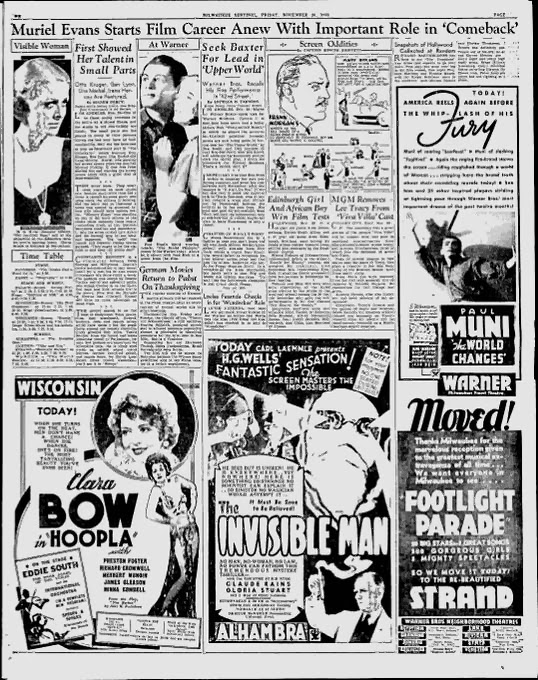
Footlight Parade will not match the five-week run of Gold Diggers of 1933 at Milwaukee's Warner theater. That doesn't necessarily mean it wasn't as popular as the previous Busby Berkeley spectacular. Since the summer, the Warner theater chain had refurbished the Strand into a first-run theater. To make room for a new Paul Muni picture, Warners moves Footlight Parade from the flagship Warner to the Strand, as illustrated below.


You'll also note the competition for the Warner duo. Let's take a slightly closer look at each.


James Whale's Invisible Man is now, after 80 years, one of 1933's best-known pictures. As part of the Universal horror cycle, it's one of the few 1933 films that remains culturally relevant on the pop level. The Whale film may be second only to King Kong in that respect. During the buildup, Universal made big claims for this one.


The other point of interest in the ballyhoo is the way the ads build up Claude Rains, emphasizing his stage credentials, without letting on that you'd see his face only at the very end of the film. That didn't stop him from making the hoped-for impression.

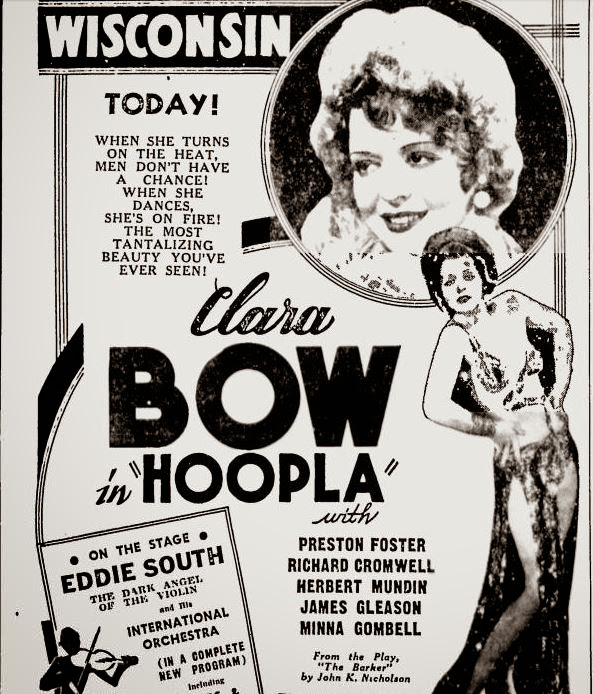
If The Invisible Man is a living film today, Hoopla isn't.


Hoopla was Clara Bow's second film for Fox and the follow-up to her scandalous comeback picture Call Her Savage. Such was the career of the 1920s "It Girl" that a comeback film was necessary when Bow was not yet thirty. Call Her Savage has become a canonical Pre-Code picture, but Hoopla hasn't the same reputation. Bow's comeback ended here; apparently it was her own call to call it quits but it seems right in retrospect that she bow out before the Code Enforcement crackdown. We can keep an image of her in our imaginations as a star who wasn't and maybe couldn't be tamed.

Tuesday, November 19, 2013

DVR Diary: John Ford's UPSTREAM (1927)

A contemporary reviewer for the trade press thought it necessary to inform readers that Upstream was not an outdoor adventure picture. Blame Fox Film for the confusion; having promised a picture of that title, co-starring Dolores Del Rio and Walter Pidgeon, only to have the project fall through, they slapped the label on a story originally titled The Public Idol. Knowing John Ford as we think we do, we might have expected an outdoor picture as well, but Upstream, long thought lost until a copy was found in New Zealand a few years ago, seems Fordian just the same. The setting of a boarding house catering to actors proves to be quite the Fordian environment. The westerns we know him best for were often filled to overflowing (some might say infested) with eccentrics whose personalities were essentially theatrical. Here no one is normal, broadly speaking. Everyone's an entertainer, all of them down on their luck -- "at rest" is the genteel way to put it, but those in that category are expected to pay in advance. Some are in decline, others still young and aspiring; both groups get their due. Our main focus falls on a romantic triangle: a knife thrower (shades of The Unknown!) and his two assistants. The male assistant (Earle Foxe) has little enthusiasm but carries a storied theatrical name. It's that name a high-powered producer is after when he calls at the boardinghouse, briefly getting everyone's hopes up. The sudden offer to star in Hamlet terrifies young Brasingham, but an elderly acolyte of the Bard -- he lights candles in front of a bust of the playwright -- gives him a quick tutorial that leads to the lad conquering London and earning a nod of the head from the royal box. Success goes to his head, however, though the now-Great Brasingham gets his comeuppance when he crashes the wedding of the knife-thrower (Grant Withers) and his female assistant (Nancy Nash) at the old boardinghouse, cluelessly thinking that the celebration put on there is in his honor.

Upstream finds Ford between two phases of his career. He had recently made his name with the western blockbuster the Iron Horse and followed up with Three Bad Men. He would next enter a more self-consciously artistic phase, influenced like his fellow Fox directors by the arrival of F. W. Murnau to make Sunrise. The influence would become apparent in films like Four Sons, released in 1928. Upstream was Ford's only 1927 release, which makes it hard to excuse the slapdash nature of the story. He seems confused over whether Brasingham is the main character or whether he was making an ensemble piece. I suspect he'd rather have done the latter, but he's stuck following Brasingham to London, where a vision of his momentary mentor inspires his to triumph, and then back to America and a closing humiliation that makes this one-hour feature feel more like a slapstick short subject where the star acts out a fantasy only to be kicked back into his rightful place. Actually, Brasingham isn't kicked into his rightful place, since he'll go on being a star, but since the other two legs of the triangle haven't gotten an equal share of development, Upstream feels like a star vehicle for the otherwise-unknown-to-me Earle Foxe -- whom Ford used as late as My Darling Clementine. I often credit early movies for telling stories efficiently, but for once this is one that really does feel too short. Still, there's a certain indisputable charm to the film that isn't just the glamor of discovery. Upstream isn't really an unearthed treasure, but there's a pleasant shock of recognition to it when you realize that, however an unlikely setting this seems for a John Ford picture, the director really does seem to be in his element. Watching it is like removing a layer of his legend, getting past the man who made westerns to the essential showman at heart.

At least one reviewer at the time saw this pretty much as I did. 

Sunday, November 17, 2013

Now Playing: NOVEMBER 17, 1933

Last week the Universal drama Only Yesterday was the big winner at the Milwaukee box office, or so we can infer from its being held over for a second week. It probably won't be the champ this week, because Busby Berkeley is back.


Following the success of 42nd Street back in March, Gold Diggers of 1933 was a summer blockbuster, staying at the Warner for an extraordinary five weeks. For their third spectacular musical this year Warners piles it on by throwing James Cagney into the mix in his first musical starring role.

The film may need no introduction, but here's the trailer anyway from TCM.com. You'll be excused for thinking it's a Twentieth Century-Fox picture at first with that drumroll, but Warners will be excused, too, since there was no Twentieth Century Fox in 1933.


What are the other theaters throwing into this buzzsaw? Only Yesterday is standing its ground, but the New Garden goes with the latest in a popular Pre-Code series.


It may have been the Honolulu detective's greatest case, but this adaptation of the Earl Derr Biggers novel in which Chan first appeared is one of the few big-studio 1933 releases (along with Warners' notorious Convention City) to have gone lost. Actually several of the early Chans are lost, and I'm not sure why. Convention City was lost because it was considered unreleasable in the Code Enforcement era; perhaps later politically correct attempts to suppress the Chan films account for the loss of this one.

Meanwhile, the Palace tries to match Footlight Parade's quantity with the quality of a live nude dancer on stage -- and Popeye the Sailor Man


Faith Bacon was the legendary Sally Rand's principal rival as a fan dancer and actually sued Rand for stealing her gimmick. Bacon lost the battle for history and died, most likely by suicide, in 1956. Here she is somewhere in between, in a "soundie" uploaded to YouTube by vitajazz.