Sunday, April 17, 2011

Fellini's CLOWNS (1970)

Why "clowns?" Why did Federico Fellini call his made-for-TV essay film I Clowns in Italian? It's not as if Italian doesn't have a word for the vocation, but it eventually sunk in to my initially obtuse skull that had he called the movie I Pagliacci, both Italian and English speaking audiences would have gone in expecting a very different movie. With the title accounted for, that leaves us the film itself to ponder. I Clowns comes from a period when Fellini seemed to be adapting the devices of Italian mondo movies to his particular sensibility. Working for television with a documentary mandate apparently sparked a creative process beginning with his American TV special, Fellini: A Director's Notebook, which he made while transitioning from an aborted sci-fi film to his Roman spectacle Satyricon. With Satyricon done, he returned to essay mode for Clowns, Roma and Amarcord. By the end, he'd personalized the format enough to dispense with any pretense of documentation, and what sets his work apart from mondo in general is the understanding that Fellini will show us re-enactments of actuality without pretending to show us "reality." Mondo pioneers Giacopetti & Prosperi were headed in the same direction with Goodbye Uncle Tom, but even then, while recreating the distant past, there was a pretense of objectivity, an implicit claim to show things as they were, that Fellini doesn't really require us to accept. Clowns actually invites us to call every documentary pretense into question. The director shows himself directing the film and has his assistant Maya Morin read much of the narration on screen, as if we were seeing "The Making of I Clowns" rather than the thing itself. The tactic also creates the impression that everything we see, and not just the obvious re-creations, could be scripted rather than spontaneous. Anita Ekberg's allegedly accidental appearance (she's supposedly shopping for a panther)only adds to that impression.


Fellini admits to being fascinated by grotesque freaks throughout his life. How do you feel about that, Anita?

Fellini also plays with the question of whether cinema can capture or preserve reality. In two different scenes, he makes an appointment to see rare film footage of famous clowns. The first time, at the home of a collector, the old film breaks and ignites in the projector. The second time, at a Paris archive, Fellini has a hard time determining whether the clip shows the clown he's looking for, and in any event the footage is much too short to make any impression. The director's disappointments seem linked to his implicit thesis about the incompatibility of cinema and classical clowning. The film opens with a surprising confession: the young Fellini (so the older man claims) was, if not frightened, then strongly disturbed by clowns when he first attended a circus. They reminded him too strongly, he recounts, of the disturbed or merely grotesque people he saw everyday in the real world. Those people, to a great extent, became the subject of Fellini's cinema, which evolved into an often literally circus-like spectacle of eccentricity. When the RAI TV project (originally broadcast in black-and-white on Christmas Day 1970 and subsequently released to theaters in color) gave Fellini the opportunity to film a literal circus, the result is problematic.

Circus clowning is arguably uncinematic when it involves bunches of clowns doing their shtick simultaneously while playing to different sections of the audience in different directions. The individual performance style is also uncinematic, as studios learned when they recruited circus clowns for silent comedies. Fellini can show us presumably acclaimed clowns doing their stuff, but as long as he sticks to documentary mode much of it leaves a moviegoer feeling underwhelmed. Things change when the director stages a center-ring funeral for "Augusto," one of the archetypal clown characters, for his climax. This is a true Fellini-esque spectacle, but the director portrays himself taking things too far. He wants to close it with the big Fellini finish, with clowns parading around the ring, but he makes the veteran clowns hustle around and around repeatedly, faster and faster each time, as if he were shooting They Shoot Clowns, Don't They? Many of the clowns simply can't keep up and have to step out of the ring to recuperate. While clearly sending up his own reputation for excess, Fellini also seems to answer his film's question, "Where are the old clowns?" by showing us symbolically that cinema did them in. While the film actually closes with a sentimental horn duet for two clowns in an empty ring, the climax that comes before gives the more modest scene the air of a requiem.

Like many a mondo, I Clowns is a hit-or-miss project. Most of the film lacks the creative engagement Fellini brings to the funeral scene, and while many individual scenes are beautifully done (particularly the Fratelli brothers' tense performance on wires in an insane asylum) many are also empty spectacles that exist only for illustration. As someone who knew next to nothing about clown history, I found the discussions of augustos and white clowns fascinating, but Fellini's presentation only whetted my appetite for more detailed accounts of famous personalities like the Fratellis than his format allowed. The film's limitations show Fellini grappling with a new mode of moviemaking that will bear fruit in the much superior Roma and Amarcord. Clowns itself remains a historically important film as an episode in the director's creative evolution, with one brilliant sequence to redeem it for movie fans in general.


I don't know if this is an authentic theatrical trailer, but rarovideousa has posted it to YouTube to promote last month's U.S. DVD premiere of the movie.

Friday, April 15, 2011

SIMON, KING OF THE WITCHES (1971)

He lives in a storm drain, so he has to go out when it rains, but Simon Sinestrari has a dream. Already one of the world's few genuine magicians by his own account, he hopes to become equal to the gods, and while banishing a glowing red orb he proclaims, "I am God!" Right there you see he isn't entirely full of it; he can banish a glowing red orb. But to most casual observers, Simon (Andrew Prine) is little more than a bum. The cops pick him up on one of his rainy walks and rifle his gear in search of drug paraphernalia before tossing him in the jug for vagrancy. There he befriends a naive young hustler of the sort you'd see in movies back then. Turk (George Paulsin) takes it for granted that Simon is what he says it is and invites him into the orbit of Hercules (Byron York), a wealthy patron of eccentrics. However patronized he may feel, Simon embraces any opportunity to make money, and he demands fair value for his work. When a contemptuous skeptic thinks to repay the assumed fraud in kind with a bad check that gets him arrested again, Simon demands compensation, but an increasingly bored Hercules asks why Simon doesn't use his vaunted powers to avenge himself. Simon takes that as a dare and asks if Hercules really wants him to curse the guy. Eager to see Simon put up or shut up, Hercules confirms the dare, and Simon announces that the offender will die within two days. Right on schedule, the writer of bad checks gets brained by a flower pot pushed from the roof of a tall building by a glowing red orb while the victim gazes upward as if paralyzed. Simon has just killed a man, but the most bother that causes is when Hercules finds himself haunted by a glowing red orb, and Simon takes care of that by releasing his onetime patron from his vow to share half the guilt for the curse. Then it's on to new adventures as Simon strives to charge a wand with occult energy, first by seducing a girl, then by menacing a gay man, so that he can claim his place among the gods at exactly 1:33 p.m. on an auspicious day. Imagine how he'd feel and what he'd do if he misses his appointment, and the police are to blame....

Bruce Kessler's picaresque horror film is built around a genuinely unpredictable main character. I'm still not sure, however, if that's because writer Robert Phippeny (reputedly a practicing magician) and star Andrew Prine have tapped into an authentic ambiguity or ambivalence or because Phippeny lacked a consistent sense of Simon's personality. His opening address to the audience notwithstanding, Simon isn't the sort of flamboyant, affected personality one might expect in a "real" magician. He states his business in a flat, matter-of-fact way, and comes across most of the time as much as a curmudgeon as a mountebank. He regards the people around him with a detached, sardonic contempt that's appropriate for someone who sees others as means to his own delusional end. As a result, Simon is often a humorous character, as when he proposes a "magical" cure for Turk's inconvenient (but conveniently unillustrated) case of priapism. The overall tone of the film is quite satirical, sending up freak-chic poseurs like Hercules and the more blatant showmanship of rival magicians like the wiccan Sarah (Ultra Violet), whom Simon mocks by breaking a "witch's" broom to disrupt her ritual. Many reviewers describe Simon as a black comedy rather than a horror film, and that may explain why Simon's crimes don't provoke the horror they ought to. If everyone is fair game for mockery, it's hard to mourn for anyone.

That Phippeny and Kessler meant Simon as a satire of a subculture rather than a shocker is clear from the lackluster effects whenever Simon shows his real power. Magic is mostly a matter of glowing red orbs and other glowy effects, while the big "psychedelic" scene when Simon steps into a mirror in search of power is too derivative of the 2001:A Space Odyssey "trip" (Kessler reports that he employed some of the same FX people) to make any real impression. The effects are inevitably disappointing, but not inappropriate for a film built around a character with real magical powers who is also a loser. You get the feeling that Simon will never transcend his Skid Row milieu when you see how easily he can be distracted by the troubles of two drug-pusher pals into forgetting his scheduled assault on heaven. He can rage at the gods all he wants, but the gutter pulls on him too strongly. Prine pulls off what's asked of him; he makes you believe such people (albeit powerless) were wandering around California back then. If he has limitations, they seem to be Simon's as well. Apart from his performance, Simon works as an exploitation film thanks to plenty of irreverent nudity and sexual humor -- though some of that humor is ickily homophobic by today's standards. Some of it is spot on, though, as when a naked woman used as a living altar tries to shoo away a curious chauffeur-clad Turk by declaring, "I'm an occult object." The story falls apart toward the end when Simon curses the city by causing floods and framing officials for crimes and the curse rebounds awkwardly on him, but Simon, King of the Witches is a period artifact that's problematic in a consistently interesting way. It's less than it could be, but still more than meets the eye.

Director Kessler says the producers messed with his movie to turn it into an exploitation film. Judge for yourself by watching the oldschool ballyhoo on this trailer, uploaded to YouTube by jeffkostello.

Wednesday, April 13, 2011

GOYOKIN (1969)

It is the way of the samurai to protect the interests of his domain. The well being of hundreds of retainers may depend on his actions. When the domain of Sabai falls on hard times, what is Rokugo Tatewaki to do? For him, the way of the samurai is piracy. When a ship bearing goyokin -- precious metals destined for the government reserves -- runs aground in his territory, Rokugo and his men seize the gold and silver from the peasants and fishermen who'd salvaged it from the wreck. The way of the samurai is slaughter: to cover up the crime, Tatewaki has the villagers slaughtered. They can be blamed for the theft and punished for it, while the loot was supposedly never recovered.

Magobei Wakizaka (Tatsuya Nakadai) isn't so sure about the way of the samurai. He comes late upon the scene and sees innocents butchered, including a woman in her wedding kimono. He protests to Tatewaki (Tetsuro Tanba), a longtime friend and his brother-in-law, who urges him not to report the deed to the bakufu -- the shogunate administration. In return for his silence, Magobei extracts a promise that Tatewaki will never pull such a stunt again. Satisfied, Magobei retires to Edo. Over time, a legend spreads about the ruined village, that it was annihilated by the kamikakushi, a divine curse symbolized by flocks of crows, except for one survivor, a woman who's seen as lucky or accursed, depending on your point of view. She's the first character we meet in Hideo Gosha's colorful thriller, as she returns to her village after a term of indenture in a textile town. She finds the village deserted except for crows. As she searches for her father or any sign of life, the movie gradually goes silent. No music, no dialogue, and finally no sound effects, until Oriha (Ruriko Asaoka) finds a body. It's an eerie moment and typical of the movie's idiosyncratic outbursts of style in the midst of a well-made thriller plot. Later, Gosha transforms crows in mid-flight into ideograms to announce a leap forward in time. Experimental or expressionist or simply indulgent moments like these may reflect the influence of spaghetti westerns on the samurai genre that itself influenced the Italian movies. What goes around comes around.


The man in the hat above is Magobei Wakizaka (Tatsuya Nakadai) and he's about to put on a show.

We first meet Magobei in Edo, where samurai stalk him amid a sideshow of swordsmanship. When they try to kill him, and he recognizes the dead as Sabei men, he realizes that Tatewaki no longer trusts him to keep silent -- or, worse, that Tatewaki assumes that he won't keep silent should the goyokin incident repeat itself. The stage is set as the Sabei clan discusses the funds needed for an extensive improvement project. Where will the money come from? Not knowing this, but suspecting the worst, Magobei heads north to Sabei, but not before making his money-hungry ronin crony Samon (Kinnosuke Nakamura) interested in what might be going on. On his way, Magobei encounters Oriha of the Kamikakushi, who has become an alcoholic gambler with her "brother" Rokuzo (Ben Hiura) as a shill. Magobei saves them from a gang of angry yakuza that caught Oriha clumsily cheating. Meanwhile, Tatewaki realizes that Magobei is coming and will probably have to die, but wants a peaceful way out. He has his sister Shino (Yoko Tsukasa) go to Magobei and urge him to go back where he came from with her and Tatewaki's best wishes. But the way of the samurai as Magobei sees it requires him to atone for his past error and ensure that justice is done for the victims of the "kamikakushi." Warned that confronting Tatewaki means certain death, Magobei says that he's dead already, and will stay dead until justice and true honor are satisfied....

Goyokin is a great adventure film, beautifully shot in the snowy landscapes of northern Japan and performed by an excellent ensemble cast. It's a debunking anti-authority film, exposing "the way of the samurai" as men like Tatewaki see it as an immoral system of oppression and cruelty. At the same time, Tatewaki isn't a pure villain. He really doesn't want to kill Magobei until the very end, and there's something poignant about the way he fails to understand the wrong of what he's doing. If it is wrong, he blames the bakufu for impoverishing Sabei and forcing his hand. We're near the end of the shogunate, the story being set in 1831, and no one seems happy with the bakufu. A character who works for the government eventually states that he's tired of being the bakufu's dog. There seems to be no authority worthy of an honest samurai's loyalty. If there is a way of the samurai worth following, each man must find it with justice as his guide.

But action fans can skip the message and enjoy a slick thriller. Gosha and co-writer Kei Tasaka skillfully gather a motley group of heroes and potential heroes and find a task for each of them. Tatewaki's master plan is to misplace a giant signal bonfire that the goyokin ship navigates by. If he snuffs the bonfire on one cliff and lights one on another, he expects to trick the ship's captain to steer straight into the rocks. He'll then send villagers out, coercing the men by taking the women and children captive, to retrieve the goyokin. Only the bloody cleanup will remain. To thwart Tatewaki, Magobei and his friends must rescue both the village men and the hostages, snuff the false bonfire and re-light the correct one -- and nothing's going to happen without a fight. And it'll all go down in the middle of a winter storm. For the occasion, Gosha puts on a brilliant show of timing and crosscutting, producing one of the most suspenseful sequences I've seen in a samurai film.

I've already implied that Tetsuro Tanba gives a strong performance as the conflicted villain, and kudos are due as well to Ruriko Asaoka for her spunky surliness and to Kinnosuke Nakamura for making his questionable ronin consistently likable yet consistently questionable. But this is Tatsuya Nakadai's show, and he is terrific. He's a master of dignified, soulful indignation and he convinces you that Magobei has been suffering inside for his one moral slip, not by emoting but with his eyes and his posture. I've liked Nakadai in just about everything I've seen him in (most readers will most likely know him from Kurosawa's Ran) and it's a shame that, still living, he still dwells in the shadow of Toshiro Mifune in most people's eyes. Mifune may have been the greater star with the greater persona, but Nakadai may well be the better actor with the greater range.

There's something special about action in winter, whether you're watching a western, a modern crime film or a samurai movie. Goyokin is probably one of the best winter action films ever made, though there's also plenty of rain and muck along the way for contrast. It's one of those rare films that can be appreciated visually as a work of art and enjoyed viscerally for violent thrills. In short, it should have something for everyone, unless you really can't stand subtitles -- and then you might try to find a copy of The Steel Edge of Revenge, a dubbed edition released in the U.S. in the 1970s. If I ask you to go to that trouble, then consider this film highly recommended.

Manos99 has uploaded a subtitled trailer to YouTube. Calling itself "an entertaining samurai film" is really being modest.

Tuesday, April 12, 2011

Wendigo Meets VAMPIRE HUNTER (1997-2004)

Can you make a decent vampire movie on a $5,000 budget. My friend Wendigo, a vampire-movie fan, thinks it's possible. You'd have to do a character-driven, intimate story, going easy on the mythos and effects. The key, he thinks, is not trying to do something you can't pull off on the budget you have, unless you can come up with a way of making it look interesting. Skip the shape-changing and other stunts; you still really need no more than a pair of fangs to get the point across. Jean Rollin is an example of someone who got by on style and story sense without elaborate makeups. The recent British film Vampire Diary is another successful example in Wendigo's opinion.

Sean Gallimore
claims to have spent no more than $5,000 on Vampire Hunter, a film shot on video in 1995, copyrighted 1997 but listed as a 2004 film in many reference sources and on the recent Blood Suckers video collection from Mill Creek Entertainment. I found Blood Suckers in the checkout aisle of a Borders bookstore a few months back and bought it cheap, thinking to myself, "Now I can hold up my end of the Wendigo series for the next few months." But after previewing some of the films I was reluctant to show any of them to Wendigo. These are micro-budgeted movies, most if not all shot on video, and the production values are amateurish. At first glance, Vampire Hunter is no exception. Gallimore is a former Disney animator as well as a martial artist. Vampire Hunter reflects his martial-arts influences more than his Magic Kingdom influences. It opens most unpromisingly with a fight in an art gallery between a hero and two vampires, a beefy dude we'll later know as Morgan Bane (Leonardo Millan) and his hair-band type minion. The hero puts up a valiant fight to save his girlfriend, but Bane seems unbeatable. Triumphant, he grouses, "Immortality sucks!" It sucks because he hasn't faced a worthy adversary in centuries, but you're supposed to assume that that's about to change.


Faces of death

Enter John O'Ryan (Gallimore), an ex-Marine and a graphic as well as a martial artist. Director Gallimore treats us to a montage of some of John's sexy artwork as well as longer, time-killing montages of O'Ryan working out. John hopes to show his art at the same accursed gallery we saw before the credits, and it's there that he and his wife encounter Morgan Bane, as well as a crazy man who tries to kill Bane with a piece of wood. O'Ryan disarms the madman, who nonetheless manages to make good his escape. No matter: Bane dispatches his scruffy sidekick to take care of the apparent vampire hunter, but Ramone (fellow animator Frank Suarez) is always prepared. The man has a cross tatooed on his palm to turn away unwanted vampires, though his stake throwing leaves a little to be desired. People in this film have a hard time killing vampires because they manage to miss the heart more often than not. But after some exertion Ramone finishes his foe. Later, Ramone has a tense confrontation with John in a parking lot after O'Ryan notices that he's been followed. Imagine the following spoken with as little emotion or inflection as possible:

John: One warning: stop following me.


Ramone: You're in danger. Your wife is in danger.


John: Oh, really? From who?


Ramone: You know who....Bane. He's got eyes for your wife, which means you're dead unless you learn to protect yourself.


John: I can take care of myself.


Ramone: I know, remember?...He's a vampire. He had eyes for my wife and she's dead now. He tried to kill me but I know how to fight them, but they're so many and I need help.


John: Stay away from me and my wife. I'm worse than any vampire.


Shouldn't the film be called Vampire Hunters? Sean Gallimore (left) and Frank Suarez (right) make two of a kind.

Don't worry, folks. John will come around. One of the aspects of this movie that resembles a character arc is our hero's gradual spiritual awakening. While Ramone is so spiritual that he can draw a cross on his hand and gain power from it, John can put a crucifix in Bane's hand with no effect. As Bane plays with the object, we learn that O'Ryan's an atheist, and infer that the traditional holy symbols won't have their traditional effect when wielded by an unbeliever.

Inevitably, of course, there are no atheists in vampire movies; with so much obviously supernatural shit floating around, it's hard to maintain one's materialist poise for long. So inevitably, as Bane makes his moves on Heather O'Ryan, John learns the ways of the vampire hunter from Ramone, who wields a mean Super Soaker full of holy water among other weapons. In the end, however, Ramone is sidelined ("It got me, and fucked up your car."), and John must penetrate Bane's lair on his own-- it's behind a black curtain in the gallery -- to save his wife from the vampire's power.


Honorable warrior John O'Ryan opens his duel with a vampirized martial-arts master by throwing garlic powder in his foe's face. Below, the fight finishes the way it started.


When martial-arts expert vampires can't stop our hero, Bane himself, after losing an eye to John in an earlier showdown, makes the unholy transformation into a puppy-faced monster in a rush to spend the majority of Gallimore's budget on gore effects....

Wendigo thinks that Gallimore simply bit off more than he could chew by trying to make a vampire-fighting action film. The auteur simply lacks the skills or means of fight choreography, camera placement or editing, not to mention a cadre of competent stuntpersons, to pull off what he wanted. Some of his actors clearly have martial-arts training, probably from Gallimore himself, but many lack any sense of timing and as a result the fight sequences often come to a dead halt while someone slowly falls to the floor. Worse, in Wendigo's opinion, Gallimore couldn't resist the temptation to try for cool effects that fall flat. The already-poor sound effects become almost unintelligble whenever he tries to give Bane a supernatural spooky voice. The props are sometimes ridiculous, too. Wendigo thinks this film has the fakest-looking wooden stakes he's ever seen; maybe that's why it's so hard to kill vampires with them. As for the sets, they have that lived-in look that simply can't be faked, and Gallimore seems very intimate with them. In other words, there's no such thing as art direction in this project, though there's lots of art on the walls.

On the other hand, Wendigo found Vampire Hunter charming in a pathetic way -- the way of a mewling kitten found out on the street in the rain. He can't say there was anything good about the film, but he feels that he saw Gallimore trying his best, and like a lot of us, when he sees that starts to root for the filmmaker a little. While Gallimore went overboard reaching for effects a bit, Wendigo felt that the story itself, the master vampire's relatively unambitous scheming, was on a level that suited the budget. If we have an "urban fantasy" genre today, then Vampire Hunter may be a Skid Row fantasy, but there's nothing necessary wrong with that. Gallimore doesn't really make any original contribution to the vampire genre, but Wendigo can't help but say, "Bravo!" to anyone who can put a feature film together on such limited resources. We might not be able to account for every penny of that $5,000, but every bit of the enthusiasm that put it all together is on screen. Wendigo can't recommend it to anyone, but he thinks it could be a fun film to watch with like-minded friends. If your mind is like ours, you might find it worth that fraction of $4.99 that it cost me.

Gallimore has posted a trailer for Vampire Hunter on YouTube under his Wassabe23 tag, but doesn't allow enabling. To take a look at it, follow this link.

Sunday, April 10, 2011

CITY OF FEAR (1959)

Film blogger Maurizio Roca is currently doing a countdown of his top 50 films noirs at the Wonders in the Dark blog Any such project begs the questions: what is film noir? what is it about? when does it begin? when does it end? Any attempt to periodize a genre that was defined by critics after the fact is bound to start a debate. Roca has elected to confine his countdown to English-language films shot in black-and-white between 1941 and 1958, though he concedes that the "classical" period could be extended in time in either direction. Other critics would want to admit foreign-language films like the work of Jean-Pierre Melville or the Nikkatsu Noirs that have recently won recognition here. Others might object to the exclusion of noirs in color on the premise that noir is a matter of theme rather than cinematography. The arguments will go on because noir is a slippery concept encompassing a wide range of influences and going in several directions at once. Thinking about when noir can be said to have ended, it occurred to me that you could define a subcategory of late noirs that have a common apocalyptic mood, by either tapping in to Fifties fears of nuclear war and radiation or by self-consciously declaring a violent end to a style of crime movie. The most obvious examples of what I mean in each respect are Robert Aldrich's Kiss Me Deadly, with its "Pandora's box" conflagration at the end, and Robert Wise's Odds Against Tomorrow, which turns a botched bank robbery into a miniature race war with an mutually-destructive climax. Add to those Irving Lerner's terse thriller from 1959, the same year as Odds, which substitutes the fear of radiation for fear of the Bomb while telling a tough, traditional crime story.

A common element of these late noirs is the idea that the oldschool criminal is in over his head when he messes, knowingly or not, with forces far beyond his control or ken. Kiss Me Deadly is the model here, as Mike Hammer mulishly carries on his pursuit of a "great whatzit" that could destroy him, but you could also extend the idea back to Samuel Fuller's Pickup on South Street, in which a pickpocket gets reluctantly mixed-up in a commie spy case. City of Fear may be the most blatant statement of this theme. It opens with Vince Ryker (the conveniently named Vince Edwards) on the lam after a prison break, accompanied by a dying accomplice. Along with his freedom, Vince claims a prize. As we learn later, he'd heard from prison gossip that the infirmary kept a supply of heroin for experimental purposes. On his way out, Vince grabs a cylinder containing what he estimates as a pound of the pure stuff. If he can arrange to have the smack cut and put out on the street, he figures it'll be worth a million dollars to him.

What Vince doesn't know, since he can't open the canister, is that it isn't heroin but Cobalt-60 inside. Having removed the metal cylinder from its lead casing, he's exposing himself and everyone he encounters to dangerous levels of radiation. Allowed to run loose, he could contaminate the entire city of Los Angeles. A police investigation team equipped with Geiger counters sweeps the streets in search of the fugitive, but keeps its work under wraps in order to prevent a panic. The problem with that approach is that they can't make clear to Vince's uncooperative criminal cronies the danger they're in if they deal with him. His moll is already contaminated but won't rat him out. A suspicious shoe salesman assumes that Vince is carrying heroin and looks for ways to get the drugs while getting rid of Vince. Another sleazeball interrogated by the cops assumes that Vince has something important and decides to horn in on his deal with the shoe dealer. Vince himself is paranoid enough as a fugitive, and the radiation poisoning isn't helping matters. On top of that, he has to worry about his cronies double crossing him and taking his precious cylinder. They all behave exactly as you would expect, and because they all want a part of the score no one who knows Vince is going to tell the cops, who face a countdown before the mayor goes public with the threat. A handful of pathetic people are playing their usual petty game for higher stakes than any can imagine....


Vince isn't entirely paranoid. Lots of people are out to get him (above). Below, his moll (Patricia Blair) faces the music from a Geiger counter.


We're in a sleazier place than prime film noir, which rarely deals with drugs in my experience, and the youthful Edwards gives a juvenile-delinquent quality to his delirious protagonist. He is as doomed a protagonist as noir can offer (except maybe for Edmond O'Brien's poisoned hero in D.O.A.), and Edwards gives him just the right blend of stupid bravado and paranoia.


Vince and his precious (foreground)


Director Lerner helps him along with nicely edited sequences illustrating Vince's suspicions as he scans the streets for enemies or flees from imagined watchers. Lerner even jump cuts within shots in an almost avant-garde way to highlight Vince's fragmented, brittle perceptions. The director also makes excellent use of urban locations and hand-held cameras while also getting maximum noir value from cinematographer Lucien Ballard whenever night or shadows fall. Icing on the cake is a young Jerry Goldsmith's bombastic modernist score -- one of his first for a feature film. It sounds like exactly the sort of soundtrack one of my late noirs should have.


Lucien Ballard's cinematography gives City of Fear instant noir cred. Below, production design underlines Vince's paranoia (check out the eye on that sign).


It's possible that filmmakers were making self-conscious noirs (or would that make them "neo-noirs?") by 1959, but a late noir like City of Fear is more likely a self-conscious synthesis, an updating of noir tropes and themes for a modern world that must have made the original noir milieu of the 1940s seem long ago and far away. Just as we began to see "late westerns" around the same time that dealt with the end of the outlaw world of the Old West, late noirs seem to portray the last days of a dying breed -- in that respect, you could also throw in Orson Welles's Touch of Evil, which starts with an explosion. It may be no accident that crime films soon took a nostalgic turn, with many Sixties films dealing with the legendary gangsters and robbers of the Twenties and Thirties. Whether they declared an end to a genre or not, films like City of Fear do seem forcefully to declare an end to an era, and Lerner's film in particular does so in uncompromising fashion.

Saturday, April 9, 2011

Sidney Lumet (1924-2011)

The dean of American directors (I suppose Eastwood or Coppola inherits this title now) passed away today at the age of 86, ending a feature-film career that lasted a neat 50 years, from 1957's Twelve Angry Men to 2007's Before the Devil Knows You're Dead. Those are pretty impressive poles, and there are plenty of landmarks between them. His historic peak was the mid-1970s, when he rolled out Serpico, Murder on the Orient Express, Dog Day Afternoon and Network in quick succession. My own favorite among his films is 1964's Fail Safe, which is arguably Lumet's most impressive achievement in that his nuclear-war nightmare has lost none of its terrible power despite its proximity in time and theme to Dr. Strangelove. Ask me to pick a sleeper from Lumet's filmography and I'll name 1988's Q&A for Nick Nolte's mighty work as a corrupt cop pitted against a conflicted Timothy Hutton. But there's plenty to choose from besides what I've mentioned, and the news of Lumet's death is particularly sad because it still seemed that he was capable of more.

Friday, April 8, 2011

THE DOCKS OF NEW YORK (1928)

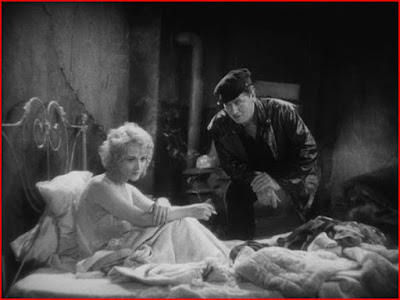
We think of the 1970s as a unique period when actors could become stars and even leading men without conventional good looks. But when you consider George Bancroft's rise to stardom in the 1920s the Seventies don't seem quite as unique. Bancroft was a beefy lout who got his big break past the age of forty; think of a Wallace Beery, if you know your classic Hollywood, with perhaps more sex appeal. Bancroft owes his place in movie history to Josef von Sternberg, who cast him as Bull Weed in the proto-gangster film Underworld. Star and director teamed up again a year later for a film that even more strongly anticipates the visual style of film noir, but in the service of a virtual fairy-tale romance of the waterfront, with Bancroft as the leading man. He plays Bill Roberts, a stoker eager for a night on the town when his ship pulls into port. He gets grief beforehand from his supervisor Andy (Mitchell Lewis), who orders him and his pal to clean up their filthy work area (they shovel coal into furnaces) before going ashore, and warns Bill that he'll lose his job if he comes back drunk. The work delays Bill long enough that he reaches the pier just as someone leaps off into the water. This suicide attempt is a bravura bit of pictorial business by Sternberg. We see the woman's reflection in the still moonlit water as she stands at the edge of the pier. We see the reflection leap and disappear from view. Moments later, the surface is dappled with little splashes, then overrun with ripples from the woman hitting the water.

Bill dives in and rescues the girl. He totes her to the nearest dive to put her to bed and hopefully get her a change of clothes. The dive's proprietors don't want her around, but Bill forces his will on them. The girl, Mae (Betty Compson) seems to have but one friend, Lou (Olga Baclanova, of Freaks fame), though we'll see that their relationship carries a strange charge. Lou also happens to be Andy's wife, and he'd returned a while earlier to find her in the arms of another man. She resignedly reunites with Andy and keeps uneasy company with him until Bill brings a dried-off and redressed Mae downstairs. She seems too beautiful to be at the end of her rope, but her sense of alienation is palpable. She stoically puffs away at cigarettes and acts like a bemused bystander of her own story until she agrees to let Bill try to show her a good time.


George Bancroft falls, or rather, dives for Betty Compson in Docks of New York.

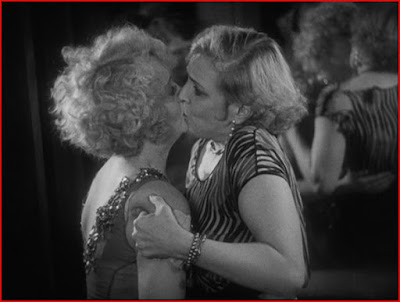
There ensues a multifaceted flirtation as Bill tries to entertain Mae while Andy keeps a lustful gaze on the troubled girl, and Lou's fiercer gaze sweeps across the entire barroom, occasionally settling intensely on Mae. The inevitable happens and Bill decks Andy, after which the festivities really begin. Some sort of sense of propriety or necessity makes Bill think it necessary to marry Mae before he can score with her, and Lou eggs the couple on. Still bemused but increasingly sincerely moved by Bill's ardor, Mae accepts his proposal and Lou summons Hymn-Book Harry, the local missionary. The wedding is parody and pathos in one. On one level Lou treats it as one big joke, yet some more intense feeling drives her to organize the spectacle. Add to that the pathos of Harry himself. He's played by Gustav von Seyffertitz, the Peter Stormare of his time and by virtue of his name alone one of my favorite silent character actors. He usually played creeps, and kept at it in sound thanks to his creepy German accent. Hymn-Book Harry is a weary, bitter figure with no illusions about the people he ministers to, but he retains a vestige of respect for the ritual and institution of marriage. He's about to walk away from the mockery Lou is arranging, but when he sees another woman take his place and propose a set of parody vows, he resumes his station to conduct the ceremony, despite Bill's lack of a license or a ring. Harry accepts his promise to get a license in the morning, while Lou gives Mae her own wedding ring with the wish that it'll do Mae more good than it did her. Throughout, Sternberg, who was good with faces, gets a wonderfully nuanced performance from Seyffertitz, whose brief presence enriches the film immensely. At the same time, Baclanova (whose sound career would also be constrained by a foreign accent) brings Lou's conflicted feelings to the surface. While the female tavern patrons converge on Mae to plant affectionate pecks on her cheeks, Lou confronts her and kisses her full on the mouth.

A few years later, Sternberg would earn eternal notoriety for having Marlene Dietrich kiss a woman in Morocco, but Docks shows that he was just repeating himself. If anything, the silent film has more lesbian subtext, thanks to Baclanova's intense performance -- but then again, I may be reading more into it than Sternberg meant to imply. Anyway, the couple retire to the bridal bed...and in the morning Bill throws a few bills on Mae's nightstand and heads downstairs to breakfast before going back to his ship. Andy hasn't forgotten last night, however -- though he thinks Bill might have -- and he fires the stoker on the spot. Bill isn't fazed; he figures he can find work anywhere, so off he goes. Seeing him go, Andy figures that now's his chance with Mae. He heads upstairs to tell the girl that Bill has abandoned her. Before long, Lou follows him upstairs. Then we see the seagulls that had been perching outside Mae's window startle and fly away, which is Sternberg's way of telling us that something terrible has happened in the room. Bill's on his way to the pier when he sees cops and crowds converging on the tavern and Mae's room. Curiosity and anxiety overcome him and he goes back to learn what happened, explaining to the officers that he's the woman's wife. Inside, Andy is dead, and Lou admits to shooting him. She gives Mae one last intense glance as she steps into the paddy wagon and wishes her luck.

It's Bill's lucky day, at least. If Andy's dead, that means he isn't fired. But somehow he feels uneasy about leaving Mae behind. Couldn't he settle down, at least for a while, and find a job on land? Not with his old sidekick from the ship urging him to get on board before it sails, apparently. But it does seem to weigh on the stoker that he might be the only thing keeping Mae from throwing herself back in the drink. And Sternberg lets us know that the water's on her mind after Bill leaves. It's not until the ship is on the way that Bill has second thoughts about sailing, but what can he do about it then? And what might he find if he can somehow get back to land under his own power?... Somehow, it works. The actors put it over with expressive but not excessive pantomime. Bancroft always keeps just short of over the top; he might not have managed such modulation in sound. Compson and Baclanova are excellent. Their tawdry environment is a creation of Sternberg, art director Hans Dreier and cinematographer Harold Rosson. Their work is phenomenal, practically the final word on what silent film could do with shadows and light. Docks is one of the most starkly attractive and atmospheric black-and-white films you'll ever see. Whether you buy the story or not, you'll believe the images and the faces they highlight. As it is, the story might end up too romantic, but it doesn't have as corny a wrap-up as Underworld and the romance never undermines the essential seediness of the setting. Pathos, usually the highest aspiration of silent cinema, seemed to require that sort of seediness, and Docks succeeds memorably in making it the true stuff of romance and monochrome art.