Sunday, December 19, 2010

Wendigo Meets THE TWILIGHT SAGA: ECLIPSE (2010)

To review: my friend Wendigo is invalid enough that he can't sit in a movie seat comfortably, and so has just seen the third filmed episode of the Twilight series this weekend. And while he yields to no one in his love for the vampire movie tradition, he defends the work of Stephanie Meyer against all comers, rejecting entirely the idea that her portrayal of vampires is somehow wrong or inherently bad. To date, he has liked Catherine Hardwicke's film of Twilight pretty much unreservedly, while finding Chris Weitz's New Moon a considerable slip in quality while still a tolerable movie.

The third film has David Slade of 30 Days of Night for a director and a new vampire villainess, Bryce Dallas Howard taking over the role of Victoria, the arch-enemy of the benevolent Cullen clan. The rest of the cast remains the same, while the famous triangle of Bella Swan, Edward Cullen and Jacob Black grows more sharp-edged. The young men and their respective clans, Edward's vampires and Jacob's shapeshifters, must quiet their rivalry to defend Bella from attack by an army of newborn bloodsuckers raised by the vengeful Victoria. Newborns, we learn, are actually more powerful (by virtue of retained human blood) than more experienced vampires, and must be handled with extreme care if you're to kill them. Hovering over the entire scene are the imperious Volturii, who offer Victoria no aid but would be happy to see her exterminate the annoying Cullens before they renege on their promise to turn the promising Bella, as Miss Swan herself desires but Edward would rather not do.


For an outsider to the phenomenon like me, Eclipse clarifies the qualities that make the series controversial to many and hateful to some. The main story is the choice Bella must make between Edward and Jacob, and the secondary choice between remaining human and joining Edward as a vampire. Ed and Jake are given ample time to make their respective cases to both Bella and the audience. Watching their debate over a sleeping Bella in a tent, the thought hit me that if Bella were Anita Blake, there'd be no issue whatsoever; she'd take both hunks to bed, maybe at the same time. At that point I realized that, instead of occupying an opposite extreme from traditional monster cinema, Twilight actually sits uneasily (in the eyes of many) in a middle ground between tradition and transgression. In the old days, one presumes, this sort of triangle would have been resolved by Edward and Jacob destroying each other so Bella could go on to live a proper life. The Anita Blake option, the complete embrace of transgression in all its polymorphous perversity, is the opposite extreme.

Wendigo reminds me of the common reading in which Edward embodies an old (though not to him) ideal of chastity. In past comments he's compared Twilight to fairy tales in which marriage is the gateway to happily ever after, while Anita Blake comes out of a different kind of romantic tradition in which sex itself is the consummation. Edward's embodiment of traditional values is what makes him difficult for monster-movie fans to comprehend or perhaps even like. He's a vampire, but not a monster. Wendigo has read the Anita Blake books and assures me that her boy-toys are monsters through and through, though some are reasonably noble. The idea of a monster doesn't preclude the idea of a noble monster; many such creatures are beloved by horror fans. But monsters by definition have an aura of danger, threat, even tragedy that simply doesn't exist for Edward Cullen, for all he talks about how dangerous his love might be. Monsters can struggle for self-control and win our sympathies by failing in their struggle and regretting their failure. By that standard, Edward isn't just something other than a monster, but someone too good to be "true" for many horror fans.

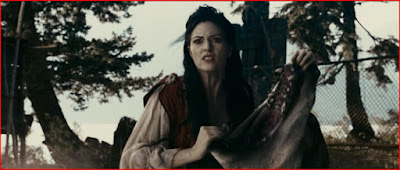
In the Twilight saga evil is a matter of choice rather than identity. In Eclipse, the noble Cullens (above) face off against the feral newborns (below).

Wendigo tells me that Edward had succumbed to temptation in his past, in episodes he recounts in the novels but haven't been shown yet on film. The film audience thus identifies him with an impossible or even offensive capacity for self-control. Because Edward doesn't seem dangerous, he's seen as a goody-two-shoes who, to the extent that he protests about his dangerousness, comes across as a whiner. Robert Pattinson's good looks don't help matters, either. But Wendigo says that Meyer wasn't consciously writing vampire fiction; she's reportedly not a fan of the genre or a steady reader of it. For her, Edward doesn't represent a folk archetype of horror but the complete alien-ness of the significant other with whom, for no necessarily rational reason, you choose to share your life. As Wendigo puts it, he may not be the "best" person for Bella, but he's the "right" one for reasons only Bella knows. The thing to remember, of course, is that Bella not Edward, is the protagonist of the series, which relates the girl's journey toward love and commitment.


Twilight's werewolves can also choose their enemies. In Eclipse, they warily side with the Cullens (above) against the newborns (below) for Bella's sake.

It occurred to me that people don't gripe as much about Jacob as they do about Edward, though he's no more of a monster than Edward is. I asked Wendigo why that seemed to be so, and he suggested that Jake's instinctive enmity toward Edward keys into the modern archetype of the werewolf as the enemy of the vampire, so that Jacob may seem "right" in a way that Edward doesn't. He also notes that werewolves automatically have a kick-ass coolness because they turn into animals and fight all the time. In the films, Taylor Lautner gets to show a greater emotional range, and especially more passion, for good or ill, and that may explain why the Jacob character gets more of a pass, however Lautner might be mocked for his obligatory shirtlessness.

While reading the novels, Wendigo leaned toward "Team Jacob" because even he got tired of Edward's self-pity in print. But after reading Breaking Dawn he switched to "Team Edward" for reasons he can't divulge without spoiling the films yet to come. He still likes Jacob better as a character, but felt that, in the end, Edward was the "right" one for Bella. Wendigo still likes to insist, however, that he belongs to "Team Bella," since Twilight is her story, and he'll stand by the character's ultimate preference.

So much for setting the stage. I agree with Wendigo that Eclipse is a big improvement on New Moon. The direction and the acting is more relaxed; all three lead actors are more casual and personable than last time, and Pattinson is the best he's been in the series so far. Slade makes more of the spectacular locations and the story seems better paced. Where New Moon seemed impersonal, perhaps because it was rushed into production, Eclipse, though just as rushed, has more style and personality. Slade has advanced as a director from 30 Days of Night, but he has more material to work with and plays more to his original material's strengths here than he did when adapting the graphic novel. One flashback scene (the film has three) is imported from another novel, and some of the mechanics of supernatural combat are altered (in the novels, you can only dismember a vampire with your teeth), but the movie is reasonably faithful to the book.


Flashback-a-rama: From the top, the "Cold Woman" battles ancient Indians; Rosalie Cullen remembers a fatal wedding; Civil-War Jasper is beguiled by a vampiress.


Bree Tanner, who became the heroine of her own novella last year, is a somewhat more prominent figure in the film than in the book, but that's no cause for complaint. Victoria's new boy-toy Riley, her puppet-leader of the newborn army, is built up more here than in the novel, but that's only to the story's benefit. The battle scenes with Cullens, werewolves and newborns are violent without being gory, thus keeping the movie safely PG-13, since under Meyer's rules vampires break rather than bleed.

Bryce Dallas Howard as Victoria is an adequate replacement for Rachelle Lefevre, though Howard's big eyes make her inevitably less menacing than the original actress. She acts the part well enough, though she's kept in the shadows a lot early on, as if Slade wanted to hide for as long as he could that Victoria wasn't quite herself. Among the returning actors, Jackson Rathbone as Jasper gets much more to do, both as a tactical leader in the present and in a Civil War flashback recounting a newborn relationship with his maker that parallels Riley's with Victoria. But at this point in the saga Wendigo believes that more credit than ever is owed to Billy Burke as Bella's dad, Charlie.

In the most mundane role, Burke steals every scene he's in in casual fashion. Charlie grounds Bella in the real world even as she discovers more of the fantastical world around her, and there's an understated pathos in his attempts to tell Bella the facts of life when she knows that there's so much more to life (or un-life) than he's ever dreamed of. Since the movies tend to downplay Bella's mundane classmates, Charlie becomes a more important figure reminding us of what Bella stands to lose, and Burke makes the role work.

There's one book and two films to go as Summit Entertainment goes the cynical Harry Potter route to maximize revenue from its tentpole series. Breaking Dawn Part I comes out next November, followed by the conclusion a year later, with Bill Condon directing both installments. Wendigo wonders whether the final novel can be split in a way that doesn't leave the first film empty or the second film nothing but a big fight scene. He also doubts whether Summit will sacrifice the all-important PG-13 to do justice to the novel's more explicit sexuality, violence and childbirth. To date, the film series, in Wendigo's opinion, has been more good than bad, stumbling in the second round like the Potter series did but back on solid ground by the third episode. He'll have to be more patient than most folks waiting for the final films, but for now he's still looking forward to them.

Thursday, December 16, 2010

KILL OR BE KILLED (1977-80)

Netflix is tricky sometimes. I'm sure they don't mean it, but sometimes they offer you one thing and give you another. That's what happened to me last night when I was browsing through their new arrivals. Something seemed funny about that 1950 film noir they were advertising as a free stream. The thumbnail art didn't look right. It looked like a long-haired guy screaming -- definitely not 1950 material. And wouldn't you know? Two reviewers on the actual page for the movie said it wasn't a noir at all. It didn't even have Laurence Tierney in it. Instead, it was a Seventies karate movie with a Nazi and a dwarf. Then the title rang a bell. Memories flooded back of a heavy-duty ad campaign that saturated TV when I was still a kid. They really put that film over as an event, and my curiosity was stoked, but I didn't have a chance to see it back then. But now I did.

Maybe those of you of my age remember the ad campaign. If so, maybe you remember further back to the Berlin Olympiad of 1941. Designed as a show of Axis solidarity and superiority, it ended in controversy surrounding the karate tournament. Baron Von Rudloff, captain of the silver-medal German team, accused the captain of the Japanese gold medalists, Mr. Miyagi (soft g, please) of bribing his compatriots into throwing their matches with diamonds. Unfortunately for the Baron, der Fuehrer wasn't interested in excuses. Rudloff was kicked off the team, stripped of his rank and dishonorably discharged. For more than thirty years afterward, the German nursed his grudge.


"Don't make me come down there!" Norman Coombes presides over the school of hard knocks in Kill or Be Killed.

Sometime in the 1970s, Rudloff reigns over a karate school in the middle of a South African desert from the vantage of the tower of his toylike castle -- the thing looks like it's made of Styrofoam. His most trusted lieutenant and confidant is Chico the dwarf, whom the Baron rescued from the humiliations of circus life. Now he's humiliated by the karate students, especially when he takes out his old circus hand puppet and reminisces about the past. But he humors the Baron's dream of staging a new Karate Olympiad in his own stadium, an exact reproduction of the surprisingly spartan venue Albert Speer designed for the 1941 extravaganza, and avenging his own humiliation at the hands and diamonds of the dread Miyagi.


"We were just sparring, Herr Baron." Chico (Daniel DuPlessis, right) and friend.

One of the Baron's students isn't quite with the program. Steve (James Ryan) apparently didn't have a problem with learning martial arts from a strutting, ranting uniformed Nazi originally, but he's starting to grow impatient and disgruntled with the situation. He wants to know what they're training for, but his attitude only gets him into fights with more loyal students. Steve's feelings for Rudloff's one female student, Olga, are the only thing keeping him in the desert. But once the Baron at last announces the purpose of their training, having lured Miyagi into accepting the challenge with smuggled diamonds, and then tells Olga that she can't be on the team and has to leave, Steve wants to go with her. They manage to flee together, with some sneaky help from a sympathetic Chico, in a battered Volkswagen. But Steve's car fu proves very poor, and the karate couple find themselves stranded in the desert. Their solution: dismantle the car, raise a big, fortunately available hunk of canvas on a mast attached to the chassis and sail to civilization.


Meanwhile, the Baron doesn't yet have a full 20-man team fit to fight Miyagi's picked squad. He sends Chico around the world to recruit the best remaining karate men. The dwarf's journey is filmed with magazine and book illustrations of London, just as Rudloff's hysterical flashback of World War II earlier in the picture was portrayed with cutouts and recordings of Hitler rants. Chico goes straight to the nearest karate school, but the teacher rebuffs him with proverbs. That forces him to recruit more creatively. We find him in a junkyard, where he's ready to make an offer to a dude who happens to be sitting in a jalopy with his pals and can bust a cinder block with his head. Turns out he'd already signed with Miyagi. This happens to Chico a lot, even in New York, when he makes an offer to an acrobatic mugger. Strangely, his quest for the kings of karate never takes him to Japan, but when you consider that he's only offering $5,000 ("plus expenses")to each prospect, his budget, like the movie's, was obviously limited.

At the same time, Rudloff still wants Steve on his side. Once the fact of Steve's attachment to Olga finally sinks in on the old Nazi, he regrets expelling her from his school. A repentant Rudloff now orders one of his goons to kidnap her. The goon surprises Olga in the middle of a lesson from her new, personal, private, female karate instructor -- she'd shooed Steve away for some reason. There ensues perhaps the most gratuitously destructive episode of fight-scene vandalism since the Jonathan Winters-Arnold Stang gas-station battle in It's A Mad, Mad, Mad, Mad World as the goon smashes a piano, a guitar, statuary, a TV set, etc in a protracted effort to subdue Olga. Eventually he succeeds, leaving Steve to discover an empty, devastated house. Rudloff's strategy works -- sort of. Steve enters the tournament, but on Miyagi's team, the Japanese having somehow convinced Steve that it'd be easier to infiltrate the Baron's dungeon and free his girl if he joins the enemy side.


"We were just sparring, whoever you are." Olga (Charlotte Michelle, left) and friend. Below, the Baron's goon perpares to El Kabong himself in an intimidating display of stupidity.

Once the tournament gets under way, after a round of feasting and dwarf entertainment, and proves quite an even affair, with fighters on both sides equally willing to cheat, the Baron decides to make the best of a bad situation. Determined to restore his honor by winning at all costs, he tells Steve to throw his fights if he hopes to see Olga again. Steve is too proud to do that, but Rudloff's prize specimen, the hulking Luke, seems quite capable of beating our hero anyway. Since these are supposed to be death matches -- a detail the film occasionally loses track of -- the Baron would just as soon see Steve die. But Chico, still remembering Steve and Olga's kindness, convinces his master to spare Steve so he can "suffer" more later.


"Gooble gobble, gooble gobble, we accept you..."

Eventually, the tournament gets out of the Baron's control as more fighters on both sides object to his, well, Nazi-like dominance. Tiring of it all himself, Rudloff has his Foreign Legion-outfitted guards herd all the karate men into two adjoining cells. And here he made his great mistake, and an inconceivable one for one so devoted to the power of the open hand. Put a few dozen guys whose hands and feet are deadly weapons in two cells separated by a wall and what are they going to do? They're going to punch and kick that wall into oblivion, of course, and then they're going to combine their strength into approximately one Hercules-unit of power, enough to bend the cell bars so they can all escape. So remember: the next time you stage a karate tournament, make sure your dungeon has solitary confinement for everyone.


The movie won't end this easily...

Seeing a rebellion break out, Rudloff, Chico and Luke pack Olga into their car and flee into the desert. Steve commandeers a vehicle to pursue him, but his car-fu is as bad as ever. In an automotive answer to drunken boxing, however, he turns obstacles into shortcuts, flipping and barrel-rolling his wreck until he blocks the Baron's escape route. Somehow he's capable of crawling out and engaging Luke in a final battle as the Baron watches and Chico holds a gun on the Baron. Strangely, the story ends with the Nazi and the dwarf, with Rudloff given the choice between revenge on his betrayers and the Spellbound finish....

According to Wikipedia, director Ivan Hall filmed Kill or Be Killed in South Africa in 1977 -- belying the ad assertion that it was "The Greatest Hollywood Martial Arts Film Ever Made," --but the film wasn't released for another three years. Then, on the strength of the U.S. ad campaign, the movie went over big enough to justify a sequel, Kill and Kill Again. Having watched it, I can understand why someone might have thought the film unreleasable. Most of what little budget Hall had went to hiring fighters; the castle looks like the sort of thing you rent for birthday parties. The "location" work is worse than a joke. The writing is witless, especially when it aspires to wit.

Rudloff: It seems that Asians never age...
Miyagi: Only today, now, is important.
Rudloff: But my letter reached you in the past.
Miyagi:
To be answered by the present person...


There's also something slightly offensive in the idea that two teams combining the best karate men on earth, one of them coached by a Japanese person (played by a Chinese person who looks just a little like Dana Carvey), don't appear to have a single Asian between them. They manage to have a black man, after all, and this is apartheid South Africa -- one of the few places, I imagine, where unrepentant Nazis could parade about more or less openly. But apart from the black guy, the fact that so many of the fighters look alike confuses the film a bit. It's hard to tell all the shirtless dudes with similar hairstyles apart. On the other hand, they're all legitimate karate men, and they strongly enhance the movie's entertainment value by beating the crap out of one another with gusto. The violence is on a strictly PG level (by 1980 standards), but it looks convincingly brutal when perpetrated by guys who probably beat one another up on a daily basis. The fights are constructed more through editing than choreography, and the editing is often pretty choppy, but the action is consistently energetic enough to keep you watching.


James Ryan is a wiry, acrobatic, intense and loud performer. His accent seems right when you're used to hearing martial artists talk in vaguely Anglo tones, and his amplified battle cries (they often sound like, "YEAHHHH!!!") are almost unsettlingly enthusiastic. He's perhaps too fond of his signature move of leaping, flipping and boxing his opponent's ears, but that does make a cool visual. While Kill or Be Killed was meant to make him a star, Ryan is inevitably overshadowed by the Nazi and the dwarf. Chico is Daniel DuPlessis's only film role, if we can trust IMDB, and he makes the most of it. But he and everyone else is eclipsed by Norman Coombes's instinctively berserk performance as Baron von Rudloff.


The only fault I can find with this sort of exploitation star turn is that Coombes's big scene comes way too early in the picture, as the camera does a 360 around him as he sieg-heils and rants about his past humiliations ("I vas DISHONORABLY DISCHARGED!!!") in a still weed-covered stadium. Looking somewhat like Sean Connery in The Hunt for Red October and sporting a range of costumes from Gestapo chic to suspenders over bared chest for desert training, Coombes is all bonus for a project like this one. You can even forgive the fact that this karate fanatic never actually fights in the picture, so that there's never a proper showdown between villain and hero. Without Coombes, Kill or Be Killed is just another tournament movie, with less variety of fighting styles than most. With him, it's on another heroically weird level, and those who travel the wild world of cinema seeking fresh frissons of weirdness may find some in the White Castle in the desert of Ivan Hall's imagination.

The only vestige of the TV ad campaign I could find online was this 9-second spot uploaded to YouTube by robatsea2009. Maybe it'll jog some memories.

Blake Edwards (1922-2010)

TCM is going to have to update its annual "Remembers" short, if not to acknowledge Jean Rollin, or to correct the first version's omission of Ingrid Pitt, then certainly to make room for a seminal figure in American pop culture. Blake Edwards was the creator of hard-boiled radio detective Richard Diamond and hard-boiled, style-setting TV detective Peter Gunn, and soft-boiled comic detective Jacques Clouseau. He directed Operation Petticoat, Breakfast at Tiffany's and, to shake things up a bit, Experiment in Terror. He did the Pink Panther thing to death -- and beyond -- but also reinvented himself as sex-farce and satire specialist with 10 and follow-up comedies deep into the 1980s. He made crap and he made classics, and he made a wonderful fake wheelchair-crash entrance to accept his honorary Oscar a few years back. I doubt whether anyone will rank him among the greats, but he left his own stamp on popular culture over half a century, and that's worthy of note today.

Jean Rollin (1938-2010)

The reaper comes for all of us eventually. I mean that figuratively, of course; some visualize a reaper and some do not. Jean Rollin, the surrealist gothic auteur who died yesterday, did as good a job of visualizing the reaper as anyone.

Brigitte Lahaie in Fascination isn't a literal embodiment of death, but she'll do for today. She's probably the definitive representation of Rollin's fascination with female beauty and morbid appetites. Maybe he saw her yesterday. I saw her as soon as I saw the news.

Click the Rollin tag below for reviews of his films and reflections on his distinctive sensibility. However you judge him, he was a unique and by definition irreplaceable cinema artist. Now he belongs to the ages -- but then again, he always did.

Tuesday, December 14, 2010

ECCENTRICITIES OF A BLONDE HAIRED GIRL (Singularidades de uma rapariga loura, 2009)

When a centenarian sets himself to writing and directing a feature film, you should probably cut him some slack. Manoel de Oliveira's updating of a story by Portuguese literary lion Jose Maria de Eca de Queiroz runs only 63 minutes, and that's with several digressions. But Oliveira, who's been making movies since the 1930s, is a man in a hurry. By the time I saw this film, he'd already released another feature (previewed on the Cinema Guild DVD, The Strange Case of Angelica looks quite promising), and IMDB reports that the 102 year old director (his birthday was Saturday) has yet another in pre-production. He also batted out a short subject, in which the characters of a Renaissance painting comment on its symbolism and relevance, earlier this year. So if 63 minutes seems short for a feature -- as it's been for the last sixty years or so -- Oliveira's entitled to some indulgence, if not to a bit of awe. Not many people have made films in their nineties -- Clint Eastwood may get there if he stays healthy and interested -- but Oliveira sets records every time he calls action on the set.

To what purpose, however? By now, Oliveira is a celebrity of global cinema by virtue of his age, but are his recent films any good? I can't say, except to note that I've seen and liked I'm Going Home, from back when the director was a mere nonagenarian. This is the first Oliveira I've seen since then, thanks to the Albany Public Library -- though you can also see it on a Netflix stream. It has some interesting visuals, but in its brevity it seems simply to stop rather than end properly.

It's the story of Macario, a department store clerk who grows infatuated with the titular blond. She lives next door to him, and he can see her looking out her window and waving her Chinese fan from his computer desk. Bit by bit he finds out more about her, though he ignores an important warning sign when she shoplifts 150 euros worth of goods from his store, where his uncle is the owner and his boss. That news seems strange, since Luisa moves in exalted social and cultural circles where Macario is but an interloper. Conscious of his poverty, he impoverishes himself further by quitting his job, but resolves to make good on some venture in Cape Verde in order to earn Luisa's love. His fortunes rise, fall, and rise again, but the importance of wealth and the worth of Luisa are thrown into doubt when her shoplifiting compulsion overcomes her at the jewelry store while Macario is shopping for her wedding ring.

Macario (Ricardo Trepa) notices the blonde across the way (above) and sneaks a closer look (below).

The story betrays its 19th century origins and its emphasis on a young man striving for social recognition by the moneyed elite, though Oliveira updates it with comments on the precarious state of the present-day Portuguese economy. There's a whiff of satire in Macario and Luisa's adventures in a high culture in which neither seems greatly interested. Macario gets to meet her at a swanky literary salon where harp solos and socially-conscious poetry recitals are featured, but the young lovers prove more interested first in each other, and then in a card game away from the cultural events. Their objectification of each other is highlighted by the set design, in which their apartment windows are made to look like picture frames on gallery walls. Oliveira plays with framing throughout the picture, making the most of windows and mirrors in shots that show his attention to composition in depth. In the gambling-table scene, a man reading poetry in the salon can be seen deep in the background, as if an ignored picture, while the lovers hover over the game. Whatever you make of his narrative skills, Oliveira still has an intelligent pictorial sense that may look deceptively modest in its lack of flash or flourish. Even the framing sequence shots of Macario narrating his story to a fellow passenger on a train are handsomely arranged to make the hurtling landscape a lively backdrop for the seated pair. This is the sort of picture where you have to watch carefully for subtleties of expression or gesture during long takes that may or may not be typical of very elderly directors.

Composition in depth: Luisa (Catarina Wallenstein) sits down to cards as a figure in the background declaims the poetry of Fernando Pessoa.

Eccentricities is a film without real closure or a "why." If you want an explanation of Luisa's kleptomania, don't hold your breath. Whether Eca de Queiros thought it required explanation or not, I can't say, and it's enough for Oliveira to show that it ultimately disillusions Macario. Let's say he doesn't offer the closure an American audience would probably expect, but the type of film Oliveira makes may not require it. We might also question the point of the flashback format, but many 19th century stories are written in that indirect fashion, as stories of characters telling stories. Oliveira isn't quite a living link to the 19th century, but he appears dedicated to sustaining a cultural continuity linking the 19th to the 21st. Above all, Eccentricities of a Blonde Haired Girl impresses me as a rigorously civilized film by a director who's probably quite conscious of his place in history in several senses of the term. I recommend it as a curiosity above all, or a kind of tribute to human potential, but some people may make more of it than that.

Sunday, December 12, 2010

OPEN CITY (1945) and THE FOREIGN FILM RENAISSANCE ON AMERICAN SCREENS, 1946-1973.

Roberto Rossellini's breakthrough style-defining film marks the beginning of the "renaissance" described in Tino Balio's new book. Balio's renaissance lasts 27 years, its endpoint being the last big art-house hit of the era, Last Tango in Paris. But he also notes a fact that makes 1973 an almost too artistically correct end to the era. Open City premiered in New York City at the World Theater on West 49th Street. Twenty-seven years later, the same venue, now the New World Theater, opened Deep Throat.

Consider some other juxtapositions. Balio's book describes the distributors who got into the art-film business. Astor Pictures, for instance, brought Fellini's La Dolce Vita to America and scored a blockbuster hit. If the Astor name sounds familiar to some readers, that might be because some of its other presentations were Robot Monster and Cat-Women of the Moon. By 1961, when Astor released the Fellini film, the company was consciously going upscale. But the relationship between art-house cinema and exploitation doesn't always go in one direction. For instance, Distributors Corporation of America released Henry-George Clouzot's classic thriller, The Wages of Fear, in 1955, along with other foreign product for the art houses. In 1959, DCA distributed Plan 9 From Outer Space.

Independent distributors serviced theaters that weren't part of the major corporate-owned (if no longer studio-owned) chains. They serviced theaters starving for product as the studios reduced production in the age of television. Theaters struggling for survival sought new product for new audiences. The obvious option was to find films that showed what Hollywood would not or could not. You could go art-house to attract an upscale audience or grindhouse to get the kids and the freaks. Art and exploitation should not be seen as opposite extremes flanking the happy medium of Hollywood tastefulness. Instead, they share a zone of exclusion defined by Hollywood tastefulness and prevailing censorship standards -- the Production Code, the Legion of Decency, local censorship boards, etc. Many chain theaters wouldn't show anything missing the Code seal or condemned by the Legion of Decency. Others took their chances with local censors and hyped the transgressiveness of their product, whether art or trash.

Discussing Open City, Balio points out how the film's original American distributor, the Mayer-Burstyn company, sold the Rossellini as an exploitation film in an effort to maximize its audience. It was billed as "Sexier than Hollywood dared to be," while newspaper advertising made the most of a Life magazine blurb touting the film's sexual frankness. The title of the film itself sent a variety of messages. As Italian critic Adriano Apra notes in an interview on the Criterion DVD, an open city in wartime means one exempt from bombing. The title becomes ironic once we're shown damage apparently done by an American bomber, but Apra infers added meanings: the availability of Rome for Rossellini's sprawling location work; the setting at the brink of liberation as metaphor for Italy's "open" future, and so on. To this, Balio adds implicit significance in Burstyn-Mayer's omission of Rome from the American edition of Roma, Citta Aperta. The bald title Open City, he notes, reminded 1940s Americans of what they called a "wide-open city" or "wide-open town," -- one where vice flourished freely due to incompetent or corrupt law enforcement.


While Joseph Burstyn of Burstyn-Mayer is a hero of Balio's book, a promoter of foreign film and a battler against censorship, Balio's account of the promotion of Open City treats it as, on some level, a misrepresentation of Rossellini's film. He might help his case if his otherwise liberally illustrated book used less movie stills and more of the advertising art whose importance he emphasizes repeatedly. Describing a Burstyn-Mayer Open City ad, he notes "fake publicity stills" of a lesbian embrace and a man being flogged. I'd have to see it to not believe it. After all, a man is flogged in the movie, and there is a lesbian embrace -- fully clothed, alas. Burstyn could have used frame enlargements, but maybe they wouldn't have been provocative enough. In any event, Balio's account begs a question: what sort of movie did Rossellini make? Was it "art" and not "exploitation," or could it be both?

Over the course of his book, Balio answers the question in general terms, noting repeatedly the link of sexual frankness or salacious content that put art and exploitation in a common category outside the Hollywood mainstream. He argues that the renaissance began to sputter out in the late 1960s, once Hollywood abandoned the Production Code and could compete in sexual frankness with foreign product and win with less pretension and greater relevance to the U.S. audience. I Am Curious (Yellow), the first foreign film to top La Dolce Vita's U.S. gross, pointed the way to survival for many remaining art-houses after 1968; by the 1970s, the word "Art" on a theater marquee almost certainly marked it as a porno house. It was that way in my hometown of Troy, New York. The American Theater, initially a second-run house, became the Cinema Art to spotlight foreign films; it survived into the 1990s with triple-bills of shot-on-video porn projected onto a big screen. There was probably purely prurient interest in art-house cinema from the very beginning, or else Burstyn wouldn't have advertised Open City as he did. While we may infer from Balio that there was a synthesis in America of art and exploitation, what about Italy? Would citta aperta have the same additional meaning for Rossellini and his home audience as it did for Americans?

By the time I watched Open City myself, I'd been inspired to buy the Rosselini War Trilogy box set by my reading of Balio's book -- and by Barnes & Noble's half-off sale on Criterion DVDs, not to mention a supplemental coupon that knocked the price down still further. My question going in was whether Burstyn, Balio or the original movie critics who made the film's reputation represented it accurately. What impressed me immediately was the ease with which the film I saw could fit Burstyn's exploitation framework. If the concept of a "wide-open city" didn't necessarily exist in those words in Italy, Rossellini did juxtapose the Italian resistance with a Roman demimonde represented by Marina (Maria Milchi), the nightclub performer (stripper?) who is a drug addict embroiled in a lesbian affair with a German Gestapo officer who keeps her in the junk. Marina will rat out her former boyfriend, Giorgio Manfredi, the fugitive communist whose pursuit by the Germans and their Italian collaborators forms the plot of the film.

Open City was misrepresented to Americans to the extent that the advertising presents Marina as the main character of the film. But Marina is certainly an important character, and probably the most photogenic. She represents the wrong path Italians could take under occupation. She protests that, by becoming a prostitute, she's only doing what "every woman" has had to do to survive. She's also unrepentant -- until she sees Giorgio's fate -- scoffing at a fellow dancer's advice that drugs are bad for her. Lots of things are bad for us, Marina says, but we do them anyway. It's almost as if the war and occupation were a perverse liberation into licentiousness for her, so that Rome is a different kind of "open city" for her than it is for the other Roman characters. Marina represents a collaborative underground of vice that probably can't help but share space dangerously with the resistance underground. And here's a historical note for those keeping score at home: Maria Milchi would turn up nearly thirty years later in Tinto Brass's Salon Kitty, a key film in the Italian canon of Nazisploitation. An accident? Perhaps not, given her character's alliance with arguably the original lesbian Nazi villain in all cinema, Giovanna Galletti's Ingrid.

Notice how both these shots were used in the Strand theater ad above.

If you resist labelling Open City an exploitation film, you still have to admit that there are lots of exploitable elements in it to which future generations of Italian filmmakers would return. Meanwhile, you can make a case for Rossellini's film as ground zero for all Italian cinema to come, or at least the two great streams, if you must separate them, of art and exploitation. Crucial and formative here is Rossellini's presentation of violence. There are two big moments of violence in the film. One, the most famous for film historians, is the shooting of Pina (Anna Magnani) as she chases a truck carrying her fiancee, Giorgio Manfredi's brother, along with Giorgio and other victims. This scene is the cinematic equivalent of Robert Capa's famous snuff photo of a Spanish Civil War soldier buying it; it has the same out-of-nowhere abruptness and absence of stylization. We never see anyone fire on Pina. We hear a shot, and down Magnani goes in a gross tumble, dead the moment she hits the pavement. This stark, unmelodramatic framing, in a film that is not without melodrama (sometimes painfully highlighted by a score from Rossellini's brother) helped define "neorealism" for Italy and the world. It also comes with a grim irony trailing behind. Francesco will be liberated moments later by a partisan ambush.


The other big moment is the torture of Giorgio Manfredi, undertaken both to force him to talk and to terrify Don Pietro (Aldo Fabrizi, seen above over Magnani's body), a patriotic priest, into talking. Structurally, this is the climax of the film. Skimming through it a second time to harvest screencaps, I noticed how many times Rossellini films Don Pietro waiting at a threshold for something or someone; at the curio shop where he priggishly moves some statues so a saint isn't looking at a nude; at a printing press, where he will receive books printed with thousand-lira notes for smuggling to the partisans. At the climax, the Gestapo seats him in an adjoining room so he can watch through an open door as Giorgio is beaten, flogged (see!) and burned with a blowtorch. It's as if the priest is meant to wait for Giorgio to break, or for his own turn to be tortured. In earlier scenes he'd been waiting to meet someone or be shown something. Now he and we are shown what is clearly intended as an ultimate revelation of Nazi cruelty.


Adriano Apra has something significant to say about this scene on the DVD:


One of the great innovations in this film -- and it's precisely in the torture scene -- is a particlar moment in which Major Bergmann forces Don Pietro to watch the torture ....and this shot/countershot of Fabrizio watching the torture scene marks a new point in cinema. Viewers are no longer called upon to merely observe a world of appearances. They're forced to watch something deeply upsetting, something that wounds them inside. Cinema now wounds us. It's no longer just entertainment we can watch comfortably in our seats. It's something that involves us directly.


It's as if the torture scene is the fount from which flows not just the neorealist tradition, not just Fellini (a co-writer of the film), De Sica, Visconti, etc., but also the exploitation tradition of in-your-face shock, the tradition of Mario Bava and the giallo directors, of Mondo movies, of Ruggero Deodato and Cannibal Holocaust, not to mention the work of someone like Pier Paolo Pasolini who traveled down both streams at once. If Open City seems to mix art and exploitation, that's probably because it predates any real differentiation in Italy. The country is often said not to have a real horror-film tradition, after all, before the mid-1950s, though it would soon prove a cornucopia or hellmouth of exploitation subgenres, all arguably authorized by Rossellini's show-don't-tell approach to Giorgio's interrogation.

Exploitation is often defined by excess, but for many original audiences Open City's torture scene was excessive. Excess can be determined by prevailing standards of taste as well as by censorship codes; in France, for instance, Balio notes the nouvelle vague's rebellion against a "Tradition of Quality" perceived as oppressively tasteful. The New Wave films, in turn, were sold here on sex appeal as much as possible, with Jean-Luc Godard himself ordered by Joseph E. Levine to add butt-shots of Brigitte Bardot to Contempt. It was easier, after all, to sell sex than style. There were other approaches -- Balio describes in detail Janus Films' successful cultivation of the "brand" of Ingmar Bergman, who'd been subjected to sexploitative promotion earlier in his career -- but the shortcut to success seemed always to be emphasizing what foreign films could show that Hollywood couldn't or wouldn't. In Open City's case there was objective truth to the advertising; Hollywood in 1946 wouldn't show a flame flickering on a man's bare chest. It would not hint so strongly that two women were lesbian lovers. That was the strength of foreign film from the viewpoint of American distributors and exhibitors, and Balio is absolutely right to define Open City as the start of an era when art, if you will, was, if you will, eminently exploitable.

There's more to Balio's story, of course. Along with a survey of important distributors, The Foreign Film Renaissance chronicles the reception of now-canonical imports, emphasizing the make-or-break importance of a handful of reviewers. The book makes a strong case, whether Balio intends it or not, for a reappraisal of the career of Bosley Crowther. For generations, Crowther, the onetime lead film reviewer of the New York Times, was a byword for philistinism, remembered most for finally ruining his career by refusing to endorse that Sacre du Printemps of American cinema, Bonnie and Clyde. Much of the resentment of Crowther I've seen among other critics prior to his 1967 debacle was probably based on his perceived power to close a foreign film with a pan. For Balio, however, Crowther plays a crucial role in legitimizing foreign film as a champion of Open City and a supporter of Joseph Burstyn in his battles against censorship. Whatever he became by the Sixties, Crowther in the Forties was some kind of vanguard figure. Subsequently, Balio recounts a mixed record, noting a social-realist bias on Crowther's part that made him hostile toward stylistic experimentation and an occasionally obnoxious incomprehension of Asian film. To the end, however, Crowther would throw his support behind those foreign films he deemed worthy, doing his part to perpetuate the renaissance even as he seemed to suppress its full scope. Crowther's disrepute is so complete that he was excluded from the Library of America anthology of American film criticism, but Balio's book suggests that at least a partial rehabilitation is in order.

While Balio's is now my favorite film book of 2010, I do have some criticisms. I've already noted the absence of advertising art that would help prove some of his points. I also wish that Balio had put the fate of canonical art films in the context of foreign-film importation in general, including pop and "true" exploitation movies. He nods in that direction by noting the success of Godzilla and Brigitte Bardot, but I missed any in-depth discussion of Hercules films, spaghetti westerns and other genre efforts as part of the massive Italian onslaught on U.S. screens during the 1960s. It would have been instructive to see statistics on the number of foreign films released in the U.S. year by year, broken down by nationality, to learn what Americans were really interested in from abroad. Space limitations as well as a bias in favor of "art" over "exploitation" probably determined Balio's priorities.

At the same time, Balio's book tempered my appreciation of the Criterion Open City. Understandably, the DVD represents a heroic reconstruction of the film from "disastrous" source materials and looks as good as possible. But it was the version released by Burstyn Mayer that made history in America, and for historical reasons that version, if it still exists, ought to have been included in an admittedly ample Rossellini package. The original reviewers probably saw something that didn't look as good as the disc, and their conflation of visual defects with spartan virtues may have influenced the American understanding of neorealism. A full-scale cleanup arguably strips a layer of romanticized grit that actually defined the film for generations, making it perhaps as controversial a project as those cleanings of paintings from the original Italian Renaissance that make them look too clean or bright for some eyes. Again, including the U.S. release version would have given buyers cakes for having and eating as far as comparative aesthetics go. As it is, the movie was a surprise for me, since I expected from its reputation something much more stark and minimalist than what I got. Indeed, the original reviewers often commented on how conventional or derivative the actual story was, while I've already noted the banal soundtrack. I actually give the story more credit, but I've seen far fewer Nazis-vs-good guys pictures recently than 1946 reviewers had, so I'm less jaded about the subject than they probably were. For viewers possibly jaded by modern levels of violence or sexual frankness, the Criterion supplemental materials do a good job of clarifying the film's historical importance, but I think most people would still consider it a good film, if a bleak one, anyway.

Balio admits that foreign films can still make a mint in America, though it's hard to say whether Crouching Tiger, Hidden Dragon tops La Dolce Vita when you adjust for inflation. What's lost now, he claims, is the movement of film buffs that helped fuel the 1946-73 renaissance, the sense that milestone films could change the way we see the world, or even change the world itself. Balio's renaissance was a romantic era for American art-film fans who could consider themselves ahead of the pack, above the rabble, for appreciating more sophisticated or exotic fare. Those who feel similarly edgy today, Balio notes, have ready access to DVDs, but as with every trend toward the privatization of experience, something seems missing at the home theater, just as reading this article isn't an exact substitute for us flocking out of the theater together to talk about the new film at the bar or the cafe. Maybe we can add an additional level of meaning to Open City by saying that it opened Americans to a cinematic cosmopolis they could visit regularly, claiming citizenship of the world in a way. If Balio is right, the films remain but the city is dead. Decide for yourselves.

Thursday, December 9, 2010

THE GIRL WITH THE PISTOL (La ragazza con la pistola, 1968)

Swinging London loomed large in the Italian imagination in the 1960s, drawing directors to work there and inspiring movies set there. There was a kind of Anglo-Italian synthesis at work in those days, we might say, the highest expression of which was Michelangelo Antonioni's Blow-Up. While that's a British film directed by an Italian, the late Mario Monicelli -- who committed suicide last week at the age of 95 -- went to Britain to make an Italian film about a Britain of the Italian imagination. He brought along an actress, Monica Vitti, identified with her work for Antonioni, who had already worked in Britain in the title role of Modesty Blaise. For Monicelli, Vitti was neither an icon of alienation nor some Anglo superwoman. Instead, in a comic performance that earned her a David di Donatello award as Italy's Best Actress of the year, she plays a traditional Sicilian woman for whom Britain becomes a land of personal liberation.

Vitti plays Assunta Patane, who lives with her sisters in traditional social segregation from the men of her town, dancing with the girls indoors while the men dance with each other outdoors. The sexes don't mix, presumably, unless a marriage is arranged. Alternative arrangements are possible, as demonstrated when Assunta is kidnapped by the stooges of Vincenzo Maccaluso (Carlo Giuffre) and taken to his lair. The stooges have grabbed the wrong girl, however; Vincenzo wanted Assunta's cousin. Still, any port in a storm. The virtuous girl resists, but is overcome by Vincenzo's smarmy charm. In Sicily, this means Vincenzo has to marry her, but he's the love 'em and leave 'em type, and in the morning he's gone.

Now Assunta bears a shame that blights her entire family. It can only be eradicated by taking revenge of Vincenzo, but that's a man's work and there's no men in the Patane family -- and her boyfriend thinks it's none of his business. There's no choice but for poor Assunta to pack her pistol and follow Vincenzo's trail to Scotland, where he works as a cook in an Italian restaurant. Here begins a picturesque picaresque chase across the United Kingdom as Vincenzo repeatedly dodges Assunta's wavering wrath and she encounters a variety of British types along the way. Gradually, as she must provide for herself to continue her pursuit, she acquires skills, or exploits the gift of her good looks, to become self-reliant. When she temporarily believes that Vincenzo has died, though not by her hand, her situation seems hopeless because she can't go home to Sicily until she's taken revenge. With no choice but to make a lasting life for herself in Britain, she is unbound from tradition, so that when the opportunity finally arises to avenge herself on the still-living Vincenzo, revenge takes another, sweeter and symmetrical form.

An innocent abroad with a mission of murder. Monica Vitti is La Ragazza con la Pistola.

I knew I was taking my chance with a comedy, but I'd wanted to see more of Monicelli's work since I'd been bowled over by his long-suppressed contribution to the big-budget anthology film Boccaccio 70. The Girl With the Pistol is available as a Netflix streaming video, but what you'll see is an English dub (with some large chunks of untranslated Italian left in) in fullscreen format, possibly with parts cut out. Since Monicelli had proven himself a fine widescreen stylist in Boccaccio, the compromised format disappointed me from the start. Even so, it was clear that Monicelli and cinematographer Carlo di Palma were inspired by British landscapes and cityscapes to get some nice location footage from all over the country. The comedy worried me more, though. The initial kidnapping and seduction were crude slapstick, and in Britain the fish-out-of-water gags threatened to tire me early. Monicelli and his writers even stoop to wringing humor from a man in a kilt; Assunta, who must greet him as a maid at a party, can't stop laughing at him and his "dress" and must hide in the kitchen until the phone rings unexpectedly for her. Also dubiously humorous is a sequence when she decides to marry a man (Corin Redgrave) who survived a suicide attempt over a failed romance, only to be shown by a sympathetic doctor (Stanley Baker) that the failed romance had been with another man. He shows her this by taking her to a gay bar so they can both do double takes at the deviants surrounding them. There is a funny payoff, however. Feeling flush over this scandalous discovery, Assunta grabs an ice cube from a tray at the bar and rubs it across her face and neck to cool down. She then tries to put the cube back where she found it, only to have the tray drawn away sharply by a fastidious bartender.

Above, truth in advertising: Monica Vitti with a pistol. Below, Stanley Baker as the Doctor with the Pistol.


The film finds surer ground as it satirizes Assunta's own inconsistent attitudes. There's a funny bit when she's agreed, despite her scruples against staying overnight with men, to accept the platonic hospitality of a friendly rugby player. He spends the night watching rugby on TV, which somehow disgusts Assunta. Here you have a woman in the house and you'd rather watch sports on TV? she asks. Rugby guy takes this as an invitation, only to incur the wrath of freshly offended Assunta in an apartment-wrecking tantrum. The scene sends up Assunta's primitive Sicilian sexism; she expects men to be beasts and grows confused when British manhood proves unbeastly. Are they unmanly, too?

It takes her a while to outgrow her home assumptions. She gets a crush on Baker's doctor and is thrilled to learn he's getting a divorce. But then she's baffled when the amicably separated couple invite her to join them and the ex-wife's new boyfriend for a trip to the zoo. Shouldn't they all want to kill each other? The more she comes to appreciate the more liberal British attitude, the quicker she loses her murderous feelings toward Vincenzo. The film even teases a reconciliation between the two, or at least a painful choice for Assunta between Vincenzo and the doctor, before her true, gently comic vengeance is finally revealed. Against the odds, Monica Vitti's sweeping character arc holds the film together as she matures from frightened avenger and ignorant outsider to successful model in more than one sense of the word. Assunta is never unattractive, but her transformation from black-clad ponytailed harridan to colorful glamor girl has an ugly-duckling-into-swan quality just the same.

Monicelli's Britain.

Monicelli's Britain is no paradise or fantasyland -- he catches its industrial drabness and finds a sight gag in the proximity of a cigarette ad to a nuclear power plant -- but it has the same power to transform visitors that Americans sometimes attribute to exotic lands. Assunta's transformation may have blossomed into a political awakening as well, but there seems to be a scene missing that would explain how she ends up brandishing a sign at an anti-war demonstration. Maybe Monicelli saw it as an automatic part of her evolution and embrace of freedom. If she ends up part of commercial culture, boasting when she sees her legs on a giant Antonionian billboard, that's still a form of liberation from the tyranny of custom she envisions repeatedly as a bad Greek tragedy with Vincenzo dodging bullets in a kilt. La Ragazza con la Pistola never becomes a great comedy, but it manages finally to be mildly amusing once Vitti wins you over, and it has historical interest for its portrayal of Britain in the Italian mind at a moment of radical cultural ferment in both countries.

"It's me!...The one on the left!...My left!..."

In lieu of a trailer, take a listen to the Girl with the Pistol theme song, "Girl with a Gun!" by Peppino de Luca, over the closing credits, as uploaded to YouTube by ChoffDiscotheque.