What is it about Jack Palance that typed him as a barbarian? We saw him just last week as a Lombard, and now Schenectady NY sees him as a Mongol.
Let's take a closer look, thanks to SomethingWeird's YouTube channel.
Now for a high-toned literary adaptation, of a sort, in Palm Beach.
So it's the nudie-cutie answer to Gunga Din, I guess.
And here's a double-feature opening in Salt Lake City.
It's always interesting to see how a sad little picture like Phantom Planet gets ballyhooed as a "Science Shocker of the Space Age."It's still amazing sometimes to imagine something like that actually playing somewhere as a first-run attraction. Back to SomethingWeird for the trailer; remember, this is the film putting its best foot forward.
It isn't even in color! But Assignment: Outer Space is, as The FearChannel demonstrates.
A randomly comprehensive survey of extraordinary movie experiences from the art house to the grindhouse, featuring the good, the bad, the ugly, but not the boring or the banal.
Wednesday, October 10, 2012
Monday, October 8, 2012
PRE-CODE PARADE: A Spencer Tracy trilogy
Just about a year ago I read James Curtis's massive biography of Spencer Tracy. It was fascinating not just for its harrowing accounts of Tracy's midlife alcoholic binges and the ways that Hollywood stardom spoiled him but for its wealth of detail of the actor's dues-paying years from repertory theater to his largely thankless years as a contract player for Fox Film. For most classic movie fans, Tracy may as well have sprung full-grown from the head of Louis B. Mayer around 1936, but he had been toiling for Fox since 1930, and the results were long hard to see. Certain films were highly touted by historians, but those films were seen only by a lucky few at festivals and retrospectives. Practically the only evidence of Tracy's Pre-Code career was his loan-out appearance for Warner Bros. in 20,000 Years at Sing Sing, though Fox Movie Channel still occasionally shows his actual film debut -- and Humphrey Bogart's -- John Ford's rotten prison comedy Up the River. It wasn't Fox Movie but Turner Classic Movies that dug up some key early Tracy pictures for broadcast last October 1. Three of those films, two Fox releases and a loaner for Columbia, have acquired reputations as early highlights for the actor, and I saw all three of them for the first time last week.
The first of them chronologically was Raoul Walsh's waterfront cop comedy Me and My Gal. It's an irreverently hard-boiled romance with Tracy as a cop turned plainclothes detective courting Joan Bennett as a hash and insult-slinging waitress. The future Father and Mother of the Bride are a low-rent Pre-Code Beatrice and Benedick whose courtship consists of busing one another's chops constantly. But in this picture everybody busts each other's chops. Everyone's a smartass except for Henry B. Walthall's paralyzed uncle of the heroine. There's a purportedly dramatic storyline involving Bennett's sister and her former boyfriend, an escaped convict out to silence her, but the tone of the film is such that it and nothing else can really be taken seriously. I enjoy the hard-boiled style but I can see how this one may have laid it on too thick even for Pre-Code audiences. According to Wikipedia it was a historic flop and an irreverence bordering on the cartoonish may have alienated people. Fourth-wall breaking moments like J. Farrell McDonald (as Bennett's belligerent dad) addressing the camera (and usually inviting it for drinks) and Tracy and Bennett doing a voiceover parody of Eugene O'Neil's Strange Interlude (also targeted by Groucho Marx in Animal Crackers) probably didn't help then but make it more interesting now. Tracy is good but I can see why he wasn't becoming a star. Even when he became a star he was admired for underplaying, and you can see that in his Pre-Code work, but there's something beyond underplaying, almost introverted in his work that may have left people cold who weren't connoisseurs of acting. M-G-M solved that problem by mostly casting him as goody-good types (his cold avenger in Fritz Lang's Fury notwithstanding). As it did with the Marx Bros., the studio made him likable by having him help people. Before Metro, it was easy to cast him as essentially self-centered people, as in the two following films.
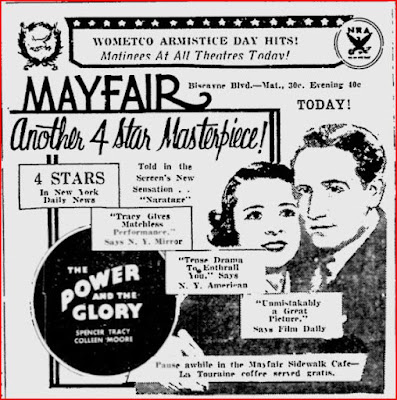
For William K. Howard's The Power and the Glory, Tracy starred but ranked second in the promotion to Fox's promotion of a new cinematic storytelling technique. This was "Naratage," which boils down to having someone narrate a story told in flashback vignettes. It may have been one of the earliest films with substantial voiceover narration, but its claim to history is that it's also one of the earliest non-linear narratives. Written by future comedy specialist Preston Sturges, it's now seen as a prototype for Citizen Kane because it uses its flashbacks, jumping back and forth in time, in an attempt to solve a mystery: why did railroad tycoon Tom Garner (Tracy) kill himself? Unlike Kane, we only see Garner's life from one vantage point, that of his childhood friend and later business partner (Ralph Morgan), who defends his friend's memory against his wife's denunciations of Garner as a cruel boss and an unfaithful husband who drove his own wife (silent superstar Colleen Moore) to suicide. Unfortunately, the childhood scenes don't really do much to illuminate Garner's adult misdeeds. We see an ill-educated but energetic man who rises through force of will and asserts his prerogatives against his workers (facing down a gang of strikers and forcing a labor war in which hundreds are said to have died) and the long-suffering wife who first fell in love with him while tutoring him in math. Tracy is convincing but not compelling as the coldly dominant Garner, lacking Charles Foster Kane's narcissist charisma, while Sturges's vaunted innovations feel like little more than gimmicks that get in the way of a more forceful narrative. The would-be avant-garde structure sabotages any effort Tracy may have made to act out the character's evolution and keeps the audience at a fatal distance from the character we ought to identify with. It only reinforces that remoteness that kept Tracy from catching fire for so long.
Fox was a troubled studio, kept afloat by Will Rogers, Charlie Chan and Shirley Temple, that let other studios try to figure out what to do with Tracy. Columbia paired him with Loretta Young, igniting a short-lived but intense affair, for Frank Borzage's Man's Castle. The title is ironic for a tale of life in a "Hooverville" shantytown. It has a clever opening with Tracy, decked in top hat and tails, feeding popcorn to pigeons from a park bench as Young looks on hungrily. Tracy decides to take her to a fancy restaurant and after dessert brazenly informs the manager that neither she nor he has any money. In classic Pre-Code style, he manages to get away without paying by threatening to make a speech denouncing the restaurant's selfishness in the middle of a Depression. Turns out that a coffee company hires him to walk the streets in the formal wear -- his dickey lights up with the company name -- for $2 a day. That's just one of the odd jobs this "bindlestiff" takes to get by. He's content to do just enough to survive and is ready to move on at a moment's notice, but Young yearns for stability and a real home, or at least a real stove. Tracy scrambles from job to job, jumping onstage to serve singer Glenda Farrell with a summons and walking the streets in stilts, where he encounters Farrell again through a second-story window. He beats that temptation, but when Young announces her pregnancy he feels a stronger temptation to hop a freight and get as far away as possible. He actually boards the train but has second thoughts and returns to marry the girl. Pre-Code means you can acknowledge that folks will have sex (and kids) before marriage. But providing for a family means taking more drastic steps, including robbing the toy store where the lay minister who performed your marriage ceremony (Walter Connolly) works as a night watchman. After some melodramatic complications and the elimination of a rival, the film ends with both Tracy and Young in a boxcar, on the run together. Pre-Codes that actually address the Depression and the struggles of poor people get bonus points from me, and the obvious chemistry between Tracy and Young is a bonus. Borzage and screenwriter Jo Swerling come closest to solving the Tracy problem by making the actor's seeming aloofness a problem within the film that the character has to overcome. He's the same sort of self-satisfied smart aleck he was in Me and My Gal, but while the Walsh film was perhaps too breezy for its own good, at least from a box office standpoint, but a more serious romance that challenges Tracy's affable complacency makes Man's Castle easily the best of these films. All three are worth seeing, even Power and the Glory for history's sake, but it's still safe to say that Spencer Tracy's best work was yet to come.
For William K. Howard's The Power and the Glory, Tracy starred but ranked second in the promotion to Fox's promotion of a new cinematic storytelling technique. This was "Naratage," which boils down to having someone narrate a story told in flashback vignettes. It may have been one of the earliest films with substantial voiceover narration, but its claim to history is that it's also one of the earliest non-linear narratives. Written by future comedy specialist Preston Sturges, it's now seen as a prototype for Citizen Kane because it uses its flashbacks, jumping back and forth in time, in an attempt to solve a mystery: why did railroad tycoon Tom Garner (Tracy) kill himself? Unlike Kane, we only see Garner's life from one vantage point, that of his childhood friend and later business partner (Ralph Morgan), who defends his friend's memory against his wife's denunciations of Garner as a cruel boss and an unfaithful husband who drove his own wife (silent superstar Colleen Moore) to suicide. Unfortunately, the childhood scenes don't really do much to illuminate Garner's adult misdeeds. We see an ill-educated but energetic man who rises through force of will and asserts his prerogatives against his workers (facing down a gang of strikers and forcing a labor war in which hundreds are said to have died) and the long-suffering wife who first fell in love with him while tutoring him in math. Tracy is convincing but not compelling as the coldly dominant Garner, lacking Charles Foster Kane's narcissist charisma, while Sturges's vaunted innovations feel like little more than gimmicks that get in the way of a more forceful narrative. The would-be avant-garde structure sabotages any effort Tracy may have made to act out the character's evolution and keeps the audience at a fatal distance from the character we ought to identify with. It only reinforces that remoteness that kept Tracy from catching fire for so long.
Sunday, October 7, 2012
THE HUMAN CONDITION (1959-61)
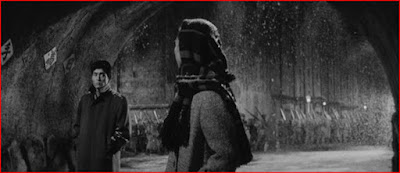
Once upon a time in Hollywood, Erich von Stroheim wanted to release a literary adaptation that ran more than eight hours, but Hollywood shot him down. About eighty years later, English-language audiences happily sat through nine hours' worth of literary adaptation from Peter Jackson, who figured out that reasonable spacing between installments (Stroheim had anticipated audiences coming in for two consecutive nights to get through Greed) made the whole easier to swallow. Jackson's idea was no innovation, however. Back in 1959, the Shochiku studio released Masaki Kobayashi's adaptation of Junpei Gomikawa's novel in three parts between January 1959 and January 1961. The Human Condition clocks in at 9 hours, 34 minutes, and I first learned about it from a Guinness Book of World Records that listed it as the longest film ever made. I'm not sure if that's an accurate description given the three-episode format (and each episode is divided into halves by an intermission), since to my mind the longest feature film would be the one that requires you to sit for the longest stretch at one time. In any event, Human Condition and Lord of the Rings are two of a kind, if only in format, but that should be enough to shame people who hesitate to try the Kobayashi due to its length. You don't have to watch it all at once, and as far as I know no one ever has. But it's definitely worth watching as a critical epic of the Japanese occupation of Manchuria during World War II.The Human Condition is mainly the story of Engineer Kaji (Tatsuya Nakadai), who avoids military service at the height of the war (1943) by taking a management job at a Manchurian mining camp. Kaji is humane and conscientious to the point that colleagues and military people think of him as a "Red." A certain obsessive contempt for "Reds" among the Japanese is a point of identification for American audiences, and while Kaji himself sometimes expresses faith in a socialist future, the film itself (I can't speak for the novel) takes a less optimistic viewpoint. From an early point, Kobayashi establishes that Kaji's good intentions will benefit him and his Chinese charges very little. He is given a work crew of POWs who've been crammed into cattle cars and starved en route to the mind. In the film's first big set piece, the survivors surge toward a grain wagon like a horde of zombies despite Kaji's warning that gorging themselves so soon could be fatal. He's forced to use a whip to drive the wretches away, looking no less the slave-driver than his less humanistic comrades.
The first installment puts Kaji at odds with the Japanese military police, who despise his humanism. This conflict climaxes when the authorities accuse him of allowing POWs to escape and try to torture a confession out of him. Not for the last time will Kaji suffer for his country's sins, but the first installment ends with him jumping from the frying pan to the fire, resigning his mine job to join the regular army.
The second installment (released in November 1959) puts him through a cruel boot camp, tormented by veterans who assume a license to abuse rookies both physically and psychologically. Far from folding like a soft civilian, Kaji thrives in adversity while others collapse and kill themselves. He proves a better soldier than most, becoming a leader after his unit is decimated during the Soviet invasion of Manchuria in August 1945. The biggest battle scenes of the story take place at the end of the second installment, and they are pretty hellacious. The front-line Japanese are hopelessly outgunned and barely barricaded against the Soviet tank and artillery assault, and the actors look authentically imperilled by huge explosions going off around them. Somehow Kaji survives this first wave, sustained in large part by his determination to reunite with his wife Michiko (Michiyo Aratama).
The final installment sees Kaji and the other suriviors desperately trying to cross Soviet lines and reach Japanese-controlled territory, acquiring a motley band of civilian refugees along the way. Of this Stagecoach-like assemblage a prostitute, despised by the others, proves the most hardy and the only civilian to survive the ordeal alongside the soldiers. Her reward is to be killed (and raped?) by Chinese partisans who find the band squatting on their farm. Kaji's crew encounters foolhardy die-hard soldiers and a refugee village of lonely women and one old man, where the other soldiers satisfy longstanding urges while Kaji continues to pine for Michiko. When a Soviet unit stumbles upon the village Kaji is ready to make a last stand, but at the urging of one of the village women he surrenders to the Russians. To this point he had an idealized view of the Russians as progressive Socialists, dismissing atrocity stories as the transgressions of the usual bad apples. Now he sees them exploiting and abusing helpless prisoners, whom Kaji feels should not be blamed for Japanese atrocities, and hypocritically granting privileges to the same vicious officers who, if anyone does, deserve to face retribution, all in order to meet the usual unreaslistic production quotas. In prison, abused by Japanese and Russians alike, Kaji's idealism is exhausted at last. Ever resourceful, he manages to escape, but by now, despite all his righteous humanism, he has become everything he never wanted to be, a war criminal and a cold-blooded murderer of his own kind. At the same time, he remains self-consciously self-denying to an ultimately insane degree. Having stolen a dumpling from a Chinese village and kept it despite a beating, the starving Kaji refuses to eat it, saving it as a present for Michiko, whom he still expects to meet again but who may be long dead for all we know. To bring Greed back into the discussion, Human Condition closes on as grim and fatalistic a note as the Stroheim film, the wintry wastes of Manchuria comparing quite nicely to Greed's Death Valley.
Needless to say, Kobayashi's view (or the novelist's) of the human condition is not a nice one. The film is a damning indictment of Japanese militarism if not of Japanese culture in general, the sort of thing the Japanese got good at, perhaps of necessity, after losing the way, and the sort of thing we wouldn't see in American cinema until the Vietnam era. The title leaves open whether the film's sentiments are self-loathing or all-encompassingly misanthropic -- it's not The Japanese Condition -- and the story forces the question whether any individual can maintain personal integrity in the midst of a collective crime. Throughout, we can always say that Kaji is a better person than many other Japanese (or Russians, or Chinese), but he's still an exploiter and a killer who can't escape the brutalization he despises in others. Kaji has no rivals for main character status and the role is a huge challenge to which Tatsuya Nakadai (best known in the U.S. as the star or Kurosawa's Ran) responds tremendously. Purely on a quantitative level it's probably one of the greatest performances in film history, but it ranks qualitatively as well.
Cinematically, I could see how some might see The Human Condition as a sort of pretentiously middlebrow endeavor akin to Schindler's List. There's a certain self-important pretension to it all, a self-conscious classiness compared to the more concentrated outrage of a contemporary war film, Kon Ichikawa's Fires on the Plain. Kobayashi's eye for composition is perhaps too masterly, Yoshio Miyajima's monochrome cinematography perhaps too brilliant. But such pictorial ambition is probably appropriate to the filmmakers' epic intentions, and the results should prove indelible for anyone who makes the epic effort to watch it all. Human Condition is heroic cinema and indisputably one of the world's great war movies. It's worth nine hours or so of any true movie lover's time.
Friday, October 5, 2012
COLD EYES OF FEAR (1971)
I'm trying to get into a Halloween mood, but this wasn't a very good start. I launched Enzo G. Castellari's Gli Occhi Freddi Della Paura (the English title is a literal translation) expecting something like a giallo, but the closest we get to that is an opening gag that seems to give us what we're looking for -- a scantily clad woman menaced by a man with a knife -- only to pull back and reveal one of those morbid cabaret shows that Europeans were fond of in those days.
Karin Schubert stars in the live giallo within the film
This is England, actually, and Cold Eyes of Fear is yet another Italian film that imagines the sceptred isle as the land of dark doings. My hunch is that we're seeing the influence of Edgar Wallace and the German films (often themselves set in England) made from his novels in these Italian movies. In many ways, Cold Eyes is an old-fashioned thriller, if not necessarily the kind Wallace wrote.
In any event, among the audience for the sex-&-violence show are young lawyer Peter Flower (Gianni Garko) and an expatriate Italian prostitute, Anna (Giovanna Ralli) who romp through Swinging London a while before heading to the home of Peter's uncle, a highly respected judge (Fernando Rey). Little do they know that an intruder has already broken in and killed the butler. Julian Mateos plays the intruder, but the dominant performance is by whoever dubbed the role into English. While the rest of the dub artists play things straight, or dull, Mateos's dubber heads straight for cartoonland, issuing the sort of Cockney accent you might hear from a drunk anglophobic American.
The intruder is only setting the stage for his partner and mastermind, who arrives disguised as a policeman, having taken the uniform from a victim sent to the house by the judge to give Flower instructions for finding certain documents. It becomes apparent quickly that the home-invaders are working at cross purposes. Quill (Mateos) is only after money, while Welt (Frank Wolff) is after different kinds of papers. As delusional flashbacks reveal, Welt was sent up the river by the judge while his accomplices got off. Ever since, he has suspected that the accomplices bribed the judge to escape justice, and he hopes to find the proof in the judge's house. At the same time, he has booby trapped the judge's office to blow up should the official pull his door open to leave. Presumably he intends to publicize whatever evidence he expects to find to show the world why the judge deserved to die.
The majesty of the law: Fernando Rey presides; Frank Wolff protests
Cold Eyes is basically a cat-and-mouse story made occasionally interesting by the contrast between a fearless, defiant Anna and the feckless weakling Flower. Take Gianni Garko out of his Sartana costume and he's a lot less formidable, but his character hardens the more he comes to believe that Welt might be right about the judge, until he's at last ready to take violent action against his tormentors. Death by JB bottle is sure to be a highlight for certain fans of Italian genre cinema. Meanwhile, there are strong insinuations that Quill is a misogynist homosexual, though it's unclear whether Welt is that kind of a partner with him. This sort of story really isn't an ideal vehicle for an action specialist like Castellari, who entertains himself with Welt's fantasies of destruction and his persecution-complex flashbacks. The film definitely becomes less linear once Welt takes center stage, as if giving in to the villain's madness, but that description may make the film sound more interesting visually than it actually is. I dug the neon-lit night scenes actually shot in London, but otherwise it's a fairly uninspired film. Not even Ennio Morricone can do much to jazz it up. It must have seemed like an old-fashioned film even at the time it came out, because there's something timelessly tired about it.
Thursday, October 4, 2012
Now Playing: OCT. 4, 1962
Let's play a geography quiz. Just from looking at the newspaper ad below, can you guess what state Hero's Island is opening in today?
To be precise, the place is Wilmington, North Carolina. And in lieu of an online trailer, here are the opening credits -- interesting cast! -- uploaded by Spiritgumm.
If this attraction seems a little too boosterish for you, here's an alternative opening in the same town today.
Crusaders, eh? Heathens, huh? This looks like one picture that probably couldn't get made today....or at least it wouldn't be advertised this way. Judge the actual movie (a 1958 Italian picture called "The Liberation of Jerusalem") by watching the U.S. dub here.
To be precise, the place is Wilmington, North Carolina. And in lieu of an online trailer, here are the opening credits -- interesting cast! -- uploaded by Spiritgumm.
If this attraction seems a little too boosterish for you, here's an alternative opening in the same town today.
Crusaders, eh? Heathens, huh? This looks like one picture that probably couldn't get made today....or at least it wouldn't be advertised this way. Judge the actual movie (a 1958 Italian picture called "The Liberation of Jerusalem") by watching the U.S. dub here.
Wednesday, October 3, 2012
Now Playing: OCTOBER 3, 1962
It's October, so let's see some spooky stuff. This double-feature from St. Joseph, MO, fills the bill.
You know, with all the talk this year of how The Head won't lay down and stay dead, anyone going to the theaters expecting to see the title cranium bouncing across the screen is in for a big disappointment.
Spokane doesn't quite have a spook show, but here's a kinda creepy picture.
Creation of the Humanoids is one of the few other places besides Plan 9 from Outer Space where you'll see and hear the immortal Dudley Manlove on screen. And could he ever pick his projects. If not as "bad" as Plan 9, Creation has much of the same naively pretentious charm. But in the month of the Cuban Missile Crisis people may have watched this movie about the consequences of "a World War III" with mixed feelings.
Despite its invocation of the Infernal Regions, this Milwaukee attraction is not a horror film ... though I must admit I haven't actually seen it.
You wanna see something really scary? Look at the body they grafted Jack Palance's head onto in Salt Lake City!
The advertising is accurate to a degree. To say that the "Conqueror" here is mightier than Attila the Hun is only to say that Palance is mightier than Palance. For the record, the most barbaric conqueror who ever pillaged the world is one Alboino the Lombard, active circa 566 A.D. I bet you didn't know that.
If that isn't barbaric enough for Salt Lake City audiences, there's always this:
Just to keep you entertained until next time, here is The Mating Urge in all its cropped, faded and Asian-subtitled splendor, as uploaded toYouTube by 8524562008. Looks like they've given him a number and taken away his name.
You know, with all the talk this year of how The Head won't lay down and stay dead, anyone going to the theaters expecting to see the title cranium bouncing across the screen is in for a big disappointment.
Spokane doesn't quite have a spook show, but here's a kinda creepy picture.
Creation of the Humanoids is one of the few other places besides Plan 9 from Outer Space where you'll see and hear the immortal Dudley Manlove on screen. And could he ever pick his projects. If not as "bad" as Plan 9, Creation has much of the same naively pretentious charm. But in the month of the Cuban Missile Crisis people may have watched this movie about the consequences of "a World War III" with mixed feelings.
Despite its invocation of the Infernal Regions, this Milwaukee attraction is not a horror film ... though I must admit I haven't actually seen it.
You wanna see something really scary? Look at the body they grafted Jack Palance's head onto in Salt Lake City!
The advertising is accurate to a degree. To say that the "Conqueror" here is mightier than Attila the Hun is only to say that Palance is mightier than Palance. For the record, the most barbaric conqueror who ever pillaged the world is one Alboino the Lombard, active circa 566 A.D. I bet you didn't know that.
If that isn't barbaric enough for Salt Lake City audiences, there's always this:
Just to keep you entertained until next time, here is The Mating Urge in all its cropped, faded and Asian-subtitled splendor, as uploaded toYouTube by 8524562008. Looks like they've given him a number and taken away his name.
Monday, October 1, 2012
PRE-CODE PARADE: Warren William in UPPER WORLD (1934)
In Upper World William is another captain of industry, railroad tycoon Alex Stream. He's negotiating a big merger that will enrich him further, but he still finds time to play with his young son and the boy's imitative railroad toy set. He'd like more time with his wife (Mary Astor), but she's too involved in playing the society maven. Alex blows off steam on a speedboat, and during one day on the water he manages to fish showgirl Lily Linder (Rogers) from drowning. He grows fascinated with her, going to the show to watch her lead a chorus in a late blast of Pre-Code gusto, "Shake Your Powder Puff," and taking her out to dinner after the Mrs. ignores their wedding anniversary. After one such tryst, his chauffeur (a randy Andy Devine) is caught speeding by a policeman (Sidney Toler). The impatient Alex tries to intimidate the cop with class, but the Officer Moran isn't impressed. Angry, Alex uses his pull with the police to have Moran demoted and transferred. Alex doesn't realize that he's just flung a karmic boomerang toward the horizon, but it'll come back to him with a vengeance later.
Lily has a boyfriend/manager, Lou Colima (J. Carroll Naish) who gets wise to Alex and quickly figures out a blackmail angle. He confronts Alex at Lily's apartment, but the proud tycoon won't knuckle under. He punches Colima to the floor, and the enraged thug pulls a gun. He fires, but kills Lily instead. Ginger Rogers, billed as the star in some advertising, makes her exit about halfway through the film, Psycho style, and it's definitely unusual to see a Rogers character get whacked, even this early in her career. In any event, Alex grabs Lily's gun and kills Colima. Finally, panicking, he tries to arrange things so that the two corpses will appear to have killed each other, but he doesn't notice that Patrolman Moran has been lurking outside Lily's building, noting a parking violation by Alex's car. Noticing Alex leave the building, Moran grows more suspicious. He takes it upon himself to go above his superiors' heads to investigate the shootings. The more he suspects Alex, the less Moran trusts anyone to take his suspicions seriously, even after he catches Alex bribing a janitor (John Qualen) to forget about ever seeing him in the building. When his superior accidentally (?) destroys an important piece of evidence, Moran goes berserk, accusing everyone of conspiring on Alex Stream's behalf. Thrown in jail himself, Moran's only chance is to talk to the ever-vigilant press. Sensing a big society scandal, the reporters listen to the paranoid patrolman and invade the Stream home during a dinner party to ask Alex for his fingerprints. They may have no right to have them, but Alex can hardly say no without admitting something to hide. The noose tightens....
Upper World ultimately opts for a cop-out finish without even giving us the big trial scenes we'd expect. There ought to be a courtroom showdown between Stream and Moran, but the picture leaves the cop in jail. That's too bad, because if Ginger Rogers stole the movie from William in the advertisements, Sidney Toler steals it from him on film. Moran is a brilliantly conceived antagonist, someone who's right for all the wrong reasons, and the plodding, piggish manner that made Toler such an obnoxious Charlie Chan, seems just right for the role with a dash of righteous self-pity thrown in. In a modern movie Moran would probably have gone completely mad and tried to kill Stream before the picture ended. Unfortunately, Upper World ends in a manner unhappily reminiscent of Bedside, with an abject Warren William somehow forgiven by Astor, herself chastened by the realization that her neglect of hubby made him go astray. William may be overshadowed by Rogers and Toler, but he's actually quite good in a role nearly the opposite of his Employees' Entrance character. While that entrepreneurial superman disdained family intimacy, Alex Stream wins sympathy for his simple craving for that same intimacy. Upper World works as long as you feel that Alex doesn't deserve the doom he blundered into or the reckoning Moran has in store for him. If it does work, and I think it does, all the credit goes to Warren William in what was probably his last great Pre-Code role.
Believe it or not, TCM doesn't have the Upper World trailer online. Well, you can't have everything.
Subscribe to:
Posts (Atom)