Friday, February 11, 2011

SYMPATHY FOR THE UNDERDOG (1971)

No two Kinji Fukasaku yakuza movies that I've seen are alike. To say that any one of them is just another yakuza movie, or that he wasted his time making yakuza movies -- before he stopped making them, that is -- is to miss the point. Fukasaku could work the genre for a wide range of moods and nuances. For this effort, early in his tremendous run of Seventies crime sagas, his subject is a different kind of disillusionment than we identify with his myth-debunking tales of criminal cynicism, inhumanity and dishonor. Sympathy for the Underdog (the Japanese title has something to do with gamblers and foreigners) is about man's inability to recapture or recreate the past -- and it throws in a little of The Wild Bunch in for good measure.

Koji Tsuruta (right) as Gunji

As is often the case, we open with a con getting out of prison. Gunji (Koji Tsuruta) has served ten years for his role in the gang wars on the docks of Yokahama. While he was gone, a corporatized yakuza clan, the Daitokai, moved in, played the smaller local gangs against each other, and eventually took over. He gathers his old cronies together -- each of them is introduced with a vignette showing their miserable civilian lives -- to make a run on the Daitokai, but the war is over almost before it began. Gunji's gang is hopelessly outnumbered and outgunned, and survives to make an honorable withdrawal only because the Daitokai bosses respect Gunji's guts. To avoid bloodshed, they agree to contribute the ridiculously large amount of 5,000,000 yen toward a memorial for Gunji's former gang boss. That money will finance Gunji's next venture, elsewhere.

The way Gunji sees it, there's only one place that's as wide open now as all Japan used to be back in the early postwar days. That's the island of Okinawa. As the original Toei trailer informs us, the U.S. was just about to turn the island back over to Japanese administration, creating the opportunity Gunji sees. His gang will muscle their way onto the island and take over from some of the small timers there.

For the "mainlanders," Okinawa is a doubly alien land. For starters, the natives don't seem to care that much for mainlanders. Secondly, the island is practically the 51st State, supporting a huge American base and servicing its soldiers and their dependence. Most of the signage Fukasaku shows us is in English, and there are lots of American faces, male and female, white and black, on the streets. Ironically, such an Americanized setting serves the same role for Fukasaku that Mexico serves for the makers of American and Italian westerns: a last frontier of outlawry, where a dying generation of outlaws can make a last stand.

The Okinawan opposition: GI gangstas (above) and Tomasaburo Wakayama (the Shogun Assassin himself, below)

Gunji scores some victories over karate-fighting Okinawans and gun-happy Americans while his men suffer casualties along the way. His biggest obstacles are Yonatal (Tomasaburo Wakayama), the "one-armed giant," and his stupidly reckless cousin Jiro (Kenji Imai). They outnumber the mainlanders, but here as in Yokahama, Gunji's grit convinces them that wiping him out isn't worth the blood. In this case, thanks in part to their capture of Jiro and their honorably unconditional release of him, Gunji's crew ends up with a territory of their own, including a lucrative operation selling whiskey smuggled off the American base. They set up headquarters in a luxurious compound. But they don't seem to enjoy it. They seem like penned-in animals sometimes, and sometimes they just seem bored. They don't know the local lingo and can't understand the songs. Gunji himself strikes up a tepidly obsessive relationship with a local prostitute (Akiko Kudo) who looks a lot like the moll who left him while he served his time. He wants the whore to be his girl so badly that we find ourselves waiting for a big revelation from her -- but it never comes. She's sympathetic, but she can't be what he wants.

The fruits of victory, from swimming pools (above) to women (like Akiko Kudo, below), somehow aren't as sweet as Gunji hoped.

The gang is already demoralized by the time Daitokai makes its move on Okinawa. The big clan arrives with bells and whistles and banners flying, like an invading army or the circus come to town. While some of the locals quickly accommodate themselves to the impending new order, Yonatal prepares to fight. He expects Gunji to take Daitokai's side as a fellow mainlander, but is impressed to learn that Gunji hates them, too. Each side thinks about an alliance, but before the thoughts can find expression Daitokai strikes swiftly and wipes out Yonatal's gang. There's nothing to do, it seems, but negotiate another peaceful exit, and Daitokai still respects Gunji enough to fork over another five million. That's still good traveling money, but where's the gang going to go? If they've learned anything in their adventure, it's that there's no place they can go to recreate their Yokahama of ten years ago. Okinawa really is the end of their trail. So after a pensive night, once again it's "Let's go," and "Why not?" in some rough Japanese translation. Daitokai's holding another one of their silly ceremonies to welcome the oyabun to Okinawa. Dozens of them will be there, along with their Okinawan quislings. There is one last place to go, after all....

A mood of melancholy gradually descends over the picture in its second half that sets Sympathy apart from the other Fukasakus I've seen. The movie seems to build toward complete anticlimax before the story takes its final Peckinpavian turn, but it gains gravitas as things slow down. Fukasaku is best known for his almost calligraphic approach to violence, his ability to send bodies flying and blood flowing like brushstrokes of pure mayhem. But he's just as capable of more quiet, moodier moments. A sequence here in which the prostitute explains the meaning of an Okinawan "migrant worker" song to a brooding Gunji while one of his cronies rages at the performer, urging her to play a Japanese song, is one of the director's finest moments. The music itself is worthy of note. Takeo Yamashita isn't Fukasaku's usual composer, and he gives Sympathy a richer, more diverse musical palate than most of the director's or the Toei studio's films of this period, combining jazzy sounds and Euro-style vocalese with austere Okinawan elements like the folk song. The cast is uniformly good; few of the characters are merely caricatures, and Koji Tsuruta is especially good at suggesting hidden depths beneath a no-bullshit exterior. It's not true that Fukasaku could do no wrong during the Seventies, but the more I see of his work, the more I regard him as one of the decade's most consistently superior directors. Sympathy for the Underdog is only further proof of that point.

This English-subtitled trailer, featuring plenty of Yamashita's great music, was uploaded to YouTube by pvehling.

At Last: A Sequel to THE ROOM

Because reality is stranger than fiction, the only possible follow-up to Tommy Wiseau's The Room (2003) comes from real life. Wiseau's vanity production is widely regarded as the worst movie of our time, if not of all time. I still haven't seen it, but reports have been pretty convincing. This achievement should be cause for shame for all involved, you might think, but there's money to be made from bad movies these days, whether they're deliberately bad or not. The Room is a success as a cult film and presumably sells well on DVD. So Sandy Schklair wants a piece of it. He was script supervisor for the picture, but Entertainment Weekly reports that he now wants to be recognized as the director of The Room. He called the shots whenever Wiseau was in front of the camera, he claims, at least for the first month of production.

"I will never give this guy credit," Wiseau tells the magazine, "If I put you on the set right now and I said to you 'Cut' and 'Go' and you expect me to give you credit as a director? Are you kidding me? That's laughable, my friend!"

Schklair tells a different story, claiming that Wiseau asked him, for all intents and purposes, to direct the film, only to insist, "I am director!" before affirming that he wanted Schklair to direct. To read more, for now, you have to buy the February 18 issue, since the story isn't online yet. I hope this goes to court. Mel Brooks himself could not imagine something this absurd, but it's definitely the stuff of cinema. Whether this story would make a bad movie or a good movie depends on your point of view -- and your talent, I suppose.

Tuesday, February 8, 2011

Wendigo Meets INTERVIEW WITH THE VAMPIRE (1994)

Before putting the disc in the machine, I asked my friend Wendigo whether time has passed Anne Rice by. I asked because it seemed to me that the trope identified with her, the vampire story told from the vampire's point of view, has been eclipsed by the avalanche of "urban fantasy" and "paranormal romance" that re-established the "victim," however willing she usually proves to be, as the point-of-view character. Wendigo answered that the change in narrative perspective is just a shift within a generic framework that remains Rice's handiwork. To the extent that urban fantasy and paranormal romance concerns itself with vampire societies and similar supernatural subgroups, they're still working with Rice's paradigm. To the extent that current authors' vampires aren't utterly accursed creatures, or not even undead, they remain, in essence, Rice's vampires. As far as Wendigo is concerned, there are two towers of vampire literature: Dracula and Interview with the Vampire. Twilight and its sequels piled on one another don't reach the historic heights of those seminal volumes. Stephanie Meyer, Charlaine Harris, Laurell K. Hamilton, the writers of White Wolf Games, etc., all labor in Rice's long shadow.

Anne Rice turned the vampire from a horror to a fantasy. It didn't happen all in one book; Wendigo says the change had been accomplished by the end of her third vampire novel, The Queen of the Damned. The first novel, published in 1976, hints at the social theme but remains focused on an individual vampire's guilt-trip of alienation and damnation. You can see some of Rice's own thoughts at the time in the interview clipping to your right. Louis' character arc makes Interview a horror novel in Wendigo's opinion. Rice adapted it for film, but by the time Neil Jordan directed, it 18 years after the novel appeared, the lavish production, more than anything else, turns Interview from the horror the novel was into the fantasy the sequel novels became.

Brad Pitt as the Interviewee, with the back of Christian Slater's head.

Rice inevitably has to telescope events to fit the novel into a two-hour screenplay, but she also foreshadows future stories and imports a resurgent Vampire Lestat from a later novel so that Tom Cruise can take a final bow and Jordan can give viewers a final scare. Strangely, for a film that I presume was meant to be a tentpole or a launch for a Lestat series of films, with or without Cruise, Rice and Jordan eliminate Lestat's role in ratting out Louis and Claudia to the villains of the Theatre des Vampires in Paris, which keeps Cruise off screen for nearly an hour. The entire Paris episode is streamlined (as is the larger European tour of the novel) and the romantic angle between Louis and Theater impresario Armand is downplayed to the point that it's unclear exactly why Claudia feels jealous. Leaving Lestat out of it undercuts the character's villainy. In the original novel, Wendigo tells me, he's a real hateful bastard who you'd want to see destroyed for the ways he torments Louis. In the film, he ceases to be a bad guy by a certain point simply by being absent, reappearing in 1988 as a pathetic character whom Louis has clearly outgrown -- though Wendigo informs me that the characters would enjoy a happy reunion later on.

Rice probably inherits some of her sensibility from Southern Gothic literature, which leads her characters in intimately strange directions with slaves (above) and one another (below).

Inevitably sacrificed is a lot of the novel's notorious homoeroticism. While Rice's vampires are sexually dead, they still experience intense romantic longing, and the feelings are mutual between Lestat and Louis, and later between Louis and Armand. It's less a case of Rice censoring herself, in Wendigo's opinion, than of Jordan failing to invest the appropriate scenes with the appropriate romanticism, and resistance from the lead actors. Brad Pitt, as Louis, seems especially determined not to have chemistry with either Cruise or Antonio Banderas as Armand. As we mentioned, where in the novel Louis is romantically obsessed with Armand for a time, in the film Pitt simply seems concerned with pumping Banderas for information.


Vampire dining tips from an indulgent Tom Cruise (above) and a dieting Brad Pitt (below)

Wendigo actually thinks that Pitt does a good job overall. He has a handle on Louis' personality, his sense of having fallen from grace and his perpetual regret. While casting Cruise as Lestat had caused controversy initially, Wendigo was as worried about Pitt, whom he then saw as a pretty boy whose primary attribute was his long hair. He was happily relieved once he saw the movie.

We didn't realize that Lestat's death scene was played by an animatronic robot until we saw the DVD documentary. Is that a tribute to Stan Winston or an insult to Tom Cruise?

Rice herself originally protested Cruise's casting, -- when she wrote the book, young Rutger Hauer was her ideal Lestat -- though she recanted quite publicly before the film came out. As Wendigo notes, Cruise is really playing the more rounded, developed Lestat of the Chronicles series as a whole than the villain of the first novel. As such, Wendigo thought he was at least as satisfactory as Pitt, though he notes that both men were really too old, already, for the characters they played. That aside, Wendigo was impressed by the range Cruise showed, especially in the 1988 scene in which Lestat is a frightened, confused wretch. I thought he made a good effort, too, though I felt he slipped into Tom Cruise-ness whenever the character had to become angry and shrill. Because I respect Brad Pitt now as a character actor and a comedian, I find him dull here in the straight role, and I find myself wondering strangely how the film would have worked with the lead roles reversed.


"Do you suffer from allergies? Or congestion? Then you shouldn't go about without a top on!"
The Nineteenth Century Nasonex Medicine Show de Paris

Perhaps surprisingly, Wendigo is most disappointed with Antonio Banderas as Armand. The character is supposed to be beautiful like the other vampires, and Banderas may have seemed more natural casting than either Pitt or Cruise. But Wendigo felt that he lost all his advantages once saddled with wig, red robe and heavy makeup. As an actor he did the best he could, but for Wendigo he's too palpably uncomfortable in his costumes to give the kind of performance the character requires.

For many viewers, the film was stolen from all of these actors by Kirsten Dunst as Claudia. She's really the central character of the central part of the film as the woman trapped in an immortal child's body exerts a femme-fatale influence over Louis while conspiring resentfully to destroy Lestat. For all that she's a more ruthless and vicious vampire than Louis, she's still his main reason to "live" rather than throw himself into a sewer and subsist on rats. The role made Dunst a star thanks to her uncanny performance, which sells a character concept that must have been nearly unimaginable to the little girl. I wouldn't be surprised if she's been driven to drink at least partially because people still tell her that this was the best work she's ever done. And it still might be.

Claudia's demise (above), and happier days (below).

Rice's genre innovation is fueled by a desire to get into the mind of a vampire, and its reflected in print by the vampires' desire to understand their own nature and history. Wendigo feels that losing a lot of Louis and Claudia's European tour also loses this aspect of longing for knowledge, self-understanding and community -- which would come to define post-Rice vampire fiction. This is one of several instances in which Jordan sacrifices theme and character development for spectacle and shock. Jordan was near the height of his powers at this time, with The Crying Game just behind him and Michael Collins and The Butcher Boy yet to come. He seemed like an inspired choice to direct Interview, but Wendigo feels that Jordan undercut the mood of the story with heavyhanded bits of black comedy, usually involving Claudia and her victims, and with scenes of pure silliness, as when Stephen Rea does a Fred Astaire dance on the ceiling of an overpass to impress Pitt. Indulgent bits like these are part of the film's overproduced quality. While it has to recreate the past, Wendigo thinks that the production goes overboard: too many extras, too much decoration, too much stardom. None of those things are necessary to get at the essence of Interview or any of Rice's novels -- though the lower-budgeted version of Queen of the Damned proved a botch for different reasons. While Wendigo still recognizes Jordan's Interview as a good film, he'd like to see someone try it again, as part of a complete Rice series, only with less money, fewer big names, but more integrity.

Sunday, February 6, 2011

On the Big Screen: THE KING'S SPEECH (2010)

Take a few minutes before reading on to listen to this old record. Northatlantic78rpm uploaded it to YouTube.


It's a halting voice with obvious speech impediments, the Elmer Fudd "w" and so on. The pauses come at such odd times that you sometimes wonder whether the speaker fully understands what he's saying. The funny thing is that it reminded me of recordings I've heard of the speech Emperor Hirohito made to the Japanese people in 1945 to confirm the country's surrender. I don't know Japanese, but the voice had the same halting quality to my untrained ears. Perhaps it's a royal quality, or else royal speech therapist Lionel Logue may have been right when he said -- if he said it -- that pauses make a speech sound more solemn. As George VI, Logue's client, said -- if he said it -- by that standard he would prove the most solemn monarch in history. The moment was solemn enough, of course, and given the circumstances the people of Britain were bound to make allowances for the voice of their king. Posterity has made further allowances, making of this brief talk a triumph of rhetoric worthy of a feature film's buildup.

Tom Hooper's film is the favorite, for many people, in the field of ten nominees for the Best Picture Oscar. It has the pedigree of class, the authority of biography, the human interest of a struggle against handicaps. It's the sort of movie that has won Oscars in the past, and Colin Firth's performance in the lead role of George VI is the sort that wins Oscars a lot. It's a bit of a stunt, as Firth must not only re-create the king's stutter and other verbal flaws, but also gets to play a monarch cussing up a storm as if suffering from Tourette's syndrome and express repressed emotions in song. After some scenes you expect to see judges holding up signs with large numerals on them. To be fair to Firth, he emphasizes emotion over technique for much of the picture, but the big scene where he rehearses the war speech, complete with cussing and singing, really goes too far. It's a grandstand play and a showoff moment for the actor that disqualifies his performance, despite its many virtues, from honest consideration as the best of the year.

The King's Speech is technically excellent on just about every level, and arguably award-worthy in the realm of production design. The thing I'll remember most about this film is its wallpaper -- and I don't mean that as an insult. Production designer Eve Stewart did an extraordinary job recreating period interiors, particularly the vividly bleak wallpaper in Lionel Logue's office. Hooper and cinematographer Danny Cohen have a way of filming scenes with the characters off center, so that backgrounds dominate the frame. This approach gives a strong sense of place, including comparative scale when you contrast scenes with Firth and Geoffrey Rush (playing Logue) in the office with scenes with the two men in the vastness of Westminster Abbey. The collaboration of Hooper, Cohen and Stewart is a genuinely brilliant accomplishment.

The film as a whole is a triumph of style over substance, an instance of talents working to their utmost to make the most of material that, the historical context aside, is conventional if not cliched. Going in, I suspected that The King's Speech would seem derivative of The Madness of King George, an earlier history film that hinges on a monarch receiving therapy from an irreverent commoner. The film itself invites comparison by having its King compare himself to "mad King George the Third," but its thematic devices are too many to be traced to a single film. In some sense, Speech may be as generic a film as you could imagine: a troubled man must open up and express repressed feelings under therapeutic prodding in order to redeem himself for past failures and rise to the biggest occasion of his life -- by delivering a speech. Subtract the history and it sounds like Screenwriting 101.

Again, the film does remarkable things with the familiar tropes. Objectively, The King's Speech is a very good movie, one that I'd probably include right now in my own Ten Best list for last year. But something bugs me about it. Something makes me feel that the film is, if not at all bad, then still wrong somehow. I think it's the very focus on George VI as a heroic figure whose role in history is somewhat inflated here. He's certainly a sympathetic figure; the second son of George V and accordingly neglected by father and public in favor of his older brother David, Bertie is additionally accursed by a stammer that seems to derive from strict measures to correct left-handedness and other alleged flaws. He embarrasses himself at his first nationwide radio address, a debacle of amplified echoing stutters that haunts "Bertie" throughout the picture. Untrained for the role, he ends up King because David (Guy Pearce) proves indiscreet and irresponsible in his pursuit of the famous Mrs. Simpson. The film tells us that Bertie is a better man before he proves himself a better king, not least because he's more politically sound than the short-reigning Edward VIII, who briefly suspects Bertie of conspiring to depose him. "The younger brother pushing the older brother off the throne; that's positively medieval, isn't it?" David says. It's a telling remark by the film against itself. If we could believe that Bertie took more of an assertive, patriotic role in ridding his country of an unreliable brother, that would be the stuff of a powerful history play. But the abdication crisis of 1936 is but a passing episode of a story that insists on the big speech as its climax, as if Bertie were a barber turned dictator with the sudden power to change the course of history. In fact, I doubt whether Bertie wrote a word of his speech, or did much if anything to edit it. Yet the film tells us that his reading the text was an important contribution to British resolve at the start of a long war. And in telling us this, the film cheats. If you played the video above, you heard the unadorned voice of George VI. In the movie, Firth is backed by Beethoven. I don't think the filmmakers were trying to convince us that the Seventh Symphony was playing over Bertie's broadcast. But we, the audience, hear that dramatic music and we're clearly meant to hear it as some analog for the purported power of the royal words. Hooper doesn't have the confidence that Firth's plain reading will have the same effect on us that he claims it had on the British people -- such an effect, the film seems to imply, that everything Churchill said subsequently may have been superfluous. But since the whole film has been staked on the idea that the king's delivery of the words will be crucial, something is wrong with this picture. Not bad, but wrong.

Despite that, kudos are still in order for the whole ensemble, from the actors already mentioned to Helena Bonham Carter as an understated Mrs. Bertie (the future Queen Mum), Michael Gambon as a gruff, pressuring George V and Derek Jacobi as a persistent Archbishop of Canterbury -- though I feel that Timothy Spall gives no more than a caricature of Churchill. There's a lot to like about The King's Speech, and I might be less critical toward it than I am were I less of a historian and it less obvious about its Oscar-worthiness. If you like good acting, within reason, and a well-made film, Hooper's movie should satisfy most viewers. But it is neither the best picture of 2010 nor the best of the Oscar nominees, and I'll be disappointed a little, to the extent that I still care about the Academy Awards, if Speech wins as much as some expect.

Friday, February 4, 2011

INTIMATE CONFESSIONS OF A CHINESE COURTESAN (Ai Nu, 1972)

Shaw Bros. saddled Chu Yuan's (or Yuen Chor's) remarkable film with a title reminiscent of Victorian erotica, perhaps hoping to sell it as erotica in English-language markets. The film definitely does have its erotic moments, but when it counts, sensuality takes second place to savagery in this revenge epic and, if anything, makes the savagery more savage.

Chinese audiences know the film by the name of its heroine, which is first mentioned at a murder scene. A man is dead in his own home, partly covered in snow falling through a hole in the roof. His butler explains that the victim had just recently entertained Ai Nu, a noted courtesan. An extended flashback follows, forming the first act of the film. Ai Nu (Lily Ho) is one of a number of young women recruited forcibly from the countryside to become courtesans at the elegant brothel of Madame Chun Yi (Betty Pei Ti). Chun wants her girls flawless and virginal. Finding that one of her minions had deflowered one of the girls en route, the madame kills him with her bare hands. She can literally put her fist through your body. She enjoys it, too, especially the taste of blood afterward.
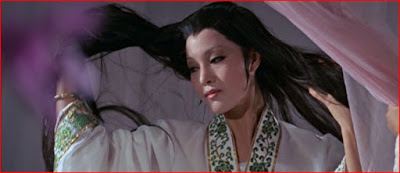
Betty Pei-Ti as Madame Chun

Another thing Chun enjoys is the company of women. This ultimate exploiter of women happens to be a lesbian, apparently keeping some of the girls as her personal concubines, unless all of them take turns at the task. She's a Chinese amazon, stunningly beautiful and masterfully violent. She takes a special interest in the spunkiest and most defiant of the new recruits, poor little Ai Nu. It's not clear how soon her interest becomes sexual, because she doesn't scruple at selling her virginity to the highest bidder among four wealthy old men, regulars at the brothel. The winner submits a blank check; he can get away with it because his son's the provincial governor. All four men get their turn at Ai Nu, tying her up, whipping her, forcing themselves upon her, the brutality of it accentuated by freeze frames and harsh sound effects just before the act is done each time.

Madame Chun with bed-warmers (Ai Nu not included)

Afterward, Ai Nu tries to hang herself in her cell; the suicide attempt is scored with Leonard Bernstein's music from On the Waterfront. She's rescued by a mute male housekeeper who had tried to show her kindness earlier, after Chun had ordered her flogged. Now he reveals that he can speak, but had taken a vow of silence in atonement for errors that had cost him the love of his life. The hero of the film seems to have revealed himself as he promises to help Ai Nu escape the brothel. But he can't get her past Chun and her private army. The hero has a few skills himself, but he's no match for the madame nor her major-domo Bao Hu (Lin Tung), the master who trained her. Our would-be hero is promptly expiring on the snowy ground, urging Ai Nu not to kill herself or otherwise throw her life away, because then who'd be around to avenge him? As she sobs over his corpse, Chun gives her a simple choice: die now, or live on Chun's terms. Ai Nu chooses life.

Lily Ho (left) gives Betty Pei-Ti a fateful elbow nudge during a training exercise

Chun sets about remaking Ai Nu in her own image, teaching her kung fu and swordsmanship and taking her to bed. Once we learn this, the scene at the murdered man's house repeats itself and we return to the present, following Constable Ji (Hua Yueh) as he investigates Ai Nu's link to the victim. He discovers an imperious, arrogant beauty, far removed from the terrified country girl we first saw. When he demands that she prove that the victim was alive when she left him, she challenges him to prove that he wasn't. Now, we suppose, the hero has arrived, but we'll learn soon enough that this film doesn't have a hero.

As Ji finds his investigation impeded by the social standing of the victim's circle, Ai Nu carries out a spree of revenge on the four men who first violated her. She varies the m.o. to keep people guessing, tying one up and setting him on fire to avenge his tying her up, but allowing another to love himself to death with three insatiable women and an overdose of aphrodisiacs. Finally, Ji finds her practically red-handed with the fourth victim, whom she'd whipped to death in a room locked from the inside as the constables desperately try to break in. Denying nothing, she only dares him to follow her to the real criminals. She leads the constables to the latest shipment of fresh females for the brothel, which she attacks. Leaving Ji to mop up, she races back to the brothel, where Bao Hu has been warning Chun about Ai Nu's dangerous intentions. Chun won't believe a word of it. She and Ai Nu are like one and the same person! Why not? Chun has created a peer for herself; that may have been the only way she'd ever find someone she could truly love. So when the constables arrive to storm the brothel, and Bao Hu with all his men insists that Ai Nu has betrayed them all, Chun can only stand by her woman at all costs.

There's a moment when the women warriors stand back to back, gravely outnumbered, and one gives the other an affectionate elbow in the side, and the other returns the gesture. It's like William Holden saying, "Let's go," and Warren Oates answering, "Why not?" It's a Wild Bunch moment, or a Sword of Doom moment if you want to keep the context Asiatic. It's the moment before Armageddon as the two women psyche themselves up for an amoklauf.

And before long it's down to Bao Hu against the women, a hopeless situation. But he doesn't go down without an epic bloodbath and a crippling blow, slicing off Chun's arm just as she's run it through his body up to her elbow. A bit of a setback, that, but Chun takes it like a trouper, worried only that Ai Nu might stop loving her now that she's a little handicapped. Of course not, Ai Nu coos. She won't stop loving Chun -- because she never did love her. It was -- duh!!! -- all a ruse to set up her revenge against all her oppressors, with the worst one saved for last. It was a nice plan, but for all that revenge is something you kinda have to boast about, this isn't exactly something you should admit so bluntly to someone who still has one good arm....

Ai Nu has an emotional ferocity and a raw romanticism that I've rarely seen in Hong Kong action films. The fantastic martial-arts context takes the transgression of lesbianism and elevates it (or degrades it, depending on your political sensibilities) to the level of a supernatural attribute. Chun and Ai Nu are the most beautiful women and the mightiest warriors in the picture, as if their sexuality (however insincere it may be on Ai Nu's part) gives them extra power, particularly in a setting where no man seems to have a conventional domestic relationship. The men are either patrons of prostitutes like the four old men, or they're emotionally damaged characters like Bao Hu and the erstwhile mute, or else sexlessly ineffectual like the constable. Given the men around them, lesbianism looks less like mere deviance (though its deviance gives the film an extra charge) than the natural recourse of naturally superior women.

The brilliant thing about Kang Chien Chu's screenplay is the way he turns Chun from an outright villainess into a tragically clueless, noirishly romantic antiheroine. The madame -- what a sap! --has clearly fallen deeply and sincerely in love with her deceiving Galataea, and after the women slaughter all around them, you can't help but feel that Ai Nu isn't righteous but just a little mean to hit Chun with the truth at a vulnerable moment. Another moment will come, however, to make us wonder how sincere Ai Nu was about her insincerity -- and there'll be consequences for that, as well. It all works, maybe just because this is my king but also, as I hope any viewing would prove, because Betty Pei Ti and Lily Ho have real chemistry and throw themselves passionately into their roles. Chu Yuan does all he can to make them majestic and malignant all at once while maintaining a suspenseful balance between pastel sensuality and livid brutality.

Intimate Confessions is arguably part of Quentin Tarantino's universe, with the business of lopping off arms possibly having a direct influence on Kill Bill. I think I saw something else here that I saw there as well; the way Ai Nu completes Chun's sentence for her at a crucial moment reminded me of the eerie exchange between The Bride and O-ren Ishii in which one finishes the other's sentence ("Silly rabbit...Trix are for kids") in a way that suggests that the cereal slogan was a shared catchphrase. That moment always leaves me thinking that there was a subtext of something between the two assassins in Tarantino's film, and it may be that Ai Nu is the something, or a key to it. But this is all just stuff for speculation unless Tarantino has actually identified Ai Nu as an influence. Whether it influenced him or not doesn't change the fact that Intimate Confessions influenced me. It's now one of my favorite Hong Kong martial arts films.

The following DVD trailer barely scratches the surface, but it'll do until you see the movie. Triphibian uploaded this copy to YouTube.

Wednesday, February 2, 2011

ARABESQUE (1966)

Stanley Donen's would-be comedy thriller is the sort of picture that normally tempts me to make a lot of screencaps. This time, however, I felt that I'd somehow be sending a wrong message. For a while, I was very impressed with the compositions of Donen and cinematographer Christopher Challis, but the self-conscious brilliance of it all began to get annoying after that while. The images call attention to themselves too blatantly and the constant recourse to catching the actors' reflections in a variety of surfaces eventually seemed pointlessly pretentious, especially as it sunk in that I was paying too much attention to the cinematography precisely because the story was an empty thing. It wants to be a suspenseful lark in the manner of Donen's Charade, and much of the ballyhoo for this picture identified Donen as the maker of that popular film. Three years separate the two pictures, but by 1966 a camp sensibility was sweeping the land, and you see it all over Arabesque. You hear it, too, in Henry Mancini's generic score. There's a more blatant artificiality to its contrivances, accentuated by all the fake Arabs in the cast. There's also arguably something campy about casting a relative stiff like Gregory Peck in a Cary Grant type role as an archaeology professor caught up in the factional struggles of an unnamed Arab nation. Peck is simply incapable of the Grant-like goofiness the film requires of him. Given the character's line of work, Harrison Ford may have been the happy medium had the role been available twenty years later: Indiana Jones and the Hittite Microdot.

But lest we single out Peck for abuse, let's add that Sophia Loren doesn't exactly achieve comic genius here. Since we're supposed to spend most of the film questioning her affiliations, it's hard to know whether to root for or against her, to laugh at her antics or merely be baffled by them. Sadly, on this occasion it simply isn't enough to just look at her. Her chemistry with Peck is inert, though that's probably Peck's fault. It's probably no accident that his most beloved role is a widower. I don't mean to dismiss the man as an actor; his Ahab in John Huston's Moby Dick has been unfairly underrated for a long time. He's just not the man for a lark like this one, though there was most likely no man for this particular lark. Instead of a second-rate Charade it ends up as fourth-rate Hitchcock. Donen doesn't have the acting talent to menace his heroes that he had in the earlier film. Then he had Walter Matthau, James Coburn and George Kennedy. Here he has a gang of fake Arabs, the most egregious being Kieron Moore as a hipster rebel. Their cumulative lack of threat quickly turns Arabesque into a cinematography appreciation session, though, as I said, after a while even the appreciation stops. I'm glad to champion style over substance when the style is deserving, but here the imbalance between overplanned images and insubstantial story is itself ungraceful. As an unfunny comedy it enters the realm of the truly bad. It's unfortunate, because it's the sort of film I'd like to like. The one thing I do like about it, I suppose, is its innocently condescending portrait of Arab politicians in business suits whose intrigues against each other have nothing to do with religious fanaticism, from back in the day when "Islamism" would have been a meaningless word and someone like Sophia Loren could embody a race's vivacious, thoroughly secular modernity. That part only seems like a fantasy in retrospect.

Anyway, the theatrical trailer has a lot of the imagery I would have screencapped. IAmOnlyLove copied it from TCM, and I copy it in turn here.

Monday, January 31, 2011

SCOTT PILGRIM VS. THE WORLD (2010)

To your left is the worst movie poster of 2010. It gives you practically no clue as to the nature of Edgar Wright's film version of Bryan Lee O'Malley's mangaform graphic novel series, apart from the bare fact that it has something to do with someone in a band. A nondescript someone, too, since it doesn't even show us Michael Cera's face -- though considering how some folks hate Cera that concealment may have made sense. But on the other hand, how can any poster convey what the Scott Pilgrim movie is? Do you do one to look like Eighties game graphics, the way they primitivized the Universal logo and fanfare at the start of the show? No, since the movie has state of the art special effects, while "video game" is only the style or archetype through which the story is told. Do you use graphics from the actual comics? No, because then people might assume that the film is a cartoon and a rather ratty looking one at that. Then again, it is a cartoon of a sort, given its reliance on computer animation, comics-style framing effects, comics-style captions identifying characters, and Batman-style graphic sound effects. It's an advance on Zombieland's reliance on captions and lists, which seemed to have no justification whatsoever, since that film made no other effort to resemble a comic book or a video game. By comparison, Scott Pilgrim is arguably the first true video-game movie, as opposed to various bad movies that have been inspired by video games or have characters participating in video games. Pilgrim stands out for actually using video-game concepts as narrative devices, and for making "video game" a genre through which it tells its eccentric romantic-comedy story.

In short: Scott Pilgrim (Cera) is the 23-year old bassist for the Toronto garage band Sex Bob-Omb. He shares a dump of an apartment and a bed (platonically) with his gay roommate and whomever the roommate brings home. Dumped by the lead singer of The Clash at Demonhead, his new girlfriend is 17-year old Knives Chau (Ellen Wong), who bonds with Scott while playing the Ninja Ninja Revolution videogame at the mall. As his bandmates aspire to earn a gig at the Chaos Theater by winning a battle-of-the-bands series, Scott falls abruptly in love with Amazon deliveryperson Ramona Flowers (Mary Elizabeth Winstead), a woman he first saw in a dream. He places an order on the desperate yet accurate assumption that Ramona will deliver it, and pursues her while neglecting initially to break up with Knives. As both girls attend the first battle of bands, Sex Bob-Omb's set is interrupted by a man crashing through the wall and flying onto the stage to challenge Scott. This flying man, David Patel, had earlier e-mailed Scott notifying him of his new obligation to fight Ramona's evil exes to the death, but Scott had deleted it because it was boring. No matter: David is here and now Scott must fight.

Scott Pilgrim was one film not released in 3-D that maybe should have been.

I'd heard of O'Malley's comics but hadn't read them before watching Wright's movie. So at the moment of confrontation, I figure: Okay. Either Knives or possibly Ramona will have to teach the dweeb to fight, so that after a standard sequence of bungled training he will at last transcend his inadequacies and assert his rights as a man. In the next instant I stood corrected. Scott Pilgrim knows perfectly well how to fight. He has superhuman strength, speed and leaping ability, as do his antagonists. He is both a dweeb and a superhero. This is possible because he exists in a video game universe where he can accumulate points with every well-struck blow toward earning an extra life (he'll need it), where Knives and Ramona in fact do have super fighting abilities (and Ramona carries a giant retractable sledgehammer in her handbag) and where defeated enemies explode into clouds of coins.


Mary Elizabeth Winstead as Ramona and --Jeeezus!!!

For all I know, anyone in the movie could fight like the main characters do, but most of them don't need to. That's because the fights are metaphors the way Astaire and Rogers's dances are metaphors, the latter for courtship if not consummation, the former for the modern struggles of lovers with one another's baggage of past but perpetually present exes. It may sound blasphemous to compare the work of Michael Cera's stuntman with the lyric agility of Fred Astaire, but the fight scenes and the dance scenes serve the same basic narrative purpose.

We can go further invoking the past. Scott Pilgrim isn't anything so much something new, apart perhaps as a matter of sensibility as it is a culmination of a century of genre evolution or a closing of an evolutionary loop. I've written in the past that the modern action film is an outgrowth of silent comedy, with the stunt-oriented work of Buster Keaton as the seminal influence (as recognized most explicitly by Jackie Chan) and The General as the first true action movie. Silent comedy itself derives from the burlesque tradition of vaudeville which exploits its inherent stage-bound unreality by making comedy out of exaggerated violence and the comic's ability to recover from it in mock-miraculous fashion. Early comic strips like Mutt & Jeff enhanced vaudevillian violence by liberating it from human limits, while movies emulated comic strips once liberated in turn by editing and special effects. With Scott Pilgrim, Edgar Wright takes everything that film has developed in special effects, stunts and fight choreography and renders it back into virtual cartoon form.

The film's historic and aesthetic achievements vary. Scott Pilgrim is actually a mixed metaphor, since it sometimes emulates its original comics medium as well as video games. But it only looks cheesy when sound effects for doorbells and telephones are inscribed on screen. There's really nothing more to do with that gimmick than what Batman did more than forty years ago.

Meanwhile, there's an imbalance to the presentation of the Evil Exes when one is portrayed by a star (Chris Evans), another by a sort of name (Brandon Routh) and the rest (not counting Jason Schwartzman as the ultimate boss) by whomever. Nor is there the sense of progression through increasingly difficult antagonists that I'd expect from a video-game format movie. Scott even defeats a pair of twin-exes with a superior sound system rather than fighting skills, as if Wright had decided that that mere fighting had grown monotonous, while Evans destroys himself through a foolhardy skateboard stunt. From the nature of the entire project, the comedy is going to be hit or miss, but overall Wright proves that he contributed something to his Simon Pegg vehicles in the form of timing and pacing. As a big budget comics adaptation, Scott Pilgrim inevitably looks impersonal compared to Sean of the Dead, but Wright and his ensemble of actors infuse it with a conviction and vivacity that make Pilgrim arguably the best fantasy film of 2010.