Thursday, June 14, 2012

JOHN CARTER (2012); or, Who's Afraid of Virginia?

Someday Andrew Stanton's debut as a live-action director will be judged on its merits, apart from a marketing campaign that already lives in infamy. Was Stanton sabotaged by incompetent marketing? Did millions hesitate over seeing the picture depending on whether or not the word "Mars" appeared in the title? It's hard for me to say. The real question, I suppose, is: was a good movie sabotaged and made into a historic flop by bad marketing? But that only begs the question of whether John Carter is a good movie. Some say so now, probably, and more may want to say it later in a spirit of revisionism. But before revisionism becomes an end unto itself, I have to say that Stanton's Carter wasn't very good. It is nowhere near as bad as Paul W.S. Anderson's Three Musketeers (though both films share some physical uncertainty about a falling body's effect on a small boat), and it will look like an enduring classic compared to such recent stuff as Immortals or Red Riding Hood. But if not mediocre, Carter is also a hopelessly mixed bag. At moments, and most often when the focus in on Tars Tarkas (Willem Dafoe) and his Tharks, Stanton taps successfully into the sword-and-sorcery (make that sword-and-super-science) vein he sought for throughout. I don't mean to overrate the Tharks -- such actors as Dafoe and Samantha Morton do strong voice work and obviously contribute something to the motion capture animation, but in a mass they tend to look alike in a monotonous, video-gamey way -- but the film is almost always duller whenever Tharks are absent, while it's at its best when Carter (aka "Virginia" thanks to an initial misunderstanding of English) interacts with the green warriors, their rebellious daughters, their goofy pets, etc. That tells you something about the virtues of cinematic barbarism, perhaps, but it also says something damning about the actors playing in their own skins.

Most damned (and double-damned this year as a star of Battleship) is Taylor Kitsch in the title role. He fails to convince as a 19th century fighting man, and while I'm by now prepared to take anachronistic acting for granted, he fails even by diminished standards. To be fair, he's stuck with a badly written character in the predictable yet still peculiar manner that passes too often for cinematic heroism these days. This film's John Carter is another of those reluctant, damaged, sullen heroes who want to be left alone most of the time. The film is coy about the source of his hurt until the big reveal comes in the middle of one of Stanton's best fight scenes, which ceases to be one. Turns out that Stanton's Carter lost his wife and child in a fire during the Civil War or thereabouts, and his remembered grief fuels a rage unleashed against savage pursuers. We learn this as Stanton intercuts between the fighting, with Carter leaping and slashing as the lesser gravity of Mars allows, and flashbacks to Carter burying his family. He often "rhymes" the shots in a way that'd look clever in a comic book but comes out crassly mawkish here. It's the most mismatched montage since Steven Spielberg's Munich, when Eric Bana's character visualized the Munich Olympic massacre while making love to his wife. And from what I'm told, there's no basis in Edgar Rice Burroughs for such a grisly flashback. Modern writers, however, want their heroes damaged or impaired in some way that must be overcome before the characters can actually be heroes. So Carter must overcome a grief-grounded fear of commitment before he takes a definite stand. If he just did the right thing and enjoyed doing it, I suppose we'd suspect his attitude or his motives for one reason or another.

On the other hand, maybe Stanton had to stress Carter's internal struggle because he knew he was stuck with some supremely boring villains. As the main aggressor on Barsoom, Dominic West has practically no personality. The film explains this somewhat by making him a puppet of the more advanced and wickedly manipulative Therns, but then the Therns themselves (led by Mark Strong) are boring. This crew makes Mickey Rourke in Immortals look Shakespearean in his grandiosity. More than Kitsch, they drag the movie down because neither they nor, admittedly, the good-guy humans can keep us interested in the conflict between Zodanga and Helium. Had the Tharks cleared the floor of both factions, then I could cheer. The collective vapidity of the Red Martians (with the arguable exception of Lynn Collins's warrior-professor-princess Dejah Thoris) ultimately kills a project that could have survived a sullen Kitsch and puts an often-impressive visual production to notorious waste. The creators profess to love the Burroughs stories, but they didn't trust the original material to win over movie audiences -- or else they didn't trust audiences to appreciate the material on its own terms. The consequences of their distrust are more infuriating than the other debacles I've mentioned for comparison's sake, because John Carter comes so close so often to being a good film, yet ultimately refuses to become one.

Wednesday, June 13, 2012

Now Playing: JUNE 13, 1962

To be honest, I haven't really been giving readers an accurate picture of moviegoers' options fifty years ago. There's an entire category of pictures that I've excluded to date: re-releases. Before VHS and DVD, if a studio hadn't sold a picture to television they always had the option of re-releasing it, usually as part of a double-bill. Exhibitors hoped to bring in people who remembered a picture fondly from their first viewing but hadn't seen it since, as well as people for whom the old movie was practically new, since there was no place else to see it but the local movie house. Sometimes an old movie would come out under a new name, though it would have been impossible to pitch "Red Hot Wheels," the re-release title of the 1950 Clark Gable picture To Please a Lady, as a new show, since Gable had died in 1960. Some re-release packages keep turning up all over the country throughout the year. Later this week you'll see some artwork for M-G-M's medieval-themed pairing of Ivanhoe (1952) and Knights of the Round Table (1954). In June, Universal started sending various packages of Abbott & Costello, Francis the Talking Mule, and Ma & Pa Kettle movies around the country under a general "Corn" rubric -- thinking to draw whom, exactly? But for now, to give you an idea of what I'm writing about, here's a re-release double bill opening this day in Miami.


These are Jerry's first two solo films, from 1957. His most recent release, The Errand Boy, had played first-run houses last Christmastime. Meanwhile, in Daytona Beach, the following may only have seemed like an old movie. It was, in fact, spanking new.


That disclaimer in the lower right is one of the strangest I've seen -- someone's idea of absurdity, I suppose. But do you wonder why this flopped? Then look at this clip in which the boys grasp at relevance by bringing Peter Sellers in for a cameo. Rolko52 uploaded it.


Keeping up the comedy theme, we move to Milwaukee for a French farce.


In some markets, Philippe de Broca has become a bankable name -- or so exhibitors hope -- and that's before the pictures he'd eventually be best known for reach the country. At the very least, this ad tells us that Love Game went over well in the U.S.

Continuing in an international vein, here's a Mexican movie imported by the legendary K. Gordon Murray, here proving that he handled more than horror movies and wrestling pictures. Of course, you can't tell from this Pittsburgh ad that it's a Mexican picture, but what you don't know...


The second feature is a 1953 Italian comedy co-directed by Mario Monicelli, of Big Deal on Madonna Street, and Steno, of Flatfoot in Hong Kong.

Back to red-blooded American trash, here's a TV parody opening in Toledo from the director of The Thing with Two Heads.


This is specifically a parody of the show Surfside 6, but since I've never seen that I can't say much about this. But Something Weird has the dope on this picture, and they'll show it to you -- for a price.

Finally, back to Milwaukee for a change of pace -- WAR! With a special live attraction...


Darin would be performing in town that weekend.Some of the advertising for this picture, which went head-to-head with Merrill's Marauders in many markets, stressed the number of TV stars in the cast. Note the emphasis on Bob Newhart, however, who was big off comedy albums and stand-up in this period. Just who you want in a Don Siegel war movie, but maybe the trailer will work for you. Bobbyfan 64 uploaded it.

Tuesday, June 12, 2012

WANDERING GINZA BUTTERFLY (1971)

During the trailer for Kazuhiko Yamaguchi's film, Meiko Kaji addresses herself directly to Toei Studio fans, greeting them for the first time and asking for their approval as stars sometimes did in these previews. It's hard to remind oneself that Kaji got her start elsewhere; you'd think that had she never existed, Toei would have to invent her. The studio that specialized in tough yet stylish crime movies during the 1970s seems like the natural home for Japan's greatest female crime-action star of the decade, yet Wandering Ginza Butterfly was her Toei debut. I often describe Toei as Japan's equivalent of Warner Bros. in the 1930s in the production of fast-moving, zeitgeist-grasping crime pictures, and this is a Toei production that often feels like an actual Warner Bros. movie in its mix of violence and sentimentality.


Kaji plays Nami, an ex-con who had to get tough (though not Scorpion-tough!) with her cellmates every so often but now wants a fresh start back in the hood -- the Ginza district of Tokyo. She befriends a low-level yakuza, Ryuji (Tsunehiko Watase), who specializes in recruiting "hostesses" for the Ginza's hundreds of dance halls and other places of ill repute. Ryuji dresses like a character out of Guys and Dolls most of the time, lending a kind of mythic veneer to the usual Toei grit, this time colorfully shot against the Ginza's neon skyline for added production value. But it's Nami who's going to wear the pants -- except when she chooses more traditional garb -- in this partnership. She's the one with the will to make construction workers pay their debts. No money? She'll just take your truck away. Debt collection is one of her many skills; another is pool hustling, which comes in handy later in the picture. For now, as she earns a living, she takes a strange interest in a small family: a single mother and her son. We learn gradually that the mother had appealed with the prison authorities for Nami's early release. This benevolent gesture stuns and shames Nami since, as we learn later, she'd been jailed, back when she rode with a female biker gang, for killing the woman's husband. Making a (sort of) honest living and helping provide for the dead man's family is her stab (to foreshadow a bit) at redemption.
Past and Present

Ironically, while the woman with the most cause to hate her doesn't, Nami's fellow hostesses turn their noses up at her when they learn that she's an ex-con. It seems like they won't let Nami play any hostess games, but when the local bad guy tries to muscle in on her employer, it's up to Nami to defend the place. Her weapon of choice is a pool cue in a game of three-cushion billiards against the bad guy's resident hustler, a drug addict who luridly loses his composure in mid-match, but recovers to force Nami to make a big comeback in order to win and save the brothel. A poster of Paul Newman as Fast Eddie Felson presides over the contest, but Yamaguchi is no Robert Rossen. Instead, apart from the opponent's withdrawal episode, the director films this showdown like Billiards for Morons, with voiceovers from Kaji recording such subtle insights as "I need one more point to win." At the risk of spoiling things, I'll inform you that our heroine does win, but it's not much of a spoiler since the bad guy decides that he's going to take over the brothel anyway, so there.
We've got trouble, right here in Ginza City, with a capital T that rhymes with B,
and that stands for Butterfly!

The local good-guy yakuza steps in at this point, trumping the bad guy by announcing his marriage to the madam and his protection of her business. But the bad guy yakuza still won't play fair and has the good-guy yakuza killed in the street. All right, then; that's all Nami can stands, and she can't stands no more. It's time for a different kind of game, the kind you play with swords with a kimono for a uniform and your own song for entrance music. Kaji takes a stroll through the rain like Cagney in The Public Enemy as her song plays on the soundtrack. Only in Public Enemy William Wellman left Cagney's wrath to the imagination, with some help from shots and groans of agony. At Toei we follow the avenger inside -- and it turns out that Ryuji's there already to introduce her to her victims. They practically part the curtain for the moment we've all been waiting for....
She's singing in the rain, but her lips don't move.
Nami's sword does all the talking.

But despite the last-reel effort to live up to Toei standards, Ginza Butterfly is relatively lighthearted affair, despite a mildly downbeat finish, while the sequel, in which Sonny Chiba co-stars, is more blatantly comic from the evidence of the trailer on the Synapse DVD. Maybe "lightheated" doesn't make my point as well as "corny" would. The movie isn't without a bare minimum of Seventies sleaze, but it isn't hardcore Toei by any stretch of the imagination. As a Kaji vehicle it doesn't compare to the Scorpion or Lady Snowblood movies, but the actress is quite likable in a role pitched on a more human or humane level than her most iconic parts, and on this first outing the humor isn't obnoxiously over the top. It's mild for a Toei picture, but unless you must have a bloodbath every ten minutes, not just the last ten, its overall amiable attitude may just win you over.

Here's that trailer I mentioned; dijedil uploaded it to YouTube.

Monday, June 11, 2012

DVR Diary: HEMINGWAY'S ADVENTURES OF A YOUNG MAN (1962)

 
A. E. Hotchner's efforts to film Ernest Hemingway's short stories about Nick Adams were cursed from the start. His initial effort, an October 1955 TV adaptation of "The Battler," was to have starred James Dean as the title character, a punchy boxer living in the woods.  Dean's death compelled Paul Newman, who was to have played Adams alongside Dean, to play the boxer's part, just as he would take the role of Rocky Graziano, intended for Dean, in his star-making picture Somebody Up There Likes Me. Maybe Newman alone felt Hotchner's project a lucky one. When Hotchner got the green light from Twentieth Century-Fox and producer Jerry Wald to write a feature film adapting several Adams stories into a single narrative, Newman signed on to re-create his role as "Battler" Ad Francis. But before the cameras rolled Hemingway, normally deeply skeptical of film adaptations of his work yet impressed by Hotchner's TV plays, killed himself. Bad news for Hotchner, maybe good for the studio. It gave Fox an exploitation hook, especially given the tendency to see the Adams stories as a clef tales of Hemingway's own youth. Tentatively titled "Young Man," the film was burdened with the author's name; perhaps coincidentally, the change also catered to Newman's supposed superstition in favor of films staring with the letter H. By the time the film premiered in July 1962, producer Wald was dead. The film bombed. It failed so badly that it was virtually a career killer for star Richard Beymer, who had just starred in West Side Story and was cast in the expectation that the musical would make him bankable. Martin Ritt directed and the film was handsomely shot on locations in America and Italy by cinematographer Lee Garmes. It looks great but the story is hopeless. Beymer is trapped by the bildungsroman format; whatever you think of him as an actor, the script compels him to be callow so experience can mature him -- though many questioned whether Nick had truly matured by the end of the picture.

Hemingway himself never answered, nor even raised the question, and to ask it -- to think of the Adams stories as pieces of a larger narrative puzzle that requires assembly -- is to miss the point of Hemingway's literary project. His early short stories are experiments in form. Their point is to tell what there is to tell inferentially or indirectly, without old-fashioned exposition. His object was to capture the way people actually spoke or acted without resorting to artificial dramatics, yet allow the discerning reader to fill in why the characters say and do what they do by recognizing the emotional truth in his prose. To elaborate on what Hemingway had written as if that was necessary to clarify what he was writing about is to defeat his purpose. From what I've read about the film project, Hemingway was under the impression that Hotchner would film the stories as a sequence of stand-alone vignettes, as they exist in print. Adventures of a Young Man does more than that, importing elements from the non-Nick novel A Farewell to Arms and some stuff made up by Hotchner to give us an Adams toughened by hard work, war and loss to the point when he can finally cut the apron strings and leave home for good. None of this is necessarily inconsistent with what Hemingway actually wrote about Adams, but filling in the blanks is inconsistent with why Hemingway wrote about the boy.

But if Hotchner, Ritt or the studio betrayed Hemingway, did they still make a good movie? Not quite. Beymer can't help being overshadowed by his guest stars, not just the showboating Newman, who plays the Battler as if he'd taken real blows over multiple takes of the Graziano picture, and for years since then, but also a bombastic Dan Dailey as an alcoholic, addicted advertising man. Newman's screen time is disproportionate to the length of "The Battler" (he and Hotchner were longtime pals and business partners) and its place in the Adams canon -- he also gets to speak a famous line from To Have and Have Not, "a man alone ain't got no damn chance," --  and his and Dailey's performances give an inaccurate impression of the Adams stories as a parade of passing eccentrics. Even if his co-stars had toned down the character acting, Beymer would probably be outmatched, but he makes more of an effort than is usually recognized. Again, the script sabotages him, so that Nick seems to grow more petulant rather than more mature. The war stuff and the Farewell to Arms do-over, with Susan Strasberg as the doomed nurse, are fatal to the picture because of their misplaced familiarity. The whole thing feels padded due to Hotchner's obligation to touch a certain number of Hemingway bases along with the extra material. That is, the excesses that hurt the film as a Hemingway adaptation cripple it as a conventional movie. In any event, time had passed Hemingway by. 1962 was a year when the most bankable literary name on a marquee was Tennessee Williams. It wasn't Hemingway's world anymore and hadn't been for about a decade. He'd known that and raged against it because he couldn't keep up and the whole period look of this movie only proved the point, I suspect. If Adventures of a Young Man was meant as a cinematic monument to Hemingway, it did succeed somewhat, because it sometimes feels like you've entered a house of the dead.

If anything, the trailer makes the film look duller than it actually is. SarBear4Ryan uploaded this copy to YouTube.

Sunday, June 10, 2012

On the Big Screen: PROMETHEUS (2012)

A fellow pedestrian recognized me as a fellow moviegoer by the soda I was slurping on the way back from the theater. "Did you just see Prometheus?" he asked me. When I answered yes, this was his review: "It wasn't scary! I figured, Alien, a horror movie. But I guess not." That's probably why Ridley Scott and his cohorts were coy about their new film's exact relation to his 1979 classic tentpole. They weren't making the same kind of horror film as that. This time Scott aspires to philosophical horror in a way that led Guillermo del Toro to despair of ever actually adapting H. P. Lovecraft's At the Mountains of Madness. He fears that Prometheus will make his project seem repetitive, but if I were him I wouldn't give up. Scott finally pulls back from horror, after all, and in spite of the film's inevitable teaser finish, leaving that field to someone working closer to Lovecraftian mode. Prometheus closes -- or virtually closes -- on a note of defiance rather than despair, affirming the special qualities of humanity rather than its insignificance. But I'm getting ahead of myself.

Prometheus manages to feel like a throwback, as a prequel should, and in spite of special effects that can't help but make this time's technology appear anachronistically superior to Alien's era, thanks to its indulgence of the sort of ancient-astronaut mythology that was trendy back in the 1970s and seems conveniently to be popular again, judging from the success of Ancient Aliens and similar TV atrocities. After a prelude, the story proper opens, and Scott acknowledges the influence of Werner Herzog, with the exploration of caves on Earth. One such cave sports paintings very like those Herzog filmed (in 3-D) in Cave of Forgotten Dreams, with the added element of an apparent star chart matching those found at digs all over the world. Pitching this discovery as proof that human origins can be traced to a world in a cluster matching the one in the cave-painting, Drs. Elizabeth Shaw (Noomi Rapace) and Charlie Holloway (Logan Marshall-Green) manage to get funding for a space expedition from an archetypal supercorporation with shadowy motives, represented on board the Prometheus vessel by Meredith Vickers (Charlize Theron), of whom the captain (Idris Elba) plausibly if teasingly asks, "Are you a robot." Perhaps I shouldn't answer, but it's no secret that David (Michael Fassbender) is. He runs the ship, acting like Hal and Dave Bowman in one person, until it's time to wake everyone up after two years in stasis. Vickers asserts her authority but the crew and the doctors have minds of their own. You know they're going to contact something or else there won't be much of a movie, and you know they're going to contact something dangerous or else it still wouldn't look like much of a movie to most people. So much for the spoilers.

If my fellow viewer felt that Prometheus wasn't a proper horror movie, he shouldn't have been surprised. In our time Scott had to make more of a roller-coaster ride movie than he did 33 years ago, so we get sight-gag set-pieces like heroes racing a dust storm or racing to get out from under a falling spaceship. The most physically horrific scene in the picture, most people seem to have decided, isn't an attack on anyone but one in which Dr. Shaw subjects herself to a robotic Cesarean section; this being a movie, she can run from the operating theater, albeit on massive pain-killers, within about a minute of being sutured. I concede, however, that she had good reason to run as fast as she could. There's actually very little in the way of Alien-style attacks, and in tone the new Scott films sometimes seems more reminiscent of James Cameron's Aliens than Scott's own precursor. But Scott does want to scare us, only with scary thoughts rather than conventional scares.

The main thematic thread of the picture is Dr. Shaw's crisis of faith. It's not a conventional crisis, since her Christian faith isn't very troubled by her hunch that life here began out there. Faith itself is the issue, not the objects of faith. Shaw says she's guided by faith in our alien origins as mapped by the cave painting, while she and her boyfriend Holloway are driven by a desire to meet and talk to the beings they believe responsible for human life. About this Hardwick could not care less, while David the "robot" seems skeptically bemused by the doctors' yearning. David and Shaw represent two extreme points of view in a debate carried to the end of the film, if not beyond. Shaw wants to meet our creators because she has questions to ask. By the end of the movie she has different questions, but she always insists on answers. The most crucial question, which I need not phrase in full, is "Why?" Without a "why," she's no better than the humans presume David to be in his knowledge that humans made his kind "because they can." It's presumed that David would be disappointed is he was capable of disappointment, but he seems to labor under something arguably worse than disappointment. His problem may be that he too readily accepts "because they can" as a satisfactory if unimpressive answer, while the human condition, embodied by Shaw, refuses to be satisfied with that explanation despite this story's damning evidence. For the Holocaust survivor Primo Levi, the defining statement of the concentration camps was a guard's remark that "there is no why" there. But humanity insists on a why, or at least that's what Scott, John Spaihts and Damon Lindelof believe -- and their belief takes them beyond the Lovecraftian presumption that the human spirit would buckle under cosmic knowledge. Faith, it seems, is the belief, if not the demand, for "why." The fact that the human quest for "why" will apparently continue, however hopeless it seems by the end and however motivated now by anger rather than hope, finally establishes Prometheus as science fiction rather than horror.

The script overplays its hand a bit by introducing one too many generational conflicts to illustrate David's assumption that everyone wants to destroy their parents, and the movie suffers from the common blockbuster syndrome of multiple-climax fatigue, also known as not knowing when to end. But Prometheus maintains thematic integrity despite its messy resolution, and it is a pretty picture no matter how you see it. Scott makes some of the best use of 3-D I've seen since Herzog's documentary, though that film still sets the standard for me. Even if you see the film flat, I expect you'll be dazzled by the cinematography Dariusz Wolski, a talent liberated from toiling for the Pirates of the Caribbean for most of the past decade and apparently enjoying his freedom. There was probably no way this film could live up to some people's expectations for it, by it's a pretty good picture on its own terms, at least most of the way -- and that's more than a lot of moviemakers can say these days. Alien may be Prometheus's sequel by default, but the new picture left me wondering what an actual sequel -- a lonely quest for "why" across the cosmos -- would be like. Consider that a thumbs-up in spite of everything.

Friday, June 8, 2012

Now Playing: JUNE 8, 1962

Miami introduces movie fans to neophyte film director Francis Ford Coppola.

The second feature, Affair in Kamakura. is also known as Juvenile Jungle but is best known today as Crazed Fruit, a film in the Criterion Collection. How's that for prestige?
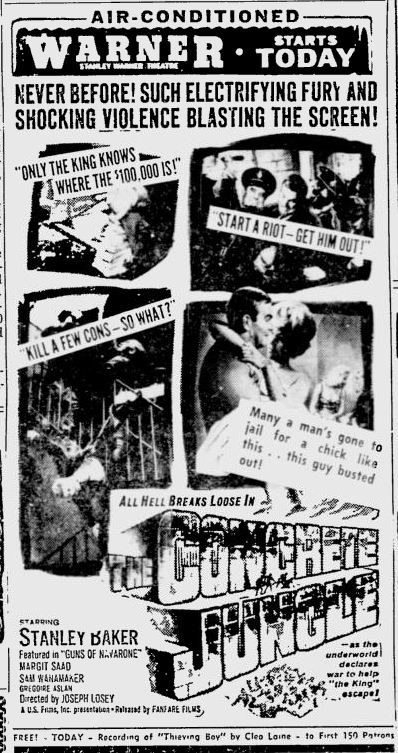
In Reading PA, an English prison picture directed by an expatriate American premieres.


In its native Britain Joseph Losey's film is plain and simply The Criminal, but Americans seemed to think that a movie sold better if you called it "The [blank] Jungle." Note how the ad reaches for any sort of exploitation angle, from the reminder that one of the actors here appeared in The Guns of Navarone, the previous year's most popular movie, to the promise of a free record to early arrivals. "Thieving Boy" was the film's theme song, and here's what the people heard on screen, thanks to TCM.


Next, another film from Britain opens in Pittsburgh amid a blizzard of blurbs.


The picture did win a bunch of BAFTA Awards, and Rita Tushingham won a prize at Cannes, and it is ranked as one of the 100 greatest British films, so I suppose those reviewers must be on to something.

Finally, this happened in Dubuque IA.


Mansfield's role in this comedy about the 1896 Olympics is actually relatively small, according to Wikipedia, but who are all those other people, after all? Let's close with a clip of her in action, uploaded by bachflat.

Thursday, June 7, 2012

DVR Diary: INSIDE THE MAFIA (1959)

A dramatic sequence of events in the fall of 1957 made the existence of a national Mafia more difficult for public officials to deny. Reports of the barbershop assassination of Albert Anastasia and the police raid on an apparent crime conclave in Apalachin, NY, whetted appetites for more information about the shadowy crime organization. But before Joe Valachi's 1963 testimony before a congressional committee very little was known about the institutions and inner workings of the Mafia. Into the breach stepped the Premium Pictures company, screenwriter Orville H. Hampton and director Edward L. Cahn, who released Inside the Mafia in 1959. Cahn was a Poverty Row visionary with a vast filmography of hackwork and a handful of primitively prescient pictures. His sci-fi film It! The Terror From Beyond Space has been recognized as a precursor of Ridley Scott's Alien, while the mindless marching masses Cahn directed in Creature With the Atom Brain and Invisible Invaders anticipate the zombie attacks of George A. Romero's films. Does Inside the Mafia similarly anticipate The Godfather and the mafia genre that followed Francis Coppola's film? The answer is a flat no. Working apparently from utter ignorance of the actual Mafia, Cahn and Hampton can't hope to approximate the ritual dynamics and familiar intimacy of post-Valachi movies. Instead, Inside is strange not in any premonitory way but as a work of crass naivete, and insulting in its pretense of telling the true story of the events leading to the Apalachin conference. The tone is set from the start when Apalachin is redubbed "Apple Lake," while Anastasia is replaced in the fatal barber chair by one Augie Martello (Ted de Corsia), who does not die, at least not right away. Secreted from an insecure hospital to a safe house, Augie lives to give his blessing to a plan of his lieutenant Tony Ledo (Cameron Mitchell) to take over the entire national crime organization. Ledo's idea is a decapitation strike against the long-exiled mastermind Johnny Lucero (Grant Richards) -- whacking him when his plane lands at the Apple Lake airport. Lucero is an amalgam of real-life boss Vito Genovese and the already-legendary Lucky Luciano, whose stature as an exile longing to return to America haunts a number of postwar crime films. For Ledo's plan to work, he must take control of the little airport. That means taking the man who runs the place and his family hostage, making them operate as if nothing is wrong so as not to alarm Lucero or anyone else. Instead of a Mafia expose, the picture becomes a rip-off of Suddenly, the picture in which Frank Sinatra takes a household hostage so he can shoot the President from their window. The imperiled family and their unlucky friends are a dull lot, but the gangsters are hardly less dull. The often manic Mitchell, here at the tale end of his peak period of Hollywood stardom and on the verge of a more productive sojourn in Europe, brings little to his role, while Robert Strauss (best known as Animal from Stalag 17) contributes most of the violence, including a few karate chops. The plot twists when Ledo learns from the TV that Augie has finally succumbed to his wounds. His plan takes a 180 degree turn; he now intends to convince Lucero that he's the man best qualified to run the organization in Lucero's name. His ploy seems to work, but there are a few twists left in the tale, while the hostages strive to free themselves, knowing that they must die otherwise. Everything ends in an Apple Lake bloodbath that the film claims "actually happened." Don't you believe them. Their claim is as viable as Criswell's at the end of Plan 9 From Outer Space, and their film is far less entertaining from that one. Inside the Mafia is exploitation of the worst time, completely lacking in inspiration and seemingly guided by the assumption that once their title had you hooked, they owed you nothing more. That kind of filmmaking ought to be a crime.