Monday, August 12, 2013

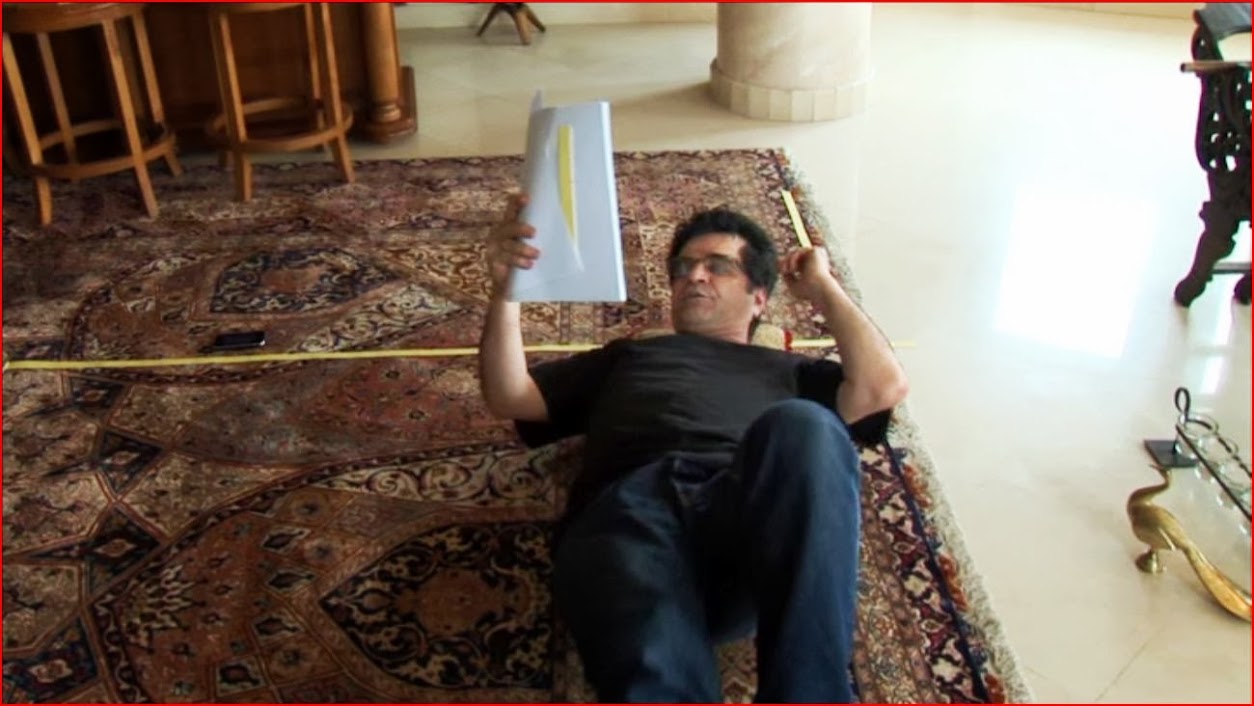
Jafar Panahi in THIS IS NOT A FILM (2011)

The director Jafar Panahi made two of my favorite Iranian movies: the small-time crime drama Crimson Gold (2003) and Offside (2006), an impressive bit of guerrilla filmmaking about female soccer fans sneaking into a men-only stadium. Since then, Panahi has been at increasing odds with what seemed an increasingly reactionary government during the Ahmadinejad administration. During the turmoil following the disputed 2009 election, Panahi was arrested but quickly released with an apology. After making public his sympathy with the opposition at the Montreal Film Festival, he was arrested again in 2010. This time he was accused of making propaganda against the Islamic Republic, apparently for working on a documentary about the recent unrest. The verdict amounted to a blacklist with the force of law. Panahi was sentenced to six years in prison; beyond that, he was forbidden to direct movies or communicate with foreigners for twenty years. Iran does allow appeals, and the prison part of his sentence appears to amount to a loose form of house arrest. But it's the ban on directing that hurts -- not that he's taken it lying down.


Mojtaba Mirtahmasb is the credited director of This Is Not a Film, but it's plainly Panahi's show. Shot on a camcorder and iPhone, it's a document of Panahi's isolated existence during the appeal process. Confined to his pretty nice apartment, with his family out visiting relatives and only his pet iguana for company, Panahi can have visitors and so summons Mirtahmasb to film his musings on frustrated projects. Close to his heart now understandable reasons is a screenplay he was denied permission to film about a young woman imprisoned by her parents to prevent her attending art school. He believes he can tell the story and even demonstrate how he would have shot it by using tape on his carpet to lay out the girl's apartment. The inadequacy of it all gets to him, however, and he flees to his balcony to brood. Fortunately, he has a very picturesque view of a massive construction project across the street.


Panahi's impulse is to protest and struggle, but his humane storytelling instincts gradually take over in the second half of the 78-minute film. A neighbor from another floor shows up to ask the director to take care of her dog Micky while she goes out. He initially agrees but gives the dog back before the girl is out the door because it scares his iguana. In the final act of the movie, Panahi takes an elevator ride with a college student who takes out everyone's garbage. In a bright moment of comic unity, they end up on the girl's floor and she tries to inflict Micky on the student, who proves even more reluctant than Panahi to deal with the animal. At last they reach the ground floor and go into the courtyard, the student cautioning Panahi not to venture out with his camera. As we'd seen earlier from the balcony, this is "Fireworks Wednesday," a periodic show of dissent denounced on the news that day as having no religious basis. It's almost too perfect a visual summation of the life of the street and the vein of protest from which Panahi has been isolated. At the same time the spontaneous moments of comedy he captures tie in to his reflections (illustrated by an American DVD of Crimson Gold, among others) on the virtues of casting amateur actors in his movies.


Since then, it turns out, Panahi has managed to make another clandestine film that premiered at the 2013 Berlin Film Festival. I don't know whether he's suffered any reprisal for doing this, and one might expect (or at least hope for) an amnesty (should it be in his power) from the new administration of President Rouhani. For the most part, This Is Not a Film is for Panahi fans only, or for people interested as much in Iranian politics as in Iranian cinema. Still, even those who know Panahi only as a kind of martyr, an Iranian counterpart to the Hollywood Ten, may see in it the qualities that make movie fans around the world hope he can make movies without Dada disclaimers in the near future.


Saturday, August 10, 2013

On the Big Screen: ELYSIUM (2013)

Neill Blomkamp's follow-up to his sleeper hit and Oscar nominee District 9 is another futuristic allegory that appears to expose the writer-director's creative limits. It's another stark tale of widening inequality, this time set in a 22nd century in which the wealthy have fled Earth in favor of the ultimate gated suburb: the titular satellite community, a utopia for a mostly-white population, albeit with an Indian president of apparently limited powers. Below, Los Angeles has been transformed into a massive shantytown of mostly brown people, where Max Da Costa (Matt Damon) is an exceptional poor white who proves exceptional in other respects. He's an orphan raised by nuns alongside a girl, Frey, who grows up to be a nurse (Alice Braga) with a sickly daughter. Max grows up to be a criminal, but is now trying to go straight despite constant hassling from the robot police. When he suffers radiation poisoning in an industrial accident he becomes one of the multitudes desperately hoping to sneak up to Elysium via the pirate shuttle racket operated by Spider (Wagner Moura). Blomkamp makes the class divide as stark and dystopian as can be imagined. Every Elysium home comes with a Medi-Pod that cures all ills and ensures effective immortality for those who can afford to move there. Smugglers like Spider are the coyotes of the 22nd century, taking people's savings in return for a chance to breach the Elysium defenses, land safely and find a house where they can put themselves or their children into a Medi-Pod. The few who make it through the land-based missile defense operated by goons like Kruger (Blomkamp alter ego Sharlito Copley) get caught by police droids, a bare minimum managing to find a Medi-Pod before getting deported. In case you can't guess, Blomkamp sees health care more as a right than as a privilege.

Given five days to live after his accident, Max is desperate to reach Elysium by any means necessary. His criminal connections give him a chance. Spider promises him passage in return for Max (aided by an exoskeleton implanted over his clothes, which he'll apparently never change again) helping him kidnap an Elysian executive (William Fichtner) who happens to be Max's employer, on Earth to inspect a factory. Spider hopes to score insider information from the memory implants in the executive's brain, but his gang soon realizes that they've stumbled on something far more valuable. The executive is in on a conspiracy with Elysium's defense secretary (a Thatcherish Jodie Foster) to overthrow the government via a forced shutdown and reboot of the satellite's operating system. Somehow this will allow Secretary Delacourt to reprogram the government to replace the president, either with herself or someone compliant. This knowledge is obviously highly valuable in its own right, but Spider also realizes that a reboot would allow someone to rewrite the citizenship rolls. He could make everyone on Earth a citizen of Elysium and thus eligible to use Medi-Pods without getting bootleg genetic IDs tattooed on their arms. Why Spider should thus undermine his own racket is unclear, but he can't do anything once Delacourt imposes a no-fly zone to facilitate the hunt for whoever killed the executive and stole the data. That means Spider can't get Max into the air, much less into orbit, so with time running out he gets the idea of revealing himself and surrendering the data in return for time in a Medi-Pod. Unfortunately, he has to deal with Kruger, recently fired by the government but clandestinely rehired by Delacourt, who evolves an agenda of his own once he realizes the significance of the data involved. Before Max turns himself in, Kruger takes Frey and her dying daughter hostage, having learned that Max had come to her for emergency assistance after his first fight with Kruger. They come along for the ride to Elysium, Kruger having bad intentions for the lady. Delacourt lifts the no-fly zone the moment Max surrenders, so Spider sends a ship after him immediately. Needless to say, Max will face several ethical dilemmas before his story ends....

However radical Blomkamp may imagine himself, with Elysium he's gone Hollywood. This film has a more-or-less happy ending, or at least one in which good triumphs. Whether the victory is sustainable is another story that we're not likely to see; Blomkamp seems uninterested in the implications of the upheaval he portrays beyond making his allegorical editorial point. Apart from that point, he's made something sadly close to an utterly generic action movie. The worst part of that is that Blomkamp doesn't prove particularly good at generic action -- though his direction of action is generic by current standards in its near-incoherence at many points. He aims for a frantic feel at the expense of clarity. Worse, despite his avowed concern for the masses, he caters to Hollywood's need to exalt the special individual. Max is told as a child that he can accomplish something unique, and by gum, he does! Also, despite Matt Damon's good intentions, the fact that he plays this potential savior rather than someone who looks more like the rest of Max's neighborhood rankles me somehow. I don't usually get politically correct about such things, but since Blomkamp himself strives for a kind of political correctness his casting of the hero, however necessary from a business standpoint, ought to be questioned. His worst mistake, however, was probably his indulging his buddy Copley in an over-the-top yet insubstantial performance that metastasizes from flunky to big bad, seemingly on an auteurial whim. Blomkamp apparently wants us to see Kruger as an epic badass villain, but Copley can't pull it off, and the film falls apart on his shoulders. Foster is getting some of the worst reviews of her career for what's admittedly a thankless villain role, but it's Copley who really lays an egg here, and Blomkamp's loyalty to him may be his own undoing, on top of his own faults. From my perspective, Blomkamp's heart is in the right place, but that never guarantees a decent movie. In a summer already notorious for expensive duds, Elysium is likely to be another.
Thursday, August 8, 2013

Karen Black (1939-2013)

She made her name with cutting edge American movies, appearing in three Raybert/BBS projects: Easy Rider, Five Easy Pieces and Jack Nicholson's Drive He Said.  But to understand why she is an icon of Seventies cinema, look at the the three-year period from 1974 through 1976. In that time, she appeared in the literary adaptations Rhinoceros, The Great Gatsby and The Day of the Locust. In the same time, she appeared in Airport 1975. In the same time, she worked for Alfred Hitchcock (Family Plot), Robert Altman (Nashville) and, for many most famously, for Dan Curtis, on film opposite Oliver Reed in Burnt Offerings and on TV in four roles in the three stories that make up Trilogy of Terror. For those who remember it all, she is the stewardess who flies the plane and the woman who fights the fetish doll -- and many others. Black soon achieved a ubiquity which proved indiscriminate. She kept on working until cancer claimed her, her filmography growing increasingly obscure. History's verdict is that she belongs to the Seventies. For those of us who grew up in those years, it's hard to realize that they're now as long ago as the 1930s were to us. They seem just a little further away today.

Wednesday, August 7, 2013

Coming Soon: Orson Welles's TOO MUCH JOHNSON

Source: New York Times .Copyright George Eastman House, Cineteca dei Friuli
How much lost film is truly lost? The answer today is slightly less following the announcement of the rediscovery and restoration of Orson Welles's legendary film project Too Much Johnson, which will have a world premiere in October in Pordenone, Italy, followed by an American screening later that month. It may be exaggerating to describe Too Much Johnson as a film, since it isn't really complete unto itself. Welles shot it in 1938, three years before Citizen Kane, with his Mercury Theater company (including Joseph Cotten) as an accompaniment to the 1894 play of the same name, which Welles intended to revive as a multimedia spectacle on Broadway. The show flopped out of town and Welles eventually lost track of the footage. It's not his first experiment with cinema, but his teenage project Hearts of Age has been readily available for some time now. Johnson comes from the period when Welles was approaching his first peak of fame. Already hailed as an innovative theater director and known by many as the voice of The Shadow on the radio, Welles would cap 1938 with his historic War of the Worlds radio broadcast. He turned 23 that year. While Citizen Kane was long considered the greatest film ever made, and is still thought so by many, Welles himself remains an archetype of talent and potential wasted, whether ruined by Hollywood or squandered by himself. Whatever Too Much Johnson proves to be in restored form, it should serve as a reminder of how much potential Welles was thought to have in his "boy genius" years. It will certainly be cause for hope that other lost films are still only temporarily missing.

Monday, August 5, 2013

Pre-Code Parade: THREE-CORNERED MOON (1933)

Here's a screwball comedy from 1933. Hollywood historians usually tell you that screwball first manifested in 1934, though they'll debate which film was actually first, and I've portrayed screwball as a comedy style suitable (for various reasons) for the era of Code Enforcement. If you believe all that, then what we have here is a premature screwball comedy. If you ever wondered how screwball characters would fare in a Pre-Code film, here you are. It is almost predictably schizoid, incapable of maintaining the blithe tone typical of true screwball, often lapsing into melodramatic hysteria. The pivotal figure here is Claudette Colbert. A key player in the emergence of screwball as the leading lady of Frank Capra's It Happened One Night, she seems here to be performing in Pre-Code and screwball simultaneously. She's the sole daughter of the flighty Widow Rimplegar (Mary Boland), who doubled down on her dubious stock investments after the 1929 Crash only to have it all catch up to her as the film opens. Responding to a margin call from her broker, she finds that she's down to $1.65 in the family bank account. That leaves the Rimplegars -- Colbert has three brothers, including Wallace Ford -- wiped out except for their mansion and its furnishings, none of which are likely to find a buyer at the trough of the Depression. None of the kids work, but now they'll have to. Ford had abandoned his law studies, but now takes them up with new urgency. The youngest son becomes a lifeguard for a dollar a day. The middle son gets an acting job (he uses Rouben Mamoulian as a reference) with one line. Claudette bluffs her way into a shoe-factory job with help from a newfound friend who appears in only two scenes. She quickly falls behind her production quotas, but her supervisor will let her keep the job if she satisfies him in other ways. Like I say, Pre-Code can dress up as screwball but something will always show through a hole in the garment.

The Rimplegars are the kind of zany family of overgrown children that would become more typical after 1934, but the stakes seem higher in 1933. For Claudette, the challenge beyond making money and getting food on the table is choosing between two potential husbands. The choice should be obvious between the pretentious writer Ronald (Hardie Albright) and the prosperous doctor Alan (Richard Arlen). Both live with the Rimplegars, but the rent-paying Alan is the family's main lifeline while Ronald is a complete parasite who scoffs at a job offer from one of Alan's patients until our heroine shames him into interviewing for the position. Ronald suffers from writer's block and fantasizes about romantic double suicide, provoking Colbert's comment that she last considered suicide after failing an algebra test at age 14. Despite his shiftlessness Ronald represents the kind of life Colbert still dreams of, the world she imagines still living in yet needs to leave behind. She feels the shocks of downhill poverty harder than her mother or siblings, exacerbated by Ronald's several betrayals, and Nugent does an effective job at making us appreciate the absurd crisis that results when Mama Rimplegar ruins a dinner made with the family's last stock of food, as well as the critical absurdity of the family squabbling childishly over who'll ask Alan for the rent money. When the youngest son faints from hunger and Colbert starts screaming that he's dead, it's hard in an interesting way to tell whether this is a dramatic highlight or if we're supposed to find her hysteria funny. With one foot in Pre-Code and another in screwball, the tone of Three-Cornered Moon is hard to gauge at times, and the film may ultimately seem neither fish nor fowl. The ad above calls the Rimplegars "sappy" and "nitwits" yet promises that you'll love them. I wouldn't go that far; the male Rimplegars are nearly insufferable, and Lyda Roberti is wasted as their imbecilic Polish maid. In the end, there may be just enough suffering for them to satisfy a Pre-Code sense of poetic justice, yet not so much to make the film other than a comedy. Any label beyond that may be giving it too much credit.

Sunday, August 4, 2013

NAVAJO JOE (1966)

Quentin Tarantino probably thinks more of this Sergio Corbucci western than anyone actually involved in making it. Burt Reynolds once described filming it and playing the title role as the worst experience in his life, and Navajo Joe definitely takes a position toward the rear of the Corbucci western filmography. Only Ennio Morricone emerges with honor, albeit under his "Leo Nichols" pseudonym. Tarantino used some of the Navajo Joe music in the Kill Bill films, and the gimmick of carving a symbol on a victim's forehead in Inglourious Basterds has roots in the Corbucci picture. It sounds good (the "Na-ha-vo Joe Na-ha-vo Johhh" chant is quite an earwig) and the locations often look terrific, but boy, the story is dumber than a bag of posts.


It's really just a by-the-numbers spaghetti story, the numbers all being well known already in 1966. Fernando di Leo, who wrote for Sergio Leone and assisted him in directing For a Few Dollars More, contributed to the script, but none of the three credited writers seems to have contributed much of interest. Navajo Joe is noteworthy only for having a Native American hero, when it was rare for Italian westerns to have Indians in them at all. Joe (usually called "the Indian") is really a spaghetti hybrid, a "bounty killer" and an avenger at once. His own grudge against the bandit leader Duncan (Aldo Sanbrell) leads him to defend an unwelcoming town against Duncan's private army. The town fathers distrust him because of his race. His only allies are an Indian woman (Nicoletta Machiavelli) and the saloon-folk refugees Joe rescued from Duncan's pillage of another town. Joe hardly needs allies, being practically a one-man army. Having allies only handicaps him -- or else giving him vulnerable allies was the only way Di Leo et al could arrange for Joe to suffer the hero's obligatory beating mid-picture.

 
The picturesque world of Navajo Joe.


This is where Navajo Joe jumps the shark for me. The translated screenplay was already pretty bad and the taciturn Joe is an utter waste of Reynolds. The energetic action sequences -- exceptionally for a spaghetti hero, Joe relies less on fast guns than on hand-to-hand attacks, fighting in what Tarantino calls a "blitzkrieg" style -- seemed likely to redeem the picture until Duncan manages to take the Machiavelli character hostage, compelling Joe to surrender when he'd been leisurely sniping bandits from a rooftop by threatening the lady. Joe does surrender and takes his beating before being hung upside down. Then we discover that Duncan, who has blithely massacred everything in his path to this point, has let Machiavelli go to wander about freely and rally the saloon folk to help Joe escape. He expects Joe to tell him where he and the townsfolk have hidden the bank's reserves, but he has given up the only thing that gave him leverage over our hero! That's too stupid to forgive, and at that moment the film lost me.


I can understand Reynolds's disappointment, though I hope he didn't simply resent all the running and jumping Corbucci required of him. His contempt for the pretty contemptible dialogue is apparent in every line he utters. You can see the logic of casting him; another young American making his name on a TV western could be the next Eastwood. The part seems all wrong in retrospect once Reynolds's movie-star persona evolved fully, but it should have seemed wrong to the filmmakers at the time, or maybe it would have had the Italians understood English better. As Joe, Reynolds is all physicality and no personality. He fared better in a more suitably roguish role in the Tom Gries-Clair Huffaker western 100 Rifles a few years later. Navajo Joe is probably a more impressive film than 100 Rifles visually, not counting Racquel Welch as a visual asset for the latter, but you'll really need to turn your brain off to enjoy this ride.

Friday, August 2, 2013

Michael Ansara (1922-2013)

One of the last survivors from the golden age of TV character actors, Arab-American actor and all-purpose ethnic Michael Ansara died last Wednesday at the age of 91. Given his versatility, it's a shame that the obits I've read identify him mainly with one role he played: Kang the Klingon, who appeared on three different Star Trek series. Mind you, Ansara made a kick-ass Klingon in both the greasy mode of the 1960s and the knobby mode of the 1990s. But he did so much more besides. Just to keep the Trekkers' attention, I just saw Ansara and Leonard Nimoy playing brother marshals in an episode of The Virginian a few weeks ago.  Not typed ethnically for once, the actors portrayed hard-assed Earp-like unpopular lawmen. The episode played on expectations that the marshals would prove the heavies of the piece, despite Ansara having played heroes on two different series previously. It takes our ever-unnamed title character (I call him "Virge.") a while to figure out that the grim lawmen are actually in the right. Seeing the light finally, Virge (that's James Drury, by the way) challenges the Ansara character to smile for once. Only after Virge boards the train to leave does Ansara give us a hint of a grin.

I miss the days when character actors made any given episode of a series, when the focus was on the guest star and, more importantly, a truly complete story, at least as much as on the regular stars of the show. The old format created ample opportunities for the actors of Ansara's generation to show their stuff and make lasting names for themselves. There were names you could trust to provide a solid hour of entertainment when they showed up as guest stars on any given show. I use those names to decide what I'm going to record on my DVR when the old shows turn up on cable today. It doesn't seem like there's a similar generation of character actors worthy of the "guest star" label now, and that makes Ansara's passing all the more sad.

In addition, he was married to Jeannie-era Barbara Eden and had the stones to defy the jihadis a generation ahead of the rest of us by appearing in Muhammad, Messenger of God. The movie isn't really that great, but Ansara makes a good villain as usual and the gesture deserves an additional salute.