Tuesday, November 10, 2015

DVR Diary: SLAUGHTER TRAIL (1951)

The 1950s were the golden age of the Hollywood western, marked by the flourishing of the "adult" or "psychological" western and the emergence of such master genre auteurs as Anthony Mann, Budd Boetticher and Delmer Daves. At the same time, a folkloric element to the genre persisted, finding expression in the title ballads that occasionally crowned but more often marred western movies. The three leading directors mostly avoided this balladic imperative (exceptions include Mann's Man From Laramie and Boetticher's Seven Men From Now) but the blockbuster success of both Fred Zinnemann's High Noon and Dmitri Tiomkin's title ballad convinced many a producer that ballads were essential to the western genre. The balladic imperative, an arguable inheritance from singing-cowboy films which in retrospect makes many films sound more corny than they really are, predates High Noon. At the start of the decade, producer-director Irving Allen conceived a balladic western with a sung-through narration. Slaughter Trail isn't quite a musical -- characters never "burst into song" and the major characters never sing -- but music is its life blood. Pop music is in its DNA. RKO, the studio that distributed Allen's film, hoped to exploit the participation as actor, singer and songwriter of Terry Gilkyson, who had recently written a hit song, "The Cry of the Wild Goose," that had been popularized by Frankie Laine, whose earlier hit "Mule Train" probably helped inspire many title ballads in the coming decade. However, Gilkyson did not write Slaughter Trail's title ballad, also known as "Hoofbeat Serenade." It's a tune that actually grows on you once you realize that Allen is going to stick with it all the way. Its refrain, as I remember it -- "You can only hear the sound/Of the hoofbeats on the ground/And the bandits ride around the Slaughter Trail" -- has an undeniable momentum, but some lyrics are dangerously self-referential, acknowledging that we're watching a movie "on the Cinecolor screen," or explaining how "we add tension to the plot" by introducing Indians. That doesn't match the often grimly serious action of the film, and the inconsistency of tone makes it hard to take any of it seriously.

The Slaughter Trail is where three masked bandits rob a stagecoach. One of them (Gig Young) has a laugh the victims will recognize anywhere, but one of the victims, Lorabelle Larkin (Virginia Grey) is actually in cahoots with the bandits. After her lover pretends to rough her up, Lorabelle continues with the stage to a cavalry fort presided over by Brian Donlevy, a late substitute for abruptly-blacklisted Howard Da Silva. The switch was probably for the best, except for the mistreated Da Silva, who was nonetheless one of the few character actors less plausible, as a typecast heel, in the hero's role than Donlevy himself. Meanwhile, the bandits make their getaway, stealing fresh mounts from some Navajo Indians to, as they say, add tension to the plot. The bandits, masks off, will eventually arrive at the fort, while the Navajos, then at peace with the whites, will demand that Donlevy find the bandits and surrender them to Navajo justice. Once Young betrays himself with unguarded laughter, and is recognized by the Navajos -- his gang had their masks off when they stole those horses -- a common western scenario is set up. Donlevy cares little for the bandits and seems to be falling for their moll, who herself softens in the company of the camp's children, but he must uphold the white man's rule of law against the Navajo demand for tribal justice. The fun thing about Slaughter Trail is how screenwriter Sid Kuller cares about this point of civilization only to set up the Indian attack he needs. The bandits, of course, are trusted to help fight for their lives, and they all die. Once Young goes down, the Navajos pretty much say, "We're done here" and go home. As far as we can tell they'll face no repercussions or reprisals, and Donlevy's ultimate unwillingness to enforce his principle punitively makes his earlier stand on it look silly and wasteful of both white and red lives. Yet the film doesn't treat his character as a fool. Instead, it keeps the door open for an eventual romance between the commander and Lorabelle Larkin after she rides off into the sunset for a period of penance and meditation. It's a realistically ambivalent finish at the end of a musical trail with insufferable stopovers for songs by Gilkyson and purported comedy relief from Andy Devine. His bits may have been funny when different comics first performed them ages ago, but Devine only leaves you wondering where exactly you'd seen them before. There are more minuses than pluses on Slaughter Trail but western genre buffs ought to check it out, if only because there's really nothing else like it.

Sunday, November 8, 2015

On the Big Screen: SPECTRE (2015)

 
Almost from the beginning, James Bond moviemakers have challenged themselves to top their opening action scenes. For his second consecutive outing as a Bond director, and Daniel Craig's fourth in the star role, Sam Mendes raises the bar very high. Spectre opens with a spectacular sequence set during the Day of the Dead festivities in Mexico City. CGI-enhanced tracking shots follow a skull-masked man who proves to be James Bond 007 through the parading crowds, into an apartment for an apparent romantic tryst, then out and up to the rooftops to make a sniper's nest for an assassination that goes catastrophically wrong. But this is all build-up for the real set piece when Bond chases his quarry into a public square where a helicopter has landed to rescue the quarry. Bond invites himself on board and commences fighting with both the quarry and the pilot as the helicopter careens over the square above panicked multitudes fleeing below.

Mendes can't top it. He isn't helped by the fact that two commercial campaigns have spoiled much of one of the other big scenes, a mountain chase in which Bond must pursue kidnappers downhill in an eventually wingless plane. Nor is he helped by a team of four writers who seem collectively committed to evoking or echoing many franchise highlights -- the Day of the Dead stuff is reminiscent of Live and Let Die and any mountain chase begs comparison to On Her Majesty's Secret Service -- or else to making as generic a James Bond film as possible. They made very little effort to creating truly interesting villains, failing to notice that the most interesting of them is the one who probably ranks third and last with the audience and definitely falls in that slot for writers and director. Even then, this tertiary villain -- I presume people will rank him below the Big Bad and the Oddjob-style enforcer -- is hardly an original concept. Nor is Spectre's main plot. If the previous Mendes-Craig effort, Skyfall, reminded people of Christopher Nolan's Dark Knight with its nihilist villain and his I-want-to-get-caught scheme, Spectre unavoidably echoes the Russo brothers' Captain America: The Winter Soldier with its device of an all-pervasive surveillance system promoted by intelligence agencies but promoting the agenda of a shadowy criminal organization, not to mention an antagonist from the hero's distant past.

Yes, everything has to be personal in modern genre movies, and with that mandate in mind the Spectre writers have succeeded in utterly trivializing a canonical villain. They do this despite an awesomely suspenseful intro at a conspirators' conclave, in which the banal reportage of evil achievements is interrupted by the master's arrival. The master remains in shadowy silence at the head of the table, cocking his head slightly to listen to his advisers as others at the table wait in obvious dread of whatever he may say. But then he reveals himself as Christoph Waltz and the effect is ruined. Increasingly, Waltz seems like another Michael Madsen, capable of magic when touched by Tarantino's wand but otherwise insufferable. He's the second lazy casting choice for a master villain in a row following Skyfall's recruitment of Javier (Anton Chigurh) Bardem. It didn't use to be that you had to prove yourself a master movie villain in order to play a Bond villain; doing the Bond movie actually would punch your ticket. But Mendes and his producers have been as unimaginative in their casting as they have proved cliched in their plotting. If Waltz gives a puerile performance (his catchphrase, for Gad's sake, is "coo-coo") he's only sinking to the writers' level. The motivation his character is given is an insult to the actor, the audience, and to Ian Fleming, but it's just the sort of thing writers today think profound because it's, you know, personal. If anything, the personal is the opposite of the profound in this sort of picture. And it's not as if the Spectre writers can't do impersonal, though that's no credit to them. It's one thing to waste Christoph Waltz because you're not Quentin Tarantino, but making something out of Dave Bautista shouldn't have been so tricky, and yet the writers waste him also. He was cast, if I recall right, shortly after Guardians of the Galaxy opened last year to prove what filmmakers could do by tapping into some of Bautista's amped-up wrestler's charisma. Seeing that, the Spectre team somehow could only think of him as another sort of Oddjob and allowed him a single word of dialogue in the whole picture while playing a character who's named in the credits but not in the actual movie. Bautista does as much as he can to suggest some intelligence, or at least some powers of observation, in this mute brute, but he's not that good an actor yet and, left without the sort of cool gimmick that the original Oddjob got, he ends up an oversized yet empty suit.

That leaves the third villain, the new boss of both Bond and M (Ralph Fiennes). Literally third, "C" (Andrew Scott) is the new overlord of British intelligence and a collaborator in the global "Nine Eyes" program. C and M's dialogues play out whatever passes for a theme here, the theme being that granting certain individuals license to kill is ethically superior to automated surveillance and indiscriminate drone deployment. Apparently the personal factor makes the difference, as M explains: a license to kill is a license not to kill. It sounds like an almost Orwellian paradox but James Bond presumably proves the point every time. For what it's worth, Fiennes and the rest of the Bond support team -- Naomie Harris as Moneypenny and Ben Whishaw as Q -- are the clearest pluses this time around, all improving on their Skyfall work. Fiennes in particular follows in Judi Dench's footsteps (she gets a brief video encore here) as a more active M who even gets an important fight scene of his own. They are, in fact, more appealing characters than the lead. It's hard not to read Daniel Craig's now-infamous comments, since partly contradicted, about preferring suicide to continuing in the role into the role as he plays it in Spectre. He breathes life into a few quips but seems indifferent if not contemptuous toward the "personal" storyline linking Bond to Waltz's villain, while his required romances are by-the-numbers stuff. Whether he changes his mind about continuing or not, it may be time for EON Productions to be rid of him, if not the whole creative crew of his series, so we can have a true 21st century Bond who brings the appropriate enjoyment to his 21st century work. The three previous Craig pictures and the writers' dogged insistence on continuity trail and drag Spectre the way that little train of barrels handicaps Bautista's villain at a crucial moment. You can tell that Spectre was meant as some sort of celebration of all the things that make Bond pictures distinctive, but the result looks like an official pastiche if not a self-parody. It's still acceptable as a mindless popcorn movie with some good action scenes, but despite its pretensions it's nothing more than that.

Friday, November 6, 2015

A GIRL WALKS HOME ALONE AT NIGHT (2014)

Ana Lily Amirpour was born in Great Britain and considers herself Iranian-American. To my knowledge, she's never set foot in Iran, yet she has made a movie in her ancestral Farsi and planted Farsi street signs on her southern California locations. Are we supposed to believe that it's taking place in Iran? Is it in some way a reflection on the Islamic Republic? Or is it just weird for the sake of weird? My last guess is probably the best one. Amirpour's "Bad City" is a dystopia -- there seems to be a municipal dumping ground for dead bodies near some busy roads -- but there's nothing oppressively Islamic about it. Instead, there's the blasphemy at the heart of the picture: under the chador that signifies modesty and obedience a vampire (Sheila Vand) stalks the city. This nameless vampire seems stuck in eternal late adolescence, happily claiming a skateboard as tribute from a frightened child. Apparently she was turned in the early 1980s, to judge from the music posters in her lair. That's nearly contemporary with the advent of the Islamic Republic, but maybe Amirpour just likes the music and fashions of that era. Apart from the vampire's mocking chador and the fact that everyone talks Farsi, Bad City looks pretty much like the America where the film was shot, complete with a hapless hero (Arash Marandi) with a leather jacket and a convertible to drive through the Lynchian industrial landscape.


A skateboarding vampire symbolizes eternal youth pretty nicely,
but even eternal youth grows dated in time.


Amirpour calls her film an "Iranian vampire spaghetti western." Check, check and .... well, no. Let's draw a line somewhere. That label really only underscores the movie-movieness of A Girl Walks Home Alone at Night. The Iranian-ness of the characters and dialogue and the genuine inspiration of the menace under the chador -- has Amirpour been accused of inflaming Islamophobia? -- only superficially covers the essentially derivative nature of the movie, giving it a pretentious novelty. Yet there is something sincere in her empathetic approach to her alienated protagonists groping toward intimacy amid squalor and danger. The vampire girl still longs for human company, for friends if not lovers whom she doesn't have to devour. There are plenty of people left over for that purpose: the pimps, the junkies and other dregs of society. Her victims eventually will include the hero Arash's father, but the father's addiction, fed by the pimp, has made Arash's life hell, if not more of a hell than life in Bad City is for anybody. Under more normal circumstances this killing might turn our hero against his undead friend, but in fact it's the moment that allows them both to cut their ties with the accursed place.


There's a slight echo of Let the Right One In/Let Me In in this creepy courtship, though A Girl Walks Home is ultimately more romantic, its vampire more in need of a soulmate than a servant. She sees something more in Arash than initially meets the eye when she finds him in a Dracula costume, having staggered stoned from a costume party, staring at a streetlamp. I don't think she's dumb enough to have though he might be like her that way, but she does seem to sense that he's like her in some way. She feels a similar sort of kinship with a prostitute who seems as much a victim of life as Arash, abused by the same pimp who claims our hero's convertible as payment for dad's drugs before the vampire kills him and manhandled by the dad (who has a past with her) until the vampire kills him. People like Arash and the hooker are the closest she'll get to the underworld of sociability with which most American vampires are blessed these days. In that sense, depending on your preferences, A Girl Walks Home is more of a proper vampire movie than many made these days, or at least more of a horror film than those fantasy films, even if it's still too romantic, in its despairing way, for some tastes.

 
Welcome to Bad City

It's a pretty slick piece of work, thanks largely to Lyle Vincent's black and white cinematography. If there's anything "spaghetti" about the picture its Amirpour and Vincent's proficiency in widescreen composition. It's mercifully light on effects, as Vand's vampire displays quite modest fangs and gets her voice mechanically modulated when she wants to scare people. Overall, it reveals Amirpour as a talent, but it seems just a little too calculated a revelation. It's paid off just the same, since she'll have an English-language cannibal movie with real stars out next year. Let's wait for that one before we say that Amirpour is really a talent to watch. For now she's done enough to get a second chance.

Monday, November 2, 2015

JAUJA (2014)

International man of cinema Viggo Mortensen returns in a role that allows him to try Spanish again, after his mixed reviews for Captain Alatriste, as well as his ancestral Danish. Argentinian director Lisandro Alonso and co-writer Fabian Casas have crafted a tale that resembles The Searchers on the scale and in the tone of Meek's Cutoff, with a folkloric if not fairy-tale quality that should have tipped me off that something more or less than meets the eye was going on. There's a studied primitivism to this period piece; leave out the fine color cinematography of Timo Salminen and it could have been made almost the same way one hundred years ago. Alonso works in long takes, in scenes that aren't built around dialogue, requiring Mortensen in particular to do a lot of non-verbal business to help define his character. The director likes to show characters taking their time coming toward us, then taking their time moving away from us. He emphasizes the spatial relationships between his characters. In an early shot, a soldier is bathing and masturbating in a small natural pool. While he works himself over, a figure appears in the distance from screen right. A cut reveals this newcomer as Mortensen, whom we watch puttering about as the soldier, now in the distance, dries up, dresses, and approaches him. There's something inherently old-fashioned about the pacing that enhances the period feel of the scene. Alonso has an effective style that looks superficially like an absence of style.


Mortensen plays Gunnar Dinesen -- is there a homage to Karen "Isak Dinesen" Blixen of Out of Africa fame there? -- an engineer and advisor to the Argentian army, apparently concerned above all with keeping his daughter (Viilbjørk Malling Agger) away from that wanker and other soldiers. His efforts avail him not, as Ingeborg elopes with a younger, better looking soldier. We're in Searchers territory once Dinesen heads out alone in pursuit of the couple, with all three in danger from renegades. Gradually it seems to become a different kind of quest, or else a different kind of story altogether.


Alonso's neo-primitivist storytelling leads you to believe that Jauja is some sort of naturalist narrative, but all along there's something almost too quaint about it. It could be the curved corners of the old-timey 1:33 aspect-ratio frame, which made me think of 19th century photographs. Maybe there's something too obviously archetypal about it, apart from the most obvious Searchers references. And maybe a spoiler warning is in order, since at a certain point, when Dinesen encounters an old woman in a cave, Alonso's tale becomes something more like a dream, or a blood memory half-recovered in a dream. The film ends far in time and place from Patagonia, but the message seems to be that dreams, myths or archetypes can transcend distance, or else that the distance between present and past, or history and dream. is even less. You can complain that this takes you right out of the picture, if you wanted to know what happened when Dinesen caught up with his daughter. But maybe a point is being made about your offended sense of linear time when a film finds reason to remind you that it's only a film, and all of it only fiction. You may try to reclaim some sort of linearity by figuring out who the girl in modern dress is, and the director himself leaves clues that point to the relevance of the Dinesen story to the present-day epilogue. But there's no denying that Jauja is the sort of film that will leave people asking "Is that it?" in way that questions whether there was ever an it to it. I suspect that there is an it to it after all, but I'm not sure yet whether there's enough of it to justify the tease that Jauja perpetrates. There's still the beautiful cinematography, the admirably laconic direction, and a fine, fully committed physical performance from co-producer Mortensen, and the twist, if you want to call it that, doesn't take any of that away. Watch the film for those, and judge the rest for yourselves.

Friday, October 30, 2015

On the very small screen: BEASTS OF NO NATION (2015)

Cary Joji Fukunaga's movie has been touted as Netflix's first feature film, but the rental and streaming superpower only bought into the project after it had been shot, paying $12,000,000 for distribution rights concurrent with its streaming debut for subscribers. Since few theaters wanted to do Netflix any favors by actually exhibiting the film, I ended up watching it on my trusty e-reader's 7" screen. The picture quality is good, but some urban and jungle scenes probably need a bigger screen to fully breathe. Since it has an intimate focus, the travails of one boy, despite a potentially epic setting, Beasts of No Nation is a fairly device-friendly picture, but that same narrow focus probably limits whatever impact Fukunaga, who adapted Uzodinma Iweala's novel as well as directing, may have intended for it.


The overall feeling is like Apocalypse Now as a boy's adventure film, or if you prefer, a boy's adventure story in the manner of Apocalypse Now. The boy is Agu, (Abraham Attah), a pre-teen citizen of an unnamed African country. Agu is a bit of a rascal; he and his friends are first seen trying to sell an "Imagination TV," i.e., a hollow console behind which they perform in various genres as one boy changes the theoretical channels. It's a state-of-the-art device; call up the 3-D channel and one boy will dive through the empty picture window, right at you! The punch line comes unexpectedly some time later, when we learn whose TV has been dismembered for this purpose. This early comedy is meant to make the radical change in tone more abrupt and stark.


The enemy is coming. They have a name, but the fact is, there are lots of enemies, lots of militias with a bewildering variety of initials. Is it the People's Front of Judea or the Judean People's Front? None of them are taking prisoners, however, and when one particular militia comes to town Agu's childhood, poor but in some ways idyllic, comes to a violent end. The family is broken up, mother ferried out of town with the youngest child, but while Agu was meant to go along he ends up with his father and brother, both of whom are mowed down by the occupying militia. In the confusion Agu escapes into the jungle, where his chances look bleak.


Agu is recruited into another militia, led by the charismatic Commandant (Idris Elba). He has a way with child soldiers and a way with soldiers in general; we see him lead his men to take a well-guarded bridge with little more than his force of personality. Afterward, he orders Agu to kill his first man, telling him that the sobbing wretch at his feet is one of those who massacred his family. It's unclear whether Agu believes this or whether he just wants to make his pathetic victim shut up. His new pal Strika, hardly older than he, joins in the slaughter as the Commandant watches approvingly.


To Agu the Commandant may look like a conqueror in his own right, but he answers to higher powers, to his own chagrin. After suffering repeated humiliations when summoned by his supreme commander, the Commandant decides to strike out on his own, taking his militia with him, but this proves a foolhardy. In time his spell over Agu and the others is broken, but where can they go from there?...


Abraham Attah makes an impressive debut as Agu, while Idris Elba is impressive as ever as the Commandant. They could be a modern Jim Hawkins and Long John Silver, if the old pirate had fed his boy drugs and demanded sex from him. Some see the Commandant as a new Kurtz, somewhere close to the original heart of darkness of Joseph Conrad's story, but a Kurtz less easily eliminated. Beasts of No Nation may well leave audiences wondering whether "Exterminate all the brutes" isn't the right idea, though that probably isn't the response Fukunaga was hoping for. It really depends on whether he intended the film as a consciousness-raising expose of the wars still ravaging Africa, or as an atrocity exhibition. The apparently deliberate vagueness about its setting subverts any educational purpose Fukunaga may have had. Someone watching this film should want to know why these things are happening, and there really can't be even a hope for a solution unless we have such an understanding. Why are all these groups fighting each other? The only hints we get are the sight of the international businessmen waiting on the Commandant's boss and the sinister, authentic slogan occasionally seen and heard: "It's Our Turn to Eat." Politics in Africa seems to be a zero-sum game of tribes and factions for whom war is a natural extension. But it doesn't take much research to learn that there's more in play than that, and any film set in modern Africa, whatever its source, owes it to its audience to show that something more is going on than generic African savagery. I'm sure Fukunaga didn't mean it this way, but I wouldn't be surprised to see Beasts condemned as a racist film, and the writer-director has himself to blame for not the providing the political context that would refute any essentialist inferences audiences might draw. Fidelity to art may limit Fukunaga's options, since the novel requires us to see everything from a small boy's limited perspective. But the director doesn't help his case with a rather generic approach to war and its horrors. The experience of a child soldier is novelty enough to justify the film, but when the child soldier re-enacts a scene from All Quiet on the Western Front late in the picture some of the necessary novelty is diluted by movie memories. Nor is the ending as inspiring or inflammatory as it could be; instead, the film glides to a gradual stop with a promise that Agu can learn to be a boy again and play like other boys in the surf. Everything's okay, then, if he's going to be all right. There's something inexcusably Hollywood about that, as if the survival of the individual excuses the general horror. By now, though, I think I'm guilty of special pleading against the film. I should make it clear that Beasts of No Nation is a fine, often alarming, sometimes horrific film that should have some impact on viewers, and I recommend that people see it.  It ought to make people want to know why such things as they see on screen have happened in Africa, but it will give them very few answers, and by the time it's over audiences' aroused curiosity may have dimmed or died -- and if so, that's a failure.

Sunday, October 25, 2015

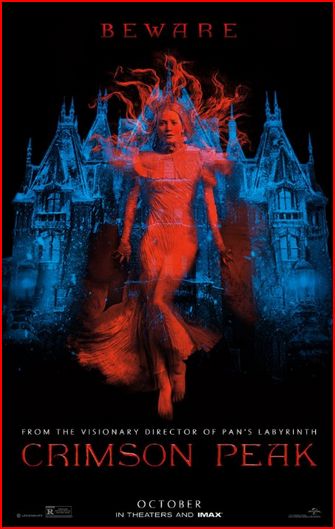
On the Big Screen: CRIMSON PEAK (2015)

 
Probably no film until At the Mountains of Madness finally happens will be first-rate Guillermo del Toro, but Crimson Peak was a mildly pleasant surprise after a week's worth of bad word of mouth. Too obviously derivative to rank with his Spanish tales, his latest film is at least a sincere pastiche of gothic film and fiction. The action appears to fall just outside the 19th century, but Peak is the director's homage to the look of that epoch, particularly as other directors have seen it. Reviewers have detected the influence of Mario Bava, and there is a Bava Ball bouncing through parts of the picture, but you underestimate del Toro if you limit his influences along generic lines. There's more Visconti (think The Leopard) than Bava in the early ballroom scenes, and Crimson Peak can be seen as an evil twin of Scorsese's likewise-inspired Age of Innocence. You underestimate del Toro if you underrate his literary influences. Peak is his self-conscious Gothic picture, and it's a surprisingly American Gothic, the first half being set in Buffalo. The heroine (Mia Wasikowska) is more someone out of Louisa May Alcott with her irrepressible blood-and-thunder literary instincts than someone from the Brontes. Thinking of her as an Alcott type, I was taken by surprise when an automobile announced that the time was more like Edith Wharton's. Del Toro and cowriter Matthew Robbins strike the right note in romanticizing her literary aspirations. Edith Cushing's courtship of Thomas Sharpe (Tom Hiddleston) coincides with his reading of her latest manuscript. Pressured by her father into renouncing her and breaking her heart, Sharpe knows how to strike; he tells Edith she's a bad writer. There's something charming about this that's more charming for taking place in a horror movie.

Rest assured, reader, that Edith is free to join her love across the ocean at Crimson Peak when her dad's head is bashed in by a mysterious assailant in his club washroom. Sharpe and his hostile sister (Jessica Chastain) live in a preposterous mansion, majestic in its isolation like The Shining's Overlook Hotel or the Benedict house in Giant, that seems not only to breathe but bleed; red clay seethes beneath the soil and the Sharpes hope to recover their family fortune harvesting it with modern machinery. Sister Lucille took a dislike to Edith back in America; at home she's the sort of complication you expect a Gothic mansion to have, and there's no more I can say about her that won't spoil the story.

Not satisfied with his pastiche and homages, del Toro strives to put his signature on the piece by making the various ghosts our heroine encounters the sort of creatures you see in a del Toro picture. Call them guillermites, if you will, and while I had to laugh at one particularly idiotic review that complained that ghosts shouldn't look like that, I must admit that the director's characteristic creations did seem a bit like alien superimpositions on an imagined 19th century. That's just a quibble, however, while the abundance of glaring clues to the truth of household arrangements past and present at Crimson Peak is a more serious weakness of the film. There's more Shining influence to be found in this film's climactic chase and combat in the snow, and in the long trek of a supporting character in order to get stabbed, while the involvement of two women in the combat arguably hearkens all the way back to The Archers' Black Narcissus, which was something of a stylistic influence on the Kubrick film. Crimson Peak is indeed rich in allusions for film buffs, but the general audience is more likely to be won over by the committed acting of the three leads, so long as they have more patience for the screenplay's novelistic pace than some reviewers have shown. I've seen several writers complain that the film is all buildup and little payoff, but I suspect that's short attention spans talking. Despite its up-to-date special effects Crimson Peak is an old-fashioned film in many ways, most of them good ways. Whatever its flaws, it's a welcome alternative to the latest found footage and other cliches that pass for horror these days, and its old-fashionedness may prove more of a virtue for Halloweens to come.

Saturday, October 24, 2015

Maureen O'Hara (1920-2015)

It's tempting to say that O'Hara was ahead of her rightful time. Watch her cut loose in At Sword's Point or Against All Flags and it's easy to imagine her today as a Katniss Everdeen or a Black Widow or simply kicking ass on a regular basis. The world could be hers -- our actual Katniss's warnings about enduring inequality notwithstanding -- in a way it could not have been, we presume, in O'Hara's heyday. Clearly she was an exceptional figure in her own time, as those films I mentioned earlier, among others, testify. Other actresses played pirate queens occasionally but O'Hara was clearly the Queen of Technicolor Action, to differentiate her from just plain Queen of Technicolor Lucille Ball, with no real rivals for her throne. She established herself as a swashbuckler before she was firmly established as John Wayne's mythic consort, and that role (sustained through five pictures) complemented her action-heroine status on the implicit assumption that only a mighty woman could stand up to, if not master, the Duke. That might and will were recognized in her last theatrical film, Only the Lonely, which closes with septuagenarians O'Hara and Anthony Quinn  thwarting an airplane hijacking. There may be an Irish stereotype at the bottom of all this, but the result was a primitive form of female empowerment. Of course, she was never primarily an action hero for fans of her time, and while her fencing prowess may be noted in the retrospectives to come you'll more likely see her wedding train lifted by the breeze from How Green Was My Valley, or watch her debate Santa Claus with little Natalie Wood in Miracle on 34th Street, and you'll certainly see a hell of a lot of John Wayne. It may have rankled her a little late in life to have to answer questions about Wayne, but Wayne's enduring relevance, along with the Christmas movie, ensures her relevance today and earns her a degree of recognition on her passing that dwarfs the parting honors this year for the likes of Lizabeth Scott or Joan Leslie. If anything, O'Hara may loom larger now than she actually was in her heyday, but there's still that nagging thought that she could have been bigger now, when presumably she could carry blockbuster tentpole movies on her own. That's presentism, of course, and as Maureen O'Hara was a creature of classic Hollywood, who can say that action-hero stardom was what she'd want? To her, today's tentpole pictures must have looked like bloated B movies, and she probably had more ambition as an actress than that. She wouldn't have wanted a career that was all At Sword's Point, I'm sure. It's fun to imagine her getting the best of both worlds, using the action pictures to bankroll what she might consider more serious acting. In the end it's all idle speculation, but I think that imagining the career O'Hara could have today testifies to the success of the career she had. You look at her then and you wish she were still around now, still in her prime, playing a lover, a fighter, or both, or anything she pleased.