Monday, June 11, 2012

DVR Diary: HEMINGWAY'S ADVENTURES OF A YOUNG MAN (1962)

 
A. E. Hotchner's efforts to film Ernest Hemingway's short stories about Nick Adams were cursed from the start. His initial effort, an October 1955 TV adaptation of "The Battler," was to have starred James Dean as the title character, a punchy boxer living in the woods.  Dean's death compelled Paul Newman, who was to have played Adams alongside Dean, to play the boxer's part, just as he would take the role of Rocky Graziano, intended for Dean, in his star-making picture Somebody Up There Likes Me. Maybe Newman alone felt Hotchner's project a lucky one. When Hotchner got the green light from Twentieth Century-Fox and producer Jerry Wald to write a feature film adapting several Adams stories into a single narrative, Newman signed on to re-create his role as "Battler" Ad Francis. But before the cameras rolled Hemingway, normally deeply skeptical of film adaptations of his work yet impressed by Hotchner's TV plays, killed himself. Bad news for Hotchner, maybe good for the studio. It gave Fox an exploitation hook, especially given the tendency to see the Adams stories as a clef tales of Hemingway's own youth. Tentatively titled "Young Man," the film was burdened with the author's name; perhaps coincidentally, the change also catered to Newman's supposed superstition in favor of films staring with the letter H. By the time the film premiered in July 1962, producer Wald was dead. The film bombed. It failed so badly that it was virtually a career killer for star Richard Beymer, who had just starred in West Side Story and was cast in the expectation that the musical would make him bankable. Martin Ritt directed and the film was handsomely shot on locations in America and Italy by cinematographer Lee Garmes. It looks great but the story is hopeless. Beymer is trapped by the bildungsroman format; whatever you think of him as an actor, the script compels him to be callow so experience can mature him -- though many questioned whether Nick had truly matured by the end of the picture.

Hemingway himself never answered, nor even raised the question, and to ask it -- to think of the Adams stories as pieces of a larger narrative puzzle that requires assembly -- is to miss the point of Hemingway's literary project. His early short stories are experiments in form. Their point is to tell what there is to tell inferentially or indirectly, without old-fashioned exposition. His object was to capture the way people actually spoke or acted without resorting to artificial dramatics, yet allow the discerning reader to fill in why the characters say and do what they do by recognizing the emotional truth in his prose. To elaborate on what Hemingway had written as if that was necessary to clarify what he was writing about is to defeat his purpose. From what I've read about the film project, Hemingway was under the impression that Hotchner would film the stories as a sequence of stand-alone vignettes, as they exist in print. Adventures of a Young Man does more than that, importing elements from the non-Nick novel A Farewell to Arms and some stuff made up by Hotchner to give us an Adams toughened by hard work, war and loss to the point when he can finally cut the apron strings and leave home for good. None of this is necessarily inconsistent with what Hemingway actually wrote about Adams, but filling in the blanks is inconsistent with why Hemingway wrote about the boy.

But if Hotchner, Ritt or the studio betrayed Hemingway, did they still make a good movie? Not quite. Beymer can't help being overshadowed by his guest stars, not just the showboating Newman, who plays the Battler as if he'd taken real blows over multiple takes of the Graziano picture, and for years since then, but also a bombastic Dan Dailey as an alcoholic, addicted advertising man. Newman's screen time is disproportionate to the length of "The Battler" (he and Hotchner were longtime pals and business partners) and its place in the Adams canon -- he also gets to speak a famous line from To Have and Have Not, "a man alone ain't got no damn chance," --  and his and Dailey's performances give an inaccurate impression of the Adams stories as a parade of passing eccentrics. Even if his co-stars had toned down the character acting, Beymer would probably be outmatched, but he makes more of an effort than is usually recognized. Again, the script sabotages him, so that Nick seems to grow more petulant rather than more mature. The war stuff and the Farewell to Arms do-over, with Susan Strasberg as the doomed nurse, are fatal to the picture because of their misplaced familiarity. The whole thing feels padded due to Hotchner's obligation to touch a certain number of Hemingway bases along with the extra material. That is, the excesses that hurt the film as a Hemingway adaptation cripple it as a conventional movie. In any event, time had passed Hemingway by. 1962 was a year when the most bankable literary name on a marquee was Tennessee Williams. It wasn't Hemingway's world anymore and hadn't been for about a decade. He'd known that and raged against it because he couldn't keep up and the whole period look of this movie only proved the point, I suspect. If Adventures of a Young Man was meant as a cinematic monument to Hemingway, it did succeed somewhat, because it sometimes feels like you've entered a house of the dead.

If anything, the trailer makes the film look duller than it actually is. SarBear4Ryan uploaded this copy to YouTube.

Sunday, June 10, 2012

On the Big Screen: PROMETHEUS (2012)

A fellow pedestrian recognized me as a fellow moviegoer by the soda I was slurping on the way back from the theater. "Did you just see Prometheus?" he asked me. When I answered yes, this was his review: "It wasn't scary! I figured, Alien, a horror movie. But I guess not." That's probably why Ridley Scott and his cohorts were coy about their new film's exact relation to his 1979 classic tentpole. They weren't making the same kind of horror film as that. This time Scott aspires to philosophical horror in a way that led Guillermo del Toro to despair of ever actually adapting H. P. Lovecraft's At the Mountains of Madness. He fears that Prometheus will make his project seem repetitive, but if I were him I wouldn't give up. Scott finally pulls back from horror, after all, and in spite of the film's inevitable teaser finish, leaving that field to someone working closer to Lovecraftian mode. Prometheus closes -- or virtually closes -- on a note of defiance rather than despair, affirming the special qualities of humanity rather than its insignificance. But I'm getting ahead of myself.

Prometheus manages to feel like a throwback, as a prequel should, and in spite of special effects that can't help but make this time's technology appear anachronistically superior to Alien's era, thanks to its indulgence of the sort of ancient-astronaut mythology that was trendy back in the 1970s and seems conveniently to be popular again, judging from the success of Ancient Aliens and similar TV atrocities. After a prelude, the story proper opens, and Scott acknowledges the influence of Werner Herzog, with the exploration of caves on Earth. One such cave sports paintings very like those Herzog filmed (in 3-D) in Cave of Forgotten Dreams, with the added element of an apparent star chart matching those found at digs all over the world. Pitching this discovery as proof that human origins can be traced to a world in a cluster matching the one in the cave-painting, Drs. Elizabeth Shaw (Noomi Rapace) and Charlie Holloway (Logan Marshall-Green) manage to get funding for a space expedition from an archetypal supercorporation with shadowy motives, represented on board the Prometheus vessel by Meredith Vickers (Charlize Theron), of whom the captain (Idris Elba) plausibly if teasingly asks, "Are you a robot." Perhaps I shouldn't answer, but it's no secret that David (Michael Fassbender) is. He runs the ship, acting like Hal and Dave Bowman in one person, until it's time to wake everyone up after two years in stasis. Vickers asserts her authority but the crew and the doctors have minds of their own. You know they're going to contact something or else there won't be much of a movie, and you know they're going to contact something dangerous or else it still wouldn't look like much of a movie to most people. So much for the spoilers.

If my fellow viewer felt that Prometheus wasn't a proper horror movie, he shouldn't have been surprised. In our time Scott had to make more of a roller-coaster ride movie than he did 33 years ago, so we get sight-gag set-pieces like heroes racing a dust storm or racing to get out from under a falling spaceship. The most physically horrific scene in the picture, most people seem to have decided, isn't an attack on anyone but one in which Dr. Shaw subjects herself to a robotic Cesarean section; this being a movie, she can run from the operating theater, albeit on massive pain-killers, within about a minute of being sutured. I concede, however, that she had good reason to run as fast as she could. There's actually very little in the way of Alien-style attacks, and in tone the new Scott films sometimes seems more reminiscent of James Cameron's Aliens than Scott's own precursor. But Scott does want to scare us, only with scary thoughts rather than conventional scares.

The main thematic thread of the picture is Dr. Shaw's crisis of faith. It's not a conventional crisis, since her Christian faith isn't very troubled by her hunch that life here began out there. Faith itself is the issue, not the objects of faith. Shaw says she's guided by faith in our alien origins as mapped by the cave painting, while she and her boyfriend Holloway are driven by a desire to meet and talk to the beings they believe responsible for human life. About this Hardwick could not care less, while David the "robot" seems skeptically bemused by the doctors' yearning. David and Shaw represent two extreme points of view in a debate carried to the end of the film, if not beyond. Shaw wants to meet our creators because she has questions to ask. By the end of the movie she has different questions, but she always insists on answers. The most crucial question, which I need not phrase in full, is "Why?" Without a "why," she's no better than the humans presume David to be in his knowledge that humans made his kind "because they can." It's presumed that David would be disappointed is he was capable of disappointment, but he seems to labor under something arguably worse than disappointment. His problem may be that he too readily accepts "because they can" as a satisfactory if unimpressive answer, while the human condition, embodied by Shaw, refuses to be satisfied with that explanation despite this story's damning evidence. For the Holocaust survivor Primo Levi, the defining statement of the concentration camps was a guard's remark that "there is no why" there. But humanity insists on a why, or at least that's what Scott, John Spaihts and Damon Lindelof believe -- and their belief takes them beyond the Lovecraftian presumption that the human spirit would buckle under cosmic knowledge. Faith, it seems, is the belief, if not the demand, for "why." The fact that the human quest for "why" will apparently continue, however hopeless it seems by the end and however motivated now by anger rather than hope, finally establishes Prometheus as science fiction rather than horror.

The script overplays its hand a bit by introducing one too many generational conflicts to illustrate David's assumption that everyone wants to destroy their parents, and the movie suffers from the common blockbuster syndrome of multiple-climax fatigue, also known as not knowing when to end. But Prometheus maintains thematic integrity despite its messy resolution, and it is a pretty picture no matter how you see it. Scott makes some of the best use of 3-D I've seen since Herzog's documentary, though that film still sets the standard for me. Even if you see the film flat, I expect you'll be dazzled by the cinematography Dariusz Wolski, a talent liberated from toiling for the Pirates of the Caribbean for most of the past decade and apparently enjoying his freedom. There was probably no way this film could live up to some people's expectations for it, by it's a pretty good picture on its own terms, at least most of the way -- and that's more than a lot of moviemakers can say these days. Alien may be Prometheus's sequel by default, but the new picture left me wondering what an actual sequel -- a lonely quest for "why" across the cosmos -- would be like. Consider that a thumbs-up in spite of everything.

Friday, June 8, 2012

Now Playing: JUNE 8, 1962

Miami introduces movie fans to neophyte film director Francis Ford Coppola.

The second feature, Affair in Kamakura. is also known as Juvenile Jungle but is best known today as Crazed Fruit, a film in the Criterion Collection. How's that for prestige?
In Reading PA, an English prison picture directed by an expatriate American premieres.


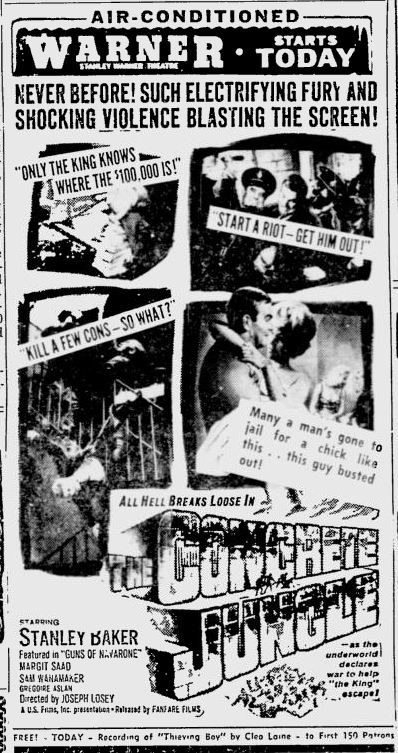
In its native Britain Joseph Losey's film is plain and simply The Criminal, but Americans seemed to think that a movie sold better if you called it "The [blank] Jungle." Note how the ad reaches for any sort of exploitation angle, from the reminder that one of the actors here appeared in The Guns of Navarone, the previous year's most popular movie, to the promise of a free record to early arrivals. "Thieving Boy" was the film's theme song, and here's what the people heard on screen, thanks to TCM.


Next, another film from Britain opens in Pittsburgh amid a blizzard of blurbs.


The picture did win a bunch of BAFTA Awards, and Rita Tushingham won a prize at Cannes, and it is ranked as one of the 100 greatest British films, so I suppose those reviewers must be on to something.

Finally, this happened in Dubuque IA.


Mansfield's role in this comedy about the 1896 Olympics is actually relatively small, according to Wikipedia, but who are all those other people, after all? Let's close with a clip of her in action, uploaded by bachflat.

Thursday, June 7, 2012

DVR Diary: INSIDE THE MAFIA (1959)

A dramatic sequence of events in the fall of 1957 made the existence of a national Mafia more difficult for public officials to deny. Reports of the barbershop assassination of Albert Anastasia and the police raid on an apparent crime conclave in Apalachin, NY, whetted appetites for more information about the shadowy crime organization. But before Joe Valachi's 1963 testimony before a congressional committee very little was known about the institutions and inner workings of the Mafia. Into the breach stepped the Premium Pictures company, screenwriter Orville H. Hampton and director Edward L. Cahn, who released Inside the Mafia in 1959. Cahn was a Poverty Row visionary with a vast filmography of hackwork and a handful of primitively prescient pictures. His sci-fi film It! The Terror From Beyond Space has been recognized as a precursor of Ridley Scott's Alien, while the mindless marching masses Cahn directed in Creature With the Atom Brain and Invisible Invaders anticipate the zombie attacks of George A. Romero's films. Does Inside the Mafia similarly anticipate The Godfather and the mafia genre that followed Francis Coppola's film? The answer is a flat no. Working apparently from utter ignorance of the actual Mafia, Cahn and Hampton can't hope to approximate the ritual dynamics and familiar intimacy of post-Valachi movies. Instead, Inside is strange not in any premonitory way but as a work of crass naivete, and insulting in its pretense of telling the true story of the events leading to the Apalachin conference. The tone is set from the start when Apalachin is redubbed "Apple Lake," while Anastasia is replaced in the fatal barber chair by one Augie Martello (Ted de Corsia), who does not die, at least not right away. Secreted from an insecure hospital to a safe house, Augie lives to give his blessing to a plan of his lieutenant Tony Ledo (Cameron Mitchell) to take over the entire national crime organization. Ledo's idea is a decapitation strike against the long-exiled mastermind Johnny Lucero (Grant Richards) -- whacking him when his plane lands at the Apple Lake airport. Lucero is an amalgam of real-life boss Vito Genovese and the already-legendary Lucky Luciano, whose stature as an exile longing to return to America haunts a number of postwar crime films. For Ledo's plan to work, he must take control of the little airport. That means taking the man who runs the place and his family hostage, making them operate as if nothing is wrong so as not to alarm Lucero or anyone else. Instead of a Mafia expose, the picture becomes a rip-off of Suddenly, the picture in which Frank Sinatra takes a household hostage so he can shoot the President from their window. The imperiled family and their unlucky friends are a dull lot, but the gangsters are hardly less dull. The often manic Mitchell, here at the tale end of his peak period of Hollywood stardom and on the verge of a more productive sojourn in Europe, brings little to his role, while Robert Strauss (best known as Animal from Stalag 17) contributes most of the violence, including a few karate chops. The plot twists when Ledo learns from the TV that Augie has finally succumbed to his wounds. His plan takes a 180 degree turn; he now intends to convince Lucero that he's the man best qualified to run the organization in Lucero's name. His ploy seems to work, but there are a few twists left in the tale, while the hostages strive to free themselves, knowing that they must die otherwise. Everything ends in an Apple Lake bloodbath that the film claims "actually happened." Don't you believe them. Their claim is as viable as Criswell's at the end of Plan 9 From Outer Space, and their film is far less entertaining from that one. Inside the Mafia is exploitation of the worst time, completely lacking in inspiration and seemingly guided by the assumption that once their title had you hooked, they owed you nothing more. That kind of filmmaking ought to be a crime.

Wednesday, June 6, 2012

Now Showing: JUNE 6, 1962

If I've seen one thing so far in my survey of 1962 that I didn't expect to see, it's the phenomenon I call Cleosploitation -- the exhibitor strategy of exploiting the gossip surrounding the affair of Elizabeth Taylor, then married to Eddie Fisher, and Richard Burton on the set of Cleopatra, a film still a year from opening, by showing a double feature of one Taylor and one Burton film. As I've remarked before, the gimmick must be working because theaters keep using it. Here's the latest example I've found, from Eugene OR.


That "Roman Threesome" tag makes the gimmick more salacious than ever. But my hunch about this whole trend is that it takes advantage of fresh curiosity about Burton, who'd been knocking around Hollywood for nearly a decade, most notably in The Robe, without really becoming a big name until Taylor made him one. Something like Ice Palace just might make more money in this market then it did when Warner Bros. pushed it as "The Motion Picture Giant of 1960."

But on to more conventional exploitation. This title, advertised in Hendersonville NC, probably promises more than it can deliver to the imaginative reader.


Veteran B-western actor Russell Hayden directed (for the only time in his career) this comedy about a Caribbean revolution defeated by sex. Even that description promises more than this picture is likely to deliver. But why not judge for yourselves? The film's in public domain and you can watch it on YouTube here.

Now for some adults-only fine-art cinema from Milwaukee.


Jean Seberg was a known quantity for Americans both for Otto Preminger's attempts to make her a star and Jean-Luc Godard's arguable success on another front with Breathless. Here she headlines a Philippe de Broca romantic comedy. De Broca's name would come closest to meaning something to Americans following the release of King of Hearts later in the decade. I have no clue about the meaning of the rabbit.

Things get just a little sleazier in Toledo.


It was rumored at one time that Ed Wood had a hand in this screenplay, but this authority finds little evidence for the claim in a purportedly dull J.D. picture. We have a trailer for this one, courtesy of captbijou.


Finally, in Pittsburgh, ...well, the fruit is ripe!


From France and writer-director Louis Solanes comes this drama of competing passions among seasonal fruit pickers. The more literal translation of the actual title, if you can trust Google with such matters, is "The girls sow the wind," which would seem to promise a sequel, "The girls reap the whirlwind," or in American, The Fruit is Rotten. But seriously, this was Solanes's first film as a director. Though still living, he hasn't directed another, says IMDB, since 1970's Africa Erotica. Star Scilla Gabel may have been familiar to Americans for a number of films ranging from Tarzan's Greatest Adventure to Mill of the Stone Women. But she wasn't enough of a name to be included in the ad. The content rather than the cast mattered most, I suspect, for the target audience.

Happy D-Day, everyone!

Tuesday, June 5, 2012

DVR Diary: LADIES THEY TALK ABOUT (1933)


Ladies: proper prison etiquette dictates that you not slap Barbara Stanwyck in the course of your petty disputes, because she will punch you in the face. That's one of the lessons learned in this Warner Bros. collaboration between directors Herbert Bretherton and William Keighley. If Ever in My Heart offered the Pre-Code public a new, goody-good Stanwyck, Ladies They Talk About is the good old bad Stanwyck, the same one that made the now-legendary Baby Face later in 1933. Here she's Nan Taylor, an unrepentant gun moll who puts on an act to give her gang an in at a bank. The gang (led by Lyle Talbot) gets the loot and gets away, but Nan has to stay behind to finish her innocent act. Unfortunately, one of the investigating officers recognizes her as a hardened crook and takes her in. Her looks make her a newspaper cover girl and attract the attention of moral crusader David Slade (Preston S. Foster), who calls for a crackdown on crime from his revival pulpit and on the radio. Turns out he and she are old school chums, she a renegade parson's daughter. He thinks she can reform and appeals for her to be released into his custody, but she makes the mistake of admitting to him what she wouldn't admit to the cops. He promptly rats her out and dooms her to a term in prison. 

Nan's place of confinement sometimes seems more like a girl's dormitory than a women's prison. The convicts are allowed to decorate their rooms as they please -- as long as they don't make an opening to the outside. Nan's fellow cons are an eclectic bunch, from a cigar-smoking butch lesbian who impresses her cellmate with her constant exercise to an aristocratic murderess who thinks of the others, especially a black prisoner named Mustard, as her servants. Playing Mustard, Madame Sul-Te-Wan has a great scene in which she chews out this biddy with a ferocity unusual for a black actress even in this period -- only for the effect to be ruined when a guard frightens Mustard with her pet cockatoo. Nan's main antagonist among the prisoners is Susie (Dorothy Burgess), who has an obsessive crush on David Slade and listens to him on the radio every night. Nan makes trouble for herself by shutting the radio off without permission, since she can't stand the sound of Slade's voice. It's Susie who learns the lesson cited above first hand; Nan floors her with one punch, and afterwards can intimidate her simply by making a fist. Stanwyck is never so close to being a female Cagney and the hard-boiled equal of Warners' gangster stars as she is here.

Slade still pines for Nan and writes her letters that she tears up contemptuously until she finds a way to use him. Learning that Talbot is in jail himself, she works up a plan for a joint breakout, part of which involves using Slade as an unwitting courier of a paper outline for an all-important prison key. Unwittingly enough, Slade mails the letter, but Nan doesn't know that her outside collaborator has himself been arrested. The letter is forwarded to prison and opened by the authorities, exposing the plot. Talbot and a partner are killed making a break, while Nan is doomed to finish her full sentence seething with fresh hatred for Slade, whom she assumes opened the letter and ratted her out himself. Finally free, she plans a mortal revenge, setting up a suspenseful climax that the directors botch. Nan goes to Slade's revival hall with a gun and heads to the anxious bench with the other penitents. It seems as if she intends to shoot him as he blesses her, and the film builds tension nicely as Slade works his way toward her while Susie, freed earlier and now working for Slade, watches with alarm and the chorus sings "Almost Persuaded." The climax should come here, one way or the other -- but the tension starts to dissipate as Slade recognizes Nan and invites her into a private room. It seems like this is what she wanted, because she has a more theatrical revenge in mind, though one not designed for play before a live audience. Her plan is more theatrical because it's more corny. She shows Slade a photograph of herself with Talbot and the other dead con, neither of whom the reformer knows. But she wants him to know that they're the reason why he's going to die. Suspicious Susie eavesdrops through a keyhole but does and says nothing until Nan has levelled her weapon and fired. Then she runs for help while Nan, her violent passion spent, immediately repents of wounding Slade in the arm. He immediately forgives her, and by the time Susie returns with some cops Slade is proposing to our antiheroine. Since bloodless wounds are the rule even in Pre-Code, no one notices that Slade has been shot, and Susie the eyewitness is disposed of with some trickery that convinces the cops that she couldn't have seen anything. The situation begs for a sequel in which psycho Susie seeks revenge on Nan, but Warners wasn't into sequels unless you count Gold Diggers of 1935, of 1937, etc. But even though Keighley and Bretherton waste opportunities on an anticlimax their closing stumble doesn't debase the entertainment value of their picture very much. If Baby Face is Stanwyck in apex-sexual-predator form, Ladies They Talk About is Barbara at her hard-boiled swaggering best. Don't expect much realism here; this picture is closer to classical, authentic pulp fiction come to cinematic life. If that idea appeals to you, so will the movie.

Warners knew that a brawling Stanwyck was a highlight, so they threw her punch into the trailer, provided as usual by TCM.com.

CHRONICLE (2012)


To the extent that Josh Trank's tale of teenagers with superpowers is part of the currently fashionable "found footage" genre, it's an abject failure -- and that's almost cause for relief. At no time are you convinced that you're actually seeing the story through the lens of a kid's video camera; the cinematography, the lighting, the framing are simply too good -- too professional. To maintain the premise that everything we see is something somebody filmed, Trank and writer Max Landis have to introduce an otherwise pointless character -- she eventually gets to be an archetypal damsel in distress -- who, like one of our three protagonists, obsessively records everything. For the big climax they give up any pretense that the story comes to us from one or two points of view, giving us a montage of news footage, security cameras, anonymous video footage, etc.  Trank could just as well have simply shown us some characters toting cameras -- maybe as an ironic commentary on the found-footage craze, and filmed his story as a conventional narrative, since he has little to say on the recording compulsion apart from suggesting that the camera is a metaphorical wall between the recorder and his subjects. This seems true for Andrew, the misfit of our teen trio and the film's eventual supervillain, but is it true of Casey, the video girl who befriends Matt, Andrew's cousin and eventual superhero?


In any event, that question fades as the film becomes less about the recording compulsion and more about an inevitable reenactment of superhero tropes, and as a whole the film is better off whenever it comes closest to shrugging off the found-footage gimmickry. Chronicle is the rare film of which I can say that it should have been in 3-D, but wasn't. Its most spectacular moment comes when Matt and Casey are driving through scenes of telekinetic chaos in the streets of Seattle, only to have their car lifted high into the air and left floating near the tip of the Space Needle as Andrew appears to menace them. The scene is shot from inside the car and the effect achieves the immediacy and spontaneity that found-footage movies aspire to -- but it would have worked just as well without the pretense that Casey is carrying a video camera throughout the experience.


Trank's pretentiously generic title tells us that he plans to play with archetypes even as he plays at realism. He and Landis give us an origin story for his teen trio involving an alien artifact and a vague transmission of energy and power. As with M. Night Shyamalan's Unbreakable, the culmination of the story is the emergence of a supervillain. In Chronicle's case, despite a mythic warning against hubris, the villain is driven not by greed or ambition but by a pile-up of petty hurts and hatreds. Andrew lives a wretched life with an alky dad on disability and a dying mother whose expenses are bankrupting the family. He's a defensive loner and despite his pals' urging that he take advantage of his new powers to make himself cool -- the effort seems to pay off at a talent show were he passes himself off as a magician -- his awkwardness is incorrigible. His road to moral ruin starts when he pukes on the brink of his first sexual experience. To compensate, he envisions himself as an "apex predator," a Homo superior if you will, though he comes across more like a Columbine shooter. Unfortunately for the picture, Dane DeHaan, the actor who plays Andrew, can't transcend the character's predetermined nature or the script's confusion over whether we should pity Andrew for his miserable background or despise him as a loser at heart.


Like Spider-Man becoming a professional wrestler, Andrew uses his powers for petty personal gain.


When Strikes the Fireman!


Chronicle's climax leaves the actors hanging, not the audience.

Chronicle rises or falls on its illusion of a superpower breakout in the real world. But the effect of its effects are inconsistent. The big fight scene over Seattle often looks just as a superhero fight should; the folks at Marvel Studios should take notes against the time when they can't just have the Avengers fight another horde of anonymous alien war machines. Long shots of bodies hurtling through the air are also queasily evocative of the September 2001 terrorist attacks, but if this film didn't evoke 9/11 it would be missing both an opportunity and part of its own point. Yet while bits like the car's predicament in the sky are highly effective, some effects are downright poor. Many of the flying scenes self-evidently involve actors dangling from cranes; there's a difference between floating and dangling, but this film's crew didn't figure that out. Meanwhile, one moment may feature brilliant camerawork, and another will have the actors dangling on an obvious soundstage in front of an obvious two-dimensional backdrop. Times like those make it hard to endorse this movie, but Chronicle has a primal energy in its best moments and enough visual imagination at its most inspired to make it worth a look, though more for superhero fans than for found-footage fetishists.