Wednesday, August 8, 2012

The Marienbad Look: NOW PLAYING, AUG. 8, 1962

How does a Reading PA theater promote one of the most enigmatic of highbrow art films? With a fashion show!


Does it seem crass? Perhaps we should judge by how many people it lured to the movie -- if we can find that out.

Stanley Kubrick's Lolita aspires to be the scandal-film of the season as it rolls out across the country. We've already seen the soft-sell "How did they make a movie of Lolita?" campaign, but for the film's arrival in Schenectady NY the advertising appeals to authority with blurbs aplenty.


If Lolita is one idea of a summer movie, here's another, opening in Daytona Beach. Like many a summer picture of our time, this one is a remake, of a sort.


Here's a hint of "that Elvis kind of action," uploaded to YouTube by enoplos.

Another summer picture opens in Spokane. This, too, may remind you of a movie that opened fifty years later.


Check out the trailer, uploaded by MovieViewerMan.

And here's the co-feature:

No immediate comparison comes to mind here.

Monday, August 6, 2012

DVR Diary: BRITISH AGENT (1934)

R. H. Bruce Lockhart had a dramatic diplomatic career that became the makings of a movie drama when he published his Memoirs of a British Agent in 1932. Warner Bros. bought the film rights and had Laird Doyle write a script for Michael Curtiz to direct. Lockhart had been sent to the new Soviet Union in 1918 on a forlorn mission to keep the Bolshevik state in the war against Germany. He was eventually arrested and accused of conspiring to kill V. I. Lenin, only to be released in a spy exchange. Needless to say, Warners elaborated on this. In real life, Lockhart fell for the widow of a Russian diplomat of the old regime. Not dramatic enough. Why not have the movie Lockhart, called "Stephen Locke" (Leslie Howard) fall in love with a revolutionary instead? Star-crossed lovers and all that. So Locke meets cute with Elena (Kay Francis) when she strays onto diplomatic property trying to escape a Cossack she'd shot at during a riot. Since she's a revolutionary, why not make her part of the government after the Revolution takes place? That way she can be torn between her love for Locke and her love for her country and its new government. Thus she betrays his confidence as he negotiates with the Soviet leaders by letting them know that he has no actual authority to fulfill promises made to them. Events gallop beyond his control anyway; "the Soviet" concludes a peace with Germany and the British land troops in Russia to spark a counterrevolution. As in life, Lenin is shot, though for dramatic purposes he is more gravely injured, falling into a coma. As the arch-revolutionary fights for his life, his cohorts call for harsh measures -- "call it terror if you will," one says -- to suppress the White armies of the counterrevolution. Locke and his diplomatic buddies -- a gum-chewing American (William Gargan), a card-sharp Italian (Cesar Romero) and a young Frenchman (whoever) -- are trying to smuggle arms to the Whites, but the net is tightening. The non-anglophones are shot down and the American is captured and tortured. He won't give up Locke, but Elena convinces him to tell her so she can tip Locke off. Instead, she resolves the contradictions of her career by ratting Locke out, but meeting him in advance of the attack so she can die with him. But wait! At the last possible moment, Lenin wakes from his coma. Lenin will live! And his first words upon waking are "Stop the terror!"

You heard me. It'd be a moment of high camp if so many people wouldn't refuse to find it funny. It exemplifies the way British Agent bends over backwards to be evenhanded in its account of the Bolshevik Revolution. It's really an apolitical film -- certainly an unideological one. The Bolsheviks aren't recognizably "totalitarian" here; the movie takes their demands for peace and bread for the poor at face value, which is fair to a certain extent. One reason for the delicate approach may have been that some of the participants were still living. That requires some name changes. Instead of Alexander Kerensky, the Provisional Government that ruled between the fall of the Tsar and the Bolshevik coup is led in the movie by a fictional "Kolinov." J. Carroll Naish is easily identifiable by his fake hair as Leon Trotsky, also living in 1934, but his character is referred to only as "Commissioner for War." A couple of characters look like Josef Stalin, but no one is called by that name. So it's not quite the Russian Revolution we've grown familiar with in more than one sense. A difference in attitude would come shortly, as you can tell by comparing British Agent with Ernst Lubitsch's Ninotchka, released five years later. That film, a product of European imagination (Billy Wilder wrote it), famously portrays Soviet Woman as de-sexed, humorless, nearly soulless, someone who sacrifices her humanity, or at least her femininity, for ideology's sake. Kay Francis, however, is no Greta Garbo. Her Elena is passionate, violent (at least initially) and incorrigibly romantic. There's no suggestion that she's had to sacrifice her womanly nature to fight for the revolution or help govern the new state. If she seems unconvincing in her role, -- and she doesn't really live up to her first gun-toting appearance -- she's probably more so now than when the movie came out, as long as the emotionless-Commie archetype still prevails. The more romantic idea of a revolutionary still had an audience before Stalin gave revolutionaries in general a bad name. British Agent may be seen as an artifact of a more naive time -- that "stop the terror" line can only inspire bitter laughter from those who know their history -- but it's essentially a film about a revolution, not the tyranny that followed. In keeping with the anti-war mood of the Pre-Code era when the film was made,-- it was released under the Code Enforcement regime in the fall of 1934 -- the film can't get too worked up over the Soviet refusing to stay in that stupid war, and who can blame it? In any event, all those issues don't amount to a hill of beans compared to the love of two people, which shows that, despite its vaunted sophistication, Pre-Code was a simpler time in some ways after all.
Warners (here using their First National alias -- check out that FN shield!) insisted on calling Lockhart's book a novel. Here's how they pitched British Agent to 1934 audiences, as preserved by the ever-reliable TCM. com.

Sunday, August 5, 2012

DVR Diary: THE GOLDEN ARROW (La freccia d'oro, 1962)

It took five credited writers to give Antonio Margheriti something to film while he had the services of fast-declining star Tab Hunter -- who as it happened, had already filmed an episode of his short-lived TV series with the "Golden Arrow" title -- but more than five writers deserve credit for what we see on screen. Add to the official list of five Italian scribes the names of Lotta Woods, Achmed Abdullah and Douglas Fairbanks Sr., since La freccia d'oro is for the most part a remake of Fairbanks's epic fantasy, Raoul Walsh's The Thief of Bagdad. In short, a rogue with a noble heart competes with three princes, one an unscrupulous conqueror, for the hand of a princess. While the rogue embarks on a quest, the princess tasks the princes with finding the rarest of treasures. They find what their counterparts found in 1924: a crystal ball, a flying carpet and a magic cure-all. The most militant of the princes conspires to take Damascus and the princess, but our hero saves the day with his own hard-won magic. Instead of a winged horse, the Thief of Damascus, clean-shaven Hassan (Hunter) has the title weapon, briefly at first and more decisively later. He wins it initially as the one contestant who can pull a heavy bow -- it's apparently a birthright -- but loses it because he meant to use it for selfish purposes. His quest to retrieve it is his atonement for various deadly sins of attitude. He has help, in this film's major deviation from the Fairbanks story, in the form of three comedy-relief genii, one old and bossy, one rather stupid and clumsy, the third rotund but otherwise nondescript.  They ground the Italian fantasy (which wasn't released in the U.S. until 1964, by which time Hunter's stardom had dimmed still further) as a kiddie picture and finally subvert whatever chance Margheriti and an ambitious art-direction and effects team to make a fantasy film worthy of its American model.


Margheriti took a long time shooting La freccia -- a contemporary news report marked six months that Hunter had spent on the production -- and the locations were worth the time spent locating them. A lot of the film was shot in Egypt at authentic ruins that give the picture just the sense of epic grandeur it needs without spending too much money on sets. When sets and effects are needed Margheriti's team goes to town. The highlight of their work is a hair-raising scene when Hassan visits an underground kingdom, is condemned by its queen for trespassing, and is chased by men on fire. Throughout, art director Flavio Mogherini and set designer Massimo Tavazzi keep things vivid and lavish. They still try hard when they fall short; their flying-carpet effects aren't much of an advance over Walsh's work and they end up skipping what seemed to be set up as the film's big finish: a fight between carpet-borne enemies. They're at their worst when the film becomes most childish. In the Fairbanks Thief of Baghdad, the hero summons an armed multitude to fend off the villains' attack. In Golden Arrow Hassan can use his weapon to dismantle the enemy's weapons, from bows to catapaults, and to tear a flying carpet apart in strips, but most of the damage is done by the three comedy genii, who rout the invaders by gathering up a lot of ash-filled urns and dropping them on soldiers' heads. While we see impressive airborne shots of two armies clashing, the hero and his buddies turn the tide without killing anyone. Even the evil prince and his traitorous ally are dispatched by dumping them into a pool of oil once their flying carpet goes to pieces. We leave them trashing about in frustration; whether anyone bothers to capture them remains a mystery.

Add Gabor Pogany and Giovanni Raffaldi's cinematography to the mix and Golden Arrow is nearly always ravishing to look at in a proper widescreen presentation. Listening to it is another story. Hunter didn't stick around to dub in his own dialogue, and the usual flat dub work by voice actors overfamiliar from countless peplum movies deprives the film of much of the verve and flamboyance it needs. The same goes for Mario Nascimbene's score, likewise overfamiliar in its repetition of too-familiar peplum motifs.  A lot of trouble was taken to finally make this picture sound like just another imported B movie. Margheriti might have been better off had he, like Douglas Fairbanks, made a silent film. Instead, Golden Arrow is an often attractive spectacle that ends up being less than meets the eye.

TCM showed it last week, and TCM has the trailer -- now so do you.

Friday, August 3, 2012

Depression Fighters: THE PRIZEFIGHTER AND THE LADY (1933) and CARNERA THE WALKING MOUNTAIN (2008)

When I first saw Wilson Yip's martial arts biopic Ip Man (2008), the film's backdrop of economic deprivation during the 1930s immediately reminded me of Cinderella Man (2005), Ron Howard's Depression-set biopic of boxer James J. Braddock. If three films make a genre, then Renzo Martinelli's 2008 biopic consolidates a global "Depression fighter" genre and simultaneously achieves the genre's reductio ad absurdam. If, after watching Ip Man, I had concluded, "Any country can do this!" I would have balked at Italy's turn. That country's combat-sport hero of the era was Primo Carnera, a figure for whom the "print the legend" approach probably isn't an option. The legend of Primo Carnera, after all, is that he was a fake, a bum, a talentless lummox whose path to the heavyweight championship was paved with fixed fights and whose reign ended the moment he met a real fighter in a real fight. The legend was locked in place by the 1956 movie The Harder They Fall, which didn't fool Carnera by making its dumb-ox patsy a South American, yet casting Carnera's real-life nemesis Max Baer as the fighter who destroys Humphrey Bogart's hapless protege. Carnera reportedly sued the producers for defamation, but another half-century would pass before anyone attempted a cinematic rehabilitation of the fighter's reputation. In Martinelli's account, Carnera (Andrea Iaia)is a guileless giant who can and would fight for real and takes offense when his initial manager (F. Murray Abraham) pays his first foes to take dives in order to protect his novice prospect. That Carnera could do real damage is indisputable; at least one opponent died after fighting him. While some historians suspect that the fix was in when Carnera beat Jack Sharkey for the crown in 1933, The Walking Mountain (a mundane rendering of his more alliteratively lively nickname, "the Ambling Alp") portrays the fight as an honest triumph for its hero.


Walking Mountain stresses how Carnera inspired pride in Italians and Italian-Americans (and spared his children the poverty he suffered in childhood; an epilogue notes that two junior Carneras grew up to be doctors) but avoids engagement with the political implications of that fame. Martinelli doctors newsreel footage to show his Carnera alongside Mussolini and has the actor give the Fascist salute in the ring, but these are just matters of period detail for the director -- one wonders how the dreaded Uwe Boll handled the political angle in his 2010 Max Schmeling biopic, for comparison's sake. Carnera suffers, I think, from ignoring politics simply because there has to be a political context in the global boxing ring when Carnera, representing Fascist Italy, Schmeling, representing first Weimar and then Nazi Germany, and Max Baer, a Jewish-American who wore the Star of David on his trunks, all wore the championship belt. I'm not saying poor naive Primo has to answer for Mussolini's crimes, but I do feel that the political drama of the period would add to the drama of the fights, as it does when filmmakers contemplate the rivalry of Schmeling and Joe Louis. And Walking Mountain can use all the dramatic help it can get. Martinelli doesn't do a very good job with the fight scenes. His staging of the Carnera-Sharkey fight is less dramatic than the actual newsreel footage. In filming the climactic Carnera-Baer bout he falls between two stools, unable to decide, it seems, whether Rocky or Raging Bull should be his model. The beating Carnera takes at Baer's hands ought to be a moment of supreme comeuppance, like Jake LaMotta's last fight with Sugar Ray Robinson in the Scorsese film, but Martinelli is incapable of investing the action with anything like Raging Bull's thematic force, much less Scorsese's expressionistic exaggerations. In part that's because Martinelli wants to emphasize Carnera's courage and perseverance under extreme adversity as the champ struggles to fight with an injured ankle while Baer gets away with all manner of dirty tactics. Nor, despite some scenes when Carnera is mean to his wife, do we get the feeling that Primo has this beating coming, especially since we understand him to be innocent of all the chicanery that advanced him early. Overall, Martinelli seems more interested in making a period piece by artificially aging or decolorizing his footage than in making his story more than a collection of fight-film cliches. But he doesn't even get the period right all the time. One anachronistic scene shows the filming of a TV preview of the Carnera-Sharkey fight of 1933 -- a year when TV was still almost purely experimental.

One angle Martinelli might have worked was whether fame went to Carnera's head. It would have been interesting, given the importance of Carnera's rivalry with Baer, had Martinelli done something with the two fighters filming W. S. Van Dyke's The Prizefighter and the Lady in Hollywood before their title fight. In the M-G-M production, Carnera plays himself as the heavyweight champion, while Baer plays a toned-down (and anglicized?) version of himself as "Steve Morgan." Reportedly, Baer was so impressed with himself as an actor that he wore Steve Morgan's robe to the ring for his real fight with Carnera, months after they filmed a kind of pre-enactment of the battle for the movie. Baer was already considered the top contender after having KO'd Schmeling, and Prizefighter has to be considered a unique instance of using a fictional film to promote a real-life fight. In fact, the film plays out like a Bizarro-world version of the historic bout, with Baer's Morgan taking a massive beating at Carnera's hands as a kind of Scorsesean comeuppance for the fictional character's arrogance and his betrayals of a long-suffering wife played by Myrna Loy. But before it ends the fight becomes more Rocky than Raging Bull -- as is usual with fight films -- as Steve Morgan mounts a major comeback once his spurned, sometimes-sozzled manager (Walter Huston, here billed below Carnera and ex-champ Jack Dempsey) and his still-faithful wife give him their tactical and moral support. It's an original-style Rocky finish -- the fight is a draw and Carnera retains the title, but is treated as a victory for Morgan. It was really the only finish the film could have. I can't see either fighter agreeing to appear if the script had one of them losing.

The Max Baer biopic is an event waiting to happen. His reign as champion has been bracketed by two other pictures, Walking Mountain and Cinderella Man, both of which portray Baer as a boorish, brutish villain -- though the Carnera picture has the bad guy gain respect its hero in the approved Apollo Creed manner. You'd think someone would want to make a picture about a proud Jew who beat the crap out of a "Nazi" and a "Fascist," yet the consensus of filmmakers who've actually used Baer as a character is that he was a creep, a jerk, an asshole who could kill people with his gloved hands. For all I know, the Carnera-Baer fight was the only heavyweight title match pitting two fighters credited -- if that's the right word -- with killing opponents against each other. The filmed record shows that Baer was a dirty fighter and a supreme trash-talker and taunter. He does not seem to have been a nice man. Yet he was considered handsome for a fighter, especially by contrast with Carnera, and M-G-M thought they could make him a sex symbol. According to one contemporary report, Clark Gable was originally slated to star in Prizefighter until someone from the studio saw the Baer-Schmeling fight. The promotion for the picture heavily emphasized Baer's sex appeal, as did the fighter himself. He pitied the German women who were unable to see him on film after the Nazis banned the picture.


As an actor, Baer makes an honest try and isn't awful, but he lacks essential movie-star charisma. His face and voice simply aren't expressive enough, though his arrogant personality sometimes shines through. He isn't helped by a corny rise-fall-and-rise story and the hackneyed heart-interest elements. There's a weak subplot featuring Otto Kruger as history's least assertive gangster, the Loy character's erstwhile boyfriend and employer who supposedly has a hate on for Steve Morgan yet can't motivate himself to do anything about it. His idea of ultimate vengeance is to invest in the promotion of the Carnera-Morgan fight so that Loy will see her hubby humiliated and abandon him. But he's still an old softy, unwilling to take what he thinks is his, and where's the fun in that? Fortunately, Van Dyke milks the climactic fight for maximum drama, starting with a slow build-up, Madison Square Garden style, to establish authenticity. He films the entire ritual of the ring announcer introducing the judges, the timekeeper and the old-time fighters (including a professional wrestler, Strangler Lewis, clearly regarded as the boxers' peer) before the fighters arrive. The director makes Carnera look as powerful as the fighter probably ever did; taking deep breaths with a massive chest and with his arms stretched over the ropes between rounds, he looks like he should have broken Baer in half in real life. It goes to show that looks aren't everything.


Apart from the fight, the highlight of the picture is Max Baer's big musical number. Prizefighter is a semi-musical -- Loy gets to sing (or lip-synch?) two songs -- and part of Steve Morgan's decadence is his decision to go on a vaudeville tour. There's something surreal about the concept; this is supposed to be a cautionary tale about what a fighter shouldn't do, but by filming it over a period of weeks in Hollywood, Baer is doing in real life what the film says his fictional self shouldn't do. As for his big number, "Lucky Fella" isn't as blatantly lewd or as relentless a parade of flesh as many Pre-Code spectaculars, but it's rather suggestive in its energetic way. The star is supported by perhaps the most athletic cohort of chorines assembled in the era for a satire on the rigors of a training camp. Van Dyke takes an anti-Berkeley approach to the scene, emphasizing the stagy artifice for added amusement as Baer and his harem run frantically in place, the girls collapsing one by one as the landscape rotates past them, symbolizing the hero's sexual prowess until a final girl defies the odds -- but look at the damn thing yourselves. MaxiesGal uploaded this priceless clip to YouTube.


A Baer biopic would almost be worth it just to have someone recreate this scene. But we're more likely to see Spike Lee finally film his and Budd Schulberg's Joe Louis screenplay -- Schulberg wrote the story for The Harder They Fall, by the way -- before anyone tells Baer's side of the story. Maybe Max Jr., the erstwhile Jethro Bodine, has the rights tied up. But if there's an interest in the ways mighty men survived hard times by fighting, there should be a market for Max Baer, warts and all. I suppose we like these boxing (or martial arts) stories because, unlike the stories of stars of team sports, they're all about individual accomplishment. In a way, a fighter is the ultimate self-made man, even when surrounded by managers, trainers, family etc. As such, he may be a special symbol of hope in tough times. He inspires even as he loses, even when he loses badly, as long as he doesn't stop trying -- or so filmmakers always hope.

A message from Brigitte Bardot: NOW PLAYING, AUG. 3, 1962

The actress addresses herself to moviegoers in Palm Beach FL:


The exhibitor fills in the details:


That was a cute bit of exploitation, but let's move on to Salt Lake City and a picture not generally considered an exploitation film. Yet this theater promotes Arthur Penn's picture with a gimmick nearly worthy of William Castle.


I'll be looking out for other instances of the Brief Pause as this picture plays out across the country. But I'll close for today with a shout-out to one of my favorite pictures of the year -- or at least three-quarters of it -- now opening in Pittsburgh.

Thursday, August 2, 2012

BOUDU SAVED FROM DROWNING (1932)

Jean Renoir called the title character of the Rene Fauchois play he adapted for film "all the tramps in the world." That's an invitation to compare Boudu, played by producer Michel Simon, to The Tramp himself, and Boudu sauvé des eaux seems designed to show what would have happened had Charlie Chaplin's character taken up the offer occasionally made in his movies to be taken into a household. Boudu, as the title says, is saved from drowning after he throws himself into the Seine in despair over the death of his dog. His rescuer, the bookseller Lestingois, insists that Boudu stay with him, his wife and his maid while he recovers. In the meantime, Lestingois gets his guest cleaned up so that Boudu, who initially looks a little like a bearded, wild-haired Old Testament prophet, ends up looking more like a mustachioed ancestor of Ron Perlman. I could envision Perlman in an American remake if Nick Nolte hadn't already taken the role. By invoking either actor I hope I've given you an idea of Simon's shaggy, shambling presence.


Boudu is a wild man, essentially untamable by culture, sex or sudden fortune. He isn't a deliberate rebel, but he is the sort that can leave something behind at any moment. He seems to be set up for a too-good-to-be-true ending as a lottery winner, the husband of Lestingois' maid -- the object of the dealers' own priapic fantasies -- and the lover of Lestingois' wife, but a childish impulse to pluck something out of the water causes the wedding party's rowboat to tip everyone into the river. Everyone else makes it to shore, but Boudu would rather let the river carry him. He'd rather switch his wet groom's gear for a scarecrow's costume. He'd rather beg from picnicking strangers than spend his lottery winnings. Would he rather his friends think he's died? It's more likely he doesn't care one way or another. It may not be as easy now as it was eighty years ago to see someone like Boudu simply as a "free spirit," and you can see pathology in Simon's performance if you like. But Renoir's message -- one that goes against the ending of the original play -- isn't really altered if you think of Boudu as "free" or "mad." The message seems to be that he is what he is, intractably so, and what he is is part of the landscape and cityscape -- part of human nature, for good or ill.


Boudu is a satire rather than a slapstick comedy, though there's a fair amount of physical humor in it. Renoir takes an almost anthropological approach to his subject. Decades later, filming an intro for French television, he stressed the technical innovations he made and their artistic purpose. In particular, he was proud of using a telephoto lens as a hidden camera to film Simon shambling through the streets of Paris so people might interact with him not realizing that he was a movie actor. Those scenes appeal to my itch for virtual tourism. You feel as if Renoir has dropped you off for a moment in the middle of 1932 Paris. Those shots are bracketed by a long tracking shot near the end that stands as a kind of thematic statement. Boudu has settled down to eat his panhandled sandwich, sharing it with a goat, but Renoir takes leave of him to let his camera slowly travel back upstream, taking the scenery in at a leisurely pace but in a way that also embeds Boudu in a natural world, in his element, and identifies him, as man or tramp, as part of nature.


Now that I think about it some more, it's also a reversal of the classic Chaplin close. In Chaplin's films the Tramp leaves the camera behind and is ever in motion on the road to the horizon. Renoir's camera leaves his tramp behind and moves on in a way that underscores Boudu's essential stasis, his unchanging nature. I don't think Renoir consciously drew contrasts with or critiqued Chaplin, but Boudu has a different, somewhat darker yet still comic notion of what a tramp is, and watching it with Chaplin in mind can only enrich our appreciation of what Renoir and Simon were saying.

Wednesday, August 1, 2012

Now Playing: AUGUST 1, 1962

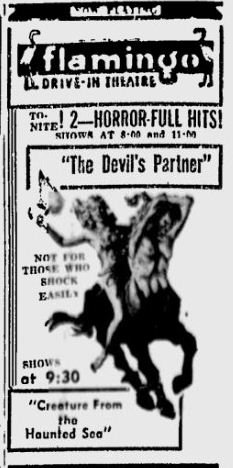
What's new in the new month? Here's a drive-in attraction for Charleston SC.


Devil's Partner isn't half bad for its budget. It can be had in numerous cheapo public-domain box sets or easily seen for free online. For now, check out the trailer from Something Weird Video's YouTube channel.


Here's a new combination of two films that have been making the rounds on their own or in different couplings this summer. This ad is from a Miami newspaper.


How about a closer look at each?First comes Jack the Giant Killer, courtesy of MovieTrailerGrave.


A fairy tale jazzed up with special effects....Sounds like something Hollywood would do now. And lo and behold!...  As for Mighty Ursus, here's a TV spot that depends entirely on ad art and ballyhoo, but the film itself can be found for free online. Peplumz uploaded this clip and has the movie itself on a YouTube channel.


Finally for today,Milwaukee welcomes a retitled picture adapted by novelist Alberto Moravia (Contempt, The Conformist) in collaboration with Pier Paolo Pasolini.


I can understand the title switch once you're outside the metropolitan markets. Alas, no video footage is readily available online for this one under any of its names -- and there were more than these two. That at least shows that people were trying to sell this movie. We could probably stand more such efforts today.