Thursday, August 16, 2012

THE ALIEN GIRL (Chuzhaya, 2010)

Anton Bormatov's movie was panned upon its limited theatrical release in the U.S. Most reviewers saw little beyond perceived cliches and brutality, and Chuzhaya is pretty much an archetypal crime story. It's an uncomfortable mating of noir tropes and the modern gang picture as a femme fatale comes between a young thug and his Ukrainian homies. Visually, it's a jarring mix of artistic compositions and the aforementioned unglamorized brutality. I'm not sure what the reviewers wanted, since I was impressed by a picture that admittedly wasn't innovative but did strive to breathe life into crime-film archetypes in a relatively novel setting.

Crackhead Kiev crime boss Rasp -- short for Rasputin? -- sends four stooges to Prague to bring home Angela, "the alien" (Natalia Romanycheva) so she can be used as a hostage to keep her freshly-imprisoned brother from ratting on Rasp. Angela was exiled to a gypsy whorehouse, we learn later, to keep her away from investigators after her role, on Rasp's orders, in the poisoning of a group of drug-dealing Kazakh cops. If her brother doesn't talk he'll get the death penalty, and once he's dead Rasp'll probably kill Angela just to be safe. None of that matters to the four stooges -- "Kid," the leader; "Beef," the fat one; "Booger," who gets shot in a gunfight with the gypsies; and "Whiz" (Evgenii Tkachuk), the youngest and maybe the brightest of the group. The gypsies want them to pay for Angela, but Kid pays them in lead. Angela's future doesn't matter -- until she starts to work on them. Once they're down to three after leaving a bleeding Booger outside a clinic, Angela looks for someone to save her from Rasp. Whiz wins the sweepstakes; enticed by sex and a sob-story, he takes down Kid and Beef but is traumatized by doing so. Angela has to take matters into her own hands to finish them off.


Whiz is haunted by his homies, guilt-stricken by having violated the one code he knows: loyalty to his gang. He takes no comfort in his quasi-erotic idyll with Angela in an abandoned excursion boat and her talk of fleeing west to live like normal people. Finally, however, she convinces herself and Whiz that they won't be safe until they take the fight to Rasp on his own turf. The setup is almost too good to be true -- so what if it involves betraying a bodyguard already persuaded to betray his boss -- except for Whiz taking a bullet. He'll live, but he can't run, and Angela leaves him to the cops. He loses and she wins, but don't forget those loose ends....


Toward the end, the imprisoned Whiz meets Angela's brother, who explains where she got her "Alien" nickname. Turns out that she's named after the Ridley Scott movie (which Whiz, as of this 1990s-set story, has never seen), and there's a reason she's named "Alien" and not "Ripley." I can see people dismissing this picture as deeply misogynist, since it portrays Angela as a manipulative monster who destroys male camaraderie from within, but my own rule is that no one woman is all women. "Alien" is not Bormatov or his writers' portrait of an entire gender but Romanycheva does give a harrowing portrayal of survivalism taken to a sociopathic extreme that doesn't stop with Rasp's demise. Opposite her, Tkachuk is convincing as an ironically guileless (though not guiltless) thug torn between male bonds and sex drive. His best scene comes when Angela tries to explain why her brother won't rat Rasp out if Rasp has her in his power. Her explanation, of course, is that Rasp will kill her if her brother squeals, but before she can say this Whiz, still haunted and grieving over the friends he's killed or left for dead, bursts out with, "It's wrong to rat on people!" The tragedy of crime cinema, noir or not, is the struggle of lawless people to live by some code when any code is impractical, to say the least. Chuzhaya catches that ironic outrage among criminals that makes their betrayals often seem more poignant or tragic than the everyday betrayals of law-aiding life. A simplistic reading would conclude that the film blames everything on Angela, who planted the seed of betrayal in Whiz. But we ought to remember that no one is innocent in Whiz's world, and we can also question whether his thug cronies, brutes and boors all, were really more worthy of his loyalty than the alien girl.

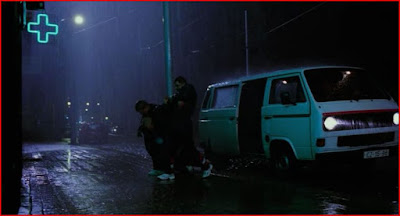


Bormatov aspires to some pictorial grandeur in the scenes in and on the beached boat and the cinematography overall by Anastasi Mikhalov achieves effective contrasts between dark, drab and damp cityscapes and the more open emptiness of outdoor exile. But let's not overrate Chuzhaya into a neglected neo-noir classic. It's a predictable enough story of the sort we've all seen often, if not in this particular setting. The violence may grow monotonous and the tone may seem oppressively dark -- this is the sort of film in which most of the cast comes back for an encore on morgue slabs. But for fans of crime cinema interested in broadening their geographic scope I think there's something to see here.

Wednesday, August 15, 2012

Now Playing: AUG. 15, 1962

From a technological standpoint, possibly, the film advertised below was probably the landmark cinematic event of 1962 -- or at least it may have been seen that way at the time. It's been rolling out at properly-equipped venues across the country this month, and we catch it here opening in Milwaukee.


If 3-D can come back repeatedly, then someone's bound to figure out a way to make this format viable again, just so they can offer something again that TV can't match. They'll probably also come up with a better way to promote the format's narrative potential.

While always looking to the future, the movies can sometimes look back admiringly on their own past. Here's proof in Pittsburgh.


Lloyd was smart enough to keep ownership of most of his pictures, and apparently admired Robert Youngson's silent-comedy compilations (Days of Thrills and Laughter was current this year) without contributing to them. Not unreasonably, he thought he could be the whole show, and World of Comedy actually did well enough for Lloyd to put together a sequel. Could he have pulled that off fifty years later? Judge for yourselves.

Of course, the movies can look back even further. Here, a Salt Lake City exhibitor invites patrons on a long trip in the wayback machine.


There hasn't yet been a good movie made about the Battle of Thermopylae -- or if there is, I haven't seen it. Here's what I thought of this one, with some thoughts about the other included.

For cities without Cinerama, here's the big wide release of the week, as advertised in Nashua NH.


Even at this late date in movie history, you can still sell a picture by promising birth-of-a-baby footage. Makes you wonder whether they sold educational illustrated books in the lobby. But speaking of exploitation, let's stop in Berlin CT for a moment.


Not to be mistaken for the later rape-revenge picture of the same name, this is actually a 1959 French film set in the U.S. You can watch it here -- without the lake, that is. The second feature, by the way, was a one-shot attempt (also known as Invisible Avenger) to revive The Shadow as a movie hero.

And speaking of exploitation once more, Jules et Jim arrives in Palm Beach with a campaign emphasizing the sex angle more than the art-film angle.


Always remember, though -- the difference between the two wasn't as great then as it is now.

Monday, August 13, 2012

SYNDICATE SADISTS (Il giustiziere sfida la citta', 1975)

The way Umberto Lenzi tells it, Tomas Milian came back from a trip to the U.S. raving about a book he'd bought at an airport to read on the flight back to Italy. The book was David Morrell's First Blood, and Milian thought that the novel's antihero, the alienated Vietnam veteran John Rambo, would be a great part for him. Fat chance of Lenzi getting the rights, of course, but couldn't Milian play a character like Rambo in his next film for the director? Couldn't he even call the man Rambo? That he could do, and so Milian is just plain Rambo, with no first name that I can recall hearing, in Lenzi's Giustiziere sfida la citta' -- "The Executioner vs. the City" according to Bing Translation. Lenzi says that he wanted to call it Rambo vs. the City but got rebuffed by the distributor because "rambo" was a nonsense word in Italy and could never sell a movie. Lenzi tells the story with some hindsight, of course, but he also relates that Milian wanted to do the film to improve his image after having played his ultimate criminal grotesque in the director's Almost Human earlier in 1975. The star's desire to play a good guy doesn't sit well with his desire to evoke the irreconcilable Rambo of Morrell's novel, as opposed to the redeemable Rambo of subsequent Sylvester Stallone movies.


Who is that masked man?

How much of the "real" Rambo is in Milian's Rambo? Lenzi's protagonist is a loner and a drifter who apparently has been carrying on a personal war on crime that had taken him to Marseilles before he arrives in Milan in the movie. The look seems right, though Milian's overall scruffiness seems more to anticipate feral cops like Mick Belker on the Hill Street Blues TV show. He doesn't care to work with others, rebuffing his buddy's invitation to join him in a new private police force (a sign identifies it as "Mondiapol"), but will lend a hand when the chips are down. This Rambo doesn't like to "grow moss" in one place, but that makes him as much like the wandering heroes of Westerns (or peplums) as it makes him a Rambo redux. In Milan's career, his Rambo looks most like a dry run for his more lighthearted Nico Giraldi character in Cop in Blue Jeans and its sequels.


Test your might -- fight!


If Giustiziere is a lesser Lenzi cop movie compared to such genre highpoints as Almost Human and Violent Naples (the latter featuring another prime Milian grotesque) it may be because director and star were trying to do too much at once. On top of polishing Milian's image and allowing him to riff on Rambo, Lenzi and writer Vincenzo Mannino are playing the old Red Harvest game, following in the foosteps of Hammett, Kurosawa and Leone by having their protagonist play two crime families against each other. Rambo's pal in the private police force is trying to solve the kidnapping of a rich man's son, for whom the perps want 2,000,000,000 lira ransom. After his buddy gets killed -- a failed pursuit ends with his skull getting smashed on a rock -- Rambo's revenge (as the film would get retitled in some places) consists of goading a rival crime clan to muscle in on the kidnappers. This brings him into contact with Paterno, an aging boss whose path last crossed with Rambo's in Marseille. He'd love to destroy Rambo, but feels incapable himself -- it's a secret that he's going blind -- and fears that his impetuous son will only get killed trying. We should see an old lion making a last stand, but what we get is an alarmingly decrepit Joseph Cotten, far from the days of his Forties stardom in Hollywood. He wears a huge pair of glasses most of the time -- there's a plot reason but you can't help thinking it's all the better to read cue cards with -- and his voice is slow and tremulous as he speaks his lines. Some of his line readings are robotic, as if he doesn't understand what he's saying or what's going on in the picture. He may have been sick, or drunk, or both, but it's a demoralizing sight that makes it hard to enjoy the picture.


Cotten aside, Giustiziere lacks the force and flash of Lenzi's best work in the genre. While we might expect a Rambo type to become a furious avenger, especially after his girlfriend is beaten to death, Milian seems too committed to being a good guy to give his part the power it needs. Nor is Lenzi in top form; most of what's good here he's done better elsewhere. For what it's worth, the film doesn't come close to living up to its American title. The U.S. poster and DVD box art show a bald fellow applying a blowtorch to a chained couple. The film itself has the chained couple but no baldy with a blowtorch. In the actual scene, Rambo's idea of torture, after having cuffed them together across a bathroom pipe, is to take a leak in front of them and throw the cuff key in the unflushed toilet.


The shot above is more suggestive than the scene itself;
the scene below is more violent.


It may be bad form to express disappointment over this, but violence and cruelty are part of the genre and any given film looks tepid without it. Worse still, keeping track of the kidnapped kid grows tiresome quickly -- as Lenzi and Mannino must have realized themselves in giving Rambo an extra revenge incentive. The American edition is apparently an incomplete translation of the Italian original, but I suspect that the full film won't make a much better impression. You might want to try Syndicate Sadists as your first Lenzi cop picture before watching the stronger stuff, but if you want to watch just one to see what the genre's about, it should be something else.

Sunday, August 12, 2012

BLACK MAGIC (1975)

Ho Meng-hua's landmark horror film for the Shaw Bros. studio is like Hong Kong's answer to White Zombie, a tangle of sex, greed and, yes, black magic. It opens with a prologue establishing its venal villain, Sha Jianmi (Ku Feng) plying his trade by using voodoo-like dolls to kill a cheating husband and his mistress for an aggrieved wife. The mystical murder comes to the attention of the film's Van Helsing figure, Master Furong (Ku Wengchun, an avuncular looking Wifred Brimley type), who immediately guesses that Sha is behind it and sets about taking him down from afar. Sha senses that a storm's coming and plasters his walls with warding posters streaked with blood from his own tongue. His efforts are to no avail, but he manages to escape with facial burns while leaving his client to die as his shack collapses on her head.


Two naked people are dead, and for Master Furong one thing is certain: Sha Jianmi is responsible


Sporting grey hair after his ordeal, Sha sets up shop near a construction site in Kuala Lumpur and somehow acquires a reputation that recommends him to Lang Jiajie (Lo Lieh), who's trying to seduce his way to Luo Yin's ("Tanny" aka Tien Ni) money and wants a love potion to lubricate his way. Sha demands payment in gold the size of his pet skull, though not in advance. Doing business with him is like dealing with the devil; you have to be careful what you ask for. His potion is good for a one-night stand, but in the morning an enraged Luo throws LJ out. Loverboy feels he didn't quite get what he wanted, but Sha doesn't care: pay or die. LJ doesn't pay, and he dies. But he's planted a thought in Luo Yin's head, since he stupidly admitted using a love potion, so the wealthy woman summons Sha to her home. She has the hots for architect Xu Nuo (Ti Lung) and, as LJ already noted, plenty of money to pay for a proper spell to lure him away from his betrothed (Lily Li). She's brazen enough to use Sha's potion on Xu's wedding day -- the briefly happy couple has Christian nuptials -- walking out with the groom in the middle of his reception as the bride looks on in horror.


Luo Yin has regrets the morning after, but she learns from her mistakes.

Luo has plenty of money to keep Sha keeping Xu in line, but Sha wants more than money. He covets Luo's body as well as her coins and gets both -- duding himself up for a while in the process in a naively charming way -- even as Luo keeps Xu as her plaything. To make things more certain she has the sorcerer put a death curse on Xu's betrothed, but her friends, figuring out that magic is involved -- the fact that they can see worms crawling beneath her skin is just a bit of a giveaway -- find that there's an expert in such things close at hand. It's none other than Master Furong, who after draining the evil worms from the intended victim heads to Luo's lair to place the place under a musical siege. The music loosens the villains' grip on Xu, who manages to escape (Ti Lung's only real fight scene in the picture is with a dog) as Furong holds Sha and his skull at bay.


Xu Nuo won't really be free again until Sha is dead, however, though temporary remedies like centipede soup are available. While Sha lives, Xu's the object of a spiritual tug of war as the bad guys reassert their influence. The film closes with a camp-cosmic showdown at the construction site as Shan and Furong vie for dominance with all the mystic powers in their arsenals, clouds gather as if the Red Sea's going to part, and poor Xu wanders among the girders. It's sort of like the climax of The Manitou staged by Harold Lloyd. I'm not sure if that'll mean anything to every reader, but to me that's a good thing: not quite intentionally funny, but it'll do.


Black Magic has a reputation for outrageous sleaze and gruesomeness, -- I haven't described the makings of some of Sha's potions, but one involves a woman stuffing rice in an intimate place --but I found it great fun. It's solid, sincere entertainment whether you find it amusing or revolting. For me, part of the fun was seeing martial-arts stalwarts like Ti Lung and Lo Lieh in situations they couldn't fight their way out of. It reinforces my feeling that they were decent actors as well as strong genre performers. Above all, however, Ku Feng carries the picture. Sha Jianmi is a great movie villain: powerful enough to be an indisputable menace, but not so powerful that he can't play the coward, too. Most importantly, Sha is no acolyte of abstract evil like a contemporary American devil worshipper, but a self-interested sociopath of limitless greed. He's perfectly hissable with just enough charisma to be compelling and just enough scuzzy venality that you're not going to root for him at the end. For moralists in the audience, he can be taken as an embodiment of the evils that can arise from loosened sexual mores, but apart from his dalliance with Luo he's more interested in money than anything else. After seeing too many villains in movies with vaguely apocalyptic motives, or who do evil to prove some kind of philosophical point, Sha is a breath of fresh air, though his breath probably doesn't smell that great.

Ho outreaches himself at the climax, as his effects can't live up to his vision, but he should have you committed enough to the story by then that you can forgive some of the cheapness and appreciate more of the craziness. As long as you're not squeamish, Black Magic is a grand piece of exotic entertainment and a landmark of global genre cinema from the Sleazy Seventies.

Friday, August 10, 2012

INSIANG (1976)

To most American movie fans, the Philippines is a place where American exploitation filmmakers went back in the Seventies and Eighties to shoot cheap and get the most for their money. By that standard, even Apocalypse Now was an exploitation film. Most of us have seen films shot in the Philippines, but not an actual Philippine film. We may even have seen films by Filipino directors like Eddie Romero or Cirio H. Santiago, but such works seem tailored more for the global grindhouse market than for Filipino audiences. Less common are films in the islands' native languages, aimed specifically if not exclusively for native audiences. DVD and streaming media make these more available now, and it was on Netflix that I first encountered the work of Lino Brocka, the man widely regarded as the Philippines' greatest director. Insiang is considered one of his best films, and it has a place in national film industry as the first Philippine film to play in competition at the Cannes Film Festival. Cineastes would have recognized a kind of neorealist melodrama, with a story reminiscent (to me) of James M. Cain, enlivened by the colorful, tawdry novelty of the slum setting and the intensity of the lead performers.


Hilda Koronel as Insiang.
Below, director Lino Brocka exploits local signage
in an almost Antonionian moment.

Insiang (Hilda Koronel) is a laundress and breadwinner for an extended family that contracts rapidly as her mother Tonya (Mona Lisa) drives most of her relations and in-laws away. Tonya is angry because her husband left her for another woman. She resents and distrusts anyone else's sexuality unless it happens to be dedicated to her. She grows ever more repressively vigilant toward Insiang's boyfriends while growing pathetically attached to Dado the butcher (Ruel Vernal), a much younger man and a local tough guy whose real interest in Insiang is obvous to just about everyone. Insiang yearns to break free of Tonya, but the feckless young men of her neighborhood, on whom she's expected to depend, are a feckless lot. Bebot, an auto mechanic (Rez Cortez), seems promising but fears Dado's jealousy, knowing the big man's interest in the girl. Inevitably, Dado forces himself on Insiang, boasting to his buddies of his conquest of mother and daughter while telling Insiang, after the initial rape, that it's her, not Tonya, that he really loves.


Insiang has finally had enough. She finally goads Bebot into eloping with her, but that goes no further than a one-night stand in a miserable hotel. Inevitably she returns home, where she tells Dado straight up that she wants revenge. He thinks that she wants Bebot to pay for running out on her, but Insiang has a greater offense than that to avenge. She'll manipulate her two oppressors, Tonya and Dado, into destroying each other, buttering up the butcher while provoking her mother with exaggerated accounts of his disdain for the older woman. She flaunts Dado's desire for her until Tonya snaps and stabs him to death. With Tonya in jail, Insiang is free at last, but she feels compelled to see her mother and tell her the truth -- that she had meant for Tonya to kill Dado. She wants reconciliation if not forgiveness, but Tonya puts on a stone face until Insiang departs in tears -- and then the mother's own tears flow at last.

Mona Lisa as Tonya confronts her daughter at home (above)
and perhaps for the last time (below)

I'll need to see more Brocka movies -- Netflix has at least one more -- before I can judge his talent apart from the visceral vitality of the Tondo slum locations used for Insiang. But he clearly brings a strong sense of place to his work that gratifies my impulse for virtual tourism, as well as a social consciousness that is literary rather than political -- a sensibility to the constraints Insiang's economic and family circumstances impose on her. Most importantly, he has a way with actors that draws powerhouse performances from Koronel and Lisa as the feuding daughter and mother. They make Insiang a primal tale of intergenerational sexual jealousy underscored by the younger woman's revulsion at her mother's neediness and the older's deeper fears and resentments. The drama is occasionally heavyhanded, especially when punctuated by a score with a soap opera's subtlety, but the lead actresses do all they can to keep things real. The squalid setting makes the story powerfully plausible, and while it doesn't exactly show the country's best face, the country's promotion of the film notwithstanding, I'd recommend Insiang as anybody's first true Philippine film. You may know already that Filipino filmmakers can blow things up real good, but now you know they can do more than that.

Now Playing: AUG. 10, 1962

For the weekend, a selection of exploitation films, starting with a familiar face -- so to speak -- appearing in Pittsburgh.


A reminder to recent readers of the blog: the head itself belongs to none other than Michel Simon of Boudu Saved From Drowning fame -- the years had not been kind, apparently.

Also in the Steel City, Doris Wishman has landed.

Here's a necessarily brief preview from TrailerFood's YouTube channel


In the peplum department, here's a double-feature in Toledo


We should be familiar with Last of the Vikings by now, but let's take a look at Son of Samson, courtesy of Something Weird. Looks like they're using some Ten Commandments sets there. At least they provided their own special effect in the form of Chelo Alonso. Check her out.


In the shockumentary section,here's an entry from Youngstown. It may also count as a foreign or "art" film, depending on how you sell it.


Finally, in the general exploitation category -- the one for any movie with a gimmick --another Youngstown exhibitor has to come up with something to compete with the cannibal picture.


No post-picture "Brief Pause" stunt as in Salt Lake City, but Free Orchids for the Ladies! It seems as if something extra is needed to put this picture over. They really ought to have more confidence in their product.

Thursday, August 9, 2012

Now Playing: AUG. 9, 1962

Tuscumbia AL is a southern town and in 1962 Jim Crow is embattled but still enthroned in much of the American South. Here, from a nearby Florence newspaper, is an ad for a special double-feature for the town's black movie fans. You can see the effort that went into it.


What a treat: two late-night showings on a work night. And what are these "Big All Star Colored Cast" films? She's Too Mean For Me, director unknown, dates back to 1949 (TCM) or 1948 (IMDB). Moreland plays a henpecked husband embroiled in a mistaken-identity plot and ultimately accused of bigamy. The punch line is that he'd rather stay in jail at the end rather than return to his monster wife. Of 1940's One Big Mistake even less is known. All we know, it seems, is that "Pigmeat" Markham starred, though we can infer his co-stars from the cast list for what IMDB describes as an edited-down version from 1947 called Pigmeat's Laugh Hepcats. Neither IMDB nor TCM can name a director or even summarize a synopsis. The Tuscumbian presumably had the original film, but it may be lost now, in either version. They didn't seem to be making them like that anymore by 1962. I imagine some audiences missed the likes of Mantan and Pigmeat, but it seems sad that this is the stuff offered as a special attraction for "colored" audiences. Of course, nothing in the ad says that the show's for "coloreds" only, but given the time and place you can draw your own conclusions.