I don't know enough early films to say whether The Mystery of the Leaping Fish is the first American drug comedy film, so let's make a more modest claim: John Emerson's two-reeler, conceived by that beloved humorist of the cinema, Tod Browning, is the Birth of a Nation of drug comedies. I suppose we could be more modest still and call it the Inherent Vice of 100 years ago. It's almost certainly the weirdest performance ever given by Douglas Fairbanks Sr., who plays the "scientific detective" Coke Ennyday. While the name is a loose play on Arthur B. Reeve's then-popular scientific detective Craig Kennedy, the character's awesome drug habit is taken from Sherlock Holmes, and expanded upon immensely. The great detective sits at his desk, injecting himself with something every couple of minutes to restore his spirits -- he chuckles after each injection -- while a huge jar labeled COCAINE is within easy reach. A closet holds the detective's many disguises, clearly labeled as such, while a clock divides Ennyday's routine into four phases: drinks, eats, sleep and dope. This film was made two years after the federal government first cracked down on the distribution of cocaine and other narcotics, so Leaping Fish flies in the face of a national anti-drug hysteria in the admirably irreverent fashion of that era's films. A police chief, I.M. Keen, rings Ennyday's doorbell, and the slightly paranoid scientific detective pulls out his "scientific periscope," a proto-TV apparatus to verify the man's identity. After his servant, dressed like a giant bellboy, opens three layers of doors, Ennyday hears the lawman's appeal. There's a man in Short Beach rolling in wealth despite lacking apparent means of support. Certainly something requires investigation there!
In Short Beach we are introduced to the mysterious leaping fish, which are inflatable floating devices for coastal frolicking. We are also introduced to the film's heroine, Inane the Fish Blower (Bessie Love). That's what they call the girl who inflates the inflatables with an air pump. The lurking Coke Ennyday discovers her in distress, having fallen off a pier into shallow water. Skipping into action with the celerity of a Keystone Kop, Coke flings himself off the pier and plants himself head-first in the mud. Inane has to rescue him from this predicament, but he'll return the favor later. The man Ennyday was assigned to trail, earlier shown literally rolling in money in his bed, is, in fact, a drug smuggler; he sends two Japanese minions out to sea with Leaping Fish, and they return with contraband. Poor Inane knows nothing about this, but is threatened just the same by the amorous attentions of Fishy Joe. Another member of the criminal ring is the Chinese launderer Sum Hop. For you youngsters, that was more drug humor. Despite his perpetual daze some instinct drives Coke Ennyday to discover a cache of opium, which he commences to eat like cake batter out of the bowl. In the double climax Coke must battle the yellow perils and their white master, while Inane must defend her virtue against Fishy Joe. She defends it with all the vim and violence you'd expect of Douglas Fairbanks himself, wiping the floor with Joe, while Ennyday, quivering as if he'd OD'd on Acme Earthquake Pills, uses his trusty hypodermics to inject his foes into various states of stupefaction. One virtually floats through the ceiling, while another throws himself out a window. Finally comes the showdown with the mastermind, which conveniently goes down in darkness, with Coke conveniently victorious when the lights go on again. Once more Coke Ennyday has conquered crime, and this time he gets the girl, too -- only that's not the end of the story. Before we really got started with the story we were shown a quick shot of Fairbanks out of makeup, laughing at something he'd just read. The film closes with the real Fairbanks trying to sell the very story we've just seen to the scenario department at the Triangle Studio. The department head tells him to stick to acting, and Fairbanks exits with a pout. He actually did a lot of his own writing under the Elton Thomas pseudonym, but here he gives one of the great good-sport performances ever in what some have seen as a send up of his own already-formed frantic screen persona. It's an all-out fearless physical performance that shows the young star unafraid to look like a complete idiot, flaunting the fakeness of Ennyday's moustache, rocking his ridiculous outfits, and pretty much pogo-ing through most of the story as if he, the actor, really were on something. He helps mightily to make The Mystery of the Leaping Fish one of the damnedest things you'll ever seen. And you can see it right here, as uploaded to YouTube by one Ivan Smirnov. Check it out, man...
A randomly comprehensive survey of extraordinary movie experiences from the art house to the grindhouse, featuring the good, the bad, the ugly, but not the boring or the banal.
Showing posts with label 1910s. Show all posts
Saturday, March 11, 2017
Saturday, January 10, 2015
100 Years Ago At the Movies: JANUARY 10, 1915
From the Troy N.Y. Northern Budget: Advance publicity for Charles Chaplin's debut as an Essanay Studios star and director of comic "panto-plays."
Tuesday, December 9, 2014
DVR Diary: YANKEE DOODLE IN BERLIN (1919)
Here's how Sennett explains himself in the March 29, 1919 issue of Moving Picture World magazine.
Sennett wasn't as courageous as his erstwhile protege Charlie Chaplin, who released his war comedy Shoulder Arms while the fighting was still under way, though by October 1918 the war was almost over. Sennett's reticence echoes the feeling at the time that Chaplin was taking a big chance by making any aspect of the war a source of comedy, not to mention the feeling more prevalent in our time that comedy "trivializes" war and its atrocities. By the time the next world war rolled around Chaplin again seemed to take a risk by trivializing Hitler in The Great Dictator, but he only set the tone for the mockery of Hitler and other Nazi leaders that continued throughout the war, from Bugs Bunny's battle with Hermann Goering in Herr Meets Hare to Moe Howard's inspired casting as Hitler in Three Stooges shorts. If anything, those burlesques take their inspiration more from Yankee Doodle in Berlin than from Chaplin's films.
With their big moustaches and bombastic manner, the Kaiser and his generals were as obvious a Sennettesque subject as Hitler was Chaplinesque. The comics playing the Prussians, led by Ford Sterling as the Kaiser himself, easily steal the film from top-billed Bothwell Browne, a popular female impersonator on stage whose only movie appearance this is. Browne plays an American flying ace assigned to go behind enemy lines and wreak havoc. Naturally his most effective tactic is to dress as a woman and arouse the rival lusts of the imperial family and the high command. Browne doesn't really make much of an impression because he's supposed to be good at what he does. Comedy might normally derive from how obviously fake a female impersonator is. But if we're supposed to believe that Browne's disguises are effective, our focus shifts to the dupes we know are being fooled. The focus shifts further away from Browne once the top Germans become rivals for the strange woman's affections, and especially when the Kaiserin learns (from her jealous son, the gangly, rat-faced, chain-smoking Crown Prince Frederick [Mal St. Clair]) that Wilhelm is making eyes at the newcomer. Her beatdowns of her imperial husband are among the slapstick highlights of the film. She hits him with everything in her domestic arsenal, spreading collateral damage all over the face. Sennett's director F. Richard Jones sets things up nicely. Knowing he's caught and there's a storm brewing, the Kaiser orders everyone else off their lawn, for delicacy's sake, and then declares mildly to the missus, "Now we're alone." At which point the Empress utterly destroys him; it's the sort of scene that gets funnier as Jones piles on the violence beyond all reasonable expectation. Seeing the Kaiser beat down this way may have been funnier and more cathartic for the 1919 audience than when the Americans attack and drive him from power. The final scenes are pure cartoon: the Kaiser, Crown Prince and General Hindenburg (Bert Roach) run on the Sennett cyclorama, chased by a gravity-defying, horizontally traveling bomb labeled "U.S.A," while Browne's hero makes his escape by latching himself to an aeroplane.
The war might have been over when Yankee Doodle hit theaters starting in March 1919, but wartime hate endured in the film's equation of Germans with monkeys ("both from the same family"). Stereotypes predating the war abound: the Kaiserin is shown draining a huge stein of beer, while the Kaiser's big serving dish conceals a single frankfurter, because Germans love those things. There's lip service to propaganda about war aims -- the Kaiser's fall marks "the end of autocracy" -- but it's possible people had already stopped taking that seriously. There's dishonest propaganda when an Irish POW, in a virtually self-contained subplot, taunts his captors by reminding them of how the Irish beat the hell out of the Germans at the Battle of the Somme. Instead of answering, "Uh, no," the indignant Germans threaten to execute the Irishman unless he becomes a German citizen -- he takes the oath with his fingers crossed before vandalizing a painting of the Kaiser. On a more insensitive note, when the Kaiser critically scrutinizes a rather sad-looking Prussian Guard, he's informed by their commander that these same men bravely stormed and captured a Belgian convent earlier in the conflict. Sennett might not have been able to get away with some of this material a few months earlier, and in any event his caution paid off when the film, often supported by live appearances by Browne and a troupe of Bathing Beauties, became a smash hit. It gave American audiences an opportunity to express their relief, after both the strains of war and the pressures of real hardcore propaganda had passed, with raucous laughter at the threat that now seemed so ridiculous. Yankee Doodle in Berlin isn't a very good film in retrospect, but it's one of those cases where you definitely had to be there at the time
Saturday, July 6, 2013
HELL'S HINGES (1916)
Western movies have been with us since 1903's The Great Train Robbery, if not before. Edwin S. Porter's short subject is probably still perceived as "the first film to tell a story," however untrue the claim is. But if westerns go all the way back to the beginnings of narrative cinema, Hell's Hinges is arguably the first western that really shows us what the genre was capable of, the first to indulge in apocalyptic violence and vengeance in a truly picturesque, cinematic fashion. Made a year after D. W. Griffith wrote history with lightning, Hell's Hinges is the Birth of a Nation of westerns. The violence is white-on-white but it portrays no less of a kulturkampf than Griffith's racist epic -- and the absence of a race element may make the culture element more stark and alarming. In 1916 the U.S. was near the high tide of the campaign for Prohibition. That campaign converges with the Ku Klux Klan revival allegedly sparked by Griffith's film as part of a nativist defense of a traditional Protestant culture deemed authentically American. Hell's Hinges portrays a war on Christianity on the 19th century frontier, in which, presumably, sympathetic audiences recognized a shadow of the war on their traditional values waged in their own days by the defenders of the saloon, the sabbath breakers, the suffragists, etc. And in William S. Hart that audience saw the wrath of God.Why does the frontier need taming? I'm not asking about the line separating settler from Indian; the problem in so many westerns is that the settlers themselves need taming. Aren't those settlers of authentic American stock? Aren't they Christians when they set out? Presumably so, but something happens on the frontier that helps define the western. Coming to tame the frontier, the settlers end up needing to be tamed. That's the situation in the town called Hell's Hinges when the film gets there, and the situation repeats itself in miniature.
Rev. Robert Henley (Jack Standing) is sent from New York to restore religion to the frontier town. In a prologue, the film has already told us that Henley is a flawed preacher, more interested in preaching as a performance for admiring ladies than in winning souls. We're also told that his sister Faith (Clara Williams) who comes to Hell's Hinges with him is a better Christian than he is. Woman is the vanguard of civilization in many westerns, whether as the archetypal schoolmarm or as an evangelist like Faith. Where Robert performs Christianity, Faith lives it. It's something you can see in every part of her demeanor, if you have the sensitivity or sensibility to recognize it. Miraculously, someone in town does recognize it. Blaze Tracy (Hart) is just one of the guys in Hell's Hinges until Faith shows up. Something about him responds to something about her. Pop fiction of the time described it as some sort of race instinct to worship and defend female purity. In simpler terms, Blaze is smitten, so he's going to defend the Henleys against the hostility of most of the town, allying himself with the "petticoat brigade," which despite the feminizing label includes a handful of righteous bearded patriarchs, all of them longing for old time preaching, but not getting it from the Rev.
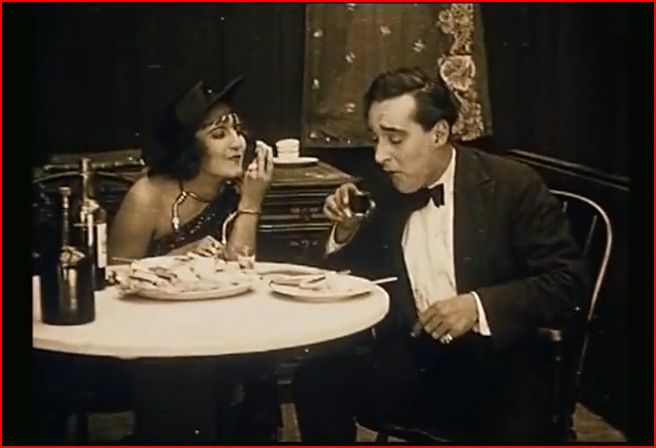
Instead, Hell's Hinges corrupts the preacher. Fearful of the potential influence of religion on business, the town saloon keeper Silk Miller (Alfred Hollingsworth) has Dolly, one of his dance hall girls (Louise Glaum) seduce Robert Henley. It doesn't take much: one drink and the Rev. is in Reefer Madness land, practically. Dolly detains him all Saturday night so he misses his Sunday sermon, the congregation finding the two passed out together. An instant alky, Robert is later goaded into joining a mob in burning his own church. A gun battle breaks out between the mob and the congregation, and Robert is killed in the crossfire.
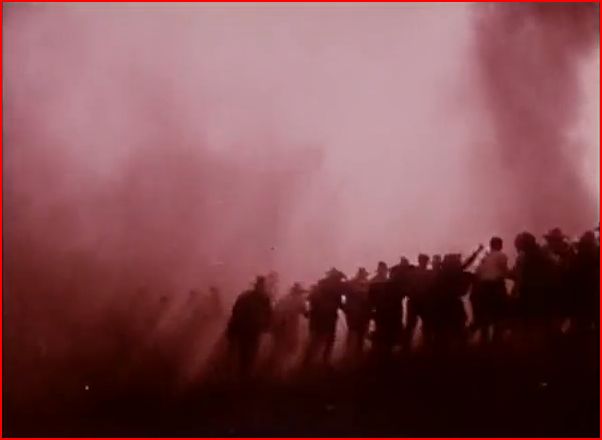
This happens while Blaze is riding out to fetch a doctor for Robert. Now that his time has been wasted, Blaze is plenty mad. I'm probably understating this. Never mind that the greater offense in his eyes was probably making Faith cry. Whatever the provocation, his anger is unfathomable, yet he is poker-faced in his determination as he marches toward the camera and into town. The violence against the church in this picture has already been somewhat startling -- did things really get this bad in the Old West? -- but what follows is stunning. Not if we measure by body count, since I think Blaze kills no more than three people. But as a matter of scale Hell's Hinges sets the standard for disproportionate response to offense. To avenge Robert Henley and his church, Blaze -- his very name is foreshadowing -- burns the town to the ground.
Charles Swickard is the credited director of this Thomas H. Ince production, but one Clifford Smith and Hart himself shared in the direction. The big question is who directed the last reel, because that director is a master. Working with cinematographer Joseph August, who would do exemplary work into the 1940s, the director stages a minor Armageddon, at once dangerously authentic -- Hart is literally playing with fire -- and precociously expressionist as fire and smoke turn the town into an abstraction of disaster and panic. From the startling (for 1916) overhead shot as Blaze cows a crowd and shoots out a lamp to the serendipitous lens flare as he walks past an explosion without flinching -- setting another precedent -- the film's climax is virtuoso filmmaking that still impresses after almost a century.
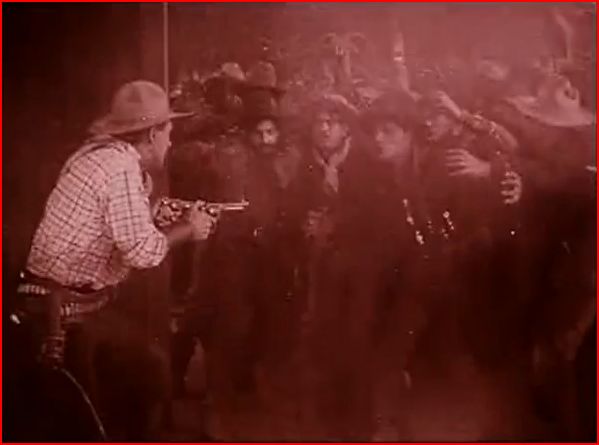
Blaze Tracy is Hart's definitive "good bad man" and the ancestor of Clint Eastwood's William Munny among others who practically become bad good men. Blaze's wrath is terrible to behold, the more so as he becomes less a laughing mocker like his erstwhile peers and more a grim-faced avenger. In his fiery apotheosis Hart achieves a paradoxical charismatic expressionlessness. We see him snarl a little as he confronts the saloon crowd, but he remains glacially unmoved by the destruction he perpetrates and the horror surrounding him, not even afraid for himself as he takes his time striding through the holocaust. Across the years, you'll recognize him as a type you still see in movies today. Much about Hell's Hinges may seem obsolete or quaint, but Hart could be a star now with this performance, because he helped define a certain kind of stardom, just as this film defined a certain kind of western.
* * *
Do you have an hour or so to kill? Then have a look at Hell's Hinges in full. MantisCinema uploaded this 63 minute version to YouTube.
Friday, October 1, 2010
THE ITALIAN (1914)
The Italian is a star vehicle for its lead actor, George Beban. "GEORGE BEBAN in THE ITALIAN" headlines every title card, and Barker introduces the actor before the story actually begins with some self-conscious theatricality. After the credits run, a curtain parts to let us into Beban's study, where the actor is looking for something to read. He finds a novelization of the film we've already begun to watch and settles down to peruse it. At first, this seems like a quaint gimmick, but when we return to the framing device at the end of the picture, we realize that Barker and Beban have a point to make. We're invited to see the actual story as Beban's imagination of the story he's reading, inserting himself into the narrative in the title role. Without a word, he's inviting us to walk a few miles with him in an Italian immigrant's shoes. He's inviting his audience to empathize with the Italian.
In the narrative, Beban plays Beppo Donnetti, a Venetian gondolier in love. He may be poor, but he enjoys life and enjoys the land he lives in. The first surprise for the original audience may have been the extent to which Barker idealizes Italy. He emphasizes the beauty of the landscape, admittedly enhanced by the presence of a pretty girl, with a quality of cloudscape cinematography I hadn't thought possible in 1914. Throughout the picture, Barker's direction has a fluency in framing, staging and editing that makes even D. W. Griffith look crude. His Italy may be romanticized, but the point seems to be to refute nativist notions that immigrants living in American poverty and squalor must have brought a squalid lifestyle with them from the old country. Not so: Beppo could well have stayed in Italy and lived a happy life, except for romantic complications. His girlfriend's father wants to marry her off to a crabby old merchant. Dad wants a son-in-law who can provide for his daughter. Beppo can't compete with a merchant on a gondolier's wages, but the father is willing to give him a chance -- a year, actually, -- to prove that he can make good enough for the girl. For Beppo, America is the land of quick opportunity, or so he hopes.
Barker makes clear that immigrants can make princely sums in America by the standards of their home countries. A little patronage doesn't hurt, either. Beppo has no real prospects when he arrives in New York, but he happens to pick a lucky corner to start out as a bootblack. One of his regular patrons is the local ward boss, who decides that Beppo is someone who could help get out the vote for his candidate. Between what he makes shining shoes and whatever he gets to keep from the walking-around money, Beppo can afford to send his girl a ticket for passage to America well in advance of her father's deadline. He may not have made his fortune yet, but he's won his girl -- though you wonder what she thinks she's won when she sets up housekeeping in a filthy ghetto tenement that makes her dad's place look like a gingerbread house by comparison.
Things go downhill from here. Mr. and Mrs. Beppo have a baby, but the baby sickens on unpasteurized milk. Unsanitary conditions in their flat obviously didn't help. A doctor tells Beppo that his baby's life depends on buying pasteurized milk, but he gets mugged on the way to the market. Desperate now, he begs the ward boss for money, but the pol isn't interested. In a melodramatic touch (and an impressive stunt) Beppo clings to the door of the moving car, imploring the boss until he's kicked into the street and into the path of traffic. After a lucky escape, he confronts the muggers and fights to reclaim his money, but when a cop arrives Beppo is arrested for disorderly conduct. A contemptuous cop crumples up the note he scribbles to his wife, so that she has no idea where Beppo is as the crisis comes for her son. By the time he's released a few days (or weeks?) later, we've already seen a grim funeral procession, a little casket being taken from the flat to a hearse.One artistic flub in The Italian is the fact that, while the New York part of the story covers at least two years, the advertising art at Beppo's bootblack station never changes.
One bad day can have terrible consequences, as Beppo is about to learn.
Some time later, an embittered Beppo reads that the boss's child is gravely ill with "brain fever." Blaming the boss's neglect for his own boy's death, Beppo plots revenge. With perhaps unlikely stealth he sneaks into the boss's home just as the doctor tells the boss that the sick child must have complete isolation and silence if he's to recover. Beppo slips into the child's room and is about to stave its skull in with a lampshade when he notices that the kid sleeps with his little fist tucked beneath his chin. Just as Ethan Edwards in The Searchers remembers the way he lifted little Debbie when she was an innocent child and cannot kill the grown squaw, Beppo remembers that his own child slept just this way. Overwhelmed with empathy, he can't carry out his revenge. We last see him mourning anew at his boy's grave...and here George Beban closes his book, stares at the ceiling and sighs as the curtains close.William K. Everson first tipped me off to the existence of The Italian in his great history American Silent Film. It's been released on DVD on a twin bill with the 1913 Traffic in Souls as Perils of the New Land. That disc is a recent acquisition of the Albany Public Library. Everson touted Barker's film as a recently-rediscovered masterpiece. Judging The Italian by the standards of its time, he did not exaggerate. It's the earliest American feature film that I've seen that I can call a classic.
Subscribe to:
Posts (Atom)