Showing posts with label 2015. Show all posts

Monday, July 23, 2018

THE LURE (Córki dancingu, 2015)

Imagine a cross between an AIP beach movie and All That Jazz and you come close to Agnieszka Smoczyńska's perhaps unwitting contribution to the urban fantasy genre. From a different perspective, perhaps it belongs in the same category as Ana Lily Amirpour's A Girl Walks Home Alone at Night, a near contemporary film and another quirky woman's take on familiar horror tropes. It's a vividly grungy fantasy with the tragic quality of many an authentic fairy tale, and it clearly has something to earn almost instant canonization in the Criterion Collection, if only Janus Film's involvement in its U.S. distribution last year.


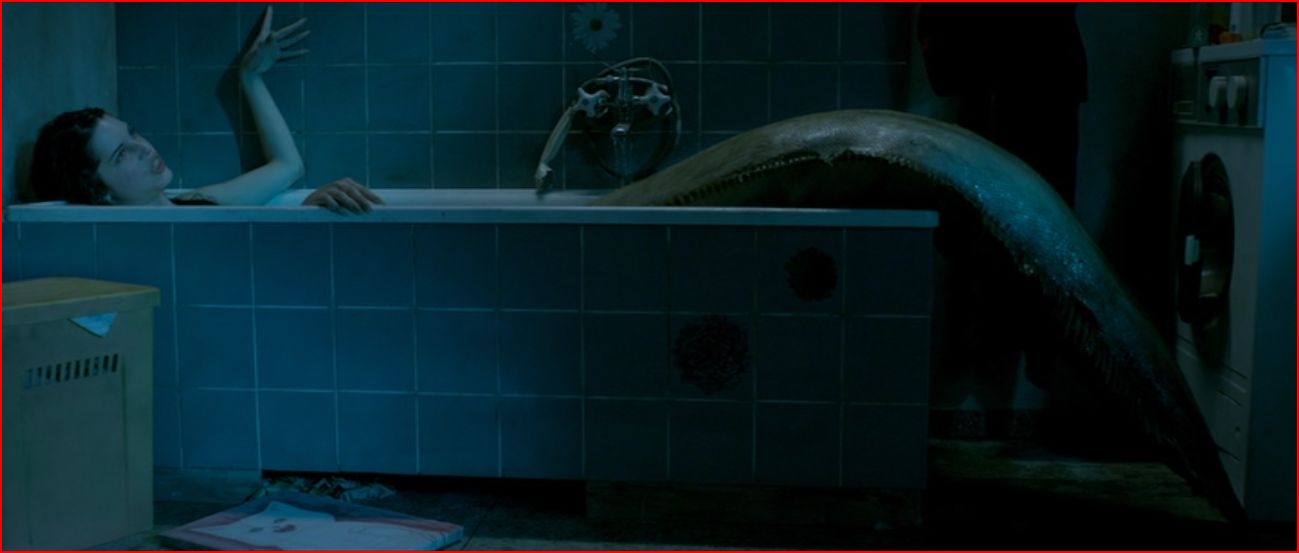
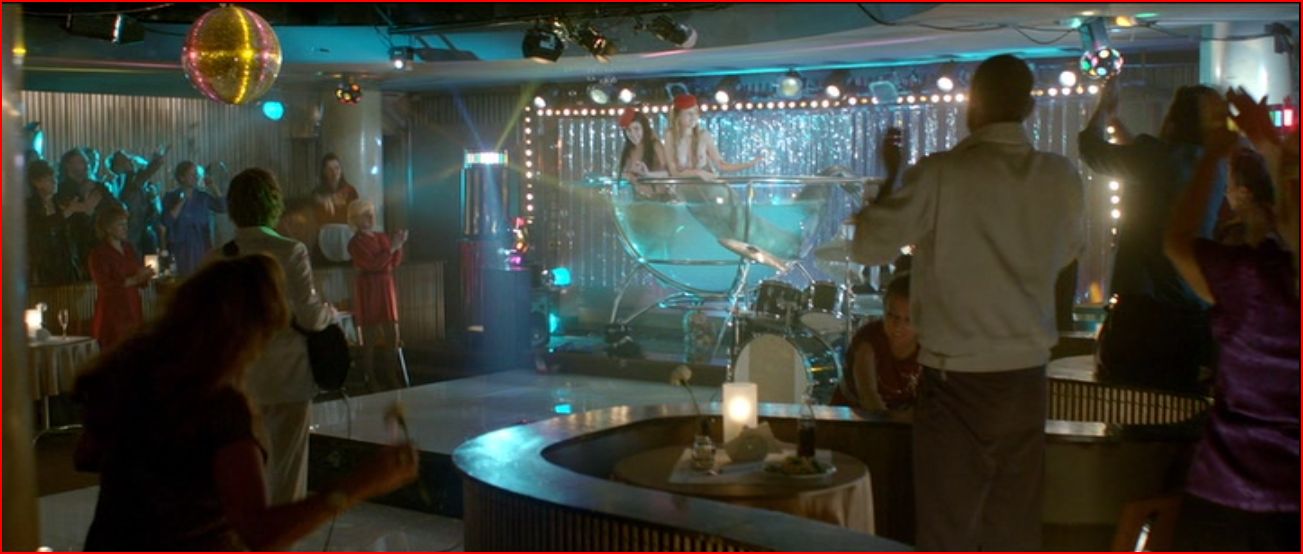
Set in a time approximately contemporary with Splash!, The Lure tells what might happen if that film's protagonist, a mermaid, made a wrong turn on her way to America and ended up in a decadent Communist bloc country. This film is twice as good, however, because there are two mermaids! In fact, Silver (Marta Mazurek) and Golden (Michalina Olszanska) are on their way to the U.S.A. when they're drawn to some Polish shore by a trashy rock trio jamming on the beach. These three could be father, mother and son, though they probably aren't. They perform regularly at the sort of trashy nightclub you might not have expected to exist in a Warsaw Pact nation, and recognizing the significance of their catch, they propose adding the finny girls, naturally topless to their act.  The mermaids can transform their tails into simulacra of human legs, but lack sex organs in that state, though they do not lack sexual desire. They could be a global cultural phenomenon but appear content to be, so to speak, big fish in a small pond.

Above, the mermaids show their true faces. Below, for a 1980s nightclub act they look a lot like a 
Commander Lexa tribute band. 

While Golden (the one who isn't blond) still sees people, with apparently one exception, as food, Silver (the blond) falls for Mietek (Jakud Gierszal) the boy in the band. He tells her he can only think of her as an animal, but she can take steps, so to speak, to correct that. Silver is your classic Hans Christian Andersen/Walt Disney mermaid, willing to sacrifice her identity and risk her existence to win a landlubber's love. She opts for a preposterous lower-body transplant. Even more preposterously, it works, though Mietek gets grossed out by her all over again when they try sex before she's fully healed. A singer in another band lures her away, putting Silver in mortal peril. By the rules of her kind, if you love a man but he marries another, you turn to sea foam -- unless you eat him, as Golden urges her to do.


In an interview, Smoczyńska says that the mermaid story was the hook that enabled her to make a movie about the seedy show-business milieu she grew up in. The result is inevitably more fantastic than whatever she originally intended, but I suppose there was something fantastical about that milieu of people struggling to live their dreams or embody other people's dreams. Perhaps liberated by the fantasy element, she makes her film a full-blown musical by staging a classical-style set piece with people bursting into song into a surprisingly well-stocked (for 1980s Poland, I presume) department store as the mermaids take their first-ever shopping trip. That exuberant excess makes The Lure more tragicomic than tragic, but also more opera than musical comedy. Inevitably more prickly than quirky than any American approach to the subject you can imagine, it still feels like a genuine 21st century fairy tale. Playing here in 2017, it makes an interesting companion piece to The Shape of Water and makes that film look like pure Hollywood pap by comparison. That's not to say that The Lure is the better film by any standard, but it's definitely the more grim fairy tale of the two, if that's what you're looking for in your sea-creature romances.

Tuesday, September 19, 2017

INVASION 1897 (2014)

How much should you hold limited resources against an ambitious filmmaker? If his resources aren't adequate to the requirements of his vision, or to conventional standards of verisimilitude, should he even bother with the project? To put it differently, is there any way to discuss the possible artistic merits of Lancelot Oduwa Imasuen's patriotic epic without bringing up his hilariously horrendous costuming of his 19th century British soldiers? Imasuen is a typically prolific "Nollywood" director from a national film industry now increasingly represented in the Netflix streaming library. IMDB hasn't been able to keep up with his output; looking there, you'd think Invasion 1897 had killed his career. An unforgiving eye would think that just desserts. Imasuen wants to show the last stand of the Kingdom of Benin (in modern-day Nigeria) against British imperialism, describing its ruler (Mike Omoregbee) inaccurately (the Negus of Ethiopia says hello) as "the last African king." Were he a director in an authoritarian country, he might have gotten the resources -- money, costumes, extras -- such a story requires, but Nollywood directors are largely on their own, as far as I can tell. Authentic uniforms or authentic-looking Britons were beyond his reach. He appears to have rented the next best things -- to uniforms, that is -- from some costume store, with no regard possible for how they fit his white "actors," none of whom, as a matter of grooming, looks remotely like a 19th century British soldier. Worst of all, the costumes clearly weren't meant to help anyone pass for a soldier. The blatant, apparently irremovable "Anarchy" patches (complete with circle-A logo) suggest that they were made for some rock or punk band, if not simply for goofy parties. Is it possible to take Invasion seriously with this glaring handicap constantly recurring?

Note Anarchy patch on the soldier in white, amid the spectacle of British headquarters,
including a portable radio in 1897!

The best answer is maybe, if Imasuen were as ambitious in form as he is in content and could make genuinely creative use of anachronism. Unfortunately, he's extremely conventional in some ways and a vulgar sensationalist in others. I was about to write that he begins Invasion in most conventional fashion, with a framing sequence, but then I remembered that the film actually begins with an absolutely gratuitous beheading scene, highlighted with a lingering shot of blood spurting from the decapitated neck. Then we get the framing sequence, set in modern London, where Igie (Charles Venn) studies African history and learns that the famous Benin art treasures captured by the British were the kingdom's way of recording its history. This realization inspires him to break into a museum in a failed attempt to confiscate some of the bronzes and other sculptures. He pleads not guilty to attempted theft at his trial, daring the court to prove that the treasures had been sold or freely given to the museum by their original owners. These purely modern scenes are easily the most competently shot, and for what it's worth, they allow Imasuen to disclaim racial animus by giving Igie a sympathetic white girlfriend (Annika Alfoti).


The main body of the film is Igie's evidence for the theft of the Benin treasures. Benin is suffering hard times before the British get aggressive, as people seem to be dropping dead en masse while the king (or Oba) seems increasingly detached from reality. The Oba is as much a spiritual figure as a temporal ruler, and the film shows him and his inner circle experiencing a portentous vision, as a long-departed elder predicts doom for the kingdom. Meanwhile, the British show increasing disrespect to the Oba, finally provoking the massacre of a small unit that provides the pretext for a full-scale invasion.


To be fair, Imasuen makes good use of the one impressive prop he had, a gunboat that looks appropriately menacing, packed with Britons and native auxiliaries (in better looking uniforms) as it motors into Benin territory. He gets even better service out of it in the best single shot of the picture, a long take of the deposed Oba orating about the transience of victory and the mortality of all men as the boat takes him into exile. The rest of it is an ill-paced, overlong mess at less than two hours, turgidly punctuated with meandering dialogue scenes in which the Oba's retainers react with great deliberation to his latest utterances or the latest bad news from the front lines. Worse still are any scenes requiring British soldiers to talk to each other. Interlarded throughout are battle scenes showing superior British firepower -- illustrated with bargain-basement CGI explosions and flames -- occasionally outmatched by Bini mastery of native terrain. The sporadic mayhem keeps things somewhat lively, especially when the Binis get to use edged weapons, but the only real momentum comes from the Oba's seeming spiral into madness. Almost as an afterthought, British soldiers are shown stuffing the art treasures into sacks. If any flaw of many here can be singled out as fatal, it's probably Imasuen's failure to develop any character into a proper hero on whom we can focus our attention. Maybe there was none, and maybe it's to Imasuen's credit that for all his clear cultural patriotism, he doesn't really idealize Benin. But his rough approach to the subject leaves it little more than a bunch of bad stuff that happened, with the added moral that white men back then had a bad habit of going where they weren't wanted.


Returning at last to modern times, we learn that Igie's narrative, for which the main body of the film stands in, was enough to get the judge to drop the charges against him and advise him to contact the International Court of Justice. As his supporters celebrate his freedom, including his gone-native girlfriend, one can't help wondering whether simply having Igie tell the story in the courtroom would have been a better movie.

Wednesday, April 12, 2017

OPERAÇÕES ESPECIAIS (2015)

The modern standard for Brazilian cop films was set by Jose Padilha's 2007 film Tropa de Elite, known in the Anglophone world as Elite Squad. Tomas Portella's film returns us to that violent milieu from the novel perspective of a female cop. Francis (Cleo Pires) is a bank employee who decides to try out for the police after rescuing a child during a robbery. To her disgust, she finds a bank security guard cowering in the same rest room where she'd taken the child. She proves a solid marksman, but learns quickly that shooting at targets is no substitute for the real thing.


While Francis turns out fairly badass, the film is realistic about her physical limitations. During one raid, she's bowled over effortlessly while guarding a stairwell when a suspect charges her. Portella and his co-writers also show her all too plausible terror during her baptism of fire, a combined car chase and fire fight. It's an impressively staged action scene, as are all the film's set pieces -- and it's made better by the director's emphasis on Francis's fear and discomfort as tight turns slam her from side to side of the car or bounce her off her partners. At one point, having struggled to pick her gun off the floor, she's crouched down in the back seat  after gunfire has blown out the rear window. One of her colleagues blasts away at the gangsters with his automatic next to her, and the empty cartridges rain down on Francis's neck while she frantically brushes them away.

That's Cleo Pires as Francis in the lower right in both shots.
Above, you can see a gangster jumping down from the upper left while another 
(in the little box just right of center) gets ready to open fire.


Francis careens from terror to recklessness in another major urban battle scene. The cops are trading fire with gangsters in a terraced apartment complex across the street, the gangsters hopping like mountain goats from terrace to terrace while gunmen try to cover their getaway. On the cops' side, a man is down and helpless with a leg wound, crying for help as Francis clings to cover. Finally she puts her own life in jeopardy, forcing her buddies to cover for her, as she drags the wounded man to shelter. She gets reprimanded for this, but it marks a turning point for her as she begins to overcome her rookie terror and win acceptance from her macho colleagues.

 The life of a cop is not all glamorous violence, but all over the world, that's what people pay to see.
 

Our heroes are federal police sent to a crime ridden town where an ex-cop is one of the leading gangsters and organized crime has much of the municipal infrastructure and public opinion on its side. At one point, the cops have to break out the candles and manual typewriters in order to take statements and file reports after their station loses power or, more likely, has it taken from them. I guess it's a good thing that they never throw anything out. The tide seems to turn after Francis loses a partner to a drive-by, but the politicians snatch defeat from the jaws of victory and reassign Francis and her team elsewhere. Despite that nod to the apparent facts of corruption in Brazil, Portella ends his film on an optimistic or at least a defiant note with the team arriving in a new town, ready for a new fight. Whether that means a sequel can be expected remains to be seen, but  Portella's skill as an urban action director and Cleo Pires' empathetic performance as Francis would make a reunion a welcome event.

Wednesday, March 22, 2017

THE TREACHEROUS (2015)

The way this film tells it, King Yeonsan of Joseon was the Korean Caligula. That doesn't mean that Min Kyu-dong's history play is Korea's Caligula, though the mad king himself (Kim Kang-woo) is a kind of amateur pornographer, compelling his concubines to assume Sapphic positions so he can paint the scenes. Whatever his politics were, if this film teaches you anything it's that Yeonsan was sex mad. Another favorite artistic subject is the mating of horses. Also, he has an infantile fixation on a favorite concubine who has become a power in the palace, finding comfort by suckling on her breast. The poor king has mommy issues, it seems, because his own mother was murdered in a past palace intrigue.


By the time of our story all his hard-working concubines -- it's challenging to hold those porno poses for long -- aren't enough for Yeonsan anymore. He demands a roundup of promising females from across the land, hundreds of whom will serve as his "comforters." That's got to be a sensitive subject for a Korean movie, given how the Koreans continue to hector the Japanese for recruiting Koreans as "comfort women" during World War II. Of course, any film featuring an insane absolute ruler will have special significance for South Korean audiences, given what they have to deal with north of the border. I'm surprised the Kim dynasty didn't treat Treacherous, a film portraying a conspiracy to kill an absolute monarch, as yet another provocation justifying missile launches. But for all we know, they did.


Anyway, Yeonsan entrusts the comforter search to his two top henchman, the father-son Im team. Most of our attention goes to the son, Im Sung-jae (Ju Ji-hoon), the king's boyhood playmate who still goes in for the occasional round of sparring. Feeling guilty about enabling a monster like Yeonsan, Sung-jae discovers a diamond in the rough in Dan-hee, a pretty butcher (Lim Ji-yeon) who makes an entertainment out of animal slaughter. Secretly the daughter of an official killed on the king's order, this woman of many skills could make the perfect assassin. But first she has to rise through the ranks, meeting the strict standards set for the king's new number-one bedmate. To get her big chance, she has to win a sex fight with her main rival as the king orchestrates probably the most demoralizing lesbian sex scene since Requiem For a Dream. Min Kyu-dong lavishes a lot of attention on the training process for the comforters, which ranges from sword dancing (Dan-hee's lead role in one performance gives her an early opportunity to kill the king that goes to waste) to dildo testing. Again, none of this rises (or sinks) to Caligula-level explicitness, at least in what Netflix is streaming, but while that might make it more erotic for some viewers it might also make viewers complicit for any arousal they feel as Yeonsan puts his comforters through their paces.


Finally, Dan-hee gets the break she's been waiting for, but if you'd begun to suspect that Treacherous was going to be a tragedy your suspicions would soon be confirmed. While her mission fails, however, this isn't a nihilistic "resistance is futile" tragedy like, say, Curse of the Golden Flower, but something more Senecan or Shakespearean in its ultimate grotesquery, as Yeonsan, after getting the Carrie prom night treatment from Im Sung-jae, ends up in a disquietingly vague scrum with a room full of pigs. And then you get an epilogue that wraps up the running quasi-operatic narration in a manner that suggests that things didn't turn out entirely as you'd just seen.


The best word to describe The Treacherous is ravishing. It describes the king's antics as well as the gorgeous art direction and Park Hong-ryeol's cinematography, not to mention all the beautiful women and their often-opulent costumes. It's almost Italian in its combination of luscious craftsmanship and almost unflinching brutality. I don't know how it works as history, but as a wild work or cinema I recommend it highly.

Wednesday, March 8, 2017

THE TIMBER (2015)

Remember a few weeks ago when I wrote about the visual appeal of violence in the snow? Anthony O'Brien's western -- a northwestern really, set in the Klondike but filmed in Romania -- is another vivid example of the juxtaposition of "darkness" in a pristine natural setting.


The terrific cinematography is by Phil Parmet, and it's the best thing about The Timber. Unfortunately, it's practically the only good thing about the picture. O'Brien's story, co-written with Steve Allrich and Colin Ossiander, is a vacuous compendium of "dark" western cliches hung on the flimsy frame of a minimal story. Two brothers are hired -- ordered, virtually, -- to hunt down their murderous father for a bounty that will save brother Samuel's (Josh Peck) land from a predatory lender. Impatient to take possession, the banker and his minions threaten Samuel's pregnant wife, who has to withstand their siege virtually alone until a friendly sheriff rides to the rescue.


The brothers' quest is part Apocalypse Now, part Blood Meridian as they encounter a human menagerie of degenerate grotesques on the way to their father, who proves a big pretentious emptiness at the heart of this would-be darkness. Including a cannibal in the mix will only remind western fans with strong stomachs of how much better the same year's Bone Tomahawk was. To be fair, The Timber doesn't aim to be a horror western, but rather, I guess, an existential meditation on the darkness that supposedly links the old man and his other son, Wyatt (James Ransome), if not the entire gold-greedy human landscape. The actors try to articulate this through dialogue that either aspires to the retro-formality of westerns in the True Grit mode or echoes the surliness that's seeped into the genre since the 1980s. They're clearly not up to the task, but neither were the writers, really. And since the action really isn't that great -- though for all I know, the film's confused melees may be shot and cut that way on purpose -- you're left with some knockout visuals that just might justify 80 minutes of a western fan's time. Brevity is one of the few things the The Timber gets right.

Tuesday, February 28, 2017

INTERROGATION (Visaranai, 2015)

The poor are always in the wrong place at the wrong time. That's the message of the mononymous Tamil filmmaker Vetrimaaran, who adapted a novel based on author M. Chandrakumar's personal ordeal at the hands of corrupt police. Chandrakumar's ordeal took place sometime in the 1980s, but Vetrimaaran updates the story to the present cellphone age and adds to the story, having the author's analog make a timely exit to avoid the worse fate suffered by his friends. The actual main character of the film is Pandi (Dinesh Ravi), a Tamil shop clerk working in Andhra Pradesh, a Telugu-language state neighboring his Tamil Nadu home. Pandi and his Tamil buddies, some of whom can barely speak Telugu, are poor, despised objects of suspicion, as Tamil criminals have been committing robberies, possibly to raise money for the Tamil Tiger terrorists of Sri Lanka. Pandi has a glancing encounter with the real robbers, but is shortly arrested in a sweep of Tamils while the actual perpetrators apparently get away.


For the cops the top priority is closing the case. Catching the actual culprits doesn't matter so much. The main idea is to get Pandi and his pals to "accept" the charges against them. The interrogation process consists of repeated beatings, their only security being the cops' desire to have living suspects confess in court. When the prisoners start a hunger strike, the cops use psychological warfare. They pretend to give in and treat the prisoners to a hearty meal before they return to headquarters to sign their release forms and receive compensation for their inconvenience. Of course, once the hunger strike is broken it's back to the beatings. Finally, cajoled by promises of light sentences and aid finding jobs afterward, the Tamils agree to confess, only to double-cross the cops by protesting to the judge, with timely help from a Tamil translator. Fortunately they've found a judge with integrity who doesn't take crap from the cops, but Pandi and friends soon learn that they've escaped from the frying pan directly into the fire.


Their translator was a policeman from Tamil Nadu who's in Andhra Pradesh investigating a corrupt Tamil politician. Eager to repay his favor, Pandi's crew help this policeman, Muthuvel (Samuthirakani), snatch the politician and take him back to Tamil Nadu. They end up at a Tamil police station, where our earnest protagonists go to work on a clean-up detail to further repay Muthuvel for his benevolence. To their horror, they see the politician getting treated much as they were in Andhra Pradesh. Pandi has a cellphone and, having been given one by a sympathetic policewoman in Andhra Pradesh to call his boss and ask for help, he pays it forward by giving the politician his phone. If anything, that makes things worse for everyone. The politician is tortured to death (without Muthuvel's okay) as part of a high-stakes party intrigue, and a cover-up is hastily arranged to make him look like a suicide. But what about these dumb dudes who've been wandering through the building cleaning stuff? Did they see something or hear something they shouldn't? No one's certain, but why take chances? As Pandi and his buddies realize that they're being set up for death, they argue over whether to try to run for it, until events leave them no more choices....


You won't see many more blatant exposes of official injustice than Visaranai. It's a no-holds-barred assault on our compassion that has no time for western stoicism. If anything distinguishes Asian film in general from American cinema it's Asians' willingness to suffer abjectly and vocally. To some western ears these Tamils may seem like big babies given how they scream and cry all the time, but films like these almost certainly present pain more honestly than Hollywood or Europe often do. Few films I've seen convey the terror of unjust confinement as convincingly and compellingly as Visaranai does. At the same time, I think the actors did a decent job of crafting distinctive personalities for the hapless Tamils, Dinesh Ravi especially, so that the characters become more than objects of our vicarious masochism. If they were nothing but victims, nothing but receptacles for torture, we might not feel for them as much as I expect any viewer will.

Tuesday, February 14, 2017

THE INNOCENTS (Los Inocentes, 2015)

Not to be confused with the Hollywood ghost story adapted from Henry James, Mauricio Brunetti's film puts a supernatural spin on the slavesploitation subgenre and is ultimately more effective as a horror film than a slavery expose. Argentina managed to abolish slavery without civil war in the 1850s, but Los Inocentes, like a miniature echo of Lincoln's Second Inaugural, shows a generation paying in blood for the blood drawn by the lash.


The screenplay by Brunetti, Natacha Caravia and Andres Gelos is flashbacky in a manner appropriate for a film haunted by curses. The main story, set in 1871, sees Rodrigo (Ludovico Di Santo) return to his father's plantation with his pregnant bride Bianca. The plantation is pure South American gothic, with Rodrigo's mother Mercedes, after whom the place is named, a madwoman whose moaning is muted only in the Madonna's presence, while the old man (Lito Cruz) is a brutal boor dripping with contempt for his son. Some of the old slaves have stayed on as servants, despite the plantation's horrific history. The flashbacks show how Rodrigo's childhood slave playmate was hanged for daring to play on a swing, and how a slave woman was burned at the stake for the double offense of getting raped by the planter and burying a statue of the Blessed Virgin in a superstitious attempt to end the drought that the planter blames on persistent slave paganism. These dead haunt the present but seem to target Rodrigo and Bianca more than the old man.


Los Inocentes isn't EC Comics-style American horror in which the dead avenge themselves on the truly guilty. It's more effective as a horror movie for having its curse reach out indiscriminately at the plantation family. The suffering of innocents is precisely what should be horrible about a curse, but to the extent that Americans expect the guilty to suffer, or assume that those who suffer are guilty of something -- like all those teenagers Jason Voorhees supposedly punished for premarital sex -- those who watch the Argentine film on Netflix may be taken effectively and shockingly by surprise by the direction it takes toward the end.


The picture benefits from Hugo Colace's moody cinematography and a cast whose costumes and performances fit the period nicely. Lito Cruz's vicious patriarch is especially impressive, a secular horror of privileged vice in his own right. You feel he's done a good job destroying his family before the ghosts even get started, and his lustful attention to Bianca is nearly as scary as whatever the ghosts have in store for her. There's something inscrutably blank about his expression when we last see him, facing the ultimate fulfillment of the curse, that makes you wonder whether he understands what's happened and why. We know and wonder why he, of all people, is left standing, but it should be clear to viewers that he hasn't exactly gone unpunished.

Sunday, February 12, 2017

FRANCOFONIA (2015)

Alexander Sokurov has become quite the cosmopolitan since his 2002 one-take epic Russian Ark made him an art-house star. Since then his subjects have included the American occupation of Japan and the German Faust legend, while his latest film is a sort of critical sequel to Ark, taking the Louvre museum in France. Francofonia strikes me as a sort of homage to Jean-Luc Godard in its mix of scripted scenes, essayistic narration and other meta elements, and while it's an homage to French cinema to that extent it also shows that you can take the boy out of Russia, but you can't always take Russia out of the boy. The nearest thing to a plot in the piece is the relationship between Jacques Jaujard, the French national museum director (Louis-Do de Lencquesaing), and Franz von Wolff-Metternich (Benjamin Utzerath), the German official in charge of preserving occupied France's cultural heritage. Jaujard had already evacuated most of the Louvre's contents to auxiliary chataeux by the time Wolff-Metternich arrived, but as it turned out the German took his cultural preservation mandate more seriously than his Nazi masters probably intended, eventually earning the French Legion of Honor for his trouble. Their story, punctuated for some quasi-Godardian reason with a visible soundtrack, is interlarded with a Russian Ark-style tour of the Louvre, Sokurov's Skype (?) chats with someone transporting precious art by stormy sea on a freighter, and comments on the museum's history. The museum tour is reminiscent of Sokurov's earlier triumph not in its lack of editing but by the appearance of a historical figure, Napoleon Bonaparte (Vincent Nemeth). He haunts the Louvre, childishly pointing out paintings of himself and explaining that much of the museum's classical collection was plundered by him from the Middle East. The museum has another resident spirit, Marianne (Johanna Korthals Altes), France's counterpart to Uncle Sam. She frolics about in her liberty cap shouting the French Revolutionary buzzwords, "liberty, equality, fraternity," but in a telling moment the tour narrator urges her to get rid of the obnoxious Napoleon after he's grasped her hand, but neither she nor we can shake the Little Corporal.

You may have recalled by now that Bonaparte was a great enemy of Russia, perhaps second only to Hitler, but it's in Sokurov's discussion of what his people call the Great Patriotic War, particularly the treatment of the Louvre and Paris compared to the treatment of Leningrad and the Hermitage museum -- the setting of Russian Ark -- that particularly Russian hurt feelings come to the surface. You get the impression that Sokurov holds it against France that Paris didn't suffer the devastation that Leningrad endured. Never mind that France had surrendered before the Germans had to consider bombing Paris, while Leningrad became a symbol of continued Russian resistance to the Nazi war machine. What really bugs Sokurov, it seems, is the idea that Paris and the Louvre were spared because on some level Germans like Wolff-Metternich saw France as part of European civilization, but didn't extend Russia the same courtesy. I suspect that Sokurov suspects that that wasn't just because of Nazi anti-communism, though that clearly had something to do with it, and to do with why he closes the film with a loud, discordant version of the Soviet national anthem. Francofonia is subtitled An Elegy for Europe, but the overall tone isn't really elegiac. It use of Napoleon links France and Germany together in a culture of imperialistic aggression against the East, in the name of a Europe defined by its exclusion of Russia. You may not like or agree with that message but at least it shows that Sokurov hasn't sold out by returning to his museum motif. This newest film isn't as good as Russian Ark or Faust, but it still proves Sokurov one of the most consistently interesting filmmakers working today.

Thursday, January 19, 2017

AFERIM! (2015)

Radu Jude is one of a generation of filmmakers who have put Romania on the map of the wild world of cinema in the 21st century. He was an assistant director on the breakthrough Romanian film, The Death of Mr. Lazarescu (2005) and started making his own features soon afterward. His Aferim! (it translates roughly as "Bravo!") was the big winner of the country's Gopo Awards, Romania's equivalent of the Oscars. Shot in beautiful black and white by Marius Panduru, it looks like a throwback to the subgenre I call "history of cruelty" that was popular in central and eastern Europe during the 1960s. Aferim! takes place at a later time than most of those pictures, during the early 19th century, but it may as well be medieval times. Gypsies (i.e. "crows") are mostly enslaved and in an aristocratic hierarchy most free people aren't much better off. A relatively privileged person is Constandin (Teodor Corban), a kind of constable tasked by his boyar master with finding a runaway "crow" in a neighboring territory. Accompanied by his son (Mihai Comanoiu) he rides arrogantly through the countryside until they track down Carfin (Toma Cuzin) and start back for home.


Constandin is a boor and a bigot, but so's everyone else in this benighted land. In one grimly hilarious scene he encounters a rural clergyman who launches into a long list of ethnic stereotypes stretching from England ("They think a lot") to the Middle East. Human life has little value and "crows" have less. But on the return trip, especially when Constandin gets to relax (and get laid) at a tavern, he starts to warm to Carfin a little. He's still a ruthless, mostly heartless person, as we see when he sells a "crow" boy in a festive market town -- complete with a proto-Ferris wheel -- but he's not entirely heartless, nor is he incapable of treating a "crow" somewhat like a human being. The long tavern sequence is a breather for the audience, too, and it's a relief to see these people enjoying life a little. Even if it seems cruel to have Carfin try to get a coin off the top of a lit candle with his teeth, the spirit of play in the scene encompasses everyone in momentarily humane camaraderie.


Finally Constandin delivers Carfin to the boyar Iordache (Alexandru Dabija). By now, we know that Carfin bolted because his affair with Iordache's wife had been found out. The boyar, a virtual Dracula in his moustache and archaic costume, is determined to personally, publicly castrate Iordache to teach his wife and everyone else a lesson, but Constandin, of all people, pleads for mercy. He only gets threatened for his trouble, while Iordache's poor wife gets Carfin's brutally severed balls rubbed in her face. Jude happily skips graphic detail in this scene, but Carfin's screams tell the story as eloquently as any image might. The moral seems to be that cruelty flows from the top in this feudal culture, and the man on top is tops in cruelty.


Aferim! is a modest masterpiece of juxtaposition, using some of the most lavish monochrome cinematography I've ever seen to illustrate the sordid poverty of old Romania. Some scenes have an almost painterly quality, and others made me think of the Russian Ilya Repin's  paintings of rough peasantry come to life, only greyscaled. You could imagine the film as a photograph of the age it portrays, while color might only undermine its illusion of authenticity, which extends to the art direction and the performances. The whole project is a satiric rebuke to nostalgia for some endangered authentic national culture, shown here to have been utterly squalid not so long ago. It's to the Romanians' credit that they haven't taken the film as an insult, but have honored it instead.

Tuesday, December 13, 2016

DHEEPAN (2015)

Jacques Audiard's film won the Palme d'Or at last year's Cannes film festival but was blanked at the César awards, France's equivalent of the Oscars. Audiard already had a bunch of those, though, earning most of them for 2005's The Beat that My Heart Skipped and 2009's A Prophet, the film that really put him over around the world. Dheepan will remind people of Prophet in its use of genre archetypes to illustrate the integration of immigrants into French society.  While Prophet is a gangster film, Dheepan turns out to be a sort of vigilante film, its hero a man with very special skills who gets pushed too far. Audiard supposedly was inspired by Sam Peckinpah's Straw Dogs, but movie buffs may see a more obvious influence by the film's climax.


Dheepan follows a counterfeit family from Sri Lanka (above) to France (below)


The title character is an imposter; Dheepan isn't his real name. Sivadhasan (Jesusthasan Antonythasan) is a Tamil, one of the Hindu minority in Sri Lanka. He is also a Tamil Tiger, a soldier in the revolutionary/terrorist organization credited with inventing suicide bombing. Stuck in a refugee camp as the civil war winds down, he gets an opportunity to emigrate using the passports of a family -- husband, wife and daughter -- who were recently killed. He recruits a woman and girl who can vaguely pass for the people in the passport pictures, and soon enough the newly dubbed Dheepan and his new family are settled in a Paris housing project. It's not much of a family and not much of a life. The daughter, Illayal (Claudine Vinasithamby), is eager to learn French and make friends but is rebuffed by her new schoolmates and gets no emotional support from her aloof maternal unit, Yalini (Kaleaswari Srinivasan). Dheepan becomes a caretaker for the project, his comings and goings strictly regulated by the gangs who run the place, while Yalini becomes a home aide for the invalid father of one of the gangbangers.


Determined to make a home for himself and his quasi-family, Dheepan grows increasingly antagonistic toward the gangs and tries to draw a white line demarcating a "no fire zone" despite the gangs' taunts and threats. But when Yalini is trapped inside her employer's apartment during a gang hit, Dheepan has to cross the line to rescue her, taking a terrible toll with machete, car and gun along the way. Like some other viewers, the climactic rampage/rescue and the too-good-to-be-true vindication that follows, in which Dheepan and Yalini have added a child of their own to the family and appear to be solid citizens of a purged and peaceful project, put me in mind of the ironic denouement of Martin Scorsese's Taxi Driver, in which Travis Bickle's killing spree, both a self-assigned rescue and a venting of frustration after a thwarted political assassination, gets him lionized by the press. By no means is Dheepan another Travis Bickle; our immigrant hero is far more sympathetic and sane than that despite his violent past. But Dheepan's ending is almost self-parodic in its pursuit of a happy ending. You can't help wondering whether Audiard is sincere or if he wants us to question his neatly generic resolution of all the storylines, or wondering why he'd want to throw it all into question. It's an odd false note on which to end an otherwise fine film, informatively observant of life in the projects and also rigorously reticent in its approach to vigilante violence. After Dheepan begins his assault, the camera remains focused tightly on him as he drives through opposition and shoots his way upstairs to save Yalini. Blink and you might miss the body flying past the driver's side window as he plows forward, though you can't miss the bodies that fall at his feet on the stairs. It's a cathartic moment in a film that ultimately seems uncertain of the finality or validity of catharsis, but despite its own uncertainty Dheepan remains a film well worth seeing on the migrant experience that to a great extent defines our time.