Like Fritz Lang's Hollywood western Rancho Notorious, Antonio de la Lona's Spanish-Italian western is about "hate, murder and revenge." It has a slightly tragic quality to it, along with a grim appreciation of how a vendetta can sustain itself by drawing in outsiders until until its originators become disposable. Steve McDougall (Anthony Steffen) returns to his home town to avenge his father, who has been executed by a longtime enemy, the ruthless rancher Lopez (Pepe Calvo). Like many a leader, Lopez, who has a personal score to settle with the McDougalls, makes sure to implicate all his men in the killing. He orders each to fire a bullet into the old man, though Rojo (Carlos Hurtado) does so with obvious reluctance, if not outright revulsion. Rojo will end up one of the film's most tragic figures, constantly conscience-stricken and clearly wanting out of the situation yet obviously too weak to take a meaningful stand until it's too late. His qualms matter little to the surviving McDougalls, which include Steve's sister Judy (Evelyn Stewart) and her husband. Once Steve arrives, all who associate themselves with Lopez are targets, or at least enemies -- which is too bad for Lopez's daughter Pilar (Gemma Cuervo), who carries a torch for Steve until he guns down her brother (Hugo Blanco).
Lopez imports new gunmen to eliminate Steve, but the feud begins to escalate beyond his control when McDougall kills one of the gunmen while the gunman's brother Gringo (Aldo Berti) stayed on the ranch trying to hit on Pilar. Now Gringo has a vendetta of his own that will lead to the death of Steve's brother-in-law, the kidnapping and torture of Judy and the deaths of Lopez and Pilar. Gringo cares about nothing but killing Steve and can't care less about Lopez's larger strategy. The moment Lopez appears to be holding him back, Lopez is a dead man, and when Pilar, who still loves Steve and has shown compassion toward the captive Judy, tries to intervene, she's mowed down without a second thought. Rojo sees all this but can't keep himself from being carried with the tide as Gringo rides off with Judy to force Steve into a fatal showdown.
The writers' treatment of Rojo is one of the film's quiet strengths but also an ultimate weakness. A long chase through the wasteland leaves only Gringo, Rojo and Judy alive after Steve picks off the rest of the ranch gang that Gringo has taken over. With a gun on Judy, Gringo forces Steve to disarm. He taunts McDougall by promising to kill Judy after Steve dies. Through all of this, Rojo has a gun, and you can see that he's finally reached the point where he can't stands no more. All of Gringo's attention is on Steve. So what does Rojo do? He throws his gun to Steve -- who can't hold on to it. Steve can do nothing to stop Gringo from blowing poor Rojo away, and it's not until Judy hits Gringo with a rock that McDougall can dive for the gun and shoot his enemy down. It's not hard to imagine Rojo surviving had he shot Gringo himself, but despite how much the writers have highlighted his conscientious observation of events, they could not imagine him claiming real agency by taking out the final villain. I suppose you can argue that tossing the gun is Rojo's ultimate refusal of agency, of a piece with his overall failure to take responsibility for anything. But it's easier to assume that it simply wasn't this flunky's place to defeat the bad guy as far as the writers were concerned, so of course he has to do something suicidal instead. The writers' decision undermines Hurtado's decent performance, which is mostly a matter of facial expressions that transcend the typical spaghetti-western dubbing. It also exposes the formulaic skeleton on which they tried to hang a more ambitious character-driven piece. For the most part, however, the film manages to find the mood it's looking for with the help of sometimes-wistful landscape cinematography by Hans Burmann and Vitaliano Natalucci and an occasionally-effective score by Felice Di Stefano. The ending may infuriate you a little, but overall Perche' uccidi ancora is a good try at a relatively mature western story.
A randomly comprehensive survey of extraordinary movie experiences from the art house to the grindhouse, featuring the good, the bad, the ugly, but not the boring or the banal.
Showing posts with label Spain. Show all posts
Monday, June 24, 2019
Sunday, October 21, 2018
ERREMENTARI (2017)
The Spanish affinity for traditional gothic horror extends to the Basque country, which gives us Paul Urkijo Alijo's grim fairy tale of a film. Based on a European legend that also influenced the "Howling Man" episode of The Twilight Zone, Errementari is set at the time of the First Carlist War in 19th century Spain. A deserter from that war is Patxi the blacksmith (Kandido Uranga), who made a pact with the minor demon Sartael (Eneko Sagardoy) in order to be reunited with his wife, only to find that she, presuming him dead, had shacked up with another man and had a daughter, Usue (Uma Bracaglia). The tragedy results in the other man killed, the wife a suicide, Usue a despised outcast raised by foster parents taunted with tales of her mother suffering in Hell, and Patxi the keeper of a terrible secret. The arrival of a government official with stories of a hidden stash of gold at Patxi's forge hastens the revelation of the secret, but it's Usue, hoping that the smith can repair her headless doll, who makes the discovery. Believing the smith a fresh murderer (in fact, a trespasser has died by accident), Usue discovers evidence that Patxi is keeping a child in a cage. Naturally, not having watched The Twilight Zone, Usue frees the pathetic victim, who promptly reveals himself as Sartael in all his folkloric if not cartoonish splendor: red skin, horns, presumably cloven hooves, etc. The demon tries to avenge himself on Patxi, but the blacksmith could not have held a demon captive in the first place without being knowledgeable and resourceful. In folklore, demons are very vulnerable. Far from invulnerable to physical attack, they're also hypersensitive to the ringing of bells and, like some vampires, they're compelled to count chickpeas cast on the ground. Worse, mess with the pile and the poor creatures have to start counting over again. It soon becomes clear that for all his frightful appearance and taunting, Sartael's actually a pretty pathetic excuse for a demon, a laughingstock among his peers, and especially his superiors, for getting himself trapped and detained so easily by a mortal. When another hellish emissary arrives, planning not only to claim Patxi's soul at last but also to demote Sartael to a fate worse than death in the infernal hierarchy, old enemies will join forces, each seeking redemption of a sort through kindness to Usue and the memory of her much-wronged mother. Boasting lavish art-direction, lurid cinematography and a satiric attitude toward Carlist conservatism (their side supported absolute monarchy) that echoes in Europe and elsewhere today, Errementari feels like a crossbreed merging Spanish historical gothic and a more Burtonesque sensibility in its sympathy for a devil who never entirely becomes a good guy. Available for streaming on Netflix in its native language and an English dub, it may be the most charming new horror film you'll see this Halloween season.
Wednesday, October 3, 2018
THE WEREWOLF AND THE YETI (La Maldicion de la Bestia, 1975)
The turning of the blowing of the leaves again turns my thoughts toward horror and monsters, and so it's time again to visit with Jacinto Molina and his onscreen alter ego, Paul Naschy. "The Curse of the Beast" is his reboot, authored by himself and directed by M. I. Bonns, of the saga of Waldemar Daninsky, who here turns into a wolfman again for the first time. Anthropologist Daninsky travels to the Himalayas with a team of European scientists in response to seeming photographic evidence of the existence of the legendary Abominable Snowman. The yeti, however, proves to be literally the last of Waldemar's worries. Losing track of an injured comrade, our hapless hero ends up in the clutches of a pair of witches who love him up into a werewolf. The territory actually is infested with witches. One, bearing the totemic name (for Naschy) of Wandessa (Silvia Solar) is the power behind the local warlord, Sekkar Khan (Luis Induni). The Khan is plagued with ulcers on his back, but Wandessa eases his agonies with skin grafts flayed from the backs on captive women. Relief never lasts, so the Khan constantly sends his head minion Temujin (Jose Luis Chinchilla) to fetch more captives, including the members of Daninsky's expedition. Whatever his own problems, Waldemar has got to save the day, though there's something of a selfish motive behind his heroism. He's been told by a local mystic, who unsurprisingly gets killed by the bandits, that the leaves of a certain plant, mixed with the blood of a young woman, will cure lycanthropy. Surprise follows surprise as only a small amount of his girlfriend's blood is needed, and the cure works-- but not before the filmmakers square things up with the audience by pitting werewolf Waldemar in perfunctory fashion against a yeti that appears in the worn, much-edited print I saw as little more than a tall blur. To use Naschy's Universal reference points, what we have here is a little bit of Werewolf of London (the Himalayan origin), a little bit of House of Dracula (the happy ending) and a bit of the old studio's Arabian Nights pictures thrown in, with the usual extra bits of sex and sadism thrown in to satisfy Seventies audiences, though not so many for me as in an uncut print. It's far from Naschy's best, but I like the way his imagination ran rampant here in directions I didn't anticipate. And of course this was not the end of Waldemar or his curse, but it's nice to see that in one part of the multiverse things turned out all right for him.
Sunday, September 23, 2018
ORBITER 9 (Órbita 9, 2017)
For an Anglophone moviegoer it's a novelty to see space exploration carried out in Spanish. This isn't some implausible chauvinism on the part of writer-director Hatem Khraiche, as he tells us eventually that Spain is just one of four countries involved in the preparation of pioneer voyages to the planet Celeste, a goldilocks world that offers the only hope of survival for the people of an increasingly polluted Earth. A young Spanish woman, Helena (Clara Lago) is the sole crewmember of one of the family-sized colony ships. Stalled by an oxygen malfunction, she has waited for a repair ship for three years since her parents apparently sacrificed themselves to extend her oxygen supply. At last, Alex the engineer (Alex Gonzalez) arrives to fix the problem. He has only 50 hours of "autonomy" to do the job; after that, Helena will have another 20 years on her own before she reaches her destination. Alex is the first human being other than her parents that she's ever seen. Five minutes in you can guess the direction the picture will take, but your movie brain should tell you that that's probably too soon to jump to conclusions. It may not surprise you to learn that Alex has some alarming secrets, and that his interaction with Helena will put both people in danger as they edge toward revolt against a manipulative government's plans. Órbita 9 is ultimately more of a thriller than an all-out sci-fi film, but the sort of dystopia that forms its backdrop does tend to lend itself to thriller plots. I've probably now made it sound like a rather conventional movie, and I suppose it is that, superficially speaking. But the lead actors put it over with convincing displays of moral indignation, with Gonzalez adding a level of guilty torment over his role in a past failed experiment. The romance angle is a little much, taking the ending almost to a fairy-tale level, but then again, this is, for all its trendy pessimism, a fantasy film that ends on an odd note of reconciliation, given the seemingly unforgivable ruthlessness the head scientist showed earlier in the picture. At 95 minutes it seems scrupulous about not overstaying its welcome, even if it strikes you a Twilight Zone episode opened out and padded to feature length. Thanks to Netflix I didn't have to go out of my way to see this, so I don't feel that I can hold much against it.
Saturday, February 24, 2018
UNCERTAIN GLORY (Incerta gloria, 2017)
Twentieth century Spain, from the civil war through the Franco dictatorship, is the new capital of gothic cinema. There's something morbidly picturesque about the ruined architecture and the passionate politics that has inspired not only Guillermo del Toro but other filmmakers as well. There's nothing supernatural about Agusti Villaronga's film or the Joan Sales novel, one of the classics on the civil war, that inspired it, but the mood is inescapable. Ruins, crypts, corpses abound, and these details make gothic what could almost as easily, from a different aesthetic vantage, have been film noir. From the country that gave us Paul Naschy and The Spirit of the Beehive, gothic seems right somehow.
The story focuses on a quadrilateral of characters: the Republican soldier Lluis (Marcel Borras), his wife Trini (Bruna Cusi), his buddy Soleras (Oriol Pla) and the local aristocrat, the Carlana (Nuria Prims). We meet the Carlana first as she barely escapes with her life when an anarchist army overruns the Carlan's estate and executes him. She convinces the soldiers that she was just a sexually-exploited maid, and now she continues to occupy the property. Looking to her children's future, she wants them recognized as legitimate heirs to the land. As no witnesses to her marriage to the Carlan to survive, she looks to Lluis to help persuade some local peasants to perjure themselves by swearing under oath that they witnessed the wedding. She's made it clear to lonely Lluis, far from home and wife, that helping her with this is his best chance at getting to ride more than the Carlan's horse.
The Carlana is a black widow, a noirish femme fatale willing to kill her deadbeat dad when he shows up to extort money from her, yet you can't help empathizing if not sympathizing with her survival instincts given the savagery of the anarchists and the brutality (we learn of it later) of most men she's known. Amid the collapse of civil society it's every woman for herself as everyone struggles to keep their heads above water. While Lluis's loyalty to Trini wavers, Soleras, struggling with his own desire for Trini, changes sides altogether, going over to the Falangists in a sort of protest against Lluis's imminent infidelity. Chickening out of a suicide attempt, he vents his spleen at the Carlana, invading her sanctum and forcing her at gunpoint to strip and reveal the scars of past tortures.
Lluis and Trini try to reconcile but their child's illness brings a new crisis. Medicine for diphtheria is in short supply on both sides of the war, as Soleras unhappily admits, but someone of the Carlana's standing can deliver the goods -- for a price. The price she extracts from Lluis for his son's life is Soleras's death. Fortunately, Soleras is more willing to pay that price than Lluis did, but what good does any of this do anyone while the war grinds on. A closing air raid blends into newsreel refugee footage, with some of our actors added, to suggest that any victory in such an environment is only temporary.That's the moral of this vividly shot picture -- cinematographer Josep M. Civit runs the gamut from the funereal darkness of the crypt to the blazing light on the landscapes. It's more a sensational, psychological piece than a historical or political drama: the foreign viewer won't learn much about the civil war from Uncertain Glory, apart perhaps from how it was experienced on an unideological individual level. You don't really need to know what any side stood for to appreciate the film's human drama and its dramatically picturesque presentation. At a time when societies everywhere seem to be coming apart, it might seem less like a period piece and more like a premonition in its gothic timelessness.
The story focuses on a quadrilateral of characters: the Republican soldier Lluis (Marcel Borras), his wife Trini (Bruna Cusi), his buddy Soleras (Oriol Pla) and the local aristocrat, the Carlana (Nuria Prims). We meet the Carlana first as she barely escapes with her life when an anarchist army overruns the Carlan's estate and executes him. She convinces the soldiers that she was just a sexually-exploited maid, and now she continues to occupy the property. Looking to her children's future, she wants them recognized as legitimate heirs to the land. As no witnesses to her marriage to the Carlan to survive, she looks to Lluis to help persuade some local peasants to perjure themselves by swearing under oath that they witnessed the wedding. She's made it clear to lonely Lluis, far from home and wife, that helping her with this is his best chance at getting to ride more than the Carlan's horse.
Lluis and Trini try to reconcile but their child's illness brings a new crisis. Medicine for diphtheria is in short supply on both sides of the war, as Soleras unhappily admits, but someone of the Carlana's standing can deliver the goods -- for a price. The price she extracts from Lluis for his son's life is Soleras's death. Fortunately, Soleras is more willing to pay that price than Lluis did, but what good does any of this do anyone while the war grinds on. A closing air raid blends into newsreel refugee footage, with some of our actors added, to suggest that any victory in such an environment is only temporary.That's the moral of this vividly shot picture -- cinematographer Josep M. Civit runs the gamut from the funereal darkness of the crypt to the blazing light on the landscapes. It's more a sensational, psychological piece than a historical or political drama: the foreign viewer won't learn much about the civil war from Uncertain Glory, apart perhaps from how it was experienced on an unideological individual level. You don't really need to know what any side stood for to appreciate the film's human drama and its dramatically picturesque presentation. At a time when societies everywhere seem to be coming apart, it might seem less like a period piece and more like a premonition in its gothic timelessness.
Tuesday, October 31, 2017
INQUISICION (1976)
If no one expects the Spanish Inquisition, how is anyone gonna deal with the French Inquisition? That's the challenge of Jacinto Molina's directorial debut, a vehicle for his on-screen alter ego, Paul Naschy. Filmed in Spain while longtime dictator Francisco Franco was still dead, the production probably was careful not to give Spanish Catholicism a bad name. Naschy plays itinerant judge Bernard de Fossey, a hammer to witches who takes too much pleasure in his work. He struggles to suppress the sexual arousal he feels reading accounts of witches consorting with the Devil, and takes his distress out on accused witches who are almost invariably attractive and tortured in the nude. Bernard's not after your typical hag; that would kill his buzz more than he actually wants it killed.
Bernard stirs up hysteria when he arrives in town, especially when the boyfriend of Catherine (Daniel Giordano), a comely local lass, is murdered by hooded highwaymen. Obsessed with getting justice, Catherine consults an actual witch (Tota Alba) who shows her how to get in touch with Satan, who may, if he's in the mood, give her the key to the mystery. It's not quite that mysterious to us, because we've seen how Bernard looks at Catherine -- and veteran Naschy fans may have noticed something familiar about one of the highwayman's leaping attack on the victim. Sure enough, under the influence of a potion -- if not also Satan! -- Catherine envisions Bernard removing the hood. She decides to take the fight to him, fulfilling his own fears of temptation, but events quickly spiral out of either person's control.
One of the subplots in Molina's screenplay follows Renover (Antonio Iranzo), a one-eyed professional informer who spreads rumors of witchcraft out of misogynist resentment of women who won't give the poor scumbag a chance. When his aggressive advances on Catherine's friends end with two women dead and himself mortally wounded, he uses his ante-mortem statement to denounce Catherine and her witchy mentor. Bernard actually has tried to protect Catherine from prosecution but has no choice now but to put her through an ordeal. He seems taken by surprise when Catherine confesses, and then denounces him, after which damning corroborating evidence promptly appears to seal his fate. While Catherine goes to her death screaming in terror, Bernard seems resigned to his fate, if not relieved by it.
For an actor-turned-director Naschy/Molina was unusually self-effacing. I don't know how many people knew that Naschy and Molina, who'd already written many Naschy pictures, were one and the same, but I'd expect exploitation film producers not to take chances and tout director Naschy as the next Cornell Wilde or something similar. Make what you will of his creative split personality, but Inquisicion is clearly an ambitious work for a first-time director. Visually it's quite attractive in the way of many Euro horror films that take advantage of ancient locations, but also effectively expressionist in cinematographer Miguel Fernandez Mila's use of lurid reds in Catherine's vision of the Sabbat (with Bernard as the Devil) and Bernard's vision of Catherine as a crimson temptress. As a writer, Molina plots things fairly well, though his conclusion, with Catherine's denunciation following Renover's fatal encounter, feels anticlimactic, if only because we expect something more hair-raising from Paul Naschy. That he closes the film that way suggests that, despite the sleaze of the torture scenes, Molina saw this as something more than the typical Naschy vehicle.
Naschy's film is a late entry in a continental cycle of witchfinding pictures, a subset of a larger "history of cruelty" genre. While its torture scenes put it in the exploitation category alongside pictures like Jess Franco's Bloody Judge, Inquisicion sustains a more subtle ambiguity on the subject of witchcraft and the devil. The old witch is plainly a witch in the most mundane sense, knowledgeable about potions and such, but we're left to judge for ourselves, prompted by the film's one voice of reason, whether Catherine saw the Devil or not -- or whether Bernard even was in on killing Catherine's lover. Our only evidence for his guilt is Catherine's vision, the authority of which we're forced to question. If Catherine's community is cursed by anything, it's by a common human malice and hypocrisy that consumes clergy and laypeople alike. Overall it's an impressive debut, though it came a little too late in the history of Spanish horror for Naschy to build on it as he might have had he stepped up a few years earlier. It still goes down as one of both Molina and Naschy's best efforts.
Bernard stirs up hysteria when he arrives in town, especially when the boyfriend of Catherine (Daniel Giordano), a comely local lass, is murdered by hooded highwaymen. Obsessed with getting justice, Catherine consults an actual witch (Tota Alba) who shows her how to get in touch with Satan, who may, if he's in the mood, give her the key to the mystery. It's not quite that mysterious to us, because we've seen how Bernard looks at Catherine -- and veteran Naschy fans may have noticed something familiar about one of the highwayman's leaping attack on the victim. Sure enough, under the influence of a potion -- if not also Satan! -- Catherine envisions Bernard removing the hood. She decides to take the fight to him, fulfilling his own fears of temptation, but events quickly spiral out of either person's control.
One of the subplots in Molina's screenplay follows Renover (Antonio Iranzo), a one-eyed professional informer who spreads rumors of witchcraft out of misogynist resentment of women who won't give the poor scumbag a chance. When his aggressive advances on Catherine's friends end with two women dead and himself mortally wounded, he uses his ante-mortem statement to denounce Catherine and her witchy mentor. Bernard actually has tried to protect Catherine from prosecution but has no choice now but to put her through an ordeal. He seems taken by surprise when Catherine confesses, and then denounces him, after which damning corroborating evidence promptly appears to seal his fate. While Catherine goes to her death screaming in terror, Bernard seems resigned to his fate, if not relieved by it.
For an actor-turned-director Naschy/Molina was unusually self-effacing. I don't know how many people knew that Naschy and Molina, who'd already written many Naschy pictures, were one and the same, but I'd expect exploitation film producers not to take chances and tout director Naschy as the next Cornell Wilde or something similar. Make what you will of his creative split personality, but Inquisicion is clearly an ambitious work for a first-time director. Visually it's quite attractive in the way of many Euro horror films that take advantage of ancient locations, but also effectively expressionist in cinematographer Miguel Fernandez Mila's use of lurid reds in Catherine's vision of the Sabbat (with Bernard as the Devil) and Bernard's vision of Catherine as a crimson temptress. As a writer, Molina plots things fairly well, though his conclusion, with Catherine's denunciation following Renover's fatal encounter, feels anticlimactic, if only because we expect something more hair-raising from Paul Naschy. That he closes the film that way suggests that, despite the sleaze of the torture scenes, Molina saw this as something more than the typical Naschy vehicle.
Naschy's film is a late entry in a continental cycle of witchfinding pictures, a subset of a larger "history of cruelty" genre. While its torture scenes put it in the exploitation category alongside pictures like Jess Franco's Bloody Judge, Inquisicion sustains a more subtle ambiguity on the subject of witchcraft and the devil. The old witch is plainly a witch in the most mundane sense, knowledgeable about potions and such, but we're left to judge for ourselves, prompted by the film's one voice of reason, whether Catherine saw the Devil or not -- or whether Bernard even was in on killing Catherine's lover. Our only evidence for his guilt is Catherine's vision, the authority of which we're forced to question. If Catherine's community is cursed by anything, it's by a common human malice and hypocrisy that consumes clergy and laypeople alike. Overall it's an impressive debut, though it came a little too late in the history of Spanish horror for Naschy to build on it as he might have had he stepped up a few years earlier. It still goes down as one of both Molina and Naschy's best efforts.
Wednesday, July 19, 2017
1898 (...Los ultimos de Filipinas, 2016)
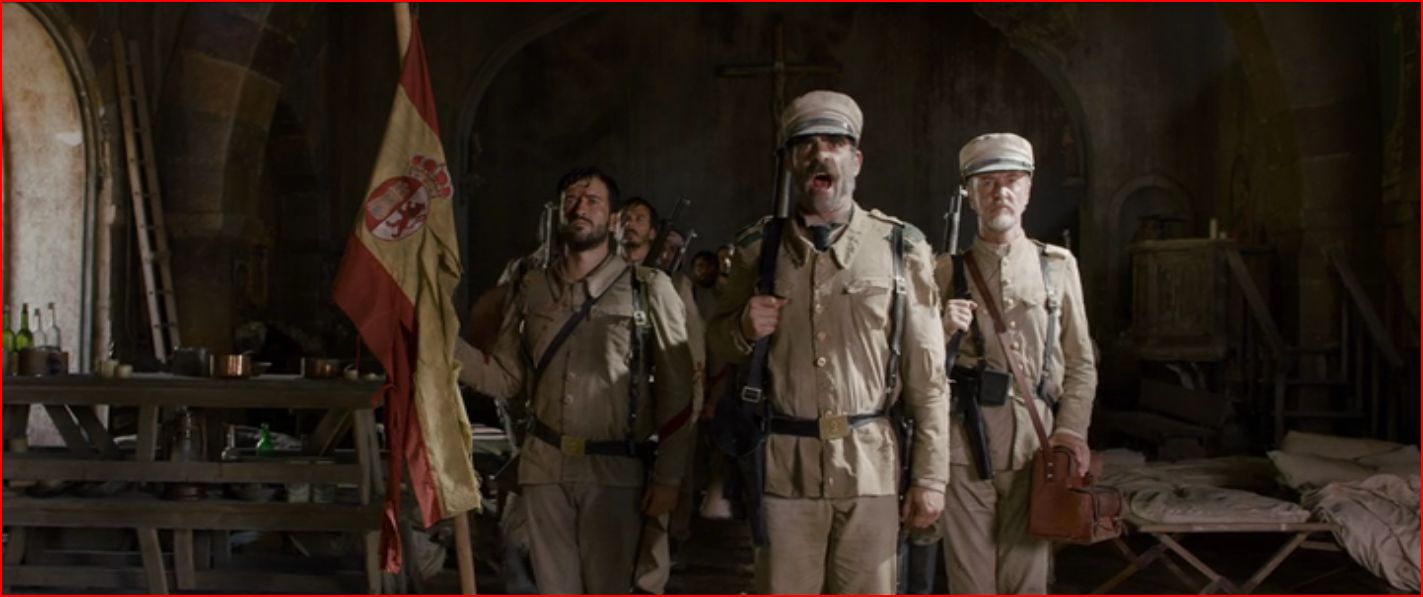
There's something about the Philippines, I guess, that makes foreign soldiers very reluctant to leave. The U.S. definitely overstayed its welcome there, but at least we didn't leave last-ditch fanatics behind when we decided to leave. When I was growing up, however, the world was fascinated by stories of Japanese soldiers holed up in the islands for up to thirty years after the end of World War II. There was precedent for this, on a more modest scale, after the 1898 war in which the U.S. "liberated" the Philippines from Spain. Despite that crushing defeat, a Spanish garrison held out at Baler, in eastern Luzon, for nearly a year, surrendering only in June 1899. The siege of Baler was the subject of a heroic war film in 1945, during the Franco dictatorship. Salvador Calvo's remake is far less celebratory.
The garrison is made up mostly of recent arrivals from Spain, few of whom have any real training. Our point-of-view character among these recruits is an aspiring artist who befriends the resident priest. While the soldiers can hold out for months with the ammo available, the important thing for the priest and his new protege is a plentiful supply of opium. One important thing the unit lacks is nutritious produce. Berberi breaks out, killing the original commander. The men continue to hold out, though at least one deserts.
Meanwhile, as the besieging Filipinos well know, Spain is negotiating a sale of the islands to the victorious U.S. to bring the war to a definitive close. Anticipating their next war with the Americans, the natives would like to end the siege with minimal fuss and hope to convince the Spaniards with up-to-date newspapers. The new commander dismisses all reports as fake news, contrived to trick them into surrendering. Eventually, our artist hero is sent out on a mission to get authentic news from Manila, the capital. He's promptly captured by a courteous Filipino commander who sends him on his way in the hope that the truth will set everyone free. The commander still won't believe and condemns the artist as a drug-addled traitor. Our hero will survive the siege, but his artistic ambitions end up one last casualty of a hopeless war.
The siege of Baler was something new to me, and that lent novelty to 1898. The siege was no Alamo and its conclusion -- the commander finally reads a piece of news he can't dismiss as fake -- is inescapably anticlimactic. The maiming of our artist hero serves as a symbolic catastrophe on top of the already pointless deaths during the siege. The film's real strength is its ensemble cast, led by Luis Tosar, Javier Gutierrez and Alvaro Cervantes as the artist. There's nothing really innovative here as far as battle films go, but for audiences outside the Spanish-speaking world 1898 provides a fresh look at the absurdity of imperialism and the folly of war.
Meanwhile, as the besieging Filipinos well know, Spain is negotiating a sale of the islands to the victorious U.S. to bring the war to a definitive close. Anticipating their next war with the Americans, the natives would like to end the siege with minimal fuss and hope to convince the Spaniards with up-to-date newspapers. The new commander dismisses all reports as fake news, contrived to trick them into surrendering. Eventually, our artist hero is sent out on a mission to get authentic news from Manila, the capital. He's promptly captured by a courteous Filipino commander who sends him on his way in the hope that the truth will set everyone free. The commander still won't believe and condemns the artist as a drug-addled traitor. Our hero will survive the siege, but his artistic ambitions end up one last casualty of a hopeless war.
The siege of Baler was something new to me, and that lent novelty to 1898. The siege was no Alamo and its conclusion -- the commander finally reads a piece of news he can't dismiss as fake -- is inescapably anticlimactic. The maiming of our artist hero serves as a symbolic catastrophe on top of the already pointless deaths during the siege. The film's real strength is its ensemble cast, led by Luis Tosar, Javier Gutierrez and Alvaro Cervantes as the artist. There's nothing really innovative here as far as battle films go, but for audiences outside the Spanish-speaking world 1898 provides a fresh look at the absurdity of imperialism and the folly of war.
Tuesday, February 16, 2016
DVR Diary: FRANKENSTEIN'S BLOODY TERROR (La Marca del Hombre Lobo, 1968)
The coming of all-digital television and the allotment of extra digital channels to existing local stations has resulted in more people discovering old movies the old way: on commercial TV, interrupted by ads, possibly further edited for time and formatted to fit the screen. In the last year or so, my local cable service has added three channels that occupy local stations' digital space. Grit is an action-oriented channel split between westerns and more recent shoot 'em-ups. Get.TV is a less genre-specific channel that showcases the Sony Pictures library, along with a bloc of vintage western TV shows. Most intriguing of the lot is Comet, which aims to cover more psychotronic territory. While the name says science fiction, Comet also shows horror films dating back at least to the 1950s, and it was on Comet that I finally got around to seeing Paul Naschy's first appearance as the accursed Waldemar Daninsky, el Hombre Lobo. The only difference between seeing it on Comet and catching it on an independent station some weekend thirty years ago is that Comet happened to have a widescreen print of the American edition of this 70 mm extravaganza, which played in 3-D during its original European release.
Readers of this blog probably know how Enrique Lopez Egiuluz's film got its inaccurate American name. U.S. distributor Independent International was committed to deliver a Frankenstein picture to theaters, namely Al Adamson's legendary Dracula vs. Frankenstein, but the picture wasn't ready, apparently due to legal reasons. So I-I slapped a new title on the Spanish film -- the end credits offer yet another title, Hell's Creatures -- and added a prologue explaining how the Frankenstein family had been cursed with lycanthropy for its unholy experiments and renamed Wolfstein, thus explaining how the film's Imre Wolfstein is a werewolf. Ironically, a later Daninsky film, released in some places as Dracula vs. Frankenstein, was retitled Assignment Terror for the U.S.in deference to the Adamson film. More confusing still, the Hammer production Horror of Frankenstein was released in some U.S. markets as Frankenstein's Bloody Terror! Check out the Gadsden Times for January 31, 1972 on the Google News Archive if you don't believe me.
Naschy was the onscreen alter ego, adopted to win over this film's anticipated German audience, of screenwriter Jacinto Molina, heretofore little more than a bit player in movies and a big fan of the Universal horror cycle. Molina/Naschy's career project was to revitalize Universal tropes with a modern, adult Euro sensibility. Waldemar Daninsky is his take on Larry Talbot, albeit more dangerous as man and wolf. His opening scene, in which he appears at a costume party in a mephistophelean red outfit, is a warning that, however charming Daninsky may be, he's someone dangerous to know. And that's before Imre Wolfstein, recently resurrected by fools removing a stake from his heart, transmits his curse to the Polish Count. While Naschy does the Talbot torment thing well, screenwriter Molina spares himself the "they won't believe me" misery Lon Chaney's Larry often endured. Daninsky has won friends who see plainly what has happened to him and are eager to help him beat the curse. Their research turns up a potential expert on curing lycanthropy whose work was thirty years in the past. The expert's son arrives by train with his female assistant and one large wooden crate. He is, in fact, the expert himself (Julian Ugarte), a vampire who revives Imre yet again, imprisons Waldemar, and plans to make Waldemar's friends his undead thralls.
Ugarte's vampire is the weirdest thing in the picture. You know he's bad news before the reveal, as the camera approaches him warily at the lonely train station. Once he's revealed, he proves a strangely frolicsome creature, seducing an intended female victim with a running dance. Here Molina takes no cues from Universal but gives us a vampire whose spirit of amoral play reminded me of Molina's contemporary, Jean Rollin. Treating the vampire that way makes sense on Molina's own terms, however, because it maximizes the contrast between the elegant, almost ethereal vampire and the brute force of the werewolf, played by Naschy as a drooling cannonball of animal fury, especially compared to the greying Imre. The transformed Daninsky swipes at his prey compulsively, swinging his arms like he was throwing haymakers, when he isn't hurling himself at human or undead targets. Even before the makeup goes on, when Waldemar is chained, the former weightlifter Naschy thrashes about so, while an incredible chanting theme for the transformation plays, that you fear for the props. Naschy has always reminded me of John Belushi a little, and if any of you remember Belushi's Weekend Update editorials when work himself into an apoplexy and throw himself to the floor, that's Naschy just getting started. You can see how he became a horror star here; Naschy as performer and Molina as writer infuse the old tropes with an unprecedented level of energy, while the widescreen cinematography and terrific locations and sets give Daninsky the biggest possible showcase. Frankenstein's Bloody Terror isn't free of the curse of dubbed Euro-horror: bland supporting characters are rendered still more bland by dull dubbing, and either this cut or further cuts imposed by Comet eliminated nearly all of a final fight between Daninsky and Imre. Most of the time, fortunately, the slow bits are redeemed by the pictorial spectacle, even in what looked like an unmastered print. Under even worse broadcast conditions long ago, Frankenstein's Bloody Terror inspired people to seek out more of Naschy's work. It has been a while since I'd seen any Naschy movies, but now I want to get back into the habit.
Readers of this blog probably know how Enrique Lopez Egiuluz's film got its inaccurate American name. U.S. distributor Independent International was committed to deliver a Frankenstein picture to theaters, namely Al Adamson's legendary Dracula vs. Frankenstein, but the picture wasn't ready, apparently due to legal reasons. So I-I slapped a new title on the Spanish film -- the end credits offer yet another title, Hell's Creatures -- and added a prologue explaining how the Frankenstein family had been cursed with lycanthropy for its unholy experiments and renamed Wolfstein, thus explaining how the film's Imre Wolfstein is a werewolf. Ironically, a later Daninsky film, released in some places as Dracula vs. Frankenstein, was retitled Assignment Terror for the U.S.in deference to the Adamson film. More confusing still, the Hammer production Horror of Frankenstein was released in some U.S. markets as Frankenstein's Bloody Terror! Check out the Gadsden Times for January 31, 1972 on the Google News Archive if you don't believe me.
Naschy was the onscreen alter ego, adopted to win over this film's anticipated German audience, of screenwriter Jacinto Molina, heretofore little more than a bit player in movies and a big fan of the Universal horror cycle. Molina/Naschy's career project was to revitalize Universal tropes with a modern, adult Euro sensibility. Waldemar Daninsky is his take on Larry Talbot, albeit more dangerous as man and wolf. His opening scene, in which he appears at a costume party in a mephistophelean red outfit, is a warning that, however charming Daninsky may be, he's someone dangerous to know. And that's before Imre Wolfstein, recently resurrected by fools removing a stake from his heart, transmits his curse to the Polish Count. While Naschy does the Talbot torment thing well, screenwriter Molina spares himself the "they won't believe me" misery Lon Chaney's Larry often endured. Daninsky has won friends who see plainly what has happened to him and are eager to help him beat the curse. Their research turns up a potential expert on curing lycanthropy whose work was thirty years in the past. The expert's son arrives by train with his female assistant and one large wooden crate. He is, in fact, the expert himself (Julian Ugarte), a vampire who revives Imre yet again, imprisons Waldemar, and plans to make Waldemar's friends his undead thralls.
Ugarte's vampire is the weirdest thing in the picture. You know he's bad news before the reveal, as the camera approaches him warily at the lonely train station. Once he's revealed, he proves a strangely frolicsome creature, seducing an intended female victim with a running dance. Here Molina takes no cues from Universal but gives us a vampire whose spirit of amoral play reminded me of Molina's contemporary, Jean Rollin. Treating the vampire that way makes sense on Molina's own terms, however, because it maximizes the contrast between the elegant, almost ethereal vampire and the brute force of the werewolf, played by Naschy as a drooling cannonball of animal fury, especially compared to the greying Imre. The transformed Daninsky swipes at his prey compulsively, swinging his arms like he was throwing haymakers, when he isn't hurling himself at human or undead targets. Even before the makeup goes on, when Waldemar is chained, the former weightlifter Naschy thrashes about so, while an incredible chanting theme for the transformation plays, that you fear for the props. Naschy has always reminded me of John Belushi a little, and if any of you remember Belushi's Weekend Update editorials when work himself into an apoplexy and throw himself to the floor, that's Naschy just getting started. You can see how he became a horror star here; Naschy as performer and Molina as writer infuse the old tropes with an unprecedented level of energy, while the widescreen cinematography and terrific locations and sets give Daninsky the biggest possible showcase. Frankenstein's Bloody Terror isn't free of the curse of dubbed Euro-horror: bland supporting characters are rendered still more bland by dull dubbing, and either this cut or further cuts imposed by Comet eliminated nearly all of a final fight between Daninsky and Imre. Most of the time, fortunately, the slow bits are redeemed by the pictorial spectacle, even in what looked like an unmastered print. Under even worse broadcast conditions long ago, Frankenstein's Bloody Terror inspired people to seek out more of Naschy's work. It has been a while since I'd seen any Naschy movies, but now I want to get back into the habit.
Wednesday, May 27, 2015
THE LIBERATOR (Libertador, 2013)
In typical modern fashion, the movie opens in medias res, showing the mature Bolivar as an embattled revolutionary racing to escape a conspiratorial trap. It then takes us back to his beginnings as just another son of South American wealth taking the Grand Tour of Europe and bringing home a bride who proves too vulnerable to his homeland's harsh environment. Broken in spirit by her early death, he returns to Europe and lives a wastrel's life until an old teacher reminds him of the need to liberate the continent from Spanish rule. Simon puts himself at the service of a General Miranda, but finds his tactics too conservative. Relegated to a backwater, he finally finds something worth fighting for passionately when someone steals his boots. He chases the culprit to a swampland shanty, where an abject mother begs him to spare her boy's life. Bolivar seems to notice poverty in all its wretchedness for the first time. As a plantation owner he had seen slavery but had considered it none of his business when another planter treated slaves badly. Now he realizes that if the revolution is to be worth anything it must be for the good of the poor. The scene may remind American viewers that their own revolution is never portrayed this way, and for good reason. Our revolution was all about middle-class aspirations frustrated by imperial trade policy, and the revolutions in Latin America were probably similarly motivated to a great extent, but the added imperative to improve the lives of poor people whose poverty is blamed directly on oppression, and who this film's Bolivar believes should get something from the revolution, makes for a very different history and a very different sort of film.
From this point forward, Bolivar is pitted constantly against ostensible allies who are ultimately only out for themselves, or whose interests are purely parochial. They resist his vision of a united continent liberated by people's war. Liberator credits Bolivar's victories to the leader's vision and the people's will. It shows a ragtag army of all races and both sexes, including foreign friends like the anti-colonial Irishmen, on a long march through the Andes, explicitly compared to Hannibal in the Alps but also implicitly comparable to Mao in China, culminating in a human-wave attack, with our hero in the lead, that proves successful against the odds. Alvero shifts from godlike views of the armies from directly above to close-up mayhem as Bolivar's host forces the Spaniards onto a bridge and the battle becomes a kind of rugby scrum with bayonets.
Bolivar makes the professional soldiers uncomfortable,
and feels most at home at the head of an inclusive people's army
Triumph turns to tragedy as Bolivar's allies mostly reject his vision of a united continent. The way he and his opponents talk past each other is telling. They fear that his united republic will give too much power to one man, namely Bolivar, and protest that they didn't fight the King of Spain only to have a dictator take over. Bolivar never bothers to refute the dictator charge. What matters to him is that the revolution and the republic are for the people, and that vested interests and local powers have no place in the new order. It appears to be an irreconcilable clash of priorities, and the Liberator's morale briefly falters before his most loyal friends urge him to stand firm and preserve his vision of union by force if necessary. In a historically questionable climax, the film implies that Bolivar was murdered by his enemies, thus thwarting the people's destiny of unity and republican equality for generations to come. But it hints that the torch will be carried on when Bolivar, before his final betrayal, meets a poor young fisherman who happens to share his name.
If Carlos the Jackal was a classic Scorsesean antihero, Ramirez's Simon Bolivar is a classic epic hero, and the actor delivers the charismatic bombast necessary for the role. Alvero and Sexton would have us see Bolivar as an epic lover as well, often draping their hero with glamorous if not gratuitous female nudity; we rarely see that sort of thing in American Revolution films, either. Maybe it comes with the territory. If it sometimes seems like a vanity project for Ramirez, that's probably because no other character in the film is developed extensively. We get to know them enough to know whether they're for or against the Liberator, or we know them until they turn against him. That tends to make Bolivar's debates with his various antagonists rather one-sided. While the film is willing to show Bolivar in moments of weakness or self-doubt, it refuses to consider that he may want too much power, and it takes for granted that those who oppose him are selfish, greedy, and indifferent to the poor. The failure of his vision is in no way his fault in this version of his story. As a film this version is interesting to the extent that its story is novel to audiences, and the filmmaking is effective without being really visionary. As history, it will be most successful if it inspires or provokes us to find out more about Bolivar on our own. As it happens, I have a biography on the shelf that I intend to pull out now, so on that level The Liberator is a success. If it wanted to be all you needed to know, or all someone wanted you to know about Simon Bolivar, that's another story.
Tuesday, May 19, 2015
DVR Diary: CHIMES AT MIDNIGHT (1966)
Welles returned repeatedly throughout his career to the idea of a Shakespearean compilation film, bringing together material from several of the history plays in a creatively condensed chronicle of 14th-15th century England. He'd seen himself as Falstaff ever since his first try, an ambitious 1939 stage production that died of technical difficulties and haphazard cutting. This first version was called Four Kings, but by the time he put a leaner version on stage in 1960 it was Chimes at Midnight. So it would remain, though the few Americans who saw the film knew it as Falstaff, to stress still more what was obvious. Once again Welles had to scramble to keep the money flowing and couldn't keep all his actors in one place the whole shoot. Filming in Spain, he cast actors like Fernando Rey as Englishmen, only to overdub their accented voices later. The biggest names in the cast were John Gielgud as Henry IV, Margaret "Miss Marple" Rutherford as Mistress Quickly, Jeanne Moreau as Doll Tearsheet and Welles himself. It typified Welles's late style, favoring rapid cutting over long takes and sweeping camera movements. It suffered his late handicap of over-reliance on post-dubbing, which hurts his own performance more than anyone else's. For a Shakespearean he mutters and mumbles too much, especially in the early scenes. But his performance does grow on you until the final scenes have the desired tragic effect.
John Falstaff is supposed to be some embodiment of the English spirit, so much so that Mistress Quickly can say of the dead man that he rests in King Arthur's bosom if anyone does. Yet Welles introduces us to a Falstaff who seems like little more than a bum, thanks in part to the mumbling. You wonder what Price Hal (Keith Baxter), the future Henry V, sees in the man. Falstaff is a robber, a coward and a liar. But I suppose what he is more than any of these is a free spirit, which is something a Prince of Wales with such a stuffy dad (Gielgud) can appreciate. But throughout the picture you can see the ways "Jack" is starting to piss Hal off, especially when, after hanging back -- very understandably, as Welles illustrates -- from the Battle of Shrewsbury, Falstaff tries to take credit for killing Hal's great rival and victim Hotspur (Norman Rodway). Even after this, though, Hal can always go back to Jack when he wants to have fun and blow off steam. Falstaff is a guy whom, having robbed pilgrims in the forest, can be robbed himself by a disguised Hal and forgive him afterward. Things change when the king's health fails and when Hal is caught mistaking him for dead and trying on his crown. Hal is haunted by his father before the old man is actually dead, and H4's stern ante-mortem lecture resolves H5 to be a morally upright monarch. But when Falstaff hears of the old king's death he thinks it's party time. He strolls in during a procession fully expecting to be made a counselor of state or something similarly great or lucrative, only to be cut dead by the new king's famous "I know thee not, old man" speech. H5's need to make a fresh start for himself looks reasonable, but it breaks Falstaff's heart, and really kills him within a day.
It'd be interesting to see Welles's 1939 Falstaff because it simply could not have been informed by all the disappointments and rejections that inform his 1965 performance. When Falstaff celebrates his buddy's ascension it's as if one of Welles's own cronies had come into money, which could only mean that Orson Welles was going to make a movie! Of course, this time Welles was making a movie, and he takes advantage of the opportunity to make Falstaff, if not the audience, feel his pain. Those in the audience who were his fans surely did feel it, and they probably feel it worse in retrospect, knowing that things would get no better for him. This is probably Welles's most transparent and, sometimes in spite of himself, his most moving performance.
Chimes at Midnight is more than a play for pathos. Welles again displays his knack for making the most of found locations and the overall art direction is wiry and stark. He may have had to compromise in dialogue scenes when one or more actors were absent and characters had to be shot from behind, but his uncompromised compositions are things of beauty. Chimes owes a lot to Sergei Eisenstein's history films in the way Welles arrays armed men behind foregrounded protagonists against a wide-open sky, but in the Battle of Shrewsbury he sheds the Russian's influence. It's a quite different affair from Eisenstein's battle in Alexander Nevsky, less self-consciously epic and less partisan. Welles doesn't gloat over the defeat of Hotspur's army as the soldiers go down in the mud the way Eisenstein gloats over the Teutonic Knights falling through the ice. Welles's battle is chaotic, bewildering and overwhelming, ultimately vindicating Falstaff's decision to watch from a safe distance, had we thought to deplore his apparent cowardice. Who wouldn't prefer his little world of a tavern, as for a while Hal seems to? The really impressive thing about Chimes is the way Welles initially seems, both intentionally and arguably not, to stack the deck against Falstaff, only to win you over to his side. I won't go as far as some fans who call it Welles's best film, but it's at least his best Shakespearean film, and a great film by any director's standard.
Tuesday, February 3, 2015
DVR Diary: VIRIDIANA (1961)
The big difference between Viridiana and Ida is that Bunuel is a satirist, while there's little evidence of satire or humor of any sort in the Polish film. Viridiana is a sort of Candide figure, continually clobbered by reality, though not as violently as her Voltairean forebear is, until she's hopefully cured of her idealism. This sort of satire knows neither left nor right; it doesn't satirize one thing to promote another, but sees everything as folly in the face of human nature. Its contempt for idealism guaranteed the antagonism of both the established church and an authoritarian regime, but that doesn't make Bunuel the opposite of either. There is less compassion for Viridiana than the admittedly frosty Ida has for its protagonist. Does this difference make one film better than the other? My snap judgment is that Ida is the more novelistic and humane film, but that's not the only basis for judgment. Will Ida stand the test of fifty years as Viridiana has? Let's compare notes in 2065 -- I'll probably have to trust you to remember what I wrote -- for by then we may have a better idea of what these parables of midcentury disillusion mean in the long term.
Monday, May 6, 2013
THE SADISTIC BARON VON KLAUS (La mano de un hombre muerto, 1962)
Once you become a horror man -- an actor typecast as a menace in scary movies, there are certain roles that come your way inevitably. One of those is the red herring. It didn't take Howard Vernon long to get there; he played Max von Klaus for the late Jess Franco in the same year that Franco had directed him in the title role of The Awful Dr. Orloff. It's as if Franco knew he would type the man with the burning gaze. Klaus hinges on the expectation that we'll be spooked by the mere sight of Vernon and suspect him of the worst. Franco uses a nice gimmick to distance the audience from the actor and the character he plays. We first see him as a static image: a snapshot at police headquarters or a painted portrait on the wall of his home. Franco confronts us with the image of Howard Vernon the newly-minted horror star before showing us the man Max Von Klaus. Later, a girl staying at the house is spooked in the middle of the night. She runs through the halls only to stop short, startled, at the site of the painting. Only then does Max himself appear to ask what's the matter.What's the matter in town is that murder has revived the legend of the accursed Baron von Klaus of 500 years ago, a sadist before the word was coined to describe him. An angry father cursed this Baron for torturing his daughter, and the townsfolk tell that the villain disappeared in the swamps but did not die. Suspicion alights on Max inevitably, although Franco is careful to give us several other suspicious characters.
The problem for Max is that his alibi for the time of one of the murders stinks. As he protests, he'd probably come up with a better alibi had he actually done the crime, but his real problem, we learn, is that he actually does have a secret to keep. Only one person, the one for whose sake he's keeping the secret, can reveal it to free him, perhaps not without cost. All of this makes Max more than a red herring. He actually becomes a sympathetic character, if not quite the hero of the picture. Franco's compassionate handling of the material seems atypical; even his fans might concede that this is a rare Franco film with a heart.
Filmed in a wider aspect ration than Orloff, Klaus is a more classically composed if perhaps slightly less personal film from Franco. There's actually less sadism to it than the English language title suggests, though there is one scene with a topless victim, filmed almost tastefully, chained to the ceiling of a dungeon. Cinematographer Godofredo Pacheco gives the old-time urban and forest locations plenty of expansive, expressionist atmosphere. The story is simple stuff, but the visuals make it worth looking at, and if not one of his best, it may be one of Franco's most likable films.
Sunday, March 31, 2013
THE AWFUL DR. ORLOFF (Gritos en la noche, 1962)
Fifty years on, I'm sure I'm not the first observer to ask what the point is of having a minion do your kidnapping for you when you have to go with him on his errands. Why have a minion if he can't take care of business while you do your all-important experimentation in the comfort of your own lair? Instead, Dr. Orloff (Howard Vernon) has to hang around outside the homes of beautiful young so he can guide his minion, Morpho (Ricardo Valle) through the streets by tapping on the cobblestones with his cane. Morpho's very prominent eyes appear to be of no use to him, so how much use can he be for the doctor, who went to the trouble of faking Morpho's death by execution, in his former capacity as a prison doctor, just so Morpho could be his minion? Maybe Orloff fears that the targeted women could beat him up. Yet he's quite capable of slipping one a mickey when it's convenient, but on the other hand he's not observant enough to notice when the victim, having noticed the obvious ploy, doesn't bother drinking the stuff. Most likely Orloff knows his limitations, some of the time.Orloff would become a magic word (as would Morpho) in the universe of Jess Franco, who made his first international success writing and directing Gritos en la noche and would litter many subsequent movies with Orloffs and Morphos the way spaghetti western producers littered the Old West with Djangos. For Franco it was a gimmick and a fetish at the same time; that's why exploitation cinema fascinates us. With The Awful Dr. Orloff (so named, I presume, for its U.S. pairing with The Horrible Dr. Hitchcock) Franco aspires to place his personal stamp on familiar archetypes. The basic story is old news but also very recent. Orloff needs to experiment on his lovely young victims to cure his disfigured daughter. It had to take tremendous self-confidence in one's own personal vision to tell such a story so soon after Georges Franju had told it in Eyes Without a Face (1959) and Giorgio Ferroni had in Mill of the Stone Women (1960). The idea goes back further, of course, at least as far as Wallace Fox's The Corpse Vanishes (1942), though in that Monogram epic Bela Lugosi -- whose contemptuous attitude toward minions is echoed in Orloff's treatment of Morpho -- is trying to cure his wife rather than his daughter. So the idea is nothing new, and it was up to Franco to make it fresh.
While Franco benefits from the black-and-white cinematography of Godofredo Pacheco, it's the music he uses that really distinguishes Orloff from the field. Despite the Belle Epoque setting, the score by Jose Pagan and Antonio Ramirez Angel is discordantly modern and eclectic, heavy on percussion but also haunted with weird whistling effects. It would make you take notice even if Franco wasn't doing his job. His own special contribution, I suppose, is a modern infusion of fetishism and just plain sleaze. For those countries that would tolerate them, he includes a handful of topless shots of captive women. Scenes of women chained and behind bars are the most obvious signs (apart from the villain names) that this otherwise antique-looking item is a Jess Franco film. He may not truly have come into his own until he began working regularly in color, but his personal touch is already present here.
Typical of Franco also, I suppose, is the transcendence of hackneyed plotting by evocative imagery. As in many future films, Orloff takes place in a world of idiot cops and reporters. Conversations at police headquarters are often the low points of Franco films, and Orloff sets the tone by giving us a dense hero in Inspector Tanner (Conrado San Martin). Franco milks the final reel for suspense by highlighting Tanner's stupidity. His girlfriend (Diana Lorys) has set herself up as bait for the kidnapper/killer, seen through Orloff's attempt to slip her a mickey, and pretended to pass out so she can be taken to his lair. She has hastily written Tanner a note explaining her ploy and sent a messenger to deliver it. To Franco's credit, he gives Tanner a reason to ignore the note. All through the picture, idiots and crazy people have been plaguing him with false clues and fake confessions. When a messenger hands him the note without saying who it's from, he assumes it's another crank at work. It's not until he's about to go to bed that night that he bothers reading it and finally rushes to the rescue. Fortunately the girl is not so competent that Tanner has nothing to do. In the end the damsel has to be in distress; that's part of the ritual. You could call this mockery of stupid authority figures or just stupid writing. But there's something undeniably compelling about the imagery, even if little is original in it. Like his peers (Jean Rollin, Paul Naschy and his collaborators) Franco understood the captivating power of gothic imagery and animating gothic ideas, obviously being captivated by them himself. Even the absurd Morpho, who looks like a hybrid of Christopher Lee's Dracula and his Frankenstein Monster, plus fake eyeballs, is indisputably compelling. You can't take your eyes off him, even if only because you keep expecting the actor to crash into furniture or trip and fall. He's creepy in the old manner of the dehumanized horrors of such films as White Zombie or Island of Lost Souls. His handicaps make him ludicrous as a minion, but something like him needs to be in such a film. And this sort of story has already been done so many times that what once may have been dismissed as mere mechanical or mercenary reproduction arguably acquires an unconscious compulsive logic. For a Franco fan, especially, Orloff can seem like a film that has to exist, or can't help existing. For a more objective auteurist, the film's true subject may be the need, simultaneously commercial and psychological, to tell the story, or our need to have the story told over again.
Postscript: Jess Franco has died at age 82 following a stroke suffered last week. Follow this link for this blog's reviews of Franco films, with more likely to come in the near future.
Subscribe to:
Posts (Atom)